ESL, ESOL, ELL—Do they mean the same thing?

Yes, they mean approximately the same:  someone whose primary language is not English is now learning English.

EPSON MFP image

ESL stands for English as a Second Language.

ESOL stands for English to Speakers of Other Languages.

ELL stands for English Language Learners.

EFL stands for English as a Foreign Language.

ESP stands for English for Special Purposes.

TESL stands for Teaching English as a Second Language.

More and more I am seeing ELL as the current politically correct term in the US.  Just a few years ago it was ESL. But I hear that in the UK and Ireland, ESOL is the preferred term.

How to test for kindergarten readiness

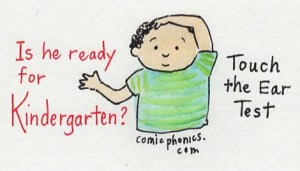
Checking that a child can touch his ear with the opposite hand is one test for kindergarten readiness.  But if you are looking for specific proof that your child is ready, here are some of the abilities which Kentucky looks for in each child:

young child attempting to touch his ear with opposite hand

  • Stating his or her name, age, birthday and phone number
  • Naming body parts as they are pointed to
  • Standing on one leg with eyes open and then closed
  • Identifying shapes such as triangles and squares
  • Printing his or her name
  • Saying (not singing) the ABC’s
  • Naming letters pointed to
  • Counting into the twenties
  • Sorting items by shape
  • Separating a certain number of blocks from a group of blocks
  • Identifying the front and back of a book
  • Identifying in what order words are read

The test used by Kentucky looks at five broad areas:  academic / cognitive; language development; physical development; self-help; and social-emotional.

Not all states test incoming kindergarteners, yet all are looking for  kindergarten-ready skills in children.  You can use this information to prepare your child for a great start to school.


Should my kindergarten son read aloud to me? How about my third grade daughter?

Reading aloud to a parent or teacher has two purposes:  to show that the child can decode words properly and to show that the child can read with fluency.  If the child is learning English as a second language, showing proper pronunciation is also a purpose.

child with adult helping to read

First decoding.  Probably your kindergarten son is at the decoding stage, that is, learning how to link language sounds with letters to form words.  If he is at this stage, then yes, he should read aloud.  That way you can tell what he knows, what he needs more practice on, and what he needs instruction on.

If you know from previous reading aloud that your third grader has mastered decoding, then your daughter needn’t read aloud for that purpose.  You might sit next to her as she reads.  If she has questions about pronouncing an unfamiliar word or if she asks about the meaning of a new word, you can help.  Occasionally you might ask her to tell you what she has read to be sure she has understood.

If your older child comes to English from a second language, she might be able to pronounce words perfectly yet have no idea what they mean.  If so, ask her to underline words she doesn’t know so you can talk about them.  If there are context clues, you might help her identify them.  With such a child, you should work on vocabulary development.

As for fluency (reading at a normal speed with voice inflection, pauses for punctuation and emotion in the voice) the kindergartener and ESL child should read aloud.  Some readers who are at the decoding stage spend so much energy on decoding that they miss the meaning.  By listening to how you say a line and then mimicking the way you say it, the child can pull together decoding and fluency.

Your third grader should be able to read fluently within her head.  However, if you notice that your child has trouble with comprehension even though she can decode well, then her reading aloud could help you to figure out why.  Is she ignoring punctuation and lumping parts of one sentence with another?  Is she sliding over longer words without decoding them because she is lazy or in a hurry?  Does she have short term memory problems, allowing her to forget the beginning of a sentence or paragraph before she gets to the end?  Is her emotional voice flat?  Is she missing inferences?  Some of this you can tell by listening to her read aloud, and some by asking her about what she has read.

In general, newer readers should read aloud with instruction and monitoring while experienced readers should read silently.

Summer reading book lists by grade and age

To maintain your child’s reading level during the summer and to avoid the summer slide, make plans now to stock up on good books.

Below are hyperlinks to lists of books appropriate for child readers. However,  the grade or age suggestions might not correspond to your child’s reading level.  Check out books in nearby grade levels too.  If your child is a precocious reader, keep in mind that books recommended for higher grades might not contain suitable content for a younger child.

boy reading on the floorAnother place to find good lists is from your child’s school or from your public library.  In the summer, children’s books tend to fly off library shelves. Reserve books now before your name goes on a waiting list.

Grade 1

Goodreads grade 1 reading list
Greatschools grade 1 reading list
Scholastic ages 6 to 7 reading list
Educationworld geade 1 reading list
ALA grade K to 2 reading list

Grade 2

Goodreads grade 2 reading list
Greatschools grade 2 reading list
Scholastic ages 8 to 10 reading list
Educationworld grade 2 reading list
ALA grades K to 2 reading list

Grade 3

Goodreads grade 3 reading list
Greatschools grade 3 reading list
Scholastic ages 8 to10 reading list
Educationworld grade 3 reading list
ALA grade 3 reading list

Grade 4

Goodreads grade 4 readinglist
Greatschools grade 4 reading list
Scholastic ages 8 to 10 reading list
Educationworld grade 4 reading list
ALA grade 4 reading list

Grade 5

Goodreads grade 5 reading list
Greatschools grade 5 reading list
Scholastic ages 11 to 13 reading list
Educationworld grade 5 reading list
ALA grade 5 reading list

Grade 6

Goodreads grade 6 reading list
Scholastic ages 11 to 13 reading list
Educationworld grade 6 reading list
ALA grade 6 reading list

Grade 7

Goodreads grade 7 reading list
Scholastic ages 11 to 13 reading list
Educationworld grade 7 reading list
ALA grade 7 reading list

Grade 8

Goodreads grade 8 reading list
Educationworld grade 8 reading list
ALA grade 8 reading list

Grade 9

Goodreads grade 9 reading list

Grade 10

Goodreads grade 10 reading list

Grade 11

Goodreads grade 11 reading list

Grade 12

Goodreads grade 12 reading list

Avoid the “summer slide” in your child’s learning

Students loose reading skills during the summer if they don’t continue reading.  Educators call this loss the “summer slide.”  It is most severe among low-income students who lose up to two months of reading skills.  Yet it is sometimes nonexistent among middle class students who make slight gains in reading during summer months.  Why the difference?

Summer slide (decline) of reading scores.


  • A study of 3000 sixth and seventh graders in Atlanta Public School showed that students who read at least six books during the summer maintained or improved their reading skills.  But students who didn’t read lost up to a whole grade of reading skills.  (B. Heyns, 1978)
  • A study of Baltimore students over 15 years found that by the end of fifth grade, Baltimore students who didn’t read during the summer measured two years behind their classmates who did.  They concluded that 2/3 of the reading difference in ninth graders can be attributed to reading or not during summer school breaks.  (K Alexander, D. Entwisle and L. Olson, 2007)
  • A study of students completing third grade who took part in their local libraries’ summer reading programs scored 52 Lexile points ahead of their classmates who did not. (Dominican University)
  •  Children’s absence from reading during the summer is a major hurdle for achieving good reading skills by the end of third grade.  (The Campaign for Grade-Level Reading)
  • The summer slide is cumulative.  Some estimate that by the end of high school the summer slide can account for up to a four year lag in reading achievement, and it can have an effect on high school graduation rates.  According to the Annie E. Casey Foundation, “one in six children who are not reading proficiently in 3rd grade do not graduate from high school on time, a rate four times greater than that for proficient readers.”

So how can you combat the summer slide?

  • Sign your child up for your local library’s summer reading program, and make sure your child completes the reading.
  • Go to the library regularly and let your child select books she will enjoy.
  • Help your child to read a chapter book a week, or a picture book each night.
  • Encourage your child to read the newspaper, television guides, magazines and online articles.
  • Reward your child with a trip to the book store to select her very own book.
  • Read to your child every evening, and let him read to you.  Your reading will teach fluency and pronunciation, and establish the notion that reading for pleasure is fun.

(This blog first appeared on May 16, 2014.)

One way to increase vocabulary: learn Latin roots

Does your child show a logical way of thinking?  Does your son delight in finding patterns?  Does your daughter love puzzles?

If so, your child might like to learn English vocabulary by studying Latin and Greek roots.

uni- as root word

More than 60 percent of English words can be traced back to Latin or Greek words, sometimes with a bypass through France.  Most of those Latin or Greek roots developed into not one or two English words, but eight or ten or more.

If a child can memorize a Latin root, he can find that root pattern in many related English words.  Thinking logically, he can assume that those other words are related in meaning to the original Latin root.

The child’s vocabulary can grow exponentially.  A student who studies vocabulary the traditional way, learning ten new unrelated words a week, can possibly learn 380 new words in a school year.  But a child who studies one Latin root a week might learn thousands of new words in a school year.

The Common Core State Standards recommend that children be introduced to Latin prefixes, suffixes and roots in third grade. But even kindergarteners can learn a Latin root a week and can infer the meaning of words made from that root.

For example, suppose a little kid learns that “mater” is the Latin word for mother.  A teacher or parent could introduce the words maternity, maternal, matriarch, matrimony, matron, and alma mater.  Even if the child can’t read, she can hear “mater” in those words and can assume they have something to do with a mother.

One easy way is to begin with the Latin and Greek roots for numbers.  Or try a word which is part of children’s lives, such bicycle.  Cycle, circle, circular, cyclical, encircle—it’s not hard to remember that they all have something to do with a circle.   Encourage children to propose their own words.  How about circus, a child might ask.  Yes, circus comes from circle.  Can you guess why?  Maybe because of the rings?  Maybe.

Having a large vocabulary is associated with strong reading comprehension.  Using Latin roots is one way to gain a large vocabulary.

Piquant ways to learn new vocabulary words

Looking up words in a dictionary is one way to learn new vocabulary words, but children, parents and teachers have so many other options.

girl with ipad in bed

  • Do a google image search. Type in Google.com/search and when the website comes up, click on Google images.  Then type in the word you want to see illustrated.
  • Create visual flashcards. Copy and paste the image from your google search, print it, and tape it to one side of an index card.  Or draw an image yourself.  Write the word on that side and on the reverse.  Study the image side; test yourself using the side with just the word.
  • Use those flashcards while walking or exercising. While fresh oxygen is pumping into your brains, you are better able to learn.
  • Replace words in a song with words you want to learn. “Oh, say, can you discern, by the dawn’s early glimmer. . .”
  • Replace words in a famous quote with words you want to learn. “Clamor not for what your country can attain for you. . .”
  • Create word graphics such as mind webs. Children could start with a word they know and find synonyms, shades of meaning or antonyms.  Or they could start with the word they are trying to learn.
  • Still using mind webs, write a root word in the center, and then develop family lines using that root.
  • Use color-coded flashcards from your paint store. Find several shades of blue, for example, each one more intense than the previous one.  Write on each card a word which becomes more intense in meaning compared to the previous one.  For example, you could learn “disdainful,” “contemptuous,” and “insolent” this way.
  • Create BINGO cards with words you want to know. They could be three-by-three or five-by-five cards.  Write one word in each box.  Then draw an emoji next to each word to help remember it.  Write a list of definitions for the words words on the card (minus the word), read the definitions, and find the word.
  • Read the front page of The New York Times, Washington Post or Wall Street Journal every day. Or read an article from the National Geographic or Sports Illustrated daily.  Those newspapers and magazines use a wide variety of vocabulary words.  Reading is one of the best ways to acquire vocabulary.
  • Sign up for a vocabulary learning blog, such as vocabulary.com to learn a word a day. “Search vocabulary learning blogs” to find several such blogs.
  • Sign up for a dictionary’s website. For example, Merriam Webster (merriamwebster.com) has a word of the day and a list of words which are timely based on the news of the day.

By the way, “piquant” means charming, interesting or attractive.

My third grader spells haphazardly, using correct spelling in one sentence and incorrect spelling of the same word in the next sentence. How can I make her care?

Some kids, like adults, are detail people, proud when things are “just so.”

Other kids, like your daughter, are not concerned with details.  Does she get distracted easily?  This could be part of the problem.  Is she trying to establish a different role in the family from an older, more obedient child?  Is her personality laid-back and easy-going?  Causes for her lack of rigor could be many.

Child writing with right hand.

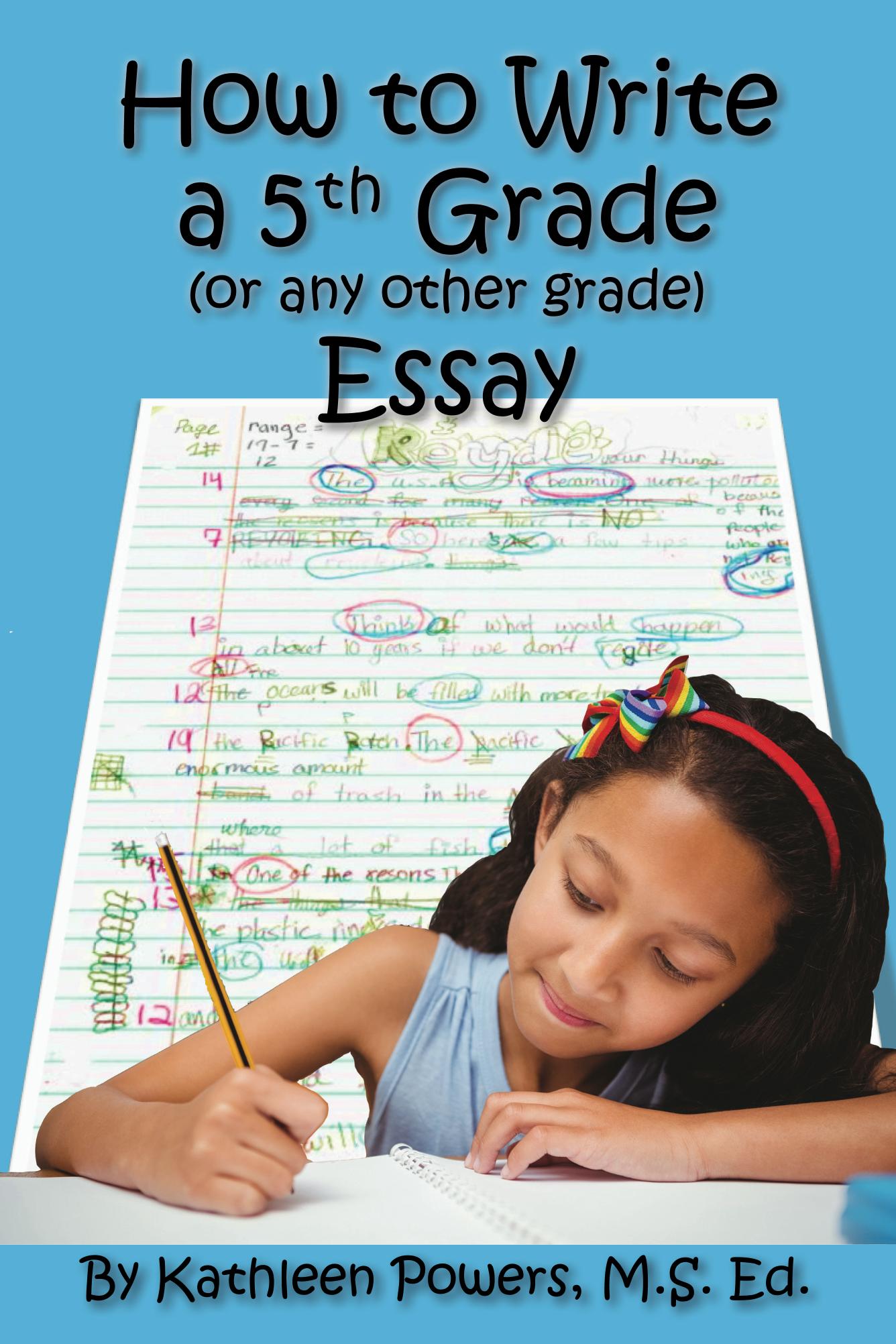
She might have gotten away with this carelessness in first and second grade, but now that she is in third grade, she will be taking the Common Core tests.  For the first time, lack of attention to detail might bring down her grades.  Does she know this?

The best motivation is internal, but for some children, an external goal focuses them.  What might motivate her to be more consistent with her spelling?  Money?  A trip to the book store?  A lunch out with Mom and Dad?

Considering your daughter’s age, a “contest” for one week might be a way to begin.  If she brings home worksheets every night and there are no spelling errors, she might earn a small but meaningful reward.  If she can keep it up for another week, then she might earn a second reward.  If she can get a certain grade on her end-of-year test, then she might earn another reward.

Or you might give her a 15-minute writing assignment at home Monday through Friday.  On Saturday she could receive her writings back and edit them, looking for spelling errors.  She could circle any word she thinks might be misspelled and look them up in a children’s dictionary or online.   This would be her chance to make changes before you evaluate her spelling.

Other ways she might find the correct spelling of questionable words are writing the word several ways and figuring out which one “looks right.” Or she might use a spell checker on the computer.  I have a spelling dictionary which I let children use to look up frequently misspelled words.

If she is writing at home, you might give her a short list of words she is likely to want to use.  If she is writing about fossils, for example, you could write “fossil,” “sedimentary,” “erosion,” and “layers.”  This encourages her to use such words and to follow standard spelling.  If she is using more advanced vocabulary, words like “canyon,” “marine” and “stratification,” and she spells those words phonetically, praise her for trying and tell her the proper spelling.

If you notice your daughter is repeatedly misspelling a particular word, you might develop a silly story which helps the child remember the correct spelling.  “An elephANT is beigger than an ant.  Or if she is misspelling a “family” of words, you might come up with a way for her to remember the spelling.

The more game-like you can make learning, the more likely your child is to participate.  And games have winners.  Offer her the prize she has earned, and let her know how proud you are.  Your daughter is still at the age where pleasing her parents is so important.  Make the most of it.

Ramona Quimby’s “mother,” Beverly Cleary, turns 100

When I was a little girl, Junie B. Jones hadn’t been born yet.  Nor had Cam Jansen, Eloise, Madeleine, the Babysitters, or Harriet the Spy.  But that’s okay.  I had Ellen Tebbits.

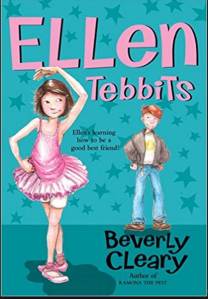
Ellen Tebbits

Ellen Tebbits , by Beverly Cleary, was the second chapter book I ever read.  Ellen was so much like me—the same age, the same straight dark hair and the same kind of mother who made me wear undershirts, snow pants and boots all winter long.  But best of all, Ellen Tebbits was funny.  From chapter one, when Ellen’s winter underwear kept falling during her ballet class, and she kept tugging it up while Otis Spofford watched and imitated her, I was hooked.

I loved reading Ellen so much that when it ended I was disappointed.  Ellen was one of those books which I wanted to go on and on.  But I went straight to my library and found another book by the Beverly Cleary, and another, and another.

Beverly Cleary is a superstar in American children’s literature.  After penning 46 children’s books, she has won or almost won many awards:

  • the 2003 National Medal of Art from the National Endowment of the Arts;
  • the 1984 John Newbery Medal for Dear Mr. Henshaw;
  • 1978 and 1982 Newbery Honor Books for Ramona and Her Father and Ramona Quimby, Age 8;
  • the 1975 Laura Ingalls Wilder Award of the American Library Association;
  • the 1980 Regina Medal from the Catholic Library Association;
  • and selection as the 1984 United States author nominee for the Hans Christian Andersen Award, an international award.

Yesterday Beverly Cleary turned 100.  Celebrate this terrific author by buying or borrowing one of her novels for your children.  Then laugh with Ellen, Otis, Henry, Beezus, Ramona and the gang.  What a wonderful legacy Beverly Cleary  has left us.

To find out more about this children’s author, go to her website, http://www.BeverlyCleary.com.

Students again opting out of Common Core testing in New York

Common Core testing began in New York State on Tuesday, April 5.  Last year New York had the highest “opt-out” rate in the country—20%, or a quarter of a million students in grades 3 to 8.  This year may see that rate increase despite shorter tests and unlimited time to take the tests.

EPSON MFP image

EPSON MFP image

  • 51.5% of students—87,899 students—in Long Island public schools refused to take the test by late last Thursday, with 106 out of 124 school districts reporting, according to reports in Newsday, Long Island’s daily newspaper.
  • 87% of students in Allendale Elementary School near Buffalo, opted out.  86% of students in the Comsewogue schools on Long Island opted out. 89 % of Dolgeville students in the Mohawk Valley opted out.  This is according to Carol Burris, executive director of the Network for Public Education and a former award-winning high school principal who is fighting Common Core.
  • While the 2015 opt-out movement was largely white, in 2016 the number of black students opting out has increased, according to Burris.
  • About 20% of eligible students—about 240,000 students—in New York skipped at least one of the tests in 2015, according to the New York State Education Department.
  • The opt-out numbers are higher for elementary and middle school students than for high school students. For older students, the scores on these tests are part of the evaluation used by college admissions offices, so there is more reason to take the tests.

For results of a Newsday survey of parents opting out of the math exam on Long Island last week, go to http://www.newsday.com/long-island/newsday-survey-thousands-of-li-students-opt-out-of-state-math-exams-1.7904604.