Category Archives: reading readiness.

Turn car rides into educational opportunities

Spring break is almost here.  For many kids, that means road trips to Disney World, the Grand Canyon or maybe to Grandma’s house.

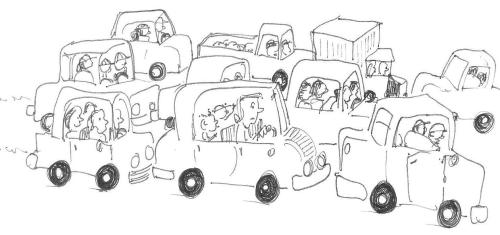
cars in travvic

Those long hours in the car might mean movie time, video game time or time playing on the phone.  But they also offer great learning opportunities.

  • For preschoolers learning their letters or numbers, make a game of finding a particular letter on a billboard, license plate or directional sign.
  • Say a letter sound (not a letter name) and let your child identify which letter matches that sound.
  • If it’s dark, you can say two words and ask the child which word begins with a particular letter. Stick to letters the child knows so she can feel successful.
  • For kids learning rhymes (sometimes called word families), suggest a word which the child can then rhyme once, twice or three times. Or go back and forth, first you, then the child, then you, then the child, until no one can think of another word.  The last one to think of a word could decide what the first word of the next round is.
  • For kids learning how to put letter sounds together to form words, sound out a CVC word and ask the child to identify it.  Then let the child sound out a word and see if you can identify it.
  • Another rhyming game is for the adult to say a nursery rhyme and ask the child to name the words which rhyme. (Hickory, dickory dock, the mouse climbed up the clock.)
  • Sequencing is a skill kindergarteners work on. You could say three activities—not in time order—and the child could put the events in the correct order.  (Mom filled the car with gas.  Dad put the suitcases in the car.  Billy packed his suitcase.)
  • Cause and effect is a skill third graders work on. You could name both a cause and an effect, and the child could identify which is which.  (Sleeping Beauty slept for 100 years.  Sleeping beauty pricked her finger.)
  • Categorizing words is an elementary school-aged skill. For example, you could say blue jay, cardinal and bird.  The child needs to find out which one in the category word.
  • Comparisons are another easy word game. You say that the answers are bigger than, smaller than or the same size.  Then you say, “An elephant is something than a mouse.”  The child tells the correct relationship.  You could use longer than and shorter than, heavier and lighter and older and younger.
  • Working memory is a skill children need to extend. Start with two words (or numbers or letters) which the child needs to repeat.  Let the child add another word and you repeat all three words.  Then let the child repeat all three words and add a fourth.  For some children this skill is incredibly difficult, so for them you might want to cap the list at four words.  For other children, seven or ten words might be possible.
  • This is a great time to review math facts. If your third grader has just learned multiplication, review the facts.
  • For older children or children learning English as a second language, car time can be vocabulary review time. You give the definition and the child gives the word.  Or let your child throw out a word meaning, and you have to identify it.  Children love stumping their parents.
  • Older children encounter idioms all the time, but they don’t always understand them.  Throw out an idiom–Jason is blue–and let your child explain what it means.

Of course these educational moments could also happen on your long flight to India or Taiwan.  They could just as easily happen on the way to school in the morning or on the way to soccer practice in the afternoon.  There are so many times you can exploit one-on-one education with your child.

Not understanding inference leads to reading comprehension problems

Inference, or reading between the lines, is the ability to use two or more ideas to arrive at another idea which hasn’t been stated.  For example, you see someone come into your home wearing a wet rain coat and carrying a wet umbrella. You can infer that it is raining out even though no one has said so.

A student with poor inference skills has reading comprehension problems.

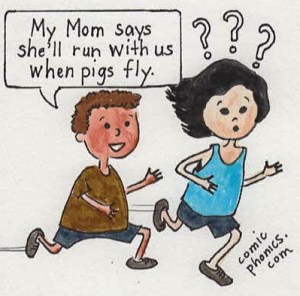
one child says "when pigs fly" but the other child doesn't understand

But there are many kinds of inferences which children must learn:

  • Pronoun antecedents:  In the sentence, “Mary gave her dog a hug,” the child needs to infer that “her” means Mary.  Figuring out pronoun references is a kind of inference.
  • Physical or emotional responses:  In the sentences, “Alan read the math problem. He frowned,” the inference is that Alan read something puzzling.
  • Cause and effect:  In the sentences, “Mom put the baby on the floor. Mom left him alone for a moment,” the inference could be the effect of a cause. What will the baby do? Will the baby do something dangerous?
  • Cumulative ideas:  When Junie B. Jones hides in a classroom cupboard, plays with clay she isn’t supposed to play with, and sticks dozens of bandages from the nurses’ office on herself, the reader can infer that Junie is a mischievous, fun-loving kid who doesn’t follow the rules.

What leads children to have problems understanding inference?

  • Vocabulary:  If a child does not understand the meaning of a word, and the inference depends on that meaning, making an inference is difficult. ESL children have this problem. I have worked with children who mix up he and she, him and her, or who use those words interchangeably. But native English speakers with limited vocabularies also miss inferences.
  •  Idioms:  ESL children are confounded by idioms and cannot make an inference from words which they interpret literally.
  • Working memory: If a child with a poor working memory must hold a certain idea in his mind over several sentences, making an  inference can be hard.
  • Predicting: Some children do not make predictions while they read. Perhaps they are focusing intently on decoding words or on pronunciation, and they have no mental energy left to make sense of what they read. Or perhaps they have never been taught to ask “why?” while they read. I work with a middle schooler whom I stop while we read together. I ask, “What do you think will happen next.” He always says the same thing. “I don’t know.”
  • Background knowledge:  Children who have encountered a situation, or who have heard their parents talk about a situation, or who have seen a situation on TV will have an easier job of making connections to what they read. Sheltered children without much life experience will have a harder time making inferences.
  • Cultural differences:  A child from one cultural background—say, Chinese—might not understand subtleties of a story about an Italian immigrant child from 100 years ago. Or an only child might miss inferences clear to a child from a large family.

In our next blog, we’ll talk about how you can help your child overcome inference problems.

Ways to strengthen children’s working memory

How can you help a child with a poor working memory to increase reading comprehension?

child playing card memory game

  • Play memory games.  Lay face down a deck of cards and find pairs.  Or play “In my suitcase.” The first person says, “I packed my suitcase, and in it I put a ____.” The next person repeats what the first person said, and adds a second item to the suitcase. Now the first person repeats what the second person said and adds a third item. The internet offers plenty of other kinds of online games.
  • Give directions  one step at a time. You might say, “Put your pencil down,” and wait until the child does that. Then say, “Put the book inside your desk.” Again wait for compliance before giving the next direction.
  • Use simple sentences when giving directions. Also, use transition words like “first,” “next,” and “finally.”
  • Choose children’s books written mostly in simple sentences or compound sentences. If there are complex sentences, make sure they are limited to one subordinate clause and are clear.
  • Ask the child to explain a complex sentence.  Ask him to describe the relationship between the two parts of the sentence–cause and effect, for example, or time order.
  • Eliminate distractions. At home, have the child do her homework in a quiet place with plainly painted walls and draperies. Settle the dogs down. Turn off all electronics. Even a ticking clock can interfere with a child’s concentration.
  • Don’t rush a child. That stress might distract her, her working memory.
  • Remind the child that she needs to remember what she reads.  Later, ask her questions about what she read so she gets in the habit of remembering.
  • Question a child about what she has just read.   After each paragraph, or after a short conversation, ask what those sentences mean. If the child has trouble remembering the beginning part, question the child after she has read less information.

When a word has a single consonant between two vowels, which syllable does the consonant go with?

When a two-syllable word has a single consonant in the middle of two vowels, which syllable does the consonant go with?

Usually the consonant goes with the second syllable.  This forms a first syllable with a long vowel and a second syllable that is either CVC or CVCe. The first syllable which ends with a long vowel is called an open syllable. Some examples include:red headed girl in easy chair reading, legs up

  • minus
  • tulip
  • pupil
  • motel
  • basic
  • humid
  • rotate
  • unite

Sometimes these words  have a one-syllable, stand-alone word as the first syllable.  Or they have a prefix as the first syllable. Helping students to recognize this tiny word or prefix can help them to pronounce the word correctly. Some words like this include:

  • beside
  • rerun
  • protest
  • defend
  • trisect
  • bypass
  • nomad
  • hotel

Some students get mixed up if the first syllable is a single vowel. They want to put the middle consonant with the first syllable instead of with the second.  If this happens, ask the child to pronounce the word both ways. Usually one way will make sense and one won’t unless the child is not familiar with the word. Some words like this include:

  • omit
  • item
  • unit
  • ozone
  • even
  • evil
  • amen

I recommend teaching children words with a single consonant between syllables after they have learned words with two middle consonants.  The latter are easier to learn because children more easily spot the CVC + CVC pattern.

One warning:  Many words beginning with the letter “a” follow the letter pattern just mentioned, but the “a” is not pronounced as a long vowel.  “Alive,” “along,” “awake,” “atone” and “apart” and dozens of other “a” words pronounce the “a” as “uh.”  Save them for a separate lesson.

My third grader skips over long words when she reads aloud. When I ask her to pronounce them, sometimes she can if she segments them, but many times she can’t. How can I help her?

Lots of children do this, thinking they can gain enough meaning from the rest of the words. And sometimes they can. But usually this is a sign of a struggling reader.

Your daughter needs to learn strategies to figure out new words.

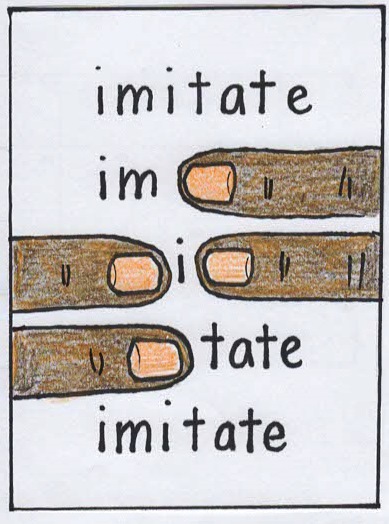
fingers covering parts of word, then revealing themWhen she reads aloud to you and encounters a word she skips, stop her and cover parts of the word to help her figure it out in small chunks. For example, in a word like “imitate,” cover over all but the “im” part. Ask her to pronounce “im.” Then ask her what a short i sounds like. Show her the “i” in the middle of the word and ask her to put those sounds together. Then show her the “tate” which should be easy to pronounce. Now reveal the word bit by bit as the child says it. You say it too to be sure she hears it pronounced correctly.

But she still might not know what the word means. Help her to understand it. Use it in a couple of sentences. My experience working with children is that many times they can remember the meaning of words, but they cannot use them properly in sentences. Ask her to create her own sentence using the word.

I would make a list of words she has learned this way, and later in the day or the next day, go back to them. Ask her to read the words and tell you what they mean. Return to these words from time to time to reinforce them.

I would also try to find ways to use the words in your everyday conversations with your daughter.

Perhaps your daughter needs more phonics education. You could quickly go over CVC rules of adding suffixes. You could instruct her about prefixes and what they mean and rules for adding them to root words.

Letting your child slide over long, unfamiliar words sets up a bad habit. Eventually, when she gets into middle school classes, she’ll encounter such words routinely and will need strategies to figure them out. Talk to her teacher about the situation. Perhaps there is a reading specialist in your school who could come to her classroom from time to time and help the students decode longer words.

And I will provide more information about how to decode longer words in upcoming blogs. Keep tuned.

My child is almost four. She wants to learn to read. Where do I begin? Or does it matter?

It matters, according to research. You should start with teaching her “the code,” that is, the connection between the sounds of the English language and the letter symbols we use to mean those sounds. Here’s how. (Look for more information on all these ideas in previously published blogs at comicphonics.com.)

  • children moving letter tilesFirst, make sure she can pronounce all 42 sounds of English. Listen to how she pronounces everyday words and make sure she is saying the sounds correctly. Help her with pronunciation.
  • Then connect sounds with letter symbols, a few at a time. Start with the beginning sounds of a few key words such as the child’s name, m for mom, d for dad, b for baby. Help her to hear those sounds in the beginnings of other words. For example, if you are pouring her milk, ask her what sound milk begins with. Then show her an “m” and explain that is how we show that sound.
  • Beginning sounds are always the easiest to hear, so focus on them.
  • Help her to write the initial of her name and a few other meaningful letters.
  • child on floor reading picture bookSince each vowel has many sounds, teach her to associate each vowel with a word and an image that begins with a “short” vowel sound such as apple, egg, igloo, octopus and umbrella. Later, she can compare the vowel sounds in new words to those vowel sounds.
  • In speaking, start putting letter sounds together to form one-syllable short-vowel (CVC) words she knows, like “cat” and “dog.” When she can hear how words are formed (phonics) by combining sounds, use letter tiles to show her what the combining of sounds in words looks like using letter symbols.
  • When you are reading stories to her, point out words she might be able to decipher, and help her to sound them out.
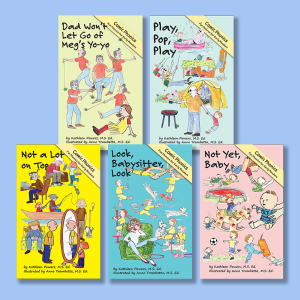
  • When she knows most of her sound – letter matches, she is ready to start reading books which use one-syllable, short-vowel words. Unfortunately, few good ones exist. We at comicphonics.com have written five humorous books for new readers. (See the links to the right of this blog.) Your librarian can point out where other books are shelved, but many labeled “first” readers contain difficult words. Margaret Hillert has written some good beginning books, and so has Dr. Seuss. Good illustrations can help the child figure out the meanings of difficult words, but she will probably need your help as she begins.

Figuring out the code of written English is how a child begins to learn to read. There are lots of commercial methods to do this, but the best I have found is the Explode the Code series. Children find its combination of goofy pictures and sequenced phonics instruction fun.

Later you can focus on other aspects of reading including fluency and comprehension. But the place to begin is demystifying the code by connecting the sounds of our speech to individual letters and pairs of letters, and then combining them to form words.

My kindergartener wants to read chapter books. What features should I be looking for so she doesn’t get discouraged?

Congratulations! Some early readers are ready for chapter books, but that doesn’t mean all chapter books are right for them. Here’s what you should be looking for.

  • Characters whom the child relates to and cares about are really important. That means child characters, ones the same age or just a bit older than the reader, or characters who behave in child-like ways, such as Toad in the Frog and Toad series. The characters in books for young readers must be encountering situations that the reader can relate to—like Junie B. Jones fearing to take the school bus, or of Nate the Great visiting his friends’ houses in search of a lost cat.
  • girl reading Junie B. JonesCharacters should be different from one another—their names, gender, and personalities. Junie B.’s friend, Lucille, is prissy and wears pretty dresses while her classmate, May, is a tattletale. Frog’s friend, Toad is a short, brown scared follower while Frog is a taller, green, organized leader.
  • If the chapter book is part of a series, familiar characters or activities should appear. Children delight in recognizing these patterns. They know that when reading Nate the Great stories, for example, Nate always takes a break to eat pancakes. His friend, Rosamond, always appears with her four black cats. Nate’s dog, Sludge, helps him solve crimes, while another dog, Fang, always makes an appearance.
  • Asian girl reading book Plots should be straightforward with no flashbacks or complicated subplots. If the story concerns finding one of Rosamond’s cats, then that becomes the whole focus of the story. Good books remind children what they have learned. A character like Nate might think about the clues he’s uncovered, and a list of them might appear as an illustration. The plots are shallow and move quickly through a series of events.
  • Good chapter books for young readers should contain illustrations. A page of text will appear harder to read than a page with a line drawing on it. The drawings should provide additional information that the text might not dwell on. For example, drawings of Junie B. show her with fly-away hair and one sock up, one sock down, telling us in pictures about her personality. Illustrations don’t need to appear on every page, but more illustrations make the book appear easier to read.  Also, illustrations lengthen the number of pages, so the child thinks she is reading more than she actually is.
  • girl looking at book displayPicture books are printed with large type, but chapter books have reduced size type. To offset this change, good chapter books for young readers will increase the space between the lines of type and increase white space by making margins larger. This makes the text easier to read and the page “friendlier.” Good children’s books use dialog too. Dialog is usually short, so more white space surrounds it. Hyphenations will not be used at the ends of lines to split words, and sentences will end on the bottom of a page rather than being carried forward to the next page.
  • Discouraged child thinks there are too many words in a book she is readingThe vocabulary of chapter books for young readers should be easy enough to read so that the child can read for enjoyment, without help. New words can be introduced, but in context, and should be repeated during the story so the child can master them.
  • Sentence structure should be normal, that is, subjects followed by predicates. When complex sentences are used, the dependent clause should come second. That is the way children speak and write, so that pattern will be easy to understand. Sentences should be shorter than adults would expect. Not all sentences need to be short, but longer sentences should make sense on the first read through.

Right now I am working with a second grader who is reading his first chapter book, Charlotte’s Web. It was assigned by his teacher. Some of the characters’ names are similar (Avery, and Mr. Arable, for example). The vocabulary is advanced. The pig is called “radiant”; he is put into a “crate”; he is watched by “goslings.” For a suburban child, these words are mysterious. The sentence structure is too sophisticated. Even though Charlotte’s Web is an excellent novel, it is not an appropriate first chapter book for my student. He is not ready to read it without help.

In my public library, chapter books for elementary school aged students are grouped together. Within those books, some are labeled on the spine, “First chap.” Those books are perfect for children reading their first chapter books. Or if you are lucky enough to have a children’s librarian, ask her what books she would suggest. Or phone or visit your school librarian and ask her for help.

Hundreds of wonderful books are appropriate for your kindergartener. Good luck!

Making small words from big words—a variation for beginning readers

What if a child is truly a beginning reader still learning CVC words? Can the game of finding small words within big words or phrases still be used to improve the child’s understanding of words and spelling? Not exactly, but if you limit the letters strategically, a beginning reader can play.  Here is how.

children moving letter tiles

  • Instead of writing a big word or phrase such as “New Year’s Day,” write a handful of letters, including only the vowels and consonants which the child has learned.
  • If the child has learned only short a words (cat, ham, fad), write the vowel “A” at the top of the page followed by a handful of letters which you know can be used for form short a CVC words. B, C, D, H, R, and T might be good letters to begin with.
  • You could also use letter tiles (Scrabble letters, for example) so that the child can move letters around. Tactile experience helps young children in learning and makes the learning seem more like a game. Also, the child doesn’t have to hold letter patterns in his head; he can manipulate various letters until he finds a word which then you or he could write down.
  • Demonstrate to the child how mixing up the letters can form words. Write B A T and B A D, showing where you got those letters, and using enough examples so the child knows what to do.
  • The competition aspect of the game might be for the child to “beat” his last score, that is, to find more words than the last time.
  • As the child learns more CVC vowels, two vowels can be used with six or seven consonants. I recommend starting with A, then O, and then U.  E and I take longer to learn since they sound similar, so I would use them indeptndently (A and E, for example, or O and I) until the child is confident with all CVC words.
  • This is a game which pairs of children can play together as a team, providing one child does not dominate, leaving the other child out.
  • Restricting the number of letter choices can help the child to focus, so do limit the number of vowels and consonants for beginning readers. Once the child is an experienced reader, he can “graduate” to the longer word or phrase game we discussed previously.

Play word games to encourage or to reward reading

When I tutor reluctant readers or bad spellers, sometimes I reward them with a word game in the last five minutes of an hour-long lesson. The kids love the game and ask at the beginning of the next lesson if they can play again. I never play this word game at the beginning of a lesson or they will balk at doing other kinds of reading work, but it is great as a reward.
This game is also a good game to play in the car on long trips or when a child is bored. It turns dead time into learning time.game of breaking up a big word into little words

  • Start by choosing a long word or a phrase. I try to relate the word or phrase to the season or to what we are studying. For example, “NEW YEAR’S DAY” or “JUNIE B. JONES” might be appropriate. After the first game, the child will want to choose the word or phrase, but you must steer him to pick an appropriate word or phrase for the game’s purpose.
  • The word or phrase should have ten to 15 letters but not many more or the game becomes too easy. Good words or phrases to work with contain several vowels, including the letter “E.” Bad words or phrases contain few vowels, do not contain the letter “E” and repeat many of the consonants.
  • I write the word or phrase at the top of a blank paper, often in all caps, so the child realizes capital letters are irrelevant.
  • Next, I explain that we are going to make little words from the big word or phrase, using the letters in any order. So for the phrase “NEW YEAR’S DAY,” I might write “ear,” “way,” and “weed,” and point out how each letter in the little words is part of the phrase.
  • I also point out that if there is only one “N” in the original word or phrase, then there can be only one “N” in the made up words. Also, if there is punctuation in the original word or phrase, it can be ignored or used.
  • The object of the game is to find as many small words as possible in five minutes.
  • Eventually you want children to discover word families, words whose letters can be moved to create other words (tea, eat, ate), words within words (heard, hear, ear, he, head), and how having certain letters (E and S, for example) makes the game easier. This shows the child is thinking about word patterns.
  • I help younger children find words, and show them word families that can be made by changing a single letter. Once they understand the game, they usually do not want help.
  • For older children, I compete with them, sometimes giving them a handicap.
  • At the end of five minutes, if there is not a competition, the game ends. If there is a competition, the child names his words aloud, and if he and I have duplicates, we cross them out. His score becomes the number of words he has without duplicates plus the handicap.
  • Additional points are given for words of five letters or more and perhaps for the word which is the longest and which seems to be the most clever use of the original letters.
  • I allow proper nouns, but I do not allow repeating the words in the original word. You can make your own rules depending on the ability level of the child. Some children will put an “S” on every noun.

Is gesturing by a child learning to read important?

When my son was almost two, and not talking much, I often read to him a picture book by Helen Oxenbury which showed a toddler doing everyday things: pulling on his socks and pants, for example. I would ask my son, “What is the baby doing?” My son would show me by gesturing—pretending to put on his socks, or pretending to pull up his pants. Once he learned to say words, I stopped this practice.

child making letter T with his body

It turns out that I should have continued with the gesturing. Research shows there is a positive relationship between gesturing and learning in children. By noticing your child’s gestures, you might be able to tell when he understands a concept or when he is trying to figure it out.

According to research,If a child understands a concept, the child’s words and gestures are in sync.

  • For example, if you ask the shape of a triangle, and the child says “three sides” and then draws a triangle with his index finger, the gestures and words are in sync, and you can presume the child understands.
  • If a child is still learning a concept, the child’s words and gestures might be out of sync, and there might be an abundance of gestures or a shrug.
  • For example, if you ask a child to tell you what an orbit means, and the child says “space” and draws a rounded triangle,” the child’s words and gestures are not in sync. The child is still learning.
  • Out-of-sync responses offer parents and teachers an opportunity to help the child learn while his understanding is fluid and open to instruction and before he learns something wrong.

Is gesturing necessary for learning? Probably not, yet research shows that children who gesture while they are learning are more likely to learn. This is especially true if the child is asked to explain a general concept.

For more scholarly details on this subject, check out the work Susan Goldin-Meadow of the University of Chicago, an expert in this field.