Category Archives: picture books

4 ways to improve reading comprehension

For years I have focused on the importance of a phonics-based reading curriculum for beginning readers.  Research shows that young students exposed to sequential phonics instruction have better reading outcomes than students who learn primarily through other approaches.

But once students have learned the basic rules of phonics, and they are reading to learn new information, research shows other activities can help students comprehend better.  Here are some.

Photos, drawings, sounds, videos and picture books can help students understand new-to-them concepts before they read about them.  Providing students with rich background information can make acquiring new information easier.  Students can fit new ideas into old ideas, or show how the new idea is the same or different from the old idea.

Venn diagrams are another way to do this.  For example, to learn the relationship of math operations, students could see a Venn diagram like this:


The idea is to connect new information to information students already know.  Stick figures showing two families’ with arrows from one person to another could show what nieces and nephews are.

Tables connecting what students know to what they don’t know can help.  Here is how.  Create a row of three sections.  On the left, write a vocabulary word or concept students know.  Leave the middle blank.  On the right, write the new concept to be learned.  Help students fill in the center by connecting the idea on the left to the new word on the right.

my birthday important day in my life, hard to forget day, day I think about milestone
What I’m doing at different times all day long 8  Pledge of Allegiance

8:15 reading class

9:15 snack

9:30 math class

schedule

We adults connect new concepts to what we know all the time.  And, like students, if what we know is scant, we have a hard time learning the new concept.  For example, I was reading a novel about a World War I soldier who was demobbed.  What in the world is demobbed? I wondered. Attacked by a mob?  Thrown out from a mob?  I looked the word up, and found that demobbed means discharged from military service.

Okay, so how do I remember it?  I know what a mob is, but in this case mob is short for mobilized, so that doesn’t help.  I know what a mobile phone is though, so I pictured a soldier texting someone on his mobile phone to tell that he is discharged.  Maybe he is throwing his hat in the air too.  So connecting pictures to words and events is another method of comprehending.

Learning to read doesn’t stop with applying the rules of phonics.  That is a vital start.  Another vital aspect of reading is comprehension, a lifelong process.


The idea is to connect new information to information students already know.  Stick figures showing two familie with arrows from one person to another could show what nieces and nephews are.

Tables connecting what students know to what they don’t know can help.  Create a row of three sections.  On the left, write a vocabulary word or concept students know.  Leave the middle blank.  On the right, write the new concept to be learned.  Help students fill in the center by connecting the idea on the left to the new word on the right.

my birthday important day in my life, hard to forget day, day I think about milestone
What I’m doing at different times all day long 8  Pledge of Allegiance

8:15 reading class

9:15 snack

9:30 math class

schedule


We adults connect new concepts to what we know all the time.  And if what we know is scant, we have a hard time learning the new concept.  For example, I was reading a novel about a World War I soldier who was demobbed.  What in the world is demobbed? I wondered. Attacked by a mob?  Thrown out from a mob?  I looked the word up, and demobbed means discharged from military service.  Okay, so how do I remember it?  I know what a mob is, but in this case mob is short for mobilized, so that doesn’t help.  I know what a mobile phone is though, so I pictured a soldier texting on his mobile phone that he is discharged.  Maybe he is throwing his hat in the air too.

Learning to read doesn’t stop with applying the rules of phonics.  That is a vital start.  Another vital aspect of reading is comprehension, a lifelong process.

Ten questions to gain deeper understanding of a book

I write quizzes about books  to help my students understand books better.  Coming up with thought-provoking questions is a struggle.  Too often I want to ask for a single fact, such as “Who is Peter’s little brother.” To help me devise more meaningful questions, I keep a list of question types. Here are questions you might use with your students.

What is the best summary of the book/chapter?  I provide four options, keeping in mind that some students have trouble distinguishing between main ideas and details.

What is the best paraphrasing of a sentence or paragraph?  I provide options which range from mostly restating information to truly putting the information into other words.

Why does the author ____?  Repeat a word?  Describe the weather so much?  Not talk about negative feelings?  Use a simile?  These kinds of questions ask the student to consider the author’s style and the choices the author makes in writing a particular way.

How is this book/chapter structured?  In chronological order?  From most important to least important information?  Stating a cause and its effects?  Stating effects leading to a cause? From scary to scarier to scariest?  Stating a conversation that becomes funnier and funnier?  Many students read without realizing someone wrote what they read, and that someone made choices.

Does the writer like or approve of ____?  We know right from the beginning that J.K. Rowling does not approve of Malfoy in the Harry Potter series.  But how do we know that?  What words tell us that?  What actions?  What facial expressions?

In what order do actions occur? List two or three actions, and ask what the next action is.  Sequencing questions might force students to reread sections or to read more carefully the first time.

What is the tone of a chapter or conversation?  What is the mood?  I usually define tone and mood in the question to help the student.

What might a certain action foreshadow? A child falls while jumping rope.  What might that fall foreshadow?  Probably another, more serious fall.

What is an important fact in a chapter?  Many children cannot distinguish between trivial facts and important facts.  All facts seem important.  Questions like this force students to rank facts.

What can you infer from the frown on a character’s face?  Or from a character’s silence?  Or from a character’s cowering?

From the picture book stage to the chapter book stage, these questions can be used to help a student grasp a deeper understanding of a book and the choices its author made to create it.

You can teach your child to read. Start with a phonics assessment.

Are you are planning to teach your child how to read this summer, either starting at the beginning or filling in the gaps?  If so, where do you start? I suggest you give your child a pretest to see what reading skills your child has learned well, and what ones he has not yet grasped. The words on this pretest are more or less divided into four kinds of words in this order: 1. Short (closed) vowel, one-syllable words. These include one- and two-letter words, words beginning or ending with blends and digraphs (black, church) words which end in twin consonants (fell, jazz), words which end in “ck,” and words to which an “s” can be added to make plural words or certain verbs (maps, runs). 2. Long (open) vowel, one-syllable words.  These include words ending with silent “e,” words with double vowels which have only one vowel pronounced (goes, pear), and certain letter combinations (ild, old).  They also include words with “oi,” “oy,” “ow” and “ou” letters. 3. Two– and three-syllable words which follow the above rules (catnip, deplete) and two- and three-syllable words which don’t follow the above rules but which follow a pattern (light, yield). These words include words with certain suffixes (le, ies) and words with a single consonant between two vowels (robin, motel). 4. Exceptions.  These include words with silent letters (gnaw, lamb), words from other languages (debris, cello), and words which fit no pattern (business). Ask your child to read the words in the pretest below.  Each row across tests a particular phonics skill.  If you child hesitates at all, that is the place to begin teaching him or her phonics.  I will talk more about how to teach these four groups of phonics skills in my next blog. Phonics assessment bad, hem, fit, don, pug, am, if, lass, jazz lock, Mick, bills, cliffs, mitts, catnip, Batman grand, stent, frisk, stomp, stuck chuck, shun, them, branch, brush, tenth star, fern, birds, fork, purr, actor, doctor, victor muffin, kitten, collect, pepper, gallon complex, helmet, falcon, napkin, after tantrum, muskrat, constant, fulcrum, ostrich skate, bike, Jude, mole, dare, shore, tire, pure need, cheer, aim, hair, bay, pie, boat, oar, Joe, low, soul fruit, few, child, blind, fold, colt, roll, light, high earn, worm, rook, pool fault, claw, all, chalk, Walt boil, so, pound, down comet, dragon, liver, salad, denim total, ever, student, basic, demon, vital apron, elude, Ethan, Owen, ideal, usurp inside, nearly, absent, unicorn, degrade, tripod advance, offense, fence gripped, planned, melted, batted, handed sweeping, boiling, thinning, flopping, biking, dating rapper, saddest, finer, bluest, funnier, silliest easily, busily, massive, active, arrive, wives keys, monkeys, armies, carried action, section, musician, racial, crucial, nuptials brittle, pickle, carbon, dormer parcel, decent, gem, urge, badge lose, sugar, nature, sure graph, Phil, then, moth bomb, thumb, gnat, gnome, high, sign whip, whirl, echo, ghoul, knee, knob could, calf, folk, hustle, listen, wrist alone, bread, bear, chief, young, squaw, swan, waltz, word decision, exposure, gigantic, polarize, occupant, quarantine If you want to help your child learn to read, one of the best things you can do is not to let him guess.  Most words can be deciphered if the student has a phonics background. Also, don’t let your child depend on pictures for meaning once the child starts to read.  Most adult reading material is not accompanied by graphics.  Students must learn to gain meaning from the text alone. If you have decided to help your child read this summer, good for you.  You don’t need to be a rocket scientist to help your child read better.  Years of research show that the best way to teach reading is to start with letter sounds (phonemes) and then to combine those letter sounds into words (phonics).  If you do this in a systematic way, such as following the four-part sequence I describe above, your child will learn to read.    

Learning through phonics is the best way to learn to read

If a child is having trouble reading, what is the most likely cause?

  • Reliance on pictures for meaning?
  • Guessing?
  • Weak word recognition skills?
  • Reliance on context word clues?

Child sitting with legs outstretched, forming the letter LWeak word recognition skills is the mostly likely cause, and because of that, students guess at words or search for clues from pictures and other words.
Weak word recognition skills means an inability to sound out the letters which form words.  If a child comes upon a new word—for example, “trek”—and the child cannot sound out the individual letters, the child cannot read the word.

Since 2000 we have known that the most effective way to teach reading is through a system of associating sounds with letters and combining those letters to form words—in other words, a phonics-based approach.  A National Reading Panel authorized and funded by Congress assessed scientific research on reading.  The Panel’s goal was to determine the most efficient way children learn to read.  The Panel concluded in 2000 that to read well, children should associate sounds of English (phonemes) with letters or letter pairs and to combine the letter-sounds into words.

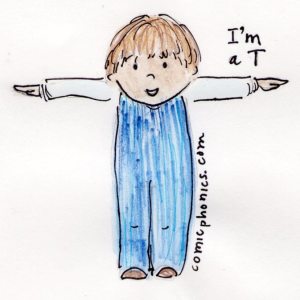
Child with arms stretched out at his sides, forming the letter T.The word “it,” for example, has two sounds, each of which is associated with a letter.  The word “shop” has three sounds with “sh” corresponding to a single sound.

By deconstructing words into their basic sounds, children learn to sound out words.  Without guessing, without context clues, without pictures, children can figure out how to read words.  Even though there are some words which defy this sounding-out system (words like “one” and “two”), the vast majority of words in English can be sounded out.

The problem is, even though we know what works best, teachers are still asking children to guess at words, to look at pictures to figure out what words mean, to read other words nearby and use those context clues to figure out words, and to memorize the look of a word.  In other words, some teachers are not teaching phonics as the primary way to learn to read.  They are relying on methods which research shows do not work as well as phonics.

When I went to first grade, I was taught to read using a memorization approach.  The first page of my first reader had the word ”look” under a picture.  The next page had the words “Oh, look” with a different picture.  The next page had “See, see, see” with another picture.  It wasn’t until fourth grade that my teacher, Sister James Bernard, CSJ, offered lesson after lesson on phonics.  What a revelation!

If your child hasn’t learned phonics, teach him or her.  If your child is guessing at words, make him sound out each letter or each syllable.  No guessing allowed!  This is the surest way to create a strong reader.

Fun picture books for beginning readers, plus learning activities

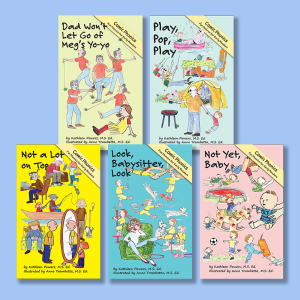
Are you looking for funny stories for your beginning reader? Silly stories using easy-to-read CVC and sight words?  With silly pictures to make kids laugh? And learning activities to reinforce the phonics?

We’ve made them!

Click on the image above for more information on these beginning readers.

Years ago, when my kids were learning to read, that’s what I wanted. But I couldn’t find them. So I started writing them. My sister, an art teacher, made them even funnier with her cartoon-like drawings. We tried them out on our kids and later my students, improved them, and now they are available for you to use with your beginning readers.

The story themes focus on little kids’ lives.

• A six-year-old receives a yo-yo for her birthday, but her father wants to play with it.

• A baby brother wants to do what his kindergarten-age brother does, but he’s too little.

• A wild child makes a mess while the babysitter gabs on the phone.

• A preschooler talks his grandfather into playing with his toys.

• A five-year-old devises ways to hide her father’s bald head.

After each story are several pages of game-like learning activities to reinforce the words and ideas of the stories.

My sister, Anne Trombetta, the illustrator, and I, the author, are teachers with masters’ degrees. We’ve applied educational research to devise story lines, words, activities and art to engage new readers.

Please check out our early reader picture books. We hope you’ll not only buy  them, but tell us how your little reader responded to the silly stories.

Is your four- or five-year-old ready to read?

At four years old, and even at five years old, most children cannot put a hand over the top of their heads and touch the opposite ear.  This was an old-fashioned way to decide whether a child was ready to read.

young child attempting to touch his ear with opposite hand

But even so, some children are ready to learn to read at four and five.  What are some of the signs?

  • The child can hear and reproduce sounds and words well.
  • The child shows curiosity about letters and words.
  • The child likes rhymes.
  • The child wants to know how to write his or her name.
  • The child has a big vocabulary and eagerly adds more words.
  • The child likes being read to.
  • The child studies picture books for meaning.
  • The child can sit still for 10 or 15 minutes at a time.
  • The child has a long attention span for his age.

Even with all these qualities, some four- and five-year-olds are not ready to read.  If you start to do sound-letter work, and he bores of it or pushes it away, back off.  But keep reading to him, and asking him to do oral work—describing what he sees in pictures, inferring what the pictures mean, predicting what will happen next, and asking him to identify the main ideas.

Eventually he will want to know more.  By six-years-old, usually kindergarten-aged, a child should be learning to read.  But even then some children balk.  In some European countries reading isn’t taught until a child turns seven, at which time the process generally goes much more quickly than at four- or five-years-old.

How does an almost two-year-old read?

How does an almost two- year-old “read”?  What does such a tiny child “read”?  How can we encourage the reading habit in such a tike?

I spent a week in early September with a 21-month-old who wanted me to “read” to him many times daily.  He taught me:

Toddlers love to hold books, turn their pages, point to objects they recognize and name those words.

They do not like to be read paragraph-long passages.

They do like to be read text if it is short. “Brown bear, brown bear, what do you see?” is an example of text that works.  Single syllable words, words the child knows, words which are repeated, tiny sentences—these hold a child’s interest just long enough before he wants to turn the page.

Pint-sized cardboard books are easy for a toddler to hold. The pages are easy to turn.  And the cardboard is able to withstand the rough handling that a tiny child gives.

“Reading” often means “studying” a picture to discover what it holds. “Balloon!” he might shout, or “Piggy eat.”

Order of pages is arbitrary to a tiny child. Sometimes he will prefer to skip some pages to head right for the picture he prefers.  Sometimes he will flip back and forth, making a connection between one page and another.  For example, he might find the moon on one page and then go back to a previous page to find the moon there.

Simple drawings are best. Bright colors with plain backgrounds help the child to focus.

Animals—especially baby animals with their mothers—fascinate many children. But one time an adult horse might be a “mommy” and another time that same image is a “daddy.”  There’s no need to correct.

Touchable books captivate toddlers. A child eagerly strokes books with inserted fabric for a sandpapery pig’s nose or a furry dog’s ear.  Books with flaps are fun to open even if the child has opened the same flap many times.  Books with cutouts—like the holes that the Hungry Caterpillar eats—are just the right size for a little one to stick his finger into.

Many times, you, the adult, needn’t read a word.  Rather you might wait for the child to take the lead.  He might point to a picture and say a word.  You might repeat his word to show you are listening or to offer correct pronunciation.

Many times all he wants is for you to listen, to share his reading time without distraction. By being willing to focus only on him, to listen wholeheartedly, you teach the child that you value what he is doing.  Your unhurried presence tells the child that this activity—reading—is important.

Teaching sounds, not letters, is where reading begins

The basic “code” of written English is sounds represented by letters.  Learning this code begins with learning to recognize the sounds of English.  Combining these sounds into two- or three-sound words is where forming words begins.  And this can be taught to children before they ever see a letter.

Because learning the code of written English is so important, learning to recognize its sounds should not be rushed.  A lifetime of reading, a career, the ability to support a family—so much depends on being able to read.

Kids need plenty of time and various kinds of interactions with sounds to learn to recognize sounds.  The younger the children, the shorter their attention spans and the more need for game-like ways to learn.

But the learning doesn’t begin with letters.  It begins with sounds.

I recommend you use several strategies to help your children identify sounds, working with your child one-on-one using manipulatives.  Why?

Your child wants nothing more than to interact with you. Putting down your cell phone and sitting by her side shows your child you treasure her.  And working with her on reading skills shows her how important you consider that knowledge to be.

Research shows that the more senses we use, the more likely we are to remember. If a child can touch manipulatives, hear you say sounds, say them herself, see objects when she says sounds and feel your warm hug when she learns, the learning will stick. Plus she will be relaxed and happy, in an emotional state which is open to learning.

Some of the strategies I recommend to teach tiny children how sounds form words are these.

  • Work on a few sounds at a time with objects around the house. If your son’s name is Bill, for example, start with the “b” sound. Put a ball in your son’s hand and say “b” (the sound, not the letter) as in ball.  Put a banana in his hands and say “b” as in banana.  Do the same for other consonant sounds and for all the vowel sounds, even sounds we represent by two letters.  You can say “oi” (the sound) as in oink, or “ch” (the sound) as in child.  You can start this activity when a child is two or three without ever showing the child a letter.


  • Find objects in picture books which begin with basic English language sounds. ABC books are good for this, but the goal should not be to say “A is for apple.”  Rather it is to focus on the sounds in words.  At first start with words which begin with a sound, but then move on to small words which include that sound in the middle of CVC words like “cat” and “bag.”


  • When the child recognizes a handful of consonant sounds and a vowel sound such as “a,” say the “a” sound and a consonant sound slowly, one after the other. Make sounds which form a word like “a” and “t” or “a” and “x.”  Repeat the sounds a little faster each time until the child can hear the sounds come together.  Usually the child will say the word, but if not, help her to hear how the sounds come together to form a word.


All these activities can be done prior to ever showing your child a letter.  And they can be done with all 42 sounds in English.  Identifying sounds and understanding how they come together to form words is the basis of reading.  Save the ABCs for a later time.


Teaching vocabulary

If kids get low grades on reading comprehension, number one on my checklist is vocabulary. If kids don’t understand the words they read, how can they possibly understand the sentences containing those words?

But how to solve this problem?

CVC means consonant-vowel-consonant, and refers to one syllable, short vowel words beginning with a consonant.

For ELL students lacking basic English words, I make flash cards: a picture on one side and the word or words used to identify that picture on the other side. A picture of a child pitching a baseball might use the words “pitch.” “toss,” or “throw.”

I start with pictures of CVC words: “cat,” hat”, and “bat,” for example. Picturing nouns is easy. Picturing verbs like “sat” and “win” is harder, and often I need to demonstrate the actions.

With my students I use the Explode the Code phonics series, so I picture vocabulary words in the order in which the student encounters the words in the series. To these I add a few sight (Dolch) words so that we can make sentences, such as “A cat is not a dog.”

What I have discovered is that students can identify the pictures with just a bit of study, but they cannot use the words in sentences. When they see the word “pitch” they can move their arms in  pitching motions, but they cannot make a sentence using the word “pitch.”

Even for students learning advanced vocabulary words, like in the Wordly Wise series, this is true. They can define a word using a synonym but they have trouble using the word in a meaningful sentence.  (For many students using this series in school, their teachers do not assign the part of the lesson in which students write the new words in sentences, a big mistake.)

When I review already learned vocabulary words, I ask for synonyms, but also for usage. “It is a cat” works for beginning ELL learners. But “It is a catapult” does not work for older ELL students or for English-speaking students.

Another method to increase ELL learners’ vocabulary is to use picture word books meant for preschoolers. Because I want to use the vocabulary my students study to teach them reading, I prefer to begin with CVC words even though a word like “pizza” might be more frequently heard.

Board books meet babies’ literacy needs

baby reading a bookBoard books, those small-sized, thick cardboard books with brightly colored pictures and rounded corners, are celebrating their 70th birthday (more or less).  They were born with the baby boom in the late 1940’s, came in various shapes and sometimes included tactile surfaces for babies to touch.
By the late 1970’s and early 1980’s, board books became a recognized “genre” of children’s literature.  Illustrator Helen Oxenbury was an early pioneer of these books meant for one- and two-year-old children.  Some of her books have become classics.

They have caught on for many reasons.  Board books are small in size, some just two inches square, perfect for tiny hands.  Their pictures are simple illustrations of babies and little children.  The illustrations use primary colors to attract toddler eyes.  The round edges of the books can be chewed by teething babies.  Board books can be flung, chewed and slapped without ripping.

Some board books have become classics, such as The Very Hungry Caterpillar by Eric Carle and Green Eggs and Ham by Dr. Seuss.  Others teach ABC’s and counting.  Many focus on babies—animal babies and human babies.  Some have words—just a few and often in rhyme—but many are wordless.

Babies can learn quite a bit about literacy from “reading” board books.  They learn that books start on the left-hand side and move to the right.  They learn that book pages flip right to left in English.  They learn that there is a right-side-up to books.  They learn that the pictures and words have meaning.  They learn that reading is a fun experience and often a special time with someone they cherish.

For most children today, board books are their introduction to reading.