
Blends are two adjacent consonants in a word which maintain the sound each has when pronounced separately. For example the “s” and “l” in “sled” are blends, but the “t” and “h” in “that” are not blends because the usual sounds of those letters are not maintained when they are used together.
The right time to teach blends is once students master CVC words (words formed by a consonant, vowel, and consonant, such as “cat”). Make sure students can pronounce CVC words made with every vowel before moving on.
Teach beginning-of-word blends first. End-of-word blends are much harder for students to learn.
The letter “s” is a good letter to start with since it forms more beginning-of-word blends than any other letter. Use real CVC words which become real CCVC words when the “s” is added, such as nap/snap, led/sled, kid/skid, top/stop and lug/slug. Little children are concrete learners, so being able to picture the words helps with the learning.
You can write the CVC word and then put an “s” in front of it. Or you can use letter tiles, gradually moving the “s” closer and closer to the CVC word, saying the “s” sound and the CVC word separately at first and then more quickly until the child can hear the blend happen.
The child might consider the process a game if you slide the “s” letter tile gradually while you say the “s” sound and the CVC word. Usually the child will shout out the blended word when he figures it out. At first this will be after you say the blended word. But as a child learns the skill of blending, he will shout out the word before you get close to saying the blended letters. The process needs to be repeated with many consonants and many CVC words.
Some consonant blends are easier to hear than others. CVC words that begin with “l” and “r” are easy to hear.
Don’t be concerned if the child adds the blended letter to the end of the word, such as saying “leds” instead of “sled.” Remind the child that the “s” is going at the beginning of the word, and repeat the process. This is a common occurrence and will gradually lessen as the child practices blends.
Try to teach every letter that can be blended. These include “b,” “c” “d,” “f,” “g,” “p,” “s,” and “t.”
Don’t teach three-letter blends at this point. They are much harder to hear than two-letter blends. Wait until the child is farther along in learning to read.
 Suppose you have a reader who scores well on teacher assessments through first grade. But then in second grade, she falters and starts guessing wrongly at new words. What is going on?
 Some word families, such as –ought, -ind, -ild, and -ight need to be taught as exceptions to phonics rules. Essentially, they are a group of sight words which follow the same spelling rule, but they are not pronounced the way they look.


 Many community colleges and four-year colleges in the US offer remedial reading and writing classes to incoming freshmen to raise lagging students to the base level expected for beginning freshmen. These remedial courses offer no credit, so by the end of freshman year, students who pass these classes will not have accumulated the 30 or so credit hours expected for the first year of college education. These students’ chances of graduating in two years from community colleges and four years from traditional colleges and universities are almost impossible. And this means that many poor readers and writers drop out and never earn a college degree.
 Next you need a plan to sequence the teaching of various types of words. You can find plenty online. Most plans start with two- or three-letter short vowel words like “cat” and “ax.” Then they move on to blends, first at the beginnings of short vowel words (“blot”) and when those are understood, at the ends of such words (“blotch.”) Adding “s” to form plurals is considered such a blend. Then teach digraphs and sight (Dolch) words. (Supplies you will need: Lists of sight or Dolch words available free online.)
 At this point, you might teach prefixes and suffixes, or words which don’t follow rules such as two-syllable words with one consonant between the two vowels. Does the consonant go with the first syllable (“robin”) or with the second syllable (“robust”)? (Supplies you will need: Lists of such words available free online.)
 Little children need to learn so many words, but 15 are especially important for answering questions in school and on tests. For example, if students think “compare” means to show how two things are different, they will answer a test question incorrectly. Knowing the meaning of direction words is vital.
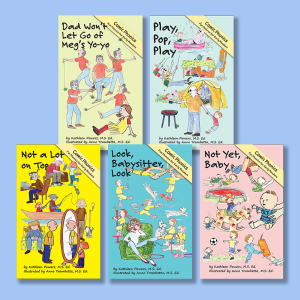


 comicphonics for early readers