Category Archives: sounds of English

The four, no five, no eight pillars of reading

Focusing on four skills leads to good reading achievement in children, we used to think.  Then came a comprehensive US government report in 2000 saying five skills are necessary.  In the ensuing 23 years, researchers tell us three more skills are necessary.   Let’s look at those skills, starting with a chart showing four skills, followed by information on five skills, and ending with the latest three skills.

Chart of 4 reading components

Previously, vocabulary was considered part of the fourth component of reading. Now it is considered a separate component, as are three previously unrecognized skills: oral language, writing, and background knowledge.

  • Phonemic awareness, the ability to hear and identify individual sounds in words—such as the sound of “b” in “bat”—and to move sounds around to hear them in various parts of words. This skill is taught in pre-K and kindergarten to most American school children.


  • Phonics, the ability to match the sounds of English to letters or to letter pairs in order to form words. This skill is usually taught in kindergarten and first grade.


  • Vocabulary, the ability to recognize and understand three kinds of words: everyday spoken words, more complex words (SAT-like words), and domain specific words (words used in specific contexts, such as the baseball-related words of pitcher, shortstop, foul ball and bunt).


  • Fluency, the ability to read text accurately at conversational speed, using expression.


  • Comprehension, the ability to understand what is read.

The three other skills that have been identified as crucial to learning to read are

  • Oral language, the ability to understand spoken language and to speak it. Proficiency in oral language precedes proficiency in reading.


  • Writing, the ability to use written symbols to represent words and to transmit meaning


  • Background knowledge, the ability to store and retrieve information and apply it to new knowledge gained from reading.


No wonder reading is such a complex skill for children to master.

You can teach your child to read. Start with a phonics assessment.

Are you are planning to teach your child how to read this summer, either starting at the beginning or filling in the gaps?  If so, where do you start? I suggest you give your child a pretest to see what reading skills your child has learned well, and what ones he has not yet grasped. The words on this pretest are more or less divided into four kinds of words in this order: 1. Short (closed) vowel, one-syllable words. These include one- and two-letter words, words beginning or ending with blends and digraphs (black, church) words which end in twin consonants (fell, jazz), words which end in “ck,” and words to which an “s” can be added to make plural words or certain verbs (maps, runs). 2. Long (open) vowel, one-syllable words.  These include words ending with silent “e,” words with double vowels which have only one vowel pronounced (goes, pear), and certain letter combinations (ild, old).  They also include words with “oi,” “oy,” “ow” and “ou” letters. 3. Two– and three-syllable words which follow the above rules (catnip, deplete) and two- and three-syllable words which don’t follow the above rules but which follow a pattern (light, yield). These words include words with certain suffixes (le, ies) and words with a single consonant between two vowels (robin, motel). 4. Exceptions.  These include words with silent letters (gnaw, lamb), words from other languages (debris, cello), and words which fit no pattern (business). Ask your child to read the words in the pretest below.  Each row across tests a particular phonics skill.  If you child hesitates at all, that is the place to begin teaching him or her phonics.  I will talk more about how to teach these four groups of phonics skills in my next blog. Phonics assessment bad, hem, fit, don, pug, am, if, lass, jazz lock, Mick, bills, cliffs, mitts, catnip, Batman grand, stent, frisk, stomp, stuck chuck, shun, them, branch, brush, tenth star, fern, birds, fork, purr, actor, doctor, victor muffin, kitten, collect, pepper, gallon complex, helmet, falcon, napkin, after tantrum, muskrat, constant, fulcrum, ostrich skate, bike, Jude, mole, dare, shore, tire, pure need, cheer, aim, hair, bay, pie, boat, oar, Joe, low, soul fruit, few, child, blind, fold, colt, roll, light, high earn, worm, rook, pool fault, claw, all, chalk, Walt boil, so, pound, down comet, dragon, liver, salad, denim total, ever, student, basic, demon, vital apron, elude, Ethan, Owen, ideal, usurp inside, nearly, absent, unicorn, degrade, tripod advance, offense, fence gripped, planned, melted, batted, handed sweeping, boiling, thinning, flopping, biking, dating rapper, saddest, finer, bluest, funnier, silliest easily, busily, massive, active, arrive, wives keys, monkeys, armies, carried action, section, musician, racial, crucial, nuptials brittle, pickle, carbon, dormer parcel, decent, gem, urge, badge lose, sugar, nature, sure graph, Phil, then, moth bomb, thumb, gnat, gnome, high, sign whip, whirl, echo, ghoul, knee, knob could, calf, folk, hustle, listen, wrist alone, bread, bear, chief, young, squaw, swan, waltz, word decision, exposure, gigantic, polarize, occupant, quarantine If you want to help your child learn to read, one of the best things you can do is not to let him guess.  Most words can be deciphered if the student has a phonics background. Also, don’t let your child depend on pictures for meaning once the child starts to read.  Most adult reading material is not accompanied by graphics.  Students must learn to gain meaning from the text alone. If you have decided to help your child read this summer, good for you.  You don’t need to be a rocket scientist to help your child read better.  Years of research show that the best way to teach reading is to start with letter sounds (phonemes) and then to combine those letter sounds into words (phonics).  If you do this in a systematic way, such as following the four-part sequence I describe above, your child will learn to read.    

Teach ŭ before teaching ĕ and ĭ

Suppose you have taught your child VC (vowel-consonant) and CVC (consonant-vowel-consonant) words using ă and ŏ and the 16 consonants that always sound the same at the onset of words.  You have had your child read lists of words with ă and ŏ shuffled.  Your child is able to pronounce those words correctly.

Now it is time to move on to ŭ.  I recommend teaching ŭ before teaching ĕ and ĭ.  In my teaching experience, children recognize the sound associated with ŭ quicker than the sounds of either ĕ and ĭ.  Some children do have trouble pronouncing ŭ, but they don’t confuse the sound with either ĕ or ĭ.  They can distinguish a difference between ŭ and ĕ / ĭ.  Children have a harder time distinguishing between the sounds of ĕ and ĭ.  So I recommend teaching ă, ŏ and ŭ in that order.

Some of the commercially available support materials you might use with your child do not sequence the short-vowel words in this order.  In that case, I recommend you jump ahead to the ŭ word section and return to the ĕ and ĭ sections later.

Sample ŭ  VC and CVC words include:

up hub pub rub tub
bud dud Judd mud Rudd
bug dug hug jug lug
dull gull hull lull null
but cut gut nut rut

Sample ŭ  VC and CVC words with ă and ŏ in sentences include:

  • Judd cut a nut.
  • Rudd dug up a bug.
  • Tess can run in the mud but not Tom.
  • Tom dug a rut.
  • Jan can hug a mutt.

How to teach words using ă and ŏ

Suppose you have taught your child the 16 consonant sounds which don’t vary at the beginning of words: b, d, f, h, j, k, l, m, n, p, qu, r, t, v, x, and z.  Now you are ready to teach vowel sounds.

Explain what vowels are

Because you will be using the words vowel and consonant with your child as you teach, make sure you take time to explain what these words mean.  Vowel refers to five letters all the time (a, e, i, o, and u) and two letters sometimes (y and w).  Consonant refers to all the other letters and to y and w most of the time.  For now you can leave out the y and w, but when you teach small words like by and now, mention that y and w act as vowels sometimes.

Should you say short / closed vowels?  Or long / open vowels? 

Today many support materials refer to vowels followed by a consonant in the same syllable (cat, hot) as closed vowels.  Years ago these vowels were called short vowels, and they were pictured with a curve over the vowel as in ă, ĕ, ĭ, ŏ and ŭ.  Similarly, vowels coming at the end of a syllable (go, hero) are today called open vowels by some reading support workbooks.  Previously they were called long vowels and pictured with a horizontal line over them as in ā, ē, ī, ō, and ū.  I will use the terms short and long since those are the terms most parents recognize.  I will use markings over vowels such as ă, ĕ, ĭ, ŏ and ŭ when referring to a particular short vowel sound and ā, ē, ī, ō, and ū when referring to a particular long vowel sound.

Naming vowel sounds as short or long is important because we need a vocabulary to use with children when we refer to vowels pronounced like their letter names and vowels pronounced more softly.  Whichever terms you use, make sure your child understands them.

Teaching words with a ă sound

While you are teaching the 16 consistent consonant-letter sounds, you can begin to teach one short vowel sound.  I recommend starting with the letter ă because almost all phonics support materials start with the vowel ă, and because ă might be the easiest short vowel sound to master.  The support materials I suggest for my students are the Explode the Code series.  That series starts with ă words.

When I am teaching in person, I use flash cards with pictures of words beginning with ă such as alligator, astronaut, and apple.  I recommend you teach your child to say “ă as in apple” to reinforce the letter connected to the sound.

Choose five or six consonant letter sounds your child has mastered.  Using letter tiles, form two and three letter words such as am, an, at, bat, bam, tan, and mat, etc.  Place the letter tiles for one word an inch or so apart and ask your child to say the sounds, keeping the picture of the apple on the table too, for reference.  Repeat saying the sounds as you slowly move the letters closer and closer together until the child says the word.  It might take many tries, but usually there is a Eureka! moment when the child realizes she is reading a word, not just letter sounds.  Reading teachers call these tiny words CVC words, meaning consonant-vowel-consonant words.

Gradually add more consonant sounds and form more words with ă as the vowel sound.  If the child loses interest, one way to extend the lesson is to use her name and write a goofy sentence such as Kim is a pan or Kim is a map.  Another way is to use your name and have her end the sentence.  Mom is a ____.  Teach her that the vowel goes first or in the middle.  Try mispronouncing a word she writes and ask her if you said it correctly.

You can buy magnetic cards which you can cut into small rectangles to attach to the back of letter tiles.  Then you can work in a metal lasagna pan or pizza pan or on the refrigerator.  If your child is four or five, a short lesson (ten minutes) teaching in one mode followed by another short lesson in another mode (writing words on an iPad or laptop, writing in a workbook) might be all she can handle for one session.  I have given one-hour lessons to a four-year-old, but I needed to have six mini-lessons to sustain her interest.

Teaching words with a ŏ sound

When, after several days or weeks, you are sure your child can read ă words, move on to ŏ words.  Create a reference card—an octopus, for example.  Work on two and three letter ŏ words such as on, off, odd, Oz, nod, fob, and Bob, etc.  After several days or weeks—whatever it takes—mix ŏ words with ă words.

To reinforce your work, read together picture books.  When you come to a word she can pronounce, point to it and ask her to say the word.  Two or three times are enough to show her that what she is learning applies to her real world.


Teach children to pronounce the sounds of English

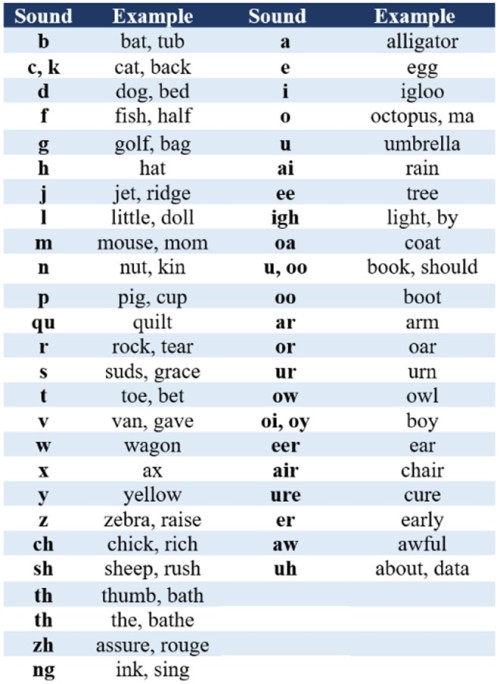
Before children learn their letters, be sure they can pronounce the sounds of English distinctly.  There are 48 sounds of standard American English, although regional dialects might include more or fewer sounds. The 48 single, distinct sounds are listed on the chart below.  Say those sounds and then ask your child to repeat those sounds.

You might wonder, “Is this really necessary?” Yes, it is. Almost always, you will encounter a sound that your child cannot hear or say properly. Let the child listen and repeat the sounds correctly until you are sure the child can hear and say the sounds. You can do this with a child as young as two. Only when the child can hear and say the sounds is it time to associate sounds with letters.

48 distinct sounds in standard American English:


Children learn sounds from big to small

children pronouncing elephantLittle children who are learning about sounds in words move from larger units of sound—phrases and words—to smaller units of sound—sounds within words and syllables.  Adults hear “On your mark, get set, go,” but a two-year-old hears “Onyourmark, getset, go.”  Children need to hear distinct sounds within words and to reproduce those sounds properly before they start pairing sounds with letters.

For this reason, most two-year-olds are too young to learn to read.  Even some five-year-olds might not be able to distinguish sounds within words.  In some countries, children don’t learn to read until they are seven. 

A good example of this is when children learn the ABC song.  Most three-year-olds can start the song with A-B-C-D. . .E-F-G-. . .H-I-J-K .  But when they get to L-M-N-O-P they sing L-um-men-oh-P or M-uh-let-O-P.  They don’t hear L-M-N-O as distinct sounds.

I still remember the day when I was in first grade when  my teacher taught my class the words of and the.  I thought, wow, those are two different words.  I didn’t know that.  I thought ofthe was a single sound.

Most two-year-olds are too young to learn to read.  Even some five-year-olds might not be able to distinguish sounds within words.  For this reason, in some countries, children don’t learn to read until they are seven. 

What can you do to help your child hear sounds more clearly?  Speak distinctly.  Slow down.  Face your child and let her watch your mouth when you talk.  When you hear her slurring sounds together which should be pronounced separately, don’t correct her but instead repeat the sounds properly.

While we’re on the subject of hearing words correctly, children will subconsciously learn the rules of grammar without instruction.  A four-year-old might say, “Mommy goed to the store,” properly making the verb past tense by adding the d sound to the end of the word without realizing go does not follow the rules.  Or he might say, “I amn’t done yet.”  He is learning contractions, not realizing that am can’t be contracted in the negative form.  Or a child might say, “Her said so.”  Objective pronouns are learned before subject pronouns.

To correct these mistakes, repeat what the child says correctly without comment on the error.  When the child hears words said properly enough times, he or she will say words that way too.


No wun ever sed lerning Eeng-lish iz e-zy

When I was a child, I needed to write the word “business” for some reason.  In my dictionary, I looked up “bizness,” “bisness,” “bizzness,” and “bissness,” growing more and more frustrated as my searches ended futilely.  Then I asked my mother who told me the correct spelling.  A “u”!  Who would ever have thought a word which sounds like “biz-nes” would be spelled with a “u”?

If only “business” were the only one.  English has many commonly used words which do not follow the rules of phonics and spelling.  Here are some with their pronunciations following.

been (ben)

broad (brod)

busy (biz-y)

color (kul-ler)

do (du)

does (duz)

friend (frend)

eye (i)

iron (i-urn)

of (ov)

one (wun)

said (sed)

sew (so)

shoe (shu)

to (tu)

two (tu)

was (wuz)

who (hu)

why (wi)

wolf (wuhlf)

woman (wuh-min)

women (wi-men)

you (yu)

Since part of these words follows rules of phonics, when teaching them you can point out that part.  Usually the vowel or vowels are the part which are abnormally sounded and spelled.  That is the part which needs to be pointed out by the teacher and memorized for reading and spelling by the student.  For example, in the word “friend,” the “f,” “r,” “n,” and “d” sound as they should.  Even the “e” does if you take away the “i.”  But you can’t take away the “i,” and that is the part which needs to be pointed out and practiced.

Some words make sense if you point out their history or their connection to other words.  “Two” makes little sense.  Why a silent “w”?  And a single “o” rarely sounds like “oo” or “u.”  But if you explain that some other words which mean two begin with “tw” such as “twin” and “twenty,” recognizing the word becomes easier.

No wun ever sed lerning Eeng-lish iz e-zy.

Learning through phonics is the best way to learn to read

If a child is having trouble reading, what is the most likely cause?

  • Reliance on pictures for meaning?
  • Guessing?
  • Weak word recognition skills?
  • Reliance on context word clues?

Child sitting with legs outstretched, forming the letter LWeak word recognition skills is the mostly likely cause, and because of that, students guess at words or search for clues from pictures and other words.
Weak word recognition skills means an inability to sound out the letters which form words.  If a child comes upon a new word—for example, “trek”—and the child cannot sound out the individual letters, the child cannot read the word.

Since 2000 we have known that the most effective way to teach reading is through a system of associating sounds with letters and combining those letters to form words—in other words, a phonics-based approach.  A National Reading Panel authorized and funded by Congress assessed scientific research on reading.  The Panel’s goal was to determine the most efficient way children learn to read.  The Panel concluded in 2000 that to read well, children should associate sounds of English (phonemes) with letters or letter pairs and to combine the letter-sounds into words.

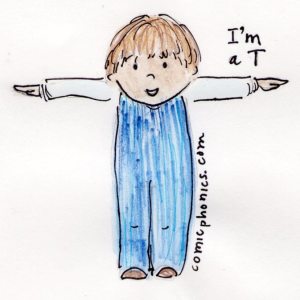
Child with arms stretched out at his sides, forming the letter T.The word “it,” for example, has two sounds, each of which is associated with a letter.  The word “shop” has three sounds with “sh” corresponding to a single sound.

By deconstructing words into their basic sounds, children learn to sound out words.  Without guessing, without context clues, without pictures, children can figure out how to read words.  Even though there are some words which defy this sounding-out system (words like “one” and “two”), the vast majority of words in English can be sounded out.

The problem is, even though we know what works best, teachers are still asking children to guess at words, to look at pictures to figure out what words mean, to read other words nearby and use those context clues to figure out words, and to memorize the look of a word.  In other words, some teachers are not teaching phonics as the primary way to learn to read.  They are relying on methods which research shows do not work as well as phonics.

When I went to first grade, I was taught to read using a memorization approach.  The first page of my first reader had the word ”look” under a picture.  The next page had the words “Oh, look” with a different picture.  The next page had “See, see, see” with another picture.  It wasn’t until fourth grade that my teacher, Sister James Bernard, CSJ, offered lesson after lesson on phonics.  What a revelation!

If your child hasn’t learned phonics, teach him or her.  If your child is guessing at words, make him sound out each letter or each syllable.  No guessing allowed!  This is the surest way to create a strong reader.

Six questions to test your beginning reader knowledge

What is the best method for learning to read, based on research?

  • primarily using phonics
  • figuring out words from their context or from pictures
  • memorizing words (sight words, whole language)

Two fists with thumbs up and knuckles touching make letter "b" and "d" with a BeD visualized between the two thumbs.What two printed letters are the hardest for children to distinguish?
  • p and q
  • q and g
  • b and d
  • m and n

Which two short vowel sounds are hardest for children to distinguish?

  • a and e
  • e and i
  • o and u
  • a and o

In order to learn to read, do children need to recite and/or recognize the ABC’s in alphabetical order?

  • yes
  • no

Which comes first?

  • recognizing a letter
  • recognizing a sound?

How many letter sounds does a child need to hear and speak in order to speak standard American English?

  • 26
  • 23
  • 42

Answers

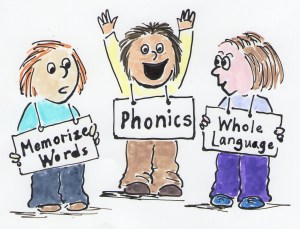
Three children with signs around their necks that read: Meniruze words, Phonics, Whole LanguagePrimarily using phonics is the best method for learning to read. The US government did a comprehensive study of hundreds of research studies on how children learn to read and discovered that using a phonics-based approach produces the best results.
Lower case “b” and “d” are the hardest letter shapes for children to distinguish. Most children are confused at first.  Sometimes this confusion lasts into third grade, but with time, all children figure it out.

Short “e” and “i” are the hardest letter sounds to distinguish. Most reading series start by teaching short “a” followed by short “o” because these two sounds are the easiest to distinguish.  Expect lots of errors when “e” and “i” words are learned, and expect learning them will take more time.  Short “u” is harder than “a” and “o,” but since there are far fewer such words, learning “u” is not so hard as learning “e” and “i.

Beginning readers do not need to know their ABC’s in order. Alphabetic order is a second or third grade skill, so it doesn’t need to be learned immediately.

Recognizing a sound is more important than recognizing a letter at first. Beginning readers need to be able to hear sounds and to pronounce them aloud.  They do not need an alphabet in front of them to do that.  Toddlers can learn to recognize sounds long before they are ready to read letters.

Child looking at flash cards of two and three letter words.

.

American standard English has 42 sounds. Some of the 26 letters duplicate sounds such as “c” and “k,” “c” and “s,” “s” and “z,” and “qu” and “kw.”  Many vowel sounds can be written multiple ways (ugly, Hannah, other).  Some sounds take two letters to make (th, ch, sh).  Regional dialects can add or subtract a sound or two, but in general there are 42 separate sounds in American English.

Eight ways you can become a better reading teacher

Here are eight ways you can become a better reading teacher.

One.  Evaluate four- and five-year-olds to see if they are ready to learn to read.  If a student is not ready, delay.

Two.  Teach your beginning readers to encode more and to decode less. Offer daily time to orally create words from sounds that the students already know.  Show a picture of a pig.  Ask students to sound out pig, not using letters, but using the sounds in the word.

Three.  Start with words whose sounds have a one-to-one correspondence to consonant and short vowel letter sounds—no digraphs, no silent letters, no exceptions to the rules.

Four.  Refer to letters by their sounds for beginning readers. Explain that letters are pictures of sounds, and that it is the sounds which are important for reading.

Five.  Teach children to pay attention to their lips and mouths when they sound out words. Each time their mouth opens or closes, or their lips change shape, their mouth is saying a different sound.  When we join together the sounds, we form words.When you introduce the ABC’s, start with a one-to-one correspondence between the sounds of English and a letter or letter pair. This is easy if a consonant makes only one sound, such as “b.”  But when a sound can be represented multiple ways (for example, “oi” and “oy”) pick one “default” way for starts and stick to it.  Avoid words which are not spelled with the default letters.  You might teach boy, toy and coy, but for now avoid teaching boil, toil, and coil.  On the other hand, if a child writes, “Mom spoyls me,” ignore the misspelling.  But when children repeatedly write a word wrong (“wuz,” for example), tell them the correct spelling so the phonetic spelling does not become embedded in their brains.

Six.  Don’t teach concepts such as digraphs, blends, and diphthongs to beginning readers. Teach sounds.  If there are fancy academic words to call these sounds, don’t use them.  You will only confuse beginning readers.

Seven.  Don’t become a speller for your students. Once they are writing and using ABC’s, write difficult words on the board.  Otherwise, tell students to sound words out.  Also don’t mark misspelled words wrong.

Eight.  When you introduce ABC’s, use typefaces which show the versions of letters which children will use when they handwrite. For example, use this type of “a” and “g.” Also, typefaces which slightly enlarge half-space letters like “a,” “c” and “e” are easier for kids to read.  (The typeface you are reading is such a typeface.)