Category Archives: picture books

How to Raise a Reader, according to The New York Times

The New York Times published  an excellent article last month entitled, “How to Raise a Reader.”  You might find the article at your library in the Book Review section.  It is worth the effort.  Here are some highlights from “How to Raise a Reader.”
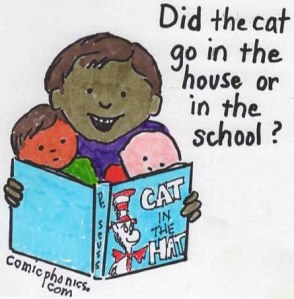
Become a reader yourself.  If you have let your reading habit slip, reacquaint yourself with the print world.

Read aloud to your infant.  Your reading material might be a medical journal or Dr. Seuss.  The content doesn’t matter to an infant.  What does matter is that you make eye contact with your child, use voice inflection, and read in the normal rhythms of your language.  If the baby responds with baby sounds, respond in kind.

Read aloud to your toddler.  Encourage your child to link the sound of your voice reading to him with strong, positive emotions.  Read at bedtime and during daytime too.  Offer your child variety in picture books, but respect his or her preferences, even if that means reading “Go, Dog, Go” night after night.  When the child interrupts, that shows he is engaged.  Stop and respond.  Finishing a book isn’t all that important at this age nor is reading every word.

Continue to read aloud to your emerging reader.  Once your child shows interest in letters and words, keep reading to him or her.  Encourage her to join in, but don’t pull back now.  She shouldn’t think of reading as work.  She should think of it as fun.  Allow your child to develop reading skills at her own pace, but if you suspect problems, follow through with her teacher.

Continue to read aloud to your early reader.  Take him or her to the library or book store.  Expand his selections from fiction to nonfiction.  Ask him and his friends what they are reading and discuss their preferences.  Let your child stay up a bit later if she reads in bed.  If your child prefers comic books or graphic novels, or if he wants to read about his favorite video game, be thrilled.  He’s reading.

Stash reading materials throughout the house. On the coffee table, in the bathroom, or in the bedroom, show off books, magazines and other reading materials to encourage reading.

Help your child build a personal library.  Make a bookcase part of the child’s bedroom or a children’s section of books part of your home library.  Give books as gifts and rewards.  Bring home armloads of books from the library.  Celebrate your child’s first library card with family stories of other first library cards.

This wonderful New York Times article goes on to describe the kinds of books children are ready for at different times in their lives.  Enjoy.


10 picture books with simple illustrations

Picture books with simple illustrations and bland backgrounds—the kinds which appeal to toddlers and children with sensory integration problems—can be hard to find if you search online or on shelf.  Even harder to find are such books which tell a story.

But they are great books for reading aloud to sensitive children.  And they are equally valuable for suggesting story ideas for children to write.

Here are ten such books from all over the world which your child might enjoy.  Many have won awards.


Why Mosquitos Buzz in People’s Ears by Verna Aardema

The Enormous Crocodile by Roald Dahl (the version illustrated by Quentin Blake)

The Snowman by Raymond Briggs

Puss Jekyll Cat Hyde by Joyce Dunbar

The Farmer and the Clown by Marla Frazee (wordless)

Flora and the Penguin by Molly Idle (wordless)

The Great Paper Caper by Oliver Jeffers

The Snowy Day by Ezra Jack Keats

Snow White and the Fox by Niroot Puttapipat

Lon Po Po:  A Red Riding Hood Story from China by Ed Young

For kids with sensory integration issues, choose picture books with pared down shapes, colors, focus

If your child resists being read to or resists reading certain picture books, it could be the pictures themselves that discourage reading.

Look for books with no backgrounds, solid colors, and focused on one or two characters.

Picture books with detailed backgrounds or with copious patterns can turn off children with sensory integration issues.  Such children have difficulty focusing if there is too much pattern, noise, motion, or texture in any experience.  They prefer plain painted walls and plain bedspreads, not papered walls and patterned bedding; low, instrumental music by a single instrument, not loud music or music with lyrics; sitting or standing still, not rocking or dancing; and loose knit clothing, not clothes with tags or clothes that are tight-fitting.

When you choose books for children who show sensory integration issues, search for picture books with these characteristics:

  • Pictures with no backgrounds, or just the hint of background—a wash of green to represent grass and trees, for example, or one or two birds in the sky, not a whole flock.
  • Characters dressed in solid colors without shading or patterns in their clothes. If you have seen Pippa the Pig books or cartoons, with their simplistic images, that is the kind you want to show your child.
  • Pictures using flat shapes and limited colors, the kind that children themselves produce. (Think of the way Peanuts cartoon characters are presented—Charlie Brown with his round head and Lucy with her dress of a single color.)
  • Pictures focusing on one or two characters, not groups. Look for pared down, minimalist images which have removed everything but the essential elements.

Likewise, when you look for  picture books for children with sensory integration issues to write about, search for picture books with the same features.  Some wordless picture books offer these kinds of pictures, but not all do.

Finding such books in your library or book store is not easy.  A section labeled “simplistic art” doesn’t exist.  I have had to scour shelves to find what I am looking for.  But the search is worth it to entice a reluctant child reader or writer.

Next blog:  Names of some books that might appeal to kids showing sensory integration issues.

Books for your child to read this summer

To maintain your child’s reading level during the summer and to avoid the summer slide, make plans now to stock up on good books.

Below are hyperlinks to lists of books appropriate for child readers. However,  the grade or age suggestions might not correspond to your child’s reading level.  Check out books in nearby grade levels too.  If your child is a precocious reader, keep in mind that books recommended for higher grades might not contain suitable content for a younger child.

boy reading on the floorAnother place to find good lists is from your child’s school or from your public library.  In the summer, children’s books tend to fly off library shelves. Reserve books now before your name goes on a waiting list.
Grade 1

Goodreads grade 1 reading list
Greatschools grade 1 reading list
Scholastic ages 6 to 7 reading list
Educationworld geade 1 reading list
ALA grade K to 2 reading list

Grade 2

Goodreads grade 2 reading list
Greatschools grade 2 reading list
Scholastic ages 8 to 10 reading list
Educationworld grade 2 reading list
ALA grades K to 2 reading list

Grade 3

Goodreads grade 3 reading list
Greatschools grade 3 reading list
Scholastic ages 8 to10 reading list
Educationworld grade 3 reading list
ALA grade 3 reading list

Grade 4

Goodreads grade 4 readinglist
Greatschools grade 4 reading list
Scholastic ages 8 to 10 reading list
Educationworld grade 4 reading list
ALA grade 4 reading list

Grade 5

Goodreads grade 5 reading list
Greatschools grade 5 reading list
Scholastic ages 11 to 13 reading list
Educationworld grade 5 reading list
ALA grade 5 reading list

Grade 6

Goodreads grade 6 reading list
Scholastic ages 11 to 13 reading list
Educationworld grade 6 reading list
ALA grade 6 reading list

Grade 7

Goodreads grade 7 reading list
Scholastic ages 11 to 13 reading list
Educationworld grade 7 reading list
ALA grade 7 reading list

Grade 8

Goodreads grade 8 reading list
Educationworld grade 8 reading list
ALA grade 8 reading list

Grade 9

Goodreads grade 9 reading list

Grade 10

Goodreads grade 10 reading list

Grade 11

Goodreads grade 11 reading list

Grade 12

Goodreads grade 12 reading list

Maintain reading skills during the summer

Students loose reading skills during the summer if they don’t continue reading.  Educators call this loss the “summer slide.”  It is most severe among low-income students who lose up to two months of reading skills.  Yet it is sometimes nonexistent among middle class students who make slight gains in reading during summer months.  Why the difference?

Summer slide (decline) of reading scores.

  • A study of 3000 sixth and seventh graders in Atlanta Public School showed that students who read at least six books during the summer maintained or improved their reading skills.  But students who didn’t read lost up to a whole grade of reading skills.  (B. Heyns, 1978)
  • A study of Baltimore students over 15 years found that By the end of fifth grade, Baltimore students who didn’t read during the summer measured two years behind their classmates who did.  They concluded that 2/3 of the reading difference in ninth graders can be attributed to reading or not during summer school breaks.  (K Alexander, D. Entwisle and L. Olson, 2007)
  • A study of students completing third grade who took part in their local libraries’ summer reading programs scored 52 Lexile points ahead of their classmates who did not. (Dominican University)
  •  Children’s absence from reading during the summer is a major hurdle for achieving good reading skills by the end of third grade.  (The Campaign for Grade-Level Reading)
  • The summer slide is cumulative.  Some estimate that by the end of high school the summer slide can account for up to a four year lag in reading achievement, and it can have an effect on high school graduation rates.  According to the Annie E. Casey Foundation, “one in six children who are not reading proficiently in 3rd grade do not graduate from high school on time, a rate four times greater than that for proficient readers.”

So how can you combat the summer slide?

  • Sign your child up for your local library’s summer reading program, and make sure your child completes the reading.
  • Go to the library regularly and let your child select books she will enjoy.
  • Help your child to read a chapter book a week, or a picture book each night.
  • Encourage your child to read the newspaper, television guides, magazines and online articles.
  • Reward your child with a trip to the book store to select her very own book.
  • Read to your child every evening, and let him read to you.  Your reading will teach fluency and pronunciation, and establish the notion that reading for pleasure is fun.

(This blog first appeared on May 16, 2014.)

Is my child on schedule to read?

The US Department of Education has put together a list of accomplishments* relating to talking and reading for children from birth to six years old.  This list shows the growth of typical children developing normally, but variations exist.  By seven years old, most children are reading.

From birth to age 3, most babies and toddlers become able to

  • Make sounds that imitate the tones and rhythms that adults use when talking.
  • Respond to gestures and facial expressions.
  • Begin to associate words they hear frequently with what the words mean.
  • Make cooing, babbling sounds in the crib, which gives way to enjoying rhyming and nonsense word games with a parent or caregiver.
  • Play along in games such as “peek-a-boo” and “pat-a-cake.”
  • Handle objects such as board books and alphabet blocks in their play.
  • Recognize certain books by their covers.
  • Pretend to read books.
  • Understand how books should be handled.
  • Share books with an adult as a routine part of life.
  • Name some objects in a book.
  • Talk about characters in books.
  • Look at pictures in books and realize they are symbols of real things.
  • Listen to stories.
  • Ask or demand that adults read or write with them.
  • Begin to pay attention to specific print such as the first letters of their names.
  • Scribble with a purpose (trying to write or draw something).
  • Produce some letter-like forms and scribbles that resemble, in some way, writing.

From ages 3-4, most preschoolers become able to

  • Enjoy listening to and talking about storybooks.
  • Understand that print carries a message.
  • Make attempts to read and write.
  • Identify familiar signs and labels.
  • Participate in rhyming games.
  • Identify some letters and make some letter-sound matches.
  • Use known letters (or their best attempt to write the letters) to represent written language especially for meaningful words like their names or phrases such as “I love you.”

At age 5, most kindergartners become able to

mother works with child reading story book

  • Sound as if they are reading when they pretend to read.
  • Enjoy being read to.
  • Retell simple stories.
  • Use descriptive language to explain or to ask questions.
  • Recognize letters and letter-sound matches.
  • Show familiarity with rhyming and beginning sounds.
  • Understand that print is read left-to-right and top-to-bottom.
  • Begin to match spoken words with written ones.
  • Begin to write letters of the alphabet and some words they use and hear often.
  • Begin to write stories with some readable parts.

At age 6, most first-graders can

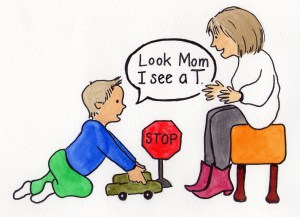
Young child writing C-A-T.

  • Read and retell familiar stories.
  • Use a variety of ways to help with reading a story such as rereading, predicting what will happen, asking questions, or using visual cues or pictures.
  • Decide on their own to use reading and writing for different purposes;
  • Read some things aloud with ease.
  • Identify new words by using letter-sound matches, parts of words and their understanding of the rest of a story or printed item.
  • Identify an increasing number of words by sight.
  • Sound out and represent major sounds in a word when trying to spell.
  • Write about topics that mean a lot to them.
  • Try to use some punctuation marks and capitalization.

*Based on information from Preventing Reading Difficulties in Young Children, a report of the National Research Council, by the Committee on the Prevention of Reading Difficulties in Young Children, 1998; and from the Joint Position Statement of the International Reading Association (IRA) and the National Association for the Education of Young Children (NAEYC), 1998.

Pride and Prejudice for babies? Anna Karenina for toddlers?

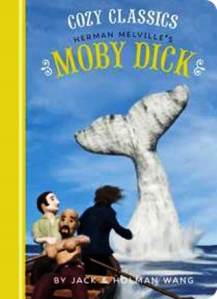
Several publishers have begun offering pint-sized versions of literary classics like Old Man and the Sea, Moby Dick and War and Peace for infants, toddlers and primary grade readers.

mobyFor $6.99, Cozy Classics (http://www.mycozyclassics.com/books/) offers Great Expectations, Pride and Prejudice and Jane Eyre.  These board books pair one word per page with one image.  Moby Dick, for example is reduced to these 12 words:  sailor, boat, captain, leg, mad, sail, find, whale, chase, smash, sink and float.  The illustrations are photos of felt-made scenes, giving the books a fuzzy feel.

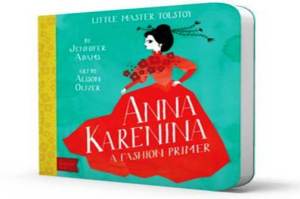
For $9.99 Baby Lit (https://babylit.com/collections/books/Classic-Lit) offers board books such as The Odyssey, Jayne Eyre and Anna KareninaAnna Karenina?  A novel about a annakmarried woman who has an affair, is ostracized by society, becomes paranoid and commits suicide?  Yes, but the Baby Lit version focuses not on the story but on the fashions of 1876 St. Petersburg—ball gowns, parasols, gloves and military uniforms.
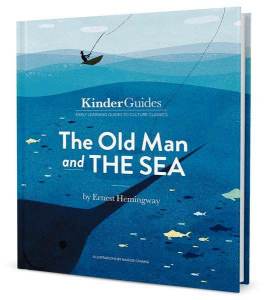
For $16.95 KinderGuides (https://www.kinderguides.com/) offers four classics (more to come) for children of six years old or older.  oldmanThe books, which are sanitized guides for the original novels, include Breakfast at Tiffany’s, 2001: A Space Odyssey, On the Road, and The Old Man and the Sea.  Each book contains a summary of the original story, information about the author, key words and characters, and a quiz.
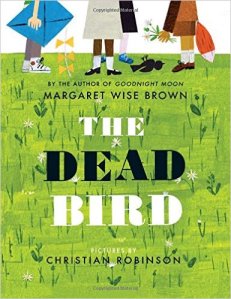
 

Best illustrated children’s books of 2016, according to The New York Times

The New York Times Book Review judges picture books published in the past year and chooses the best ones based only on the illustrations.  The covers of this year’s ten winners are shown below.

Avoid the “summer slide” in your child’s learning

Students loose reading skills during the summer if they don’t continue reading.  Educators call this loss the “summer slide.”  It is most severe among low-income students who lose up to two months of reading skills.  Yet it is sometimes nonexistent among middle class students who make slight gains in reading during summer months.  Why the difference?

Summer slide (decline) of reading scores.


  • A study of 3000 sixth and seventh graders in Atlanta Public School showed that students who read at least six books during the summer maintained or improved their reading skills.  But students who didn’t read lost up to a whole grade of reading skills.  (B. Heyns, 1978)
  • A study of Baltimore students over 15 years found that by the end of fifth grade, Baltimore students who didn’t read during the summer measured two years behind their classmates who did.  They concluded that 2/3 of the reading difference in ninth graders can be attributed to reading or not during summer school breaks.  (K Alexander, D. Entwisle and L. Olson, 2007)
  • A study of students completing third grade who took part in their local libraries’ summer reading programs scored 52 Lexile points ahead of their classmates who did not. (Dominican University)
  •  Children’s absence from reading during the summer is a major hurdle for achieving good reading skills by the end of third grade.  (The Campaign for Grade-Level Reading)
  • The summer slide is cumulative.  Some estimate that by the end of high school the summer slide can account for up to a four year lag in reading achievement, and it can have an effect on high school graduation rates.  According to the Annie E. Casey Foundation, “one in six children who are not reading proficiently in 3rd grade do not graduate from high school on time, a rate four times greater than that for proficient readers.”

So how can you combat the summer slide?

  • Sign your child up for your local library’s summer reading program, and make sure your child completes the reading.
  • Go to the library regularly and let your child select books she will enjoy.
  • Help your child to read a chapter book a week, or a picture book each night.
  • Encourage your child to read the newspaper, television guides, magazines and online articles.
  • Reward your child with a trip to the book store to select her very own book.
  • Read to your child every evening, and let him read to you.  Your reading will teach fluency and pronunciation, and establish the notion that reading for pleasure is fun.

(This blog first appeared on May 16, 2014.)