Category Archives: methods of teaching reading

You diagnose the reading problem

You diagnose the reading problems.Situation:  A first grader can read CVC words in lists and on flash cards.  When another consonant is added to create a blend CCVC word (cot to clot, or ran to bran) she stops, sounding out the first consonant and skipping the second consonant.  She asks what the four-letter words mean.

When she sees paragraphs, she cringes and says, “That’s too hard.”  Throughout a half-hour lesson she asks every five minutes or so if the lesson is over yet.  The mother is concerned that this child is behind her classmates in reading.

Diagnosis:

  • This little girl is already intimidated by the reading process. Her repeatedly asking if the lesson is about to end shows her discomfort with reading.  This child needs much encouragement.
  • Repeating successful work might be a good way to begin a lesson in order to give the girl confidence.
  • She could benefit from frequent but short lessons (ten or fifteen minutes), perhaps with a timer.
  • How two consonants work together to form blended sounds is a new concept for her. Working on one blend each lesson (“bl,” for example) might be a good place to begin.  She could be shown pictures of “bl” words (blue, black, blaze, bleed, blocks, blossom, blueberry, blush, blow, and blouse).
  • After sounding out the words and recognizing the “bl” sound, she could be shown the “bl” letter blend. Letter tiles moved slowly together to form BLVC words could reinforce the blended sound of those letters.
  • She also needs work on vocabulary, so as often as possible seeing a picture of the new word, or acting out the new word, might help her remember its meaning.

As for the mother’s concern that the child has fallen behind classmates, that might be true.  However, the girl is not far behind and can easily catch up with frequent, short, unpressured lessons.  Her mother might read to her strictly for pleasure, perhaps pointing out a CVC word here and there that the child probably knows.  The mother could keep a list of words that the child can read on the refrigerator, asking the child to add a word or two each day a day so the child and the mother can see progress.

One example of how to teach a four-year-old to read

For several weeks I have been tutoring a four-year-old, teaching her to read.

  • I started with letter tiles, placing one before her at a time and asking her what sound each letter represented. She knew many of them, but not all of them.  As I expected, she couldn’t sound out “e” and “i” and was vague on “u” too.  The consonants “d,” “j,” “q,” “x,” “y” and “z” also were mysteries.
  • On a paper I had written all the sounds associated with individual letters, and as she said them properly, I crossed them out, to know which letters we needed to focus on.
  • Reading tutor with 4-year-oldSince she was confident about “o” and “a,” I used those letters to form CVC words, real and imaginary, spelling them phonetically. With the letter “a” I sandwiched two consonants, one on either side, separating the tiles and then moving them closer and closer until they looked like a word.  All the time I was pronouncing the sounds, such as “c” “a” and “t.”
  • Since the hardest letter sounds for beginning readers to hear are the middle sounds in CVC words, I kept using the same vowel sound, the letter “a,” for one half-hour lesson. I put a “t” after the “a” and kept it there for several minutes, exchanging one beginning consonant for another as she read the words.
  • My little student caught on quickly that the sound in the middle and at the end of the word didn’t change, so all she had to focus on was the beginning sound. When we encountered one of her difficult letter sounds, I would say it and then she would.
  • At our next lesson, I repeated much of the first lesson, asking her to pronounce the sound for each letter tile. This time she sounded the “q” consistently correct, so I crossed out that letter sound on my list.
  • I made CVC words using the letter “o.” Some words were real; some were nonsense words or real words spelled phonetically.  What she showed me was that she knows the sounds of various letters.
  • The next week I used both “a” and “o” words. This was more difficult because my student needed to keep track of two sounds in CVC words.
  • This past week I used “u” as the vowel. At first, my student would forget the sound “u” represents, but by the end of the lesson, she was remembering it.

Because the lesson lasts just 30 minutes, this student hangs in there, but by the end of a half hour she is losing interest.  I compliment her work often, telling her, “You didn’t know that letter last week, and now you do!” or “You figured out that word all by yourself.”  Sometimes she acts out a word or tells me what it means, and I compliment her on that too.

These early lessons focus on letter sounds and how combining sounds gives us words.  It might seem boring to an adult, but brain research shows that there are no built-in pathways in our brains for reading, the way there are for movement and speech.  A novice reader, like my student, must activate much more of her brain to read “cat” than an experienced reader like me.  Over years of reading, my brain has built shortcuts to figuring out words that this child’s brain hasn’t done yet.

At our next lesson, we will do more CVC words using “u” as the vowel, and then exchange the “u” for “a” and “o.”  We will focus on letter sounds my student is still learning.  Her progress may seem slow, but it is steady.

Fractured fairy tales

Being able to discuss characteristics of fiction—character, setting, motivation, and point of view, for example—is an advanced skill, something beginning readers and certainly nonreaders can’t do.  Right?

Wrong!

By using two versions of the same fairy tale, children are able to contrast the stories, telling what is the same and what is different, who is telling the story, how characters change, and where and when the story takes place.  Even writing styles of authors can be contrasted.

Another advantage of using two versions of the same fairy tale is to deepen the meaning of the original.  Just like reading one book of fiction and one book of nonfiction on the same topic deepens meaning, so does reading two differing fictional accounts of the same story.

Read about these examples and see what I mean (clicking on the cover graphic will enlarge it).

    • Mike Artwell’s Three Little Cajun Pigs Mike Artwell’s Three Little Cajun Pigs sets the porcine trio deep in Louisiana where Trosclair, Thibodeaux and Ulysse need to build homes in swampland.  Old Claude, an alligator, would like to lick his chops on couchon de lait—that’s Cajun for roast pig.  The basic elements of The Three Little Pigs are included in the story, but with changes children can easily notice, including telling the story in couplets.


    • Lisa Campbell Ernst’s Little Red Riding Hood; A New Fangled Prairie Tale Lisa Campbell Ernst’s Little Red Riding Hood; A New Fangled Prairie Tale finds Little Red Riding Hood in a red hoodie riding a bike through rows and rows of sunflowers on her way to Grandma’s.  Meanwhile, a vegetarian wolf wants to learn Grandma’s secret muffin recipe.  However, Grandma is meaner than the wolf.  Lots of details are the same, but enough differ to make finding them a treasure hunt.


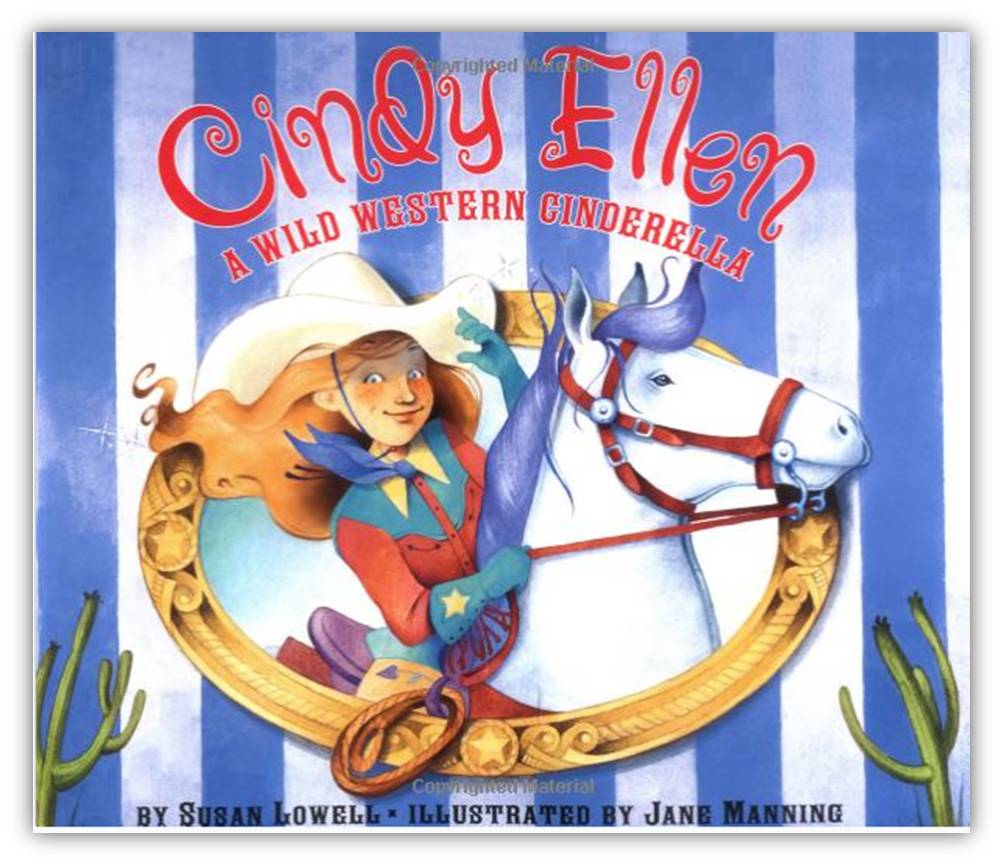
    • Susan Lowell’s Cindy Ellen:  A Wild Western Cinderella Susan Lowell’s Cindy Ellen:  A Wild Western Cinderella offers a sweet cowgirl whose father has married the “orneriest woman west of the Mississippi.”  Cindy Ellen mends fences, milks cows and shovels a corral, attracting Joe Prince, the son of a cattle king.  Lots of changes make this tale a delight, but younger kids might need help recognizing the original Cinderella in this fractured version.


    • Laura Murray’s The Gingerbread Man Loose in the School  Laura Murray’s The Gingerbread Man Loose in the School lets the sweet cookie monster loose in a school, looking for the students who baked him while they are outside at recess.  The silly story is illustrated through comic book panels, unlike a traditional fairy tale.


    •  Leah Wilcox’s Waking BeautyLeah Wilcox’s Waking Beauty focuses on a prince who will do almost anything not to kiss the snoring Beauty—hollering, jumping on her bed, throwing water at her, even shooting her from a canon.  Not your Grandma’s fairy tale.


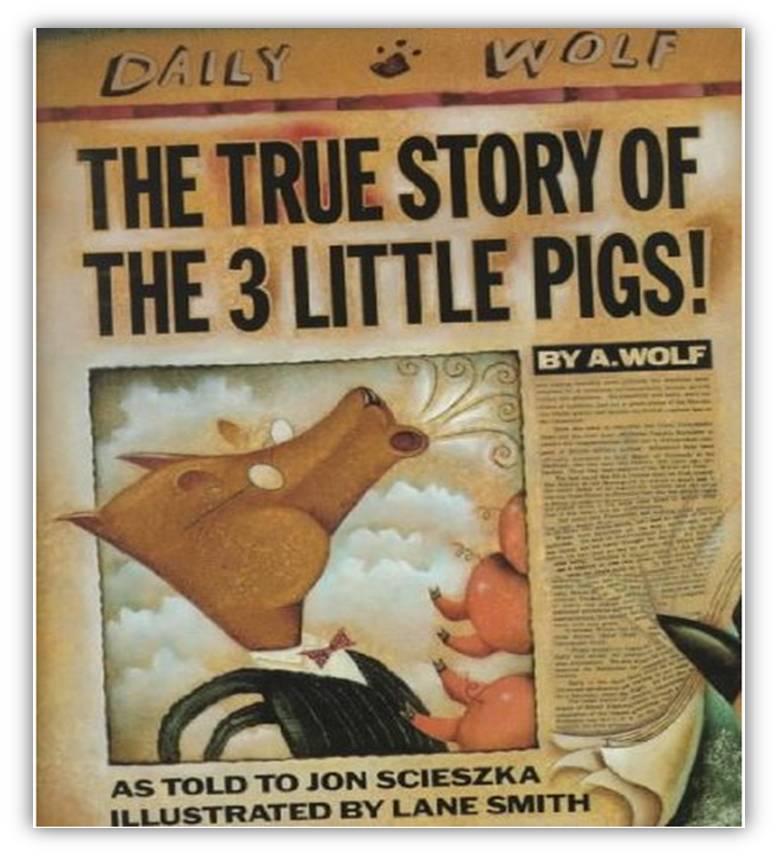
  • Jon Scieszka’s The True Story of the 3 Little PigsAnd of course Jon Scieszka’s The True Story of the 3 Little Pigs, one of the first of this type fairy tale and one of the best, tells the familiar story from Alexander T. Wolf’s point of view.

As starting points for discussion of literature with young children, these stories are great.

What’s a graphic novel?

One of the biggest trends in children’s literature in the past ten years is the rise of graphic novels.  Not sure what I mean?  Think Captain Underpants and The Wimpy Kid.  Graphic novels are

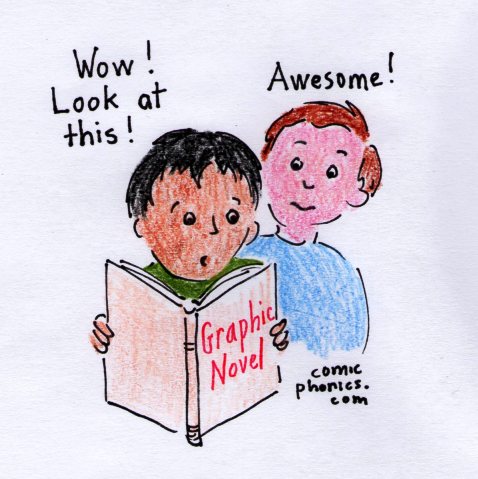
  • Two boys reading a book entitled "Graphic Novel."comic-strip-like stories with a beginning, middle and end (not a continuing saga).
  • fiction and nonfiction stories told as much in colorful drawings as in words.
  • a hybrid form of action literature that appeals to 12 to 18-year-olds but now is working its way to much younger readers.
  • a newly recognized form of literature by the Young Adult Library Services Association, part of the American Library Association, which has been selecting the best graphic novels for teens since 2007.
  • a form of children’s literature reviewed in respected journals such as School Library Journal.

Graphic novels, like all novels, cover many themes such as romance, sci-fi, fantasy, super heroes, and modern warfare.  Not all graphic novels are novels.  Recent nonfiction titles include Pride and Prejudice, a biography of Thomas Jefferson, Poseidon, landing on the moon and the great apes of Africa.

When graphic novels started appearing, said Mary Tyner, a media specialist from Peachtree Elementary School in Peachtree Corners, Georgia, they were inferior literature and she did not buy them for her school library.  But as they improved and as they were reviewed by respected journals, she began buying, and now she can’t keep the 153 titles on her library’s shelves.

“They are an extremely motivating literature that encourages children to read,” Tyner said.  Over time, she has seen the reading level of graphic novels press downward, but there are few for beginning readers, perhaps because it is hard to have a meaningful story line in beginning reading books, said Tyner.

Another advantage of graphic novels is that they teach synthesizing skills, said Deb Schiano, media specialist at Loundsberry Hollow Middle School in Vernon, New Jersey.  “In our society children must be aware how to read images,” said Schiano, and how to combine the images with words to form meaning.  She compares graphic novels to storyboards from which the student can pick up story arcs by reading the drawings.  Combining the pictures with the words creates more complex meaning.

Graphic novels also attract disabled students, said Schiano.  “For the dyslexic student who can’t decipher words, graphic novels are another way to learn.” In her school last year one teacher used them consistently with learning disabled students.

Both media specialists said graphic novels also encourage children to write and illustrate their own stories, sometimes using online sites.

What has all this to do with beginning readers?

  • Young children will see their older siblings reading graphic novels, and will enjoy paging through them to study the drawings.  The joy that that the older child shows might encourage the younger child to want to read.
  • With time, graphic novels will probably reach down into first grade reading levels and attract younger and younger readers.
  • As a child’s reading ability improves, he might want to buy these books or to borrow them from the library.  Parents unfamiliar with this genre might scorn graphic novels as inferior, but it is worth remembering they have advantages over text-only books.  For reluctant readers, or disabled readers, or boys, they can be a way to motivate the child to read.
  • Graphic novels can also be found on iPhones and Android phones.  Expect your young children to be intrigued when they find them online, and eventually, to want to buy them this way.

How can I increase the impact of books when I read to my young son?

  • Have you considered pairing two books about the same subject, one facts, one fiction?
  • Or have you considered following a book with a related film?
  • Or have you considered reading a book about the making of a work of art (a cathedral, for example), and then visiting a cathedral with your child?
  • Have you considered reading about the creation of a piece of music and then listening to the actual piece with your child?

This slideshow requires JavaScript.


The example above pairs a picture book, sheet music (on page 78), a youtube piano tutorial, and a youtube video of an orchestra playing Gershwin’s Rhapsody in Blue. Click on these underlined links to see more details or to view the videos.

All too often, we read nursery rhymes, fairy tales and other fiction to our children without considering related nonfiction books, films, music, and paintings. Boys, in particular, might prefer additional factual information.

When my daughter was a third grader, she read Mr. Popper’s Penguins by Florence Atwater. I found some National Geographic Magazine articles on penguins, and together we read them, deepening her understanding of penguins. For a school assignment, she wrote her own penguin book, dedicating it to National Geographic. She could also have read Penguins and Antarctica by Mary Pope Osborne and Natalie Pope Boyce, a nonfiction companion book to Eve of the Emperor Penguin, part of the Magic Tree House fiction series by Mary Pope Osborne. A documentary film about penguins, March of the Penguins, would have told her about the brutal lives of penguins on Antarctica. The animated Happy Feet, though less factual, would have offered another perspective.

Is there a new baby coming into the family? Big Brother Dustin by Alden R. Carter follows a child with Down Syndrome as he anticipates becoming a big brother. A funny companion book might be Junie B. Jones and a Little Monkey Business by Barbara Park, a novel about a kindergartener’s belief that her newborn brother is really a monkey. Many child-oriented nonfiction books are available about pregnancy and birth.

When you read two different types of books on the same subject, often you investigate the subject from two different vantages. Little children need to learn that there are many ways of looking at the same information and that they all might be good, or that one might be real and the other entertaining.

Sometimes the child makes connections between the two books, but sometimes the adult needs to point out similarities and differences to obtain the most impact. For example, you could explain what the words “fiction” and “nonfiction” mean, and how Clifford is a pretend dog while a book about dog breeds shows pictures of real dogs. “Real” and “make believe” are concepts a child needs to learn.

Some children prefer fiction while others prefer nonfiction. By pairing them, the child is exposed to both genres. But of course the main reason for pairing is to deepen meaning for the child. Your child will gain the most impact if you discuss the books with him. –Mrs. K

When I was a child, my favorite book was Black Beauty.  Unfortunately, I never ventured to the nonfiction section of our library.  Was I unaware of it or just stubborn, refusing to step out of my comfort zone?  I certainly would have enjoyed learning more about horses.  My favorite TV horse was a dappled horse ridden by Little Joe on the TV show, Bonanza.  The nonfiction books would have given me opportunities to look at pictures or to read the captions, even if most of the content was too advanced for me. –Mrs. A

How about you? Have you found pairing books or books with other medium to be a good way for your child to learn more? Let us know.

Should I call vowels “long” and “short”? If I don’t, what do I call them?

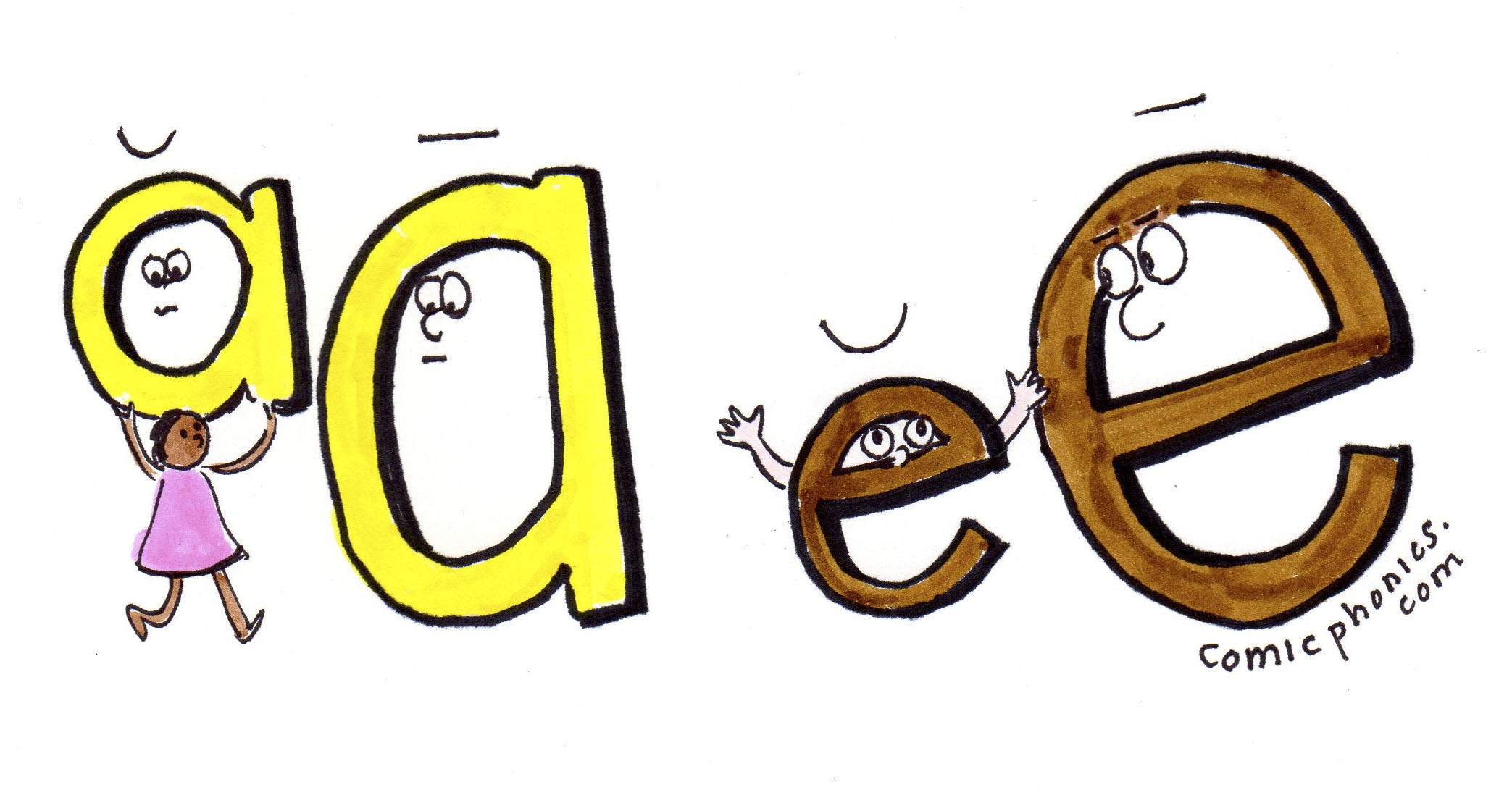
When a vowel sounds like its name, we have traditionally called it a long vowel. When the vowel can be said with the mouth only partly opened, we have traditionally called it a short vowel.
Long and short sounds of a and e
long, short i, o, u
Most Americans learned this way of naming vowel sounds, but today some experts recommend tossing out this old-fashioned naming system for several reasons.

    • First, calling a vowel sound either long or short does not accurately describe the vowel sound since both kinds of sounds take about the same amount of time to say.
    • Second, if the amount of time to pronounce these vowels is about the same, then what does long and short measure? Some experts say it is the length of the opening of the mouth. True, the mouth does open a bit more for long i’s and o’s, but not for the other long vowels.
    • Third, there is a whole other group of vowel sounds which is neither long nor short (ou and oi, for example). Reading specialists call these diphthongs, but that term is usually not used with little children. These vowel sounds are usually called by the sound they make.

You can teach vowel sounds without ever using the terms long and short vowels, but eventually in school, the teacher, or a workbook, or a test probably will use those terms. If your child has not heard the terms before, she might be confused.

I recommend focusing on the sounds until the child knows them. Associate the sounds with letters only after you are sure your child can hear and pronounce the sounds correctly. Mention long and short vowels in passing, but don’t dwell on those terms. After all, it’s not what you call a vowel sound that is important in learning to read; it is being able to pronounce the vowel sound correctly.

When your child notices that the ten common vowel sounds are represented by only five letters, explain that hundreds of years ago, when people were first writing down our language, they ran out of letters to use, so they doubled up on some letters, using them to represent two different sounds. But quickly add that there are clues in the words which tell you which way to pronounce the sounds, so it’s usually not a problem.

My child is a reluctant reader. How can I encourage him?

First, commit to working with your child every day for many months or even years.  He will not become an eager reader without your help, or the help of a dedicated tutor who works with him several times a week.

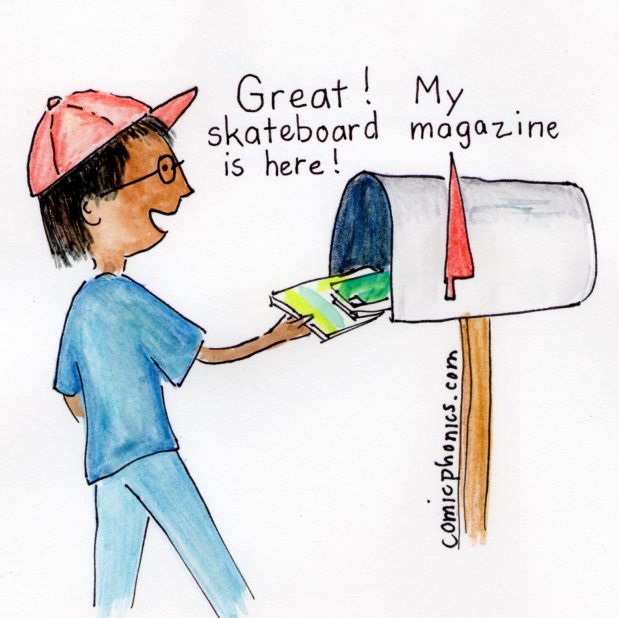
Boy at mailbox discovering skateboard magazineNext, find reading material that your child enjoys.  Boys—and most reluctant readers are boys—prefer nonfiction—how an engine works, for example, or how to build a bird house, or sports stories.  Nonfiction offers certain pluses:  illustrations (photos, charts, and diagrams), subheadings, a separate introduction, and maybe a summary.  Tempt your child with a skateboard magazine or a comic book or graphic novels.  Find online sites too.  Then:

  • Build on past success.  Ask your child to reread material he has mastered, but which he couldn’t read a short time ago.  Remind him of his gains.
  • Introduce new reading material which you suspect your child can read with 90% success.  Increase the difficulty level in tiny, tiny increments so the child has a growing feeling of success, not failure.
  • If a child stumbles through a sentence, focusing on individual words and not on the sentence, repeat the sentence for him with fluency, so he knows what the sentence means.
  • Stop the child after a passage and ask what it means.  Don’t let him move on until he knows the meaning of what he has already read.
  • Take turns reading.  You read one page; he reads one page.  Or for older students, you read one paragraph; he reads one paragraph.
  • Let him read to you without distractions.  No TV calling from another room.  No cell phone in your hand, or tablet in your lap.  No brother on a video game in another room.  Give him your undivided attention.
  • Read to your child—maybe at bedtime?—without any expectation that he will join in.  Let him enjoy reading as pure entertainment.
  • If he has only one reading strategy—such as guessing at a word—model other strategies.
  • Cover part of the word to show a part he can read.  Reveal more of the word.
  • Point out prefixes and suffixes, and cover them so the child can see the basic word unit.
  • Ask him to read a sentence leaving out a difficult word.  Together discuss what that word might mean.
  • Ask him if a word looks like any other word he knows.  Talk about word families or rhyming words which often sound the same.
  • If the child’s attention span is short, have more reading sessions but limit their time, and use a timer so the child can monitor how long the reading session will go on.
  • Praise his efforts.  Point out successes like
    • Knowing a word he missed in the past.
    • Sounding out a word.
    • Pronouncing a word using correct syllable breaks.
    • Putting inflection into his reading.
  • Talk to your child’s teacher.  She might know appropriate reading materials to recommend.  She can keep you abreast of reading skills the class is working on so you can work on them at home.  She will carefully watch your child for reading problems or successes if she knows you are working with him too.

My son was a reluctant reader, way behind at the end of first grade.  I consulted an expert and followed his advice.  I worked with my son for at least a half hour every day over summer vacation, asking him to read lists of words (for phonics) and easy reading books (for comprehension).  He hated it.  Every session was a struggle.  Yet he started second grade reading on grade level and was an eager reader after that.  By sixth grade he was devouring a chapter book a week, anticipating the publication dates of books in series he enjoyed.

The sooner you can intervene with a reluctant reader, the more likely you are of success.  Analyze your kindergartener’s or first grader’s reading habits.  If he is a reluctant reader, commit yourself to working with him now, before he becomes discouraged or evasive.  –Mrs. K

What is a Lexile score? My daughter’s Iowa test showed a Lexile score.

A Lexile score is a number used to measure a student’s reading achievement.  Several kinds of tests can be analyzed to determine this score.  The Iowa test is one of them.

Chart of typical grade level scoresA Lexile score is not the same as a grade level score in reading.  The lowest Lexile score—zero L—corresponds to the reading level of a beginning reader.  The highest scores—1600+L—correspond to advanced readers.

These scores can be used to choose appropriate reading materials for a student.  About a half a million books have been analyzed and given a Lexile score.  A student with a score of 800L, for example, would find appropriate reading material in books with a similar score.  At such a match, the student could be expected to comprehend 75% of the reading.  Below is a sampling of Lexile scored books.

List of Lexile scored books.

Find more book lists at: http://goo.gl/hA2X0P

A Lexile score is a scientific measurement of reading based on two factors:  how often words in the test or text are used in English and sentence length.  It is a 21st century readability formula developed by MetaMetrics (www.lexile.com), an organization which “develops scientific measures of student achievement,” according to its website.

Many state departments of education and school districts have licensed Lexile to analyze their tests and to link students with appropriate reading materials.  Several testing organizations such as the Gates-MacGinitie Reading Tests, the Iowa Test, the Sanford and Iowa achievement tests and the Total Reader, an online testing site, are “translating” their reading scores into Lexile scores.  Some online reading sites offer Lexile scores for their reading material.

One shortcoming of the Lexile readability measurement is that, like many readability formulas before it, Lexile measures just a few factors, leaving out many others.  Format and design factors (length of page, length of type line, length of paragraphs, type size and font, size of margins, white space between lines, use of graphics and use of color, for example) are not measured. Neither are the age-appropriateness of the material, the child’s interest in it, or the prior knowledge the child brings to reading.

Even so, Lexile is becoming a widely used method to measure a student’s reading ability and the readability of written materials.

First anniversary

A little over a year ago, Mrs. K and I sat at my dining room table and made plans for a blog and a series of books for early readers. A month ago, December, 17, marked the first year anniversary of our blog. During the past year:

  • We have received more than 10,000 views of our website.
  • Two topics have tied for the most read blogs:
    • how not to mix up b and d, and
    • the meaning of CVC.
  • The third most-read blog was about teaching vowel sounds.
  • Many other well-read blogs concern methods of teaching reading and information about our book apps and funny pages.
  • More than half the views come from U.S. readers.
  • Yet viewers from the U.K, Canada, Australia, the Philippines, India, New Zealand and South Korea also read our blog often.
  • Viewers come from every continent except Antarctica.
Countries of comicphonics.com blog viewers of the past year

Click on the chart to enlarge it.

This information is useful in planning blogs for 2014. We thank you, our readers, for reading our blog, for leaving comments and for making suggestions for future blogs. Our goal is to continue to provide useful information for teaching little children how to read.

Are you running into problems teaching your child to read? Have you come across a new book that your child loves to read? Have you found web sites or apps that your child uses to learn to read? Let us know so we can pass along information to your fellow parents and teachers.

— Mrs. A

More tips to help a child read bigger words

  • The same rule that applies to CVC/CVC words applies to CVC/CVCE words; that is, to words of two syllables which have (usually) a short vowel in the first syllable, two consonants in the middle of the word, and a long vowel in the second syllable controlled by a silent “e” at the end of the word.  The syllables split between the middle two consonants unless there is a blend, in which case the syllables split before or after the blend.
  • To teach these words, it might be easier to find some compound words that form this way, such as “tadpole,” “backbone” and “pancake.”  Make a list and let the child circle the two separate words which form the compound word.  Then ask the child to put the separate words together to form a new word.  Some words you might use are
     
    Two words that together make one word
  • When these words are mastered, move on to CVC/CVCE words which are not compound words such as “membrane,” “umpire” and “pollute.”  The same rule applies as above.  Have the child divide the word between the syllables.  If the child has trouble deciding where to divide, remind her that usually one syllable ends and another one begins between the two middle consonants.  Help her to identify blends that need to stay together in the same syllable.  Some words you might use are
     
    two syllables divided by middle consonants
  • When your child understands the pattern, you might explain that some bigger words follow the same pattern.  Introduce three syllable words with the CVC/CVC/CVCE pattern, such as “illustrate,” “vaccinate” and “indispose.” But if the child is struggling to understand the previous CVC/CVCE words, hold off on three syllable words.  Some words you might us are
     
    Introduce three syllable words.

Our blog will continue to teach multisyllabic words in the near future.  Let us know if you find this information useful or if you have particular problems teaching your child reading.  We will investigate for you and offer the best advice we can find.  –Mrs. K and Mrs. A