Category Archives: letter sounds

My child can read basic words. What kind of literature skills should s/he have for kindergarten?

Most states have adopted a common core of standards now used to teach and to assess children’s learning at each grade level and in academic subjects.  Included in these standards are ones for kindergarten reading which include understanding literature, informational texts and reading skills.  Those standards are

kindergarden literature skill standards

Go to http://www.corestandards.org/ELA-Literacy/RL/K for more on the common core of standards.

Key Ideas and Details

  • With prompting and support, the child should be able to ask and answer questions about key details in a text.
  • With prompting and support, the child should be able to retell familiar stories, including key details.
  • With prompting and support, the child should be able to identify characters, settings, and major events in a story.

Craft and Structure

  • The child should be able to ask and answer questions about unknown words in a text
  • The child should be able to recognize common types of texts (e.g., storybooks, poems).
  • The child, with prompting and support, should be able to name the author and illustrator of a story and define the role of each in telling the story.

Integration of Knowledge and Ideas

  • With prompting and support, the child should be able to describe the relationship between illustrations and the story in which they appear (e.g., what moment in a story an illustration depicts).
  • With prompting and support, the child should be able to compare and contrast the adventures and experiences of characters in familiar stories.

Range of Reading and Level of Text Complexity

  • The child should actively engage in group reading activities with purpose and understanding.

For more information, go to www.corestandards.org/ELA-Literacy/RL/K

How can I test my child’s basic reading skills so I know what skills he has mastered and what ones he needs to learn?

If your child knows a little bit about how to read, but you are not sure how much or where to begin, I came across a series of tests that might help you.
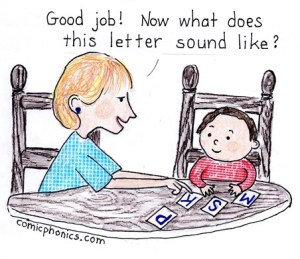
Mother sointing to Letters on flash card and asking, "What does the letter sound like/"The tests are from a 1981 book by a Montessori educator, Aline D. Wolf.  She wrote Tutoring is Caring for tutors of students who are experiencing difficulty in learning how to read.  Here is what she suggests, updated by Mrs. K to suggest online resources not available 32 years ago:

First test—recognizing sounds.  With a deck of ABC’s (available where school supplies are sold) or letter tiles (Scrabble pieces or letter tiles sold as parts of games) or an online site of moveable ABC’s, ask the student to say aloud the sound each letter makes.  The order of the ABC’s is irrelevent.

You might think, “Johnny can already read some words.  I can skip this step.”  Don’t.  Your child might have memorized the look of certain words the way a two-year-old can recognize “McDonalds” without being able to read.  Or he might have had a certain book read to him so many times that he can say the words from memory.  Test the letter sound of every letter.

A word of caution:  Test the letter sound, not the letter name.  This is not a test of ABC’s.  It is a test of the sound that the ABC’s make.  For vowels, listen for the short vowel sounds.

Another word of caution: Certain letters—a, g and q—can be written different ways in different type faces.  The child needs to recognize the common ways these letters are written as well as recognizing capital and lower case forms of every letter.  If you are writing the letters yourself, show all the common ways these letters are represented, but in general, use the letter form children use when they print.

If the child knows none or few of the letter sounds, begin by teaching some consonants that are generally pronounced the same all the time.  You don’t need to teach them all before you begin the vowels.  Teach ones that look different (not both “b” and “d,” or “m” and “n” or “p” and “q”).  You might start with “b,” “g,” “n,” “s,” and “t,” for example, and then add a short vowel sound (not i or e for starts since they sound so much alike).  From these few letters you can form words and show the child how words are formed.  He should be able to maneuver the cards or tiles or online letters to form words and to pronounce them.

Second test—combining the sounds.  Once the child knows the alphabet sounds, ask her to construct words by moving the cards or tiles around.  Have the child use all the letters.  If this is difficult, brush up on the sounds she finds troubling and try again.

Third test—reading simple words with short vowel sounds.  Create a list of CVC words and ask the child to read them.  You can find lists of such words online, or you can create your own list.  Try to use all the letter sounds.  If the child can’t read these words with ease, Wolf suggests preparing color-coded word lists (which our blog will explain soon).  If the child can read these words, move on to the fourth test.

Fourth test—reading words with blends.  Create a list of about 25 short-vowel words with blends at the beginning, at the end, or both.  If the child cannot read these words, go to the color-coded word lists.  If the child can read these words, move on to the fifth test.

A word of caution:  Blends are two or three consonants which together sound exactly like they sound when used separately.  The “s” and “t” in “stop” sound like they should in “sit” and “Tom.”  Don’t introduce digraphs at this point, that is, two or three consonants which, when used together, create a completely new sound.  The “t” and “h” in “the” do not sound like a “t” and “h” in Tom and hen.

Fifth test—reading short vowel words with two syllables.  You can find word lists online, or in some workbooks, or you can create them yourself.  Make sure each syllable uses a short-vowel.  Blends are okay.  If the child can’t do this, Wolf suggests a method to teach two-syllable words which our blog will talk about soon.  If the child can read these words, move on to the sixth test.

Sixth test—reading words with digraphs or unusual consonant sounds.  Now introduce a word list of about 25 words that uses sh, ch, th, wh, qu, ck, tch, ce, ci, ge, gi, gy, and other unexpected consonant pairings.  If the child can’t read these words fluently, a future blog will explain what to do.  If he can read the list, move on to the seventh test.

Seventh test—reading words with long vowel sounds.  This list should consist of about 25 one-syllable words with various patterns of long vowels—a silent “e” at the end; twin vowels side-by-side; two different vowels side-by-side, including “y”; “-ight,”  “-ild” and “—ow.”  If the child has trouble, then begin teaching long-vowels; if not, proceed to the final test.

Final test—reading words that cannot be pronounced using rules of phonics.  These words are exceptions to every rule—“should,” “was,” “mother” and “do,” for example.  They are sight words whose sound must be memorized.

If the child can score well on all these tests, and the child is still having difficulty reading, Wolf suggests that the problem is not decoding.  It might be fluency, phrasing, or comprehension.

What are Dolch words? Are they the same as sight words?

Yes, Dolch words are the same as sight words.  Many teachers expect beginning readers to recognize these words by the end of first grade.

Child looking at flash cards of two and three letter words.

Click on the picture to enlarge it.

The list of 220 Dolch words was compiled by Edward W. Dolch, Ph. D. in 1936 and published in his book Problems in Reading in 1948.  Dolch listed the most commonly used words in children’s books available in the 1930’s.  He then divided them into six parts:  pre-primer, primer, Grade 1, Grade 2, Grade 3 and nouns.

Dolch thought that if a child could read the words on his list, then that child could read fluently.  Even though many of the words on the list are pronounced according to the rules of phonics, some are not and do need to be memorized.  This is why the list is sometimes called sight words.  Many kindergarten and first grade classrooms have these words posted to the walls or have flash cards of these words.

Online you can find free copies of the list by searching for “Dolch words.”  You can also find flash cards, interactive sentences which pronounce the words for a child and spelling tests based on these words.

Few story books use just the Dolch words.  Dr. Seuss in writing The Cat in the Hat, tried but found it impossible.  However, he used just 236 words, many from the Dolch list.

Is there a low tech, inexpensive way to teach my children their letter sounds?

I’ve had success teaching reading to brand new readers by matching pictures to the correct letter using homemade flashcards.  Both native English speakers and ESL preschoolers have found this a fun way to learn letter sounds.  It can be done in five minutes here and there, making it a good way to teach children with short attention spans.

Child sorting picture flash cards to match with the letter B.

To enlarge the picture, click on it.

I suggest you try this method:

  • Cut some index cards in two, each about 3 by 2 ½ inches.  Or use the index cards whole if you prefer.
  • On ten or twelve blank cards, paste pictures of words which begin with the same consonant sound, such as the letter “b.”  Use pictures of a ball, a balloon, a bear, a banana, a ballerina and others until you have about ten to twelve cards with “b” pictures.
  • On another ten or twelve blank cards, paste pictures of words which begin with other letters, such as an apple, a cat, a dog, a kite and a piano until you have about the same number of cards as “b” cards.
  • On one blank card write or paste a capital B and a lower case b, “Bb.”
  • Lay the card labeled “Bb” on a table.  Shuffle all the picture cards, or let your child do that.  The more she can participate in the process, and eventually control it, the more likely she is to be eager to play the “game.”
  • Now taking one card at a time, have your child say the word of the picture.  Emphasize the “b” sound for her, and ask her if the card starts with a “b” sound.  If so, tell her to put the card next to the “Bb” card.  If not, tell her to put the card a little distance away.
  • Keep doing this until you have gone through all the cards and made two piles of picture cards.
  • With practice, your child will be able to match the words to the letter quickly.
  • After she has mastered “Bb,” make a set of cards using another consonant sound.  You can keep the same set of random cards or add to them.  Some of the random cards will eventually become the letter cards, so you need to add to that group of cards as you develop more letter cards.
  • Begin with the 16 consonants which almost always sound the same:  (Bb, Dd, Ff, Hh, Jj, Kk, Ll, Mm, Nn, Pp, Qq, Rr, Tt, Vv, Xx and Zz).  You don’t want to  do the ABC’s in order, starting with Aa.  Begin with any of the consonants I just listed.  If the child’s name is Tom, start with “Tt.”  If it is Hannah, start with “Hh.”
  • Try not to use pictures of words that start with blended sounds.  For example, don’t use “blue” or “braids” yet.  Later, after the child is sure of the single sound of a letter, you can start combining letter sounds.
  • Don’t start with a consonant that has multiple sounds, such as Gg, Ss or Cc.  For starts, choose letters and words that follow the rules of phonics.  Try to reduce confusion as much as possible.
  • Also, don’t start with vowels.  I teach vowels slightly differently.  I’ll tell you about that in my next blog.

Perhaps this sounds like too much work?  I use the cards over and over with new reading students, so for me the time it took to make the cards was well worth it.  If you have more than one child, you too can reuse the cards, and if you laminate them, they last forever.  (Laminating is expensive, but clear packing tape protects the cards well.)  And the cards are easy to make.  I made mine while watching TV.

In addition to being low tech, the cards are an inexpensive method to teach sounds.  A pack of index cards; old books, magazines or stickers to use for pictures; and tape together probably cost a few dollars and can be used to create many sets of cards.

How about you?  Were you taught your letter sounds by another low tech method?  How are you teaching your children their letter sounds?  Tell our readers by clicking the comment button.

Are nursery rhymes still important?

Yes, they are, but sadly, more and more children come to school today with little knowledge of them.

boy pretending to be Humpty

There are many reasons—busy parents without time to read the rhymes, foreign-born parents unfamiliar with the rhymes, and competition from TV and electronics for children’s time.  Yet, for many reasons, nursery rhymes should be part of a child’s education, and the earlier the better.

  • Children—even one-year-old children—can appreciate nursery rhymes, often their first encounter with books, verses and rhythmical sentences.  If they are being read to, they learn what a book is, what side goes up, how to turn a page, what words look like in print and how to get meaning from pictures.  This experience is the beginning of getting meaning from printed words, a start to reading comprehension.
  • They learn that reading books can be fun, social occasions with Grandma cuddling as she sounds out the rhymes.
  • Children can learn what English sounds like.  They hear their mother’s voice rising and falling, speeding up and slowing down, getting softer and louder, and sounding scared or full of laughter.  This can be particularly important for ESL children who might hear these rhymes from preschool teachers.
  • They develop an ear for fluency, and when they are ready to repeat the rhymes themselves, they are likely to add the inflection of a good reader.
  • Kids naturally like rhythm which nursery rhymes offer in abundance.  If Dad claps out the rhythm to “Pat-a-cake, Pat-a-cake, Baker Man,” soon the child will mimic him, picking up the cadence of English.
  • Because nursery rhymes are so rhythmical, children become aware of units of sound (called phonemes) from which words are made.  They learn to progress through the sounds in a word in a particular order (called phonemic segmentation), a necessary prereading skill.
  • Children also love rhyme (one reason Dr. Seuss is so popular).  They begin to learn patterns, expecting a rhyme every so often in the rhythm, and are rewarded when that word comes.  They begin to share in the reading of nursery rhymes aloud.
  • Because nursery rhymes are short, children need only a short attention span for a single nursery rhyme.
  • Also because the rhymes are short, children can memorize them and recite them aloud.
  • Nursery rhymes contain words the child doesn’t hear every day or in a familiar context.  “Jack and Jill went up a hill to fetch,” “eating her curds and whey,” and “Jack, be nimble” are examples.
  • Many nursery rhymes tell simple stories with beginnings, middles and ends.  The children hear of problems they might encounter—falling down and getting lost—and hear how those problems are resolved, or in Humpty Dumpty’s case, not resolved.
  • Nursery rhymes are great for group chanting and singing, sometimes called choral reading.  Think of “Mary Had a Little Lamb,” “Twinkle, Twinkle, Little Star,” and “London Bridge is Falling Down.”  Can you think about “Mary Had a Little Lamb” without singing it in your head?  The tune makes the rhyme easier to remember and makes reading fun.
  • Reading nursery rhymes to children preserves an older American culture and a connection with past generations.  Many of today’s grandmothers, as children, were read the same rhymes by their grandmothers.
  • Later on in life, the child will encounter many allusions to nursery rhymes (and allusions to Greek mythology, Shakespeare and the Bible).  But the child will only make connections—and have a richer experience—if he is familiar with the original rhymes.  For example, Agatha Christie called one of her mysteries One, Two, Buckle My Shoe.  Why?
  • Reading nursery rhymes online is a way to connect a child’s use of a tablet, phone or computer with literature from an early age.

    Father reading to child and child asks, 'How old is Old McDonald?"

    To enlarge, click on the picture.

The history of nursery rhymes in English goes back hundreds of years to a time when most people could not read or write.  Part of an oral culture, they reported events of their time for adults and children alike.  For example,

  • “Ring around the Rosy” is believed to have originated in 1347 during the Black Death in Europe.  The ring referred to a round mark on the skin which was the first sign of the bubonic plague.  The last line, “And we all fall down,” was no laughing matter.
  • “Mary, Mary, Quite Contrary,” refers to Mary, Queen of Scots, who was beheaded for her religious beliefs.
  • “Little Miss Muffett” refers to the daughter of a bug expert in Shakespeare’s day.
  • “Thirty Days Hath September” is believed to come from the 13th century, based on a similar rhyme in French to help remember how many days are in a month.

So are nursery rhymes important?  What do you think?  Did someone read nursery rhymes to you?  Can you recite any from memory?  Have you enjoyed passing along this tradition to your children and grandchildren?  Let our readers know.

Can dyslexia be identified in a preschooler?

By definition, dyslexia is a learning disability characterized by difficulty reading.  There are secondary characteristics—difficulty spelling, and illegible handwriting, for example—but until a child has attempted to read, it’s probably too early to identify dyslexia.

Even so, the National Center for Learning Disabilities has listed several warning signs for dyslexia, shown in the chart below, and some of them apply to preschoolers.

Dyslexia is the most common learning disability, affecting about five percent of American children.  Its cause is unknown, although scientists think it probably has more than one cause.  About a quarter of the children who have dyslexia also have attention deficit hyperactivity disorder, though most children with dyslexia don’t exhibit ADHD.  If an older child in the family or a parent has dyslexia, then the younger child has an increased chance of having it too.

Children diagnosed with dyslexia have normal intelligence and vision, yet they cannot figure out how to read by first grade.  Eventually they do, but they often require intervention from the school system, a tutor or a dedicated parent.

Dyslexia affects information processing in the part of the brain controlling language.  Usually children without dyslexia begin to realize that sounds combine to form words or parts of words, and that those sounds can be represented by letters.  Children with dyslexia have difficulty making these connections.

Children with dyslexia do learn to read, but it takes longer.  Teachers need to repeat the phonemes or basic sounds of English (about 44) and help children recognize these sounds in words and in syllables.  “Go” for example, has two phonemes, g and long o.  Then teachers need to connect these phonemes to letters, and the letters to tiny words which follow the rules of pronunciation.

If you are concerned about dyslexia, the National Center for Learning Disabilities website offers a 40-page toolkit about dyslexia, including several pages about characteristics of children pre-K to second grade and strategies to help them learn.  Your right to have your child tested by the public schools, the type of testing done and a video from an educator who has dyslexia are included in the toolkit.

Why is reading such a complex skill?

According to an April 2000 study (www.nationalreadingpanel.org) researched by the National Institute of Child Health and Human Development (a division of the National Institutes of Health) and the federal Department of Education, there are four main components to reading, each of which can be further divided.

Chart of 4 reading components

Click on the picture to enlarge it.

The first component is systematic phonics instruction.  The study defined phonics as how a letter corresponds to a sound in English, and defined systematic phonics as planned, sequential letter-sound instruction.  Some English letters have one corresponding sound (such as most consonants like b and d).  Some letters have two sounds (hard g and soft g, for example).  And some letters have many sounds (vowels and y).  Most systematic phonics instruction begins with teaching consistent consonant sounds and later moves on to vowels with multiple sounds, and then to consonants whose sounds change in combination with other letters (th and kn, for example).

Another component is phonemic awareness.  Phonemes are the smallest units of spoken English, 41 in all, represented by one or more of the 26 letters of the alphabet.  Some words have one phoneme (oh, for example, has the one phoneme o) while most words have two or more phonemes (go, for example, has two phonemes, g and o, while style has four phonemes, s, t, i and l.).  Putting together the phonemes to form words is an important component of reading.

Fluency is the third component.  The federal study defined fluency as reading aloud with speed, accuracy and proper expression.  When a child pauses at a comma or period and changes his pitch if he is reading a quote from a mean witch or a baby duck, that child is showing fluency.  Children who ignore punctuation or who read in a monotone or who plod along do not show fluency.

Reading comprehension, the fourth component, is perhaps the most complex.  It involves understanding vocabulary in the context of a text.  At the same time, reading comprehension means a student is actively engaging with a text so that the student can draw meaning.  If a child can read “trek” but does not know the word’s meaning, comprehension is limited by the lack of vocabulary but not by phonics or phenomes.  If a child can read a text but has little interest in the subject, and reads in a monotone, the child’s comprehension may be limited by fluency or passivity.

Adding to the complexity of reading is that all four of these skills work in unison as a child reads.  When a child is reading words accurately; when that child is grouping words in phrases and sentences with proper inflection; when that child is moving at a moderate rate; and when that child is laughing or questioning or pausing to consider what might happen next, that child is truly reading.

What does CVC mean?

If you do much reading about how to teach early readers, you will come across CVC.  It means consonant-vowel-consonant, and refers to one syllable, short vowel words beginning with a consonant, followed by a short vowel and ending with a consonant. Cat, pen, pig, dot and bug are examples.

CVC means consonant-vowel-consonant, and refers to one syllable, short vowel words beginning with a consonant.

Click on the picture to enlarge it.

CVC words are usually the first words children learn once they know their consonant sounds and short vowel sounds.  In CVC words, all the letters are pronounced, and they are pronounced the way children expect.  So for example, the word “gas” would be included as a CVC word, but the word “was” would not be included since the “s” sounds like a “z.”

Almost all English reading systems based on a phonetic approach begin by using CVC words.  Children usually learn short vowel words first because what you see is what you get—no silent letters (late, heat), no digraphs that turn letter sounds into other letter sounds (chat, the), and no use of letters that have secondary pronunciations (has, sew).

Although many words in English do not follow rules of phonics, most of them do.  So teaching children patterns that work most of the time offers them confidence to figure out words that are new to them.

However, most reading books meant for beginning readers do not limit themselves to CVC words.  Writing a meaningful story using only CVC words is hard.  Even Dr. Seuss in The Cat in the Hat used words that do not follow CVC rules. (“The sun did not shine.  It was too wet to play.”)

If your child is ready to read CVC words, you could point to CVC words for the child to read in books, and you could read the other words.  If you own the book and don’t mind marking it, you could underline the words the child should know and take turns reading words in sentences.  Goodwill is an inexpensive source for such books.

Can flashcards be used with preschoolers? If so, how?

I have worked successfully using flash cards with three and four-year-olds.  The children were learning the alphabet.  I used a deck of cards with all 26 letters printed on them, plus pictures of words which begin with each letter.  Here’s how you might use the cards:

Child holding a pile of flash cards that she's studied and now knows.

Click on the picture to enlarge.

  • Use flash cards to recognize the names of the A, B, C’s.  For very young children, start with just a few cards (such as the letters in family names, Mom and Dad).  Later increase the number of letters until all 26 could be identified.
  • Use flash cards to recognize the sounds of the A, B, C’s.  Start with a few cards whose sounds the child already knows and add more until all 26 letter sounds can be identified.
  • Use flash cards to pair letter names and sounds.  Once the child knows the names of the A, B, C’s and the sounds individual letters make, shuffle the cards and pull them one at a time for the child to identify both names and sounds.  Resist the urge to place all the cards face up on a table.  For some children, seeing all 26 cards at once is overwhelming even though they know the letters and sounds.  Showing one card at a time is not so intimidating.  Start small.
  • Use flash cards to order A, B, C’s.  Taking a handful of cards at a time (A to E, for example), place them face up in mixed order on a table.  Let the child arrange the cards in order.  Sing the ABC song slowly with the child if she hesitates.  Then add another set of cards (F to J, for example) until all the cards are in proper order.
  • Use flash cards to identify a letter and its sound with a word.  It’s important for the child to memorize a word which comes to mind immediately for each letter.  This will be useful when the child is beginning to sound out words.  When learning with vowels, choose words that begin with short vowel sounds.  For example, A is for apple, E is for egg, I is for igloo, O is for octopus and U is for umbrella.
  • Flash cards are also useful for learning sight words.  Not all tiny words follow the rules of phonics (the, as, of, is, was and they, for example).  Yet children need to be able to recognize these words to read.  In many kindergarten and first grade classrooms, teachers have lists of these words on the wall for students to use when writing.  Manufacturers sell boxed sets of commonly used sight words too.

What letter sounds should I teach first?

Suppose your child knows her ABC’s.  How do you start teaching letter sounds?  With vowels?  With consonants?  In ABC order?

Child seeing letter on dog's collarThe English alphabet includes 26 letters, of which 16 letters, almost always make the same sound.  If you begin teaching letter sounds using those letters there are advantages for your child.

  • These 16 letters follow rules for the sounds they represent.  A ”B,” for example, always sounds like a “B.”  An “M” always sounds like an “M.”  This predictability is reassuring to children who are deciphering the alphabet sound code.
  • Whether those 16 letters come at the beginning of a word, or in the middle, or at the end, the child can identify a consistent sound.  The “N” in “not” sounds the same as the “n” in “pencil” and the “n” in “pan.”  Compare that to a “Y” which has one sound at the beginning of words (such as “yo-yo”) and multiple sounds at the end of words (“party,” “boy” and “buy”) or no sound at the end of words (“day” and “key”).

It makes sense to begin by teaching letter sounds that follow rules.  It also makes sense to begin with letters that have meaning to the child.  If the child’s name is Pranavi, start by teaching the letter sound “P.”  If the child’s brother’s name is Bhavik, teach the “B” sound.

If the child can remember a particular letter with a particular word, the child can go to that special word to compare new words for sound.  “Z” is for zoo is great, but if the child’s brother’s name is Zachary, then “Z” is for Zachary might be more meaningful, and so more easily remembered.

The 16 letters that almost always make the same sound are B D F H J K L M N P Q[u] R T V X and Z.