Category Archives: learning

When the student becomes the reading teacher

Sometimes my best teaching strategies come from children themselves.

I was working with a PreK student the other day.  She has mastered reading CVC words (consonant-vowel-consonant words like “cat” and “six”).  Now we are focusing on blends at the beginning of CCVC words like “swim” and “spill.”

One at a time I was showing her illustrations of CCVC words.  At the same time I was sliding a handful of letters near the illustration.  The letters included the letters needed to spell the word plus some distracting letters.  My student’s job was to pull out the letters needed in the correct order and “write” the word under the illustration.

Except that she didn’t want to do that.  She wanted to write her name using the letter tiles.  We were getting nowhere, so I let her write her name.  Then, after her name she wrote the word “is,” and after “is” she wrote “not.”  Then she wrote the word we were trying to spell in the picture, “twin.”

“Chaulian is not twin,” she said aloud, laughing because she knows she is not a twin.  I pulled out the letter “a” and inserted it into her sentence.   “Chaulian is not a twin,” she read.

“You wrote a sentence,  Chaulian.”

She was engaged again.  I pulled another illustration, this time of a plum.  I took away “twin” and put six letters in front of my student.  From them she picked “plum” and changed her sentence to “Chaulian is not a plum,” laughing once more at the ridiculousness of that thought.

We continued, with Chaulian writing little sentences about herself using CCVC words.

A few days later I tried this same approach with an even younger child.  She is learning CVC words, but of course she already knows how to spell her name.  I asked her to spell her name with letter tiles and then I added “is not a” and pulled illustrations.  Nneka is not a cat.  Nneka is not a map.  Nneka is not a ten.  Like Chaulian, Nneka’s interest in our reading game increased when her name was used.  And when she read aloud her nonsense sentences, she laughed and laughed.  Our work together had turned into a silly game.

Little children are self-centered, so of course it made sense to use their names.  And wacky little sentences made our work fun.  I was thrilled to keep their attention longer than usual.  Win-win.

Chaulian is a teacher.
Teaching sounds, not letters, is where reading begins

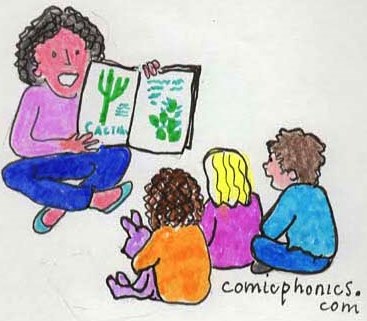
The basic “code” of written English is sounds represented by letters.  Learning this code begins with learning to recognize the sounds of English.  Combining these sounds into two- or three-sound words is where forming words begins.  And this can be taught to children before they ever see a letter.

Because learning the code of written English is so important, learning to recognize its sounds should not be rushed.  A lifetime of reading, a career, the ability to support a family—so much depends on being able to read.

Kids need plenty of time and various kinds of interactions with sounds to learn to recognize sounds.  The younger the children, the shorter their attention spans and the more need for game-like ways to learn.

But the learning doesn’t begin with letters.  It begins with sounds.

I recommend you use several strategies to help your children identify sounds, working with your child one-on-one using manipulatives.  Why?

Your child wants nothing more than to interact with you. Putting down your cell phone and sitting by her side shows your child you treasure her.  And working with her on reading skills shows her how important you consider that knowledge to be.

Research shows that the more senses we use, the more likely we are to remember. If a child can touch manipulatives, hear you say sounds, say them herself, see objects when she says sounds and feel your warm hug when she learns, the learning will stick. Plus she will be relaxed and happy, in an emotional state which is open to learning.

Some of the strategies I recommend to teach tiny children how sounds form words are these.

  • Work on a few sounds at a time with objects around the house. If your son’s name is Bill, for example, start with the “b” sound. Put a ball in your son’s hand and say “b” (the sound, not the letter) as in ball.  Put a banana in his hands and say “b” as in banana.  Do the same for other consonant sounds and for all the vowel sounds, even sounds we represent by two letters.  You can say “oi” (the sound) as in oink, or “ch” (the sound) as in child.  You can start this activity when a child is two or three without ever showing the child a letter.


  • Find objects in picture books which begin with basic English language sounds. ABC books are good for this, but the goal should not be to say “A is for apple.”  Rather it is to focus on the sounds in words.  At first start with words which begin with a sound, but then move on to small words which include that sound in the middle of CVC words like “cat” and “bag.”


  • When the child recognizes a handful of consonant sounds and a vowel sound such as “a,” say the “a” sound and a consonant sound slowly, one after the other. Make sounds which form a word like “a” and “t” or “a” and “x.”  Repeat the sounds a little faster each time until the child can hear the sounds come together.  Usually the child will say the word, but if not, help her to hear how the sounds come together to form a word.


All these activities can be done prior to ever showing your child a letter.  And they can be done with all 42 sounds in English.  Identifying sounds and understanding how they come together to form words is the basis of reading.  Save the ABCs for a later time.


Parental expectations for ELL can be too high

How long should it take for an English Language Learner (a student learning English as a second language) to read at grade level?

Longer than many parents want.

I am working with an ELL fifth grader from another country.  I tested her by having her read a list of basic English words, all of which she said she knew.  Then I had her read passages at a second, third and fourth grade level, and answer questions.

What I noticed is that she could score 100% on the second and third grade questions, providing the questions were multiple choice.  If she had to write a definition, she could copy what the passage said, but she could not paraphrase the words.  If she had to write sentences in her own words, she couldn’t do it.  If she could say the sentences aloud rather than write them, she couldn’t do it.

This is typical.  Multiple choice responses are easiest since the answer is provided; you just have to identify it.  Putting ideas into your own words is harder because you must rely on vocabulary which might not be in the passage and you must create sentences, a task which calls on so many skills—vocabulary, grammar, syntax, subject-verb agreement, pronoun case, articles—the list goes on and on.  A person can learn to read English without learning to speak or to write, but in the US students are tested verbally and in writing, and of course both skills are needed for 21st century success.

Another factor to consider when judging how long learning to read will take is whether English is spoken at home.  For this student, it is not.  She cannot ask a parent what a word means.  She cannot hear proper pronunciation.  She is on her own.

Still another factor is the student’s motivation to learn English.  My student is motivated.  She focuses for the full hour we are together and completes her homework.

The mother of this student hoped that her daughter would learn to read quickly enough to be ready for fifth grade state exams in three months.  I told the mother that is unlikely, watching sadness fill her eyes.

Could it happen?  Yes, for an extremely intelligent and motivated learner living in an enriched English environment.  But is it likely?  No.  Becoming fluent in a language takes time, more time than many parents want.

Teaching vocabulary

If kids get low grades on reading comprehension, number one on my checklist is vocabulary. If kids don’t understand the words they read, how can they possibly understand the sentences containing those words?

But how to solve this problem?

CVC means consonant-vowel-consonant, and refers to one syllable, short vowel words beginning with a consonant.

For ELL students lacking basic English words, I make flash cards: a picture on one side and the word or words used to identify that picture on the other side. A picture of a child pitching a baseball might use the words “pitch.” “toss,” or “throw.”

I start with pictures of CVC words: “cat,” hat”, and “bat,” for example. Picturing nouns is easy. Picturing verbs like “sat” and “win” is harder, and often I need to demonstrate the actions.

With my students I use the Explode the Code phonics series, so I picture vocabulary words in the order in which the student encounters the words in the series. To these I add a few sight (Dolch) words so that we can make sentences, such as “A cat is not a dog.”

What I have discovered is that students can identify the pictures with just a bit of study, but they cannot use the words in sentences. When they see the word “pitch” they can move their arms in  pitching motions, but they cannot make a sentence using the word “pitch.”

Even for students learning advanced vocabulary words, like in the Wordly Wise series, this is true. They can define a word using a synonym but they have trouble using the word in a meaningful sentence.  (For many students using this series in school, their teachers do not assign the part of the lesson in which students write the new words in sentences, a big mistake.)

When I review already learned vocabulary words, I ask for synonyms, but also for usage. “It is a cat” works for beginning ELL learners. But “It is a catapult” does not work for older ELL students or for English-speaking students.

Another method to increase ELL learners’ vocabulary is to use picture word books meant for preschoolers. Because I want to use the vocabulary my students study to teach them reading, I prefer to begin with CVC words even though a word like “pizza” might be more frequently heard.

How to get children to focus for a reading lesson

Is your child having trouble focusing during his or her reading lesson?  Here are some tips.

Establish a routine for the lessons, so the child knows what to expect. Be consistent with time and place.  Try working on the hardest thing first, such as reading lists of phonics words.  Try ending with a game—something fun but related to the work you are doing.  The younger the child, the more important it is to segment lessons into predictable parts.  If possible, identify all parts of the lesson before you begin so the child has an overview of what he will be working on.

If the child is distracted by sounds, while you work run a low, constant sound in the background—perhaps one of those baby sound machines of a heartbeat or of ocean waves.  Or run the dishwasher or a hair dryer.

If the child is distracted by sights, create a bland space to work in—soft colors, no patterned draperies, no posters. If there is a window, close the blinds or pull the shades to limit distractions.  Keep the surface of the child’s desk or table clear.

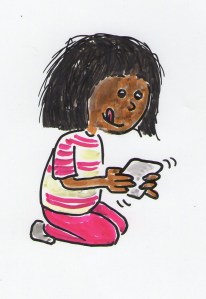
Consider whether the child will have trouble putting down electronic equipment. If so, save that part of the lesson to the end.Kneeling young girl is playing a portable video game.

Model the behavior you want from your child. If he is to read a paragraph, then you read a paragraph.  If he is to read a column of words, you read a column of words.

Before your lesson, encourage the child to have physical exercise—to run outside, to take a walk with you, or to bicycle, for example. The exercise will bring oxygen to the child’s brain and it will get rid of the “willies.”

Allow the child time to consider an answer to a question. If she seems to be having trouble, ask her to think out loud.  Perhaps give her hints, but let her struggle a bit to find the answer.

Allow the child to have a say in the “rules” of your lessons. If he wants a five minute break every ten minutes, allow it so long as he pays attention during the lesson.  If he wants to stand on the chair or  twist like a pretzel while he is reading, allow it so long as he is doing the work.  Kids with sensory integration issues need this leeway to hang in there.  Compromise so that you can achieve what you need to during each lesson and so that he feels like he is being heard and respected.

Before one part of the lesson ends, tell the child what will happen next. Let the child mentally prepare for what comes next.  Let the only surprises be good surprises.

Let the child wear comfortable clothes and work on a comfortable chair.  Put a box or a pile of books in front of the chair so the child has a place to rest her feet.

When you talk to the child, wait until she is looking at you, until you have her complete attention. Use small, easy to follow sentences.  Put one idea in each sentence.  If directions are three steps, say one step, allow the student to follow it, and then say the second step.  For some children too much incoming information is distracting.

Try to find game-like ways to teach. Children will be more cooperative if they think they are playing a game.

When and how to teach blends

Blends are two adjacent consonants in a word which maintain the sound each has when pronounced separately.  For example the “s” and “l” in “sled” are blends, but the “t” and “h” in “that” are not blends because the usual sounds of those letters are not maintained when they are used together.

The right time to teach blends is once students master CVC words (words formed by a consonant, vowel, and consonant, such as “cat”).   Make sure students can pronounce CVC words made with every vowel before moving on.

Teach beginning-of-word blends first.   End-of-word blends are much harder for students to learn.

The letter “s” is a good letter to start with since it forms more beginning-of-word blends than any other letter.  Use real CVC words which become real CCVC words when the “s” is added, such as nap/snap, led/sled, kid/skid, top/stop and lug/slug.  Little children are concrete learners, so being able to picture the words helps with the learning.

You can write the CVC word and then put an “s” in front of it.  Or you can use letter tiles, gradually moving the “s” closer and closer to the CVC word, saying the “s” sound and the CVC word separately at first and then more quickly until the child can hear the blend happen.

The child might consider the process a game if you slide the “s” letter tile gradually while you say the “s” sound and the CVC word.  Usually the child will shout out the blended word when he figures it out.  At first this will be after you say the blended word.  But as a child learns the skill of blending, he will shout out the word before you get close to saying the blended letters.  The process needs to be repeated with many consonants and many CVC words.

Some consonant blends are easier to hear than others.  CVC words that begin with “l” and “r” are easy to hear.  

Don’t be concerned if the child adds the blended letter to the end of the word, such as saying “leds” instead of “sled.”  Remind the child that the “s” is going at the beginning of the word, and repeat the process.  This is a common occurrence and will gradually lessen as the child practices blends.

Try to teach every letter that can be blended.  These include “b,” “c” “d,” “f,” “g,” “p,” “s,” and “t.”

Don’t teach three-letter blends at  this point.  They are much harder to hear than two-letter blends.  Wait until the child is farther along in learning to read.

Diagrams help students read

“Scaffolding” is an educator term to describe teacher actions to help students  learn something new.  Scaffolding could be a series of questions meant to prepare students for what they are to read.  Scaffolding could be a timeline of a topic—say American history—to show where a subtopic—say the Civil War—fits into the big picture.

Scaffolding can also be simple diagrams to help visual learners, ESL students and students with comprehension issues understand what they are about to read or write.  These diagrams help students “see” the organization of a reading passage, or they help students “see” the structure of a paragraph or essay they are about to write, providing clarity.

For example, suppose a student needs to read a biography of Coretta Scott King.  To help the student see the organization of Mrs. King’s life, the teacher could draw a color-coded diagram of important activities in Mrs. King’s life.   Take a look.

This diagram is a simple visual pattern following Mrs. King’s life, more or less in chronological order.  With a little help, the student might see that Mrs. King’s life was private until she married; then her life became public as she worked with her husband on civil rights matters; then her life became even more public after his death as she led efforts to honor him and she spoke and wrote about ongoing civil rights matters.

If each box of the diagram is outlined in a color which corresponds to a portion of Mrs. King’s life or activities, the overall organization of the essay becomes clear.   Color-coding the information is important because it helps visual learners “see” how the reading passage breaks down into smaller chunks.

Whether it is Junie B. Jones’ fear of school buses or why polar bears face a bleak future, a diagram showing students what they will read before they read it allows them to see the big picture and each subtopic in the order in which they will read about it.  For children learning English or children with reading comprehension problems, a diagram can help them understand and remember what they read.

How to teach –ight, -ought, -ind, -ild and word families that don’t follow rules

Words ending with –ight don’t follow the rules of phonetics.  The “g” and “h” are silent, and there is no silent “e” after the “t” to make the vowel “i” long.

Some word families, such as –ought, -ind, -ild, and -ight need to be taught as exceptions to phonics rules.  Essentially, they are a group of sight words which follow the same spelling rule, but they are not pronounced the way they look.

It’s probably better to delay teaching words like these until students learn the basic rules of phonics.  Exceptions to rules are confusing.  Better to get the rules understood before introducing exceptions.

That said, how do you teach such exceptions?

  • Teach one exception family of words at a time, giving several days for the student to get used to that family.
  • Post a list of the family of exception words so students can see them on and off many times a day.
  • Ask the children to read short paragraphs containing such words.
  • Ask the children to compose a silly verse using a familiar song for rhythm. For example, to “Old McDonald Had a Farm” students could write, “My brother Dwight did pick a fight, EE I EE I Oh.  He picked a fight with a mighty knight, EE I EE I Oh.”  The sillier the better.  Write down the song, show the words to the students, and sing it daily to reinforce the family pronunciation and spelling.
  • Play games using the exception word families. Students could write the 15 –ight words plus 10 –ite words on a blank BINGO board. You could call off a definition of each word which students would need to identify on their boards.
  • Have a spelling bee using the words.
  • Students could write a paragraph using as many of the words as they can. This could be a group project the first time and later an individual project.

Students should be reminded about words with the same sound as the exception but which follow the rules of phonics.   Students need to remember which words go with which rule.

English has many words which don’t follow the rules, but it helps when there are a whole group of them which follow their own strange rule.  They can be taught in groups rather than singly.

Colleges offer remedial reading and writing courses, but too late for most students

Many community colleges and four-year colleges in the US offer remedial reading and writing classes to incoming freshmen to raise lagging students to the base level expected for beginning freshmen.  These remedial courses offer no credit, so by the end of freshman year, students who pass these classes will not have accumulated the 30 or so credit hours expected for the first year of college education.  These students’ chances of graduating in two years from community colleges and four years from traditional colleges and universities are almost impossible.  And this means that many poor readers and writers drop out and never earn a college degree.
Colleges and universities are rethinking their remedial English courses for many reasons.

  • These remedial courses, in both English and math, cost about $7 billion each year.


  • Few freshmen who require remedial courses ever earn a degree.


  • 96% of two- and four-year colleges and universities enroll students in remedial courses.


  • In one state, California, more than 70% of community college students qualify for remedial English courses, and of those, only 60% pass the remedial courses and start credit courses, according to a 2016 study by the Public Policy Institute of California. Of those 60% who do pass, most never finish a college level English course with a C grade or better.  California is pretty typical of the rest of the country.


  • Starting in the fall of 2018, all such remedial courses will be eliminated at California State University, the largest public university system in the US. The stated purpose is to enable more students to graduate in four years.


What does this mean if you are teaching a young child to read?

Reading and writing are two of the most make-it or break-it life skills.  If a little kid is having trouble, now is the time to intervene.  The longer a student flounders, the more he falls behind and the less likely he is to catch up, even with help.  By the time a student reaches college, high school, or even middle school, it’s usually too late.  The time to learn to read and write is when a child is four, five, six and seven years old.

If you want your children to succeed, do whatever is necessary to ensure that they can read by the time they start third grade.

Can listening to music help kids to focus?

Yes, it can if it is the right kind of music.

For work requiring focus and concentration, children should listen to instrumental music with no voices or lyrics.  Such music works even better than ambient noise, such as a ceiling fan or hair dryer in the background.

If listeners become accustomed to hearing the same kind of music when learning, they respond repeatedly in the same way, much like Pavolov’s dogs in his famous experiments.  Children learn to associate a particular stimulus—the instrumental music—to a particular behavior—focused attention.

On the other hand, for work requiring little thought but a great deal of energy, children should listen to music with a quick beat and energizing lyrics.

Why does music help?  Listening to music releases a chemical called dopamine which turns on different parts of the brain known to be important for learning.