Should I give my beginning reader spelling tests?

Little children love to show that they are growing up.  If they have older siblings, they have probably watched them write their spelling words and have heard you pretest them on those words.  Since the whole idea of testing is new and “grown-up,” of course they want to be part of it.

Young child writing C-A-T.

Click on the picture to enlarge it.

Rudolph Flesch, the proponent of teaching a phonics-based reading system in the mid-20th century, advocated teaching spelling at the same time as reading.  His position was, if the child can read a word, he can spell it.

But how to test?  Here is one way to make spelling tests games.

  • Cut out little pictures of words to be tested—cat, hat, bat—and paste them on a sheet of paper with a number next to each picture.  Five to ten pictures per page is plenty.  Then have the child spell the word orally to you, or if the child can write her letters, have the child write the answers on a separate piece of paper.
  • Start by using all rhyming words—bat, cat, fat, hat, mat, pat, rat, sat; can, fan, man, pan, ran, tan, van; big, dig, pig, wig, for example.  Then, when you are sure the child had mastered the rhyming words, mix up words of the same vowel sound.  If the child is successful, then mix various CVC words on the test.  This method ensures success for the child and gives her confidence before she faces words with varying vowels.
  • If the child is writing the spelling words, you do not need to be nearby—a plus for the child’s independence.
  • Or you can go online to have a similar experience using a computer.
  • At www.mrskilburnkiddos.wordpress.com/reading/CVC-words , you can see photos of another type of spelling test.  A picture of a CVC word is glued on an index card.  Below the picture are three squares where the child can spell the word with letter tiles.  Several index cards are joined together with a ring to form a single test.  You would need to use this idea as a pattern to create the test yourself.

What does CVC mean?

If you do much reading about how to teach early readers, you will come across CVC.  It means consonant-vowel-consonant, and refers to one syllable, short vowel words beginning with a consonant, followed by a short vowel and ending with a consonant. Cat, pen, pig, dot and bug are examples.

CVC means consonant-vowel-consonant, and refers to one syllable, short vowel words beginning with a consonant.

Click on the picture to enlarge it.

CVC words are usually the first words children learn once they know their consonant sounds and short vowel sounds.  In CVC words, all the letters are pronounced, and they are pronounced the way children expect.  So for example, the word “gas” would be included as a CVC word, but the word “was” would not be included since the “s” sounds like a “z.”

Almost all English reading systems based on a phonetic approach begin by using CVC words.  Children usually learn short vowel words first because what you see is what you get—no silent letters (late, heat), no digraphs that turn letter sounds into other letter sounds (chat, the), and no use of letters that have secondary pronunciations (has, sew).

Although many words in English do not follow rules of phonics, most of them do.  So teaching children patterns that work most of the time offers them confidence to figure out words that are new to them.

However, most reading books meant for beginning readers do not limit themselves to CVC words.  Writing a meaningful story using only CVC words is hard.  Even Dr. Seuss in The Cat in the Hat used words that do not follow CVC rules. (“The sun did not shine.  It was too wet to play.”)

If your child is ready to read CVC words, you could point to CVC words for the child to read in books, and you could read the other words.  If you own the book and don’t mind marking it, you could underline the words the child should know and take turns reading words in sentences.  Goodwill is an inexpensive source for such books.

My child seems behind his first-grade classmates who are already reading. What can I do?

Check to see if there is a Reading Recovery program in your school.  It is designed for just the kind of situation you describe.  Reading Recovery identifies children having trouble reading at the beginning of first grade, intervenes with a private tutor, and, for 75 percent of the students who complete the program, gets them to grade level reading within 20 weeks.

At the start of first grade, or around students’ sixth birthdays, children in schools with a Reading Recovery program are evaluated for their reading abilities.  Those who rate in the lower 5 to 20 percent compared to their classmates are offered a specially trained tutor who works with an individual student for a half-hour daily for 12 to 20 weeks.  Then the students are reassessed.  The great majority of students going through the program read on grade level after 20 weeks and no longer need intervention.  For the few who don’t, specific data collected on those students can be used to plan other interventions.

Since reasons for not reading well vary from child to child, each tutor tailors a program based on her student’s strengths and weaknesses.  During a typical lesson a child reads one or more tiny books (just a few words on each page and only a few pages) with comprehension the primary focus of the lesson.  The books are chosen by the tutor based on the child’s interests.  A student also learns phonics, fluency and other reading skills, and writes in a journal-like notebook.  Each day the child brings home a tiny book which she is encouraged to read to her parents.

Reading Recovery intervenes early in a child’s education before problems consolidate and before the child develops a self-concept as a poor reader.  It was started in the 1970’s by a New Zealand developmental psychologist, Marie Clay.  New Zealand is the only country to offer this program in every school, but it has spread to the UK, Ireland, Australia, Canada, and the U.S.

Reading Recovery began in the U.S. in 1984, and last year was offered to 50,000 first graders in 4100 schools in 41 states.  It is offered only in schools (not privately) which pay for the training of Reading Recovery teachers.  Teachers are trained for a year, and during that time they observe experienced teachers working with students and begin to work with students themselves.  This is to assure there are highly skilled tutors able to plan a program that will lead a student to successful reading.

Data is collected on every child who takes part in a Reading Recovery program.  In 25 years, in the U.S. 1,551,444 students have completed the program, and of them, 1,209,577 have achieved grade level reading abilities within 20 weeks.

To find out if there is a Reading Recovery program near you, go to the Reading Recovery Council of North America (www.readingrecovery.org).  On the home page, under Quick Links, click Directories.  Then click Teacher/Leader Registry, and put in your city or state in the appropriate blanks.  A list of Reading Recovery teachers and their school email addresses appear.  If you contact a local one, that teacher can tell you what schools in your area participate.

Can flashcards be used with preschoolers? If so, how?

I have worked successfully using flash cards with three and four-year-olds.  The children were learning the alphabet.  I used a deck of cards with all 26 letters printed on them, plus pictures of words which begin with each letter.  Here’s how you might use the cards:

Child holding a pile of flash cards that she's studied and now knows.

Click on the picture to enlarge.

  • Use flash cards to recognize the names of the A, B, C’s.  For very young children, start with just a few cards (such as the letters in family names, Mom and Dad).  Later increase the number of letters until all 26 could be identified.
  • Use flash cards to recognize the sounds of the A, B, C’s.  Start with a few cards whose sounds the child already knows and add more until all 26 letter sounds can be identified.
  • Use flash cards to pair letter names and sounds.  Once the child knows the names of the A, B, C’s and the sounds individual letters make, shuffle the cards and pull them one at a time for the child to identify both names and sounds.  Resist the urge to place all the cards face up on a table.  For some children, seeing all 26 cards at once is overwhelming even though they know the letters and sounds.  Showing one card at a time is not so intimidating.  Start small.
  • Use flash cards to order A, B, C’s.  Taking a handful of cards at a time (A to E, for example), place them face up in mixed order on a table.  Let the child arrange the cards in order.  Sing the ABC song slowly with the child if she hesitates.  Then add another set of cards (F to J, for example) until all the cards are in proper order.
  • Use flash cards to identify a letter and its sound with a word.  It’s important for the child to memorize a word which comes to mind immediately for each letter.  This will be useful when the child is beginning to sound out words.  When learning with vowels, choose words that begin with short vowel sounds.  For example, A is for apple, E is for egg, I is for igloo, O is for octopus and U is for umbrella.
  • Flash cards are also useful for learning sight words.  Not all tiny words follow the rules of phonics (the, as, of, is, was and they, for example).  Yet children need to be able to recognize these words to read.  In many kindergarten and first grade classrooms, teachers have lists of these words on the wall for students to use when writing.  Manufacturers sell boxed sets of commonly used sight words too.

Do preschool-aged boys prefer different reading materials from girls?

Yes.  Even three- and four-year-olds show differences.  Here are some differences worth pointing out, although these vary from child to child.

  • Boys—even preschool boys—prefer different genres of reading from girls.  Boys like “how to” books read to them—how a car engine works or how a pitcher holds the ball for various throws, for example.  Boys often prefer books with humor or books that show a boy being mischievous.   Boys like science fiction and fantasy.  Boys as young as three might prefer different reading material from girls of the same age.

    Boy telling mother information from a book about turtles

    Click on image to enlarge it.

  • Girls like fairy tales more than boys.  Many fairy tales have girls as the main subjects—Cinderella, Goldilocks, Little Red Riding Hood, Sleeping Beauty, and Snow White.  Don’t be surprised if boys are bored by fairy tales.  Fairy tales originated in a time without bikes, jets, video games and Angry Birds.  Fairy tales can seem pretty dull to a three-year-old who regularly plays games on a smart phone or on wii.
  • Boys like visual aids to help understanding—a diagram of how an elevator works, photos of Hurricane Sandy, or cartoons, for example.  They may prefer to have nonfiction read to them more than girls do.  They like manuals and the diagram directions for Legos.
  • Boys like to see boy characters, or if not boys, then men they might want to become when they are big.  A boy who likes flying might enjoy a book about a sixteen-year-old boy learning to fly.  A four-year-old boy beginning baseball practice might like books about boys playing baseball or a biography of a slugger like Babe Ruth when he was a kid.  Boys want boy characters doing boy things, just as girls want girl characters doing all things.
  • Boys like fiction crammed with action.  They like books heavy on plot and low on emotion.  Girls like these books too, but they also like books about relationships more than boys do.
  • Boys like books with useful knowledge they can share with other boys, the kind of knowledge other boys will find appealing.  “Hey Grandpa!  Do you know the first team that ever won a Super Bowl?  I do.”

If you are reading this blog, you are probably a mother or female teacher of young children.  Your first choice of material to read to your child may not be the same as a little boy would choose.  If your child is interested in science, maybe reading an article in National Geographic or Popular Mechanics makes sense.  You don’t have to read books.  Magazines and newspapers are fine.  The daily Charlie Brown or Garfield comic might appeal more than a “Jack and the Beanstalk” story.

Boys love technology.  Figure out his passions and search for information on the internet.  Even if he can’t read yet, he will recognize that reading would be a useful skill to access information he loves.  Or help him write an email to someone and then help him to read the response.  Boys like useful reading.

Lastly, can you get Dad or Grandpa or another man to model reading?  If a boy sees the girls and women in his life reading, but not the teen boys or the men, he might think that reading is not a boy’s activity.  Try to get a man to read to your child regularly.

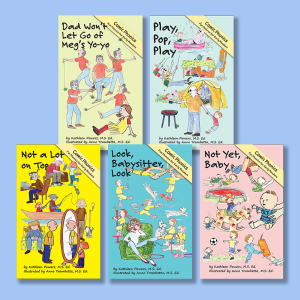
What’s behind the ‘Comic’ in ComicPhonics?

When reading is fun, readers stay engaged.  With a little silliness, even reluctant children may find reading enjoyable.  With that in mind, Mrs. A. has drawn some silly images to accompany easy reading phrases and sentences for your early readers.

Click on any one of the comics below and a full-size gallery will appear for you to page through, forward or backward. Your early reader might enjoy reading these comics online.   After viewing the gallery, it takes two steps to get back to my blog: first click a few times on the “back arrow” icon until comicphonics.com appears–or type comicphonics.com; then click on the “refresh” icon.

You can also download this gallery, save it to your computer for later viewing, or print up some 8-1/2 x 11 sheets.  Just click here on  Comic Phonics .    Enjoy.

Should I teach my grandson to read one word at a time, the way I was taught? Is this a good way?

If you learned to read in the 1950’s or 1960’s, you probably learned via the “look-say” method.  Your teacher wrote a word, such as “look,” on the blackboard.  She said it aloud.  You said it aloud.  You opened your reader to page 1.  There under a picture, was the word, “look.”  You read it aloud.  During the day your teacher referred back to the word on the board to help you remember it.  You repeated it.

The next day you did it again, except this time you added the word “see.”  When you turned to page two, there were both words, “look” and “see.”

2 Children reading books.  One is shown using a past reading technique and the other is using a more modern approach.By this method, children were taught to read words as whole units, much like Chinese children are taught their written language.  By the end of first grade, baby boom children had a reading vocabulary of about 150 to 180 words.  They might have been taught some phonics at this point, or phonics might have waited until second grade, or they might never have been taught phonics.  Students were expected to memorize thousands of words.

This “look-say” method was invented by Rev. Thomas H. Gallaudet, the director of a school for deaf and speechless children in the early 19th century.  Many schools adopted this method then, especially when it was endorsed by Horace Mann, the Secretary of the Board of Education in Massachusetts.  But after a while, teachers protested that their students couldn’t read.  And so teachers went back to a phonics-based approach until the 1950’s, when “look-say” became popular again.

There are several problems with this method of teaching reading.

  • With 50,000 words in everyday use in English, a student would never learn them all.
  • Nor could he read books which did not strictly adhere to the vocabulary list.
  • He would not learn word-attack skills to figure out new words.
  • But the biggest problem is that evidence was mounting by the 1970’s that another method, the phonics method, taught reading better.

Even so, “look-say” was not abandoned.  Instead in the 1980’s, it was wrapped into another reading instruction approach called “whole language” which ignored research supporting the superiority of a phonics-based approach.  Whole language focused on context, expecting the student to learn new words from the context of the other words in a sentence.  Like “look-say,” whole language was a haphazard approach.

So back to your question:  Should you teach your grandson to read whole words?  Sure, if you teach phonics as well.  But don’t skip the phonics.

Consider this:  You can teach your grandchild word after word after word, endlessly, or you can teach your grandchild about 41 letter/blend/diagraph sounds and about 100 rules.  Using the first approach, he’ll memorize several hundred words in a couple of years.  Using the second approach, he’ll master word attack skills that he can use on 80 percent of the words in the English language.

What are McGuffey Readers? Are they a good way to teach my child to read?

Long before there was research on how children learn to read, in 1836 William McGuffey created the first set of readers for American children. His series begins with a book of mostly one syllable words used in 55 stories, all of which teach a lesson on how to be good.  The second book of 85 lessons teaches history, biology, botany, table manners and respectful behavior using words a bit longer and harder to read.  Four more books in the series teach grammar and public speaking, using stories from Shakespeare and the Bible.  The first two books were much more widely read than the last four.

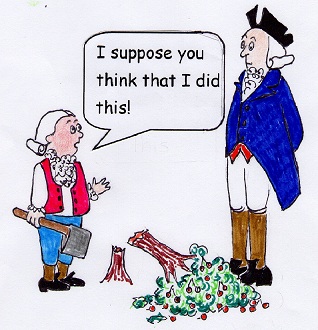
clip of George Washington chopping cherry treeOne of the stories concerns George Washington cutting down a cherry tree and confessing the truth to his father—perhaps the source of that myth.  Another story emphasized being kind to horses.  Another teaches respect for the flag.

McGuffey’s Readers, as they became known, were used in schools in the western and southern U.S. throughout the 19th and early 20th centuries.  The original stories, based on a European Christian ethical code, gradually changed in later editions to teach lessons not connected to any specific religion.  Millions of Americans were influenced by these books, and could quote from them later in life.  Henry Ford was one of those.  He was so indebted that he distributed thousands of the readers at his own expense.

Reading specialists today would find fault with McGuffey Readers.  The first book introduces words in no particular sequence.  Lesson one introduces three short vowel words, but by lesson 11, a digraph is used, and lesson 12 introduces words with long vowels.  The sound of letters is not emphasized.  Often the teacher would read the lesson aloud, and then the student would spell a word, name its letters, and then pronounce the word correctly.  Many words were memorized as sight words rather than as words that could be sounded out.

A selection from the first book follows.  Notice the use of three-syllable words, long vowels, “head” which doesn’t follow phonics rules, and the digraph “wh,” as well as one-syllable, short-vowel words.

“I like to see a lit-tle dog,
And pat him on the head;
So pret-ti-ly he wags his tail
When-ev-er he is fed.”

However, to McGuffey’s credit, reading specialists would point out that the lessons in McGuffey Readers become progressively harder to read; these readers were one of the first texts to be created that way.  New words are listed at the beginning of each lesson and words from past lessons are repeated.

Perhaps as many as 120 million copies of McGuffey Readers were printed, making them one of the most influential books ever printed.  They can still be purchased in some book stores and online.  Since the copyright on these books has long expired, and since there were many editions with changes from the originals, what is available today under the name McGuffey Readers varies.  The books are still being used to teach reading, especially in home school situations in the U.S.

For a free, online, early twentieth century version of the first reader, go to http://www.gutenberg.org/ebooks/14640.

How can I help my child not to mix up b and d?

When children are learning the lower case alphabet, they frequently mix up certain pairs of letters:  p and q, g and q, l and I, and especially b and d.   This is normal.  As they get experience, they recognize differences in these letter pairs.  But mix-ups with b and d might linger well into elementary school.

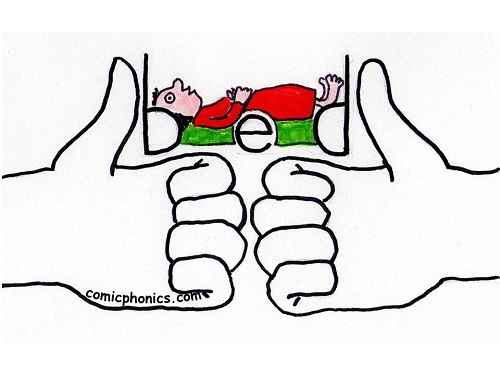
b sees dOne solution is to tell the child that b and d look at each other.  Draw the letters with the b loop facing the d loop, and put dark irises in the loops.  Tell the child that b comes before d in the alphabet, so when looking at b d, b is the first letter and d is the second letter.

two hands making letter b, d with a bed spelled out between the thumbs.Another way to handle the b d problem is to have the child make fists with both hands while holding up the thumbs.  When the child looks at his left hand, it looks like the letter b with the thumb the stem and the fist the loop of the letter.  When the child looks at his right hand, it looks like the letter d.  Now tell the child to bring her fists together until they touch and to look at the shape.  Her hands should look like a bed with the thumbs the bedposts and the fists the mattress.  If the child knows the word “bed,” the child can easily figure out b and d.

How can I make learning to read fun for my child?

The key is to make learning a game.  The more game-like learning is, the more likely the child is to want to participate.  If the child can use her hands or whole body, learning will seem more like a game.  Try these strategies:

  • Let the child put a star child playing letter  BINGOor some other sticker on the corner of an alphabet card when the child knows a letter.  Or if the child is reading a book you own, let the child paste a star on each page she can read.  The child will enjoy pasting the star, will have visible proof of learning, and will have something concrete to prove progress for Dad or Grandma.
  • Let the child stamp alphabet cards with the date when the child knows them.  Remember how the librarian used to stamp the books with the return date?  Those kinds of stamps are still available at office supply stores.  (You can buy a deck of alphabet cards for a dollar or two at dollar stores, so don’t be concerned if the cards are defaced.)
  • Let the child hit or shake some kind of noisemaker for a successful answer.
  • If you play BINGO letter or word games, ask the child to create or accumulate the markers.  Plastic caps from milk or juice containers, Barbie doll high heels, shapes that the child has colored and cut, coins, stamps cut off of envelopes—let the child decide what markers to use today.  What fun to cover a BINGO card with Angry Birds and pigs.
  • As the child begins to read books, let the child underline the words she knows in pencil or highlight them with markers.  Read the same book a week later and let the child underline in a different color.  Do it a week later with a third color.  The child should notice more and more underlined words.  (You can buy used children’s books for a dollar or two at Goodwill and other resale stores, so don’t fret if the books are marked.)
  • Let the child write his name or other words on the refrigerator using magnetized letters.  Point out the work proudly to family members.
  • On the computer, pull up a blank page and let the child hunt and peck for ABC’s or the letters of his name.  Use a large font—size 36 or bigger.  Vary the color of the ink and the type faces.  Print the page and display it proudly.
  • For reluctant learners, use a kitchen timer to limit the time for any learning activity.  Usually, the younger the child, the shorter the time.  Five minutes might be long enough.  Let your child’s behavior guide you.