My child is a reluctant reader. How can I encourage him?

First, commit to working with your child every day for many months or even years.  He will not become an eager reader without your help, or the help of a dedicated tutor who works with him several times a week.

Boy at mailbox discovering skateboard magazineNext, find reading material that your child enjoys.  Boys—and most reluctant readers are boys—prefer nonfiction—how an engine works, for example, or how to build a bird house, or sports stories.  Nonfiction offers certain pluses:  illustrations (photos, charts, and diagrams), subheadings, a separate introduction, and maybe a summary.  Tempt your child with a skateboard magazine or a comic book or graphic novels.  Find online sites too.  Then:

  • Build on past success.  Ask your child to reread material he has mastered, but which he couldn’t read a short time ago.  Remind him of his gains.
  • Introduce new reading material which you suspect your child can read with 90% success.  Increase the difficulty level in tiny, tiny increments so the child has a growing feeling of success, not failure.
  • If a child stumbles through a sentence, focusing on individual words and not on the sentence, repeat the sentence for him with fluency, so he knows what the sentence means.
  • Stop the child after a passage and ask what it means.  Don’t let him move on until he knows the meaning of what he has already read.
  • Take turns reading.  You read one page; he reads one page.  Or for older students, you read one paragraph; he reads one paragraph.
  • Let him read to you without distractions.  No TV calling from another room.  No cell phone in your hand, or tablet in your lap.  No brother on a video game in another room.  Give him your undivided attention.
  • Read to your child—maybe at bedtime?—without any expectation that he will join in.  Let him enjoy reading as pure entertainment.
  • If he has only one reading strategy—such as guessing at a word—model other strategies.
  • Cover part of the word to show a part he can read.  Reveal more of the word.
  • Point out prefixes and suffixes, and cover them so the child can see the basic word unit.
  • Ask him to read a sentence leaving out a difficult word.  Together discuss what that word might mean.
  • Ask him if a word looks like any other word he knows.  Talk about word families or rhyming words which often sound the same.
  • If the child’s attention span is short, have more reading sessions but limit their time, and use a timer so the child can monitor how long the reading session will go on.
  • Praise his efforts.  Point out successes like
    • Knowing a word he missed in the past.
    • Sounding out a word.
    • Pronouncing a word using correct syllable breaks.
    • Putting inflection into his reading.
  • Talk to your child’s teacher.  She might know appropriate reading materials to recommend.  She can keep you abreast of reading skills the class is working on so you can work on them at home.  She will carefully watch your child for reading problems or successes if she knows you are working with him too.

My son was a reluctant reader, way behind at the end of first grade.  I consulted an expert and followed his advice.  I worked with my son for at least a half hour every day over summer vacation, asking him to read lists of words (for phonics) and easy reading books (for comprehension).  He hated it.  Every session was a struggle.  Yet he started second grade reading on grade level and was an eager reader after that.  By sixth grade he was devouring a chapter book a week, anticipating the publication dates of books in series he enjoyed.

The sooner you can intervene with a reluctant reader, the more likely you are of success.  Analyze your kindergartener’s or first grader’s reading habits.  If he is a reluctant reader, commit yourself to working with him now, before he becomes discouraged or evasive.  –Mrs. K

What is a Lexile score? My daughter’s Iowa test showed a Lexile score.

A Lexile score is a number used to measure a student’s reading achievement.  Several kinds of tests can be analyzed to determine this score.  The Iowa test is one of them.

Chart of typical grade level scoresA Lexile score is not the same as a grade level score in reading.  The lowest Lexile score—zero L—corresponds to the reading level of a beginning reader.  The highest scores—1600+L—correspond to advanced readers.

These scores can be used to choose appropriate reading materials for a student.  About a half a million books have been analyzed and given a Lexile score.  A student with a score of 800L, for example, would find appropriate reading material in books with a similar score.  At such a match, the student could be expected to comprehend 75% of the reading.  Below is a sampling of Lexile scored books.

List of Lexile scored books.

Find more book lists at: http://goo.gl/hA2X0P

A Lexile score is a scientific measurement of reading based on two factors:  how often words in the test or text are used in English and sentence length.  It is a 21st century readability formula developed by MetaMetrics (www.lexile.com), an organization which “develops scientific measures of student achievement,” according to its website.

Many state departments of education and school districts have licensed Lexile to analyze their tests and to link students with appropriate reading materials.  Several testing organizations such as the Gates-MacGinitie Reading Tests, the Iowa Test, the Sanford and Iowa achievement tests and the Total Reader, an online testing site, are “translating” their reading scores into Lexile scores.  Some online reading sites offer Lexile scores for their reading material.

One shortcoming of the Lexile readability measurement is that, like many readability formulas before it, Lexile measures just a few factors, leaving out many others.  Format and design factors (length of page, length of type line, length of paragraphs, type size and font, size of margins, white space between lines, use of graphics and use of color, for example) are not measured. Neither are the age-appropriateness of the material, the child’s interest in it, or the prior knowledge the child brings to reading.

Even so, Lexile is becoming a widely used method to measure a student’s reading ability and the readability of written materials.

What are high/low books?

High interest / low reading level books are books that appeal to children who are older than the reading level of the book.

High/low books in a way are a mismatch: the reading level is lower than the age of the child to whom the book appeals. A good example is the Fudge series by Judy Blume. The early books are written at a second grade level but appeal to third or fourth grade children because the narrator begins as a fourth grader and grows older in the series.

Too many words on a page make reading hard.These books appeal to children who are struggling to read. The stories are about kids their age doing activities they do. These books are also good for ESL students whose age might not align with their reading level in English, and for disabled children, including those with dyslexia, who are behind their peers in their reading level.

What makes these books different? They share many of these qualities:

  • Shorter, everyday vocabulary words with concrete meanings
  • Short sentences
  • Short paragraphs
  • Large margins
  • Unjustified right margins (margins that look ragged)
  • Larger type size (minimum 11 point) in clear fonts
  • Realistic characters who are the same age as the reader
  • Easily differentiated characters
  • A fast moving plot which is low on description
  • Compelling stories
  • Chronological order (no flashbacks)
  • One point of view, not two
  • Illustrations, photos, graphs and maps
  • Tight, concrete writing

Many lists of these books can be found online.

A long list can be found at http://www.schoolonwheels.org/pdfs/3328/Hi-Lo-Book-List.pdf. This list gives the reading level (RL) and the interest level (IL) plus a one sentence description of the book. All the books on this list are fiction.

Some small house book publishers are known for publishing books for reluctant readers who often happen to be high/low readers. At http://www.nbss.ie/sites/default/files/publications/READ_-_hilow_books.pdf you can find the books of several publishers which are geared to students older than their reading level suggests. These books are mostly appropriate for high schoolers.

At http://www.booktrust.org.uk/books/children/bookmark/booklists/141/ there is a list of 14 books for various age levels written below age level.

http://specialeducation.answers.com/english-and-math/10-high-interest-low-reading-level-books-for-teens-with-reading-difficulties gives information about ten books, some nonfiction, which are written at low reading levels but which would still appeal to kids in their teens.

The largest teachers’ union in Britain has a listing of book publishers and book series appropriate for high/low readers. Go to http://www.teachers.org.uk/node/12418 .

Seven publishers of high/low books are listed at http://www.writing-world.com/children/foster03.shtml. Included are hyperlinks to those publishers. –Mrs. K


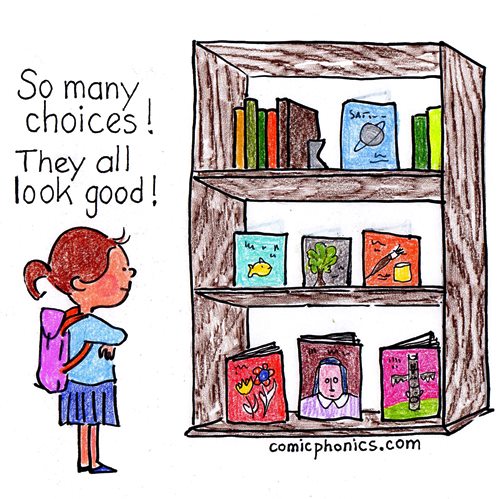
Does having a small number of books in my child’s kindergarten classroom make a difference as long as there is a media center in the school?

girl looking at book displayYes.  It makes a big difference.

Research shows that if children have easy access to reading material, they are more likely to read.  In a classroom with few books, children will read less.

A classroom that encourages reading is bursting with books, magazines, comic books, tablets or whatever will entice children to read.  Some classroom teachers allocate a box per student that at all times is full of books for the child to read.  The box is on the child’s desk or at the child’s feet, but within reach of the child.

Most teachers have a classroom library full of age-level, appropriate books of all kinds.  Before morning classes begin, it is the student’s responsibility to get a book or two for her desk, so if she finishes an assignment early, she can pull it out and read quietly.

Why does your child’s classroom have few books?  Depending on the reason, there are many remedies.

New teachers right out of college usually don’t have a stockpile of children’s books for their classrooms.  Sometimes retiring teachers pass along their classroom books to new teachers, but many times the new teacher depends on her own resources to develop a classroom library.  Some schools offer books to new teachers, but usually not enough to suffice.

So how can you help a teacher to create a classroom library?  You could

  • Contact neighbors to ask for books their older children are no longer reading.
  • Contact used book stores or Goodwill to get boxes of books at a huge discount.
  • Attend garage sales or estate sales and pick up books there for a slight cost.  If you go at the last hour on the last day, you might be able to obtain books free if you will just haul them away.
  • Convince the PTSA to donate money so the teacher could buy books she would like in the classroom.

The books don’t need to be new.  If you go in any classroom with its own library, you’ll see that the books are dog-eared, the bindings are splitting, and pages are taped.  New books are great, but the point is to have many, many books, new or old, for the children to pick up, sample, and read.

Another reason a classroom teacher might not have many books is the socio-economic status (SES) of the community in which the school is located.  A study of 20 first grade classrooms in low SES communities showed these classrooms had fewer books and fewer types of books, and children there used books less than in schools located in wealthier communities.

What can you do to help a classroom teacher in such a school?

  • If the school is a Title 1 School, money might be available to buy classroom books.  Check with your principal to see if some money could be allocated for classroom book purchases.
  • You could ask your PTSA for a “grant” to buy books for your child’s classroom.
  • You could pair up with the PTSA of a school in a wealthier community, which might be willing to donate books to your school.
  • You could find out the names of kindergarten and elementary teachers who retired recently, contact them, and see if they have any books they might be willing to donate.
  • You could contact your local library and see if they have children’s books which they are “retiring” due to multiple copies or the need for more space on the shelves.  Or perhaps they have books that will be tossed because they are torn, soiled or less than perfect.  You could offer to fix them for your child’s classroom.
  • If your community has a city council or neighborhood groups, you could go to meetings and plead for books for the classrooms of the local school.  Chambers of Commerce, church groups and fraternal organizations sometimes have money available.  Or they might have wealthier members who would make a donation in exchange for a tax write-off.

A lot of work?  Yes, but keep in mind your goal:  a print-rich classroom that will encourage children to read.  –Mrs. K

Assessing reading comprehension by using multiplication

Are you looking for a simple way to assess your child’s reading comprehension skills?  Take a look at the “Simple View of Reading.”

Although a “Simple View of Reading” (SVR) was proposed in 1986, its simplicity and success make it a useful tool to assess reading comprehension today.  Almost thirty years ago, two researchers, P. Gough and W. Tunmer, suggested that reading includes two primary steps, decoding words (using phonics skills to figure out words) and language comprehension (knowing the meaning of words especially when words are strung together to form sentences).

They represented their Simple View of Reading with a math equation:

Decoding x Language Comprehension = Reading Comprehension

(This formula uses scores from tests in decoding and language comprehension.  For this formula to work, all scores for decoding and language comprehension must be between 0% and 100%.)

What does this simple formula mean?

  • Reading comprehension requires the child to master two areas, decoding words and language comprehension.
  • If a child can do one but not the other, or can do one better than the other, his reading comprehension score will be only as high as the lower of the two other scores.

How can you use this Simple View of Reading to identify your child’s reading comprehension skills or lack of them?

  • First, ask yourself:  Is my child’s reading problem decoding?  Is his problem language comprehension?  Is he having problems in both areas?
  • If you are not sure, test the child in both areas.
  • You can test decoding by having a child read lists of real and nonsense words.  Lists are available online.  Having the child read nonsense words (e.g., zups, thab, slig) is important because some children memorize the look of a word without being able to sound it out.  Also, to assess decoding, don’t use words from a reading passage because the child might figure out a word from the context.  To test decoding, you must remove context.
  • You can also test decoding by reading an unfamiliar passage aloud and asking the child questions about facts, main ideas, sequencing and paraphrasing .  If he can respond accurately when he is the listener, yet he cannot do that when he is the reader, his problem could be decoding.
  • You can test both decoding and language comprehension by having the child read aloud to you.  (If he can pronounce words correctly, or in a few cases, use phonetic pronunciation for unfamiliar words, decoding is not his issue.)  Stop and ask the child what various words mean.  Ask the child to paraphrase a difficult sentence.  Ask the child to paraphrase the passage.  Ask the child to predict what might happen next.  If the child can decode, yet he cannot explain what he has read, his problem is likely language comprehension.  Teachers often see this situation in ESL students who learn the rules of phonics well but whose vocabulary in English is not extensive.
  • To make the evaluation easy, use a scoring method of high, medium, and low based on your own mental tally from working with the child.  If the child scores high in both decoding and language comprehension, he probably does not have a reading comprehension problem.  But if he scores medium or low in decoding or language comprehension, he has a reading comprehension problem.
  • A medium or low score in decoding means he needs more work in phonics.
  • A medium or low score in language comprehension means he needs vocabulary building, work on pronunciation, time listening to a native speaker read a text aloud, and strategies to gain meaning from sentences and passages.

Can writing make my child a better reader?

Yes.  The skills are entwined and reinforce one another if taught together.

  • Brain research shows that the more modes of learning which we use, the more apt we are to remember.  Children who are learning how to recognize a letter shape, or to distinguish between two similar letter shapes, will reinforce reading these shapes if they write the letters as well.
  • Children with poor reading skills often have poor handwriting skills. Yet practice at handwriting (drawing letters with their fingers, forming the shape of letters with their bodies, tracing letter strokes and patterns,  or giving directions to another person on how to write a letter) can improve not only writing skills but reading skills.
  • If a young child likes a certain genre, say fairy tales, and attempts to write one (even just a few sentences), she may encounter problems—how to begin, sequencing, spelling, or how to describe the frog’s voice.  The next time she reads a fairy tale, or has one read to her, she will be more aware of the way another author handled the same problems.  Her reading comprehension will develop in more sophisticated ways than if she had not written her own fairy tale.
  • Sounding out letters and then assembling groups of letters into words is one of the first steps of reading.  Many methods from flash cards to letter tiles help children grasp the connection between letters and sounds, but one of the best methods is writing.  The child wonders about the spelling of a word and sounds it out before writing it down, sometimes erasing, until he is satisfied.
  • Kindergarteners might not be ableGirl reading "inventive" writing of younger sister. to read many words, but if they know their letter sounds, they can write any word they can think of using phonetic spelling.  Then they can read their passage back.  With adult help, they can understand that stories, emails and even books are within their grasp both as writers and as readers.
  • The phrase “reading and writing” puts the reading first, but research in the past thirty years has shown that writing comes first for most children.  The old philosophic idea of a child being an empty vessel who needs to be filled up with knowledge (often from reading) has been shown not to be true.  Children are vessels bursting with ideas, longing for an audience to share them with, sometimes through writing.  –Mrs. K

When my son was in kindergarten, phonetic spelling was called inventive writing.  I loved it since I could read his thoughts even in kindergarten.  But many parents didn’t like it.  They claimed that their children would never learn to spell words correctly.  That has been an ongoing criticism which young adults now blame for their not being able to spell well.  However, with spell-check, this is becoming a moot point.  –Mrs. A

First anniversary

A little over a year ago, Mrs. K and I sat at my dining room table and made plans for a blog and a series of books for early readers. A month ago, December, 17, marked the first year anniversary of our blog. During the past year:

  • We have received more than 10,000 views of our website.
  • Two topics have tied for the most read blogs:
    • how not to mix up b and d, and
    • the meaning of CVC.
  • The third most-read blog was about teaching vowel sounds.
  • Many other well-read blogs concern methods of teaching reading and information about our book apps and funny pages.
  • More than half the views come from U.S. readers.
  • Yet viewers from the U.K, Canada, Australia, the Philippines, India, New Zealand and South Korea also read our blog often.
  • Viewers come from every continent except Antarctica.
Countries of comicphonics.com blog viewers of the past year

Click on the chart to enlarge it.

This information is useful in planning blogs for 2014. We thank you, our readers, for reading our blog, for leaving comments and for making suggestions for future blogs. Our goal is to continue to provide useful information for teaching little children how to read.

Are you running into problems teaching your child to read? Have you come across a new book that your child loves to read? Have you found web sites or apps that your child uses to learn to read? Let us know so we can pass along information to your fellow parents and teachers.

— Mrs. A

My neighbor, who was born in Korea, sends her children to English tutors year-round. Should I do the same? Her children get straight A’s and are in gifted classes.

Tutoring is a way of life in some cultures, including South Korea.  There children go to school for six to eight hours during the day, 220 days a year, and then they go to a tutor for another four to six hours in the evening.  Estimates are that Korean children spend up to 13 hours a day being educated, almost half of that time in the largest private tutoring system in the world. Tutor teaching a child.

The cost is high.  Some Korean parents spend up to half their income on their children’s education, leaving them little money for other expenses.  It also has increased the debt of private citizens.

So why do parents in South Korea use private tutoring?

  • Dissatisfaction with the fairly uniform curriculum available to Korean students;
  • A desire for their children to be accepted at top universities;
  • The option for students to study subjects they cannot get in school;
  • The opportunity for students to receive excellent educations, leading to excellent jobs.

In the U.S., Korean parents continue using tutoring services.  They rarely cancel a tutoring lesson, and when they do, they make it up.  Often, they help their children with math and science homework, but use private tutors for English and social studies.

But in the U.S., many non-Asian parents balk at using tutors. Why?  They might think that

  • tutoring is elitist;
  • tutoring stresses children;
  • tutoring leads a child to believe he is deficient and cannot learn on his own;
  • tutoring usurps the time when children should be playing;
  • tutoring interferes with organized sports programs;
  • tutoring interrupts the time when parents might want to chill out after work.

Yet when you look at the valedictorians and salutatorians of our high schools, or at a breakdown of student backgrounds at excellent universities, you find many privately tutored students of Asian background.

One way of looking at extracurricular learning is that it can add months of learning to each year of a child’s education.  I have personally seen four-year-olds, who don’t know their ABC’s, start working with a private tutor and by the end of kindergarten—after working one hour a week, year-round—able to read at third or fourth grade levels and easily qualify for gifted programs in their public schools.

Should you hire a tutor for your child?  I cannot answer that, but I know that your child will be competing for scholarships, a place in college, and good jobs with children like your neighbors who are being tutored.  –Mrs. K

Many parents have their child participate in after-school sports for hours a day. They will drive many miles to have the child on the elite team or with the best coach.  They will send their child to sports camps and even hire a personal trainer. They’ll fly across the country for gymnastics meets or baseball world series.  They do not consider the athletic endeavors to be stressful, yet those same parents may never consider hiring an academic tutor.  In our typical American culture, too much time spent on academics is considered stressful.  Yet, a child who does better in school may be less stressed at school.  It is a complicated issue.  –Mrs. A

My neighbor hires a tutor to work with her preschool child on reading for an hour a week. Is that really necessary?

Tutoring is a multi-billion dollar industry in the U.S., so your neighbor joins plenty of other parents in using tutoring services. I work as a private tutor, and I have tutored four-year-olds in how to read. Good idea? Bad idea? It depends.

Parents hire reading tutors for many reasons:

  • Many foreign-born parents speak English as a second language. They want their children to learn reading, vocabulary and pronunciation from a native English speaker.
  • Other parents want their children to be the best in the class and can afford to pay for that excellence.
  • Some children are poorly organized and benefit from systematic instruction.
  • Some children have no one at home to help them. The tutor takes on that role.
  • Some parents hire a tutor as a babysitter—someone to develop a relationship with the child and keep the child occupied in useful tasks while the parent is working.
  • Some students have genuine learning problems—dyslexia, for example. The sooner the problem is identified and the sooner the child works with an expert, the more likely the child will keep up with classmates and learn ways to overcome her disabilities

In many Asian countries, using tutors is customary. When parents move to the U.S., they bring that custom with them. In some immigrant communities, almost all the children are tutored, so the children assume that tutoring is normal. Their parents are often engineers or doctors, and expect the same careers for their children. What gave the parents an edge in Korea, Taiwan, India or Shanghai is what they want for their children in the U.S.

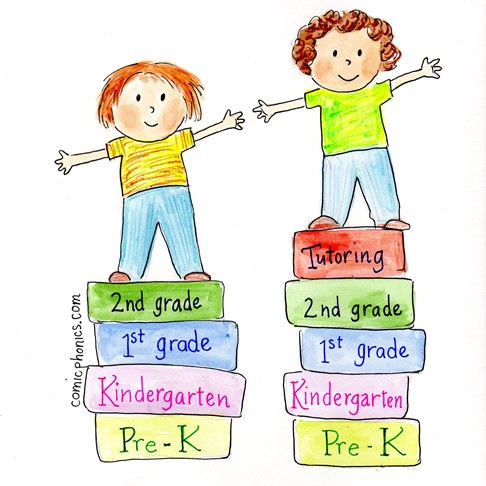
2 kids showing tutoring's advantageOne of the most compelling reasons for tutoring is the amount of extra education it gives a child. A four-year-old who is tutored only during the weeks when school is not in session gains 16 weeks a year of ongoing education. Multiply those 16 weeks by kindergarten, first grade and second grade, and that child will have studied a year more than her classmates when she starts third grade. A year more of education at a time in life when learning is so essential!

One grandmother I know said when her son was young, he struggled learning how to read. By first grade he was already behind and feeling overwhelmed. This grandmother helped her son with his homework, but it was always a struggle. If she had it to do over, she says, she certainly would get him a tutor, and enroll him in a structured summer program. Now it is 25 years later and she sees the same learning style in her grandson. She has recommended that her son hire a tutor for the boy, and he agrees.

Should your child be tutored? If it is just to keep up with the neighbor, maybe not. Talk to his preschool teacher. Read with him yourself. Not every child needs to be tutored, especially those who have an involved parent. I never had an outside tutor, but I had a wonderful mother who read to me every day and helped me with my homework. Don’t underestimate your capabilities or your influence. After all, most of the learning your child has done until now has been with you as his teacher.

Do you have a list of good books for my kindergartener to read? Or for me to read to her?

Yes!  The Common Core State Standards for English Language Arts and Literacy has published lists of recommended books by grade level.  These lists do not include all good books (far from it!).  Rather the lists suggest books of the right complexity and quality for children by grade level.  The lists also suggest the wide range of subjects that a student should encounter in reading.

The Common Core Standards developers would prefer that you use these lists as guides to find appropriate reading material for you child.  One of the criticisms of the Common Core Standards is that teachers will limit themselves to only the reading material listed.

For kindergarteners and first graders, the lists include stories, poetry, read-aloud stories, read-aloud poetry, informational texts and read-aloud informational texts.  Some of the stories are classics such as Are You My Mother by P. D. Eastman and Green Eggs and Ham by Dr. Seuss.  Others are newer stories.

When you read these or any books with your child, pause as you read and ask the child to tell you what is happening.  If there are pictures, ask him what he learns from them.  Ask him what he thinks will happen next.  When you complete the book, ask him what it was about.   Can he name the setting (time and place) and important characters?  Pick out two or three new words and see if he remembers what they mean.

To find complete lists of recommended books for all grade levels, review the contents listing at the front of the Common Core State Standards for English Language Arts & Literacy in History/Social Studies, Science, and Technical Subjects.

Below are the books recommended for kindergarten and first grade.

kindergarten to 1st grade stories.

To enlarge the graphic, click on it.

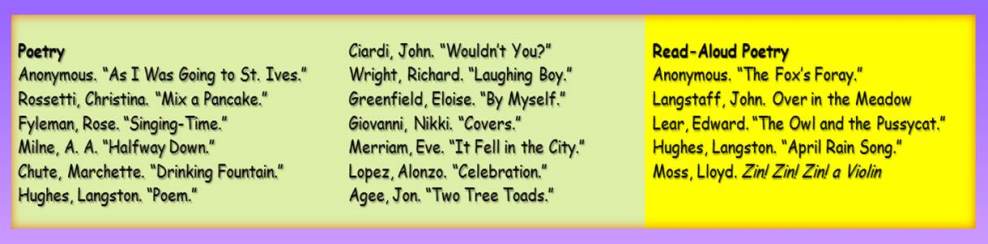
kindergarten to 1st grade poetry.

To enlarge the graphic. click on it.

kindergarten to 1st grade informational text

To enlarge the graphic, click on it.