What’s normal for a child developing spoken language skills?

Is it normal to talk in complete sentences by two years old? Is it normal not to talk at all until five?  Here are some milestones for a normally developing child. But there are many variations on normal.

  • Infants should begin turning their heads toward noises in their early weeks. Loud noises, like thunder or a nearby dog’s bark, should startle them. A mother’s or caregiver’s voice should soothe them.
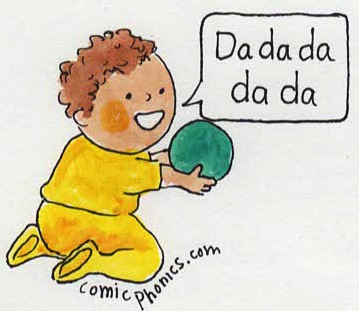
toddler saying dadadada

  • By the time infants are six months old, many are babbling, that is, making lots of meaningless sounds. They might be saying “da-da-da-da-da” over and over. Rarely is a child associating his own voice sound with meaning at this age, yet it has been done. It is also normal for a child not to be babbling at half a year. If he is curious about his world and smiles when he sees people and things he loves, or when he enjoys experiences, he’s probably developing normally. No need to worry.
  • From six to twelve months, children love to mimic adults. If you wave bye-bye, the child will wave bye-bye. If you stick out your tongue, the child will stick out his tongue. If you talk a blue streak while looking at him, he might try to babble back. What he says isn’t important, but his efforts to babble are. Yet some perfectly normal children won’t babble yet.
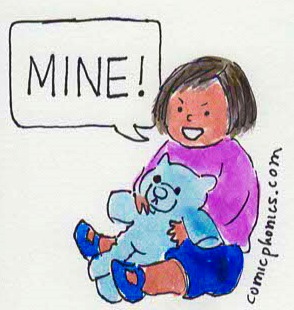
child saying Mine!

  • At around a year old some children begin saying meaningful words. Usually they are nouns like “dog” or “mom,” but “mine” and “no” are sometimes first words too. Children might gesture with their early words to add meaning. Between twelve and 18 months, children add new words and use them correctly, usually one at a time.
  • Between 18 months and two years, children usually begin putting words together in tiny sentences, such as, “No, no Miss” or “Nana bye-bye.” However, some might be chattering in complete sentences by the time they are two, and carrying on meaningful conversations, almost always child-centered. Usually they combine gestures with speech for added meaning.

child says Nana, Pay me!

  • By two, if a child is not talking, or if she depends almost exclusively on pointing or grunting, this could be normal behavior. But more likely it is a sign that the child should be seen by a speech pathologist for testing. Many school districts offer services for preschoolers with delayed speaking.
  • However, at two years old it is normal for children to mispronounce words since they are learning vocabulary rapidly and might be mixing up certain words which sound similar. Or they might be tripping on sounds which are more difficult to say. If that happens, repeat the word properly in a reply to the child so the child can hear the word, but don’t focus on correcting the child. Mistakes are usually temporary.

Child says Papa goed home

  • Between two and three years old, children develop larger vocabularies, adding a new word each almost daily. They add action verbs and adjectives. More and more they talk in small but complete sentences. They may leave out articles, yet they are picking up the rules of grammar (subject first, verb next; adjective first, noun next). You know they are learning grammar when they put the “d” sound at the end of irregular verbs to make the past tense, such as “Nana drived car,” or “I seed Daddy.”
  • Some children stutter as they are learning to speak. This is not usually a problem for the child (unless someone makes fun of him) but it can be frightening for the parent. When this happens, resist your urge to think the sky is falling. Instead, slow down with your child, listen to him without interrupting, and never show any sign that his speech is abnormal. If it doesn’t subside in a month or two, then contact your pediatrician.
  • Between three and four children should be speaking in small sentences. Their spoken vocabularies should continue to expand—more if they interact with well educated adults or if someone reads to them frequently. They should be using the past tense appropriately. Some children will be able to tell small stories and carry on simple conversations. Some will speak in much longer sentences and chatter nonstop. Even so, certain letter sounds might still be giving them problems.
  • By four to five years old, children should be able to talk in sentences, to tell little stories, to repeat rhymes and to enjoy word play. If the child is struggling to speak, or if she refuses to speak, she should definitely be referred to a speech pathologist through the school system. Many school districts offer early education focusing on speech to such children.
  • What if a child asks for help with words? Congratulations. Your child has learned that you can be trusted to help her learn. She will learn faster if she is willing to ask for help, so encourage her to ask questions. A child’s questions can drive a parent crazy, but asking you questions is your child’s fastest way to learn.

For more information, check out the work of Jules Csillag, a speech pathologist at http://www.julesteach.es. Also, online or in the library are many sources for normal child development, including language development.

Reading to kids is important to expand their vocabularies

We all know that reading to kids is important. Now there is more research to back up this “chicken soup for the brain” of little kids.

family reading togetherAccording to Jessica L. Montag, a researcher in the Department of Psychology of the University of California, Riverside, and her colleagues, Michael N. Jones and Linda B. Smith, reading, as opposed to talking to children, is important because reading exposes children to many more new words than they would hear from spoken language alone.

Montag took 100 picture books which appear on lists of excellent books for children. She analyzed the words in those books. Then she compared the words with spoken language of caregivers talking to little children. Her research was published in August.

What she found is that the books use more words and different kinds of words than do parents, teachers and caregivers of young children. In fact, the books use 70% more unique words than did the speech. Also, the text provides different types of sentences, sentences of varying complexity, and sentences of different lengths. The books introduce topics outside the parents’ and children’s normal lives, exposing children to new ideas and the vocabulary associated with those new ideas.

So if you’re tempted to skip the reading some days, or to just look at the pictures, think again. The text is important to growing a child’s vocabulary, and a large vocabulary is associated with successful independent reading.

Comparing Common Core ELA test results in different states is like comparing apples, oranges, pears, tomatoes, kiwi, quince, cherries, raspberries. . .

One of the professed goals of the Common Core curriculum is that test results of students in one state, such as Georgia, can be compared to the test results of students in another state, say Connecticut.

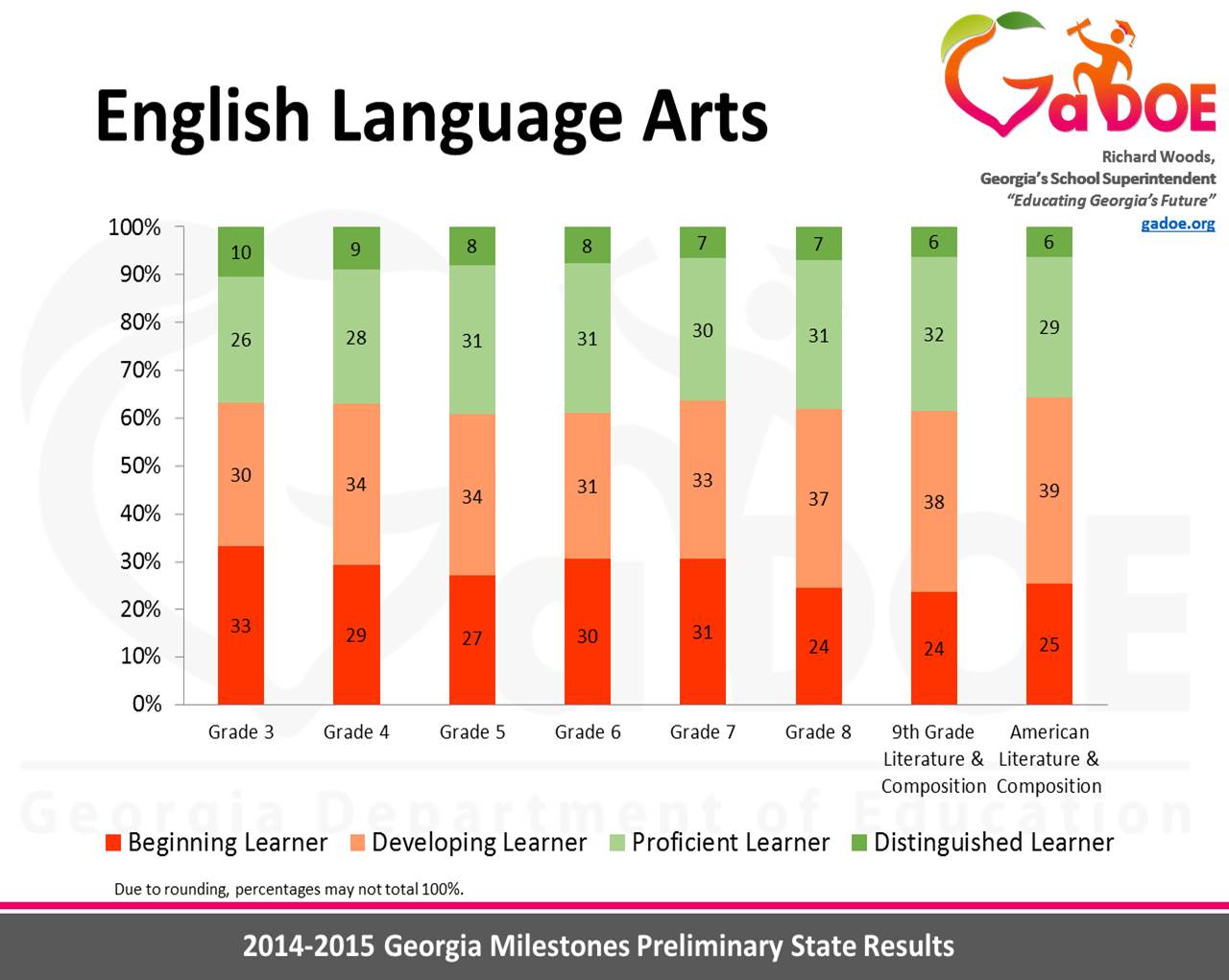
table showing ELA test results in GA by grade

Click on table to enlarge it.

But the truth is, it can’t be done. Students all over the country took more than a dozen different tests this past spring. Fourteen states’ students took the same test, so their results can be compared. So can test results for students from another seven states who took the same tests. But then there are states like New York and Georgia which wrote their own tests. Student scores from those states can’t be compared to any other state’s student scores. And maybe that is the point, considering the horrible test results dribbling forth.

The Smarter Balanced Assessment System created a test used by 14 states, mostly in the western US: Hawaii, Washington, Oregon, California, Idaho, Nevada, Montana, North Dakota, South Dakota, Missouri, West Virginia, Vermont, New Hampshire and Connecticut.  Here are the results issued to date.

  • California has delayed the release of its test results until September 9, even though, by law, results should have been published in August. California has also removed from its Department of Education website data of past years’ test results in ELA and math, the two subjects tested with new tests this past spring, so that comparisons between the old and new test scores cannot easily be made. Insiders say the new test results are dismal. The state blames the delay on revealing specific results on the launch of a new web site to showcase the data. California says it wants to ensure that the test results are accurate.
  • New Hampshire will not release results until November, saying that since many students took the test with pencil and paper, not computer, it takes longer to score and record the results. New Hampshire has announced that its high school juniors will not take the Common Core test in the future, but will instead take an SAT exam.
  • Connecticut, which released its results at the end of August, shows that 55.4 percent of students in all grades passed the ELA test. About four percent of the state’s students boycotted the test.
  • In Missouri, 59.7 percent of students passed the ELA test; however, minorities and low income students scored 13% lower scores than the rest of the students. However, in June the state legislature banned future use of the test in Missouri.
  • In Oregon, 47 percent of third graders passed the ELA test.
  • West Virginia’s Department of Education said the majority of its students scored less than 50% on the tests, except for fifth graders who scored 51%. Third graders scored a 46% proficiency rate.
  • 48 to 61 percent of Idaho students passed the Idaho ELA test. Complete results will be out in October.
  • 53 to 62 percent of Washington State’s students passed the ELA test.

The Partnership for Assessment of Readiness and Careers created a different test used by seven states: Colorado, New Mexico, Illinois, Louisiana, Maryland, New Jersey, and Massachusetts. Washington, D.C.’s students also used the test. No test results have been issued.

Twenty-three other states, including Georgia, made their own tests or decided to leave the Common Core.

  • In Georgia, 36 % of test takers passed the ELA tests written by Georgia.  On September 3, Georgia announced that of the third graders who took the ELA test, 36 percent passed. 26 percent did okay while 10 percent did better than okay. Almost 2/3 of students failed.
  • In New York, 31.3 percent of test takers passed the ELA tests written by that state. Ten percent of eligible students opted out of taking the tests, skewing the results. Gov. Andrew Cuomo, a defender of the Common Core Standards, said today he is forming a commission to revamp education in NY.
  • Arizona inaugurated its own test this past spring, but results will not be announced until October.

And five states have not taken part in the Common Core: Texas, Nebraska, Virginia, Indiana and Alaska.

Was Georgia’s test harder than New York’s or West Virginia’s? No one knows. It was a lot harder than the Criterion Referenced Competency Test (CRCT) that was given in Georgia in past years, according to the state superintendent of education, Richard Woods. In a statement, he said, “Our previous assessment, the CRCT, set some of the lowest expectations for student proficiency in the nation, and that cannot continue. Georgia Milestones sets higher standards for our students and evens the playing field with the rest of the nation.”

We will have to take Mr. Woods’ word that the new Milestones test “evens the playing field with the rest of the nation” since the Georgia test was given only in Georgia, and like apples and raspberries, cannot be compared to test results in other states.

A breakdown of Georgia results will be released by the Georgia Department of Education in October, as will the results of many other states.

One way to learn English vocabulary: Study Latin and Greek roots

When I was in high school, studying Latin, I experienced one of those “light bulb” moments when I discovered that many of the words I used every day in English came from Latin. And I realized that if I could learn Latin words, I could increase my English vocabulary exponentially!

child looking at a unicycle, bicycle and tricycle

Even young children can increase their vocabularies if they learn Latin and Greek roots. For example, suppose a child plays the game “Uno.” The child learns quickly that “uno” means one. But so do many words that begin with uni. Uniform means one kind of clothes worn every day. Unite means everybody becomes one big group. Universe means one huge collection of stars and planets. Unicycle means a bicycle with one wheel.

Teaching children new vocabulary words using Latin roots has many advantages.

  • Many ESL children who come from Latino backgrounds already are familiar with many Latin roots and the meanings of the roots because the roots and meanings are the same or similar in Spanish, Portuguese and Italian. Connections to new English words are already a part of their vocabularies.
  • Instead of children learning isolated words which bear no relationship to one another, children can learn word families which are connected by a single idea. For example, “ped” in Latin means foot. Pedal, pedestrian, and pedicure all have meanings related to feet.
  • Children can combine two roots to understand some English words which don’t need to be studied separately. For example, bicycle comes from “bi” which means two and “cyclus” which means circle.
  • Certain areas of study, such as biology and mathematics, use Latin or Greek roots for basic vocabulary. Children who are fascinated by dinosaurs can look at pictures of many different kinds and notice that many names contain the root “–saurus” which means “terrible lizard.” Others have names with the root “pod” which means foot or feet.

One way to begin learning vocabulary from Latin and Greek roots is to have children study the words for numbers, from which there are so many derivations.  Duo, meaning two, has led to duet, duel, and duplicate.  Tres, meaning three, has led to triple, tricycle and triangle.  Quator, meaning four, has led to quarter, quart, and quatrain.

Online you can find many Latin and Greek root vocabulary-building websites as well as workbooks devoted to teaching vocabulary through roots. I am mystified why this way of approaching vocabulary is not used more often. I considered it a short cut way to study for the SAT!

Teach children to predict, an important reading skill

Predicting means anticipating ahead of time what might happen in a story. As adults, we do it all the time. We read a murder mystery and we predict “who done it.” We read a romance and predict how the couple will get together. We read a thriller and predict if the characters will escape.

Predicting is more than making a guess. It is using what we already know and applying it to a new situation. When children predict, they make a connection between what they know and what they don’t know yet. They increase the likelihood that they will comprehend what they read. Wild guesses are not predictions.

Predicting from what we know to what we don't know graphic

Predicting focuses little children on what they are about to read. By looking at pictures, titles, subtitles, charts, photos, cartoons and other graphics, they grasp an idea about a story. Predicting attracts the child to a story. She wants to know if her prediction is correct. Predicting forces children to use visual or word clues to create meaning.

The Common Core State Standards include predicting in the reading standards.

However, predicting does not come naturally to all children. Children with dyslexia might be able to predict in a real life situation when there is no reading involved, but because they struggle deciphering the phonics code, they lose track of the meaning. Some children with dyslexia also have trouble sequencing. If so, predicting what will happen next is difficult.

Autistic children may also have trouble predicting since they have trouble interpreting social clues. The text might say that a character froze and was unable to talk, but the child might not know that the character is scared. How then can he predict what will happen next?

Here is a method of predicting that can be used with children of all ages. It combines vocabulary with predicting.

  • Go through a picture book or reading selection before the student reads it. Write down a dozen or more vocabulary words important to understanding the meaning of the text. Choose words which the child is likely to already know plus one or two new words.
  •  Write or type the words clearly on a paper, and then cut apart the words. Have one set of words for each pair of children if children are working in pairs. Put the words in plastic sandwich bags.
  • Explain to the child that he will be predicting what a story is about. He will be acting like a detective by using word clues.
  • Let the child pull out one word from the bag, read it aloud it and tell you what it means. If the child can’t read yet, tell him what the word says. If he doesn’t know the meaning, explain it to him. Lay the word on the desk or table in front of the child.
  •  Ask him what he thinks the story will be about based on that one word. Accept his answer.
  • Let the child pull a second word, repeating the previous two steps. Continue until all the words are read aloud. Encourage the child to change his mind about the prediction, or to become more convinced with each word.
  • Now ask the child to sort the words into categories or groups. (This step might be too advanced for some preschoolers.) Again, ask what he thinks the text might be about. Accept all answers, but gently steer the child into a prediction related to the text.
  • Now read the text. As you or the child read, note words the child pulled from the bag. Ask if the child still thinks his prediction is correct, or if he has changed his mind.
  • When the reading selection is complete, remind the child of his prediction and ask if he was correct.  Look at the words again.  Talk about what words helped and what words didn’t.  Ask what other words might have made the prediction closer to the truth.

Common Core English/Language Arts test results becoming available

Common Core test results for students tested at the end of the 2013-14 school year are beginning to be released. The youngest readers tested are third graders. Here are the results for grades 3 to 12 from the three states which have made public their results so far for the English/Language Arts tests:

Child writing with right hand.

  • In New York, 31.3% of students scored proficient or better, meaning more than 2/3 of the one million students tested flunked the English test.
  • West Virginia’s Department of Education said the majority of its students scored less than 50% on the tests, except for fifth graders who scored 51%. Third graders scored a 46% proficiency rate.
  • In Missouri, 59.7% passed the test; however, minorities and low income students scored 13% worse than the rest of the students.

Although students in these states did not take the same tests, they were tested on the same concepts.  Comparing the proficiency rates from one state to another is not fair since students took different tests and many eligible students opted out of taking the tests.  In New York, 200,000 students refused to take the tests.  These students fit the profile of white, with lower test scores, and from less needy areas.  This means a large number of students who might have raised the overall state test results did not take the test.

More states are expected to release test results later this month.

New York released a prompt which its third graders were required to read for their test. NY also released six test questions related to that prompt. Click here to see the prompt and the questions. If you find the test questions hard, so did NY third graders.  More than half the students missed two of the questions.

Is the Common Core’s emphasis on nonfiction reading justified?

Perhaps the biggest change the Common Core is bringing to public school reading in the US is its emphasis on reading more nonfiction and less fiction. The reasoning behind this change is to prepare students better for the reading they need to do in their math, science and social studies classes and in their future careers, especially in STEM fields (science, technology, engineering and math).

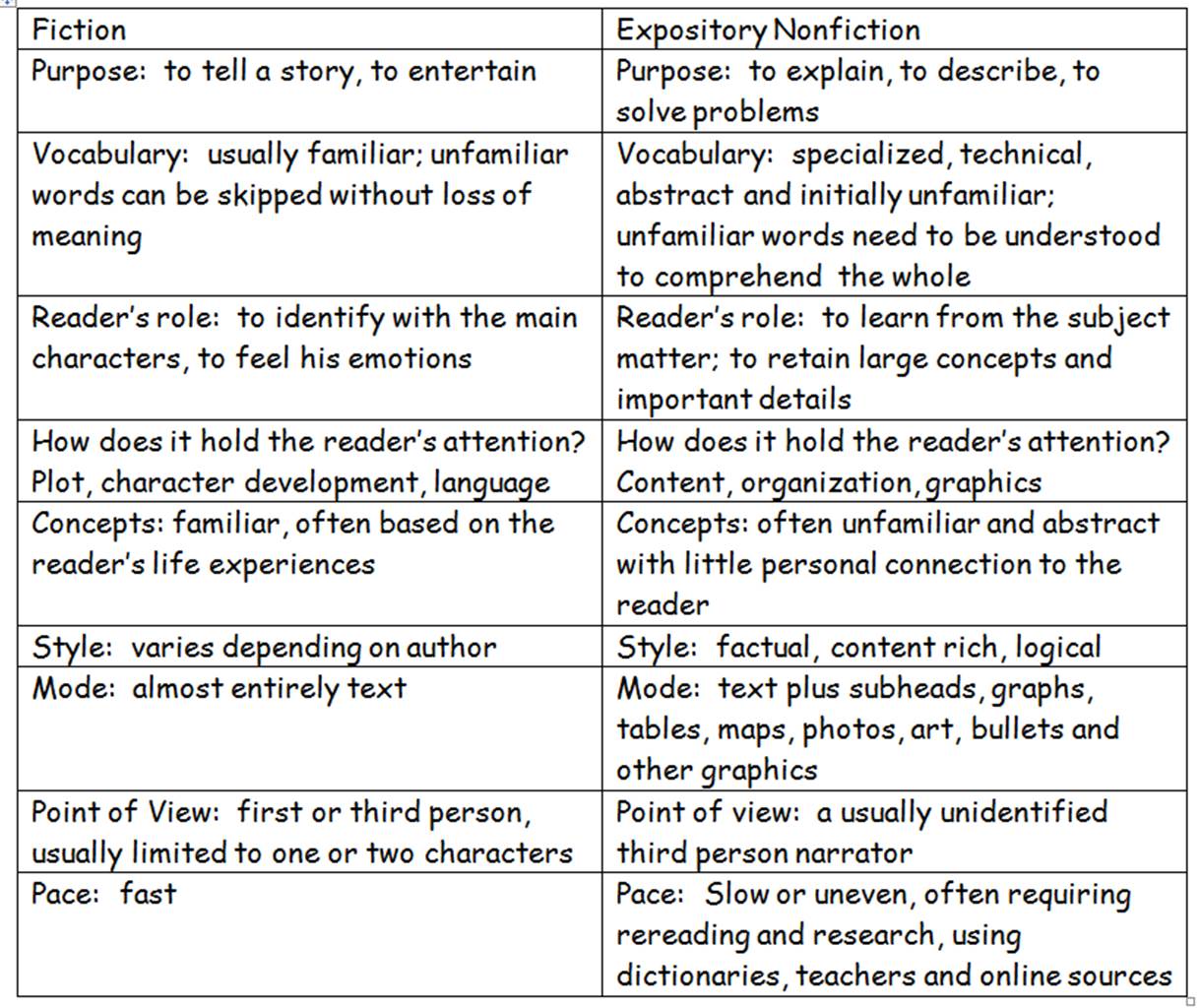
Is the change really necessary? Let’s compare fiction reading and nonfiction reading for students who are beyond the picture book stage.

chart comparing fiction reading skills with nonfiction reading skills

(Adapted from State of Wisconsin, Wisconsin Governor’s Literacy Education and Reading Network Source)

As you can see, reading nonfiction is harder than reading fiction. It often requires more parent or teacher involvement prior to the reading to make connections to what the student already knows; during the reading to explain vocabulary and concepts; and after the reading to restate the main ideas and important details or to explain complicated concepts.

Fiction, too, can be better understood with teacher involvement, but usually fiction can be appreciated (if to a lesser degree) by the student reading alone so long as the student’s reading level matches the reading selection.

If you hope your child will have a great career someday as a doctor or environmentalist or physics teacher, you can appreciate why an increased emphasis on nonfiction reading is important even in first grade. You may question the Common Core, but its emphasis on more nonfiction reading can only help our kids.

Help children determine shades of meaning

Shades of meaning can be difficult for some children to interpret. What’s the difference between “yell” and “holler” or “huge” and “enormous”?

Dr. Timothy Rasinski, a professor at Kent State University, has come up with a fun way for children to work on distinguishing between close meanings. Here’s what he suggests:

  • 3 images of a muscleman--skinny, with muscles, really builtGo to the paint store and select five paint chips which are slightly louder or softer than one another, or darker or lighter. For each student you are working with, pick several sets of these color chips. The colors themselves don’t matter, but they should show incremental differences in color.
  • Offer the student three to five words  to distinguish among, such as whisper, state, exclaim, yell, and murmur. Give younger children fewer choices.
  • Let the child choose the word with the weakest word meaning.  Ask the child to write that word on the weakest color chip. Then let the child choose the strongest word meaning and write that word on the strongest color chip. Let the child arrange the other words in order on the other chips.
  • Have the child lay the cards on a table from weakest to strongest or vice versa. Let the child discuss why he chose the order he did.
  • For really young children who cannot read yet, pictures can be used instead of words for some ideas.

What kinds of word choices work well for this exercise? I would use verbs, nouns or adjectives that are similar. Go to a thesaurus to find near synonyms such as must, ought to, should; ignore, neglect, let slide; tuba, trumpet, trombone, flute, whistle.

Provide words from varied disciplines: square, rhombus, quadrilateral, rectangle; knoll, mountain, peak, ridge, hill; quiet, silent, still, peaceful, hushed; business person, entrepreneur, magnate, tycoon, merchant; eagle, hummingbird, dove, raven, peacock.

Many times students will disagree on the ordering. What is important is not the choices they decide on, but the thinking they use to make their choices. If you have an urge to say, “No, this one should come before that one,” let the child explain his thinking, and as long as it makes sense, accept it. This is a game in which the process is more important than the end result.

Making small words from big words—a variation for beginning readers

What if a child is truly a beginning reader still learning CVC words? Can the game of finding small words within big words or phrases still be used to improve the child’s understanding of words and spelling? Not exactly, but if you limit the letters strategically, a beginning reader can play.  Here is how.

children moving letter tiles

  • Instead of writing a big word or phrase such as “New Year’s Day,” write a handful of letters, including only the vowels and consonants which the child has learned.
  • If the child has learned only short a words (cat, ham, fad), write the vowel “A” at the top of the page followed by a handful of letters which you know can be used for form short a CVC words. B, C, D, H, R, and T might be good letters to begin with.
  • You could also use letter tiles (Scrabble letters, for example) so that the child can move letters around. Tactile experience helps young children in learning and makes the learning seem more like a game. Also, the child doesn’t have to hold letter patterns in his head; he can manipulate various letters until he finds a word which then you or he could write down.
  • Demonstrate to the child how mixing up the letters can form words. Write B A T and B A D, showing where you got those letters, and using enough examples so the child knows what to do.
  • The competition aspect of the game might be for the child to “beat” his last score, that is, to find more words than the last time.
  • As the child learns more CVC vowels, two vowels can be used with six or seven consonants. I recommend starting with A, then O, and then U.  E and I take longer to learn since they sound similar, so I would use them indeptndently (A and E, for example, or O and I) until the child is confident with all CVC words.
  • This is a game which pairs of children can play together as a team, providing one child does not dominate, leaving the other child out.
  • Restricting the number of letter choices can help the child to focus, so do limit the number of vowels and consonants for beginning readers. Once the child is an experienced reader, he can “graduate” to the longer word or phrase game we discussed previously.

Play word games to encourage or to reward reading

When I tutor reluctant readers or bad spellers, sometimes I reward them with a word game in the last five minutes of an hour-long lesson. The kids love the game and ask at the beginning of the next lesson if they can play again. I never play this word game at the beginning of a lesson or they will balk at doing other kinds of reading work, but it is great as a reward.
This game is also a good game to play in the car on long trips or when a child is bored. It turns dead time into learning time.game of breaking up a big word into little words

  • Start by choosing a long word or a phrase. I try to relate the word or phrase to the season or to what we are studying. For example, “NEW YEAR’S DAY” or “JUNIE B. JONES” might be appropriate. After the first game, the child will want to choose the word or phrase, but you must steer him to pick an appropriate word or phrase for the game’s purpose.
  • The word or phrase should have ten to 15 letters but not many more or the game becomes too easy. Good words or phrases to work with contain several vowels, including the letter “E.” Bad words or phrases contain few vowels, do not contain the letter “E” and repeat many of the consonants.
  • I write the word or phrase at the top of a blank paper, often in all caps, so the child realizes capital letters are irrelevant.
  • Next, I explain that we are going to make little words from the big word or phrase, using the letters in any order. So for the phrase “NEW YEAR’S DAY,” I might write “ear,” “way,” and “weed,” and point out how each letter in the little words is part of the phrase.
  • I also point out that if there is only one “N” in the original word or phrase, then there can be only one “N” in the made up words. Also, if there is punctuation in the original word or phrase, it can be ignored or used.
  • The object of the game is to find as many small words as possible in five minutes.
  • Eventually you want children to discover word families, words whose letters can be moved to create other words (tea, eat, ate), words within words (heard, hear, ear, he, head), and how having certain letters (E and S, for example) makes the game easier. This shows the child is thinking about word patterns.
  • I help younger children find words, and show them word families that can be made by changing a single letter. Once they understand the game, they usually do not want help.
  • For older children, I compete with them, sometimes giving them a handicap.
  • At the end of five minutes, if there is not a competition, the game ends. If there is a competition, the child names his words aloud, and if he and I have duplicates, we cross them out. His score becomes the number of words he has without duplicates plus the handicap.
  • Additional points are given for words of five letters or more and perhaps for the word which is the longest and which seems to be the most clever use of the original letters.
  • I allow proper nouns, but I do not allow repeating the words in the original word. You can make your own rules depending on the ability level of the child. Some children will put an “S” on every noun.