Ohio’s almost C grade = Illinois’ F grade on Common Core English tests

Between 33 to 38 percent of third through eighth graders in Illinois “met expectations” or “exceeded expectations” on the language arts part of the 2015 Common Core test. So in Illinois about one-third passed.

Across the border in Ohio, students who took the exact same test.  About 40 percent of them scored at the same levels as in Illinois. However, Ohio is saying that an acceptable score is lower than in Illinois. Using Ohio’s terminology, 60 or more percent of students scored at “proficient” levels. So in Ohio about two-thirds passed.
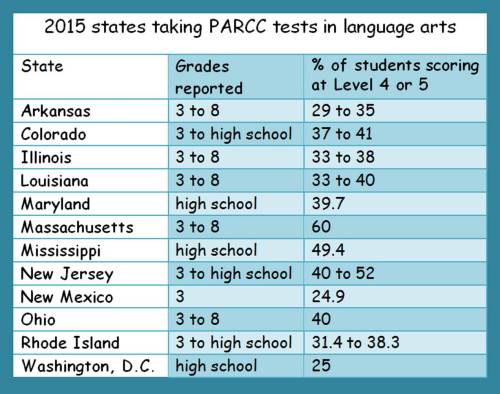
chart showing state results on PARCC LA tests taken in 2015


What gives? In Ohio if a student is approaching a C score on the test, he passes. In Illinois, if he has the same score, he fails.

A failing score means a student is not ready for the next grade, and if he continues at the same rate, he will not be prepared to enter college or a career.

The test maker, Partnership for Assessment of Readiness for College and Careers (PARCC), did not identify what score it considers to be a minimally passing score. It left that to the states. However, it did divide test scores into five broad categories:

• Level 1, Did not yet meet expectations (a minimum score of 650);
• Level 2: Partially met expectations (a minimum score of 700);
• Level 3: Approached expectations (a minimum score of 725);
• Level 4: Met expectations (a minimum score of 750); and
• Level 5: Exceeded expectations (a minimum score of 810).
• A perfect score is 850.

Illinois defines a passing score as either a Level 4 or Level 5; Ohio defines passing as a Level 3 (although Ohio uses different terminology, calling a Level 3 score “proficient.”)

My dictionary defines “proficient” as having an advanced degree of competence; an expert. Yet students scoring “proficient”in Ohio do not know what is expected in their grade level.  Semantics?

Before the test scores were announced, Ohio dropped out of future PARCC testing.

Other states which used the PARCC tests have announced results using the PARCC categories. Their results, as hyperlinked from a PARCC website, follow. Not all states reveal complete data to make a one-on-one comparison. Some states had large numbers of students not take the tests. Direct comparisons are difficult to make considering all the variables. All scores shown below are for language arts only.

  • Arkansas’ results show a range of 54 to 66 percent of students scoring at a Level 3, 4 or 5; and a range of 29 to 35 percent of students scoring at a Level 4 or 5 in grades 3 to 8.
  • Colorado’s results show 37 to 41 percent of students in grades 3 to high school met or exceeded” expectations. Definitions of “met or exceeded” were not provided.
  • Louisiana’s results show a range of 64 to 74 percent of students scoring at a level 3, 4 or 5; and 33 to 40 percent scoring at a Level 4 or 5.
  • Maryland’s results for 11th graders show 39.7 percent scoring at a Level 4 or 5.
  • Massachusetts’ results show 60 percent of students in grades 3 to 8 scoring at Level 4 or 5; and 83% scoring at a Level 3 or better.
  • Mississippi’s results show 49.4 percent of high school students scoring at a Level 4 or 5; and 72.7 percent scoring at a Level 3 or better.
  • New Jersey’s results of grade 3 through high school students show 40 to 52 percent scoring at a Level 4 or 5 while another 20 to 28 scored at a Level 3.
  • New Mexico does not list statewide results as a whole. But for grade 3, 24.9 percent scored at a Level 4 or 5; and another 23.6 scored at a Level 3.
  • Rhode Island’s results of grades 3 through high school show 31.4 to 38.3 of students scoring at Levels 4 and 5; and another 19.3 to 30.5 scoring at Level 3.
  • Washington, D.C.’s results show 25 percent of high school students scored at Level 4 or 5; and 37 percent scored at level 3, 4 or 5.

What does it all mean? If your child took a PARCC test, check the numerical score and ignore the terminology. If the score is 750 or better, relax.  If it’s lower, recognize that your child’s education is not up to snuff, according to the new Common Core State Standards. Then decide what you are going to do about it.
 

How to make your child a confident, competent reader

If you want your child to become a good soccer player, what should your child do?child kicking soccer ball

  • Read the life of soccer great, Pele?
  • Watch reruns of great World Cup games?
  • Practice, practice, practice running, blocking, swiveling, interfering, kicking and scoring?

If you want your child to become a good piano player, what should your child do?child playing violin

  • Prowl through Mozart’s haunts in Vienna?
  • Listen to Erroll Garner perform multiple versions of the same tune?
  • Practice scales, practice chords, practice phrases, practice, practice, practice?

And if you want your child to become a good reader, what should he or she do? boy reading on the floorRead, read, read.  Becoming a good reader, like becoming a good athlete or musician, is a skill.  It  needs to be honed by thousands of hours of practice. There’s no shortcut.

Parents pay me to tutor their children in reading, yet between our lessons, many children do no reading. Would you pay a coach to work with your son in a batting cage for an hour a week and then expect the boy not to wait a week to hit the ball again?  Would you pay an art teacher to work with your child an hour a week and then allow the child not to pick up charcoal until the next lesson?

If you want your child to improve his reading, then he needs to practice daily. Few classroom teachers allocate a half hour or an hour of class time daily to active reading instruction. If you want your child to improve as a reader, it’s up to you to provide reading time for him and for you.

How? Find books, magazines, online information or other kinds of reading that will interest your child. Lists of books by grade and topic abound on the internet. Have him read aloud to you. Notice what his strengths are and what his weaknesses are. Does he have trouble pronouncing words or knowing what they mean? Does he skip punctuation? Does he slur over big words? Does he skip whole lines of type as he reads? Does he miss inferences? Does he read without emotion, without inflection?  Does he mispronounce certain letters?  Then these are areas he needs to practice with you to help him.

Even if you are not an English teacher, you are a reader and can offer your child feedback on his reading. Model how reading is done. Don’t let him read off by himself. You need to be involved, to hear how he reads so that you can offer help.
Good readers self-monitor, stopping when they realize they aren’t getting it, but poor readers don’t. Help your child to get over the notion that one read through is enough.

If you want your child to be a confident and competent reader, you cannot depend on the schools. You must get involved. Even if you hire a tutor like me, you must get involved to be sure your child practices between his lessons. Practice is the only sure way to learn a skill.

Should kids leave kindergarten knowing how to read?

Yes, kids should finish kindergarten knowing how to read, according to a survey of kindergarten teachers. Eighty percent of teachers said yes in 2012, up from 31 percent in 1998.

boy reading

This change in thinking about kindergarteners’ reading achievement was discovered through research by the University of Virginia. The researchers looked at surveys of 2500 kindergarten teachers in 1998 and compared them with surveys of 2700 kindergarten teachers taken about five years ago.

Expectations of kindergarteners today are more like expectations of first graders in the recent past. According to the teachers, students should enter kindergarten knowing the alphabet and they should leave kindergarten knowing how to read.

Why the change? Credit (or blame) the 2001 No Child Left Behind law which required third graders to be tested in English language skills.  To raise third graders’ achievement levels, teachers needed to find more time to teach the basics.  That time was found in kindergarten.

This pressure to learn academic skills at younger and younger ages has come at a price, according to the researchers. The amount of time kindergarteners spend in art, music, play and child-selected activities has decreased.

Is this change good or bad for children? We will need to wait for future research to answer that question.

How to overcome inference problems

If you know a child has trouble with inference (reading between the lines to come up with an idea which has not been stated but which the reader should know is true), here are some ideas to help.

child questions Rapunzel's actions

  • Go online and search for reading selections with inference questions. Make sure they are the right grade level or age for your child. Ask the child to read the selections aloud and then answer the inference questions provided. Help the child to make connections.
  • Expose your child to various times, places and cultures. Fill in the gaps in his knowledge. Together  read books or watch a TV show or go to a baseball game. Ask your child what seemed strange or unusual, and what reminded him of his own life.  ESL students need to know more about American culture to understand inferences and English language idioms.
  • Model inference-making as you read aloud to your child. “You know what I think will happen next? I think blah, blah, blah. What do you think?” Or, “Cinderella’s stepsisters are so mean. I bet something bad happens to them because they are so mean. What do you think?”
  • Expand your child’s vocabulary. If you encounter a new word or two while reading, explain the word. Use it later that day and the next day. Offer the child a reward—a high five—if he can use the word properly. Don’t baby his vocabulary. Use real words and real grammar. Let your child overhear you using an adult vocabulary, and explain a word if he looks perplexed.  Don’t wait for him to ask.
  • While reading, stop and ask about pronouns. “Who is the ‘he’ in this sentence? What does ‘it’ mean in this sentence? Problems with pronoun antecedents are common, so common that the SAT offers questions to see if high school students can figure them out.
  • Before your child starts to read a story, offer background information. Recently I was working with a sixth grader who was reading a Sherlock Holmes story. I asked who was telling the story. My student had not stopped to consider this, and when he did consider it, he didn’t know. I asked when the story took place? Again, he was clueless. Don’t assume. Provide helpful information to make a story or book clear.
  • When a student makes an inference connection, ask her how she knows. She might be guessing. Let her prove she has picked up the right clues.

Not understanding inference leads to reading comprehension problems

Inference, or reading between the lines, is the ability to use two or more ideas to arrive at another idea which hasn’t been stated.  For example, you see someone come into your home wearing a wet rain coat and carrying a wet umbrella. You can infer that it is raining out even though no one has said so.

A student with poor inference skills has reading comprehension problems.

one child says "when pigs fly" but the other child doesn't understand

But there are many kinds of inferences which children must learn:

  • Pronoun antecedents:  In the sentence, “Mary gave her dog a hug,” the child needs to infer that “her” means Mary.  Figuring out pronoun references is a kind of inference.
  • Physical or emotional responses:  In the sentences, “Alan read the math problem. He frowned,” the inference is that Alan read something puzzling.
  • Cause and effect:  In the sentences, “Mom put the baby on the floor. Mom left him alone for a moment,” the inference could be the effect of a cause. What will the baby do? Will the baby do something dangerous?
  • Cumulative ideas:  When Junie B. Jones hides in a classroom cupboard, plays with clay she isn’t supposed to play with, and sticks dozens of bandages from the nurses’ office on herself, the reader can infer that Junie is a mischievous, fun-loving kid who doesn’t follow the rules.

What leads children to have problems understanding inference?

  • Vocabulary:  If a child does not understand the meaning of a word, and the inference depends on that meaning, making an inference is difficult. ESL children have this problem. I have worked with children who mix up he and she, him and her, or who use those words interchangeably. But native English speakers with limited vocabularies also miss inferences.
  •  Idioms:  ESL children are confounded by idioms and cannot make an inference from words which they interpret literally.
  • Working memory: If a child with a poor working memory must hold a certain idea in his mind over several sentences, making an  inference can be hard.
  • Predicting: Some children do not make predictions while they read. Perhaps they are focusing intently on decoding words or on pronunciation, and they have no mental energy left to make sense of what they read. Or perhaps they have never been taught to ask “why?” while they read. I work with a middle schooler whom I stop while we read together. I ask, “What do you think will happen next.” He always says the same thing. “I don’t know.”
  • Background knowledge:  Children who have encountered a situation, or who have heard their parents talk about a situation, or who have seen a situation on TV will have an easier job of making connections to what they read. Sheltered children without much life experience will have a harder time making inferences.
  • Cultural differences:  A child from one cultural background—say, Chinese—might not understand subtleties of a story about an Italian immigrant child from 100 years ago. Or an only child might miss inferences clear to a child from a large family.

In our next blog, we’ll talk about how you can help your child overcome inference problems.

Ways to strengthen children’s working memory

How can you help a child with a poor working memory to increase reading comprehension?

child playing card memory game

  • Play memory games.  Lay face down a deck of cards and find pairs.  Or play “In my suitcase.” The first person says, “I packed my suitcase, and in it I put a ____.” The next person repeats what the first person said, and adds a second item to the suitcase. Now the first person repeats what the second person said and adds a third item. The internet offers plenty of other kinds of online games.
  • Give directions  one step at a time. You might say, “Put your pencil down,” and wait until the child does that. Then say, “Put the book inside your desk.” Again wait for compliance before giving the next direction.
  • Use simple sentences when giving directions. Also, use transition words like “first,” “next,” and “finally.”
  • Choose children’s books written mostly in simple sentences or compound sentences. If there are complex sentences, make sure they are limited to one subordinate clause and are clear.
  • Ask the child to explain a complex sentence.  Ask him to describe the relationship between the two parts of the sentence–cause and effect, for example, or time order.
  • Eliminate distractions. At home, have the child do her homework in a quiet place with plainly painted walls and draperies. Settle the dogs down. Turn off all electronics. Even a ticking clock can interfere with a child’s concentration.
  • Don’t rush a child. That stress might distract her, her working memory.
  • Remind the child that she needs to remember what she reads.  Later, ask her questions about what she read so she gets in the habit of remembering.
  • Question a child about what she has just read.   After each paragraph, or after a short conversation, ask what those sentences mean. If the child has trouble remembering the beginning part, question the child after she has read less information.

Working memory problems can lead to reading comprehension problems

Working memory is the amount of information a student can hold in his mind while working with it.  If a child has trouble remembering what he just read, he will have comprehension problems.

Think of working memory as a post-it note in your brain, according to reading expert Susan Gathercole.* Like a post-it note,

long directions, kids confused

  • Working memory contains limited information. Once it runs out of space, it can’t hold any more information.
  • Working memory works better with simple information such as lists or easy-to-understand relationships. Complex thoughts and complex sentences need to be simplified for working memory to use them.
  • Working memory doesn’t last long. It has a limited shelf life—minutes or even seconds. Distractions can wipe out working memory like a snap of fingers.

How do working memory problems arise? Let’s look at a few examples.

If a teacher gives multiple-step directions, a child can forget the first direction before the teacher says the last direction.  Or if a teacher gives one long direction, a child can forget most of it before she follows it.  For example, a teacher can spell a whole word  for a kindergartener, but the child’s hand cannot write fast as the teacher can say the letters. The child might write two letters and then look up, confused.

Or a teacher might say, “Okay, class, put away your math workbook and take out your spelling book and turn to page 10.” That is three steps, more steps than some little children can retain in their working memory.

Or test directions might say, “As you read the selection, underline important facts before you answer the multiple-choice questions.” The sentence structure of the directions is complicated: a subordinate clause, followed by an independent clause, followed by another subordinate clause. Complex sentences can be difficult for young children to understand. Also, the sequencing of what to do might confuse a child. “Before” would seem to indicate “Do this first,” but the direction in the “before” clause is the last action the child should do. Children with small working memories might give up and do everything in the order stated.

If a student needs to read a selection of five or six sentences, he might forget what was said in the first sentence by the time he finishes the last sentence.  If you ask him what he read, he might remember only the information in the last two sentences. His working memory can’t hold onto all that information.

In our next blog we’ll talk about how to strengthen a child’s working memory.


“No Child Left Behind” overturned by Senate; Obama expected to sign

The US Senate voted on December 9 to overturn “No Child Left Behind” and to replace the 2003 law with  a law which puts more control of education in the hands of the states and local school districts.  The House already passed the same bill.

EPSON MFP image

EPSON MFP image

President Obama is expected to sign the bill into law before the year ends.

“No Child Left Behind” gave the federal government more power over education at the expense of the states.  Many people view that law as mandating more testing and as leading to the Common Core curriculum, both opposed by more and more parents.

Under the new law, states would set their own standards and decide how much testing is necessary.  States would still need to test students in math and English/language arts, to publish those results, and to help failing students and schools.

“No Child Left Behind” law overturned by House; Senate expected to follow

sstudent filling in dots for testThe 2002 law that increased the US government’s role in education and mandated testing has been scrapped by the House of Representatives. If its replacement passes the Senate, as expected, “No Child Left Behind” (NCLB) will be replaced by a law which greatly reduces the federal government’s part in education and reduces the amount of tests US kids take. President Obama has indicated he would sign such an act.

This expected change in law does nothing to interfere with the Common Core State Standards which states can adopt or not as they see fit.  However, NCLB gave rise to the Common Core, and opposition to the Common Core and all its difficult testing has, in part, led to the end of “No Child Left Behind.”

Changes the new law would make include:

  • Schools would be less accountable to the federal government and more accountable to states and local school districts which would write their own standards for schools, students and teachers.
  • The US Education Department’s role would be reduced.
  • Students in public schools would need to be tested annually in math and English/language arts, and those scores would need to be published.
  • Schools would need programs to help low achieving students and schools.
  • Title 1 money for poor schools would continue.


Soul searching in NY: Will common sense win?

In New York, the percentage of students in grades 3 to 8 who passed the statewide “Common Core” English test in 2015 was 31.3%, about the same as in other states. In math, it was 38.1%, a little better.

However, in New York 220,000 students “opted out” of taking the test in May. 220,000 students is about 20% of all students who should have taken the English exams. That is the highest percentage of students in any state refusing to take the Common Core-aligned tests.  In some school districts the opt-out students were as high as 60% of the total. With so many parents voting against these tests by stilling their children’s number 2 pencils, what is next in New York for the controversial tests?

  • The governor of New York, who has been a firm backer of the tests, is about to announce that teachers’ job evaluations will not depend on test results.
  • Scores needed to “pass” these tests might be lowered. Before the Common Core-aligned tests began in NY in 2013, students needed a grade of 65% to pass high school English courses. The grade has been raised to 79% for students taking the test in 2022 (originally in 2017) but education officials are rethinking that.
  • Teaching-for-the-test strategies might change. One New York City school has eliminated music and art for its algebra students so that there can be two teachers in algebra classes, one to teach the whole group and another to teach pockets of students needing more help. That school’s test results are higher than other schools’ results. Other schools are thinking of hiring specialist teachers for English and math in elementary grades rather than having one teacher teach all subjects.

US literacy rank among other high ranking countries.It is unlikely that the tests will be scrapped completely despite nationwide opposition to the tests. Politicians and educators know US students are not up to snuff when it comes to language and math skills. International tests results on the latest PISA reading tests (Program for International Student Assessment) show the US ranks 24th out of 65 countries, with Asian countries dominating the high scores.
Stay tuned.