Category Archives: reading strategies

This Kid Can’t Read

Before you can help students to read, you need to know why they can’t read. An umbrella statement like, “This kid can’t read” is too broad to be helpful. You need to be more specific in identifying the problem. For example,

• Does she know how to read maps, charts, graphs and political cartoons?

• Can she decode CVC, CVCe and other one-syllable words?

• Can she segment and pronounce two-, three-, and four-syllable words?

• Does she struggle so much with decoding English sounds that she cannot take in meaning?

• Is her English vocabulary limited?

• Does she recognize prefixes, suffixes and root words?

• Does she apply punctuation when she reads?

• Does she read in a monotone without inflection or expression?

• Does she monitor her understanding as she reads, rereading whenever she realizes she doesn’t understand?

• Does she know how to use context clues?

• Can she predict what will happen next as she reads?

• Does she make inferences?

• Can she identify the main idea in a reading passage?

• Can she summarize a passage, paraphrasing?

• Can she distinguish between important details and less important details?

• Can she detect author bias?

• Does she know how to think deeply?

• Does she believe she can read?

Reading problems can be divided into dozens of smaller, specific problems. And those smaller problems can be tackled—and usually solved—by a skilled teacher using appropriate strategies.

Teaching inferences

If students’ vocabulary is good but comprehension lags, the problem could be inferences.

Inferences are connections between what is said in the text and what we know to be true based on our experiences.

Good students delight in bringing their own world view to their reading, enriching the reading experience. But struggling readers don’t know they are supposed to do this. They think everything must be right there on the page. If asked to answer a question based on inference, they might say, “It doesn’t say,” or “The answer isn’t here.”

How can you teach inferences? According to Kylene Beers*, using the “It says—I Say—And So” chart helps.

Suppose, for example, the students read “The Three Little Pigs.” You ask, “Why can’t the wolf blow down the house made of brick?”

It says: The third little pig made his house out of brick.

I say: Brick is strong and heavy. And it is stuck together with cement.

And so: The brick is too strong to be blown down by the wolf.”

For the “It Says—I Say” strategy to work, this strategy must be used regularly, with modeling by the teacher or by students. A good place to start is with fairy tales or other well-known stories. Later, move on to grade level texts.

*When Kids Can’t Read; What Teachers Can Do. Portsmouth, NH: Heinemann, 2004

When is it most useful to discuss a reading passage with poor readers?

Is it most useful before reading? During reading? Or after reading?

During reading.

From my experience, engaging students while they are reading makes the greatest positive impact. It helps students pull greater meaning from the text they are reading, and it models the kinds of thinking good readers do.

What kinds of questions help?

• What does that mean? “That” could refer to a vocabulary word, a sentence or a concept.
• What is confusing or hard to understand? Often a teacher can tell that something the student has read confuses him, but the student doesn’t say so. Even if the student says, “I don’t know,” the teacher likely has ideas about what is difficult to understand. Identifying the problem—an idiom, a metaphor, a reference to another part of the text—and explaining it can be vital to the student’s understanding.
• Who is she? What is her relationship to ___? Sometimes poor readers fail to recognize relationships among characters or the role of a particular character in the text. Or they may fail to recognize that Jean Louise and Scout are the same person.
• What will happen next? Predicting shows students know enough of a story to say what is possible. Not being able to predict might indicate students are not following the plot or a character’s emotional response to a situation.

Modeling by an adult is important for struggling students. “Hmm. I wonder what Nate the Great will do next?”  Or “What is a spinning wheel anyway? I’ve never seen one. Have you?” Or “A red letter day? What in the world is a red letter day?”

Struggling readers need to see that asking questions while they are reading is not a sign that they are dumb; it is a sign they are intelligent. They need to know that good readers ask lots of questions as they read, and if they don’t know the answers, they find out—stopping in the middle of their reading to ask an adult, a dictionary or the internet.

Kids need to know the facts

When I go to students’ homes to tutor them in reading and writing, I bring a pocket-sized  atlas.  That is because inevitably a geographical place is named in a reading passage, and when I ask the students if they know where “Scandinavia” or “New Zealand” is, they don’t know.

It’s not just knowledge of geography which students lack.   It’s when the American Revolution happened, or what news event happened in Egypt this past week or why it’s correct to say the sun is a relatively close star.

Kids just don’t know.

But this lack of knowledge has serious effects on their reading comprehension scores.  I was working on a reading passage with a middle schooler recently, and one of the questions was why Charles Darwin was mentioned but not identified in a passage about the Galapagos Islands.  The student shrugged.  “Who is Charles Darwin?” I asked.  The student shrugged again.  How could he answer the question if he didn’t know who Darwin is?

This problem becomes more acute when the student is from another country and from another first language (or if his parents are).  Years ago I taught two brothers, third and second graders, who were English language learners.  They were reading a passage about Halloween.  They had no idea what “Halloween” meant,  nor jack-o-lanterns nor trick-or-treating.  How could they answer the questions about Halloween in the reading passage?  I took them trick-or-treating on the next Halloween, but their parents were mystified why people would give their children candy.

Even if kids know the code of reading—the sounds of our language and how putting letters together forms words—they cannot score well on comprehension if they don’t know what the facts in the passage are, and what unstated facts are expected to be known as general background knowledge.

I was working with Georgia students using a passage from a New York State test.  The passage concerned winter, snow and sledding.  “I’ve never seen snow,” said my student.  I put the passage away.

If you have young children, read them not just fairy tales and nursery rhymes, but nonfiction—facts.  If you have middle schoolers or older, talk to them about current events, and if they don’t know where something is happening, point to the location on a map.  Use dinners or car rides to offer information.

Ignorance is no advantage in reading or in life.

Will avatars improve learning how to read?

What’s the future of reading?

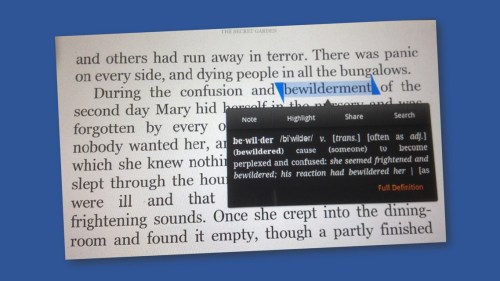
Kindle pronunciation and definition pop-up

Already available on the Kindle, readers just touch unfamiliar words and a definition pop-up appears. (shown is an excerpt from “The Secret Garden” by Frances Hodgson Burnett) CLICK on the picture for a link to the pronunciation.

A student who knows she has trouble reading long words creates an avatar—say an owl—to help her.  Then whenever she is reading online, the avatar would appear before every long word.  The avatar will help her to figure out long words–three and four syllable words.

The student could skip the avatar if she thinks she knows the word.  But if she  needs help, she could click on the owl and the owl might segment the word into syllables, making the word easier to deconstruct.  “Conversation” might show in a tiny screen as “con-ver-SA-tion.”

If the word does not follow the rules of phonics, the word might be shown as it is pronounced.  “Business” might appear as “BIZZ-ness.”

An option for the avatar to pronounce a word might also exist.  If a student can figure out “discreet” but not “discretion,” the avatar might pronounce the latter word.

With technology, we have the ability to personalize reading instruction, offering individual help for students.  Fast learners could have an avatar which acts as a high speed dictionary and thesaurus, allowing students to read difficult words without a word search.  Slower learners’ avatars could offer private tutoring help, allowing students to progress at their own slower pace with no one the wiser.  ESL students could get help with pronunciation.

Even older students reading advanced text books could use this help with the avatar segmenting the word, perhaps showing its root, pronouncing it, and defining it.  It could refer to previous pages in the book where the word is used the way an index does—all at the click of an avatar.

Sound farfetched?

With Google’s Alexa, some of this technology already exists.  If a student is stumped by a word, the student can spell the word and ask how to say it or what it means, and Alexa, after a split-second of “thinking.” would respond.

It’s only a matter of time before this kind of technology will be custom fit to meet individual students’ reading needs.

Diagrams help students read

“Scaffolding” is an educator term to describe teacher actions to help students  learn something new.  Scaffolding could be a series of questions meant to prepare students for what they are to read.  Scaffolding could be a timeline of a topic—say American history—to show where a subtopic—say the Civil War—fits into the big picture.

Scaffolding can also be simple diagrams to help visual learners, ESL students and students with comprehension issues understand what they are about to read or write.  These diagrams help students “see” the organization of a reading passage, or they help students “see” the structure of a paragraph or essay they are about to write, providing clarity.

For example, suppose a student needs to read a biography of Coretta Scott King.  To help the student see the organization of Mrs. King’s life, the teacher could draw a color-coded diagram of important activities in Mrs. King’s life.   Take a look.

This diagram is a simple visual pattern following Mrs. King’s life, more or less in chronological order.  With a little help, the student might see that Mrs. King’s life was private until she married; then her life became public as she worked with her husband on civil rights matters; then her life became even more public after his death as she led efforts to honor him and she spoke and wrote about ongoing civil rights matters.

If each box of the diagram is outlined in a color which corresponds to a portion of Mrs. King’s life or activities, the overall organization of the essay becomes clear.   Color-coding the information is important because it helps visual learners “see” how the reading passage breaks down into smaller chunks.

Whether it is Junie B. Jones’ fear of school buses or why polar bears face a bleak future, a diagram showing students what they will read before they read it allows them to see the big picture and each subtopic in the order in which they will read about it.  For children learning English or children with reading comprehension problems, a diagram can help them understand and remember what they read.

How to teach –ight, -ought, -ind, -ild and word families that don’t follow rules

Words ending with –ight don’t follow the rules of phonetics.  The “g” and “h” are silent, and there is no silent “e” after the “t” to make the vowel “i” long.

Some word families, such as –ought, -ind, -ild, and -ight need to be taught as exceptions to phonics rules.  Essentially, they are a group of sight words which follow the same spelling rule, but they are not pronounced the way they look.

It’s probably better to delay teaching words like these until students learn the basic rules of phonics.  Exceptions to rules are confusing.  Better to get the rules understood before introducing exceptions.

That said, how do you teach such exceptions?

  • Teach one exception family of words at a time, giving several days for the student to get used to that family.
  • Post a list of the family of exception words so students can see them on and off many times a day.
  • Ask the children to read short paragraphs containing such words.
  • Ask the children to compose a silly verse using a familiar song for rhythm. For example, to “Old McDonald Had a Farm” students could write, “My brother Dwight did pick a fight, EE I EE I Oh.  He picked a fight with a mighty knight, EE I EE I Oh.”  The sillier the better.  Write down the song, show the words to the students, and sing it daily to reinforce the family pronunciation and spelling.
  • Play games using the exception word families. Students could write the 15 –ight words plus 10 –ite words on a blank BINGO board. You could call off a definition of each word which students would need to identify on their boards.
  • Have a spelling bee using the words.
  • Students could write a paragraph using as many of the words as they can. This could be a group project the first time and later an individual project.

Students should be reminded about words with the same sound as the exception but which follow the rules of phonics.   Students need to remember which words go with which rule.

English has many words which don’t follow the rules, but it helps when there are a whole group of them which follow their own strange rule.  They can be taught in groups rather than singly.

How to teach a child to read with little cost

If you are attempting to teach your child to read, and you go to Amazon or your local book store and find literally hundreds of instruction books, dozens of video games, and all kinds of apps and CDs, and boxes of flash cards, where do you begin?  Is all that “stuff” really necessary?
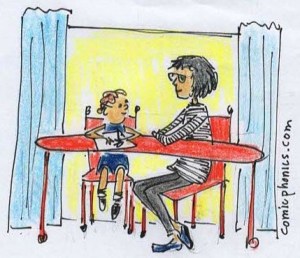
I suggest a method which includes spending time with your child but not much money.

Start with the sounds of English. There are about 42 in most parts of the US.  Say the sounds aloud, one at a time.  Let your child listen and repeat the sounds aloud.  If he can’t say one or two of the sounds, work on those sounds for a few minutes each day until he can hear and repeat all the sounds.  (Supplies you will need:  a list of the 42 sounds, available free on this website and online.)

Next, explain that we associate letters with those sounds.  Start with consonants and teach the child to match each sound with a letter.  Move on to vowels and explain that some sounds share the same letter.  (At this point, don’t try to teach digraphs or exceptions.)  Say a particular sound and ask your child what letter goes with that sound.  Show a handful of letters to choose from and add more options as the child gains accuracy.  (Supplies you will need:  a set of the ABC’s on cards, on letter tiles or written by hand on index cards.)

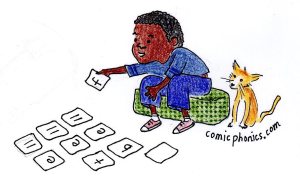
Once the child can associate sounds with letters accurately, form CVC (consonant—vowel—consonant) words, such as “c a t.” From years of experience I have found that letter tiles work best at this.  (I use Scrabble game tiles, but there are other kinds.)  Set the three letters an inch apart.  Say the letter sounds one by one.  Move the letter tiles together slowly and then more rapidly, saying the letter sounds so that they eventually slur together.  Help the child learn that when we put letter sounds together, we form words.  (Supplies you will need:  lists of CVC words available free online.)

At this point, your child can read many of the words in some books, such as The Cat in the Hat, Green Eggs and Ham and  Hop on Pop.   Encourage the child to read the words she can and you read the other words.  If you own the books and don’t mind marking them, you can underline the words your child knows as she reads–a visible proof to the child that she can read.  (Supplies you will need:  a few early reading books available free online or for less than a dollar each at most resale stores.)
CVCC twin consonantsNext you need a plan to sequence the teaching of various types of words.   You can find plenty online.  Most plans start with two- or three-letter short vowel words like “cat” and “ax.”  Then they move on to blends, first at the beginnings of short vowel words (“blot”) and when those are understood, at the ends of such words (“blotch.”)  Adding “s” to form plurals is considered such a blend.  Then teach digraphs and sight (Dolch) words.  (Supplies you will need:  Lists of sight or Dolch words available free online.)

Some authorities suggest teaching two- and three-syllable short vowel words at this point, such as “catnip” and “tunnel.” Others suggest tackling one-syllable long vowel words beginning with words ending with a silent “e” such as “bake” and “tune” and then moving on to other long vowel combinations such as “ee” and “oa.”  There is no right or wrong sequence.  It is important to keep reviewing words the student already learned and mixing them up while you are teaching new kinds of words.  (Supplies you will need:  Lists of such words available free online.)

boy choosing right root for a prefixAt this point, you might teach prefixes and suffixes, or words which don’t follow rules such as two-syllable words with one consonant between the two vowels. Does the consonant go with the first syllable (“robin”) or with the second syllable (“robust”)?  (Supplies you will need:  Lists of such words available free  online.)

Three- and four-syllable words follow the same rules as one- and two-syllable words, but the problem is where to put the inflection so that they are pronounced correctly.  Help the child pronounce such words all possible ways until she hears the correct way.  You and your child might read books you own or library books, and when you come to long words, stop, and figure them out together.  (Supplies you will need:  Picture books, and lists of multi-syllable words available free online.)

By now your child is reading.  She might need help occasionally pronouncing a particular word, or more likely, understanding the meaning of an unfamiliar word.  But learning the sounds of English (phonemes) and linking those sounds to form words (phonics) is largely done.

A few students in my class read quickly. What do I do to keep them on task?

You could prepare a quiz ahead of time on the reading selection. Let the quiz focus on the pages to be read.  Ask students to raise their hands when their reading is done, give them the quiz and watch.  Since the quick readers are often gifted students, ask questions not at the knowledge level, but at higher level thinking.  Ask inference questions too which everyone finds tough.  Ask students to write not only the answer but the page and paragraph or line number which proves their answers.  Collect and check the quizzes to know if the quick readers are skimming or truly gaining knowledge.

dhild running with book in hands

You could ask quick readers to outline the reading passage. If it is nonfiction, then the outline could name the way information is presented, such as chronological, problem and solution, cause and effect, or whatever is appropriate.  Then the students could write one sentence per paragraph describing the information in each paragraph.  If the reading selection is fiction, then the outline could state the type of writing, such as description, dialog, action, or whatever is appropriate.  Writing one sentence per paragraph might not work for fiction, but one sentence per scene or character might.  The point is for the students to prove to you that they comprehend what they have read.

You could ask students to choose five words from the passage that they don’t understand or that they think their classmates might not understand and use a classroom dictionary to look them up. Then students should write each word in sentences to show what the word means.

You could ask students to write one (or two or more) questions about the reading which require thoughtfulness to answer. Collect them, shuffle them, and then use them for class discussion or homework.

Notice that all of these assignments focus on the original reading selection and either extend or deepen students’ understanding of it.  Students need only paper and pen and possibly a dictionary to do the work.  If you have the extra assignments printed up to use as needed, you can pass the appropriate one out any time a student finishes early.  And most of the ideas work well in science and social studies classes as well as in ELA classes.

Of course you could always have early finishers take out books and read them.  If the books’ Lexile numbers fit the students’ reading levels, this works.  But it does not enrich the reading lesson, and it could cause resentment among the slower readers who might feel punished for their slower progress.

Work with kenesthetic learners’ strengths–their bodies

Most preschoolers and many school-aged children are kenesthetic learners, that is learners who learn best when they are physically active.

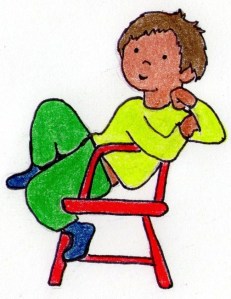
Should my child sit still when she learns to read?

Ask such a child what “humongous” means, and she will spread her arms as far as she can reach.  Ask a one-year-old what the dog in the picture is doing, and the child will get down on all fours and sniff.  Ask a child the difference between up and down, the child will stand on a chair and say, “up,” and then jump to the floor and say, “down.”

These children use as much of their bodies as possible not only to learn but to demonstrate that they have learned.

How do you know if a child is a kenesthetic learner?

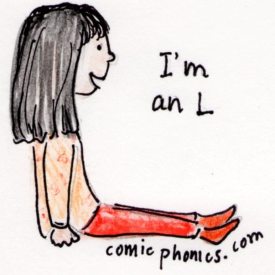
Child sitting with legs outstretched, forming the letter L

  • The child loves sports—running, jumping, dancing, and tumbling.
  • The child seems more active than other children of the same age.
  • The child gestures while talking.
  • When the child sees a demonstration, the child wants to try it herself.
  • The child ends the day dirty—dirt under his fingernails, peanut butter in his hair, shoes scuffed—and he is oblivious.
  • When reading or writing, the child kneels on a chair, stands, sits on the desk, stands on the chair and leans over, and does all of these in the span of five minutes.
  • The child fidgets while learning—tapping her fingers, puffing up her cheeks, wriggling her shoulders—yet she pays attention.
  • The child loves Legos, puzzles, and toys that can be put together or taken apart.
  • The child has great hand-eye coordination, and can learn to control pencils, paint brushes, screw drivers and tools with ease.

dhild running with book in hands

How does such a learning style affect reading?  What can you do?

  • Since a kenesthetic learner often reads later than his peers, you might panic that he is lagging his classmates. It helps if you can accept that for this child, reading is a low interest activity.  You can reinforce what he is learning by connecting it to activities he loves.  “A is for arrow.  B is for basketball.  C is for coach.”
  • Because the child needs to move, let him swing his legs, stand, lie on the floor, or move a rubber ball from hand to hand as he listens to instruction.children moving letter tiles
  • Break up reading lessons into mini-lessons with in-between times when the child is free to move around. Use this time for the child to act out what he has learned.
  • Since the child likes to use his hands, teach using manipulatives such as letter tiles, pictures to sort by sound, parts of sentences cut into phrases, flashcards, and online work which includes using a mouse. Vary the writing instruments the child uses since the feel of some will attract the child to work.
  • Suggest that the child draw what he is learning. Have her fill in boxes and use arrows to show relationships.
  • Use repetitive physical activity to deepen learning. Throw a ball back and forth while spelling new words.  Take a walk while discussing subjects and predicates.  Move magnetized words into sentences on the refrigerator while shifting weight in a dancing rhythm.  Draw mind webs while reading to show comprehension.
  • Teach a hard concept after physical activity.