Category Archives: reading comprehension

What is a Lexile score? My daughter’s Iowa test showed a Lexile score.

A Lexile score is a number used to measure a student’s reading achievement.  Several kinds of tests can be analyzed to determine this score.  The Iowa test is one of them.

Chart of typical grade level scoresA Lexile score is not the same as a grade level score in reading.  The lowest Lexile score—zero L—corresponds to the reading level of a beginning reader.  The highest scores—1600+L—correspond to advanced readers.

These scores can be used to choose appropriate reading materials for a student.  About a half a million books have been analyzed and given a Lexile score.  A student with a score of 800L, for example, would find appropriate reading material in books with a similar score.  At such a match, the student could be expected to comprehend 75% of the reading.  Below is a sampling of Lexile scored books.

List of Lexile scored books.

Find more book lists at: http://goo.gl/hA2X0P

A Lexile score is a scientific measurement of reading based on two factors:  how often words in the test or text are used in English and sentence length.  It is a 21st century readability formula developed by MetaMetrics (www.lexile.com), an organization which “develops scientific measures of student achievement,” according to its website.

Many state departments of education and school districts have licensed Lexile to analyze their tests and to link students with appropriate reading materials.  Several testing organizations such as the Gates-MacGinitie Reading Tests, the Iowa Test, the Sanford and Iowa achievement tests and the Total Reader, an online testing site, are “translating” their reading scores into Lexile scores.  Some online reading sites offer Lexile scores for their reading material.

One shortcoming of the Lexile readability measurement is that, like many readability formulas before it, Lexile measures just a few factors, leaving out many others.  Format and design factors (length of page, length of type line, length of paragraphs, type size and font, size of margins, white space between lines, use of graphics and use of color, for example) are not measured. Neither are the age-appropriateness of the material, the child’s interest in it, or the prior knowledge the child brings to reading.

Even so, Lexile is becoming a widely used method to measure a student’s reading ability and the readability of written materials.

What are high/low books?

High interest / low reading level books are books that appeal to children who are older than the reading level of the book.

High/low books in a way are a mismatch: the reading level is lower than the age of the child to whom the book appeals. A good example is the Fudge series by Judy Blume. The early books are written at a second grade level but appeal to third or fourth grade children because the narrator begins as a fourth grader and grows older in the series.

Too many words on a page make reading hard.These books appeal to children who are struggling to read. The stories are about kids their age doing activities they do. These books are also good for ESL students whose age might not align with their reading level in English, and for disabled children, including those with dyslexia, who are behind their peers in their reading level.

What makes these books different? They share many of these qualities:

  • Shorter, everyday vocabulary words with concrete meanings
  • Short sentences
  • Short paragraphs
  • Large margins
  • Unjustified right margins (margins that look ragged)
  • Larger type size (minimum 11 point) in clear fonts
  • Realistic characters who are the same age as the reader
  • Easily differentiated characters
  • A fast moving plot which is low on description
  • Compelling stories
  • Chronological order (no flashbacks)
  • One point of view, not two
  • Illustrations, photos, graphs and maps
  • Tight, concrete writing

Many lists of these books can be found online.

A long list can be found at http://www.schoolonwheels.org/pdfs/3328/Hi-Lo-Book-List.pdf. This list gives the reading level (RL) and the interest level (IL) plus a one sentence description of the book. All the books on this list are fiction.

Some small house book publishers are known for publishing books for reluctant readers who often happen to be high/low readers. At http://www.nbss.ie/sites/default/files/publications/READ_-_hilow_books.pdf you can find the books of several publishers which are geared to students older than their reading level suggests. These books are mostly appropriate for high schoolers.

At http://www.booktrust.org.uk/books/children/bookmark/booklists/141/ there is a list of 14 books for various age levels written below age level.

http://specialeducation.answers.com/english-and-math/10-high-interest-low-reading-level-books-for-teens-with-reading-difficulties gives information about ten books, some nonfiction, which are written at low reading levels but which would still appeal to kids in their teens.

The largest teachers’ union in Britain has a listing of book publishers and book series appropriate for high/low readers. Go to http://www.teachers.org.uk/node/12418 .

Seven publishers of high/low books are listed at http://www.writing-world.com/children/foster03.shtml. Included are hyperlinks to those publishers. –Mrs. K


Assessing reading comprehension by using multiplication

Are you looking for a simple way to assess your child’s reading comprehension skills?  Take a look at the “Simple View of Reading.”

Although a “Simple View of Reading” (SVR) was proposed in 1986, its simplicity and success make it a useful tool to assess reading comprehension today.  Almost thirty years ago, two researchers, P. Gough and W. Tunmer, suggested that reading includes two primary steps, decoding words (using phonics skills to figure out words) and language comprehension (knowing the meaning of words especially when words are strung together to form sentences).

They represented their Simple View of Reading with a math equation:

Decoding x Language Comprehension = Reading Comprehension

(This formula uses scores from tests in decoding and language comprehension.  For this formula to work, all scores for decoding and language comprehension must be between 0% and 100%.)

What does this simple formula mean?

  • Reading comprehension requires the child to master two areas, decoding words and language comprehension.
  • If a child can do one but not the other, or can do one better than the other, his reading comprehension score will be only as high as the lower of the two other scores.

How can you use this Simple View of Reading to identify your child’s reading comprehension skills or lack of them?

  • First, ask yourself:  Is my child’s reading problem decoding?  Is his problem language comprehension?  Is he having problems in both areas?
  • If you are not sure, test the child in both areas.
  • You can test decoding by having a child read lists of real and nonsense words.  Lists are available online.  Having the child read nonsense words (e.g., zups, thab, slig) is important because some children memorize the look of a word without being able to sound it out.  Also, to assess decoding, don’t use words from a reading passage because the child might figure out a word from the context.  To test decoding, you must remove context.
  • You can also test decoding by reading an unfamiliar passage aloud and asking the child questions about facts, main ideas, sequencing and paraphrasing .  If he can respond accurately when he is the listener, yet he cannot do that when he is the reader, his problem could be decoding.
  • You can test both decoding and language comprehension by having the child read aloud to you.  (If he can pronounce words correctly, or in a few cases, use phonetic pronunciation for unfamiliar words, decoding is not his issue.)  Stop and ask the child what various words mean.  Ask the child to paraphrase a difficult sentence.  Ask the child to paraphrase the passage.  Ask the child to predict what might happen next.  If the child can decode, yet he cannot explain what he has read, his problem is likely language comprehension.  Teachers often see this situation in ESL students who learn the rules of phonics well but whose vocabulary in English is not extensive.
  • To make the evaluation easy, use a scoring method of high, medium, and low based on your own mental tally from working with the child.  If the child scores high in both decoding and language comprehension, he probably does not have a reading comprehension problem.  But if he scores medium or low in decoding or language comprehension, he has a reading comprehension problem.
  • A medium or low score in decoding means he needs more work in phonics.
  • A medium or low score in language comprehension means he needs vocabulary building, work on pronunciation, time listening to a native speaker read a text aloud, and strategies to gain meaning from sentences and passages.

More tips to help a child read bigger words

  • The same rule that applies to CVC/CVC words applies to CVC/CVCE words; that is, to words of two syllables which have (usually) a short vowel in the first syllable, two consonants in the middle of the word, and a long vowel in the second syllable controlled by a silent “e” at the end of the word.  The syllables split between the middle two consonants unless there is a blend, in which case the syllables split before or after the blend.
  • To teach these words, it might be easier to find some compound words that form this way, such as “tadpole,” “backbone” and “pancake.”  Make a list and let the child circle the two separate words which form the compound word.  Then ask the child to put the separate words together to form a new word.  Some words you might use are
     
    Two words that together make one word
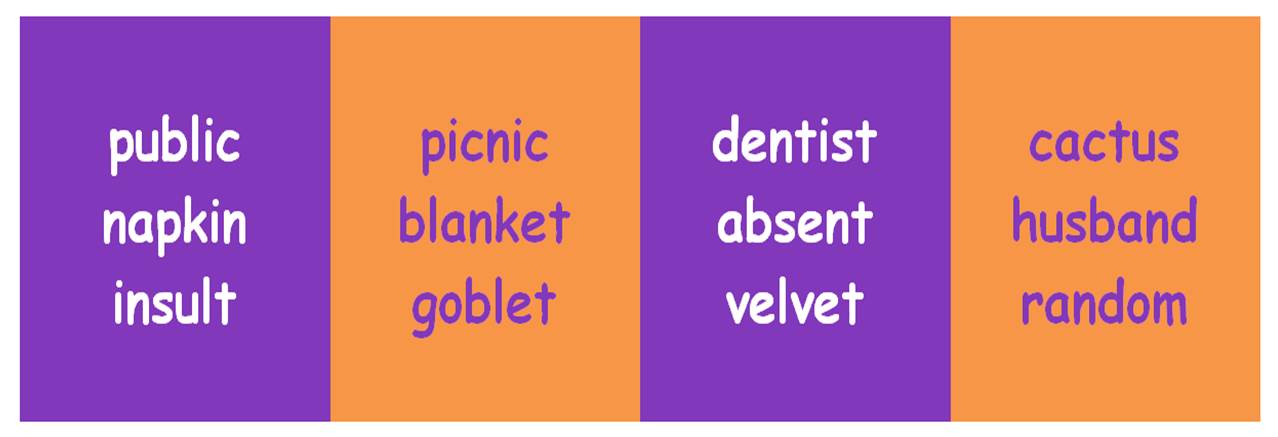
  • When these words are mastered, move on to CVC/CVCE words which are not compound words such as “membrane,” “umpire” and “pollute.”  The same rule applies as above.  Have the child divide the word between the syllables.  If the child has trouble deciding where to divide, remind her that usually one syllable ends and another one begins between the two middle consonants.  Help her to identify blends that need to stay together in the same syllable.  Some words you might use are
     
    two syllables divided by middle consonants
  • When your child understands the pattern, you might explain that some bigger words follow the same pattern.  Introduce three syllable words with the CVC/CVC/CVCE pattern, such as “illustrate,” “vaccinate” and “indispose.” But if the child is struggling to understand the previous CVC/CVCE words, hold off on three syllable words.  Some words you might us are
     
    Introduce three syllable words.

Our blog will continue to teach multisyllabic words in the near future.  Let us know if you find this information useful or if you have particular problems teaching your child reading.  We will investigate for you and offer the best advice we can find.  –Mrs. K and Mrs. A

My granddaughter can read small words, but she stumbles over bigger words when we read together. How can I help her?

Here are some tips to help with bigger words:

  • If you are reading for sheer enjoyment, anticipate the words she might not know and say them quickly, so she can keep reading and not lose her thought.  Don’t worry that she might not be learning new word attack skills in your reading session; she is learning other aspects of reading such as fluency and comprehension which are often hard to learn when she stops to consider every new word.  Also, if she is tired or ornery, this kind of reading lesson gets her to read without causing frustration.grandparent reading with grandchild.
  • But if you are reading with your granddaughter to help her decipher words, and if she is in a receptive mood, you might cover parts of the word (usually syllables) and then uncover them, so she can join them together.  For example, if the word is “continent,” cover the “tinent” part with your thumb and let her say “con.”  Then cover the “con” and the “ent” parts and let her read “tin.”  If she mispronounces “tin,” pronounce it correctly.  Then cover all but the “ent” and let her figure out those four letters.  If she can put it together, fine, but if not, you do it while covering and exposing parts of the word as you say it.  Then move on to another word.  The goal should be to teach her a method of figuring out words, not mastering every word you encounter in a particular lesson.
  • If you own the book, and don’t mind marking it, you could highlight every word she can read correctly.  She will see that the number of words she can read far outnumbers the few she can’t.  You might ask her what she notices about the words that are not highlighted.  She might say, “They are long,” or “They have lots of letters.”  Tell her there are ways to figure out those words just like there are ways to figure out three-letter words, and you will work with her on those long words.
  • A good place to begin is with compound words.  They can be easy to decipher if the child looks for small words inside big words.  Try some with her such as “pancake,” “popcorn” and “forget.”  Make a list of such words and let her be the detective, discovering the small words inside the large words.  Have her circle each of the small words and then pronounce them together.  Some words you might use are:compound words are small words inside big words
  • Some longer words have pronunciation rules that are easy for a child to remember.  For example, if a six- or seven-letter word has double consonants in the middle (biggest, kitten, flabby), that means the word usually has two parts, or syllables, and the first syllable ends between the “twin” letters.  (Use the word “syllable” since this is a term your granddaughter will need to learn anyway.)  Phonics books sometimes refer to these words as VC/CV or CVC/CVC words since they generally have short vowel sounds in both syllables.  You could practice a handful of those words, writing them on notebook paper for your granddaughter to pronounce.  Choose words whose letters follow the rules of phonics so she is not confused.  Have her draw a line between the double consonants and then pronounce each syllable.  Some words you might use are:"twin" letter words have double consonants in the middle.
  • Some other six- or seven-letter words have one vowel near the beginning, another vowel near the end, and two or three consonants in the middle.  These are a variation on VC/CV or CVC/CVC words with twin conconants.  Show her words like “contest,” “nutmeg” and “insect.”  Explain that the words have two syllables, and that the first syllable ends between the two consonants.  Have her draw a line between the middle consonants and then pronounce each syllable.  Some words you might use are:two syllable words with vowels in the first and last syllable

Our blog will have more on how to teach multisyllabic words in the near future.  Let us know if you find this information useful or if you have particular problems teaching your child reading.  We will investigate for you and offer the best advice we can find.  –Mrs. K and Mrs. A

Are there any tricks to help my child with reading comprehension?

One proven tactic to learn almost anything factual is music.  According to Annie Murphy Paul, author of the blog, The Brilliant Report, and an expert on human intelligence, music has been used for thousands of years to help us remember facts.  You used this technique when you were a child.  How did you learn your ABC’s?  By singing them, of course.

Ways to improve the likelihood of facts being remembered through song are to write lyrics that use concrete actions and powerful visual images.  Literary devices such as alliteration (words beginning with the same letter), assonance (words with the same vowel sounds), repetition and especially rhyme make a song more memorable, according to Paul.

Young girl reading a bookResearch shows that there are certain steps to increase reading comprehension as well.  Those steps are to read the title and try to understand what it means; then to read subtitles and boldfaced words and to ask yourself what they mean; then to interpret the drawings, photos, graphs, tables, political cartoons and charts to see what information you can glean from them; and last, to read the text.  If you follow the first three steps before you read the text, you should have a good idea what the text will be about.  You will have created a context into which the text makes sense.

This is true for picture books and early reading books as well as a high school chemistry text.  First the title, then the subtitles, then the illustrations and last the words themselves.

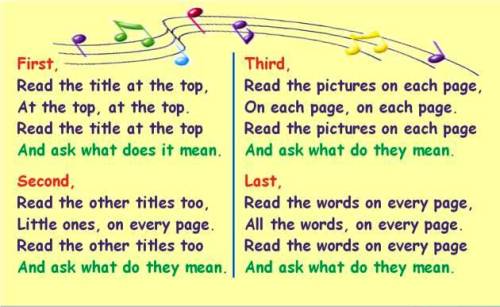
I have “translated” this information into a song about reading comprehension that you and your preschooler can remember.  Sing the following verses to the melody of “London Bridges Falling Down.”

Reading Skills Rhyme

To enlarge or print an 11″ x 8.5″ version, click on the picture.

Using this pattern when reading books with your child should improve her reading comprehension.  And after your child memorizes the song, she should have a sequence of strategies to use even when you are not there.

Let me know if this song helps by responding to our blog.  And if you are interested in practical research on how the brain works, go to www.anniemurphypaul.com and subscribe to her weekly newsletter as I do.

Is a child’s vocabulary destiny?

Consider this:

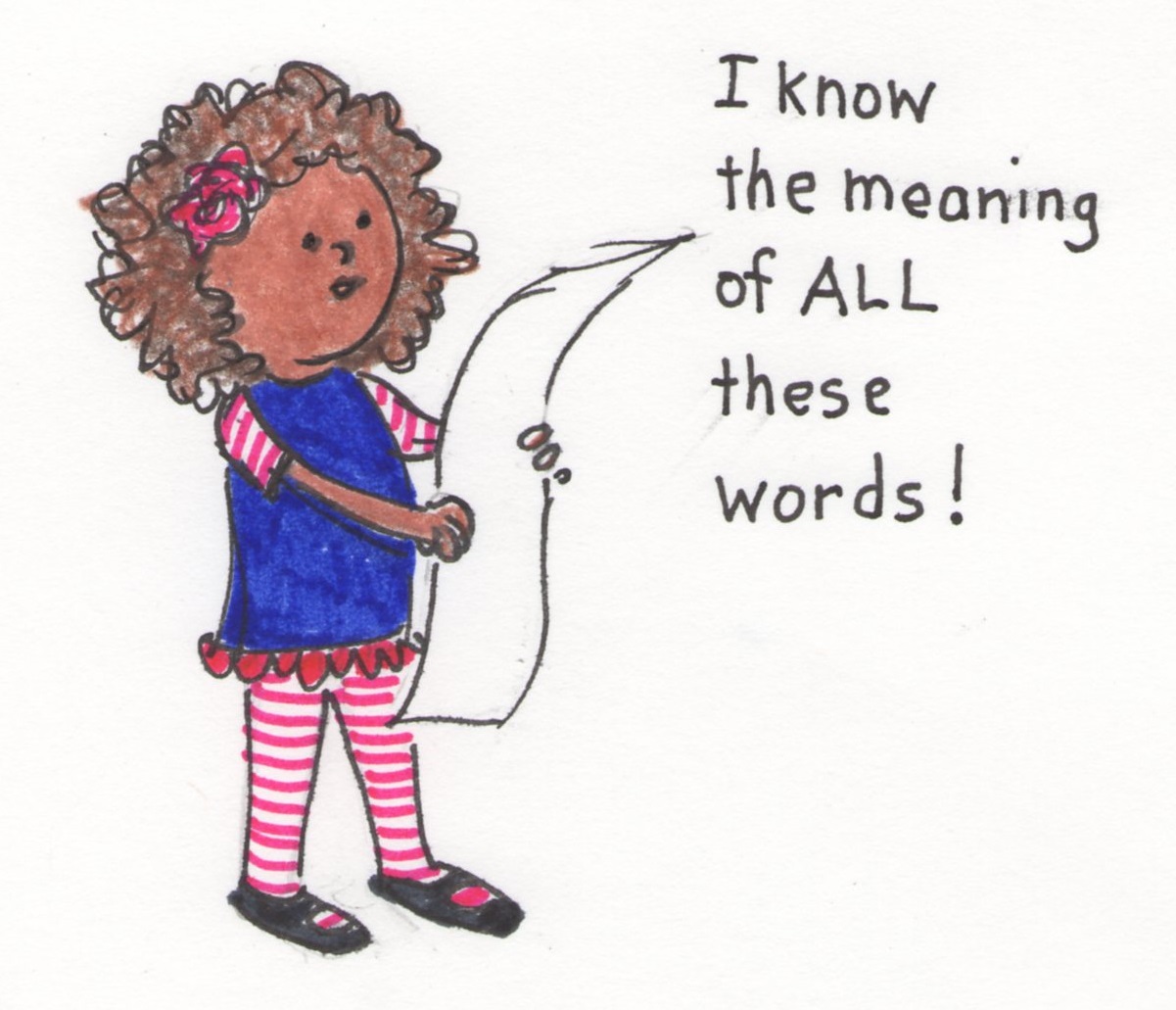
  • Three-year-old children from professional families already have bigger English vocabularies than parents in lowGirl is looking at a list of words she can read.-income families.
  • Children from professional families hear 300 more spoken English words in an hour than children of parents on welfare.
  • By the time children are four-years-old, children of professional parents will have heard 32 million more words than children from poor families.

What does this research by Betty Hart and Todd R. Risley (1980’s and 1990’s) mean?  Combined with more recent research that shows that vocabulary acquisition is the single greatest predictor of reading success, it means that children of professional parents are far ahead of children from low income families as they start preschool.  Other studies show that as a child moves through school, this vocabulary gap increases, directly correlating to a child’s achievement in reading comprehension.

So what can you do with your preschooler, primary grade child, or ESL learnerto increase his vocabulary?  Quite a bit.

A young girl uses the word odiferous to describe a stinky diaper.

  • Use “big” words when you talk to your child.  Provide a rich vocabulary for your child to hear.  “Baby” words are no easier to learn than adult words, so use adult vocabulary with your child.  For example, when I was a child, my father used to come home from work and ask us children, “Is everything copacetic?”  Of course, we didn’t know what he meant, but he explained, and within a short time we were asking one another the same thing.
  • Define new words when you know your child doesn’t understand.  Give an example you can refer to again and again.  Try to give an image to keep in mind if you can.  “Shutters are those door-like things on the sides of house windows, remember?”
  • Choose new words that sound somewhat similar to words the child already knows.  For example, a child knows what a computer is, but “compute” would probably be a new word.  Make the connection to how the computer can add up numbers quickly to help the child remember what compute means.
  • Encourage your child to ask you what a word means.  Don’t laugh at him because he doesn’t know.  We all learn by asking questions, so questioning is a great skill to help your child to develop.
  • Repeat new words often until the child understands.  One or two times is not usually enough.  Try six or ten uses of the word in a few days to cement the word into the child’s memory.
  • Read, read, read to children to expose them to new words.  Nursery rhymes contain old-fashioned words the child might not know.  Emails from Grandma might too.  Read from a variety of genres, but pick topics of interest to the child, so she will pay attention.  Choose books that stretch the child’s vocabulary with new words in context, but not too many.
  • When you are reading to your child, and you come to a new word, read it in context, and then ask the child what she thinks it means.  Try to find something right in her answer, even if it’s, “Well, that was a thoughtful explanation.  Well done.  Now let me explain what the word really means.”
  • Read the same book to a child several times, helping the child to conquer the words in context.  If there are many new words, don’t discuss each one.  Pick a few so the child focuses on enjoying the book.
  • Set yourself a goal of a word a day for a preschooler.  Keep a list on the refrigerator to remind you to use past words again to help with retention.  Let the child see the list growing.  As we measure the height of our children, they feel pride.  As we measure their learning, they will bask in that success, too.

How about you?  Have you come up with any ideas to help improve your child’s vocabulary?  Share your ideas by commenting on this blog.

Are nursery rhymes still important?

Yes, they are, but sadly, more and more children come to school today with little knowledge of them.

boy pretending to be Humpty

There are many reasons—busy parents without time to read the rhymes, foreign-born parents unfamiliar with the rhymes, and competition from TV and electronics for children’s time.  Yet, for many reasons, nursery rhymes should be part of a child’s education, and the earlier the better.

  • Children—even one-year-old children—can appreciate nursery rhymes, often their first encounter with books, verses and rhythmical sentences.  If they are being read to, they learn what a book is, what side goes up, how to turn a page, what words look like in print and how to get meaning from pictures.  This experience is the beginning of getting meaning from printed words, a start to reading comprehension.
  • They learn that reading books can be fun, social occasions with Grandma cuddling as she sounds out the rhymes.
  • Children can learn what English sounds like.  They hear their mother’s voice rising and falling, speeding up and slowing down, getting softer and louder, and sounding scared or full of laughter.  This can be particularly important for ESL children who might hear these rhymes from preschool teachers.
  • They develop an ear for fluency, and when they are ready to repeat the rhymes themselves, they are likely to add the inflection of a good reader.
  • Kids naturally like rhythm which nursery rhymes offer in abundance.  If Dad claps out the rhythm to “Pat-a-cake, Pat-a-cake, Baker Man,” soon the child will mimic him, picking up the cadence of English.
  • Because nursery rhymes are so rhythmical, children become aware of units of sound (called phonemes) from which words are made.  They learn to progress through the sounds in a word in a particular order (called phonemic segmentation), a necessary prereading skill.
  • Children also love rhyme (one reason Dr. Seuss is so popular).  They begin to learn patterns, expecting a rhyme every so often in the rhythm, and are rewarded when that word comes.  They begin to share in the reading of nursery rhymes aloud.
  • Because nursery rhymes are short, children need only a short attention span for a single nursery rhyme.
  • Also because the rhymes are short, children can memorize them and recite them aloud.
  • Nursery rhymes contain words the child doesn’t hear every day or in a familiar context.  “Jack and Jill went up a hill to fetch,” “eating her curds and whey,” and “Jack, be nimble” are examples.
  • Many nursery rhymes tell simple stories with beginnings, middles and ends.  The children hear of problems they might encounter—falling down and getting lost—and hear how those problems are resolved, or in Humpty Dumpty’s case, not resolved.
  • Nursery rhymes are great for group chanting and singing, sometimes called choral reading.  Think of “Mary Had a Little Lamb,” “Twinkle, Twinkle, Little Star,” and “London Bridge is Falling Down.”  Can you think about “Mary Had a Little Lamb” without singing it in your head?  The tune makes the rhyme easier to remember and makes reading fun.
  • Reading nursery rhymes to children preserves an older American culture and a connection with past generations.  Many of today’s grandmothers, as children, were read the same rhymes by their grandmothers.
  • Later on in life, the child will encounter many allusions to nursery rhymes (and allusions to Greek mythology, Shakespeare and the Bible).  But the child will only make connections—and have a richer experience—if he is familiar with the original rhymes.  For example, Agatha Christie called one of her mysteries One, Two, Buckle My Shoe.  Why?
  • Reading nursery rhymes online is a way to connect a child’s use of a tablet, phone or computer with literature from an early age.

    Father reading to child and child asks, 'How old is Old McDonald?"

    To enlarge, click on the picture.

The history of nursery rhymes in English goes back hundreds of years to a time when most people could not read or write.  Part of an oral culture, they reported events of their time for adults and children alike.  For example,

  • “Ring around the Rosy” is believed to have originated in 1347 during the Black Death in Europe.  The ring referred to a round mark on the skin which was the first sign of the bubonic plague.  The last line, “And we all fall down,” was no laughing matter.
  • “Mary, Mary, Quite Contrary,” refers to Mary, Queen of Scots, who was beheaded for her religious beliefs.
  • “Little Miss Muffett” refers to the daughter of a bug expert in Shakespeare’s day.
  • “Thirty Days Hath September” is believed to come from the 13th century, based on a similar rhyme in French to help remember how many days are in a month.

So are nursery rhymes important?  What do you think?  Did someone read nursery rhymes to you?  Can you recite any from memory?  Have you enjoyed passing along this tradition to your children and grandchildren?  Let our readers know.

Can dyslexia be identified in a preschooler?

By definition, dyslexia is a learning disability characterized by difficulty reading.  There are secondary characteristics—difficulty spelling, and illegible handwriting, for example—but until a child has attempted to read, it’s probably too early to identify dyslexia.

Even so, the National Center for Learning Disabilities has listed several warning signs for dyslexia, shown in the chart below, and some of them apply to preschoolers.

Dyslexia is the most common learning disability, affecting about five percent of American children.  Its cause is unknown, although scientists think it probably has more than one cause.  About a quarter of the children who have dyslexia also have attention deficit hyperactivity disorder, though most children with dyslexia don’t exhibit ADHD.  If an older child in the family or a parent has dyslexia, then the younger child has an increased chance of having it too.

Children diagnosed with dyslexia have normal intelligence and vision, yet they cannot figure out how to read by first grade.  Eventually they do, but they often require intervention from the school system, a tutor or a dedicated parent.

Dyslexia affects information processing in the part of the brain controlling language.  Usually children without dyslexia begin to realize that sounds combine to form words or parts of words, and that those sounds can be represented by letters.  Children with dyslexia have difficulty making these connections.

Children with dyslexia do learn to read, but it takes longer.  Teachers need to repeat the phonemes or basic sounds of English (about 44) and help children recognize these sounds in words and in syllables.  “Go” for example, has two phonemes, g and long o.  Then teachers need to connect these phonemes to letters, and the letters to tiny words which follow the rules of pronunciation.

If you are concerned about dyslexia, the National Center for Learning Disabilities website offers a 40-page toolkit about dyslexia, including several pages about characteristics of children pre-K to second grade and strategies to help them learn.  Your right to have your child tested by the public schools, the type of testing done and a video from an educator who has dyslexia are included in the toolkit.

How can I make reading to my four-year-old a more educational experience (not just fun)?

Children pick up many foundational skills when someone reads to them frequently.  In fact, reading to children is probably the single most important way to prepare them to read by themselves.  But you could monitor your child to be sure he is learning more subtle concepts about reading in English.  Most schools expect these skills to be mastered by the end of kindergarten:

  • Knowing that in English words are read from left to right.  (You could point to words with your finger as you read to reinforce this idea, especially if you come from another language in which words are read from right to left or top to bottom.  If you read to your child in both languages, remind the child that you are reading in English.)
  • Knowing that words are read from top to bottom.  (Occasionally, ask your child where you should begin reading on a page.  Or turn the book up-side-down to see if the child recognizes the mistake.)

    child telling grandpa he is holding the book upside down.

    Click on the picture to enlarge it.

  • Knowing that pages are turned from right to left.  (Ask your child to turn the pages for you.)
  • Knowing that words are shown in print by a grouping of letters with a space before and after.  The space before indicates a new word is to begin; the space after indicates that a word has ended.  (Point to tiny words like “a” or “I” and to big words like “dinosaur,” and comment on the size of the word.  Or ask the child to count how many words are on a particular line.)
  • Knowing that words are formed from specific sequences of letters.  (Write a “word” like xxxxxxx or abcdefg and ask your child if that is a word.  Even though a child cannot read, he begins to figure out that not every grouping of letters makes a word.)
  • Knowing that words are made from combinations of 26 letters, upper and lower case.  (Make sure your child can name the upper and lower case letters.)
  • Since understanding word families helps with reading (pig, wig, big), children need to identify words that rhyme.  (Play rhyming games with your child.  Recite nursery rhymes with your child.)
  • Since English words are made of syllables, understanding the number of syllables in a word is important.  (When you are reading, stop and say “ty-ran-a-saur-us” with a pause between each syllable.  Have your child clap the syllables and count the syllables with you.  Ask your child if you should pronounce the word “ty-ran-a-saur-us” with pauses between the parts, or “tyranasaurus.”  If your child is learning English as a second language, distinguishing syllables from words can be difficult, so for bilingual children you might want to slow down a bit until the child is more fluent in English.)
  • Knowing that rhyming words are the same at the end, but different at the beginning.  (Help a child to sound out the rhyming part and the sound beginnings for words such as bed, red and sled.)
  • Knowing that words are composed of sounds which correspond to letters.  (As you read, help the child to isolate the sounds in some three-letter words, such as sad, hop or fig.  The child doesn’t need to know the letter names that correspond to the sounds at this point, but she should gain experience reproducing the sounds.)
  • Knowing that changing a letter sound creates a new word.  (Say a word like “bag” and ask what would happen if you changed the first sound to the “r” sound or if you changed the last sound to a “t” sound.  Help the child to manipulate letter sounds to form new words.  Using letter tiles helps with this skill.)
  • Knowing that each letter usually corresponds to a sound.  (Help the child to learn the most common consonant letter sounds.)
  • Recognizing that there are long and short vowel sounds, and that adding certain letters, such as an e at the end of a three-letter word, changes the sound and the word.  (This is a more advanced skill, so if your child finds it hard, ignore it for a few months and then try again.)
  • Knowing sight words.  (Help the child to recognize more and more words by sight, and sometimes, let the child read those words when you come to them in a story.  Don’t do it every time or reading to your child won’t be fun.  But as a child gains sight word knowledge, point to the words as you read, so the child can recognize words he knows and can pick up new words.)
  • Knowing that many words are spelled almost the same, but slight differences do change the word.  (Point out “rat” and “rate” or “ball” and “bell” to show what a difference one letter can make.)

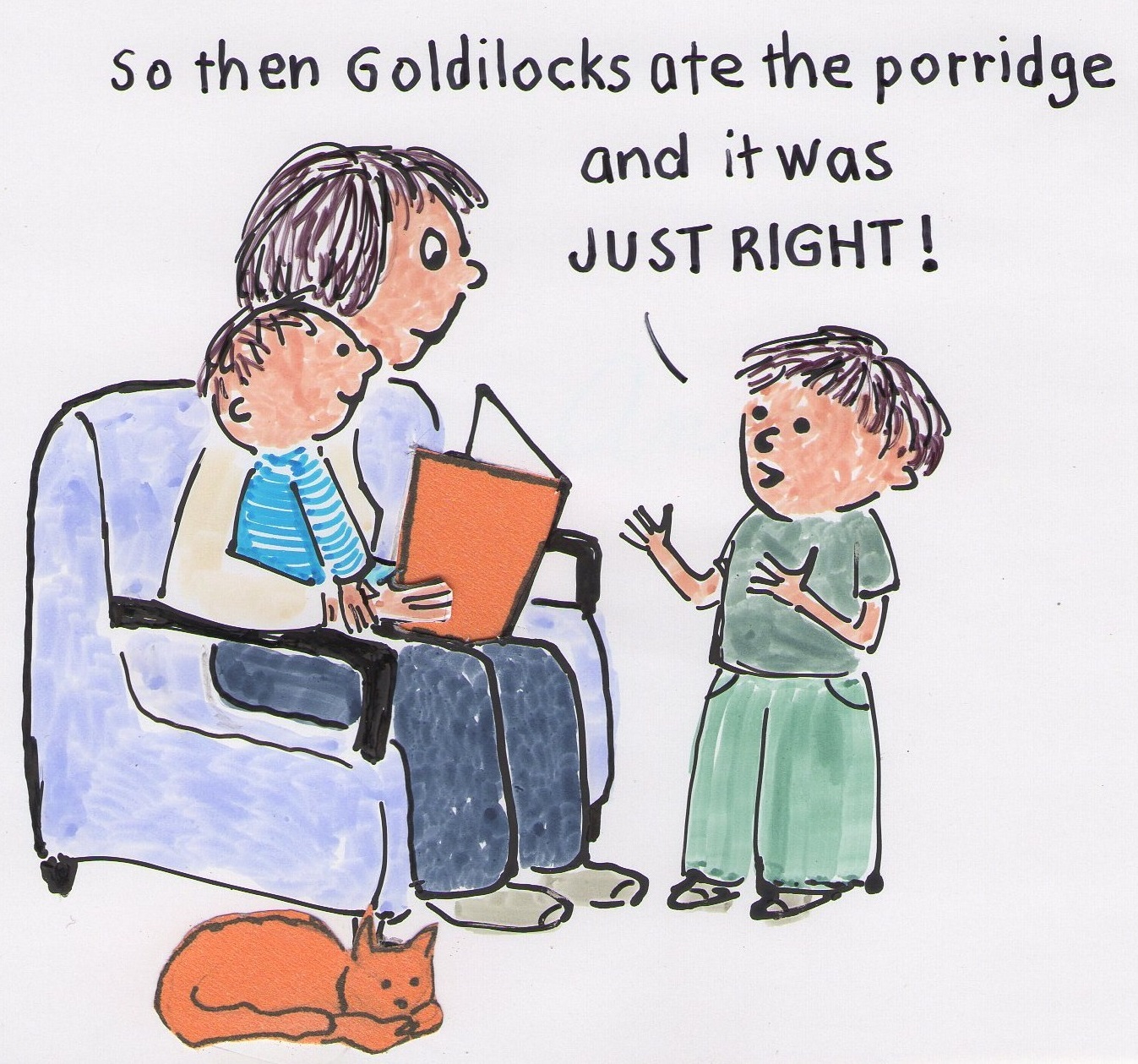
    child retelling story of Goldilocks

    Click on the picture to enlarge it.

  • Hearing sentences read fluently, with pauses at commas and periods.  Children should recognize a change in an emotional tone, or a change of voice when the big, bad wolf speaks compared to when Little Red Riding Hood speaks.  They should learn that there is meaning in stories and in nonfiction.  (Ask your child what is happening on a given page, or what the story is about.  Ask the child to predict what might happen next.  Ask the child what happened first, in the middle, and at the end.)

These ideas come from the Common Core State Standards Initiative (the suggestions in parentheses are from Mrs. K), and are intended as a standard for measuring the foundational reading skills of kindergarteners.  Most states are now using Common Core Standards.  For more information, go to http://www.corestandards.org/ELA-Literacy/RF/K.