Category Archives: methods of teaching reading

Is there a low tech, inexpensive way to teach my children their letter sounds?

I’ve had success teaching reading to brand new readers by matching pictures to the correct letter using homemade flashcards.  Both native English speakers and ESL preschoolers have found this a fun way to learn letter sounds.  It can be done in five minutes here and there, making it a good way to teach children with short attention spans.

Child sorting picture flash cards to match with the letter B.

To enlarge the picture, click on it.

I suggest you try this method:

  • Cut some index cards in two, each about 3 by 2 ½ inches.  Or use the index cards whole if you prefer.
  • On ten or twelve blank cards, paste pictures of words which begin with the same consonant sound, such as the letter “b.”  Use pictures of a ball, a balloon, a bear, a banana, a ballerina and others until you have about ten to twelve cards with “b” pictures.
  • On another ten or twelve blank cards, paste pictures of words which begin with other letters, such as an apple, a cat, a dog, a kite and a piano until you have about the same number of cards as “b” cards.
  • On one blank card write or paste a capital B and a lower case b, “Bb.”
  • Lay the card labeled “Bb” on a table.  Shuffle all the picture cards, or let your child do that.  The more she can participate in the process, and eventually control it, the more likely she is to be eager to play the “game.”
  • Now taking one card at a time, have your child say the word of the picture.  Emphasize the “b” sound for her, and ask her if the card starts with a “b” sound.  If so, tell her to put the card next to the “Bb” card.  If not, tell her to put the card a little distance away.
  • Keep doing this until you have gone through all the cards and made two piles of picture cards.
  • With practice, your child will be able to match the words to the letter quickly.
  • After she has mastered “Bb,” make a set of cards using another consonant sound.  You can keep the same set of random cards or add to them.  Some of the random cards will eventually become the letter cards, so you need to add to that group of cards as you develop more letter cards.
  • Begin with the 16 consonants which almost always sound the same:  (Bb, Dd, Ff, Hh, Jj, Kk, Ll, Mm, Nn, Pp, Qq, Rr, Tt, Vv, Xx and Zz).  You don’t want to  do the ABC’s in order, starting with Aa.  Begin with any of the consonants I just listed.  If the child’s name is Tom, start with “Tt.”  If it is Hannah, start with “Hh.”
  • Try not to use pictures of words that start with blended sounds.  For example, don’t use “blue” or “braids” yet.  Later, after the child is sure of the single sound of a letter, you can start combining letter sounds.
  • Don’t start with a consonant that has multiple sounds, such as Gg, Ss or Cc.  For starts, choose letters and words that follow the rules of phonics.  Try to reduce confusion as much as possible.
  • Also, don’t start with vowels.  I teach vowels slightly differently.  I’ll tell you about that in my next blog.

Perhaps this sounds like too much work?  I use the cards over and over with new reading students, so for me the time it took to make the cards was well worth it.  If you have more than one child, you too can reuse the cards, and if you laminate them, they last forever.  (Laminating is expensive, but clear packing tape protects the cards well.)  And the cards are easy to make.  I made mine while watching TV.

In addition to being low tech, the cards are an inexpensive method to teach sounds.  A pack of index cards; old books, magazines or stickers to use for pictures; and tape together probably cost a few dollars and can be used to create many sets of cards.

How about you?  Were you taught your letter sounds by another low tech method?  How are you teaching your children their letter sounds?  Tell our readers by clicking the comment button.
With so many apps available for preschoolers, how do I know which are the best ones to use to teach my child to read?

The best apps to teach reading share many of the same characteristics as the best apps to teach math or to teach games.  Here are some traits to look for, although you will not find each of these traits in every app.

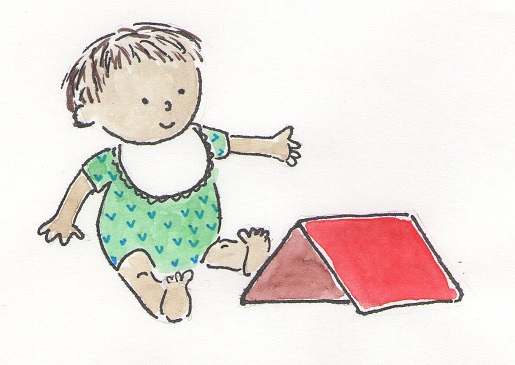
baby looking at an iPad

To enlarge, click on the picture.

  • The app should be age or developmentally appropriate for your child.  It should seem like play but allow the child to gain self-confidence both in mastering the media and in mastering the material presented on the app.
  • The app should be interactive.  Most apps are passive, limiting a child to clicking or scrolling down, but that’s about it.  The best apps allow children to solve problems or to develop curiosity.  Some apps allow coloring, drawing lines and highlighting, with the child deciding how.
  • The app should be intuitive to use.  Using computers is often hard for preschoolers since interaction depends on mastering a mouse and a keyboard.  But pads are intuitive, allowing for swiping with a single finger to move from page to page.  Once the child tries the process a few times, he understands it.
  • The app should allow for repetition.  Young children like to have their favorite books read to them over and over.  They might also like to go to their favorite apps over and over.
  • The app should take advantage of the technology.  A book about a pet might show the word “dog,” but an app might show the printed word, offer a picture of a group of dogs wagging their tails, and create the sounds of panting and barking.
  • The app should be open-ended: divergent, not convergent.  Usually an app encourages a child to hit an icon which might be right or wrong, a dead end for the child.  But if the answer allows the child to continue in a manner she prefers, or to get to an answer in a round-about way, the child has some input into the outcome.
  • The app should extend a child’s skill or make up for a child’s shortcomings.  If a child cannot print yet, or has poor printing skills, a good app would produce the desired letters without the child needing to “write.”  Or for an ESL child or a child with speech problems, a good app might “read” the words aloud so that the child can hear the words pronounced correctly.
    child taking iPad out of toy chest

    To enlarge, click on the picture.

  • The app should be fun and engaging.  Stories should move in time order so that they are easy for a young child to follow.  There should be an obvious beginning, middle and end.  The vocabulary and sentence structure should be comfortable for the child so he gets it the first time he hears it.  The art work should make the child laugh.
  • The app should foster socialization.  Apps that store child-taken photos of a trip to the zoo allow for later sharing with preschool classmates or with family.  Apps that allow a child to film a Barbie fashion show or Grandpa snoring beg to be shared.  SKYPE allows for sharing over great distances.

Spend some time investigating apps for your young children.  Teach them how to access the apps you have selected.  And next week do it again, because the apps—like your child—are always changing.

How can I make reading to my four-year-old a more educational experience (not just fun)?

Children pick up many foundational skills when someone reads to them frequently.  In fact, reading to children is probably the single most important way to prepare them to read by themselves.  But you could monitor your child to be sure he is learning more subtle concepts about reading in English.  Most schools expect these skills to be mastered by the end of kindergarten:

  • Knowing that in English words are read from left to right.  (You could point to words with your finger as you read to reinforce this idea, especially if you come from another language in which words are read from right to left or top to bottom.  If you read to your child in both languages, remind the child that you are reading in English.)
  • Knowing that words are read from top to bottom.  (Occasionally, ask your child where you should begin reading on a page.  Or turn the book up-side-down to see if the child recognizes the mistake.)

    child telling grandpa he is holding the book upside down.

    Click on the picture to enlarge it.

  • Knowing that pages are turned from right to left.  (Ask your child to turn the pages for you.)
  • Knowing that words are shown in print by a grouping of letters with a space before and after.  The space before indicates a new word is to begin; the space after indicates that a word has ended.  (Point to tiny words like “a” or “I” and to big words like “dinosaur,” and comment on the size of the word.  Or ask the child to count how many words are on a particular line.)
  • Knowing that words are formed from specific sequences of letters.  (Write a “word” like xxxxxxx or abcdefg and ask your child if that is a word.  Even though a child cannot read, he begins to figure out that not every grouping of letters makes a word.)
  • Knowing that words are made from combinations of 26 letters, upper and lower case.  (Make sure your child can name the upper and lower case letters.)
  • Since understanding word families helps with reading (pig, wig, big), children need to identify words that rhyme.  (Play rhyming games with your child.  Recite nursery rhymes with your child.)
  • Since English words are made of syllables, understanding the number of syllables in a word is important.  (When you are reading, stop and say “ty-ran-a-saur-us” with a pause between each syllable.  Have your child clap the syllables and count the syllables with you.  Ask your child if you should pronounce the word “ty-ran-a-saur-us” with pauses between the parts, or “tyranasaurus.”  If your child is learning English as a second language, distinguishing syllables from words can be difficult, so for bilingual children you might want to slow down a bit until the child is more fluent in English.)
  • Knowing that rhyming words are the same at the end, but different at the beginning.  (Help a child to sound out the rhyming part and the sound beginnings for words such as bed, red and sled.)
  • Knowing that words are composed of sounds which correspond to letters.  (As you read, help the child to isolate the sounds in some three-letter words, such as sad, hop or fig.  The child doesn’t need to know the letter names that correspond to the sounds at this point, but she should gain experience reproducing the sounds.)
  • Knowing that changing a letter sound creates a new word.  (Say a word like “bag” and ask what would happen if you changed the first sound to the “r” sound or if you changed the last sound to a “t” sound.  Help the child to manipulate letter sounds to form new words.  Using letter tiles helps with this skill.)
  • Knowing that each letter usually corresponds to a sound.  (Help the child to learn the most common consonant letter sounds.)
  • Recognizing that there are long and short vowel sounds, and that adding certain letters, such as an e at the end of a three-letter word, changes the sound and the word.  (This is a more advanced skill, so if your child finds it hard, ignore it for a few months and then try again.)
  • Knowing sight words.  (Help the child to recognize more and more words by sight, and sometimes, let the child read those words when you come to them in a story.  Don’t do it every time or reading to your child won’t be fun.  But as a child gains sight word knowledge, point to the words as you read, so the child can recognize words he knows and can pick up new words.)
  • Knowing that many words are spelled almost the same, but slight differences do change the word.  (Point out “rat” and “rate” or “ball” and “bell” to show what a difference one letter can make.)

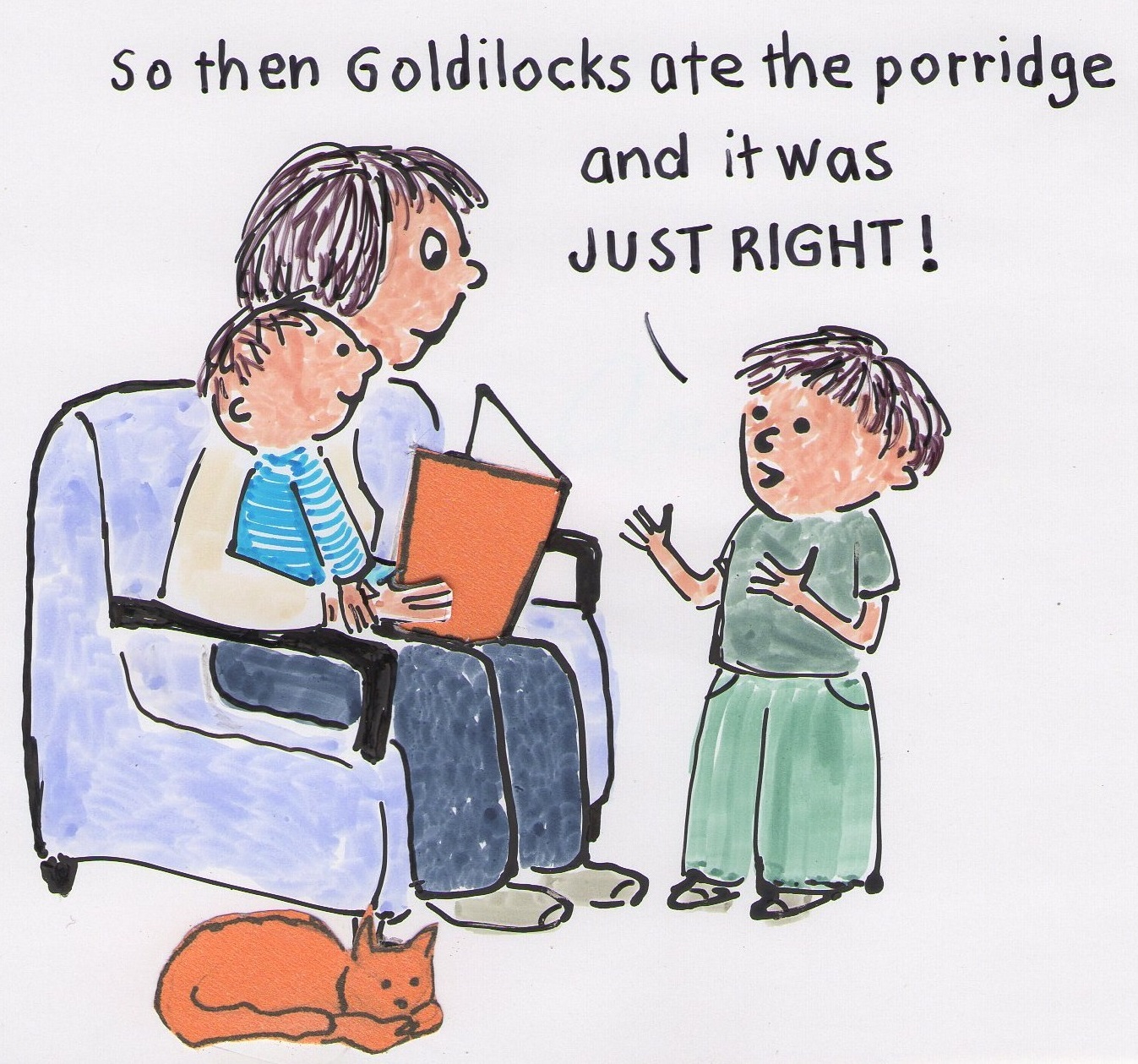
    child retelling story of Goldilocks

    Click on the picture to enlarge it.

  • Hearing sentences read fluently, with pauses at commas and periods.  Children should recognize a change in an emotional tone, or a change of voice when the big, bad wolf speaks compared to when Little Red Riding Hood speaks.  They should learn that there is meaning in stories and in nonfiction.  (Ask your child what is happening on a given page, or what the story is about.  Ask the child to predict what might happen next.  Ask the child what happened first, in the middle, and at the end.)

These ideas come from the Common Core State Standards Initiative (the suggestions in parentheses are from Mrs. K), and are intended as a standard for measuring the foundational reading skills of kindergarteners.  Most states are now using Common Core Standards.  For more information, go to http://www.corestandards.org/ELA-Literacy/RF/K.

Is using phonics the best approach for teaching reading to young children?

In 1997, Congress asked the National Institute of Child Health and Human Development (a division of the National Institutes of Health) plus the federal Department of Education to investigate the best research about the teaching of reading.  This action came about to settle once and for all the “reading wars” by proponents of various ways of teaching reading.

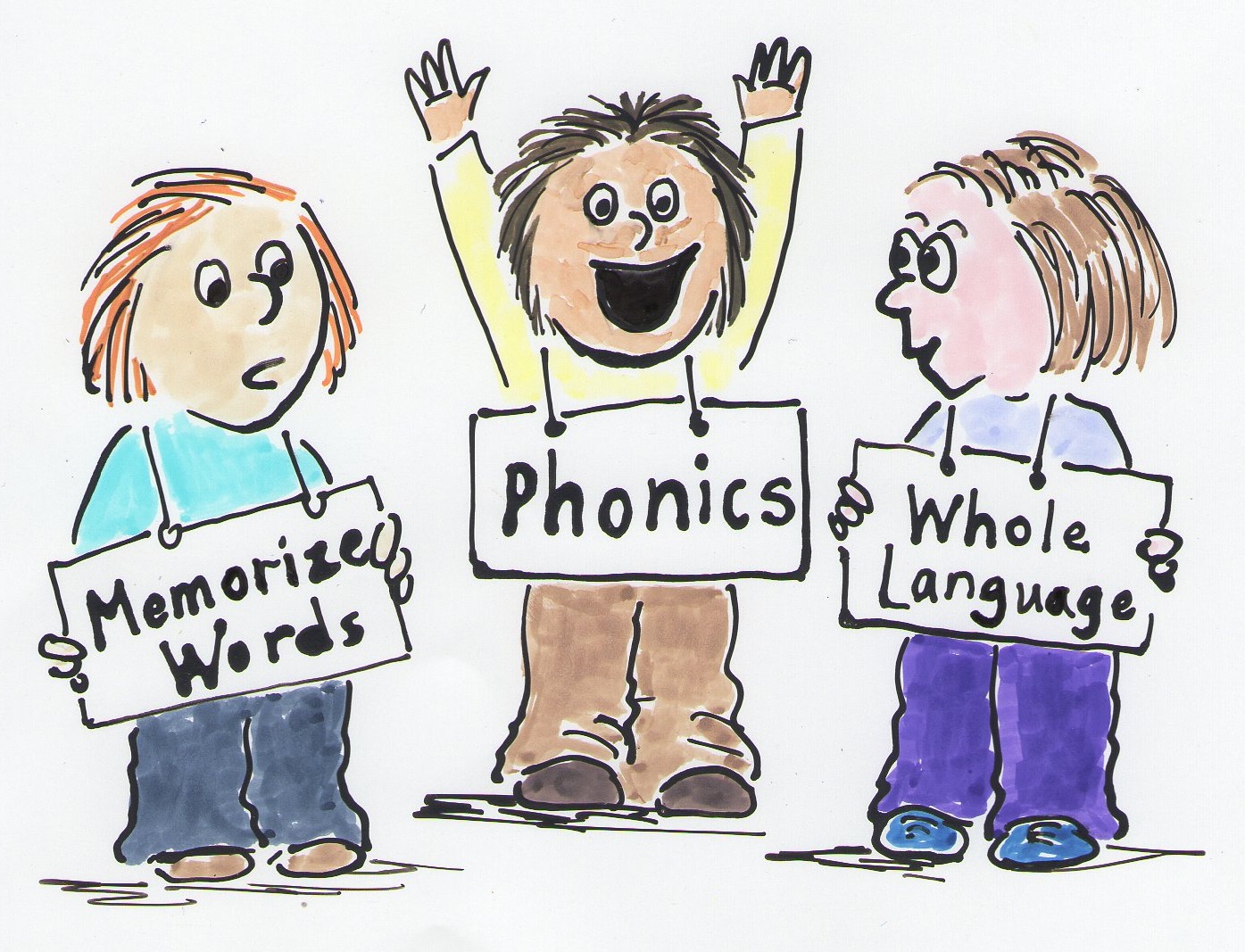
Three children with signs around their necks that read: Meniruze words, Phonics, Whole Language

Click on the picture to enlarge it.

A panel composed of 12 university professors, one principal from an elementary school, a parent, and one language arts teacher from a middle school, reviewed thousands of experimental research results; held public hearings at which parents, teachers, students, scientists and government officials testified; and asked for input from leading educational organizations concerned with reading issues.

In April 2000, the results were published (www.nationalreadingpanel.org).  They showed that although reading is a complex process and not every child learns to read the same way, a systematic, phonics-based approach yields the best results, especially for the youngest students.  The panel said kindergarteners (the youngest children researched) gain the most reading and spelling abilities from studying phonics, but that students through grade 6 improve using this approach.

For low achieving students and students with disabilities, a phonics-based approach significantly helped them to read words compared to other approaches.  For students who were already good readers, a phonics-based approach helped with spelling.

The panel stressed that systematic phonics instruction needs to be one of four components to teaching reading.  The panel defined phonics as how a letter corresponds to a sound in English, and defined systematic phonics as planned, sequential letter-sound instruction.  The other three components (to be discussed in a coming blog) are phonemic awareness, fluency and reading comprehension.

The panel indicated that teachers and parents should not teach only phonics if they expect a student to learn to read.  Yet phonicst is a good place to begin, especially for the youngest students.

Should I give my beginning reader spelling tests?

Little children love to show that they are growing up.  If they have older siblings, they have probably watched them write their spelling words and have heard you pretest them on those words.  Since the whole idea of testing is new and “grown-up,” of course they want to be part of it.

Young child writing C-A-T.

Click on the picture to enlarge it.

Rudolph Flesch, the proponent of teaching a phonics-based reading system in the mid-20th century, advocated teaching spelling at the same time as reading.  His position was, if the child can read a word, he can spell it.

But how to test?  Here is one way to make spelling tests games.

  • Cut out little pictures of words to be tested—cat, hat, bat—and paste them on a sheet of paper with a number next to each picture.  Five to ten pictures per page is plenty.  Then have the child spell the word orally to you, or if the child can write her letters, have the child write the answers on a separate piece of paper.
  • Start by using all rhyming words—bat, cat, fat, hat, mat, pat, rat, sat; can, fan, man, pan, ran, tan, van; big, dig, pig, wig, for example.  Then, when you are sure the child had mastered the rhyming words, mix up words of the same vowel sound.  If the child is successful, then mix various CVC words on the test.  This method ensures success for the child and gives her confidence before she faces words with varying vowels.
  • If the child is writing the spelling words, you do not need to be nearby—a plus for the child’s independence.
  • Or you can go online to have a similar experience using a computer.
  • At www.mrskilburnkiddos.wordpress.com/reading/CVC-words , you can see photos of another type of spelling test.  A picture of a CVC word is glued on an index card.  Below the picture are three squares where the child can spell the word with letter tiles.  Several index cards are joined together with a ring to form a single test.  You would need to use this idea as a pattern to create the test yourself.

What does CVC mean?

If you do much reading about how to teach early readers, you will come across CVC.  It means consonant-vowel-consonant, and refers to one syllable, short vowel words beginning with a consonant, followed by a short vowel and ending with a consonant. Cat, pen, pig, dot and bug are examples.

CVC means consonant-vowel-consonant, and refers to one syllable, short vowel words beginning with a consonant.

Click on the picture to enlarge it.

CVC words are usually the first words children learn once they know their consonant sounds and short vowel sounds.  In CVC words, all the letters are pronounced, and they are pronounced the way children expect.  So for example, the word “gas” would be included as a CVC word, but the word “was” would not be included since the “s” sounds like a “z.”

Almost all English reading systems based on a phonetic approach begin by using CVC words.  Children usually learn short vowel words first because what you see is what you get—no silent letters (late, heat), no digraphs that turn letter sounds into other letter sounds (chat, the), and no use of letters that have secondary pronunciations (has, sew).

Although many words in English do not follow rules of phonics, most of them do.  So teaching children patterns that work most of the time offers them confidence to figure out words that are new to them.

However, most reading books meant for beginning readers do not limit themselves to CVC words.  Writing a meaningful story using only CVC words is hard.  Even Dr. Seuss in The Cat in the Hat used words that do not follow CVC rules. (“The sun did not shine.  It was too wet to play.”)

If your child is ready to read CVC words, you could point to CVC words for the child to read in books, and you could read the other words.  If you own the book and don’t mind marking it, you could underline the words the child should know and take turns reading words in sentences.  Goodwill is an inexpensive source for such books.

My child seems behind his first-grade classmates who are already reading. What can I do?

Check to see if there is a Reading Recovery program in your school.  It is designed for just the kind of situation you describe.  Reading Recovery identifies children having trouble reading at the beginning of first grade, intervenes with a private tutor, and, for 75 percent of the students who complete the program, gets them to grade level reading within 20 weeks.

At the start of first grade, or around students’ sixth birthdays, children in schools with a Reading Recovery program are evaluated for their reading abilities.  Those who rate in the lower 5 to 20 percent compared to their classmates are offered a specially trained tutor who works with an individual student for a half-hour daily for 12 to 20 weeks.  Then the students are reassessed.  The great majority of students going through the program read on grade level after 20 weeks and no longer need intervention.  For the few who don’t, specific data collected on those students can be used to plan other interventions.

Since reasons for not reading well vary from child to child, each tutor tailors a program based on her student’s strengths and weaknesses.  During a typical lesson a child reads one or more tiny books (just a few words on each page and only a few pages) with comprehension the primary focus of the lesson.  The books are chosen by the tutor based on the child’s interests.  A student also learns phonics, fluency and other reading skills, and writes in a journal-like notebook.  Each day the child brings home a tiny book which she is encouraged to read to her parents.

Reading Recovery intervenes early in a child’s education before problems consolidate and before the child develops a self-concept as a poor reader.  It was started in the 1970’s by a New Zealand developmental psychologist, Marie Clay.  New Zealand is the only country to offer this program in every school, but it has spread to the UK, Ireland, Australia, Canada, and the U.S.

Reading Recovery began in the U.S. in 1984, and last year was offered to 50,000 first graders in 4100 schools in 41 states.  It is offered only in schools (not privately) which pay for the training of Reading Recovery teachers.  Teachers are trained for a year, and during that time they observe experienced teachers working with students and begin to work with students themselves.  This is to assure there are highly skilled tutors able to plan a program that will lead a student to successful reading.

Data is collected on every child who takes part in a Reading Recovery program.  In 25 years, in the U.S. 1,551,444 students have completed the program, and of them, 1,209,577 have achieved grade level reading abilities within 20 weeks.

To find out if there is a Reading Recovery program near you, go to the Reading Recovery Council of North America (www.readingrecovery.org).  On the home page, under Quick Links, click Directories.  Then click Teacher/Leader Registry, and put in your city or state in the appropriate blanks.  A list of Reading Recovery teachers and their school email addresses appear.  If you contact a local one, that teacher can tell you what schools in your area participate.

Can flashcards be used with preschoolers? If so, how?

I have worked successfully using flash cards with three and four-year-olds.  The children were learning the alphabet.  I used a deck of cards with all 26 letters printed on them, plus pictures of words which begin with each letter.  Here’s how you might use the cards:

Child holding a pile of flash cards that she's studied and now knows.

Click on the picture to enlarge.

  • Use flash cards to recognize the names of the A, B, C’s.  For very young children, start with just a few cards (such as the letters in family names, Mom and Dad).  Later increase the number of letters until all 26 could be identified.
  • Use flash cards to recognize the sounds of the A, B, C’s.  Start with a few cards whose sounds the child already knows and add more until all 26 letter sounds can be identified.
  • Use flash cards to pair letter names and sounds.  Once the child knows the names of the A, B, C’s and the sounds individual letters make, shuffle the cards and pull them one at a time for the child to identify both names and sounds.  Resist the urge to place all the cards face up on a table.  For some children, seeing all 26 cards at once is overwhelming even though they know the letters and sounds.  Showing one card at a time is not so intimidating.  Start small.
  • Use flash cards to order A, B, C’s.  Taking a handful of cards at a time (A to E, for example), place them face up in mixed order on a table.  Let the child arrange the cards in order.  Sing the ABC song slowly with the child if she hesitates.  Then add another set of cards (F to J, for example) until all the cards are in proper order.
  • Use flash cards to identify a letter and its sound with a word.  It’s important for the child to memorize a word which comes to mind immediately for each letter.  This will be useful when the child is beginning to sound out words.  When learning with vowels, choose words that begin with short vowel sounds.  For example, A is for apple, E is for egg, I is for igloo, O is for octopus and U is for umbrella.
  • Flash cards are also useful for learning sight words.  Not all tiny words follow the rules of phonics (the, as, of, is, was and they, for example).  Yet children need to be able to recognize these words to read.  In many kindergarten and first grade classrooms, teachers have lists of these words on the wall for students to use when writing.  Manufacturers sell boxed sets of commonly used sight words too.

Should I teach my grandson to read one word at a time, the way I was taught? Is this a good way?

If you learned to read in the 1950’s or 1960’s, you probably learned via the “look-say” method.  Your teacher wrote a word, such as “look,” on the blackboard.  She said it aloud.  You said it aloud.  You opened your reader to page 1.  There under a picture, was the word, “look.”  You read it aloud.  During the day your teacher referred back to the word on the board to help you remember it.  You repeated it.

The next day you did it again, except this time you added the word “see.”  When you turned to page two, there were both words, “look” and “see.”

2 Children reading books.  One is shown using a past reading technique and the other is using a more modern approach.By this method, children were taught to read words as whole units, much like Chinese children are taught their written language.  By the end of first grade, baby boom children had a reading vocabulary of about 150 to 180 words.  They might have been taught some phonics at this point, or phonics might have waited until second grade, or they might never have been taught phonics.  Students were expected to memorize thousands of words.

This “look-say” method was invented by Rev. Thomas H. Gallaudet, the director of a school for deaf and speechless children in the early 19th century.  Many schools adopted this method then, especially when it was endorsed by Horace Mann, the Secretary of the Board of Education in Massachusetts.  But after a while, teachers protested that their students couldn’t read.  And so teachers went back to a phonics-based approach until the 1950’s, when “look-say” became popular again.

There are several problems with this method of teaching reading.

  • With 50,000 words in everyday use in English, a student would never learn them all.
  • Nor could he read books which did not strictly adhere to the vocabulary list.
  • He would not learn word-attack skills to figure out new words.
  • But the biggest problem is that evidence was mounting by the 1970’s that another method, the phonics method, taught reading better.

Even so, “look-say” was not abandoned.  Instead in the 1980’s, it was wrapped into another reading instruction approach called “whole language” which ignored research supporting the superiority of a phonics-based approach.  Whole language focused on context, expecting the student to learn new words from the context of the other words in a sentence.  Like “look-say,” whole language was a haphazard approach.

So back to your question:  Should you teach your grandson to read whole words?  Sure, if you teach phonics as well.  But don’t skip the phonics.

Consider this:  You can teach your grandchild word after word after word, endlessly, or you can teach your grandchild about 41 letter/blend/diagraph sounds and about 100 rules.  Using the first approach, he’ll memorize several hundred words in a couple of years.  Using the second approach, he’ll master word attack skills that he can use on 80 percent of the words in the English language.

What are McGuffey Readers? Are they a good way to teach my child to read?

Long before there was research on how children learn to read, in 1836 William McGuffey created the first set of readers for American children. His series begins with a book of mostly one syllable words used in 55 stories, all of which teach a lesson on how to be good.  The second book of 85 lessons teaches history, biology, botany, table manners and respectful behavior using words a bit longer and harder to read.  Four more books in the series teach grammar and public speaking, using stories from Shakespeare and the Bible.  The first two books were much more widely read than the last four.

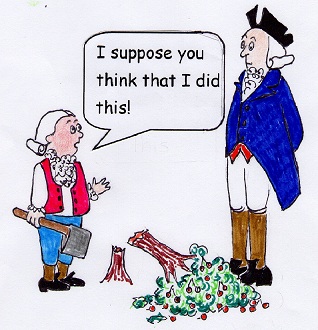
clip of George Washington chopping cherry treeOne of the stories concerns George Washington cutting down a cherry tree and confessing the truth to his father—perhaps the source of that myth.  Another story emphasized being kind to horses.  Another teaches respect for the flag.

McGuffey’s Readers, as they became known, were used in schools in the western and southern U.S. throughout the 19th and early 20th centuries.  The original stories, based on a European Christian ethical code, gradually changed in later editions to teach lessons not connected to any specific religion.  Millions of Americans were influenced by these books, and could quote from them later in life.  Henry Ford was one of those.  He was so indebted that he distributed thousands of the readers at his own expense.

Reading specialists today would find fault with McGuffey Readers.  The first book introduces words in no particular sequence.  Lesson one introduces three short vowel words, but by lesson 11, a digraph is used, and lesson 12 introduces words with long vowels.  The sound of letters is not emphasized.  Often the teacher would read the lesson aloud, and then the student would spell a word, name its letters, and then pronounce the word correctly.  Many words were memorized as sight words rather than as words that could be sounded out.

A selection from the first book follows.  Notice the use of three-syllable words, long vowels, “head” which doesn’t follow phonics rules, and the digraph “wh,” as well as one-syllable, short-vowel words.

“I like to see a lit-tle dog,
And pat him on the head;
So pret-ti-ly he wags his tail
When-ev-er he is fed.”

However, to McGuffey’s credit, reading specialists would point out that the lessons in McGuffey Readers become progressively harder to read; these readers were one of the first texts to be created that way.  New words are listed at the beginning of each lesson and words from past lessons are repeated.

Perhaps as many as 120 million copies of McGuffey Readers were printed, making them one of the most influential books ever printed.  They can still be purchased in some book stores and online.  Since the copyright on these books has long expired, and since there were many editions with changes from the originals, what is available today under the name McGuffey Readers varies.  The books are still being used to teach reading, especially in home school situations in the U.S.

For a free, online, early twentieth century version of the first reader, go to http://www.gutenberg.org/ebooks/14640.