Category Archives: methods of teaching reading

My granddaughter can read small words, but she stumbles over bigger words when we read together. How can I help her?

Here are some tips to help with bigger words:

  • If you are reading for sheer enjoyment, anticipate the words she might not know and say them quickly, so she can keep reading and not lose her thought.  Don’t worry that she might not be learning new word attack skills in your reading session; she is learning other aspects of reading such as fluency and comprehension which are often hard to learn when she stops to consider every new word.  Also, if she is tired or ornery, this kind of reading lesson gets her to read without causing frustration.grandparent reading with grandchild.
  • But if you are reading with your granddaughter to help her decipher words, and if she is in a receptive mood, you might cover parts of the word (usually syllables) and then uncover them, so she can join them together.  For example, if the word is “continent,” cover the “tinent” part with your thumb and let her say “con.”  Then cover the “con” and the “ent” parts and let her read “tin.”  If she mispronounces “tin,” pronounce it correctly.  Then cover all but the “ent” and let her figure out those four letters.  If she can put it together, fine, but if not, you do it while covering and exposing parts of the word as you say it.  Then move on to another word.  The goal should be to teach her a method of figuring out words, not mastering every word you encounter in a particular lesson.
  • If you own the book, and don’t mind marking it, you could highlight every word she can read correctly.  She will see that the number of words she can read far outnumbers the few she can’t.  You might ask her what she notices about the words that are not highlighted.  She might say, “They are long,” or “They have lots of letters.”  Tell her there are ways to figure out those words just like there are ways to figure out three-letter words, and you will work with her on those long words.
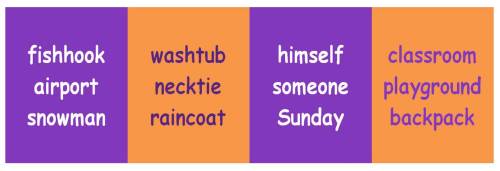
  • A good place to begin is with compound words.  They can be easy to decipher if the child looks for small words inside big words.  Try some with her such as “pancake,” “popcorn” and “forget.”  Make a list of such words and let her be the detective, discovering the small words inside the large words.  Have her circle each of the small words and then pronounce them together.  Some words you might use are:compound words are small words inside big words
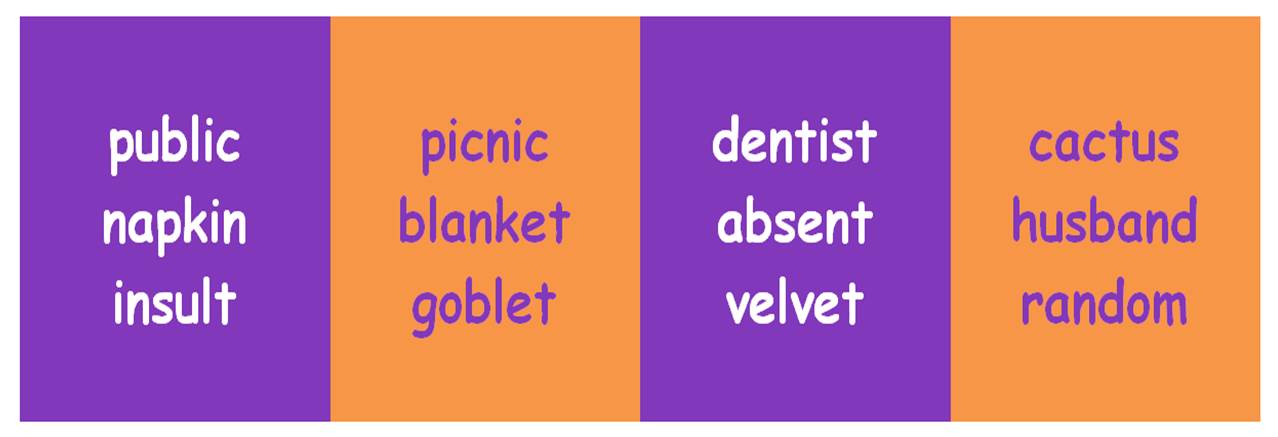
  • Some longer words have pronunciation rules that are easy for a child to remember.  For example, if a six- or seven-letter word has double consonants in the middle (biggest, kitten, flabby), that means the word usually has two parts, or syllables, and the first syllable ends between the “twin” letters.  (Use the word “syllable” since this is a term your granddaughter will need to learn anyway.)  Phonics books sometimes refer to these words as VC/CV or CVC/CVC words since they generally have short vowel sounds in both syllables.  You could practice a handful of those words, writing them on notebook paper for your granddaughter to pronounce.  Choose words whose letters follow the rules of phonics so she is not confused.  Have her draw a line between the double consonants and then pronounce each syllable.  Some words you might use are:"twin" letter words have double consonants in the middle.
  • Some other six- or seven-letter words have one vowel near the beginning, another vowel near the end, and two or three consonants in the middle.  These are a variation on VC/CV or CVC/CVC words with twin conconants.  Show her words like “contest,” “nutmeg” and “insect.”  Explain that the words have two syllables, and that the first syllable ends between the two consonants.  Have her draw a line between the middle consonants and then pronounce each syllable.  Some words you might use are:two syllable words with vowels in the first and last syllable

Our blog will have more on how to teach multisyllabic words in the near future.  Let us know if you find this information useful or if you have particular problems teaching your child reading.  We will investigate for you and offer the best advice we can find.  –Mrs. K and Mrs. A

How do I teach CVC words that end in –ck and words that end in –ook without confusing my son?

When a child is learning to read, and is at the short vowel, one-syllable, consonant-vowel-consonant (CVC) word stage, the child often encounters words from the word family –ook (book and look, for example) or words that end with –ck (sock and truck, for example).  Strictly speaking, these word don’t follow the CVC rule for pronunciation, so they should be taught separately, starting with the –ck family words.

CVC words that end in _ch and _ook.

To enlarge, click on the picture.

Usually there is no problem reading CVC -ck words once the child understands that –ck is a single sound.  But reading, pronouncing and spelling the –ook words can be a problem.  How can you help your child?

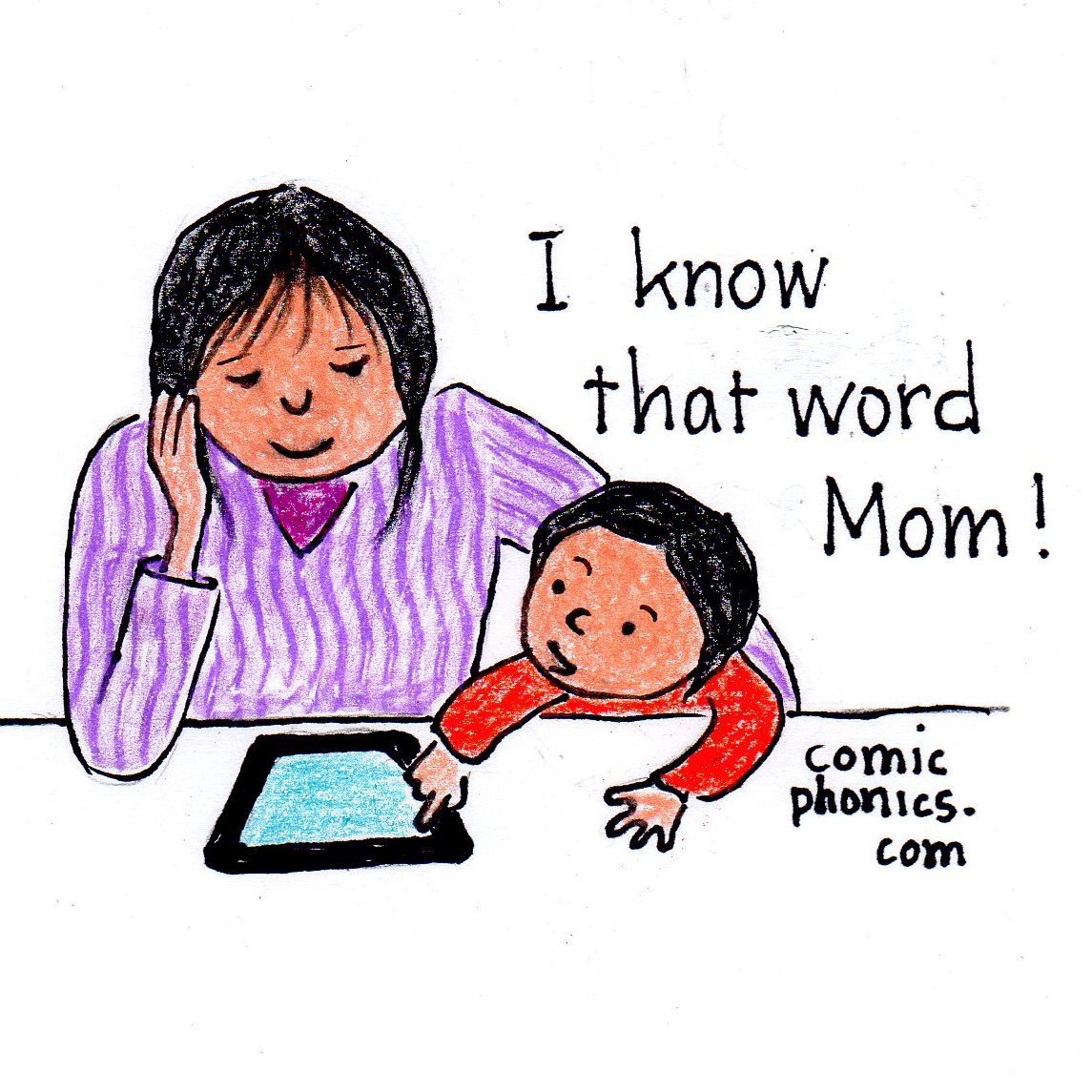
"I know that word, Mom," says the child lookinFirst, wait until your child is comfortable with CVC –ck words (see list above) to explain this difference.   Teach the CVC words that end in –ck first and make sure the child understands how to read, pronounce and spell those words.  Then introduce –ook family words.

  • Point out to your child that the –ook sound is not the same as the short –ock or short –uck sound.  Say the sounds aloud so the child can hear the difference, and ask the child to say the sounds too.  Don’t show letters at this point since it is the sound that guides the child as to which letters to use.  The child needs to be able to hear the difference.
  • If you have pictures of words that end in –ock (clock, dock, flock, knock,), in -uck (buck, puck, suck, tuck, truck) and –ook (book, cook, crook, hook, rook) you could create a set of flash cards for the child to sort by sound.  As the child sorts, ask the child to pronounce the word to be sure she is hearing the word correctly.
  • Tell your child that after a word with the –ook sound, just a “k” is used, as in book and look, two words the child might already know as sight words.  You could create a set of flash cards with the –ook family words on them and use them as sight words if that helps.
  • If you have letter tiles, practice moving them to show –ook family words and ask the child to read them after your example.
  • When the child seems comfortable with the difference in sound, practice moving tiles to show the difference in spelling.  For example, construct l-o-ck, and under it construct l-oo-k.  Say each word and ask the child to tell what he notices.  Do the same with other word pairs such as cr-o-ck and cr-oo-k; h-o-ck and h-oo-k; r-o-ck and r-oo-k; and t-o-ck and t-oo-k.
  • Practice moving tiles so that just one word—lock—appears.  Ask the child to pronounce it.  Take out the -ck and put in –ook and ask the child to pronounce the new word.  Keep moving tiles around until the child grasps the correct pronunciation of each word.
  • When you are reading –ck and –ook words, reinforce the spelling.

At this point the child usually hasn’t learned how to read long vowel sounds, so there is no need to add to confusion by introducing words like bake and smoke now.

Are there any tricks to help my child with reading comprehension?

One proven tactic to learn almost anything factual is music.  According to Annie Murphy Paul, author of the blog, The Brilliant Report, and an expert on human intelligence, music has been used for thousands of years to help us remember facts.  You used this technique when you were a child.  How did you learn your ABC’s?  By singing them, of course.

Ways to improve the likelihood of facts being remembered through song are to write lyrics that use concrete actions and powerful visual images.  Literary devices such as alliteration (words beginning with the same letter), assonance (words with the same vowel sounds), repetition and especially rhyme make a song more memorable, according to Paul.

Young girl reading a bookResearch shows that there are certain steps to increase reading comprehension as well.  Those steps are to read the title and try to understand what it means; then to read subtitles and boldfaced words and to ask yourself what they mean; then to interpret the drawings, photos, graphs, tables, political cartoons and charts to see what information you can glean from them; and last, to read the text.  If you follow the first three steps before you read the text, you should have a good idea what the text will be about.  You will have created a context into which the text makes sense.

This is true for picture books and early reading books as well as a high school chemistry text.  First the title, then the subtitles, then the illustrations and last the words themselves.

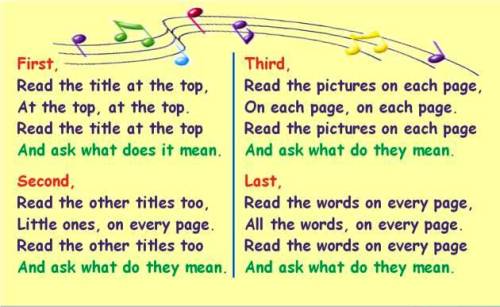
I have “translated” this information into a song about reading comprehension that you and your preschooler can remember.  Sing the following verses to the melody of “London Bridges Falling Down.”

Reading Skills Rhyme

To enlarge or print an 11″ x 8.5″ version, click on the picture.

Using this pattern when reading books with your child should improve her reading comprehension.  And after your child memorizes the song, she should have a sequence of strategies to use even when you are not there.

Let me know if this song helps by responding to our blog.  And if you are interested in practical research on how the brain works, go to www.anniemurphypaul.com and subscribe to her weekly newsletter as I do.

My child is struggling to learn short vowel sounds. What can I do?

As a temporary help, you could create word lists or flash cards using color-coded letters for the vowels.

Colors for vowel soundsIn Tutoring is Caring, Montessori teacher Aline D. Wolf suggests printing the letter representing the vowel sound in a particular color to help the child remember the sound.  She suggests using colors whose name has the letter sound that the child is trying to say.  So for example, short e words would be written with red e’s.  Since vowels are the most difficult sounds for the child to master, the color would alert the child that the colored letter is a vowel, and the color would also give the child a clue as to the letter’s pronunciation.

The colors Wolf suggests are

  • Red for the short e sound since red’s vowel sound is short e.
  • Rust for the short u sound since rust’s vowel sound is short u.
  • Silver for the short i sound since silver’s vowel sound is short i.
  • Tan for the short a sound since tan’s vowel sound is short a.
  • Olive for the short o sound since olive’s vowel sound is short o.
  • Black for all consonants.

Wolf says it is important that the child recognize the colors using their specific names.  If a child sees olive and says green, then the clue that the sound of “ol” gives would be lost.  She recommends beginning with “e” and then “u” because they are easier.

Wolf wrote her suggestions in 1981, before personal computers, so today we have other options.  Using a computer, it is easy to duplicate these colored letters in words, just as using crayons or colored pencils makes it easy by hand.

Another suggestion she makes is to use broken lines for silent letters, a signal to the student that the letter is necessary but it is not pronounced.  This is easy to do if you are handwriting the letters, but I could not find a broken letter type face on my computer.  However, the computer offers other options such as outlined letters or highlighted letters, either of which could indicate silent letters.

With her lists of color-coded words, Wolf puts a drawing of a word that begins with that letter at the top of the list as an extra reminder of the letter sound.  So for short e, there is a drawing of an elephant; for u, an umbrella; for i, an igloo; for a, an alligator; and for o, an olive.

Cautioning that color-coding is a crutch, Wolf says it should be used as long as necessary, but that gradually the child should be weaned from the colors.  For children who don’t need the extra boost that colored letters give, they should not be used at all.

How to wean a child?  Wolf suggests that the child could match color coded words with the same words printed in black.  Or the child could match words printed in black with objects around the house or at school such as milk, pan and egg.  The child could also match words with pictures.

My child can read basic words. What kind of literature skills should s/he have for kindergarten?

Most states have adopted a common core of standards now used to teach and to assess children’s learning at each grade level and in academic subjects.  Included in these standards are ones for kindergarten reading which include understanding literature, informational texts and reading skills.  Those standards are

kindergarden literature skill standards

Go to http://www.corestandards.org/ELA-Literacy/RL/K for more on the common core of standards.

Key Ideas and Details

  • With prompting and support, the child should be able to ask and answer questions about key details in a text.
  • With prompting and support, the child should be able to retell familiar stories, including key details.
  • With prompting and support, the child should be able to identify characters, settings, and major events in a story.

Craft and Structure

  • The child should be able to ask and answer questions about unknown words in a text
  • The child should be able to recognize common types of texts (e.g., storybooks, poems).
  • The child, with prompting and support, should be able to name the author and illustrator of a story and define the role of each in telling the story.

Integration of Knowledge and Ideas

  • With prompting and support, the child should be able to describe the relationship between illustrations and the story in which they appear (e.g., what moment in a story an illustration depicts).
  • With prompting and support, the child should be able to compare and contrast the adventures and experiences of characters in familiar stories.

Range of Reading and Level of Text Complexity

  • The child should actively engage in group reading activities with purpose and understanding.

For more information, go to www.corestandards.org/ELA-Literacy/RL/K

How can I test my child’s basic reading skills so I know what skills he has mastered and what ones he needs to learn?

If your child knows a little bit about how to read, but you are not sure how much or where to begin, I came across a series of tests that might help you.

Mother sointing to Letters on flash card and asking, "What does the letter sound like/"The tests are from a 1981 book by a Montessori educator, Aline D. Wolf.  She wrote Tutoring is Caring for tutors of students who are experiencing difficulty in learning how to read.  Here is what she suggests, updated by Mrs. K to suggest online resources not available 32 years ago:

First test—recognizing sounds.  With a deck of ABC’s (available where school supplies are sold) or letter tiles (Scrabble pieces or letter tiles sold as parts of games) or an online site of moveable ABC’s, ask the student to say aloud the sound each letter makes.  The order of the ABC’s is irrelevent.

You might think, “Johnny can already read some words.  I can skip this step.”  Don’t.  Your child might have memorized the look of certain words the way a two-year-old can recognize “McDonalds” without being able to read.  Or he might have had a certain book read to him so many times that he can say the words from memory.  Test the letter sound of every letter.

A word of caution:  Test the letter sound, not the letter name.  This is not a test of ABC’s.  It is a test of the sound that the ABC’s make.  For vowels, listen for the short vowel sounds.

Another word of caution: Certain letters—a, g and q—can be written different ways in different type faces.  The child needs to recognize the common ways these letters are written as well as recognizing capital and lower case forms of every letter.  If you are writing the letters yourself, show all the common ways these letters are represented, but in general, use the letter form children use when they print.

If the child knows none or few of the letter sounds, begin by teaching some consonants that are generally pronounced the same all the time.  You don’t need to teach them all before you begin the vowels.  Teach ones that look different (not both “b” and “d,” or “m” and “n” or “p” and “q”).  You might start with “b,” “g,” “n,” “s,” and “t,” for example, and then add a short vowel sound (not i or e for starts since they sound so much alike).  From these few letters you can form words and show the child how words are formed.  He should be able to maneuver the cards or tiles or online letters to form words and to pronounce them.

Second test—combining the sounds.  Once the child knows the alphabet sounds, ask her to construct words by moving the cards or tiles around.  Have the child use all the letters.  If this is difficult, brush up on the sounds she finds troubling and try again.

Third test—reading simple words with short vowel sounds.  Create a list of CVC words and ask the child to read them.  You can find lists of such words online, or you can create your own list.  Try to use all the letter sounds.  If the child can’t read these words with ease, Wolf suggests preparing color-coded word lists (which our blog will explain soon).  If the child can read these words, move on to the fourth test.

Fourth test—reading words with blends.  Create a list of about 25 short-vowel words with blends at the beginning, at the end, or both.  If the child cannot read these words, go to the color-coded word lists.  If the child can read these words, move on to the fifth test.

A word of caution:  Blends are two or three consonants which together sound exactly like they sound when used separately.  The “s” and “t” in “stop” sound like they should in “sit” and “Tom.”  Don’t introduce digraphs at this point, that is, two or three consonants which, when used together, create a completely new sound.  The “t” and “h” in “the” do not sound like a “t” and “h” in Tom and hen.

Fifth test—reading short vowel words with two syllables.  You can find word lists online, or in some workbooks, or you can create them yourself.  Make sure each syllable uses a short-vowel.  Blends are okay.  If the child can’t do this, Wolf suggests a method to teach two-syllable words which our blog will talk about soon.  If the child can read these words, move on to the sixth test.

Sixth test—reading words with digraphs or unusual consonant sounds.  Now introduce a word list of about 25 words that uses sh, ch, th, wh, qu, ck, tch, ce, ci, ge, gi, gy, and other unexpected consonant pairings.  If the child can’t read these words fluently, a future blog will explain what to do.  If he can read the list, move on to the seventh test.

Seventh test—reading words with long vowel sounds.  This list should consist of about 25 one-syllable words with various patterns of long vowels—a silent “e” at the end; twin vowels side-by-side; two different vowels side-by-side, including “y”; “-ight,”  “-ild” and “—ow.”  If the child has trouble, then begin teaching long-vowels; if not, proceed to the final test.

Final test—reading words that cannot be pronounced using rules of phonics.  These words are exceptions to every rule—“should,” “was,” “mother” and “do,” for example.  They are sight words whose sound must be memorized.

If the child can score well on all these tests, and the child is still having difficulty reading, Wolf suggests that the problem is not decoding.  It might be fluency, phrasing, or comprehension.

What should a typical reading lesson be like for a beginning reader?

First, review work from the previous lesson that the child can do.  If he can’t be successful yet with the past lesson’s work, review work from an earlier lesson that allows the child to be successful.  This gives the child confidence and eases the child into a learning situation which he may not like.

Reviewing past lessons before adding a new lesson.

Adding a new letter combination to an already learned long A sound list.

An education teacher of mine once drew two sets of circles on the board.  The first two circles were side by side, but they did not overlap.  The second set overlapped.  The teacher said the first two circles represented learning new material with no connection to what we already know.  If we read and speak English (the first circle), and we are trying to learn Spanish (the second circle) with no common words or culture, the learning is extremely hard.

But if the English circle and the Spanish circle overlap, with words in common, learning Spanish is easier.  And the more information in the intersecting part of the circles, the easier it is to learn new material.

Reviewing what is in the first circle is a good way to begin lessons.  Help the student recall what she already knows and the progress she has made so far before introducing new work.

 “Emily, you’ve learned so many letter patterns for the sound of ‘a.’  Good for you.  Now let’s learn another one.”

Next, introduce new work.  Use several approaches, if possible, and encourage plenty of hand manipulation so the new ideas stick.

The younger the child, the shyer the child, and the less confident the child, the more important it is to have multiple ways to learn and to demonstrate learning.  In school, a teacher often asks a child to read aloud to assess reading skills, but many children are not comfortable reading aloud.  Provide other ways to show mastery—matching pictures with letters or words; acting out words in mime; drawing letters with a finger in the air; moving letter tiles around; writing; or telling a story in pictures.

Third, end the lesson with a game.  If the child knows there will be a game at the end, he will endure the difficult learning for the pleasure of the game.  Plus, he will feel good about coming back for another lesson knowing he will be rewarded with another game.

You might think you are wasting time with a game, but my experience says you’re not.  I’ve played word BINGO, Scrabble, who can write the most words from the letters in a phrase the fastest, pantomimes, and games the child makes up herself.  If you can, relate the game to the topic you’ve been teaching.  Or relate the game to a favorite interest of the child—dinosaurs, for example.  Or read to the child.

In the last minute of the lesson, review one more time the new information. Research shows this is a good teaching practice that leads to retention.

Do you have a successful lesson procedure?  We’d love to hear about it.

Is a child’s vocabulary destiny?

Consider this:

  • Three-year-old children from professional families already have bigger English vocabularies than parents in lowGirl is looking at a list of words she can read.-income families.
  • Children from professional families hear 300 more spoken English words in an hour than children of parents on welfare.
  • By the time children are four-years-old, children of professional parents will have heard 32 million more words than children from poor families.

What does this research by Betty Hart and Todd R. Risley (1980’s and 1990’s) mean?  Combined with more recent research that shows that vocabulary acquisition is the single greatest predictor of reading success, it means that children of professional parents are far ahead of children from low income families as they start preschool.  Other studies show that as a child moves through school, this vocabulary gap increases, directly correlating to a child’s achievement in reading comprehension.

So what can you do with your preschooler, primary grade child, or ESL learnerto increase his vocabulary?  Quite a bit.

A young girl uses the word odiferous to describe a stinky diaper.

  • Use “big” words when you talk to your child.  Provide a rich vocabulary for your child to hear.  “Baby” words are no easier to learn than adult words, so use adult vocabulary with your child.  For example, when I was a child, my father used to come home from work and ask us children, “Is everything copacetic?”  Of course, we didn’t know what he meant, but he explained, and within a short time we were asking one another the same thing.
  • Define new words when you know your child doesn’t understand.  Give an example you can refer to again and again.  Try to give an image to keep in mind if you can.  “Shutters are those door-like things on the sides of house windows, remember?”
  • Choose new words that sound somewhat similar to words the child already knows.  For example, a child knows what a computer is, but “compute” would probably be a new word.  Make the connection to how the computer can add up numbers quickly to help the child remember what compute means.
  • Encourage your child to ask you what a word means.  Don’t laugh at him because he doesn’t know.  We all learn by asking questions, so questioning is a great skill to help your child to develop.
  • Repeat new words often until the child understands.  One or two times is not usually enough.  Try six or ten uses of the word in a few days to cement the word into the child’s memory.
  • Read, read, read to children to expose them to new words.  Nursery rhymes contain old-fashioned words the child might not know.  Emails from Grandma might too.  Read from a variety of genres, but pick topics of interest to the child, so she will pay attention.  Choose books that stretch the child’s vocabulary with new words in context, but not too many.
  • When you are reading to your child, and you come to a new word, read it in context, and then ask the child what she thinks it means.  Try to find something right in her answer, even if it’s, “Well, that was a thoughtful explanation.  Well done.  Now let me explain what the word really means.”
  • Read the same book to a child several times, helping the child to conquer the words in context.  If there are many new words, don’t discuss each one.  Pick a few so the child focuses on enjoying the book.
  • Set yourself a goal of a word a day for a preschooler.  Keep a list on the refrigerator to remind you to use past words again to help with retention.  Let the child see the list growing.  As we measure the height of our children, they feel pride.  As we measure their learning, they will bask in that success, too.

How about you?  Have you come up with any ideas to help improve your child’s vocabulary?  Share your ideas by commenting on this blog.

Mrs. K and Mrs A publish another beginning reading book

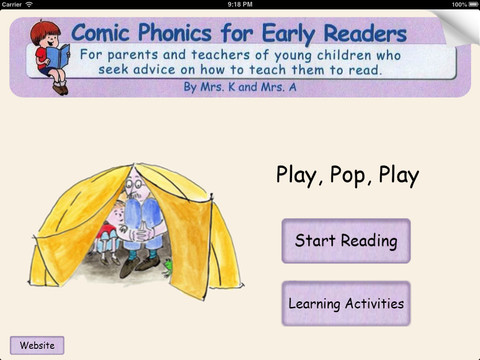
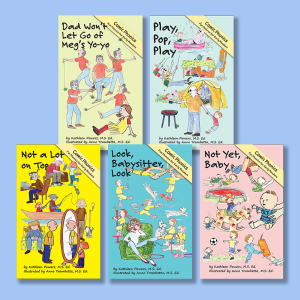
Mrs. K and Mrs. A have published our third children’s book app in three months!  Play, Pop, Play, our latest book app, resembles our prior book apps, Not a Lot on Top and Look, Babysitter, Look.  All three are written in easy CVC words for beginning English and ESL readers and have hilarious drawings featuring a little kid to attract young readers.

Play, Pop, Play iTunes App

Go to http://goo.gl/JMrT3 for more information.

In Play, Pop, Play, little Tom wants his Pop to play with him—tucked under a table, splashing in a tiny swimming pool, and pumping high on swings.  Pop tires out and wants to nap, but Tom keeps going until—well, you’ll have to read to find out.

Several activity pages follow, all using the simple vocabulary and events of the story.  Unlike paper workbook pages, these app pages are interactive, encouraging the beginning reader to draw lines with electronic crayons, swipe words in a word search, and number the story events in sequence—appropriate reading skills for new readers.  Then—poosh!—the child can erase and start over, or save, or email her work to Grandma.

Play, Pop, Play is available for $1.99 on Apple iPhones, iPads and iPods.  To preview or to buy this book, go to http://goo.gl/JMrT3.

Also, check out Not a Lot on Top at http://goo.gl/ClVyM, and Look Babysitter, Look at http://goo.gl/K1HcU.

Mrs. K and Mrs. K and Mrs. A publish second beginning reader book app: “Look, Babysitter, Look”

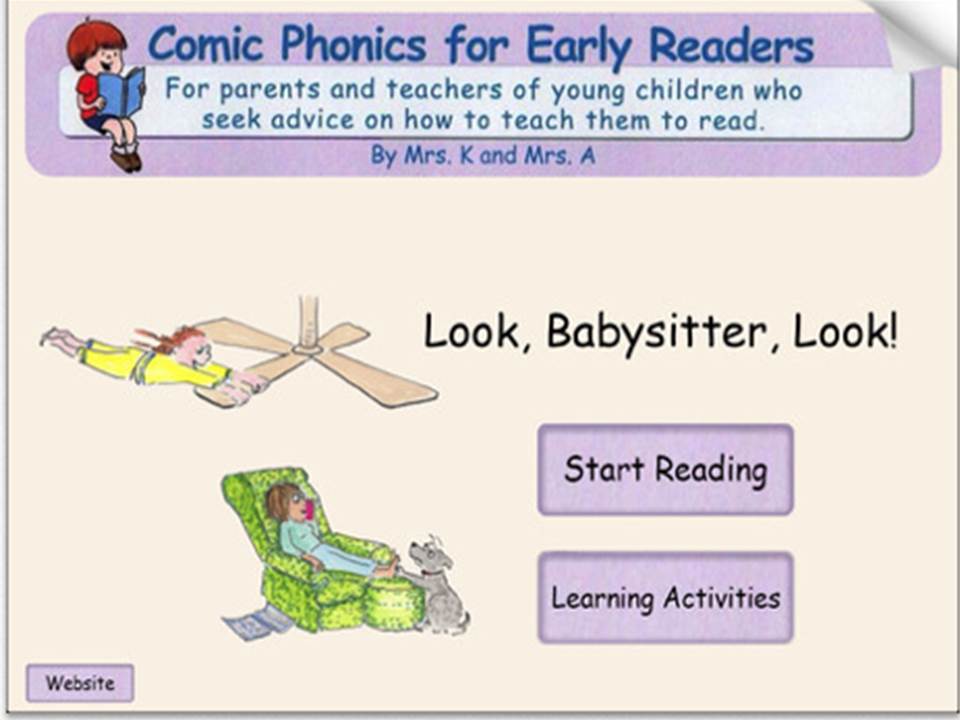
Mrs. K and Mrs. A have published our second children’s book app for beginning English readers and beginning ESL readers, Look, Babysitter, Look.

Book app for iPhone and iPad.

Available for iPhone and iPad at http://goo.gl/K1HcU

The story of Look Babysitter Look follows the antics of a little girl who cannot sleep while her clueless babysitter talks on the cell phone.  The pictures are funny, the words are easy and the cost low–$1.99 for the book and activity pages.  The book was designed as a fun method to attract beginning readers using phonics—mostly short-vowel, one-syllable (CVC) words.

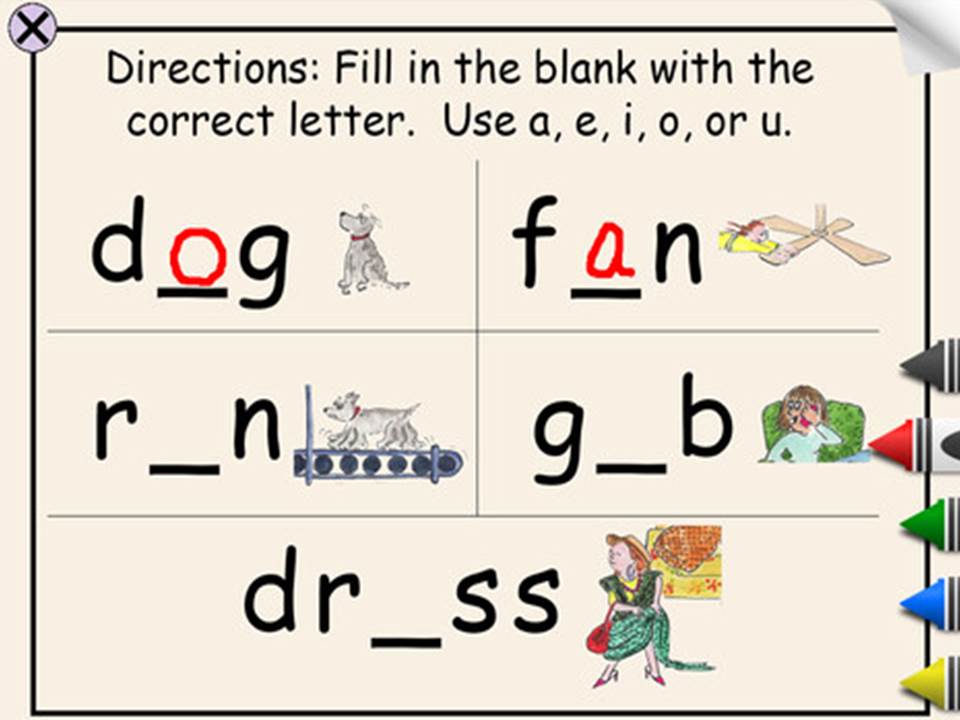
Look  babysitter look sample activity page.The activity pages resemble workbook pages except that they are interactive, which delights kids.  A child can write a letter in a blank with an electronic crayon, circle words in a word search, fill in simple crossword puzzle words or draw lines to match drawings that rhyme.  All the activities are appropriate for a beginning reader and pertain to Look, Babysitter, Look’s characters and theme.

Right now Look, Babysitter, Look is available on Apple products through iTunes books but we expect it will be available on android products.  To preview the book, or to buy it, click on http://goo.gl/K1HcU.

Also, check out our first book, Not a Lot on Top, at http://goo.gl/ClVyM.