Category Archives: how to make learning fun

Piquant ways to learn new vocabulary words

Looking up words in a dictionary is one way to learn new vocabulary words, but children, parents and teachers have so many other options.

girl with ipad in bed

  • Do a google image search. Type in Google.com/search and when the website comes up, click on Google images.  Then type in the word you want to see illustrated.
  • Create visual flashcards. Copy and paste the image from your google search, print it, and tape it to one side of an index card.  Or draw an image yourself.  Write the word on that side and on the reverse.  Study the image side; test yourself using the side with just the word.
  • Use those flashcards while walking or exercising. While fresh oxygen is pumping into your brains, you are better able to learn.
  • Replace words in a song with words you want to learn. “Oh, say, can you discern, by the dawn’s early glimmer. . .”
  • Replace words in a famous quote with words you want to learn. “Clamor not for what your country can attain for you. . .”
  • Create word graphics such as mind webs. Children could start with a word they know and find synonyms, shades of meaning or antonyms.  Or they could start with the word they are trying to learn.
  • Still using mind webs, write a root word in the center, and then develop family lines using that root.
  • Use color-coded flashcards from your paint store. Find several shades of blue, for example, each one more intense than the previous one.  Write on each card a word which becomes more intense in meaning compared to the previous one.  For example, you could learn “disdainful,” “contemptuous,” and “insolent” this way.
  • Create BINGO cards with words you want to know. They could be three-by-three or five-by-five cards.  Write one word in each box.  Then draw an emoji next to each word to help remember it.  Write a list of definitions for the words words on the card (minus the word), read the definitions, and find the word.
  • Read the front page of The New York Times, Washington Post or Wall Street Journal every day. Or read an article from the National Geographic or Sports Illustrated daily.  Those newspapers and magazines use a wide variety of vocabulary words.  Reading is one of the best ways to acquire vocabulary.
  • Sign up for a vocabulary learning blog, such as vocabulary.com to learn a word a day. “Search vocabulary learning blogs” to find several such blogs.
  • Sign up for a dictionary’s website. For example, Merriam Webster (merriamwebster.com) has a word of the day and a list of words which are timely based on the news of the day.

By the way, “piquant” means charming, interesting or attractive.
Turn car rides into educational opportunities

Spring break is almost here.  For many kids, that means road trips to Disney World, the Grand Canyon or maybe to Grandma’s house.

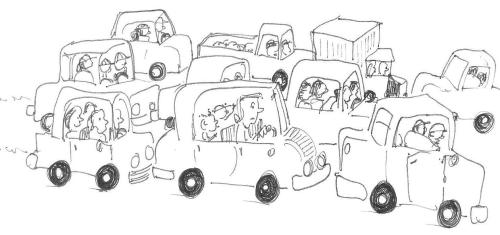
cars in travvic

Those long hours in the car might mean movie time, video game time or time playing on the phone.  But they also offer great learning opportunities.

  • For preschoolers learning their letters or numbers, make a game of finding a particular letter on a billboard, license plate or directional sign.
  • Say a letter sound (not a letter name) and let your child identify which letter matches that sound.
  • If it’s dark, you can say two words and ask the child which word begins with a particular letter. Stick to letters the child knows so she can feel successful.
  • For kids learning rhymes (sometimes called word families), suggest a word which the child can then rhyme once, twice or three times. Or go back and forth, first you, then the child, then you, then the child, until no one can think of another word.  The last one to think of a word could decide what the first word of the next round is.
  • For kids learning how to put letter sounds together to form words, sound out a CVC word and ask the child to identify it.  Then let the child sound out a word and see if you can identify it.
  • Another rhyming game is for the adult to say a nursery rhyme and ask the child to name the words which rhyme. (Hickory, dickory dock, the mouse climbed up the clock.)
  • Sequencing is a skill kindergarteners work on. You could say three activities—not in time order—and the child could put the events in the correct order.  (Mom filled the car with gas.  Dad put the suitcases in the car.  Billy packed his suitcase.)
  • Cause and effect is a skill third graders work on. You could name both a cause and an effect, and the child could identify which is which.  (Sleeping Beauty slept for 100 years.  Sleeping beauty pricked her finger.)
  • Categorizing words is an elementary school-aged skill. For example, you could say blue jay, cardinal and bird.  The child needs to find out which one in the category word.
  • Comparisons are another easy word game. You say that the answers are bigger than, smaller than or the same size.  Then you say, “An elephant is something than a mouse.”  The child tells the correct relationship.  You could use longer than and shorter than, heavier and lighter and older and younger.
  • Working memory is a skill children need to extend. Start with two words (or numbers or letters) which the child needs to repeat.  Let the child add another word and you repeat all three words.  Then let the child repeat all three words and add a fourth.  For some children this skill is incredibly difficult, so for them you might want to cap the list at four words.  For other children, seven or ten words might be possible.
  • This is a great time to review math facts. If your third grader has just learned multiplication, review the facts.
  • For older children or children learning English as a second language, car time can be vocabulary review time. You give the definition and the child gives the word.  Or let your child throw out a word meaning, and you have to identify it.  Children love stumping their parents.
  • Older children encounter idioms all the time, but they don’t always understand them.  Throw out an idiom–Jason is blue–and let your child explain what it means.

Of course these educational moments could also happen on your long flight to India or Taiwan.  They could just as easily happen on the way to school in the morning or on the way to soccer practice in the afternoon.  There are so many times you can exploit one-on-one education with your child.

What kind of books do you read to your kids?

When my kids were little, I selected their reading materials from the picture book section of my library and book store.  In retrospect, I was limiting my children’s literature to fairy tales, Dr. Seuss and fiction of all kinds.

Yet children need exposure to nonfiction as well:  how to books, how things work books, information about animals and the natural world we live in, biographies, history, books with maps and tables, books about dinosaurs, even current events news.

Take a quick survey of the books you have read to your preschooler in the past week.  Were any of them nonfiction?

Expand your child’s horizons starting today.  Find the nonfiction section of the children’s section of your library and see what’s there that might interest your child.

  • Does he like dinosaurs? Lots of books explore the lives of these amazing creatures.  Or does he have a pet?  Books on dogs, cats, birds and almost every other animal abound.
  • Is your daughter into fashion? Find books about how clothes have changed over the centuries.  Find a biography of Coco Channel.  Look for a magazine with Downton Abbey or Academy Award dresses.
  • Is your child into building? You can find books and magazines on how to build a soap box, a tree house or a house of cards.  Or you can learn how a spider builds a web, how a bird builds a nest or how a beaver dams a stream to build a house with an underwater doorway.
  • Do you travel with your child? Magazines highlight fascinating places around the world.  Even if your child can’t read, together you can compare your home with the ones pictured.  Or together you can wonder what it would be like to take a gondola ride or to walk on the Great Wall of China.  Maybe you could plan a vacation.
  • Did Grandpa serve in the Army? Let Grandpa read to your child about the locations where he served or about the military uniforms he wore.  Did Grandpa fly a jet?  Find books about military aircraft.
  • Cooking books are great how-to books. With your child, find a picture of something you would like to eat and cook it together.
  • How about the handbook for your car? Or you phone?  Your child and you can look over the pictures and identify parts and what they do, picking up vocabulary.
  • Look for books with maps, charts, tables, pictographs, photos and other non-textual ways of presenting information.  Help your child to understand what those graphics mean.

Reading nonfiction is harder than reading fiction, yet students must be adept at both kinds of literature under the Common Core State Standards.  Start now preparing your child for his future by exploring nonfiction together.

Ways to strengthen children’s working memory

How can you help a child with a poor working memory to increase reading comprehension?

child playing card memory game

  • Play memory games.  Lay face down a deck of cards and find pairs.  Or play “In my suitcase.” The first person says, “I packed my suitcase, and in it I put a ____.” The next person repeats what the first person said, and adds a second item to the suitcase. Now the first person repeats what the second person said and adds a third item. The internet offers plenty of other kinds of online games.
  • Give directions  one step at a time. You might say, “Put your pencil down,” and wait until the child does that. Then say, “Put the book inside your desk.” Again wait for compliance before giving the next direction.
  • Use simple sentences when giving directions. Also, use transition words like “first,” “next,” and “finally.”
  • Choose children’s books written mostly in simple sentences or compound sentences. If there are complex sentences, make sure they are limited to one subordinate clause and are clear.
  • Ask the child to explain a complex sentence.  Ask him to describe the relationship between the two parts of the sentence–cause and effect, for example, or time order.
  • Eliminate distractions. At home, have the child do her homework in a quiet place with plainly painted walls and draperies. Settle the dogs down. Turn off all electronics. Even a ticking clock can interfere with a child’s concentration.
  • Don’t rush a child. That stress might distract her, her working memory.
  • Remind the child that she needs to remember what she reads.  Later, ask her questions about what she read so she gets in the habit of remembering.
  • Question a child about what she has just read.   After each paragraph, or after a short conversation, ask what those sentences mean. If the child has trouble remembering the beginning part, question the child after she has read less information.

Skipping long words can be a sign of a struggling reader. How can you help a child decode such words?

One way to help children decode big words is by familiarizing children with prefixes and suffixes. English is a language which creates new words from already existing words by adding a word part—usually a single syllable—before or after the original word. If the word part is added at the beginning of a word, the word part is called a prefix. If it is added after the word part, it is called a suffix.boy choosing right root for a prefix

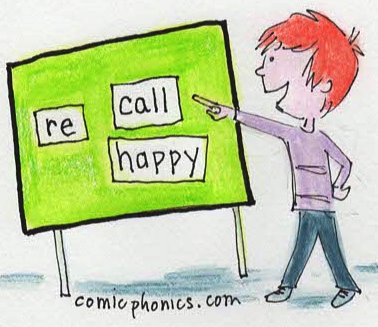
Prefixes usually change the meaning of a word. Un + happy creates “unhappy,” whose meaning is the opposite of “happy.” Re + view creates “review” which means to view again. Suffixes usually change the part of speech of a word, the verb tense of a word or the number of a word. Music +al changes “music,” a noun, to “musical,” an adjective. Jump + ed changes the present tense verb, “jump” to the past tense verb, “jumped.” Girl + s changes the singular, “girl,” to the plural, “girls.”

If children can recognize that a long word has a prefix or a suffix or both, they can segment that word both for pronunciation and for meaning. “Unwinding” can become un + wind + ing. “Un” means not, “wind” means coil and “ing” makes the word an action.

Children should be taught prefixes and suffixes as a separate part of reading instruction. I would start with prefixes only. One way to do this is to make a game of combining prefixes with words, sometimes called roots. (I like to use materials the child can touch, but of course, this work can be done on computer using sites such as ixl.com.) Here’s how:

  • Find a list of commonly used prefixes. Many web sites list about one hundred such prefixes, but I would start with a shorter list of ten or twelve of the most commonly used ones, such as bi (two), dis (the opposite), il (not), im (not) in (not), mis (badly), non (not), pre (before), re (again), sub (under) and un (not).
  • Teach the child what each prefix means, giving her a word to help her remember each one, such as bicycle, disagree, illogical, improper, indirect, mispronounce, nonfat, prepay, resend, submarine, and unhappy.
  • When she knows the meaning of the prefixes, write each prefix on an index card. Write two or three familiar words which could be paired with each prefix. Shuffle both sets of cards separately. Match each prefix with a word which makes sense, and ask the child to read the word and tell what it means.
  • Or, you could choose two root words, one of which can be paired with a given prefix, and help the child determine which root works and why.
  • Later, you could create a list of the words she has created. See if she can segment the words and tell what they mean. If she can’t do some of them, repeat the activity until she can. Gradually remove the words and prefixes she knows and add new prefixes and words until she knows several dozen prefixes.

In a future blog we’ll talk about how to figure out suffixes.  Suffixes are trickier because they sometimes involve changes in spelling the original word.

My child is almost four. She wants to learn to read. Where do I begin? Or does it matter?

It matters, according to research. You should start with teaching her “the code,” that is, the connection between the sounds of the English language and the letter symbols we use to mean those sounds. Here’s how. (Look for more information on all these ideas in previously published blogs at comicphonics.com.)

  • children moving letter tilesFirst, make sure she can pronounce all 42 sounds of English. Listen to how she pronounces everyday words and make sure she is saying the sounds correctly. Help her with pronunciation.
  • Then connect sounds with letter symbols, a few at a time. Start with the beginning sounds of a few key words such as the child’s name, m for mom, d for dad, b for baby. Help her to hear those sounds in the beginnings of other words. For example, if you are pouring her milk, ask her what sound milk begins with. Then show her an “m” and explain that is how we show that sound.
  • Beginning sounds are always the easiest to hear, so focus on them.
  • Help her to write the initial of her name and a few other meaningful letters.
  • child on floor reading picture bookSince each vowel has many sounds, teach her to associate each vowel with a word and an image that begins with a “short” vowel sound such as apple, egg, igloo, octopus and umbrella. Later, she can compare the vowel sounds in new words to those vowel sounds.
  • In speaking, start putting letter sounds together to form one-syllable short-vowel (CVC) words she knows, like “cat” and “dog.” When she can hear how words are formed (phonics) by combining sounds, use letter tiles to show her what the combining of sounds in words looks like using letter symbols.
  • When you are reading stories to her, point out words she might be able to decipher, and help her to sound them out.
  • When she knows most of her sound – letter matches, she is ready to start reading books which use one-syllable, short-vowel words. Unfortunately, few good ones exist. We at comicphonics.com have written five humorous books for new readers. (See the links to the right of this blog.) Your librarian can point out where other books are shelved, but many labeled “first” readers contain difficult words. Margaret Hillert has written some good beginning books, and so has Dr. Seuss. Good illustrations can help the child figure out the meanings of difficult words, but she will probably need your help as she begins.

Figuring out the code of written English is how a child begins to learn to read. There are lots of commercial methods to do this, but the best I have found is the Explode the Code series. Children find its combination of goofy pictures and sequenced phonics instruction fun.

Later you can focus on other aspects of reading including fluency and comprehension. But the place to begin is demystifying the code by connecting the sounds of our speech to individual letters and pairs of letters, and then combining them to form words.

Teach children to predict, an important reading skill

Predicting means anticipating ahead of time what might happen in a story. As adults, we do it all the time. We read a murder mystery and we predict “who done it.” We read a romance and predict how the couple will get together. We read a thriller and predict if the characters will escape.

Predicting is more than making a guess. It is using what we already know and applying it to a new situation. When children predict, they make a connection between what they know and what they don’t know yet. They increase the likelihood that they will comprehend what they read. Wild guesses are not predictions.

Predicting from what we know to what we don't know graphic

Predicting focuses little children on what they are about to read. By looking at pictures, titles, subtitles, charts, photos, cartoons and other graphics, they grasp an idea about a story. Predicting attracts the child to a story. She wants to know if her prediction is correct. Predicting forces children to use visual or word clues to create meaning.

The Common Core State Standards include predicting in the reading standards.

However, predicting does not come naturally to all children. Children with dyslexia might be able to predict in a real life situation when there is no reading involved, but because they struggle deciphering the phonics code, they lose track of the meaning. Some children with dyslexia also have trouble sequencing. If so, predicting what will happen next is difficult.

Autistic children may also have trouble predicting since they have trouble interpreting social clues. The text might say that a character froze and was unable to talk, but the child might not know that the character is scared. How then can he predict what will happen next?

Here is a method of predicting that can be used with children of all ages. It combines vocabulary with predicting.

  • Go through a picture book or reading selection before the student reads it. Write down a dozen or more vocabulary words important to understanding the meaning of the text. Choose words which the child is likely to already know plus one or two new words.
  •  Write or type the words clearly on a paper, and then cut apart the words. Have one set of words for each pair of children if children are working in pairs. Put the words in plastic sandwich bags.
  • Explain to the child that he will be predicting what a story is about. He will be acting like a detective by using word clues.
  • Let the child pull out one word from the bag, read it aloud it and tell you what it means. If the child can’t read yet, tell him what the word says. If he doesn’t know the meaning, explain it to him. Lay the word on the desk or table in front of the child.
  •  Ask him what he thinks the story will be about based on that one word. Accept his answer.
  • Let the child pull a second word, repeating the previous two steps. Continue until all the words are read aloud. Encourage the child to change his mind about the prediction, or to become more convinced with each word.
  • Now ask the child to sort the words into categories or groups. (This step might be too advanced for some preschoolers.) Again, ask what he thinks the text might be about. Accept all answers, but gently steer the child into a prediction related to the text.
  • Now read the text. As you or the child read, note words the child pulled from the bag. Ask if the child still thinks his prediction is correct, or if he has changed his mind.
  • When the reading selection is complete, remind the child of his prediction and ask if he was correct.  Look at the words again.  Talk about what words helped and what words didn’t.  Ask what other words might have made the prediction closer to the truth.

Help children determine shades of meaning

Shades of meaning can be difficult for some children to interpret. What’s the difference between “yell” and “holler” or “huge” and “enormous”?

Dr. Timothy Rasinski, a professor at Kent State University, has come up with a fun way for children to work on distinguishing between close meanings. Here’s what he suggests:

  • 3 images of a muscleman--skinny, with muscles, really builtGo to the paint store and select five paint chips which are slightly louder or softer than one another, or darker or lighter. For each student you are working with, pick several sets of these color chips. The colors themselves don’t matter, but they should show incremental differences in color.
  • Offer the student three to five words  to distinguish among, such as whisper, state, exclaim, yell, and murmur. Give younger children fewer choices.
  • Let the child choose the word with the weakest word meaning.  Ask the child to write that word on the weakest color chip. Then let the child choose the strongest word meaning and write that word on the strongest color chip. Let the child arrange the other words in order on the other chips.
  • Have the child lay the cards on a table from weakest to strongest or vice versa. Let the child discuss why he chose the order he did.
  • For really young children who cannot read yet, pictures can be used instead of words for some ideas.

What kinds of word choices work well for this exercise? I would use verbs, nouns or adjectives that are similar. Go to a thesaurus to find near synonyms such as must, ought to, should; ignore, neglect, let slide; tuba, trumpet, trombone, flute, whistle.

Provide words from varied disciplines: square, rhombus, quadrilateral, rectangle; knoll, mountain, peak, ridge, hill; quiet, silent, still, peaceful, hushed; business person, entrepreneur, magnate, tycoon, merchant; eagle, hummingbird, dove, raven, peacock.

Many times students will disagree on the ordering. What is important is not the choices they decide on, but the thinking they use to make their choices. If you have an urge to say, “No, this one should come before that one,” let the child explain his thinking, and as long as it makes sense, accept it. This is a game in which the process is more important than the end result.

Making small words from big words—a variation for beginning readers

What if a child is truly a beginning reader still learning CVC words? Can the game of finding small words within big words or phrases still be used to improve the child’s understanding of words and spelling? Not exactly, but if you limit the letters strategically, a beginning reader can play.  Here is how.

children moving letter tiles

  • Instead of writing a big word or phrase such as “New Year’s Day,” write a handful of letters, including only the vowels and consonants which the child has learned.
  • If the child has learned only short a words (cat, ham, fad), write the vowel “A” at the top of the page followed by a handful of letters which you know can be used for form short a CVC words. B, C, D, H, R, and T might be good letters to begin with.
  • You could also use letter tiles (Scrabble letters, for example) so that the child can move letters around. Tactile experience helps young children in learning and makes the learning seem more like a game. Also, the child doesn’t have to hold letter patterns in his head; he can manipulate various letters until he finds a word which then you or he could write down.
  • Demonstrate to the child how mixing up the letters can form words. Write B A T and B A D, showing where you got those letters, and using enough examples so the child knows what to do.
  • The competition aspect of the game might be for the child to “beat” his last score, that is, to find more words than the last time.
  • As the child learns more CVC vowels, two vowels can be used with six or seven consonants. I recommend starting with A, then O, and then U.  E and I take longer to learn since they sound similar, so I would use them indeptndently (A and E, for example, or O and I) until the child is confident with all CVC words.
  • This is a game which pairs of children can play together as a team, providing one child does not dominate, leaving the other child out.
  • Restricting the number of letter choices can help the child to focus, so do limit the number of vowels and consonants for beginning readers. Once the child is an experienced reader, he can “graduate” to the longer word or phrase game we discussed previously.

Play word games to encourage or to reward reading

When I tutor reluctant readers or bad spellers, sometimes I reward them with a word game in the last five minutes of an hour-long lesson. The kids love the game and ask at the beginning of the next lesson if they can play again. I never play this word game at the beginning of a lesson or they will balk at doing other kinds of reading work, but it is great as a reward.
This game is also a good game to play in the car on long trips or when a child is bored. It turns dead time into learning time.game of breaking up a big word into little words

  • Start by choosing a long word or a phrase. I try to relate the word or phrase to the season or to what we are studying. For example, “NEW YEAR’S DAY” or “JUNIE B. JONES” might be appropriate. After the first game, the child will want to choose the word or phrase, but you must steer him to pick an appropriate word or phrase for the game’s purpose.
  • The word or phrase should have ten to 15 letters but not many more or the game becomes too easy. Good words or phrases to work with contain several vowels, including the letter “E.” Bad words or phrases contain few vowels, do not contain the letter “E” and repeat many of the consonants.
  • I write the word or phrase at the top of a blank paper, often in all caps, so the child realizes capital letters are irrelevant.
  • Next, I explain that we are going to make little words from the big word or phrase, using the letters in any order. So for the phrase “NEW YEAR’S DAY,” I might write “ear,” “way,” and “weed,” and point out how each letter in the little words is part of the phrase.
  • I also point out that if there is only one “N” in the original word or phrase, then there can be only one “N” in the made up words. Also, if there is punctuation in the original word or phrase, it can be ignored or used.
  • The object of the game is to find as many small words as possible in five minutes.
  • Eventually you want children to discover word families, words whose letters can be moved to create other words (tea, eat, ate), words within words (heard, hear, ear, he, head), and how having certain letters (E and S, for example) makes the game easier. This shows the child is thinking about word patterns.
  • I help younger children find words, and show them word families that can be made by changing a single letter. Once they understand the game, they usually do not want help.
  • For older children, I compete with them, sometimes giving them a handicap.
  • At the end of five minutes, if there is not a competition, the game ends. If there is a competition, the child names his words aloud, and if he and I have duplicates, we cross them out. His score becomes the number of words he has without duplicates plus the handicap.
  • Additional points are given for words of five letters or more and perhaps for the word which is the longest and which seems to be the most clever use of the original letters.
  • I allow proper nouns, but I do not allow repeating the words in the original word. You can make your own rules depending on the ability level of the child. Some children will put an “S” on every noun.