Category Archives: how to make learning fun

How to Raise a Reader, according to The New York Times

The New York Times published  an excellent article last month entitled, “How to Raise a Reader.”  You might find the article at your library in the Book Review section.  It is worth the effort.  Here are some highlights from “How to Raise a Reader.”
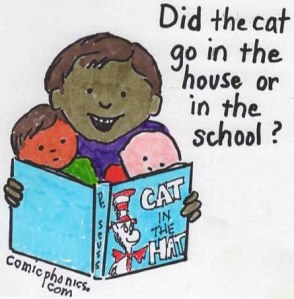
Become a reader yourself.  If you have let your reading habit slip, reacquaint yourself with the print world.

Read aloud to your infant.  Your reading material might be a medical journal or Dr. Seuss.  The content doesn’t matter to an infant.  What does matter is that you make eye contact with your child, use voice inflection, and read in the normal rhythms of your language.  If the baby responds with baby sounds, respond in kind.

Read aloud to your toddler.  Encourage your child to link the sound of your voice reading to him with strong, positive emotions.  Read at bedtime and during daytime too.  Offer your child variety in picture books, but respect his or her preferences, even if that means reading “Go, Dog, Go” night after night.  When the child interrupts, that shows he is engaged.  Stop and respond.  Finishing a book isn’t all that important at this age nor is reading every word.

Continue to read aloud to your emerging reader.  Once your child shows interest in letters and words, keep reading to him or her.  Encourage her to join in, but don’t pull back now.  She shouldn’t think of reading as work.  She should think of it as fun.  Allow your child to develop reading skills at her own pace, but if you suspect problems, follow through with her teacher.

Continue to read aloud to your early reader.  Take him or her to the library or book store.  Expand his selections from fiction to nonfiction.  Ask him and his friends what they are reading and discuss their preferences.  Let your child stay up a bit later if she reads in bed.  If your child prefers comic books or graphic novels, or if he wants to read about his favorite video game, be thrilled.  He’s reading.

Stash reading materials throughout the house. On the coffee table, in the bathroom, or in the bedroom, show off books, magazines and other reading materials to encourage reading.

Help your child build a personal library.  Make a bookcase part of the child’s bedroom or a children’s section of books part of your home library.  Give books as gifts and rewards.  Bring home armloads of books from the library.  Celebrate your child’s first library card with family stories of other first library cards.

This wonderful New York Times article goes on to describe the kinds of books children are ready for at different times in their lives.  Enjoy.
 

For kids with sensory integration issues, choose picture books with pared down shapes, colors, focus

If your child resists being read to or resists reading certain picture books, it could be the pictures themselves that discourage reading.

Look for books with no backgrounds, solid colors, and focused on one or two characters.

Picture books with detailed backgrounds or with copious patterns can turn off children with sensory integration issues.  Such children have difficulty focusing if there is too much pattern, noise, motion, or texture in any experience.  They prefer plain painted walls and plain bedspreads, not papered walls and patterned bedding; low, instrumental music by a single instrument, not loud music or music with lyrics; sitting or standing still, not rocking or dancing; and loose knit clothing, not clothes with tags or clothes that are tight-fitting.

When you choose books for children who show sensory integration issues, search for picture books with these characteristics:

  • Pictures with no backgrounds, or just the hint of background—a wash of green to represent grass and trees, for example, or one or two birds in the sky, not a whole flock.
  • Characters dressed in solid colors without shading or patterns in their clothes. If you have seen Pippa the Pig books or cartoons, with their simplistic images, that is the kind you want to show your child.
  • Pictures using flat shapes and limited colors, the kind that children themselves produce. (Think of the way Peanuts cartoon characters are presented—Charlie Brown with his round head and Lucy with her dress of a single color.)
  • Pictures focusing on one or two characters, not groups. Look for pared down, minimalist images which have removed everything but the essential elements.

Likewise, when you look for  picture books for children with sensory integration issues to write about, search for picture books with the same features.  Some wordless picture books offer these kinds of pictures, but not all do.

Finding such books in your library or book store is not easy.  A section labeled “simplistic art” doesn’t exist.  I have had to scour shelves to find what I am looking for.  But the search is worth it to entice a reluctant child reader or writer.

Next blog:  Names of some books that might appeal to kids showing sensory integration issues.

How to make vocabulary stick

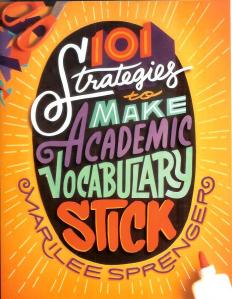
academicvocabIf you teach students vocabulary, check out 101 Strategies to Make Academic Vocabulary Stick by Marilee Sprenger.

Let me identify a few of the strategies:

  • Create a chart marked noun, verb, adjective and adverb. Make sure students know what those parts of speech are.  When you teach a new word, ask the students to write the word in the appropriate column.  Then talk about different forms of the word.  “Predict,” for example is a verb.  But “prediction?”  A noun.  “Predictable?”  An adjective.  “Predictably?” An adverb.
  • You, the teacher, “wear” the new word on your person. Write the word on masking tape and tape it to yourself.  Let students observe you walking around wearing the new word.  Let them think about that word.  Later, let students offer their thoughts about the word before you define it for them.
  • Teach students how to annotate their books or articles in order to learn new vocabulary words. For example, teach students to circle words they don’t know.  Write the meaning in the margin.  Now draw a line connecting the new word with the margin meaning.  Or draw connecting lines between a new word and its synonym or antonym.
  • Act out a word, and let students guess what the word might be. This is a good way to reinforce synonyms too.
  • To teach prefixes and suffixes, create a graphic organizer with the affix in the center. Around it write four words using this affix.  From each word, like spokes of a wheel, write the definition of the word.  Still farther out on the spokes, write a sentence using the words properly.
  • To categorize shades of meaning, draw five squares next to each other, forming a “train.” Study five words (on the board or on sticky notes for each student or group).  Using the squares, line up the five words in some kind of order (strongest to weakest, most informal to most formal, or most general to most specific, for example).
  • Use online dictionaries, but not just any online dictionaries. Lingro.com can offer students a definition every time they click on an online word they don’t know.  Blachan.com/shali defines a word, tells its part of speech, and shows images from Flickr, Google and Yahoo.  Wordhippo.com tells a word’s meaning, a synonym, an antonym, its pronunciation, and words which rhyme with it.  Wordhippo translates words into other languages too.  These dictionaries are great for English language learners.

These are just seven of the suggestions in 101 Strategies to Make Academic Vocabulary Stick.  Further information about each strategy is available in the References section of the book, including the names of educators who “invented” the strategies and the research to back them up.

And you thought you were creative!

Talk to babies, even before they are born

Recently I visited my two-month-old grandson for a week.  As much as possible, I held him.  And when he was awake, I talked to him.

EPSON MFP image

I would look into his alert grey eyes and jabber on and on—about the inch of snow expected, about a book I had read, about what a terrible burper he was.  I used the same adult vocabulary I would use to talk to you but perhaps with more inflection and facial animation.

His eyes would follow me but mostly he would listen—listen to me describing the soft, touchable fabric of his onesie, or listen to my theories about why he slept so little.  I would ask him questions. “What do you want for lunch?  Milk or milk?  Do you want to look over my shoulder or look straight ahead?  How’s your diaper?”  He stared back attentively at first, but by the end of the week when I would talk to him, he would smile, quiver and say, “oo, oo,” the only sound he could make.

Now there is research which confirms that babies not only hear before birth but once they are born, they prefer to hear the language they have heard in utero.  Above all newborns prefer to hear the voice of their mothers, but next in priority they prefer to hear the voices of people who speak the same language as the mother, voices with the same rhythms.

We know that phonemes—the basic sound units of language—can be recognized by new babies in the weeks following birth.  Previously it was thought that babies couldn’t recognize slight differences in language sounds until the babies were several months old.  But now we know that babies’ sound perception and preference begins in the womb.

How can we help new babies to develop language skills?

EPSON MFP image

  • Pregnant women should talk to their babies before birth. They should provide opportunities for unborn children to hear language spoken.  This can mean babies’ overhearing conversations between mother and father; it can mean babies’ overhearing phone conversations or radio news; it can mean babies’ hearing the mother talk to herself.  Little ears are listening, so we should give them language to hear.
  • Newborn babies are far from “empty-headed.” Already they have heard hundreds, maybe thousands of hours of spoken language, and have developed a preference for the language of their mothers.  Once born, babies are refining their understanding of that language’s sounds as they listen to their caregivers’ speech.  We should provide opportunities for babies to hear speech—while mothers are feeding babies, while caregivers are changing babies’ diapers, while grandparents are holding babies.
  • Babies’ brains are functioning at an abstract level from their earliest days. They hear phonemes like the sound of “m” in “milk,” and then hear that same “m” sound in “mom,” and learn that the same sounds are used over and over with different results.  Years later, they will take this knowledge and apply it when they learn to read.

Did you know that according to a 1995 study*, the most important thing we can do while caring for a child is to talk to the child?  Or that the three-year-old children of well educated, professional parents hear three times as many words as the three-year-old children of poorly educated parents?

In fact if you listen to the vocabulary of a child, you can predict his success in life.  That’s how strong the correlation is between vocabulary and career success.

Talk, talk, talk, talk, talk to your children, including your babies.  If you have never chatted with an infant, swallow your pride and allow yourself to seem foolish.  It’s one of the best things you can do to ensure your child’s future success.

*Hart, B and Risley, T.  (1995).  Meaningful differences in the everyday experiences of young American children.  Baltimore:  Paul Brookes.

Learn vocabulary through online games

One key to reading well is to understand many vocabulary words.  Is there a fun way to learn new vocabulary words?  How about learning through online vocabulary games?

http://www.vocabulary.co.il offers many kinds of vocabulary learning games, a few of which are described below.

  • Prefixes offers matching games for various grade levels.  For third through fifth graders, four prefixes appear on the left and four meanings appear on the right.  Click on one prefix; then click on its matching meaning and a line connects them.  When all four have been matched, click on the “check answers” tab, and check marks appear in front of the correct matches.
  • Foreign-language offers matching and other games for English-Spanish, English-French, English-German, and English-Latin learners.
  • Word scrambles ask the player tot unscramble given letters to form a word. You can press “hint” for help.  A clock keeps track of your speed in finding the correct word.
  • Idiom games include matching games and choosing the right meaning of a phrase from four possible choices.
  • Spelling games include word searches, unscrambling of words and choosing the correct part of speech for a given word.
  • Syllable games ask the player to divide words into syllables.
  • SAT vocabulary games offer various kinds of word-building games for older kids.

Twenty-four different kinds of vocabulary learning are offered, and from them, usually there are many choices in kinds of games to play and age or grade level choices.

Do you multitask when you teach your child?

Do you multitask when you oversee your children’s work?  Do you listen to little Sia read while stealing glances at your smart phone for text messages?  Do you cut away from little Andy writing his ABCs to check your Facebook page?

EPSON MFP image

According to research, those little breaks in concentration — just two or three seconds — can double the number of errors a person makes in his or her work.  When your work is supervising your child’s work, you can miss your child’s victories and mistakes and miss opportunities to intervene.

All the technology around us and our speed in using it encourages us to multitask.  We run the treadmill while watching TV.  We drive with buds in our ears.  We push the baby carriage while texting.  We make dinner while we supervise the children’s homework.  It’s not possible all the time to stop multitasking, but when it is possible, we should.  Research shows that multitasking is just another word for doing two things poorly. Single tasking, or as Grandma used to say, “paying attention” is the way to do work well.

I have seen parents on their laptops or cell phones or both while their preschooler works a puzzle in a doctor’s waiting room.  The child looks up for affirmation, but no one notices: an opportunity to show the child how important he is — wasted.

When your work is teaching children to read or write, turn off the electronics.  Put the tablet and cell phone out of sight.  Sit close so your child can see he has your full attention.  When he speaks, respond not with “uh-huh” or “um” but with specific words that show you are listening.  Look at your child’s body language.  When her grimace shows you she is confused or needs help, offer encouragement.  When she pronounces a word well or writes a big kid word like “irritable,” say how proud you are of her work.

If you must take a call, answer an email, or mix the meatloaf, tell the child you will work with her in four or twelve or however many minutes.  Then set the kitchen timer so the child can see it, and when it rings, give her your undivided attention.  Let her know some of your time is just for her.  Make her feel treasured.

For more information on the ineffectiveness of multitasking, read an article in The New York Times, at https://goo.gl/m33dNg.

Facing dyslexia in a preschooler

So you suspect your preschooler has dyslexia.  What can you do?

  • Realize that the younger a child is when identified as dyslexic, the sooner help can begin. If possible, you want to identify the situation before the child becomes frustrated and discouraged, and before the child is labeled as “different.”child making letter T with his body
  • Ask your school district to test the child. Because of the child’s age, the district might balk, and say he will be tested when in kindergarten, or first grade, or later.  Sometimes the district will become involved if you have some “proof” that the child is dyslexic.  This might require private testing at your expense by some recognized expert.
  • From the school district, find out what services your child will receive and when.baby reading a book
  • If the school district “officially” won’t help, make an appointment with your elementary school’s reading specialist. She will probably have ideas you can start with, and she might be able to lend you materials or at least identify materials that will help.
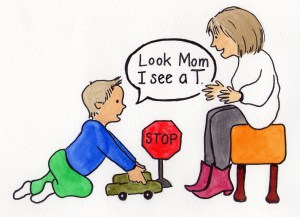
  • Consider hiring a reading tutor, one with experience teaching children with dyslexia. A good tutor will use many strategies, particularly game-like, hands-on approaches that will appeal to a preschooler.boy sees a T in STOP
  • If someone else in the immediate family has dyslexia, there’s a good chance your child has the same kind of reading problem and can be helped the same way. What worked for your other relative?
  • Check out ideas on the internet. Use keywords such as dyslexia, preschooler, reading and learning strategies.
  • Begin working with your child yourself. Focus on the sounds of the language first, and make sure your child can hear them and pronounce them properly.  Only then match sounds with letters.mother works with child reading story book
  • Is letter recognition difficult? Buy an ABC puzzle or letter tiles or a Scrabble game.  Use the letters to play games forcing the child to identify letters.  Unfortunately, most sources for letters use only capital letters, and it is generally lower case letters which cause problems.
  • Work on printing letters properly. If fine motor coordination is difficult, use a computer keyboard instead.  But again, most keyboards identify the keys with capital letters.Mother shows child spelling of her name Kelly
  • Use music. Teach your child the ABC song.  Sing songs together which rhyme or read nursery rhymes.
  • Teach directions. Up, down. Left, right.  Inside, outside.
  • You may find it takes longer for your dyslexic child to master certain skills when compared to a child without reading difficulties. Be patient.  If a younger sibling is catching on faster than the dyslexic child, work with each child independently and out of earshot from one another.  If at all possible, conceal from your child that he is having reading difficulties.  Find ways for him to succeed at learning.A teacher says the first part of a rhyme, and the child says the rest of it.

How about pulling your child out of preschool, or stopping all reading instruction for a year or until the child is seven or until the child reaches first grade?  These are not good solutions.  In pre-K students are expected to know their letter sounds and to match them with ABC’s.  In kindergarten children are expected to read CVC words, high frequency words, and some two-syllable words.  A child who can’t keep up with his classmates develops low self-esteem which can intensify reading problems.

Be proactive.  If you think your three or four-yer-old shows signs of reading difficulty, act as soon as possible for the best outcome.

How to teach sight words

You can teach your child sight words through many methods.  Buying or making cards with pictures on them can help make the words stick better in the child’s mind.  You can have your child learn a word a day by pointing to the word and having the child say it aloud.  Repeating helps the words stick.  Many kindergarten classrooms have word walls where the sight words are posted so children can use them when writing.

EPSON MFP image

You can find such words with magnetic backings (or you can make them).  Put them on your refrigerator, or in a large metallic baking pan or cookie sheet.  Then help your child move the words around to make phrases or sentences.

Games are another good way to teach sight words.

  • Make a BINGO sheet with sight words for your child to find and cover.
  • Play Concentration. Make a set of cards with two of each sight word.  Start with just a few pairs, mix them up and turn them over on a table, and then turn them, two at a time, to see who can find the most matching pairs.
  • Play Go Fish with the same set of matching cards.

Some word pairs can easily be confused, so spend extra time on them:  of and off; for and from; was and saw; on and no; their and there; them and then; and when, where, what and with.

One caution:  Children who learn sight words before they learn phonics may try to memorize all words rather than sounding them out.  They may balk at learning phonics.  They need to know it is important to be able to sound out words using certain rules so when they encounter new words they can figure them out.

How to retain new vocabulary

Review, review and more review is the way to help children retain new vocabulary.

"I know that word, Mom," says the child lookin

Too often the push by teachers is to teach more words rather than to solidify the words students already “learned.”  The result is that the words practiced weeks ago don’t stick in students’ minds.

What can you do to make words stick?

Suppose one week you teach ten or twelve new words to a student.  That week you review the words daily—perhaps asking the student to draw each word’s meaning one day, or to have a spelling bee kind of review another day, or to write the words in sentences another day.

The next week you teach ten or twelve new words.  You use the same kind of daily review, but you include a few words from the previous week’s list which have caused the most problems.

For the third week of vocabulary instruction, instead of introducing new words, intensively review the combined words of the previous two weeks.  Perhaps you could offer fill-in-the-blank worksheets with a bank of vocabulary words at the top of the sheet.  Or during a writing lesson, suggest composing a paragraph using ten of the words from both lists.  Offer a prize (a bell rung in a student’s honor or a sticker) if the student can find one of the new vocabulary words in the ordinary course of the day’s work.

During the fourth week, introduce another set of new words, using various strategies.  Repeat some of the words from the previous weeks during the daily review.

During the fifth week, do not introduce new words; instead focus on words from the first three weeks which are difficult to remember and which are likely to be used or encountered by the student.  Focus on useful words.

Learn new, review.  Learn new, sweeping review.  Continue this pattern, spending as much time on learning new words as reviewing old ones, and your student will remember vocabulary words.

Avoid the “summer slide” in your child’s learning

Students loose reading skills during the summer if they don’t continue reading.  Educators call this loss the “summer slide.”  It is most severe among low-income students who lose up to two months of reading skills.  Yet it is sometimes nonexistent among middle class students who make slight gains in reading during summer months.  Why the difference?

Summer slide (decline) of reading scores.


  • A study of 3000 sixth and seventh graders in Atlanta Public School showed that students who read at least six books during the summer maintained or improved their reading skills.  But students who didn’t read lost up to a whole grade of reading skills.  (B. Heyns, 1978)
  • A study of Baltimore students over 15 years found that by the end of fifth grade, Baltimore students who didn’t read during the summer measured two years behind their classmates who did.  They concluded that 2/3 of the reading difference in ninth graders can be attributed to reading or not during summer school breaks.  (K Alexander, D. Entwisle and L. Olson, 2007)
  • A study of students completing third grade who took part in their local libraries’ summer reading programs scored 52 Lexile points ahead of their classmates who did not. (Dominican University)
  •  Children’s absence from reading during the summer is a major hurdle for achieving good reading skills by the end of third grade.  (The Campaign for Grade-Level Reading)
  • The summer slide is cumulative.  Some estimate that by the end of high school the summer slide can account for up to a four year lag in reading achievement, and it can have an effect on high school graduation rates.  According to the Annie E. Casey Foundation, “one in six children who are not reading proficiently in 3rd grade do not graduate from high school on time, a rate four times greater than that for proficient readers.”

So how can you combat the summer slide?

  • Sign your child up for your local library’s summer reading program, and make sure your child completes the reading.
  • Go to the library regularly and let your child select books she will enjoy.
  • Help your child to read a chapter book a week, or a picture book each night.
  • Encourage your child to read the newspaper, television guides, magazines and online articles.
  • Reward your child with a trip to the book store to select her very own book.
  • Read to your child every evening, and let him read to you.  Your reading will teach fluency and pronunciation, and establish the notion that reading for pleasure is fun.

(This blog first appeared on May 16, 2014.)