Category Archives: comprehension

4 ways to improve reading comprehension

For years I have focused on the importance of a phonics-based reading curriculum for beginning readers.  Research shows that young students exposed to sequential phonics instruction have better reading outcomes than students who learn primarily through other approaches.

But once students have learned the basic rules of phonics, and they are reading to learn new information, research shows other activities can help students comprehend better.  Here are some.

Photos, drawings, sounds, videos and picture books can help students understand new-to-them concepts before they read about them.  Providing students with rich background information can make acquiring new information easier.  Students can fit new ideas into old ideas, or show how the new idea is the same or different from the old idea.

Venn diagrams are another way to do this.  For example, to learn the relationship of math operations, students could see a Venn diagram like this:


The idea is to connect new information to information students already know.  Stick figures showing two families’ with arrows from one person to another could show what nieces and nephews are.

Tables connecting what students know to what they don’t know can help.  Here is how.  Create a row of three sections.  On the left, write a vocabulary word or concept students know.  Leave the middle blank.  On the right, write the new concept to be learned.  Help students fill in the center by connecting the idea on the left to the new word on the right.

my birthday important day in my life, hard to forget day, day I think about milestone
What I’m doing at different times all day long 8  Pledge of Allegiance

8:15 reading class

9:15 snack

9:30 math class

schedule

We adults connect new concepts to what we know all the time.  And, like students, if what we know is scant, we have a hard time learning the new concept.  For example, I was reading a novel about a World War I soldier who was demobbed.  What in the world is demobbed? I wondered. Attacked by a mob?  Thrown out from a mob?  I looked the word up, and found that demobbed means discharged from military service.

Okay, so how do I remember it?  I know what a mob is, but in this case mob is short for mobilized, so that doesn’t help.  I know what a mobile phone is though, so I pictured a soldier texting someone on his mobile phone to tell that he is discharged.  Maybe he is throwing his hat in the air too.  So connecting pictures to words and events is another method of comprehending.

Learning to read doesn’t stop with applying the rules of phonics.  That is a vital start.  Another vital aspect of reading is comprehension, a lifelong process.


The idea is to connect new information to information students already know.  Stick figures showing two familie with arrows from one person to another could show what nieces and nephews are.

Tables connecting what students know to what they don’t know can help.  Create a row of three sections.  On the left, write a vocabulary word or concept students know.  Leave the middle blank.  On the right, write the new concept to be learned.  Help students fill in the center by connecting the idea on the left to the new word on the right.

my birthday important day in my life, hard to forget day, day I think about milestone
What I’m doing at different times all day long 8  Pledge of Allegiance

8:15 reading class

9:15 snack

9:30 math class

schedule


We adults connect new concepts to what we know all the time.  And if what we know is scant, we have a hard time learning the new concept.  For example, I was reading a novel about a World War I soldier who was demobbed.  What in the world is demobbed? I wondered. Attacked by a mob?  Thrown out from a mob?  I looked the word up, and demobbed means discharged from military service.  Okay, so how do I remember it?  I know what a mob is, but in this case mob is short for mobilized, so that doesn’t help.  I know what a mobile phone is though, so I pictured a soldier texting on his mobile phone that he is discharged.  Maybe he is throwing his hat in the air too.

Learning to read doesn’t stop with applying the rules of phonics.  That is a vital start.  Another vital aspect of reading is comprehension, a lifelong process.
New York students must learn phonics in 2025

Phonics must be taught to students in grades pre-K through third grade in all New York State (NYS) schools beginning in the fall of 2025.

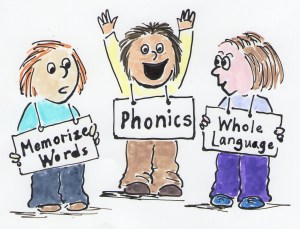
Three children with signs around their necks that read: Meniruze words, Phonics, Whole Language

This emergency directive by the NYS Board of Regents requires all public school districts to review how reading is taught in their districts.  It requires NYS districts to make necessary changes so that phonics is taught to pre-primary and primary grade students next September.

In particular, districts must teach six concepts associated with reading:

  • phonemic awareness (the ability to hear individual sounds in a word such as the sounds K A T in the word “cat”),
  • phonics (the ability to put together individual sounds to form words),
  • fluency (the ability to read words accurately, at a reasonable pace and with expression),
  • comprehension (the ability to understand what is read)
  • vocabulary (the ability to understand the meaning of words and to integrate new words into reading), and
  • oral language (the ability to listen and to speak).
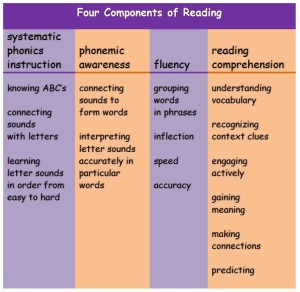
Chart of 4 reading components

Click on the picture to enlarge it.

This emergency action by the NYS Regents comes because almost a third of students cannot figure out new words by fourth grade.  They have been taught to memorize sight words and high frequency words.  But they have not been taught how to sound out new words.  As a result, about a third of students can’t read fourth grade texts.

The NYS Regents is authorized by law to oversee all educational activities in NYS.

Nearly 25 years ago a federal study of research on reading showed that knowing phonemes and phonics is fundamental to learning to read.  Yet many teacher training programs and district curricula do not focus on teaching phonemes and phonics.  Last year the Regents encouraged school districts to teach phonics but resistance was strong.  Now the Regents has mandated it.

The four, no five, no eight pillars of reading

Focusing on four skills leads to good reading achievement in children, we used to think.  Then came a comprehensive US government report in 2000 saying five skills are necessary.  In the ensuing 23 years, researchers tell us three more skills are necessary.   Let’s look at those skills, starting with a chart showing four skills, followed by information on five skills, and ending with the latest three skills.

Chart of 4 reading components

Previously, vocabulary was considered part of the fourth component of reading. Now it is considered a separate component, as are three previously unrecognized skills: oral language, writing, and background knowledge.

  • Phonemic awareness, the ability to hear and identify individual sounds in words—such as the sound of “b” in “bat”—and to move sounds around to hear them in various parts of words. This skill is taught in pre-K and kindergarten to most American school children.


  • Phonics, the ability to match the sounds of English to letters or to letter pairs in order to form words. This skill is usually taught in kindergarten and first grade.


  • Vocabulary, the ability to recognize and understand three kinds of words: everyday spoken words, more complex words (SAT-like words), and domain specific words (words used in specific contexts, such as the baseball-related words of pitcher, shortstop, foul ball and bunt).


  • Fluency, the ability to read text accurately at conversational speed, using expression.


  • Comprehension, the ability to understand what is read.

The three other skills that have been identified as crucial to learning to read are

  • Oral language, the ability to understand spoken language and to speak it. Proficiency in oral language precedes proficiency in reading.


  • Writing, the ability to use written symbols to represent words and to transmit meaning


  • Background knowledge, the ability to store and retrieve information and apply it to new knowledge gained from reading.


No wonder reading is such a complex skill for children to master.

Increase comprehension by using the SQ3R method

Ever hear of the SQ3R* (or SQRRR) reading method? SQ3R is a method of reading which improves comprehension.

  • S means Survey headlines, subheadings, bold and italicized print, and graphics before reading a passage.  Also read the introduction and conclusion.  From them, develop an understanding of what the text concerns before you read.
  • Q means Question.  Write down questions you have about what you will be reading.  One way is to turn the headlines and subheadings into questions.
  • R means Read.  Answer the questions you asked while you read.  Take notes, highlight, and draw diagrams to help you understand and remember what you read.
  • R means Recite.  Say out loud what you have learned from your reading.  Use your own words.  This process helps move the information into your long-term memory.
  • R means Review.  Save your annotated text or notes and study them many times. 

SQ3R has evolved into SQ4R for some readers, who suggest the fourth R should be Rewrite.  Write a summary of the passage in the margins, on post-it notes, on notebook paper or on computer/tablet/phone. 

Can this method be used with young readers?  Absolutely.  If you are reading a book about whales to your preschooler, for example, first survey the cover, read the title, page through the book, and look at the pictures.  Ask what the book is about and what the youngster hopes to learn from the book.  Then read the book.  Ask the child to tell you what the book said.  Later that day and the next day, again ask the child to tell what the book was about or to draw a picture of what the book was about.

*SQ3R was developed by Francis P. Robinson and described in his 1946 book Effective Study.

Understanding content–the later part of reading comprehension

Reading comprehension requires a child to understand two broad skills according to The Simple View of Reading, proposed in 1986.**  Those skills include recognizing words (usually through organized phonics instruction) and understanding the content of language.  In our last blog we talked about word recognition.  Today let us discuss language comprehension.

Understanding content depends on four elements:

  • Understanding vocabulary,
  • Having a wide and somewhat sophisticated knowledge base,
  • Understanding sentence structures, and
  • Understanding figurative language.

In kindergarten, first and second grades, children focus on building phonics skills so they can code and decode words.  In third grade, children’s focus shifts to understanding the content of written language.  This is the time when children recognize as sight words many of the words they have worked for two or three years to code and decode.  With less thought going into deciphering letter sounds and combining them into words, children have more energy to focus on understanding what those words, phrases and sentences mean.

By third and fourth grade, children have mastered the basics of phonics, including words of many syllables.  They recognize letter patterns quickly if the reading is grade appropriate, though they still struggle with technical language, subject specific vocabulary, and words of foreign derivation.  They rely on their understanding of prefixes, root words, and suffixes as well as context to figure out the meaning of new words.  They might reread a passage when they realize they don’t understand it.  They might look up words in dictionaries.  They might predict, summarize and conclude.  They might scan headlines, subheadings, captions and graphics to gain understanding.

Until third and fourth grade, most students’ oral language skills—using precise words, speaking in complicated sentences and using irony, for example—outstrip their reading skills.  But in third and fourth grades that gap narrows.  A child’s comprehension depends far less on decoding skills and more on understanding a wide vocabulary, having a sophisticated understanding of the environment and understanding how sentences, paragraphs and various genres of writing are constructed.

Sometime in late middle school, children’s oral language converges with their reading comprehension.*  Students gain new vocabulary and understanding of their environment more from reading than from conversation.  At this time of life, it is important for students to read widely and often to increase their vocabulary and knowledge base, to understand how ideas are structured and to appreciate how figurative language enriches comprehension.

This understanding of reading skills—a combination of word deciphering skills and comprehension skills—was proposed in 1986 by Gough and Tunmer.** They called this understanding The Simple View of Reading (SVR).

*Biemiller, A.  (1999).  Language and reading success. Cambridge, MA: Brookline Books.

**Gough PB, Tunmer PB. Decoding, reading, and reading disability. Remedial and Special Education. 1986;7:6–10. doi: 10.1177/074193258600700104.

Worth reading: The Settled Science of Teaching Reading*

I thought the time for discussion was over, that the correct way to teach reading had been established by research almost twenty years ago.

Apparently not.  On social media the discussion continues.  Is it better to focus on teaching phonics and how letter sounds form words or to focus on whole language (memorizing words and discovering meaning).

After a study of hundreds of research reports of how children learn to read, the US government reported in 2000 that the best way to teach English reading is to focus on phonemes and phonics first.  Children need instruction on how sounds correspond to letters, and how combining those letters forms words. New readers also need to memorize high frequency words that don’t necessarily follow the rules of phonics (words like “was, ” “do,” and “the”).

According to the 2000 National Reading Panel, students need to learn five concepts relating to reading:

  • Phonics (combining letters to form words)
  • Phonological awareness (how sounds correspond to letters)
  • Fluency (reading in phrases with appropriate stops and starts and with voice inflection)
  • Vocabulary
  • Comprehension (understanding what is read)

Decoding the language comes from studying phonics, phonological awareness and fluency.  Combine that with vocabulary and you achieve the desired result of reading comprehension.

Yet research also shows that even today not all reading teachers know, or even if they know, apply the correct approaches to teaching reading.

If your kindergarten child comes home with lists of words to memorize, beware.  If those words are sight words, okay.  But the main focus of his or her learning should be how sounds correspond to letters, and how combining those letters forms words, and how combining those words forms sentences with meaning.

*https://www.collaborativeclassroom.org/blog/the-settled-science-of-teaching-reading-part-1/?_hsmi=76082821

7 symbols early readers can use to annotate texts

Annotating texts is an important reading skill.  Finding the main idea, identifying ideas which support that main idea, identifying facts (not opinions), discovering new or unusual words—as adults we know to look for this kind of information and to annotate it in the margins as we read.

But what if you are a beginning reader and can’t write words like “main idea” or even “fact”?  How do you annotate a text so you can go back and understand it better?

An elementary school in the Bronx has figured out how.  The school teaches preschoolers to mark texts with the following seven symbols.  (The meaning of the symbols follows.)   

Marking the text this way is part of Concourse Village Elementary School’s way of helping students understand what they read.  And it works!  88 percent of students scored at the advanced or proficient levels on the New York State exams in both math and English language arts in 2018.  That’s more than 40 points higher than the citywide averages.  To find out more information, go to an article in Edutopia at https://www.edutopia.org/article/driving-deep-reading-comprehension-k-5.

How to foster rich academic language

Academic language—the vocabulary and phrases we use to talk about what we are studying, such as “factor,” “amendment,” or “gerund”—begins early in a student’s life.  “Add” and “subtract” are academic words.  So are “vowel,” “consonant,” and “syllable.”

Today it seems there are more academic language words than when I was a student.  “Digraph” was a word I didn’t learn until I was an adult.  I didn’t need it.  As a student, I learned “blend” which meant both blends and digraphs.  I learned “evaporate” in high school when I studied the water cycle for the first time.  But my four-year-old grandson was taught evaporation in his preschool.  He explained: “The rain comes down and then it goes back up again.”

What can we do to help our youngest students become comfortable with academic language?  According to researchers Friedberg, Mitchell, and Brooke* we can do plenty.

We can foster a language rich environment, whether at home or in the classroom.  We can use precise, adult words which are just as easy to learn as “baby” words.  “Explain what you see.”  “What can you infer about the feelings of Cinderella?”

We can teach essential vocabulary, and repeat those words often so that students learn them.  “Before,” “during,” “next” and “after” are essential to describe sequences.  Synonyms and antonyms need to be taught.  “Sufficient” means “enough.”

We can teach words showing shades of meaning.    An “incident” is a small “event.”  A “catastrophe” is a big “problem.”

We can teach content area words.  In a math class, we can teach “addend” and “sum.”  In a reading class, we can teach “sentence” “fragment” and “run-on.”

We can model the use of academic language.  We can say “spider” and “insect,” not “bug.”

To reinforce meanings, we can show photos, draw pictures and use diagrams.  We can post graphics on the refrigerator or bulletin board for students to scrutinize up close.

As students become a bit older, we can teach root words, prefixes and suffixes to show word relationships.  “Un” means “not” so “unhealthy” means not healthy.  “Ful” at the end of a word turns a noun into an adjective, so “grace” becomes “graceful.”

We can model self-monitoring of comprehension.  We can read a sentence or a paragraph and then paraphrase aloud what we just read to prove we understand it.

*“​Understanding Academic Language and its Connection to School Success​” (Friedberg, Mitchell, & Brooke, 2016).


Decoding or encoding to learn to read?

So often when people talk about reading instruction, they talk about “decoding.”  By “decoding” they mean looking at a written word, such as “cat,” pronouncing each letter sound or digraph, and putting those letter sounds together to pronounce the whole word, with or without meaning.  I teach many children who can decode words correctly, but who have no idea what those words mean.

This decoding process starts with a visual image of a word.  But as brain research teaches us, a better way to start the process of reading is with sounds.  To start with sounds, though, means to start not with decoding but with encoding.  “Encoding” means starting with sounds and joining them together to form words.

How would we teach reading by encoding?  We might show a picture of a cat.  Children would say, “cat.”  They would think about what a cat is. Then students would sound out the word “cat,” listening for and then saying the separate sounds in the word–“c,” “a,” “t.”

With decoding, students break apart an already written word.  With encoding, students construct a word orally from a spoken or pictured word.  With decoding, students start the reading process by using the visual center of the brain, the right hemisphere.  With encoding, students start the reading process with the listening and speaking parts of the brain, the left hemisphere.

What difference does it make?  Students who encode start the reading process with sounds.  As toddlers, we learn words—their pronunciation and their meaning—through listening and repeating the sounds we hear.  If those words are nouns, we usually see an image of the word as well.  Later, when we see a cat or talk about a cat, we remember the image, how the word was pronounced and how we pronounced the word.  We don’t remember letters because we didn’t learn “cat” using an alphabet.  “Cat” was not originally stored in our brains in alphabetic form but rather in sound-picture associations.

With encoding, after the student has practiced weeks or months of oral sounding out of words, a teacher would introduce the alphabet a few letters at a time, and immediately help students construct words they know using sounds they already know.  With encoding, the child creates meaningful words.

Recognizing sounds come first, not recognizing letters

Which comes first, reading or speaking?  Speaking, of course.  A one-year-old can say a few words, but hardly any one-year-old can read.  Most two-year-olds can say hundreds of words and can form tiny sentences, but hardly any two-year-olds can read.

Which comes first, recognizing sounds or recognizing letters? Recognizing sounds, of course.  A one-year-old can recognize and repeat the sounds of many words, but few one-year-olds can recognize letters.  A two-year-old knows hundreds of words, but hardly any two-year-olds recognize more than a handful of letters.

So if sounds and speaking come before recognizing letters and reading, why do some teachers teach the ABC’s first—recognizing visual “pictures” of sounds—rather than teaching the sounds of our language first?

Are we teaching reading backwards?

What if instead of teaching children to read “cat” using ABC’s, we taught children to read “cat” orally, with no ABC’s?  What if we taught children how to recognize the separate sounds that form words like “cat”?  What if we said “c-a-t” slowly, emphasizing the “c,” “a,” and “t” sounds without ever naming those sounds with letter names?  What if we asked preschoolers to break down little words like “cat” into their beginning, middle and ending sounds without ever naming those sounds with letter names?

This would be a radically different approach to teaching reading.  But this approach would align with what researchers are learning about how our brains learn to read.

The foundation of reading is not ABC’s.  The foundation of reading is sounds, sounds listened to by a child and sounds repeated aloud by a child.

How would that work in practice?

  • You, the teacher, would say, one-at-a-time, the 40-plus sounds of the English language. Your student would repeat those sounds, one at a time.  If some sounds were hard for the student to say, you would repeat those sounds and ask the child to repeat those sounds until you were sure the child could hear and pronounce those sounds correctly.
  • Next, one-at-a-time, you would say some tiny words and ask the child to say each word and to say the sounds in the word. You would model how to do this with many words until the child knew what was expected.  You would make it a game, looking around and saying the name of an object nearby like “bat.”  You would sound out the word slowly—“b,” “a,” “t”—and ask the child to do the same.  At first this might be hard for the child, but once she figures out what is expected, she would sound out words quickly.
  • With practice, the child would understand that individual sounds, when combined, form words. Only then would you introduce ABC’s.

Pronunciation of words is an important aspect of learning to read.  Our brains store the sounds of words just like they store the meaning and the look of words. In your mind, right now, as you are reading these words, you are saying the words, right?  And you are remembering the meaning of those words, though at this stage of your life, that might be so automatic that you are unaware of it.  Long ago when you were learning to read, it was the sound of the words which came first to you, long before you knew what the words meant or before you could decipher the letter patterns of words.  Sounds come first.

For more information, read the research of Linnea Ehri (2002).