How to know ahead of time if a child will do well in reading, part 2

In our past blog, we discussed one of the two best predictors of later reading achievement, an awareness of letter sounds, based on the research of Dr. Maryanne Wolf of Tufts University.

Today we will look at the second predictor, an ability to rapidly name objects.

Do you remember the story of Helen Keller, the blind and deaf child, who with the help of a gifted teacher, Annie Sullivan, learned to read and speak? Her progress began when one day she recognized that water has a name. From that “Eureka!” moment, Helen realized that everything has a name.

A toddler goes through the same process of learning that everything has a name. This happens at about 18 months when various parts of the child’s brain work in sync to integrate concepts. First, the child names concrete things (what we call nouns), such as Mom, Dad, cat, and dog. Every day the child adds new words, many of which come from the books read to him.

A little later, a child begins to name letters. This activity is sophisticated. The child realizes that those abstract shapes we call letters mean something. One time my friend offered a two-year-old a small stuffed animal which she had received at a fast food restaurant. The toddler looked at the tag on the toy and said, “Chick-fil-A.” Of course he couldn’t read, but he recognized the familiar shape of the letters on the red background.

Learning to recognize letters and numbers and to give them names is the beginning of reading. Here is how you can help a child learn to name things.

  • Play “Simon Says” so that the child learns her body parts.

Simon says Put your left arm up

  • Play “I see something. . .blue” so that the child needs to name objects in the room, in the car or in the grocery store.
  • Teach your child the ABC song, making sure she eventually learns that “elemeno” is actually four separate letters.
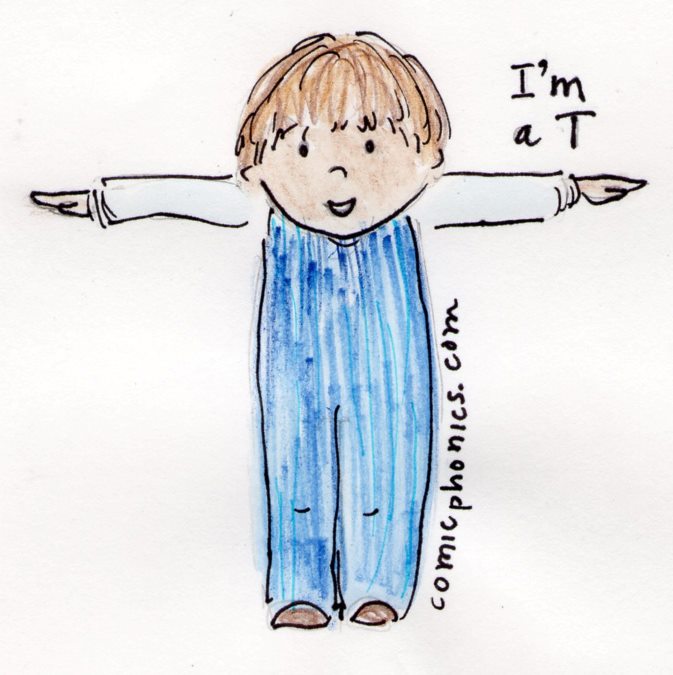
    child making the letter T
  • Point to familiar letters in unfamiliar places, such as the first letter of the child’s name in a sign or on a cereal box.
  • Read to your child. For the youngest children, let them absorb the pictures and name objects in the pictures. For three-year-olds and up, read the words, using your finger to point to the words as you read.

For a well-prepared child, reading doesn’t begin in school. It begins years before.

Is there any way to know ahead of time if my child will do well in reading?

Yes. According to Prof. Maryanne Wolf, director of the Center for Reading and Language Research at Tufts University, the two best predictors of later reading achievement are

  • an awareness of separate sounds (42 in English) and
  • the ability to rapidly name objects.

Today we’ll discuss sound awareness.

When I was a high school student studying French, I used to lie in bed listening to a Montreal radio station. I would try to figure out where one word ended and the next word began.  This same skill is what babies do when they listen to adults talk to them although they don’t realize it. Luckily for most babies, their mothers or caretakers speak slowly and distinctly and repeat words over and over.

With time toddlers begin to hear parts of words and realize that some words have one part (for example, Mom) while other words have more than one part (for example, Grandma).

Still later, usually around age four, children learn their ABC’s, not understanding what they are all about. But with instruction, they learn that each sound in English corresponds to a letter or a pair of letters in the ABC’s.

How can you enhance your child’s success in reading?

Make your child aware of words, syllables and individual sounds.

  • Encourage prereaders to write using invented spelling, advises Dr. Wolf. When the child writes, he sounds out a word and uses the letter symbols which seem appropriate. The “words” might not conform to proper spelling, but that is not the point. The child is working to figure out sounds, a skill he will need in order to read.Girl reading "inventive" writing of younger sister.
  • Encourage the child to listen to someone reading nursery rhymes. Then encourage the child to say the rhymes herself, advises Dr. Wolf.  Take “The Itsy Bitsy Spider,” for example.

The itsy bitsy spider
Climbed up the waterspout.

Down came the rain
And washed the spider out.

Out came the sun
And dried up all the rain.

So the itsy-bitsy spider
Climbed up the spout again!

  • Notice how “itsy bitsy,” “waterspout” and “out,” and “rain” and “again” rhyme. Notice the repetition of the word “rain” and the emphasis on the words “down” and “out.” Other nursery rhymes show alliteration (repetition of consonant sounds) and assonance (repetition of vowel sounds). When children listen to these sounds they learn to discriminate among similar sounds, figuring out what sounds the same and what sounds different.
  • Research shows that exposure to rhymes and alliteration helps children to figure out sounds and later, to read.

In our next blog we will discuss the other predictor of reading achievement, the ability to name.

Physical details can affect readability

Just like we don’t think about the plumbing, water pressure or electricity in our homes (unless there is a problem), we don’t think about little details that have an effect on readability. But these little details can make a big difference to new or struggling readers.

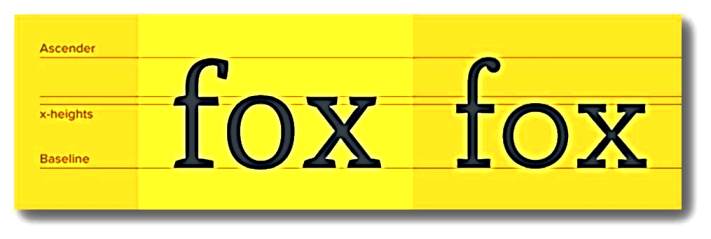
For example, the x-height factor alters readability. X-height refers to the measurement of the lower case x in a font. The bigger the x measures in relation to the type face, the easier that type face is to read. Notice that in the example below, the first x is slightly larger than the second x. Actually the first x is almost two-thirds the size of the f. So is the o.

The X factor in type facesAnother factor affecting readability is the length of the line of type.

Some short
lines of type
make the eye
shift back
and forth
uncomfortably.
They interrupt
eye movement,
making reading
hard.

Do you ever get emails which go from the left of your screen all the way over to the right margin? Are they harder to read than, say, an email that is half as wide? Yes. That’s because, for efficient reading, there is an optimal line length—about 55 to 66 characters, including the spaces between words—and a maximum line length—about 70 characters. Many books meant for children take line length into account, but not all do.


How to use spelling tests to reinforce CVC words

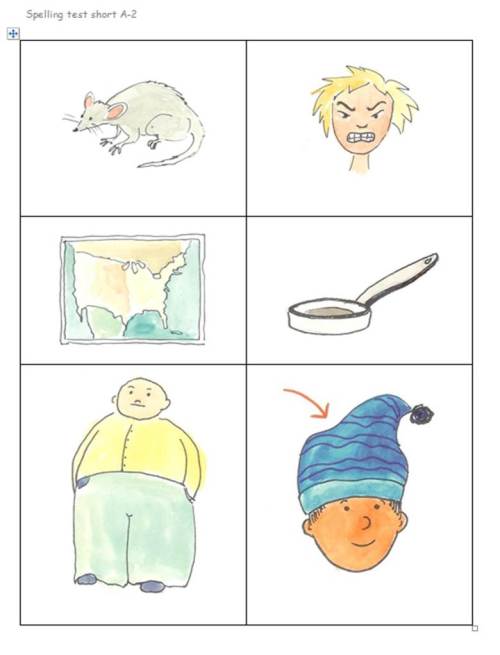
Years ago, I would cut  pictures of CVC words from various sources, paste them on index cards, sort them by vowel sound.  Then I would use them as spelling tests for beginning readers. (Now Mrs. A draws the pictures, including those below.)  This low-tech approach still works great with beginning readers and spellers.

Six drawings of short A CVC words

These drawings are samples of a packet of 12 pages of CVC drawings that can be downloaded for a small fee.  Click on the pictures for more information.  

Why use pictures for the spelling test instead of just dictating the words?

  • When the child is in charge of the pile of pictures, she can spell at her own pace, jotting down words she knows quickly and slowing down for words she is unsure of or for words she writes incorrectly and needs to repair.
  • Young children are people in motion, so the more parts of their bodies they can use to learn, the better. Taking off the rubber band, shuffling the cards, flipping them into a second pile as they are used and rubber-banding them again are fun.  Making learning fun is so important for children of any age, but especially for preschoolers.
  • Some children delight in erasing and will write a word incorrectly just so they can erase it. Spelling is a new experience for them, but it can take time, time when a tutor or mother might grow impatient. But since the child is working independently, the process can take as long as the child wants.
  • While the child is working independently, I can observe where she might need more help or prepare the next lesson, a better use of my time than dictating.
  • ESL students who might be shy about moving at a slow pace gain privacy by controlling the time it takes to complete the test.

One time I gave a preK student a short A test which he finished with pride—his first spelling test! When he found out I had more cards—more tests—he begged me to let him take the cards home and use them for the next week.  His mother later told me that  he took the spelling tests every day. What an eager learner!

Do after-school tutoring centers really improve a child’s reading?

Yes, after-school tutoring centers can improve the reading abilities of many children.

According to 2009 research by the University of Illinois, tutoring centers which do the following have the best chances of helping a student to improve reading skills:

• The center uses trained tutors (experienced teachers but also tutors whom the center trains).

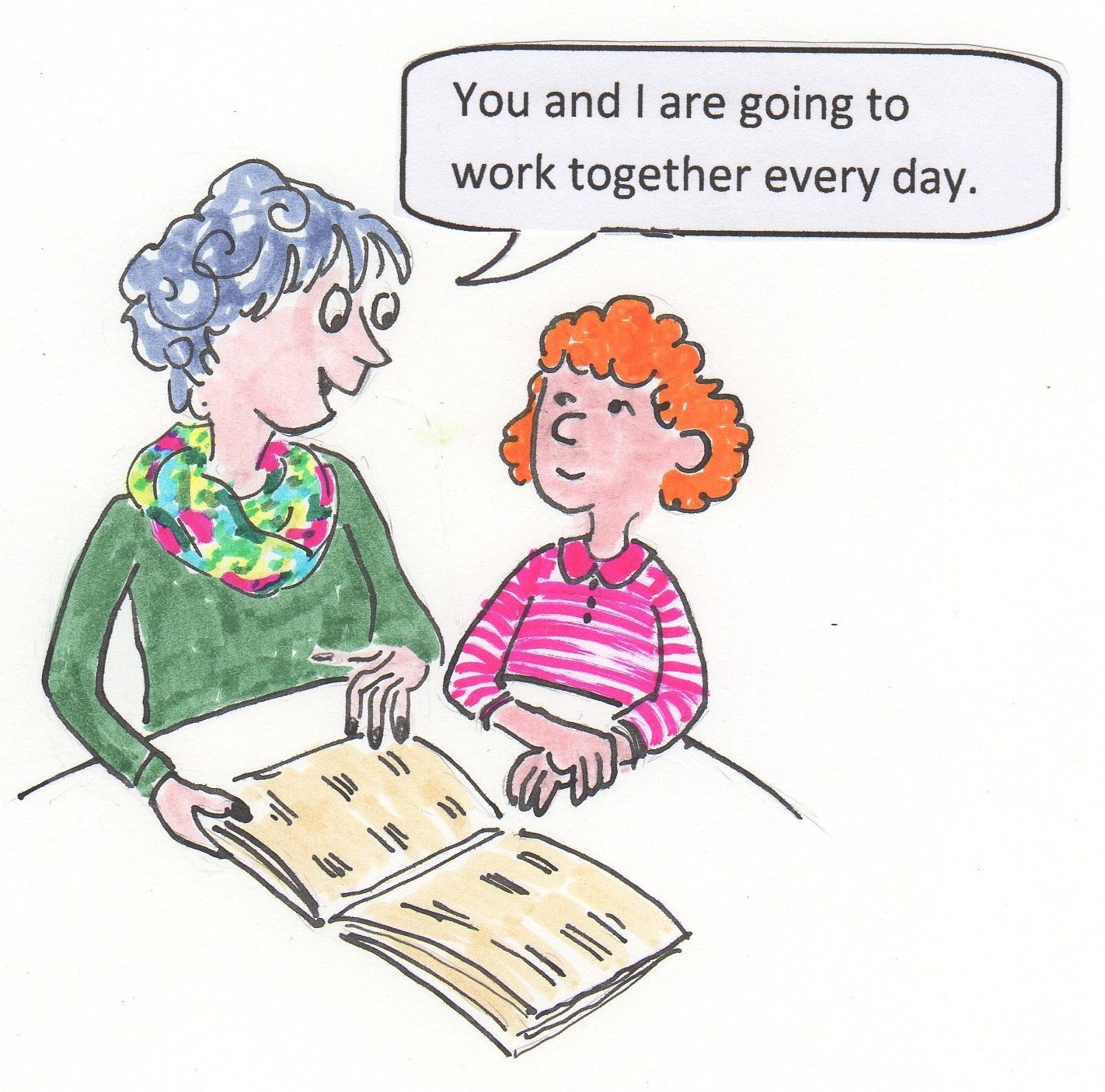
Adult holding a book open for the child next to her and saying, "You and I are going to work together every day."

• The center tests the student to identify his reading strengths and weaknesses and then prepares a plan to address the weaknesses.

• The center continues to assess the student from time to time—with formal tests and with informal tutor appraisals—to show progress or a need for more work on certain concepts.

• The center’s tutors are in touch with the students’ classroom teachers so that they can work together to help students.

• The center’s reading program follows a sequenced strategy.

A 2001 US Department of Education report on tutoring centers agrees on these good practices suggested by the University of Illinois, but adds these others:

• The center offers intensive, on-going training for teachers.

• The center works with the child regularly (daily or at a minimum of once a week for up to an hour of instruction).

• The center offers individual strategies to meet the needs of the 17 to 20% of students not helped by the center’s usual approach to teaching reading.

Whether a tutoring center can improve the reading skills of a particular child depends on the needs of that child. If a child is doing average-to-well in school or is a good ESL student, the after-school program probably can strengthen his skills. If the child has serious reading problems, such as dyslexia, the tutoring center might be willing to develop an individualized instruction plan. But not all centers are able to do this.

My advice is to identify your child’s needs with the help of his classroom teacher and then interview various tutoring centers to find one which will meet his needs or, if none seem right, look for a private tutor who specializes in teaching reading.

For more information on these research reports, go to
http://www.cprd.illinois.edu/files/ResearchBrief_Tutoring_2009.pdf and http://www.cns.gov/areads/about/evtutoringworks.pdf.

How do I read to my two-year-old? Is he even ready?

Some one-year-olds are ready to be read to, and some two-year-olds are not yet ready. But most are. Reading to a two-year-old can be fun and educational for the child, and subconsciously, prepare the child for more sophisticated reading.

Two-year-olds are all about physical motion, so reading to them should include movement. You could start with board books, and ask the child to tell you what he sees. He might say, “Baby.” Probe a bit. “What is the baby doing? Show me.” Even if he can’t put into words the baby’s actions, he might be able to act them out.  Helen Oxenbury’s books are great for children who cannot speak yet.

baby reading a bookHis physical needs might include holding the book and turning the pages. He will learn to turn pages correctly if you help him. But he will want to go back and forth. He might see a dog on page eight and remember seeing the dog on an earlier page, and he might flip the pages to find the dog. Don’t expect formal sequencing of pages with a two-year-old.

Some books for young children have textured parts for the child to touch. Others have flaps that open and close, or they offer pop-up parts that unfold. Little children love these books, but roddlers tend to rip the pages. Beware. They love to move things in a trial-or-error way to see what happens. Yet their touch is usually not delicate.

You might start reading a picture book and the child might interrupt, pointing to a picture and talking about it. He might not care for the story yet, but he might be fascinated by the pictures. Don’t think that just because there are words you must read them. Let the child guide you.  If he doesn’t want you to read, look for some wordless books or just discuss the pictures.  Most wordless books are intended for toddlers.  They are also great for older ESL students new to English.

Two-year-olds are acquiring language rapidly. If you point to a picture and say “bug” or “triangle,” the child might remember the new word. Two-year-olds are also picking up grammar, so be sure you use grammar correctly, even if the child doesn’t. You don’t need to correct him most of the time.  By hearing you say grammar correctly, he will eventually say sentences correctly.

I remember my preschoolers choosing the same books over and over. I was bored reading them repeatedly, but they weren’t. Children find it comforting to hear, day after day, how the little bird found its mother or how Sylvester returned to his family.

father reading Old McDonald to childNursery rhymes are great for the littlest readers.  Some, like “The Itsy, Bitsy Spider” and “This Little Piggy,” encourage finger or toe play. You can tell the child enjoys nursery rhymes when he starts doing the finger play himself.  Plus, children love rhymes, anticipate them, and race to complete the rhyme.  Rhymes teach children about word families (spout, out; rain, again), too.

You might use reading to a toddler to establish routines, such as what you and your child do before or after a nap.

If there are older children, you might want to read to them at a different time, since a two-year-old’s abilities are quite different from a four- or five-year-old’s.  On the other hand, a patient toddler might pick up reading skills and vocabulary by listening to his older sibling read with you.

So should you read to a two-year-old? Definitely, but keep in mind the abilities of a child that age.


Survey shows number of kids reading for fun is decreasing

Fewer children are reading books for fun, according to just-released results of a survey sponsored by Scholastic, an American publisher of children’s books.Young girl reading a book

According to the survey of 1000 children aged 6 to 17, 31 percent said they read for fun in 2014, down from 37 percent in 2010.

Some of the other findings include:

    • Children aged 6 to 11 who were read to aloud, and who had their time online restricted, correlated with those children who read more.
    • Having time to read on their own at school correlated with more reading by children aged 12 to 17.
    • 17 percent of all children surveyed said they have time to read independently at school, with the percentage dropping as the grade of the children increased.
    • Children aged 6–11 who identified themselves as frequent readers read about 43 books per year. Infrequent readers aged 6 to 11 read about 21 books annually.
    • Among children aged 12–17, frequent readers reported reading about 40 books annually while infrequent readers said they read only about 5 books annually.
  • The study says there are three predictors of which children will become frequent readers:
      o Children who say they “really enjoy reading.”
      o Children who believe that reading for fun is important, and
      o Children who have parents who read frequently.

To read the report on the survey, go to http://www.scholastic.com/readingreport/downloads.htm.

Are you surprised by this survey’s findings? I’m not surprised, but I am concerned. In the past week I spent a great deal of time with more than 100 teenagers. Almost all had smart phones and ear buds which they used nonstop, even during classes. Many balked at reading passages in their text book. Some said they could not find information buried within paragraphs.

As electronic equipment grows more dominant in our lives, will the ability and willingness of our children to read anything more complicated than a text message decline as well? –Mrs. K

Teaching CVC words ending in double consonants

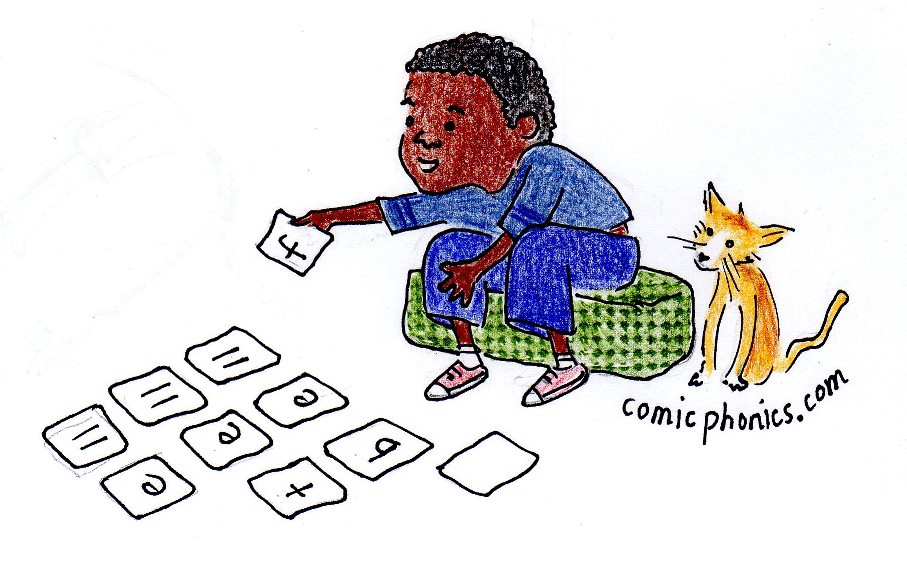
When a child is learning to read, the child is learning to spell as well. Since most one-syllable, short vowel words (CVC) have three letters, all of which are pronounced, these words are usually easy for the child to spell. If you use letter tiles or cards with individual letters written on them, reinforce spelling as you and the child move the tiles around to form new words. At this stage, merging reading and spelling is easy.CVCC twin consonants

Another set of words are almost as easy to learn to spell. These are words which end with the double consonants of l, s, and f and z. If you take the time to point out to the child the double final consonants in these words, the child will learn to spell them easily. Be sure to tell the child that these double consonants are pronounced as a single sound. What are some common CVC word families with double ending consonants?

  • –ell: bell, dell, fell, hell, sell, smell, spell, tell, well, yell
  • –ill: bill, dill, fill, hill, kill, mill, pill, sill, still, till, will
  • –oll: doll
  • –ull: dull, gull, hull, mull, skull
  • –ass: ass, bass, class, glass, grass, pass
  • –ess: bless, dress, less, mess
  • –iss: bliss, criss, hiss, kiss, miss
  • –oss: boss, cross, floss, loss, moss, toss
  • –uss: fuss, muss
  • –aff: staff
  • –eff: Jeff
  • –iff: cliff, miff, sniff, stiff, tiff,
  • –off: off, scoff
  • –uff: bluff, buff, cuff, fluff, gruff, huff, muff, puff, scruff, scuff, snuff, stuff
  • –azz: jazz, razz
  • –iz: fizz, frizz
  • –uz: buzz, fuzz

It is important to point out to the child that even though most of the time l, s, f and z are doubled at the end of short words, sometimes these letters are not doubled. So as not to confuse the child, list just a few exceptions to this doubling rule (pal, gas, bus, yes, us, and plus), using words that the child is likely to encounter.

Also point out that a few common words that don’t end in l, s, f and z double the final consonant even though most other words do not. Add, odd, egg, inn, and mitt are some examples that the child might read and use. When the child understands the concept of syllables, you can explain that this rule of doubling the l, s, f and z usually applies to one syllable words only. Many times children try to write “until” as “untill” (proving they have internalized the rule), so it is worth pointing out the correct spelling when the child is ready to learn two-syllable, short vowel words. –Mrs. K


How can I help my child navigate ebook technology? There are so many features to remember.

In 2012 the most popular interactive parts of ebooks (according to research) were voice narration, hot spots (places on the screen that respond to touch), games, sounds (music and sound effects), and text highlighting.

None of these features are present in traditional print books.

Kneeling young girl is playing a portable video game.

What this means is that before children can “read” an ebook, they need to know how to navigate its interactive features. For some children, navigating is fun. If they have wrestled with video games, like Mario Brothers, they might find navigating an ebook a challenge or even easy.

But for children new to electronic equipment, or for children who find new situations difficult, learning to read an ebook can be frustrating. For example, ebook readers need to familiarize themselves with numerous icons, whose meaning changes depending on the ebook. Tapping a backwards circling arrow in one book might mean go back to the previous page, while in another book it might alert the narrator to read the book aloud.

What can you as a parent do to help your child navigate ebooks?Boy on floor reading an ebook on his tablet.

  • Show your child various versions of the same book—a print version, an audio version, and a digitally available one, for example. Or show several different digital stories. Point out that reading each one requires different skills. Try to name some features that are the same and some that are different.
  • Model how to navigate an ebook, talking to yourself out loud so your child can hear you think aloud. Ask your child for suggestions. Explore the technology of the book together.
  • When you or someone close to you gets a new phone or tablet or other device, explore its features with your child. Point out to your child the new features and how important it is to stay up-to-date on these changes. Imagine together what features your next device will have.
  • When the child reads an ebook and encounters a problem, help him to solve it with minimal involvement from you, so he develops a “can-do” attitude. Remind him of another situation like this which he has already encountered. Encourage him to try various approaches. Be persistent.
  • Most importantly, make your child comfortable with the idea of change.

What is choral reading?

Choral reading is group reading aloud in which a fluent reader serves as a model for students learning to read. It is a reading method frequently used in pre-K to second grade classrooms and in ESL classrooms, but it can also be a good method to teach reading at home.

Here’s how it works:

  • A fluent reader, usually a teacher, parent or recorded voice, reads a story aloud. The students gather around the teacher who uses a large-sized book whose text is also large. As she reads, she points to each word. Or, if children have their own copies of the text, they point to the words she says with their fingers.choral reading
  • The teacher reads the selection once while the children follow along silently with their eyes on the text.
  •  The teacher reads the selection several more times, each time with students joining in for the words they can say. Usually, with repeated readings, students can read more of the words.
  • Often the selection is reread the next day or soon after to reinforce the students’ ability to read the selection.

Why do choral reading?

  • It’s fun. Children love to read aloud when they are one of many voices. Many times the selections have repeated phrases like “I’ll huff and I’ll puff and I’ll blow your house down,” or rhymes, which increase the fun.
  • More skilled readers serve as models for the less skilled students sitting by their sides. The less skilled readers listen not only to their teacher, but to their peers, and they learn from each other.
  • Less skilled students, who might be embarrassed to read aloud by themselves, feel comfortable as part of the group. Their mistakes either can’t be heard or are ignored. They feel more confident about reading aloud. They also realize that with repeated readings, they can read more words.
  • ESL students learn proper pronunciation, phrasing and intonation from listening and mimicking the fluent reader.
  • Dyslexic readers, who often memorize words rather than sound them out, remember better because they are enjoying the reading experience. Their lack of reading ability is less noticeable when they are part of a group.