Identify the main idea with a colored pencil

I find colored pencils or highlighters are so useful when teaching writing.  But they can be just as useful when teaching reading, especially if the same colors are used consistently.

Suppose you are teaching students to identify the main idea in a reading passage, and that the students are reading from a source which they can mark.  First, have students read a passage.  Then help them discover the main idea.  Instruct them to underline or highlight the main idea with a particular color, such as red.  Later, whenever you are working on main idea, ask students to identify it with a red underline.

Sometimes a whole sentence is a main idea, but sometimes the main idea is not identified so neatly.  Sometimes a phrase can be underlined.  Or sometimes the student needs to write the main idea over the title using red ink if it is implied but not stated directly.

Many times all or part of the main idea is repeated in paragraph after paragraph.  Students need to know that the main idea is often repeated, and they need to identify examples of it by underlining those repeats with their red pencils.

What if you are teaching supporting details?  A different color—say orange—could be used to underline supporting details.  If the main idea in a Cinderella story is that Cinderella wants to go to the ball, then all the details helping her get there should be underlined in orange—the fairy godmother, the pumpkin carriage, the mice footmen, the ball gown and of course the glass slippers.  Even the clock striking is an important detail.

Almost every reading test asks for the main idea.  Students need practice, lots of practice in all kinds of reading materials, to identify the main ideas and the details which support the main ideas.

If you are consistent with your color choices, students will get used to seeing their reading through the colors they apply.  And if you are checking to see if students are identifying correctly, all you need to do is look for the color red or orange or whatever color scheme you decide on.  Walking around a classroom, you can easily tell if the students identify correctly, or if they are fooled.

You might be thinking, but students can’t mark textbooks.  True.  But so many schools today use workbooks in many subjects for each student.  Even if the purpose of a particular passage has nothing to do with finding a main idea—a science or math passage, for example—you can still use it to identify main ideas.


Make a summer resolution to read

On January first, many of us make New Year resolutions.  Why not do the same thing on the first day of summer vacation?  In particular, why not make a resolution to encourage our children to read?

Here are some easy ways to get even the youngest readers reading.

  • Make time for reading every day. Turn off the TV.  Put away the phone.  Turn off the video games.    You can read to your little one, or you can share the reading with your youngster who is learning to read or is reluctant to read.  If you have a reluctant reader, you can read up to a suspenseful part, and then ask your reluctant reader to take turns.  Or you can read five pages while he reads one.  Whatever gets the student to read.

girl reading Junie B. Jones

  • Provide books, lots of books. This could mean weekly trips to the library for a stack of books.  Or trips to the local resale shop.  Or a special trip to the bookstore for one special book as a reward.  Let the child pick and choose.  If he finds one author he likes, find more by the same author or on the same topic.

Son and mother reading on a park bench.

  • Document the reading. On the refrigerator, start a chart for each member of the family.  List the title of each book read.  Make it a contest if your child is competitive.  Recognize that chapter books take longer than picture books and “handicap” the readers of longer books.  Offer rewards?

children looking at picture of Lincoln and Mrs. Lincoln

  • Make sure children see you, the adult, reading for pleasure. Laugh out loud when you read a funny passage.  Whistle when you read something exciting.  Talk about what you are reading.  “Wow!  I didn’t know that!”  Entice your little ones into the pleasure of reading.

Research shows that some of the gains made by children during the previous school year are lost if they don’t read during the summer (called the “summer slide”).  Likewise,  those gains made during the school year can be solidified and even augmented by reading during the summer.  Read!

Increasing interword spacing may help students to read better

Both versions of the above paragraph are shown in the same size type and with the same spacing between lines. What is different is that the first version is the normal (default) way words are shown while the second version is the expanded version with additional space between letters.

The research, conducted by Elizabeth Sacchi at Binghamton University, State University of New York, is part of the National Science Foundation-funded Reading Brain Project.  The project studies how children’s brains behave as they read.  Sacchi’s research is the first of its kind in the US to look at what happens inside the brain as children read letters which are spaced variously.

Researchers think the improved reading of children who read words with letters spaced farther apart is not due to visual processing.  Children at the very beginning stages of reading don’t show much change in reading ability when letters are spaced farther apart.  But as the reading gets more advanced, reading improvement can be seen.

This US study backs up a European study of six years ago which showed that more space between letters can help children identified as dyslexic read 20% faster.  In that study, not only was the space between letters expanded, but the space between lines was expanded.

The Italian researchers think increased spacing helps dyslexic children overcome an effect called “crowding.”  Crowding makes letters hard to identify when the letters are placed close to other letters.

Children without reading problems showed no benefit when reading the more widely spaced letters and lines in the European study.

For more information on the American study, go to Elizabeth Sacchi et al, An Event-Related Potential Study of Letter Spacing during Visual Word Recognition, Brain Research (2018). DOI: 10.1016/j.brainres.2018.01.028.  For more information on the European study, go to the Proceedings of the American Academy of Science, 2012.

The X factor in type faces

[Another way to increase the readability of words is to increase the size of the half-space letters, as in the first example above.  For more information, see an earlier blog.]

Don’t slip down the Summer Slide!

Research shows that students loose reading skills during the summer if they don’t continue reading.  Educators call this loss the “summer slide.”  It is most severe among low-income students who lose up to two months of reading skills.  Yet it is sometimes nonexistent among middle class students who make slight gains in reading during summer months.  Why the difference?

Summer slide (decline) of reading scores.

  • A study of 3000 sixth and seventh graders in Atlanta Public School showed that students who read at least six books during the summer maintained or improved their reading skills.  But students who didn’t read lost up to a whole grade of reading skills.  (B. Heyns, 1978)
  • A study of Baltimore students over 15 years found that By the end of fifth grade, Baltimore students who didn’t read during the summer measured two years behind their classmates who did.  They concluded that 2/3 of the reading difference in ninth graders can be attributed to reading or not during summer school breaks.  (K Alexander, D. Entwisle and L. Olson, 2007)
  • A study of students completing third grade who took part in their local libraries’ summer reading programs scored 52 Lexile points ahead of their classmates who did not. (Dominican University)
  •  Children’s absence from reading during the summer is a major hurdle for achieving good reading skills by the end of third grade.  (The Campaign for Grade-Level Reading)
  • The summer slide is cumulative.  Some estimate that by the end of high school the summer slide can account for up to a four year lag in reading achievement, and it can have an effect on high school graduation rates.  According to the Annie E. Casey Foundation, “one in six children who are not reading proficiently in 3rd grade do not graduate from high school on time, a rate four times greater than that for proficient readers.”

So how can you combat the summer slide?

  • Sign your child up for your local library’s summer reading program, and make sure your child completes the reading.
  • Go to the library regularly and let your child select books she will enjoy.
  • Help your child to read a chapter book a week, or a picture book each night.
  • Encourage your child to read the newspaper, television guides, magazines and online articles.
  • Reward your child with a trip to the book store to select her very own book.
  • Read to your child every evening, and let him read to you.  Your reading will teach fluency and pronunciation, and establish the notion that reading for pleasure is fun.

(This blog first appeared on May 16, 2014.)

Benefit of reading to children: reduced hyperactivity

Want to improve your baby’s, toddler’s or preschooler’s behavior?  Read to your children.  And play with your children.

That’s the conclusion of a study reported in the April issue of Pediatrics.  Two sets of children, one from birth to about three years old, and another from three to five years old, were studied.  Parents were videoed reading to their children or actively playing with the children, and later the parents’ positive interactions were reinforced by the researchers.

The results show that both groups of children’s behavior benefited from the active reading and play by parents, compared with control groups of children.  Hyperactivity at the time the child started school was reduced compared to hyperactivity in a control group, and remained lower for one and a half years.

The researchers recommend that pediatric primary care pediatric practices encourage parents to read and play actively with their babies, toddlers and preschoolers in order to achieve more desirable behavior in the children.

For more information on the study, got to http://pediatrics.aappublications.org/content/early/2018/04/05/peds.2017-3393.

Use cloze activities to test reading comprehension

If you are trying to assess whether your student, especially your English Language Learner, can understand what she is reading, use cloze activities.

Cloze activities are written passages with words left out.  Students need to supply the missing words.  Sometimes random words are omitted—such as every seventh word—and a blank space replaces a missing word.  Sometimes a particular part of speech is omitted.  Sometimes words that are important for the structure of a sentence,  like prepositions, are omitted.

Let’s take a paragraph and show several cloze variations which yield particular information about a student’s reading comprehension.

This morning, I woke up early and slipped downstairs to play with the new puppy.  Max was in a cage, so I opened it, and let him out.  Quickly I took him to the back of the yard where he knew what to do.  I threw a ball which he liked and a rubber bone which he didn’t like.  Then we came inside and I fixed him a simple breakfast.

Now suppose we leave out every eighth word of the above paragraph.  Here is the result.

This morning, I woke up early and _______ downstairs to play with the new puppy.  ________ was in a cage, so I opened ________, and let him out.  Quickly I took _______ to the back of the yard where ________ knew what to do.  I threw a ________ which he liked and a rubber bone _______ he didn’t like.  Then we came inside ________ I fixed him a simple breakfast.

Depending on the word choices the student makes, you can learn if the student understands the meaning of the paragraph.  You can ask her to justify her choice by explaining which context clues she used.

Now suppose we try a different cloze paragraph, this time leaving out all pronouns.

This morning, _______ woke up early and slipped downstairs to play with the new puppy.  Max was in a cage, so _______ opened _______, and let _______ out.  Quickly _______ took _______ to the back of the yard where _______ knew what to do.  _______ threw a ball which _______ liked and a rubber bone which _______ didn’t like.  Then _______ came inside and _______ fixed him a simple breakfast.

From this exercise, you can learn whether the student knows both subject and object pronouns and when to use them.

Now suppose you are testing appropriate use of articles.  You can remove all articles, and in addition, put spaces before all nouns or adjective-noun groups to see if the student knows whether articles are needed and if so, which articles are needed.

This morning, I woke up early and slipped downstairs to play with _______ new puppy.  _______ Max was in _______ cage, so I opened it, and let him out.  Quickly I took him to _______back of _______ yard where he knew what to do.  I threw _______ ball which he liked and _______ rubber bone which he didn’t like.  Then we came inside and I fixed him _______ simple breakfast.

If a student is studying vocabulary, a word bank can be supplied and from those words the student chooses words to fill in the blanks.

Before you use a cloze activity, know what you are testing for and then create or find a cloze activity which will yield that kind of information.

When the student becomes the reading teacher

Sometimes my best teaching strategies come from children themselves.

I was working with a PreK student the other day.  She has mastered reading CVC words (consonant-vowel-consonant words like “cat” and “six”).  Now we are focusing on blends at the beginning of CCVC words like “swim” and “spill.”

One at a time I was showing her illustrations of CCVC words.  At the same time I was sliding a handful of letters near the illustration.  The letters included the letters needed to spell the word plus some distracting letters.  My student’s job was to pull out the letters needed in the correct order and “write” the word under the illustration.

Except that she didn’t want to do that.  She wanted to write her name using the letter tiles.  We were getting nowhere, so I let her write her name.  Then, after her name she wrote the word “is,” and after “is” she wrote “not.”  Then she wrote the word we were trying to spell in the picture, “twin.”

“Chaulian is not twin,” she said aloud, laughing because she knows she is not a twin.  I pulled out the letter “a” and inserted it into her sentence.   “Chaulian is not a twin,” she read.

“You wrote a sentence,  Chaulian.”

She was engaged again.  I pulled another illustration, this time of a plum.  I took away “twin” and put six letters in front of my student.  From them she picked “plum” and changed her sentence to “Chaulian is not a plum,” laughing once more at the ridiculousness of that thought.

We continued, with Chaulian writing little sentences about herself using CCVC words.

A few days later I tried this same approach with an even younger child.  She is learning CVC words, but of course she already knows how to spell her name.  I asked her to spell her name with letter tiles and then I added “is not a” and pulled illustrations.  Nneka is not a cat.  Nneka is not a map.  Nneka is not a ten.  Like Chaulian, Nneka’s interest in our reading game increased when her name was used.  And when she read aloud her nonsense sentences, she laughed and laughed.  Our work together had turned into a silly game.

Little children are self-centered, so of course it made sense to use their names.  And wacky little sentences made our work fun.  I was thrilled to keep their attention longer than usual.  Win-win.

Chaulian is a teacher.

Using “the” for second reference and specific reference

Knowing when to use “a,” “an,” and “the” is hard  for students learning English as a second language.  This is especially true for Asian students who have no articles in their native languages.  For Europeans it is easier because they are used to articles, though sometimes not used in the same way as in English.

To review what we said in recent blogs:

  • “A” or “an” is used before singular nouns (A dog licked an object).
  • No article is used before noncount singular nouns and before plural nouns. (I like rice and bananas.)
  • “The” is used before one-of-a-kind nouns but not before names. (The Statue of Liberty seemed big to Molly.)
  • “The” is used before titles to describe roles when the name is not included. (The senator spoke.)

Here are some other rules.

  • “The” is used for singular, plural and noncount nouns when the nouns are mentioned for the second time. “I saw a girl today.  The girl wore a head scarf.”  In the first sentence, girl is singular and is mentioned for the first time, so “a” is used.  “The” is used at the second reference to mean the girl just talked about.

One way to teach this concept is by using cartoons which show objects for the first time in one frame and then repeated in a later frame.  “Snoopy is asleep on a dog house.  He jumps off the dog house to chase a ball.  The ball stops next to Charlie Brown.”  Ask students to create sentences about the action.

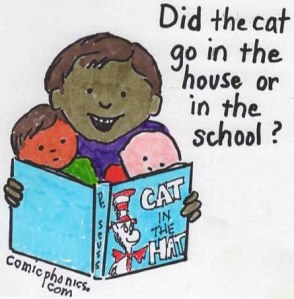
Another way is with picture books.  “A cat wearing a hat came into a house.  Two children watched.  The cat talked to the children in the house.”

  • “The” is used when we refer to a singular object which is specific to the speaker or character. If a child says, “I will take the bus to school tomorrow,” we know he means the particular bus which he always takes, the one which stops near his house.  When someone says, “I need to go to the dentist later today,” the speaker means she needs to visit the dentist whom she always sees, not just any dentist.  To the speakers, the bus and the dentist are specific and one-of-a-kind.  So “the” is appropriate.


  • In the US we use “the” when we say particular phrases like “the hospital.” Americans say “He went to the hospital” but British people say “He went to hospital.”


  • When a singular or plural noun is preceded by a possessive noun or pronoun, no article is needed. (Our coats are near Mary’s purse.)


  • When a singular or plural noun is preceded by a number, no article is needed. (The principal needs 10 teachers to proctor the exam for 300 students.)


  • The United States or the US is always preceded by “the.”  So are the Philippines and the Netherlands.


  • Homework is noncount.  It is wrong to say “a homework” or “two homework.”  To show amounts of homework, use the word “assignments” after “homework.”  I have three homework assignments.

Teaching “the,” part one

Once students have learned that “a” or “an” must precede a singular count word, and that no article precedes a singular noncount word, it is time to teach how to use the article “the” with proper nouns.

EPSON MFP image

Cut out pictures of one-of-a-kind monuments or natural landmarks, such as the Grand Canyon, White House, Niagara Falls, and Statue of Liberty.  Also cut out pictures of a few famous people like Abraham Lincoln, Queen Elizabeth and Barack Obama, and pictures of places that the student knows or visits like the church, school and library he attends.  Cut out pictures of a few cities or towns, rivers and mountains.  Under each, write its name without any article.

Explain to students that the article “the” is used in front of one-of-a-kind nouns.  So even though “a” would be used in front of “statue,” because the Statue of Liberty is the only one like it, we use “the,” not “a,” in front of that name.  Let the students mimic you saying “the White House” and “the Eiffel Tower.”

Explain that “the” is not used in front of people’s names.  So we do not say “the George Washington.”  We do not use articles of any kind in front of people’s names.  Show pictures of people whose names the student would know.  Under the picture, write the name without any article.  Ask the student whether an article should be said, and if so, which one.

If we use a title without a name, we do use “the.”  So we say “The President boarded the helicopter.”  “The teacher called on me.”

We do not use “the” in front of the names of most businesses or institutions.  We say, “I attend Simpson Elementary School,” not “I attend the Simpson Elementary School.”  Or “My mother works at St. Peter’s Hospital,” not “My mother works at the St. Peter’s Hospital.”

Remembering these distinctions is hard and takes time.  Take the first five minutes of every lesson to review.  Each time you teach a new concept, add it to the “deck” of cards the student has already learned.  Don’t move on until the student can figure out when to use or not use an article, and which article to use.

Next:  Using “the” for a second reference


When to use “a” and “an”

For most native speakers of English, using “a,” and “an,” pose no problem.  We don’t forget to use them, and we use them properly.

child playing card memory game

But if I ask you what are the rules for using articles, could you explain them?  Probably not.  We use articles—or not—based on whether what we say sounds right with or without them.

Nonnative speakers of English can’t rely on what sounds right because they don’t know what sounds right.  So how can we teach articles to children learning English as a second language?  We need to teach rules.

Here is my suggestion.

Find pictures of common items which are often found grouped together.  Find pictures of one of those items, such as one banana, one egg, one leaf, and one envelope.  Also find pictures of the same items grouped with others, such as a bunch of bananas, several leaves, a carton of eggs, and several envelopes.  Make sure some of the items begin with vowel sounds (eggs, envelopes, alligators, and olives, for example).

Find pictures of common items which cannot be counted, such as sand, rice, sugar and water.

Tape each picture to an index card, and under each write the name of the item or items without any article.  Then under the name of the item write the same word with an adjective in front of it.  So you might write “car” and under it write “old car,” or “rice” and “hot rice,” or “alligators” and “scary alligators.”

Start the lesson by showing the student a single common item which can be counted, such as a car.  Explain that when we have one of a common noun, the first time we mention it we say “a” or “an” in front of it.  Ask the child to repeat what you say:  “I see a leaf.  The boy holds an umbrella.  An ostrich looks at me.”

Explain that even if we put a describing word in front of the common noun, we still need “a” or “an.”  Let the child practice mimicking you with “A black horse trots.  A white egg is on a plate.  An orange pumpkin grows.”

When the student seems to understand that concept (after days of practice) explain that we have some words in English which cannot be counted.  Show a picture of someone playing a musical instrument with the words “music” and “loud music” under the picture.  Because music cannot be counted, it never has an “a” or “an” in front of it.  Ask the student to repeat what you say:  “I eat hot rice.  Clean water tastes good.  Loud music comes from the radio.”

Shuffle the pictures of the singular items which can be counted (a car, a banana) with the pictures of the noncount items (music, rice).  Practice putting or not putting an article in front of them for several days until the student realizes that singular items which can be counted are preceded by “a” or “an” and noncount items are not.

Next:  Adding plurals to the mix.  Then, adding proper nouns to the mix.  Later, using “the.”