Category Archives: vocabulary

Making small words from big words—a variation for beginning readers

What if a child is truly a beginning reader still learning CVC words? Can the game of finding small words within big words or phrases still be used to improve the child’s understanding of words and spelling? Not exactly, but if you limit the letters strategically, a beginning reader can play.  Here is how.

children moving letter tiles

  • Instead of writing a big word or phrase such as “New Year’s Day,” write a handful of letters, including only the vowels and consonants which the child has learned.
  • If the child has learned only short a words (cat, ham, fad), write the vowel “A” at the top of the page followed by a handful of letters which you know can be used for form short a CVC words. B, C, D, H, R, and T might be good letters to begin with.
  • You could also use letter tiles (Scrabble letters, for example) so that the child can move letters around. Tactile experience helps young children in learning and makes the learning seem more like a game. Also, the child doesn’t have to hold letter patterns in his head; he can manipulate various letters until he finds a word which then you or he could write down.
  • Demonstrate to the child how mixing up the letters can form words. Write B A T and B A D, showing where you got those letters, and using enough examples so the child knows what to do.
  • The competition aspect of the game might be for the child to “beat” his last score, that is, to find more words than the last time.
  • As the child learns more CVC vowels, two vowels can be used with six or seven consonants. I recommend starting with A, then O, and then U.  E and I take longer to learn since they sound similar, so I would use them indeptndently (A and E, for example, or O and I) until the child is confident with all CVC words.
  • This is a game which pairs of children can play together as a team, providing one child does not dominate, leaving the other child out.
  • Restricting the number of letter choices can help the child to focus, so do limit the number of vowels and consonants for beginning readers. Once the child is an experienced reader, he can “graduate” to the longer word or phrase game we discussed previously.

Play word games to encourage or to reward reading

When I tutor reluctant readers or bad spellers, sometimes I reward them with a word game in the last five minutes of an hour-long lesson. The kids love the game and ask at the beginning of the next lesson if they can play again. I never play this word game at the beginning of a lesson or they will balk at doing other kinds of reading work, but it is great as a reward.
This game is also a good game to play in the car on long trips or when a child is bored. It turns dead time into learning time.game of breaking up a big word into little words

  • Start by choosing a long word or a phrase. I try to relate the word or phrase to the season or to what we are studying. For example, “NEW YEAR’S DAY” or “JUNIE B. JONES” might be appropriate. After the first game, the child will want to choose the word or phrase, but you must steer him to pick an appropriate word or phrase for the game’s purpose.
  • The word or phrase should have ten to 15 letters but not many more or the game becomes too easy. Good words or phrases to work with contain several vowels, including the letter “E.” Bad words or phrases contain few vowels, do not contain the letter “E” and repeat many of the consonants.
  • I write the word or phrase at the top of a blank paper, often in all caps, so the child realizes capital letters are irrelevant.
  • Next, I explain that we are going to make little words from the big word or phrase, using the letters in any order. So for the phrase “NEW YEAR’S DAY,” I might write “ear,” “way,” and “weed,” and point out how each letter in the little words is part of the phrase.
  • I also point out that if there is only one “N” in the original word or phrase, then there can be only one “N” in the made up words. Also, if there is punctuation in the original word or phrase, it can be ignored or used.
  • The object of the game is to find as many small words as possible in five minutes.
  • Eventually you want children to discover word families, words whose letters can be moved to create other words (tea, eat, ate), words within words (heard, hear, ear, he, head), and how having certain letters (E and S, for example) makes the game easier. This shows the child is thinking about word patterns.
  • I help younger children find words, and show them word families that can be made by changing a single letter. Once they understand the game, they usually do not want help.
  • For older children, I compete with them, sometimes giving them a handicap.
  • At the end of five minutes, if there is not a competition, the game ends. If there is a competition, the child names his words aloud, and if he and I have duplicates, we cross them out. His score becomes the number of words he has without duplicates plus the handicap.
  • Additional points are given for words of five letters or more and perhaps for the word which is the longest and which seems to be the most clever use of the original letters.
  • I allow proper nouns, but I do not allow repeating the words in the original word. You can make your own rules depending on the ability level of the child. Some children will put an “S” on every noun.

If my child reads slowly, he can pronounce almost all the words correctly, but he understands almost nothing. If he reads faster, he mispronounces many words but he seems to understand a bit. Which do I go for—accuracy or comprehension?

Accuracy. But let’s backtrack a little.

At what stage of reading is your son? Is he reading passages matched to his reading level? If a child is plodding laboriously through text, the text is too difficult for his reading level. He is not achieving fluency. I suggest you go back to easy readers which he can read accurately and with understanding in order to give him confidence.boy reading book

If he is in third grade, for example, you might find some first grade reading for him. Ask your librarian for help. If he can read sight words and CVC words at a good pace, with word accuracy and with overall comprehension, you know he is reading at least at an early first grade level. Gradually increase the reading difficulty. You want to maintain the child’s confidence, so increasing the difficulty level should not happen in a matter of days but rather over weeks or months.

Some problems to listen for:

  • If a child is stumbling, word to word, he is not phrasing within sentences.  For example, all the words in a prepositional phrase go together and should be said as a unit; the subject and it’s modifiers should be said as a unit.  Practice reading aloud with you modeling how to say a given sentence, and ask your son to phrase words so that they make sense.
  • If a child is reading in a flat monotone, his reading lacks inflection.  Some languages lack inflection (Korean, for example), and children from that background might feel foolish saying some words louder and some words softer, or saying part of a word louder than the rest of a word.  If you can read with inflection, let the child listen to you and then ask him to repeat the words the same way.  If you cannot read with inflection, a child can listen and read along to books on tape.
  • If a child is bulldozing longer words rather than sounding them out, he could have problems with phonics, or be dyslexic,  or  be an impatient personality.  Cover suffixes and prefixes, discuss the root word’s meaning and the meaning of the suffixes and prefixes, and then reassemble the word.  Reread the sentence and ask the student what the word means in the context of that sentence.

Some manufacturers have a reading level on the back cover of children’s books. “RL 2.2” for example means reading level second grade, second month. Other books are color coded by the library, and still others show reading level with a lexile score. In my public library, one long wall of books contains easy readers for children learning to read. You might find an author whom your child likes. Ask your librarian for help so that your child is reading at the correct reading level and gaining confidence.

As your child progresses to higher reading levels, he will probably read with less accuracy and at a slower speed unless you actively intervene. Ask him to read aloud. When he pauses or stumbles, let him try to figure out the difficulty himself, but if he can’t, stop him and help him. Perhaps you will notice he doesn’t understand a concept in phonics; or that prefixes or suffixes confuse him; or that he doesn’t know where to make the break in multi-syllable words so he pronounces words wrong; or that a secondary meaning of a common word baffles him. Teach him how to solve his problem. Then let him continue reading that sentence or that paragraph. Now ask him to reread it. If he continues to stumble at the same spot, you know that he needs stronger intervention on a particular skill.

At the end of paragraphs or chapters, it’s important to ask your child what happened (in fiction) or what is the main idea (in nonfiction). If he talks around the idea but cannot nail it, he was focusing on individual words and missing the meaning of sentences or paragraphs. The reading was too hard. If he can retell the story or explain the main idea, he is comfortable at that reading level, and should try a slightly higher reading level.

What I see with many of my students is that they begin to have difficulty with reading once they have mastered the basic rules of phonics. It’s not a decoding problem; it’s a vocabulary problem.  As the reading level increases, so do the number of words they don’t understand. It’s not a matter of pronunciation usually; it’s a matter of having no idea what a given word or an idiom means. This is particularly true for ESL students.

That is why I say accuracy is important. If a child cannot read a given word accurately and know what it means, then understanding a sentence or a paragraph—with lots of unknown words—becomes impossible.

My daughter reads fast, but when I ask her to summarize, she can’t explain well. What do I do?

Occasionally a read-a-holic student will have lower than expected reading grades. The parent is baffled because the child always has a book in her hands and goes through novels voraciously. When I ask such a student to read aloud for me, she shows many of these behaviors:

dhild running with book in hands


  • She doesn’t slow down for commas or stop for periods.
  • Her sentences merge and keep going for as long as she can read without taking a breath, and when she pauses to breathe, it might be in the middle of a sentence.
  • She may skip a line of reading when moving from the end of one line to the beginning of the next.
  • When she comes to an unfamiliar vocabulary word, she bulldozes it, pronouncing it any which-way, and continues reading.
  • Her inflection is flat, like that of an auctioneer.
  • She does not self-monitor; she doesn’t pause to consider that she didn’t understand what she just read.
  • When she answers questions about the reading selection, she does not remember important details and she doesn’t take the time to search for them in the selection.
  • She misses inferences and more subtle figurative language like metaphors.When asked to restate the main idea in a sentence or two, she talks around the subject but doesn’t nail the point the author is making.

What’s going on?

For such a student, speed is the important value. Finish quickly. Move on. (Notice if she is slap-dash about her piano practicing, dressing or cleaning her room. This is a personality trait, not just a reading trait.) In reading, this behavior might develop as she reads novels of her choice. She doesn’t care if she understands every nuance; she would rather understand enough to enjoy the story without slowing down for details.

This kind of reading might work for leisure-time reading, but it doesn’t work for most school reading, especially the kind of reading being tested under the new Common Core Standards. Common Core is trying to break such bad habits by forcing a reader to name the paragraph in which the answer is found, to define a word, to distinguish between fact and opinion, to restate an idea, to infer and to summarize.

What to do to improve fluency and reading comprehension?

  • Ask your student to read aloud. She will fume because it takes longer to read aloud. But make her do it. Silently read along with her and note the kinds of errors  which she is making.
  • If she is ignoring punctuation, stop her and ask her to reread and pause appropriately. She will hate this, but making this one change is half the battle.
  • Ask her to use inflection now that she can hear the sentences correctly. Model it if necessary.
  • If she slides over longer words she doesn’t know, stop her immediately and ask her to sound out the word. If she can’t do it on her own, cover a prefix and a suffix; ask her what the root means, or if she knows another word with that root. Then reassemble the word and pronounce it.
  • Sometimes it is not the long words which stump students; it is the idioms or the secondary meanings of short, familiar words. Stop your student when she encounters such words to be sure she understands them.
  • If she skips lines of reading, have her use her finger to keep track, or an opaque book mark.
  • At the end of a paragraph or a few paragraphs, ask her to explain what she just read. If she has missed something significant, go back and show it to her and together figure out why she missed it.
  • Many times, ask what the main idea is. If she can’t nail it, have her reread while you point out clues to the overall meaning.
  • Model self-monitoring by stopping her now and then to take stock of what was read and what to expect next.  Let your student hear you talking to yourself about what you just read.
  • Lastly, let her read her leisure-time reading undisturbed, bad habits and all. You can only fight so many battles; let her win that one small skirmish.

My child knows how to read pretty well for a first grader. Should I still read aloud to her?

Yes! Here’s why:

  • A child’s reading level doesn’t catch up with a child’s listening level until eighth grade, according to Jim Trelease, author of The Read-Aloud Handbook. A younger child can appreciate a book she cannot read yet—the plot, the descriptions, the characters and the vocabulary—if an adult reads it aloud to her.

    Father reading to child and child asks, 'How old is Old McDonald?"

    To enlarge, click on the picture.

  • Reading aloud to a child attracts him to reading by himself. He takes pleasure from being read to, and will want more of that pleasure even if an adult is not available to read to him. He will delight in life-long reading.
  • Books contain rich vocabulary, words more numerous than what we parents say on an everyday basis to our children. Children learn the vocabulary from the books we read aloud because we pronounce the words properly and because we explain them to our children. With such a rich vocabulary they are better prepared to understand their teachers and the reading they do on their own.
  • In books read aloud, children hear more sophisticated grammar than they read in grade-level books. Subconsciously they learn good grammar.
  • Good books contain the kind of values we want to pass on to our children. Reading these books aloud offers opportunities to discuss these values with our children.
  • Reading to fidgety children increases their attention span. It gives them practice sitting and listening which they need to do in school to succeed since so much school instruction is verbal.
  • Read-aloud time is bonding time. Do you remember in To Kill a Mockingbird how first grader, Scout, would sit on her father’s lap while he read legal papers aloud? She didn’t care what he read. It was their special time together.

Strategies good readers use

Suppose you need to read something new to you, something you find hard to understand. What would you do?Discouraged child thinks there are too many words in a book she is reading

  • Would you slow down?
  • Would you start over?
  • Would you look for help on the page, using headlines, boldfaced words, diagrams, photos or highlighted words explained in the margins?
  • Would you underline main ideas as you go along?
  • Would you mark unknown vocabulary words to look up later?
  • Would you look up those words now and write the words in the margins?
  • Would you realize you recognize a word but not the way it is used, and look up this other meaning?
  • Would you take away prefixes and suffixes to see if there is a root word you understand?
  • Would you draw a diagram, sketch, or chart to make sense of relationships?
  • Would you read the whole thing from beginning to end to get a gist of the passage, and then go back to figure out individual parts?
  • Would you write paragraph summaries in the margins or on post-it notes?
  • Would you ask for help from someone who might understand it?
  • Would you seek out an easier version (assuming one exists), read it, and then try reading the harder version again?
  • Would you try to explain what you read to someone else to see if you really understand it?
  • Would you monitor your own struggle, trying to figure out why the reading passage is hard for you?
  • Or would you read until you are totally bewildered and then give up?

Good readers use many strategies as they read in order to figure out the meaning of what they are reading. They don’t use all the above strategies at the same time, but good readers “attack” difficult reading using many approaches.

Poor readers might just read the words as they appear, plodding along, hopelessly lost. Or they might try one strategy, and when they find it doesn’t help much, then give up.

In future blogs, we will discuss some of these strategies that good readers—even beginning readers—use to gain meaning from difficult texts.

How can I jump start my child’s reading comprehension

Reading comprehension—taking meaning from printed words—is the goal of all reading. Before reaching this goal, independent readers need to advance through three other stages: recognizing that the 42 sounds in English are represented by 26 letters and combinations of letters; recognizing that arranging those letters or letter pairs with other letters creates words; and being able to say the words aloud (or in the mind) in such a way that the sounds represent the way people speak English. If children can do this, then children are in a position to comprehend what they read.

Chart of 4 reading components

Click on the picture to enlarge it.

But even with all this good foundation, some children flounder when it comes to understanding what they read. There are many reasons. One of the most important, especially for ESL students and for culturally deprived children, is not understanding the vocabulary.

What can a parent or teacher do to jump start reading comprehension?

Ask the right kind of questions, according to reading expert Timothy Shanahan, a reading researcher whose views are highlighted in the February issue of Reading Rockets, an online source for excellent information about reading.  (For a link, see the end of the blog.)

According to Dr. Shanahan, three kinds of questions should be asked to guide students into understanding a text:

  • First, what are the important issues and important details raised by the reading selection? When Junie B. Jones misses the school bus, for example, the young reader should be questioned about why Junie B. didn’t want to take the school bus, not where she sat on the bus or who annoyed her. At the end of the story, why did Junie B. finally run outside to talk to the janitor? “Close reading”—the kind of reading demanded by the Common Core Standards—is not the same as trivial reading, according to Dr. Shanahan.

questions to ask when reading closely

  • Second, how has the author crafted the reading selection? These kinds of questions should be “text dependent.” That is, the child should be able to answer these questions only if the child has read the text. In Alexander and the Terrible, Horrible, No Good, Very Bad Day, for example, what kind of mood is Alexander in when he wakes up? Why is that kind of mood important for the start of the story? Is Alexander the oldest child, the middle child or the youngest child? What difference does this make in the story?
  • Since a part of crafting a reading selection is choosing the vocabulary to use, children should be asked about important vocabulary words. What is Australia? Where is Australia? What is a janitor? Why is he at school when the children have gone home?
  • Third, what are the conclusions a reader can take from the story? What are the big ideas?  What has Junie B. learned?  Why are Junie B’s mother and teacher happy and not mad at the end of the story? Will Junie B. take the school bus in the future?  Why does Alexander’s mother say again and again that some days are like that, even in Australia? Why does she say Australia and not a nearby city? Why does Alexander say that too, at the very end of the book?  The purpose of these questions, according to Dr. Shanahan, is to interpret the text.

Dr. Shanahan recommends asking questions in the same order as the information is presented in the reading selection. He says it is not important to ask a particular number of questions, or that the number of questions from each of the three categories be equal. Always there should be some questions from each category asked, but sometimes one kind of question needs to be more thoroughly investigated than the other two. In particular, understanding how a writer crafted a reading selection will demand closer reading and might require more questions from a parent or teacher.

To read the posting on Reading Rockets, go to http://www.readingrockets.org/blog/examples-close-reading-questions. While you are there, sign up for the free monthly newsletter full of good ideas about teaching reading.

How much do you know about reading and vocabulary?

1. How many word families (go, going, goes, went, and gone, for example, are one word family) does an incoming ninth grader need to know?  a. about 1000  b. about 10,000  c. about 100,000  d. about 1 million

2. If a student reads widely 60 minutes a day, five days a week, how many words will he read in a year?  a. about 30,000  b. about 100,000  c. about 1 million  d. about 2.5 million

3. If a student reads widely for 60 minutes a day, five days a week, about how many new vocabulary words will he learn in a year?  a. 1000  b. 2000  c. 3000  d. 4000

4. If a teacher assigns a student to look up vocabulary words, and to write their definitions, and to write sentences using the words properly, is this an effective way to learn new vocabulary words?  a. yes  b. no

5. If a student reads all assigned school reading, but does not read widely outside of assigned reading, can a student learn as much vocabulary as he needs to know?  a. yes  b. no

Click here for  ANSWERS

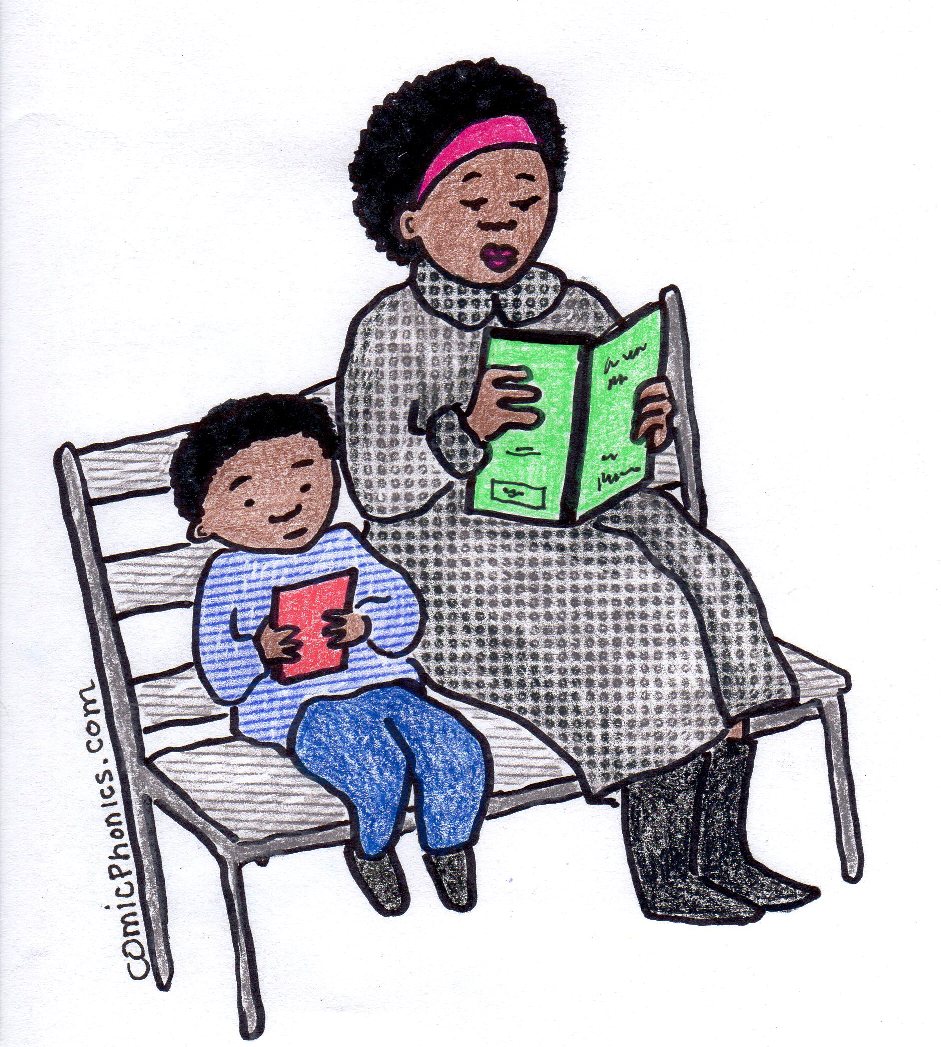
Son and mother reading on a park bench.So what can parents do to make sure their children—even beginning readers—learn the vocabulary they will need to succeed in school?

  • Read often and widely to your children. Choose fairy tales, how-to books, biographies and any subject of interest to your child.
  • Once your child can read independently, make sure she does. You read one page while she reads the next; or you read your book while she sits next to you reading hers.  If you model the behavior you expect, you are more likely to get it than if you watch TV while you ask your child to read.
  • When your child asks you what a word means, tell her, and sometimes explain how you know or how your remember that word. If you don’t know a meaning, look it up.  Make your child familiar with dictionaries, thesauruses and online search engines.
  • Make sure your child knows the vocabulary of the subjects she is studying in school. If she is learning her shapes, she needs to know circle, square, rectangle, oval, rectangular prism and trapezoid.  If she is studying grammar, she needs to know her parts of speech.
  • Some words have one meaning in one context (to set the book on the table) and have another meaning in another context (the set of odd numbers). Make sure your child knows multiple meanings of everyday words.
  • Let your child see you figuring out the meanings of words through context clues, through breaking a word into prefixes, roots and suffixes, and through the use of dictionaries, thesauruses and online search engines. Help her to do this over and over, so she has strategies to use to figure out new words.
  • Engage in conversations with your child using new-to-her vocabulary words. These could be discussions about something you are reading together or about what she studied in preschool today.  If your child uses words like “thing,” “something,” or “stuff,” ask her to use a more specific word.

To learn, we need to know the vocabulary of what we are learning.  To comprehend reading, we need to know thousands of words.  It begins at the beginning, reading aloud to your child.

You diagnose the reading problem

You diagnose the reading problems.Situation:  A first grader can read CVC words in lists and on flash cards.  When another consonant is added to create a blend CCVC word (cot to clot, or ran to bran) she stops, sounding out the first consonant and skipping the second consonant.  She asks what the four-letter words mean.

When she sees paragraphs, she cringes and says, “That’s too hard.”  Throughout a half-hour lesson she asks every five minutes or so if the lesson is over yet.  The mother is concerned that this child is behind her classmates in reading.

Diagnosis:

  • This little girl is already intimidated by the reading process. Her repeatedly asking if the lesson is about to end shows her discomfort with reading.  This child needs much encouragement.
  • Repeating successful work might be a good way to begin a lesson in order to give the girl confidence.
  • She could benefit from frequent but short lessons (ten or fifteen minutes), perhaps with a timer.
  • How two consonants work together to form blended sounds is a new concept for her. Working on one blend each lesson (“bl,” for example) might be a good place to begin.  She could be shown pictures of “bl” words (blue, black, blaze, bleed, blocks, blossom, blueberry, blush, blow, and blouse).
  • After sounding out the words and recognizing the “bl” sound, she could be shown the “bl” letter blend. Letter tiles moved slowly together to form BLVC words could reinforce the blended sound of those letters.
  • She also needs work on vocabulary, so as often as possible seeing a picture of the new word, or acting out the new word, might help her remember its meaning.

As for the mother’s concern that the child has fallen behind classmates, that might be true.  However, the girl is not far behind and can easily catch up with frequent, short, unpressured lessons.  Her mother might read to her strictly for pleasure, perhaps pointing out a CVC word here and there that the child probably knows.  The mother could keep a list of words that the child can read on the refrigerator, asking the child to add a word or two each day a day so the child and the mother can see progress.

How do I help my child figure out difficult words? She stumbles, stops and looks helplessly at me.

Many reasons exist for children stumbling on difficult words.

  • It could be “the code,” the way that certain sounds correspond to certain letter patterns in English. Sometimes a review of sounds and their corresponding letters helps children to figure out new words.
  • Young girl trying to read mysterious on a poster,It could be the number of letters (or syllables) in the word. Longer words are more difficult to read than shorter ones—more sounds, more word parts.  Covering up some parts of the word while revealing another part can help the child to focus on a little bit of the word at a time.
  • Many difficult words are actually words with prefixes and suffixes. Teach your child what prefixes and suffixes are, where to find them at the beginnings and endings of words, and what those word fragments mean.  You can find lists of words with particular prefixes and suffixes on line.  If the child is trained to look for these little parts of words, she can often figure out what a word means.
  • A word might be difficult because it has more than one meaning. The child might be familiar with a commonly used meaning, but not with secondary meanings.  When you are reading with your child and she stops, ask what that word means to her.  Then tell her there is another meaning she might not know about, and explain.  Words with the same spelling and different meanings are called homographs.  You can find common ones online.
  • Sometimes the context helps a child to figure out difficult words, but sometimes context is no help at all. Sometimes a dictionary becomes necessary.  When I tutor children, I make it a point to look up one word each lesson.  This teaches the students how to use a dictionary and that looking up words is sometimes the smart solution.
  • Too much information in context can baffle the child. What is important?  What doesn’t matter?  As an adult, you might know, so eliminate the distractors by covering them up with your fingers.  That leaves less information for the child to analyze.

Check the reading level.  The book might be too difficult for the child, replete with sentences that are long, with esoteric vocabulary words, with small type and with little white space.  If your child doesn’t have to read it, take the book away and recommend reading material better suited to her skills.  If she does have to read it, talk to her teacher about her struggles and see if there are alternative readings, especially easier ones.  Sometimes if she reads the simpler version first, she can gain confidence to tackle the harder version.  And sometimes the simpler version is good enough.