Category Archives: vocabulary

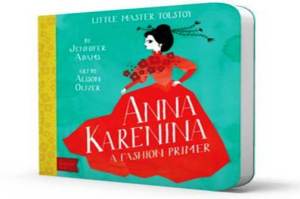
Pride and Prejudice for babies? Anna Karenina for toddlers?

Several publishers have begun offering pint-sized versions of literary classics like Old Man and the Sea, Moby Dick and War and Peace for infants, toddlers and primary grade readers.

mobyFor $6.99, Cozy Classics (http://www.mycozyclassics.com/books/) offers Great Expectations, Pride and Prejudice and Jane Eyre.  These board books pair one word per page with one image.  Moby Dick, for example is reduced to these 12 words:  sailor, boat, captain, leg, mad, sail, find, whale, chase, smash, sink and float.  The illustrations are photos of felt-made scenes, giving the books a fuzzy feel.

For $9.99 Baby Lit (https://babylit.com/collections/books/Classic-Lit) offers board books such as The Odyssey, Jayne Eyre and Anna KareninaAnna Karenina?  A novel about a annakmarried woman who has an affair, is ostracized by society, becomes paranoid and commits suicide?  Yes, but the Baby Lit version focuses not on the story but on the fashions of 1876 St. Petersburg—ball gowns, parasols, gloves and military uniforms.

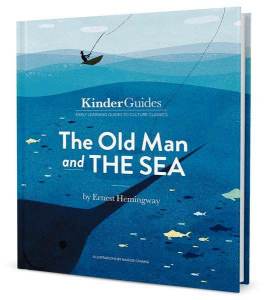
For $16.95 KinderGuides (https://www.kinderguides.com/) offers four classics (more to come) for children of six years old or older.  oldmanThe books, which are sanitized guides for the original novels, include Breakfast at Tiffany’s, 2001: A Space Odyssey, On the Road, and The Old Man and the Sea.  Each book contains a summary of the original story, information about the author, key words and characters, and a quiz.
 

2016 word of the year by the American Dialect Society

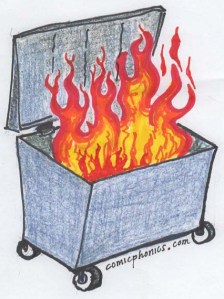
“Dumpster fire” was chosen as the American Dialect Society’s 2016 word of the year.  To be considered, the word (in this case a phrase) must have become prominent in the past year and must have “reflected public preoccupations,” according to the chair of the selection committee, Ben Zimmer, who also writes the “Word on the Street” column for The Wall Street Journal.

The Dialect Society defines dumpster fire as “an exceedingly disastrous or chaotic situation.”  A synonym could be “train wreck.”

2015’s word of the year by this group was “they.”  They?  Yes, they, but with a new meaning, referring to the singular, not the plural.

In 2014 the word was “#blacklivesmatter.”

In 2013 the word was “because.”  That’s right.  Because.  It was chosen because it was being used not to introduce a clause (as in this sentence) but to introduce other grammatical constructions such as nouns.  Because bologna.  Hmm.

In 2012 the word was “hashtag,” in 2011 it was “occupy,” and in 2010 it was “app.”

For more on “dumpster fire” go to the American Dialect Society website (www.AmericanDialetc.org) or to this past weekend’s Wall Street Journal, p. C4.

By the way, did you know the word “dumpster” was coined by the Dempster brothers who invented the dumpster in the 1930’s?  You learn something new every day.

Teaching “and” and “but”

Learning new vocabulary words in elementary school is important for reading comprehension.  But vocabulary instruction needs to include a deeper understanding of words students use all the time, words they haven’t paid much attention to, such as the conjunctions “and” and “but.”

boy reading

Children know what “and” and “but” mean.  But do they realize they use “and” to connect two words or ideas which are both positive or both negative?  And do they realize they use “but” to join one word or idea they favor and another word or idea they don’t favor?

Helping students learn to read means pointing out the relationships which conjunctions create.  Here’s how.

  • Start with the word “and.” Write a sentence such as “I like ice cream and cookies.”  Point out to the student that you used “and” to join two ideas you feel the same way about.  Ask her if there are any other ways she could say “I like ice cream and cookies” without using “and.”  If she is stumped, suggest, “I like ice cream.  Additionally, I like cookies.”  Or, “I like ice cream as well as cookies.”  Or, “I like ice cream.  Also, I like cookies.”  Point out that “and,” “additionally,” “as well as” and “also” all are used to connect ideas which we feel the same way about, either positively or negatively.

Other words which mean the same as “and” include consequently, because,  moreover, and furthermore.  A semicolon between two sentences usually indicates that the idea in the first sentence continues in the second sentence.

  • Now write a sentence such as “I like ice cream but not anchovies.”    Ask her if there is any other way to say that idea.  She might say, “I like ice cream.  However, I don’t like anchovies.”  Or, “I like ice cream although I don’t like anchovies.”  Or, “I like ice cream even though I don’t like anchovies.”  Point out that “but,” “however,” “although” and “even though” all are used to connect ideas we don’t feel the same way about.  One idea we like and one idea we don’t like.  One idea usually uses a form of “not” or a prefix that means “not” such as un, im, ir, or dis.

Words which mean the same as “but” show contrast.  Some other words are though, despite and yet.

  • To reinforce the difference between “and” and “but” and their synonyms, suggest two ideas, such as summer and winter. Ask the student to say or write a sentence saying how they feel about those two times of year.  Now ask the student to change the word or words they used to connect summer and winter to a word or phrase which means the same thing.  Now do it again to another phrase or word which means the same thing.  Try another relationship, such as snakes and dogs.  Again, ask for synonyms for the connecting words.

Being aware how “and” and “but” and their synonyms create different relationships between ideas is important in reading.  If a child is reading and comes to the word “however,” she knows the thought has just changed to an opposite kind of thought.  If she comes to the word “moreover,” she knows more of the same kind of thought is coming.

Another way of teaching these ideas is to suggest that “and” is something like a plus sign, but “but” is something like a subtraction sign.  Or “and” is something like walking straight ahead while “but” is something like taking a U-turn.

What was the word of 2016, according to Oxford Dictionaries?

Post-truth” is the word of 2016, according to the Oxford Dictionaries*.  This adjective means “relating to or denoting circumstances in which objective facts are less influential in shaping public opinion than appeals to emotion and personal belief.”  Post-truth has often been paired with politics, both in the US and UK, and saw a spike in usage beginning in May (before the Brexit vote), peaking at the time of the US Presidential election in November.

Child Browsing the Web

Contenders for Oxford’s word of the year include:

  • Adulating, a noun: meaning behaving like a responsible adult
  • Alt-right, a noun: an ideological group of extreme conservatives
  • Brexiteer, a noun: a person favoring the UK’s withdrawal from the EU
  • Chatbot, a noun: a computer program which simulates human conversation on the internet
  • Coulrophobia, a noun, an extreme fear of clowns
  • Glass cliff, a noun: a situation in which a woman or minority member gains leadership and where the risk of failure is high
  • Hygge, a noun: cosiness and comfortable socializing, making a person feel well
  • Latinx, a noun or adjective: a person of Latin American descent
  • Woke, woker, wokest, an adjective: alert to injustice, especially racial injustice

*https://en.oxforddictionaries.com/word-of-the-year/word-of-the-year-2016

What was the word of 2015

Surreal” is the word of the year according to Merriam Webster Dictionary.  It is an adjective meaning “marked by the intense irrational reality of a dream.**”  The word is used to describe something shocking or surprising, something above or beyond what is real.  In 2016 it was used to describe terrorist attacks and the US Presidential election.

EPSON MFP image

Contenders for Merriam-Webster’s word of 2016 include

  • Revenant, a noun: one who returns after a long absence
  • Icon, a noun: a person who is successful and admired
  • In omnia paratus, a Latin prepositional phrase: ready for all things.  This phrase was used in the original Gilmore Girls TV show and in its revival.
  • Bigly, a phantom word thought to be used by Donald Trump. Actually, he said “big league” in debating, but it sounded like “bigly.”
  • Deplorable, an adjective used as a noun by Hillary Clinton. It means “lamentable,” “deserving censure or contempt,” “wretched” or “abominable.”
  • Irregardless, an adverb used on air by a broadcaster during the final game of the World Series. This word is nonstandard English, and the dictionary recommends using “regardless” instead.
  • Assumpsit, a noun: a legal term meaning an express or implied promise of a contract.  It was used by Rep. Joe Kennedy at the Democratic National Convention.
  • Faute de mieux, a French phrase: “for lack of something better.”  It was used by Justice Ruth Bader Ginsburg in a decision she wrote.
  • Feckless, an adjective: weak or ineffective.  Mike Pence used it in a Vice-Presidential debate.

**https://www.merriam-webster.com/words-at-play/word-of-the-year-2016

Learn vocabulary through online games

One key to reading well is to understand many vocabulary words.  Is there a fun way to learn new vocabulary words?  How about learning through online vocabulary games?

http://www.vocabulary.co.il offers many kinds of vocabulary learning games, a few of which are described below.

  • Prefixes offers matching games for various grade levels.  For third through fifth graders, four prefixes appear on the left and four meanings appear on the right.  Click on one prefix; then click on its matching meaning and a line connects them.  When all four have been matched, click on the “check answers” tab, and check marks appear in front of the correct matches.
  • Foreign-language offers matching and other games for English-Spanish, English-French, English-German, and English-Latin learners.
  • Word scrambles ask the player tot unscramble given letters to form a word. You can press “hint” for help.  A clock keeps track of your speed in finding the correct word.
  • Idiom games include matching games and choosing the right meaning of a phrase from four possible choices.
  • Spelling games include word searches, unscrambling of words and choosing the correct part of speech for a given word.
  • Syllable games ask the player to divide words into syllables.
  • SAT vocabulary games offer various kinds of word-building games for older kids.

Twenty-four different kinds of vocabulary learning are offered, and from them, usually there are many choices in kinds of games to play and age or grade level choices.

How to make kids better readers

Renaissance Learning offers many ways to make children better readers.  Here are some of their suggestions.

“Give your students more choices.” Let children choose which books to read from a huge selection, both fiction and nonfiction.Young girl 's reading choices include a print book and an eBook.Young girl 's reading choices include a print book and an eBook.

Make sure the reading level is just right.”  A useful gauge is to count the number of words a student misses on a single page.  If it is five or more, that book is probably too hard and will discourage children from reading.

Devote time to reading practice.”  Designate a certain time every day—before bed, before the morning school bus or during the school day—for reading.  Children will look forward to this time, especially if it is part of a routine.boy reading on the floor

Build relationships with daily check-ins.” During reading time, talk to your child.  Comment on what he is reading.  Let him know you care.

Make reading practice a social experience.” Read together with a child, one page for her, one page for you.  Or after you read, discuss what you and the child like and don’t like.

Create a book-store style display.” On the bookshelf, show off books by their jackets or front covers to encourage a child to choose that book.  Display books you have read so you can talk to the child about why you like the book and why he might.girl reading Junie B. Jones

Read aloud to students of all ages.” When you read to a younger child, you expose him to books whose ideas he can grasp even though the vocabulary might be difficult for his reading level.  When you read to an older child, you introduce genres which the child might not choose, and you model comprehension strategies such as predicting, asking questions and summarizing.

Acknowledge and celebrate success.” Praise your child for his reading.  Create a spot to post his reading accomplishments—names of books and articles read, or number of pages read.

For more detailed information, go to http://doc.renlearn.com/KMNet/R60386.pdf.

Reading tips from Scholastic

Scholastic, the publisher of so many children’s books, offers seven tips to increase reading opportunities for children on its website, http://www.scholastic.com/parents/resources/article/more-reading-resources/reading-tips-parents.  I have paraphrased them below.

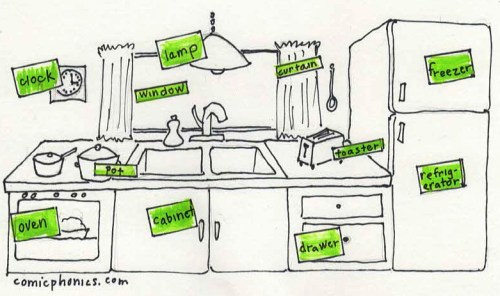
  • Label everything in your home with masking tape or Post-it notes.  This is a great way for young children to learn vocabulary, including long words such as refrigerator and calculator.
  • Find a book that is “just right” for your child.  Have the child read the front cover, the back cover, and the first page of a book.  If the child can read all the words, the book might be okay or it might be too easy.  If the child can’t read five of the words, the book is probably too hard.
  • Teach the child how to read a street map of your neighborhood.  Reading diagrams, maps and graphs is an important skill in Common Core curriculum.  Have the child translate the diagram into word directions.  “Go down the front steps.  Turn left.  Walk to the end of the street.  Turn left onto Delaware Avenue and keep walking until you get to Lincoln Park.  Be careful crossing the street.”
  • Read greeting cards together.  Go to the grocery store or drug store’s birthday card section.  Read the cards together and vote which one is best.
  • Take pictures during an outing or vacation.  Later, ask the child to create captions for each photo and gather them into a photo album.  Or make a booklet of photos and words.
  • Read the Sunday comics with your child.  Cut out good ones to hang on the refrigerator.  Reread them.  [Inference can be learned from this activity, looking at facial expressions where words are not used.]
  • Help your child write a letter to his favorite author.  Most authors have a website which will accept emails.  Or you can find a mailing address on the publisher’s website.

What words should fourth graders know?

If you had to devise a list of 100 vocabulary words that every fourth grader should know, what words would you include?  (You can assume fourth graders already know basic words like “no” and “went,” and words learned in previous grades, words like “multiplication,” “noun,” “habitat” and “community.”)

EPSON MFP image

Would you include “jar” on your list?  How about “malicious”?

Both words made the list compiled by the editors of the American Heritage Dictionary.  See if you know them all:


accommodate
afterthought
allegiance
aloft
ancestor
anticipation
antics
apparel
ascend
beckon
brink
catastrophe
coax
compassion
complexion
content
courteous
cringe
derelict
dignity
distaste
dormant
elaborate
endure
enforce
exertion
expanse
extraordinary
foliage
foremost
frank
function
futile
gaze
glimmer
glimpse
grimace
headstrong
hesitate
hoist
immense
imperceptibly
indication
inscription
instinctive
intent
interior
jar
keepsake
knack
literacy
lurch
makeshift
malicious
massive
meager
melancholy
merge
mingle
minuscule
momentary
nape
nimble
obstinate
opt
overwhelming
pact
pandemonium
persuade
phenomenal
ponder
quantity
quaver
quench
radiant
ravine
recipient
resentful
satisfactory
sensitive
sentiment
shudder
sickly
sleek
solemn
soothe
stagger
stern
tantalize
temptation
transform
unscrupulous
vain
vengeance
violate
vital
vivid
wistful
yield
zest

If you are working with your child on expanding her vocabulary, and you are not using a vocabulary book, this list might be a good place to begin.  (It comes in book form at the American Heritage Dictionary website, https://www.ahdictionary.com/word/hundredfourth.html.)

  • Start with one or two words a day. It’s better to learn the words slowly and remember them than to cram and later forget most of them.
  • Ask your child to pronounce the new word first, and make sure she can read and pronounce it correctly.
  • Explain the meaning or meanings. Some of these words, like “frank” and “vain,” have multiple meanings.  Make sure your child learns all the commonly used ones.
  • Ask her to write each word in a sentence which demonstrates the meaning. “I see a nape” does not show that the child understands the word “nape,” but “The barber buzzed the hair on the nape of Dad’s neck” shows the child does understand.
  • Review, review, review. The more times the child encounters the words, the more likely she is to remember and use them herself.

When I work with my son on reading, should he read silently or should I interrupt and ask questions?

If you are working with your son, you should be involved.  What does an involved reading teacher do?

  • Before he reads a selection, you could read it, understand it, and preview it with your son. That does not mean giving away the ending if it is a story.  But it might mean explaining the setting or motivation of the main character.  In nonfiction, it might mean showing him a map or other graphic to make the reading easier to comprehend.

Tutor teaching a child.

  • Before reading, you and your son together could look at any graphics accompanying the article. You could ask him to interpret the graphics to be sure he understands the data.  You could ask him to read headlines and subheadings, and then ask him to predict what he is about to read.
  • If he has trouble pronouncing words or if he slurs big words, ask him to read a short section at a time aloud. Go back to the words he missed and discuss them, asking him to pronounce them, writing the words in syllables on notebook paper so he can see the structure of the word, explaining prefixes, suffixes or word roots.  If there are vocabulary words you suspect he might not know, ask him the meanings, and if he can’t explain them correctly, discuss their meanings.  Then ask him to read that part of the selection again.
  • Now ask him what it means. Don’t accept, “It’s about a farm,” but ask for more specific meaning.  “It’s about a small baby pig that a farmer is going to kill.”  Ask him if his prediction was right or should he change it.
  • Fluency can only be judged by a teacher if the child reads aloud.  Listen for pacing, inflection, changing of voice tone, loudness or softness.  If you know your child is a fluent reader, you needn’t have him read aloud often for fluency.  But if he is not a fluent reader, you might want to read a sentence at a time using fluency and have your child mimic you.
  • If you read along silently, and your child finishes a selection long before you do, probably he is racing. Ask him about the meaning.  If his answer is vague, ask him to read again but slower.
  • If your child is a competent reader, your job might consist of asking for feedback—orally or written. If your child is reading fiction, you might ask about setting, characters, theme, ups and downs in the story and the climax.  If he is reading nonfiction, ask for the thesis and organization of the article.  Ask a question which the article answers and let the student find and read the part which answers your question.
  • If you can’t be engaged with your child during the reading, you could leave questions to answer so you know the child has paid attention.

Good teachers interrupt when they hear mistakes or hesitancy.  They ask questions if they suspect the student is not understanding.

But if your son is reading strictly for his own pleasure, back off.  Maybe when the day’s reading is done, ask him what his reading selection was about or what he liked, but don’t pressure him.  If he is asking you questions like, “Hey, Mom, what does contentious mean?” or “Why do hunters want elephant tusks anyway?” he is doing what you want—consulting an expert when he doesn’t understand.