Category Archives: reading tips

Prereading questions help struggling readers

Parents and teachers can help poor readers develop the skills of good readers by asking questions about the reading passage before students begin to read.

First, the adult should read and understand the passage and the places where a student is likely to encounter comprehension problems.

Second, the adult should propose questions about the themes of the passage. Ask the students to read the title. What does is probably mean? If there are graphics, ask what they tell abut the passage.  Encourage students to notice and comment on these clues.

For example, suppose some struggling second graders will be reading Junie B. Jones and the Stupid, Smelly Bus. Some questions might be

• Is it normal for some kids to feel a little bit scared when they do something alone for the first time, like taking a school bus?
• Did that ever happen to you or someone you know?
• When some kids are scared, do they want to hide? Do you?
• Can a kid break school rules without knowing he or she is doing something wrong?

Good questions are those without clear-cut “yes” or “no” answers. Good questions make children think. Good questions develop discussion on the themes about which the children will be reading.

Finally, after students read the selection, return to the questions. Ask students if their thinking has changed. For some it might not have changed, but others will gain insights.

For this activity, fewer questions leading to deeper discussion is better than many questions with shallow discussion. If a question can readily be answered with a “yes” or “no,” follow up immediately by asking for an example.

Another way of using the questioning technique is to print a half-dozen questions on a handout. Next to each question have two columns, one labeled “before reading” and the other “after reading.” Under each heading students can write “yes” or “no.” This method forces students who might not want to engage in oral discussion to commit to an answer. Their written answers can serve as the start of a discussion.

It is the “why” behind the “yes or “no” which prepares students for gaining deeper meaning from the passage.

When is it most useful to discuss a reading passage with poor readers?

Is it most useful before reading? During reading? Or after reading?

During reading.

From my experience, engaging students while they are reading makes the greatest positive impact. It helps students pull greater meaning from the text they are reading, and it models the kinds of thinking good readers do.

What kinds of questions help?

• What does that mean? “That” could refer to a vocabulary word, a sentence or a concept.
• What is confusing or hard to understand? Often a teacher can tell that something the student has read confuses him, but the student doesn’t say so. Even if the student says, “I don’t know,” the teacher likely has ideas about what is difficult to understand. Identifying the problem—an idiom, a metaphor, a reference to another part of the text—and explaining it can be vital to the student’s understanding.
• Who is she? What is her relationship to ___? Sometimes poor readers fail to recognize relationships among characters or the role of a particular character in the text. Or they may fail to recognize that Jean Louise and Scout are the same person.
• What will happen next? Predicting shows students know enough of a story to say what is possible. Not being able to predict might indicate students are not following the plot or a character’s emotional response to a situation.

Modeling by an adult is important for struggling students. “Hmm. I wonder what Nate the Great will do next?”  Or “What is a spinning wheel anyway? I’ve never seen one. Have you?” Or “A red letter day? What in the world is a red letter day?”

Struggling readers need to see that asking questions while they are reading is not a sign that they are dumb; it is a sign they are intelligent. They need to know that good readers ask lots of questions as they read, and if they don’t know the answers, they find out—stopping in the middle of their reading to ask an adult, a dictionary or the internet.

Guessing at long words means more phonics work is necessary

Suppose you have a reader  who  scores well on teacher assessments through first grade.  But then in second grade, she falters and starts guessing wrongly at new words.  What is going on?

It could be that this child has not learned the rules of phonics, or has learned the rudimentary rules but not the more advanced rules.  Instead, this student relies on a system of memorizing the look of words.

A child can get by for years using whole word guessing.  But then because of the sheer number of new long words, this system no longer sustains learning words with two, three and four syllables, words with prefixes and suffixes, words which must be sounded out first one way and then another to figure them out.

Research shows that a “whole language” approach to learning to read—that is memorizing new words—doesn’t work nearly as well as a system based on phonics.

I have worked with many students who can sound out one- and two-syllable words but who guess at longer words.  They say a word which begins the same way as the longer word but which doesn’t make sense.  They continue reading without stopping to consider that what they just said makes no sense, a clue that they are not comprehending what they read.

For example, suppose a sentence says, “The President issued an executive order.”  A student reads, “The President issued an exercise order.” In a split second the student searched her mind and retrieved “exercise,” a familiar word that begins the way the original word begins.

If you have a child who slurs longer words or who substitutes a word that begins the same way as the original word, this child probably needs advanced phonics work.  By advanced I mean learning rules for splitting long words into parts and for understanding how prefixes and suffixes attach to a root word and change the pronunciation and meaning of a root.

Even after children can read, they need to continue to work with phonics.

Diagrams help students read

“Scaffolding” is an educator term to describe teacher actions to help students  learn something new.  Scaffolding could be a series of questions meant to prepare students for what they are to read.  Scaffolding could be a timeline of a topic—say American history—to show where a subtopic—say the Civil War—fits into the big picture.

Scaffolding can also be simple diagrams to help visual learners, ESL students and students with comprehension issues understand what they are about to read or write.  These diagrams help students “see” the organization of a reading passage, or they help students “see” the structure of a paragraph or essay they are about to write, providing clarity.

For example, suppose a student needs to read a biography of Coretta Scott King.  To help the student see the organization of Mrs. King’s life, the teacher could draw a color-coded diagram of important activities in Mrs. King’s life.   Take a look.

This diagram is a simple visual pattern following Mrs. King’s life, more or less in chronological order.  With a little help, the student might see that Mrs. King’s life was private until she married; then her life became public as she worked with her husband on civil rights matters; then her life became even more public after his death as she led efforts to honor him and she spoke and wrote about ongoing civil rights matters.

If each box of the diagram is outlined in a color which corresponds to a portion of Mrs. King’s life or activities, the overall organization of the essay becomes clear.   Color-coding the information is important because it helps visual learners “see” how the reading passage breaks down into smaller chunks.

Whether it is Junie B. Jones’ fear of school buses or why polar bears face a bleak future, a diagram showing students what they will read before they read it allows them to see the big picture and each subtopic in the order in which they will read about it.  For children learning English or children with reading comprehension problems, a diagram can help them understand and remember what they read.

How to teach –ight, -ought, -ind, -ild and word families that don’t follow rules

Words ending with –ight don’t follow the rules of phonetics.  The “g” and “h” are silent, and there is no silent “e” after the “t” to make the vowel “i” long.

Some word families, such as –ought, -ind, -ild, and -ight need to be taught as exceptions to phonics rules.  Essentially, they are a group of sight words which follow the same spelling rule, but they are not pronounced the way they look.

It’s probably better to delay teaching words like these until students learn the basic rules of phonics.  Exceptions to rules are confusing.  Better to get the rules understood before introducing exceptions.

That said, how do you teach such exceptions?

  • Teach one exception family of words at a time, giving several days for the student to get used to that family.
  • Post a list of the family of exception words so students can see them on and off many times a day.
  • Ask the children to read short paragraphs containing such words.
  • Ask the children to compose a silly verse using a familiar song for rhythm. For example, to “Old McDonald Had a Farm” students could write, “My brother Dwight did pick a fight, EE I EE I Oh.  He picked a fight with a mighty knight, EE I EE I Oh.”  The sillier the better.  Write down the song, show the words to the students, and sing it daily to reinforce the family pronunciation and spelling.
  • Play games using the exception word families. Students could write the 15 –ight words plus 10 –ite words on a blank BINGO board. You could call off a definition of each word which students would need to identify on their boards.
  • Have a spelling bee using the words.
  • Students could write a paragraph using as many of the words as they can. This could be a group project the first time and later an individual project.

Students should be reminded about words with the same sound as the exception but which follow the rules of phonics.   Students need to remember which words go with which rule.

English has many words which don’t follow the rules, but it helps when there are a whole group of them which follow their own strange rule.  They can be taught in groups rather than singly.

Is it important for beginning reader to know the ABC’s in order?

No.  Knowing the ABC’s in order isn’t important until a child learns alphabetical order.child making letter T with his body

What is important is for a beginning reader to hear and say the 42 sounds of English, and to be able to associate each of those sounds with a letter or pair of letters.

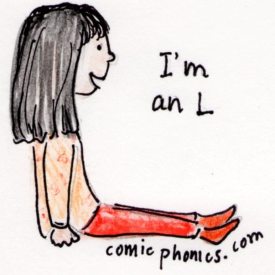
Some reading specialists recommend not showing a child letters until the child can repeat the sounds.  In English, sounds come first.  Sounds are paired with one or more symbols (letters) so we can show sounds visually.Child sitting with legs outstretched, forming the letter L

When I teach children sound-letter pairings, I start with the consonants since most consonants, like “b” and “k,” are always pronounced the same.  Then I move on to short vowel sounds, saving “e” and “i” until “a,” “o.” and “u” are learned since “e” and “i” sound similar.  That still leaves more than a dozen sounds to match with letters or letter groups.

However, many teachers drill the ABC’s by singing the ABC song.  They might test beginning readers on the order of the ABC’s, making allowances for the “L, M. N, O” section which is almost always the last part learned.

Find out what your child’s teacher expects.  But to answer your question, no, knowing the order of the ABC’s is not important for beginning readers.

Colleges offer remedial reading and writing courses, but too late for most students

Many community colleges and four-year colleges in the US offer remedial reading and writing classes to incoming freshmen to raise lagging students to the base level expected for beginning freshmen.  These remedial courses offer no credit, so by the end of freshman year, students who pass these classes will not have accumulated the 30 or so credit hours expected for the first year of college education.  These students’ chances of graduating in two years from community colleges and four years from traditional colleges and universities are almost impossible.  And this means that many poor readers and writers drop out and never earn a college degree.

Colleges and universities are rethinking their remedial English courses for many reasons.

  • These remedial courses, in both English and math, cost about $7 billion each year.


  • Few freshmen who require remedial courses ever earn a degree.


  • 96% of two- and four-year colleges and universities enroll students in remedial courses.


  • In one state, California, more than 70% of community college students qualify for remedial English courses, and of those, only 60% pass the remedial courses and start credit courses, according to a 2016 study by the Public Policy Institute of California. Of those 60% who do pass, most never finish a college level English course with a C grade or better.  California is pretty typical of the rest of the country.


  • Starting in the fall of 2018, all such remedial courses will be eliminated at California State University, the largest public university system in the US. The stated purpose is to enable more students to graduate in four years.


What does this mean if you are teaching a young child to read?

Reading and writing are two of the most make-it or break-it life skills.  If a little kid is having trouble, now is the time to intervene.  The longer a student flounders, the more he falls behind and the less likely he is to catch up, even with help.  By the time a student reaches college, high school, or even middle school, it’s usually too late.  The time to learn to read and write is when a child is four, five, six and seven years old.

If you want your children to succeed, do whatever is necessary to ensure that they can read by the time they start third grade.

How to teach a child to read with little cost

If you are attempting to teach your child to read, and you go to Amazon or your local book store and find literally hundreds of instruction books, dozens of video games, and all kinds of apps and CDs, and boxes of flash cards, where do you begin?  Is all that “stuff” really necessary?
I suggest a method which includes spending time with your child but not much money.

Start with the sounds of English. There are about 42 in most parts of the US.  Say the sounds aloud, one at a time.  Let your child listen and repeat the sounds aloud.  If he can’t say one or two of the sounds, work on those sounds for a few minutes each day until he can hear and repeat all the sounds.  (Supplies you will need:  a list of the 42 sounds, available free on this website and online.)

Next, explain that we associate letters with those sounds.  Start with consonants and teach the child to match each sound with a letter.  Move on to vowels and explain that some sounds share the same letter.  (At this point, don’t try to teach digraphs or exceptions.)  Say a particular sound and ask your child what letter goes with that sound.  Show a handful of letters to choose from and add more options as the child gains accuracy.  (Supplies you will need:  a set of the ABC’s on cards, on letter tiles or written by hand on index cards.)

Once the child can associate sounds with letters accurately, form CVC (consonant—vowel—consonant) words, such as “c a t.” From years of experience I have found that letter tiles work best at this.  (I use Scrabble game tiles, but there are other kinds.)  Set the three letters an inch apart.  Say the letter sounds one by one.  Move the letter tiles together slowly and then more rapidly, saying the letter sounds so that they eventually slur together.  Help the child learn that when we put letter sounds together, we form words.  (Supplies you will need:  lists of CVC words available free online.)

At this point, your child can read many of the words in some books, such as The Cat in the Hat, Green Eggs and Ham and  Hop on Pop.   Encourage the child to read the words she can and you read the other words.  If you own the books and don’t mind marking them, you can underline the words your child knows as she reads–a visible proof to the child that she can read.  (Supplies you will need:  a few early reading books available free online or for less than a dollar each at most resale stores.)
CVCC twin consonantsNext you need a plan to sequence the teaching of various types of words.   You can find plenty online.  Most plans start with two- or three-letter short vowel words like “cat” and “ax.”  Then they move on to blends, first at the beginnings of short vowel words (“blot”) and when those are understood, at the ends of such words (“blotch.”)  Adding “s” to form plurals is considered such a blend.  Then teach digraphs and sight (Dolch) words.  (Supplies you will need:  Lists of sight or Dolch words available free online.)

Some authorities suggest teaching two- and three-syllable short vowel words at this point, such as “catnip” and “tunnel.” Others suggest tackling one-syllable long vowel words beginning with words ending with a silent “e” such as “bake” and “tune” and then moving on to other long vowel combinations such as “ee” and “oa.”  There is no right or wrong sequence.  It is important to keep reviewing words the student already learned and mixing them up while you are teaching new kinds of words.  (Supplies you will need:  Lists of such words available free online.)

boy choosing right root for a prefixAt this point, you might teach prefixes and suffixes, or words which don’t follow rules such as two-syllable words with one consonant between the two vowels. Does the consonant go with the first syllable (“robin”) or with the second syllable (“robust”)?  (Supplies you will need:  Lists of such words available free  online.)

Three- and four-syllable words follow the same rules as one- and two-syllable words, but the problem is where to put the inflection so that they are pronounced correctly.  Help the child pronounce such words all possible ways until she hears the correct way.  You and your child might read books you own or library books, and when you come to long words, stop, and figure them out together.  (Supplies you will need:  Picture books, and lists of multi-syllable words available free online.)

By now your child is reading.  She might need help occasionally pronouncing a particular word, or more likely, understanding the meaning of an unfamiliar word.  But learning the sounds of English (phonemes) and linking those sounds to form words (phonics) is largely done.

A few students in my class read quickly. What do I do to keep them on task?

You could prepare a quiz ahead of time on the reading selection. Let the quiz focus on the pages to be read.  Ask students to raise their hands when their reading is done, give them the quiz and watch.  Since the quick readers are often gifted students, ask questions not at the knowledge level, but at higher level thinking.  Ask inference questions too which everyone finds tough.  Ask students to write not only the answer but the page and paragraph or line number which proves their answers.  Collect and check the quizzes to know if the quick readers are skimming or truly gaining knowledge.

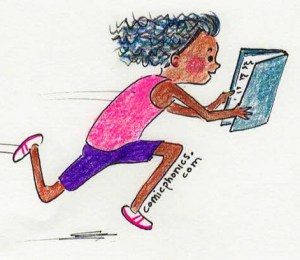
dhild running with book in hands

You could ask quick readers to outline the reading passage. If it is nonfiction, then the outline could name the way information is presented, such as chronological, problem and solution, cause and effect, or whatever is appropriate.  Then the students could write one sentence per paragraph describing the information in each paragraph.  If the reading selection is fiction, then the outline could state the type of writing, such as description, dialog, action, or whatever is appropriate.  Writing one sentence per paragraph might not work for fiction, but one sentence per scene or character might.  The point is for the students to prove to you that they comprehend what they have read.

You could ask students to choose five words from the passage that they don’t understand or that they think their classmates might not understand and use a classroom dictionary to look them up. Then students should write each word in sentences to show what the word means.

You could ask students to write one (or two or more) questions about the reading which require thoughtfulness to answer. Collect them, shuffle them, and then use them for class discussion or homework.

Notice that all of these assignments focus on the original reading selection and either extend or deepen students’ understanding of it.  Students need only paper and pen and possibly a dictionary to do the work.  If you have the extra assignments printed up to use as needed, you can pass the appropriate one out any time a student finishes early.  And most of the ideas work well in science and social studies classes as well as in ELA classes.

Of course you could always have early finishers take out books and read them.  If the books’ Lexile numbers fit the students’ reading levels, this works.  But it does not enrich the reading lesson, and it could cause resentment among the slower readers who might feel punished for their slower progress.

Work with kenesthetic learners’ strengths–their bodies

Most preschoolers and many school-aged children are kenesthetic learners, that is learners who learn best when they are physically active.

Should my child sit still when she learns to read?

Ask such a child what “humongous” means, and she will spread her arms as far as she can reach.  Ask a one-year-old what the dog in the picture is doing, and the child will get down on all fours and sniff.  Ask a child the difference between up and down, the child will stand on a chair and say, “up,” and then jump to the floor and say, “down.”

These children use as much of their bodies as possible not only to learn but to demonstrate that they have learned.

How do you know if a child is a kenesthetic learner?

Child sitting with legs outstretched, forming the letter L

  • The child loves sports—running, jumping, dancing, and tumbling.
  • The child seems more active than other children of the same age.
  • The child gestures while talking.
  • When the child sees a demonstration, the child wants to try it herself.
  • The child ends the day dirty—dirt under his fingernails, peanut butter in his hair, shoes scuffed—and he is oblivious.
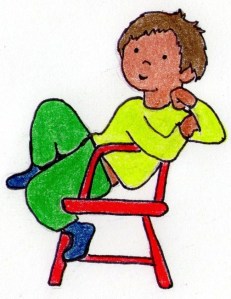
  • When reading or writing, the child kneels on a chair, stands, sits on the desk, stands on the chair and leans over, and does all of these in the span of five minutes.
  • The child fidgets while learning—tapping her fingers, puffing up her cheeks, wriggling her shoulders—yet she pays attention.
  • The child loves Legos, puzzles, and toys that can be put together or taken apart.
  • The child has great hand-eye coordination, and can learn to control pencils, paint brushes, screw drivers and tools with ease.

dhild running with book in hands

How does such a learning style affect reading?  What can you do?

  • Since a kenesthetic learner often reads later than his peers, you might panic that he is lagging his classmates. It helps if you can accept that for this child, reading is a low interest activity.  You can reinforce what he is learning by connecting it to activities he loves.  “A is for arrow.  B is for basketball.  C is for coach.”
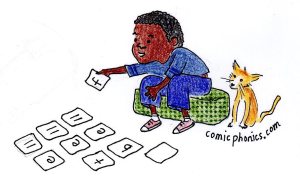
  • Because the child needs to move, let him swing his legs, stand, lie on the floor, or move a rubber ball from hand to hand as he listens to instruction.children moving letter tiles
  • Break up reading lessons into mini-lessons with in-between times when the child is free to move around. Use this time for the child to act out what he has learned.
  • Since the child likes to use his hands, teach using manipulatives such as letter tiles, pictures to sort by sound, parts of sentences cut into phrases, flashcards, and online work which includes using a mouse. Vary the writing instruments the child uses since the feel of some will attract the child to work.
  • Suggest that the child draw what he is learning. Have her fill in boxes and use arrows to show relationships.
  • Use repetitive physical activity to deepen learning. Throw a ball back and forth while spelling new words.  Take a walk while discussing subjects and predicates.  Move magnetized words into sentences on the refrigerator while shifting weight in a dancing rhythm.  Draw mind webs while reading to show comprehension.
  • Teach a hard concept after physical activity.