Category Archives: reading strategies

How to retain new vocabulary

Review, review and more review is the way to help children retain new vocabulary.
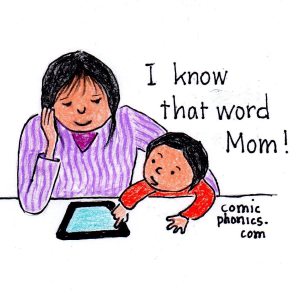
"I know that word, Mom," says the child lookin

Too often the push by teachers is to teach more words rather than to solidify the words students already “learned.”  The result is that the words practiced weeks ago don’t stick in students’ minds.

What can you do to make words stick?

Suppose one week you teach ten or twelve new words to a student.  That week you review the words daily—perhaps asking the student to draw each word’s meaning one day, or to have a spelling bee kind of review another day, or to write the words in sentences another day.

The next week you teach ten or twelve new words.  You use the same kind of daily review, but you include a few words from the previous week’s list which have caused the most problems.

For the third week of vocabulary instruction, instead of introducing new words, intensively review the combined words of the previous two weeks.  Perhaps you could offer fill-in-the-blank worksheets with a bank of vocabulary words at the top of the sheet.  Or during a writing lesson, suggest composing a paragraph using ten of the words from both lists.  Offer a prize (a bell rung in a student’s honor or a sticker) if the student can find one of the new vocabulary words in the ordinary course of the day’s work.

During the fourth week, introduce another set of new words, using various strategies.  Repeat some of the words from the previous weeks during the daily review.

During the fifth week, do not introduce new words; instead focus on words from the first three weeks which are difficult to remember and which are likely to be used or encountered by the student.  Focus on useful words.

Learn new, review.  Learn new, sweeping review.  Continue this pattern, spending as much time on learning new words as reviewing old ones, and your student will remember vocabulary words.
Should my kindergarten son read aloud to me? How about my third grade daughter?

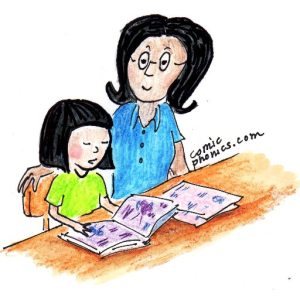
Reading aloud to a parent or teacher has two purposes:  to show that the child can decode words properly and to show that the child can read with fluency.  If the child is learning English as a second language, showing proper pronunciation is also a purpose.

child with adult helping to read

First decoding.  Probably your kindergarten son is at the decoding stage, that is, learning how to link language sounds with letters to form words.  If he is at this stage, then yes, he should read aloud.  That way you can tell what he knows, what he needs more practice on, and what he needs instruction on.

If you know from previous reading aloud that your third grader has mastered decoding, then your daughter needn’t read aloud for that purpose.  You might sit next to her as she reads.  If she has questions about pronouncing an unfamiliar word or if she asks about the meaning of a new word, you can help.  Occasionally you might ask her to tell you what she has read to be sure she has understood.

If your older child comes to English from a second language, she might be able to pronounce words perfectly yet have no idea what they mean.  If so, ask her to underline words she doesn’t know so you can talk about them.  If there are context clues, you might help her identify them.  With such a child, you should work on vocabulary development.

As for fluency (reading at a normal speed with voice inflection, pauses for punctuation and emotion in the voice) the kindergartener and ESL child should read aloud.  Some readers who are at the decoding stage spend so much energy on decoding that they miss the meaning.  By listening to how you say a line and then mimicking the way you say it, the child can pull together decoding and fluency.

Your third grader should be able to read fluently within her head.  However, if you notice that your child has trouble with comprehension even though she can decode well, then her reading aloud could help you to figure out why.  Is she ignoring punctuation and lumping parts of one sentence with another?  Is she sliding over longer words without decoding them because she is lazy or in a hurry?  Does she have short term memory problems, allowing her to forget the beginning of a sentence or paragraph before she gets to the end?  Is her emotional voice flat?  Is she missing inferences?  Some of this you can tell by listening to her read aloud, and some by asking her about what she has read.

In general, newer readers should read aloud with instruction and monitoring while experienced readers should read silently.

Turn car rides into educational opportunities

Spring break is almost here.  For many kids, that means road trips to Disney World, the Grand Canyon or maybe to Grandma’s house.

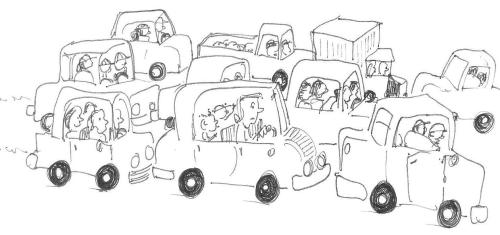
cars in travvic

Those long hours in the car might mean movie time, video game time or time playing on the phone.  But they also offer great learning opportunities.

  • For preschoolers learning their letters or numbers, make a game of finding a particular letter on a billboard, license plate or directional sign.
  • Say a letter sound (not a letter name) and let your child identify which letter matches that sound.
  • If it’s dark, you can say two words and ask the child which word begins with a particular letter. Stick to letters the child knows so she can feel successful.
  • For kids learning rhymes (sometimes called word families), suggest a word which the child can then rhyme once, twice or three times. Or go back and forth, first you, then the child, then you, then the child, until no one can think of another word.  The last one to think of a word could decide what the first word of the next round is.
  • For kids learning how to put letter sounds together to form words, sound out a CVC word and ask the child to identify it.  Then let the child sound out a word and see if you can identify it.
  • Another rhyming game is for the adult to say a nursery rhyme and ask the child to name the words which rhyme. (Hickory, dickory dock, the mouse climbed up the clock.)
  • Sequencing is a skill kindergarteners work on. You could say three activities—not in time order—and the child could put the events in the correct order.  (Mom filled the car with gas.  Dad put the suitcases in the car.  Billy packed his suitcase.)
  • Cause and effect is a skill third graders work on. You could name both a cause and an effect, and the child could identify which is which.  (Sleeping Beauty slept for 100 years.  Sleeping beauty pricked her finger.)
  • Categorizing words is an elementary school-aged skill. For example, you could say blue jay, cardinal and bird.  The child needs to find out which one in the category word.
  • Comparisons are another easy word game. You say that the answers are bigger than, smaller than or the same size.  Then you say, “An elephant is something than a mouse.”  The child tells the correct relationship.  You could use longer than and shorter than, heavier and lighter and older and younger.
  • Working memory is a skill children need to extend. Start with two words (or numbers or letters) which the child needs to repeat.  Let the child add another word and you repeat all three words.  Then let the child repeat all three words and add a fourth.  For some children this skill is incredibly difficult, so for them you might want to cap the list at four words.  For other children, seven or ten words might be possible.
  • This is a great time to review math facts. If your third grader has just learned multiplication, review the facts.
  • For older children or children learning English as a second language, car time can be vocabulary review time. You give the definition and the child gives the word.  Or let your child throw out a word meaning, and you have to identify it.  Children love stumping their parents.
  • Older children encounter idioms all the time, but they don’t always understand them.  Throw out an idiom–Jason is blue–and let your child explain what it means.

Of course these educational moments could also happen on your long flight to India or Taiwan.  They could just as easily happen on the way to school in the morning or on the way to soccer practice in the afternoon.  There are so many times you can exploit one-on-one education with your child.

How can writing improve reading?

When educators combed research on the writing / reading connection in 2010, they found three writing activities which improve reading comprehension.

EPSON MFP image

  • Having students write about the stories and texts they read by writing personal responses, analyses, or interpretations; by writing summaries; by writing notes; and by answering or asking questions in writing about what they have read.
  • Having students learn about the process of writing; about how texts are structured; about how paragraphs and sentences are put together; and about how to spell.
  • Having students write  frequently.

All of these writing activities improve students’ reading. In future blogs, we will look at why these activities improve reading, and how these activities can be incorporated into a student’s schoolwork or work at home. We’ll start in the next blog with the last idea, that students should write more to improve their reading.

Meanwhile, for more information, see Writing to Read.  At this site you can read the full report, Writing to Read; evidence for how writing can improve reading by Steve Graham and Michael Hebert for the Carnegie Corp. of NY, 2010.

You might also enjoy reading Shanahan on Literacy, a blog about reading by an expert in the field. In his current blog, Dr. Shanahan comments on ideas in this report.

How should children increase their vocabularies?

Research shows that a rich vocabulary is essential to reading comprehension. But are any methods of learning vocabulary better than others?

Yes.  A 2010 survey of research about vocabulary acquisition by the National Reading Technical Assistance showed three  ways are superior:

  • “Higher frequency of exposure to targeted vocabulary words will increase the likelihood that young children will understand and remember the meanings of new words and use them more frequently.” This means rereading The Three Little Pigs or a social studies chapter to a child three, four and five times has value in helping a child learn new vocabulary.

mother works with child reading story book

  • “Explicit instruction of words and their meanings increases the likelihood that young children will understand and remember the meanings of new words.” Your stopping to explain the meaning of a word helps a child to remember it. Learning words in the context of a story book or a science lesson helps students retain the meaning better than singling out a list of words, not in any context, for learning. Using multimedia, in addition to books, greatly helps ESL students to learn vocabulary and pronunciation.
  • “Questioning and language engagement enhance students’ word knowledge.” When a teacher or parent asks questions or comments on a new word, a child remembers that word better. Starting with easy questions and then building to more difficult questions helps too. While learning, the child should not be a passive listener; he needs to interact to retain vocabulary better.


Ways to strengthen children’s working memory

How can you help a child with a poor working memory to increase reading comprehension?

child playing card memory game

  • Play memory games.  Lay face down a deck of cards and find pairs.  Or play “In my suitcase.” The first person says, “I packed my suitcase, and in it I put a ____.” The next person repeats what the first person said, and adds a second item to the suitcase. Now the first person repeats what the second person said and adds a third item. The internet offers plenty of other kinds of online games.
  • Give directions  one step at a time. You might say, “Put your pencil down,” and wait until the child does that. Then say, “Put the book inside your desk.” Again wait for compliance before giving the next direction.
  • Use simple sentences when giving directions. Also, use transition words like “first,” “next,” and “finally.”
  • Choose children’s books written mostly in simple sentences or compound sentences. If there are complex sentences, make sure they are limited to one subordinate clause and are clear.
  • Ask the child to explain a complex sentence.  Ask him to describe the relationship between the two parts of the sentence–cause and effect, for example, or time order.
  • Eliminate distractions. At home, have the child do her homework in a quiet place with plainly painted walls and draperies. Settle the dogs down. Turn off all electronics. Even a ticking clock can interfere with a child’s concentration.
  • Don’t rush a child. That stress might distract her, her working memory.
  • Remind the child that she needs to remember what she reads.  Later, ask her questions about what she read so she gets in the habit of remembering.
  • Question a child about what she has just read.   After each paragraph, or after a short conversation, ask what those sentences mean. If the child has trouble remembering the beginning part, question the child after she has read less information.

When a word has a single consonant between two vowels, which syllable does the consonant go with?

When a two-syllable word has a single consonant in the middle of two vowels, which syllable does the consonant go with?

Usually the consonant goes with the second syllable.  This forms a first syllable with a long vowel and a second syllable that is either CVC or CVCe. The first syllable which ends with a long vowel is called an open syllable. Some examples include:red headed girl in easy chair reading, legs up

  • minus
  • tulip
  • pupil
  • motel
  • basic
  • humid
  • rotate
  • unite

Sometimes these words  have a one-syllable, stand-alone word as the first syllable.  Or they have a prefix as the first syllable. Helping students to recognize this tiny word or prefix can help them to pronounce the word correctly. Some words like this include:

  • beside
  • rerun
  • protest
  • defend
  • trisect
  • bypass
  • nomad
  • hotel

Some students get mixed up if the first syllable is a single vowel. They want to put the middle consonant with the first syllable instead of with the second.  If this happens, ask the child to pronounce the word both ways. Usually one way will make sense and one won’t unless the child is not familiar with the word. Some words like this include:

  • omit
  • item
  • unit
  • ozone
  • even
  • evil
  • amen

I recommend teaching children words with a single consonant between syllables after they have learned words with two middle consonants.  The latter are easier to learn because children more easily spot the CVC + CVC pattern.

One warning:  Many words beginning with the letter “a” follow the letter pattern just mentioned, but the “a” is not pronounced as a long vowel.  “Alive,” “along,” “awake,” “atone” and “apart” and dozens of other “a” words pronounce the “a” as “uh.”  Save them for a separate lesson.

How to divide words into syllables—start with words having double consonants between two short vowels

Figuring out how to pronounce words with two or more separated vowels can be a problem. However, there are guidelines which often help.

boy reading book If a word has two consonants of the same letter in the middle of the word, the split into syllables happens between the two consonants. These words are easy to segment and to pronounce. Words like this include

  • happen
  • little
  • mitten
  • ribbon
  • puddle
  • peddler
  • attic
  • minnow
  • biggest

girl on floor readginIf a word has two different middle consonants preceded by and followed by short vowels, the split into syllables usually happens between the two consonants. Usually the vowel sound to the left of the double consonants is short because the first syllable creates a CVC “word,” and the syllable after the split is short for the same reason. Words like this include

  • Hagrid
  • often
  • piston
  • Wilson
  • walnut
  • mascot
  • dentist
  • impish
  • whiplash

Seated young boy is playing a portable video game..Sometimes in the middle of a two-syllable word are three consonants composed of a consonant and a blend or a blend and a consonant.  The three consonants are preceded and followed by a single vowel. The split into syllables happens before or after the blend, in such a way as to keep the blend together. Usually these words contain short vowels before and after the split. Words like this include

  • chinchilla
  • tundra
  • umbrella
  • ashes
  • pumpkin
  • sandbox
  • liftoff
  • pigskin
  • distress

All of these two-syllable words have certain features in common which make pronunciation easy:

  • they have either two consonants or one consonant and a blend in the middle of the word,
  • and they have a single vowel preceding and following the middle consonants.
  • The first vowel is a short vowel, and usually the second vowel is short also if it is followed by a single consonant or a blend.

But what if there is only one consonant between two vowels? Does the consonant go with the first vowel or the second? It depends.  We’ll talk about that soon.

Skipping long words can be a sign of a struggling reader. How can you help a child decode such words?

One way to help children decode big words is by familiarizing children with prefixes and suffixes. English is a language which creates new words from already existing words by adding a word part—usually a single syllable—before or after the original word. If the word part is added at the beginning of a word, the word part is called a prefix. If it is added after the word part, it is called a suffix.boy choosing right root for a prefix

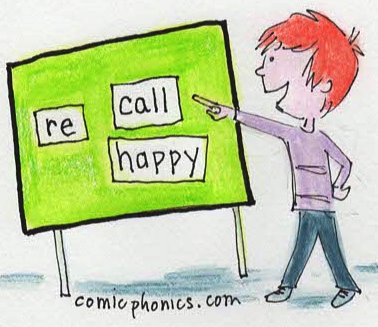
Prefixes usually change the meaning of a word. Un + happy creates “unhappy,” whose meaning is the opposite of “happy.” Re + view creates “review” which means to view again. Suffixes usually change the part of speech of a word, the verb tense of a word or the number of a word. Music +al changes “music,” a noun, to “musical,” an adjective. Jump + ed changes the present tense verb, “jump” to the past tense verb, “jumped.” Girl + s changes the singular, “girl,” to the plural, “girls.”

If children can recognize that a long word has a prefix or a suffix or both, they can segment that word both for pronunciation and for meaning. “Unwinding” can become un + wind + ing. “Un” means not, “wind” means coil and “ing” makes the word an action.

Children should be taught prefixes and suffixes as a separate part of reading instruction. I would start with prefixes only. One way to do this is to make a game of combining prefixes with words, sometimes called roots. (I like to use materials the child can touch, but of course, this work can be done on computer using sites such as ixl.com.) Here’s how:

  • Find a list of commonly used prefixes. Many web sites list about one hundred such prefixes, but I would start with a shorter list of ten or twelve of the most commonly used ones, such as bi (two), dis (the opposite), il (not), im (not) in (not), mis (badly), non (not), pre (before), re (again), sub (under) and un (not).
  • Teach the child what each prefix means, giving her a word to help her remember each one, such as bicycle, disagree, illogical, improper, indirect, mispronounce, nonfat, prepay, resend, submarine, and unhappy.
  • When she knows the meaning of the prefixes, write each prefix on an index card. Write two or three familiar words which could be paired with each prefix. Shuffle both sets of cards separately. Match each prefix with a word which makes sense, and ask the child to read the word and tell what it means.
  • Or, you could choose two root words, one of which can be paired with a given prefix, and help the child determine which root works and why.
  • Later, you could create a list of the words she has created. See if she can segment the words and tell what they mean. If she can’t do some of them, repeat the activity until she can. Gradually remove the words and prefixes she knows and add new prefixes and words until she knows several dozen prefixes.

In a future blog we’ll talk about how to figure out suffixes.  Suffixes are trickier because they sometimes involve changes in spelling the original word.

My third grader skips over long words when she reads aloud. When I ask her to pronounce them, sometimes she can if she segments them, but many times she can’t. How can I help her?

Lots of children do this, thinking they can gain enough meaning from the rest of the words. And sometimes they can. But usually this is a sign of a struggling reader.

Your daughter needs to learn strategies to figure out new words.

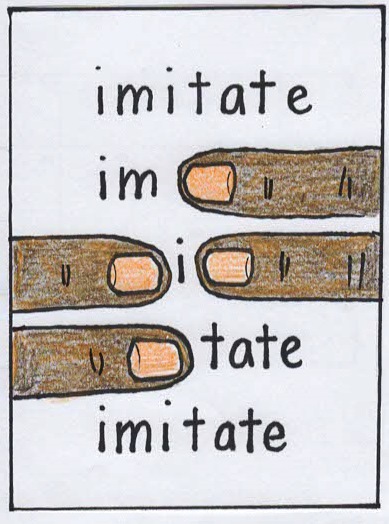
fingers covering parts of word, then revealing themWhen she reads aloud to you and encounters a word she skips, stop her and cover parts of the word to help her figure it out in small chunks. For example, in a word like “imitate,” cover over all but the “im” part. Ask her to pronounce “im.” Then ask her what a short i sounds like. Show her the “i” in the middle of the word and ask her to put those sounds together. Then show her the “tate” which should be easy to pronounce. Now reveal the word bit by bit as the child says it. You say it too to be sure she hears it pronounced correctly.

But she still might not know what the word means. Help her to understand it. Use it in a couple of sentences. My experience working with children is that many times they can remember the meaning of words, but they cannot use them properly in sentences. Ask her to create her own sentence using the word.

I would make a list of words she has learned this way, and later in the day or the next day, go back to them. Ask her to read the words and tell you what they mean. Return to these words from time to time to reinforce them.

I would also try to find ways to use the words in your everyday conversations with your daughter.

Perhaps your daughter needs more phonics education. You could quickly go over CVC rules of adding suffixes. You could instruct her about prefixes and what they mean and rules for adding them to root words.

Letting your child slide over long, unfamiliar words sets up a bad habit. Eventually, when she gets into middle school classes, she’ll encounter such words routinely and will need strategies to figure them out. Talk to her teacher about the situation. Perhaps there is a reading specialist in your school who could come to her classroom from time to time and help the students decode longer words.

And I will provide more information about how to decode longer words in upcoming blogs. Keep tuned.