Category Archives: reading research

Reading to kids is important to expand their vocabularies

We all know that reading to kids is important. Now there is more research to back up this “chicken soup for the brain” of little kids.

family reading togetherAccording to Jessica L. Montag, a researcher in the Department of Psychology of the University of California, Riverside, and her colleagues, Michael N. Jones and Linda B. Smith, reading, as opposed to talking to children, is important because reading exposes children to many more new words than they would hear from spoken language alone.

Montag took 100 picture books which appear on lists of excellent books for children. She analyzed the words in those books. Then she compared the words with spoken language of caregivers talking to little children. Her research was published in August.

What she found is that the books use more words and different kinds of words than do parents, teachers and caregivers of young children. In fact, the books use 70% more unique words than did the speech. Also, the text provides different types of sentences, sentences of varying complexity, and sentences of different lengths. The books introduce topics outside the parents’ and children’s normal lives, exposing children to new ideas and the vocabulary associated with those new ideas.

So if you’re tempted to skip the reading some days, or to just look at the pictures, think again. The text is important to growing a child’s vocabulary, and a large vocabulary is associated with successful independent reading.

Is gesturing by a child learning to read important?

When my son was almost two, and not talking much, I often read to him a picture book by Helen Oxenbury which showed a toddler doing everyday things: pulling on his socks and pants, for example. I would ask my son, “What is the baby doing?” My son would show me by gesturing—pretending to put on his socks, or pretending to pull up his pants. Once he learned to say words, I stopped this practice.

child making letter T with his body

It turns out that I should have continued with the gesturing. Research shows there is a positive relationship between gesturing and learning in children. By noticing your child’s gestures, you might be able to tell when he understands a concept or when he is trying to figure it out.

According to research,If a child understands a concept, the child’s words and gestures are in sync.

  • For example, if you ask the shape of a triangle, and the child says “three sides” and then draws a triangle with his index finger, the gestures and words are in sync, and you can presume the child understands.
  • If a child is still learning a concept, the child’s words and gestures might be out of sync, and there might be an abundance of gestures or a shrug.
  • For example, if you ask a child to tell you what an orbit means, and the child says “space” and draws a rounded triangle,” the child’s words and gestures are not in sync. The child is still learning.
  • Out-of-sync responses offer parents and teachers an opportunity to help the child learn while his understanding is fluid and open to instruction and before he learns something wrong.

Is gesturing necessary for learning? Probably not, yet research shows that children who gesture while they are learning are more likely to learn. This is especially true if the child is asked to explain a general concept.

For more scholarly details on this subject, check out the work Susan Goldin-Meadow of the University of Chicago, an expert in this field.

My grandson is scheduled to start kindergarten this fall, but I think he might not be ready. Is there any way to know for sure?

The old rule of thumb is that if a child can put his hand across the top of his head and touch his opposite ear, he is the right age to start school. If he can’t reach his ear yet, he is too young.

young child attempting to touch his ear with opposite hand

But such a test doesn’t begin to take into account all the criteria which could be used to judge the readiness of a child for school.

If your child has been to preschool, his pre-K teacher should be consulted. She has a good idea which students are ready to move on. And if you do send your child to kindergarten, and the kindergarten teacher contacts you in the early weeks of the school year saying your child is not ready, believe her. Not every child who is the right age is ready for kindergarten.

What criteria should you use to assess your child? According to the U.S. Department of Education’s National Center for Education Statistics, these criteria should be assessed:

  • Can your child communicate his wants and needs? Can he say, for example, that he needs to urinate or that another student is bothering him?
  • Can your child get along with peers by sharing and taking turns?
  •  Can your child count to 20?
  • Does your child recognize letters and numbers? Kindergartener are not expected to know how to read—although many can. But your child should recognize many letters and numbers and have an inkling of what they are used for.
  • Can your child follow directions? Sit or stand, line up, voices off, criss cross apple sauce—these are common directions that your child will be expected to follow.
  • Can your child sit still for ten, fifteen or twenty minutes, and pay attention to a teacher during that time? Kindergarteners have short attention spans, but they should be able to sit still long enough to listen to a teacher read a story or to watch a film about a baby whale. Not every five-year-old can do that.
  • Is your child able to hold a pencil or paint brush? Is he able to cut with a scissors? Most kindergarteners need more work on these skills as well as on gross motor skills, but they should show rudimentary skill.
child cutting with a scissors

EPSON MFP image

Kindergarten teachers who responded to the Fast Response Survey System (FRSS) Kindergarten Teacher Survey on Student Readiness said being able to communicate needs and wants and being curious and enthusiastic about trying new activities are the two most important skills kindergarteners need to start school with.

Some other things to look for include:

  • Can your child handle emotions? It’s normal for a five year old to break down in tears when she’s upset. But, it’s important that she has coping strategies.
  • Can your child use the toilet unassisted? And can he or she be trusted to behave in a restroom without adult supervision?
  • Is your child obviously meek and likely to be picked on? If so, he might need some coping skills to keep bullies at bay.

Although the first two or three years might be hard for young kindergarteners, research shows that they show no academic difference from their classmates by third grade.

If your child is in sports, another consideration is the cut-off birthday. Baseball in my state has a cut-off date of July 31, meaning any child born on August 1 or later cannot participate on the same teams as children born in July. For August-born children sent to kindergarten on schedule, this means they will play on teams with kids a year behind them in school. Their teammates might be strangers rather than classmates.

Still another consideration is driving. If a student is one of the youngest children in his class, his classmates will get their driving permits up to a year before he does. Your child might feel left out, or he might pressure you to let him drive as a passenger with his older friends. Will you be comfortable with that?

And will you be comfortable with your 17-year-old heading off for college with classmates who are already 18 and 19?

Good luck on your decision. There’s so much to consider.

Common Core requires increasingly complex texts

One of the goals of the Common Core Standards that is receiving flak across the country is the push for students to understand increasingly complex texts.

Discouraged child thinks there are too many words in a book she is readingYou might assume that a second grader would read more difficult books than a first grader, but according to the people who wrote the standards, there is not proof that this is happening in US schools. Their “research shows that while the complexity of reading demands for college, career, and citizenship have held steady or risen over the past half century, the complexity of texts students are exposed to has steadily decreased in that same interval.”

They believe that the texts used in middle schools and in high schools have been “dumbed down” over recent decades. To counteract the “dumbing down” of texts, the Common Core Standards want to increase the difficulty of the texts students read so that US students are well prepared for college and for work.

The Standards state that the reading complexity levels for all grades need to be made more difficult, and that what a student studies in May should be more complex than what he studied in the previous September.

How will this be measured? Three ways:

  • Qualitatively: An attentive teacher will note whether a student recognizes various levels of meaning in a work of literature, or if he recognizes that language is used in new or archaic ways, of if the reading requires background specific knowledge that the student might not have.
  • Quantitatively: Readability measures will be used to determine the difficulty level of the materials students read, and the students will be tested to see how much of the material they understand.
  • Reader-task considerations: A teacher with knowledge of her student will rate the student’s motivation, knowledge base, and experience as well as the purpose of the assigned reading, and the difficulty of the task which the teacher assigns (for example, responding to open-ended questions is more difficult than responding to multiple choice questions).
Common Core Georgia Standards

Click on picture for the entire document.

The Georgia Department of Education has created a rubric for teachers (and parents) to use to determine the text complexity of a given reading selection. When the points are totaled, texts with scores of between 80 to 100 are considered of appropriate complexity.

For more information, go to: https://www.learninga-z.com/commoncore/text-complexity.html and https://www.georgiastandards.org/Common-Core/Pages/ELA.aspx

My daughter’s school library has all the books color coded. She’s in turquoise. Is that good for a first grader?

Too many words on a page make reading hard.What you are probably referring to is a way of categorizing books based on their difficulty level. It is called Guided Reading Levels and was developed by Irene Fountast and Gay Su Pinnell in 1996. The 26 Guided Reading Levels use ten criteria to categorize books:

  • genre (fiction and nonfiction and their subcategories)
  • text structure (the way the text is organized, usually chronologically, but sometimes comparing and contrasting; using cause and effect; and problem and solution)
  • content (the subject matter)
  • themes and ideas (the big ideas which the author is trying to show)
  • language and literary features (dialog, literary devices and technical language, for example)
  • sentence complexity (simple sentences are usually easier; complex sentences are usually harder)
  • vocabulary (the words a child is likely to know at a certain grade)
  • words (the number and the difficulty level)
  • illustrations (graphics of all kinds)
  • book and print features (length of a page, layout, subheadings, and table of contents, for example)

This system grew out of a somewhat simpler method of categorizing reading material developed by Reading Recovery in New Zealand. The Reading Recovery method creates 20 levels and uses four criteria:

  • book and print features
  • content, themes and ideas
  • text structure, and
  • language and literary elements

Another method which I talked about in an earlier blog is the Lexile Score.

These three methods of categorizing reading difficulty in children’s texts are some of the latest methods in an effort going back  to the 1870’s. In 1923 a formula was introduced by Lively and Pressey based on word frequency and sentence length. In 1935, Gray and Leary identified 44 factors that should be considered. Within thirty years, 200 readability formulas had been proposed.

Then, for about a generation, these kinds of formulas grew out of fashion.  But with the advent of computers, new systems have been developed based on word frequencies and sentence length. The Guided Reading Levels is one of them.

Turquoise means your child is reading at an end of first grade or beginning of second grade reading level.

For more information on the Guided Reading Levels, go to http://www.fountasandpinnellleveledbooks.com. For a chart comparing several methods of categorizing children’s texts, go to http://www.readinga-z.com/learninga-z-levels/level-correlation-chart/.

Use the K-W-L approach before reading to activate prior knowledge

K-W-L charts have been used by reading teachers for almost 30 years, but they can be just as useful to parents of young children to help them with reading comprehension.

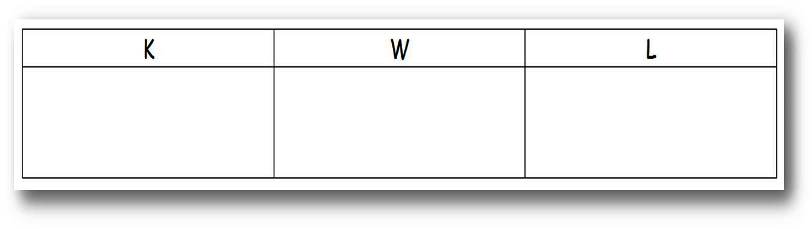
K stands for “know” or what the child already knows about a given topic. W stands for “want to know” or what new information the child would like to learn about a given topic. L stands for “learned” or what the child has learned after reading (or having been read to).Empty K-W-L chart

With younger children who cannot read yet, using the K-W-L strategy sets up a pattern which the children can use in the future. One reason some children struggle with reading comprehension is because they don’t think about a topic before they read about it. If children learn to consider what they already know, and link new information to that, they will usually understand the new information better and retain it.

Since writing down words doesn’t help a nonreader such as a preschooler or a new ESL student, drawing pictures can replace the words. Even for children who can read a bit, sometimes drawing the pictures adds fun to the learning experience.

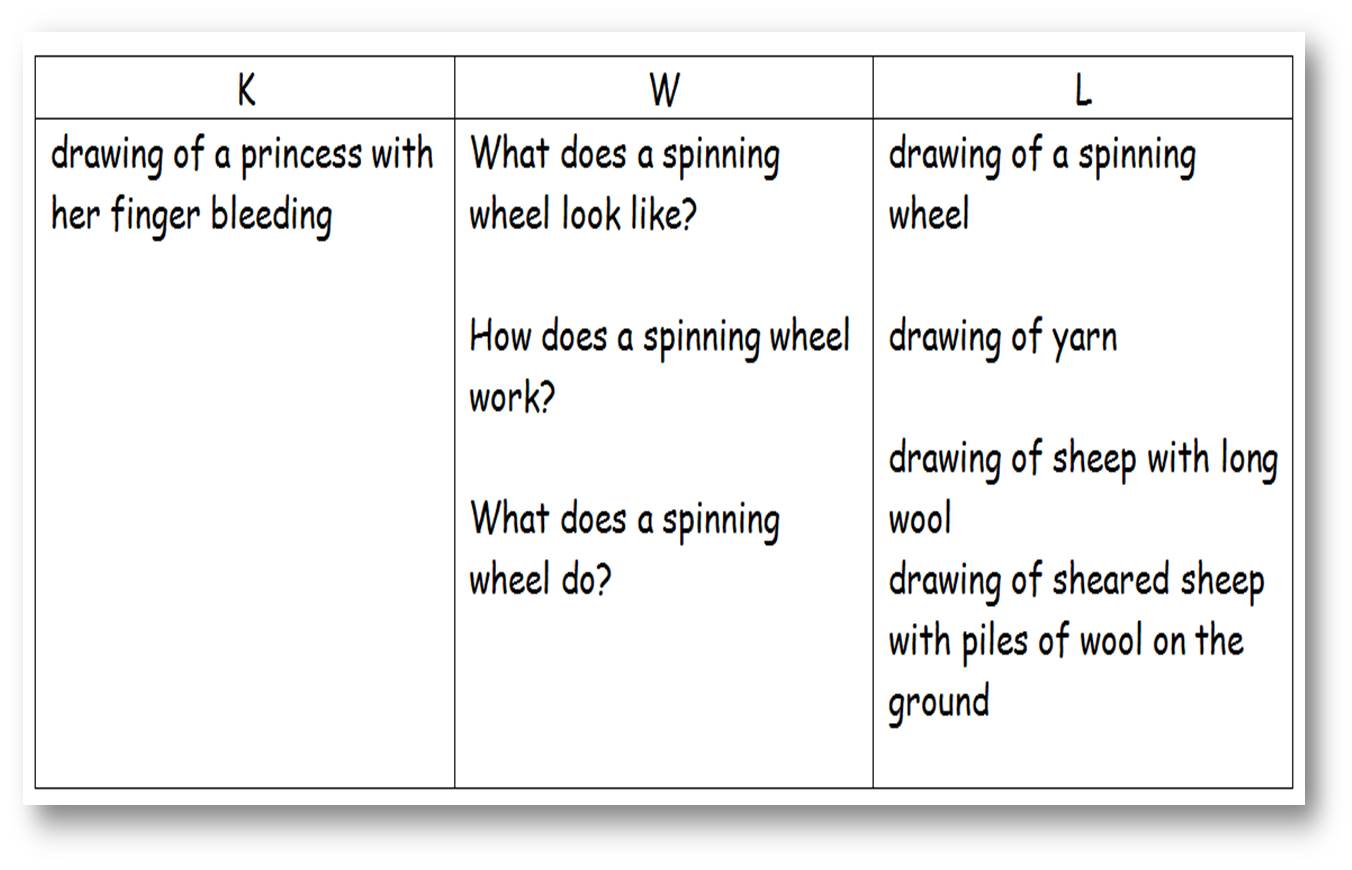
For example, suppose you read the story of Sleeping Beauty to your child, but she has no idea what a spinning wheel is. You find a book about how people used to make yarn by hand before machines did it. What kind of K-W-L chart might arise before you read the book about making yarn by hand?Example of filled-in K-W-L chart

If you, as the parent or teacher, want your child to learn a particular idea from a reading passage, you might steer the discussion to that idea as you and your child fill in the chart. But the chart works best if it reflects the child’s own understanding of a topic, and his own questions about that topic.

For example, if the topic is diamonds, the child might write:Example of a filled-in K-W-L chart

For the K-W-L strategy to help reluctant readers, the questions under “W” and the information under “L” should be linked back to what the child said she knows under “K.” So the teacher or parent might help the child create a chart like this:Example of a filled-in K-W-L chart

By connecting the “Want to Know” and “Learned” information to what the child already Knows, the child is extending the knowledge base she already has, rather than learning and soon forgetting isolated facts.

The K-W-L strategy and chart was first created by Donna Ogle. For more information, see Ogle, D.M. (1986). K-W-L: A teaching model that develops active reading of expository text. Reading Teacher, 39, 564-570.

What causes dyslexia?

Dyslexia (the brain’s inability to read, write and spell with ease) has many causes, not all of which apply to every impaired reader.

In people with dyslexia, nerve cells in the brain are thought not to work well together in order to achieve reading. Or those cells might cooperate, but at slower rates than for average readers. Why?


What might cause dyslexia?


faulty genes

brain injuries

problems connecting sounds to symbols

blockage of brain pathways

using the right hemisphere for left hemisphere functions

migrating neurons

hearing problems

unskilled reading teachers


  • Genetics might play a role for some readers. Defects in a gene known as DCDC2 and its interaction with another gene, KIAA0319, have been identified as related to dyslexia, according to researchers at Yale University.
  • Physical problems in certain parts of the brain might cause dyslexia. Sections of the brain specializing in language or vision, in particular, are needed to see letters; to associate those letters with sounds, syllables and words; and to derive meaning by combining words into sentences. If one part of the brain used in reading is damaged, dyslexia could result. Injuries to parts of the brain might have occurred before birth—a stroke, for example—or they might have happened after birth—a fall, for example.
  • Problems identifying sounds within words and connecting those sounds to letters or to letter patterns is the most studied possible cause of dyslexia. Children with this problem have trouble sounding out c-a-t. When they hear words like “Tyranasaurus Rex,” they don’t hear syllables or individual letter sounds; they hear words. No problem. But when they learn to read, they must take the sounds inside words apart and attach letters to those sounds and put the letters back together again to know words. For some people, this is hard.
  • Failure (blockage?) of the pathways normally used in reading could be a cause of dyslexia. Or weakness at connecting points along the brain’s pathways could cause slow processing.
  • While most readers use the left hemisphere of the brain in a dominant way when reading, it is thought that some dyslexic readers might use the right hemisphere more dominantly, or they might use both hemispheres equally. If so, reading becomes a labor-intensive undertaking.
  • Some researchers think that when the brain is developing, neurons that should be part of one section of the brain “migrate” to another spot in the brain and develop there. When a reader tries to access those cells, they are not where they are supposed to be, hampering the reading process.
  • Young children who have hearing problems might develop a life-long problem associating sounds with symbols for those sounds, resulting in dyslexia.
  • A well trained reading teacher who can identify anomalies in a child’s struggle to read can’t undo the above problems, but she can suggest strategies to lighten or even overcome some of these problems. However, if a child’s teacher is not savvy concerning strategies in the field of reading, the child might flounder. A teacher isn’t the cause of dyslexia, but her lack of skill can make the child’s struggle to read harder.

Reading is about a 6,000-year-old activity for human beings, a new activity in the evolution of the brain. The brain is not programmed to read any more than it is programmed to sing opera. Rather, in learning to read, we humans use parts of the brain which our non-reading ancestors used for something else—seeing and speaking, for example. Those same pathways which evolution streamlined for one purpose are now being used for additional purposes relating to reading, writing and spelling.

Work with brain imaging technology is revealing to researchers the parts of the brain involved in dyslexia. Work with the genome is revealing gene interactions which might have an effect upon reading. The answer to your question—What causes dyslexia?—is the brain and the complicated way in which the brain works.

For detailed information on some of these causes, read expert Maryanne Wolf, Ph.D., author of Proust and the Squid; The Story and Science of the Reading Brain.

Is there any way to know ahead of time if my child will do well in reading?

Yes. According to Prof. Maryanne Wolf, director of the Center for Reading and Language Research at Tufts University, the two best predictors of later reading achievement are

  • an awareness of separate sounds (42 in English) and
  • the ability to rapidly name objects.

Today we’ll discuss sound awareness.

When I was a high school student studying French, I used to lie in bed listening to a Montreal radio station. I would try to figure out where one word ended and the next word began.  This same skill is what babies do when they listen to adults talk to them although they don’t realize it. Luckily for most babies, their mothers or caretakers speak slowly and distinctly and repeat words over and over.

With time toddlers begin to hear parts of words and realize that some words have one part (for example, Mom) while other words have more than one part (for example, Grandma).

Still later, usually around age four, children learn their ABC’s, not understanding what they are all about. But with instruction, they learn that each sound in English corresponds to a letter or a pair of letters in the ABC’s.

How can you enhance your child’s success in reading?

Make your child aware of words, syllables and individual sounds.

  • Encourage prereaders to write using invented spelling, advises Dr. Wolf. When the child writes, he sounds out a word and uses the letter symbols which seem appropriate. The “words” might not conform to proper spelling, but that is not the point. The child is working to figure out sounds, a skill he will need in order to read.Girl reading "inventive" writing of younger sister.
  • Encourage the child to listen to someone reading nursery rhymes. Then encourage the child to say the rhymes herself, advises Dr. Wolf.  Take “The Itsy Bitsy Spider,” for example.

The itsy bitsy spider
Climbed up the waterspout.

Down came the rain
And washed the spider out.

Out came the sun
And dried up all the rain.

So the itsy-bitsy spider
Climbed up the spout again!

  • Notice how “itsy bitsy,” “waterspout” and “out,” and “rain” and “again” rhyme. Notice the repetition of the word “rain” and the emphasis on the words “down” and “out.” Other nursery rhymes show alliteration (repetition of consonant sounds) and assonance (repetition of vowel sounds). When children listen to these sounds they learn to discriminate among similar sounds, figuring out what sounds the same and what sounds different.
  • Research shows that exposure to rhymes and alliteration helps children to figure out sounds and later, to read.

In our next blog we will discuss the other predictor of reading achievement, the ability to name.

Physical details can affect readability

Just like we don’t think about the plumbing, water pressure or electricity in our homes (unless there is a problem), we don’t think about little details that have an effect on readability. But these little details can make a big difference to new or struggling readers.

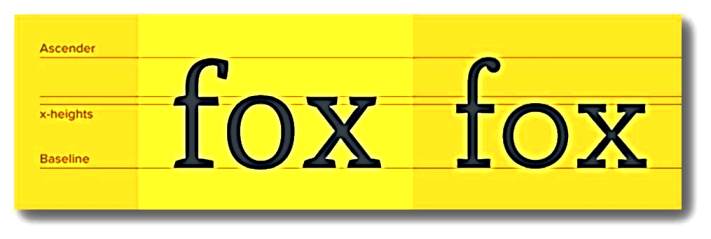
For example, the x-height factor alters readability. X-height refers to the measurement of the lower case x in a font. The bigger the x measures in relation to the type face, the easier that type face is to read. Notice that in the example below, the first x is slightly larger than the second x. Actually the first x is almost two-thirds the size of the f. So is the o.

The X factor in type facesAnother factor affecting readability is the length of the line of type.

Some short
lines of type
make the eye
shift back
and forth
uncomfortably.
They interrupt
eye movement,
making reading
hard.

Do you ever get emails which go from the left of your screen all the way over to the right margin? Are they harder to read than, say, an email that is half as wide? Yes. That’s because, for efficient reading, there is an optimal line length—about 55 to 66 characters, including the spaces between words—and a maximum line length—about 70 characters. Many books meant for children take line length into account, but not all do.


Do after-school tutoring centers really improve a child’s reading?

Yes, after-school tutoring centers can improve the reading abilities of many children.

According to 2009 research by the University of Illinois, tutoring centers which do the following have the best chances of helping a student to improve reading skills:

• The center uses trained tutors (experienced teachers but also tutors whom the center trains).

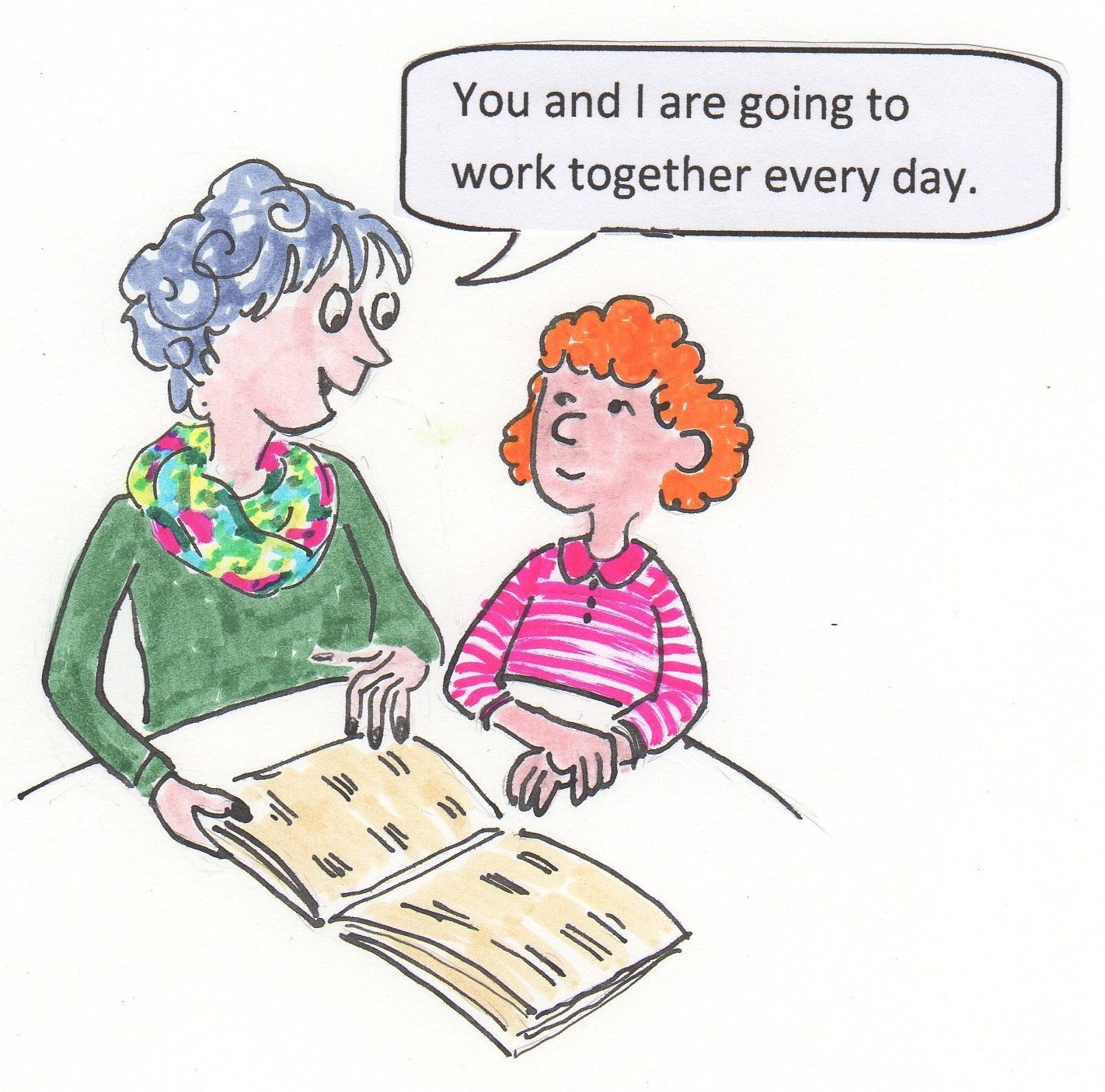
Adult holding a book open for the child next to her and saying, "You and I are going to work together every day."

• The center tests the student to identify his reading strengths and weaknesses and then prepares a plan to address the weaknesses.

• The center continues to assess the student from time to time—with formal tests and with informal tutor appraisals—to show progress or a need for more work on certain concepts.

• The center’s tutors are in touch with the students’ classroom teachers so that they can work together to help students.

• The center’s reading program follows a sequenced strategy.

A 2001 US Department of Education report on tutoring centers agrees on these good practices suggested by the University of Illinois, but adds these others:

• The center offers intensive, on-going training for teachers.

• The center works with the child regularly (daily or at a minimum of once a week for up to an hour of instruction).

• The center offers individual strategies to meet the needs of the 17 to 20% of students not helped by the center’s usual approach to teaching reading.

Whether a tutoring center can improve the reading skills of a particular child depends on the needs of that child. If a child is doing average-to-well in school or is a good ESL student, the after-school program probably can strengthen his skills. If the child has serious reading problems, such as dyslexia, the tutoring center might be willing to develop an individualized instruction plan. But not all centers are able to do this.

My advice is to identify your child’s needs with the help of his classroom teacher and then interview various tutoring centers to find one which will meet his needs or, if none seem right, look for a private tutor who specializes in teaching reading.

For more information on these research reports, go to
http://www.cprd.illinois.edu/files/ResearchBrief_Tutoring_2009.pdf and http://www.cns.gov/areads/about/evtutoringworks.pdf.