Category Archives: reading readiness.

What’s choral reading?

Choral reading is reading aloud as a group, much like a choir reads the words and sings them together aloud. It is commonly done in lower grades and in ESL classes for several reasons:group of students reading together from a single book

  • Children who are less skilled readers can listen to the more skilled readers beside them, and can model their reading after their classmates’ reading. In particular, less skilled readers can hear fluency (emphasis of certain words or syllables, pauses for punctuation, speeding up and slowing down) which less skilled readers might read too slowly to use correctly.
  • Children who stumble over sight words can hear them pronounced and can say them aloud without drawing attention to themselves. ESL students can hear correct inflections and can practice copying them.
  • Less skilled readers can practice aloud with anonymity, their mistakes or hesitancies masked by the reading of the larger group.
  • Children who are poky readers, who stumble while trying to decode words, will gain comprehension which they sometimes miss.
  • Choral reading is fun for children.

Certain kinds of books or readings work well for choral reading.

  • If a book has a rhyme pattern, or a predictable rhythm, it can be a good choice. A poem or nursery rhyme makes a good choral reading selection.
  • If the book is short, so that it can be repeated several times in a few minutes, it can be a good choice.
  • If the book is at the reading level of the less skilled students, it can be a good choice.
  • If less skilled readers are familiar with the rhyme or story, it can be a good choice.

Working one-on-one with a student, the parent and student can read aloud together from the same page. If the choral reading happens in a classroom, each student should have a copy of the text or be able to see a Big Book which everyone can use. Usually the adult reads first while the students follow along, pointing their fingers at the spoken words. Then the student joins in. The student might feel more comfortable if the adult reads with gusto, drowning out the mistakes of the beginning reader. As the selection is reread, the adult can read less loudly, allowing the child’s voice to be heard. Rereading the selection several times over several days is a good way to help the less skilled reader to remember the words or to figure them out quickly.

Where can I find a good list of books for my child to read this summer?

If you are looking for appropriate summer reading for your child, may I suggest several lists of books for you to check out.

http://www.corestandards.org/assets/Appendix_B.pdf

This website is an appendix of the Common Core State Standards. By grade level, many books, poems, stories and other kinds of reading are offered as exemplars, meaning these are good examples of the kinds of reading children should be doing. These are not the only readings that the Common Core standards recommend, but they are of the high quality that the Common Core is encouraging.

students taking out piles of books at the library


http://commoncore.scholastic.com/teachers/books/non-fiction

The above website contains nonfiction published by Scholastic, Inc., a respected children’s book publisher in the US. You can easily go to the appropriate grade level at this web site to find lists of books.

http://www.teachersfirst.com/100books.cfm.

The above Teachers First website is offered as a service to teachers by The Source for Learning, a non-profit learning and technologies corporation. Scroll down to find 100 recommended books grouped by age level.

http://www.ala.org/alsc/compubs/booklists/summerreadinglist

The above website is from the Association for Library Service to Children. Two years ago this organization put together annotated lists of books for children. The books are grouped by grade level and the list can be easily downloaded.

There are other lists compiled by the California Department of Education, the New York Public Library, religious groups and book publishers. If you go to your online search engine and search for “reading books for children by grade level,” you will find many sources of lists.

With hundreds of books to choose from, your child is sure to find many.

My grandson is scheduled to start kindergarten this fall, but I think he might not be ready. Is there any way to know for sure?

The old rule of thumb is that if a child can put his hand across the top of his head and touch his opposite ear, he is the right age to start school. If he can’t reach his ear yet, he is too young.

young child attempting to touch his ear with opposite hand

But such a test doesn’t begin to take into account all the criteria which could be used to judge the readiness of a child for school.

If your child has been to preschool, his pre-K teacher should be consulted. She has a good idea which students are ready to move on. And if you do send your child to kindergarten, and the kindergarten teacher contacts you in the early weeks of the school year saying your child is not ready, believe her. Not every child who is the right age is ready for kindergarten.

What criteria should you use to assess your child? According to the U.S. Department of Education’s National Center for Education Statistics, these criteria should be assessed:

  • Can your child communicate his wants and needs? Can he say, for example, that he needs to urinate or that another student is bothering him?
  • Can your child get along with peers by sharing and taking turns?
  •  Can your child count to 20?
  • Does your child recognize letters and numbers? Kindergartener are not expected to know how to read—although many can. But your child should recognize many letters and numbers and have an inkling of what they are used for.
  • Can your child follow directions? Sit or stand, line up, voices off, criss cross apple sauce—these are common directions that your child will be expected to follow.
  • Can your child sit still for ten, fifteen or twenty minutes, and pay attention to a teacher during that time? Kindergarteners have short attention spans, but they should be able to sit still long enough to listen to a teacher read a story or to watch a film about a baby whale. Not every five-year-old can do that.
  • Is your child able to hold a pencil or paint brush? Is he able to cut with a scissors? Most kindergarteners need more work on these skills as well as on gross motor skills, but they should show rudimentary skill.
child cutting with a scissors

EPSON MFP image

Kindergarten teachers who responded to the Fast Response Survey System (FRSS) Kindergarten Teacher Survey on Student Readiness said being able to communicate needs and wants and being curious and enthusiastic about trying new activities are the two most important skills kindergarteners need to start school with.

Some other things to look for include:

  • Can your child handle emotions? It’s normal for a five year old to break down in tears when she’s upset. But, it’s important that she has coping strategies.
  • Can your child use the toilet unassisted? And can he or she be trusted to behave in a restroom without adult supervision?
  • Is your child obviously meek and likely to be picked on? If so, he might need some coping skills to keep bullies at bay.

Although the first two or three years might be hard for young kindergarteners, research shows that they show no academic difference from their classmates by third grade.

If your child is in sports, another consideration is the cut-off birthday. Baseball in my state has a cut-off date of July 31, meaning any child born on August 1 or later cannot participate on the same teams as children born in July. For August-born children sent to kindergarten on schedule, this means they will play on teams with kids a year behind them in school. Their teammates might be strangers rather than classmates.

Still another consideration is driving. If a student is one of the youngest children in his class, his classmates will get their driving permits up to a year before he does. Your child might feel left out, or he might pressure you to let him drive as a passenger with his older friends. Will you be comfortable with that?

And will you be comfortable with your 17-year-old heading off for college with classmates who are already 18 and 19?

Good luck on your decision. There’s so much to consider.

Kids learn sounds from big to small

Little children who are learning about the sounds in words move from larger units of sound—phrases and words—to smaller units of sound—sounds within syllables.

Take the word “elephant,” for example.

Word: elephant
Syllables: el-e-phant
Onsets/rhymes e-l e f-int
Phonemes e l e f i n t

children pronouncing elephant

First, children learn that sentences are composed of words. (I can remember being in first grade and learning that “of the” is two words, a revelation at the time).

Next, children learn the sound of the whole word. They might mispronounce “elephant,” saying it as a two-syllable word (el-phint) as they grow accustomed to it. Eventually they say it right.

Children then learn to break the word into parts (syllables), pronouncing each syllable distinctly.

With a teacher’s or parent’s help, they learn to identify sounds within the word.

Later, they learn to match those sounds to letters.

This sequence—from a phrase to whole words to syllables to the smallest distinct sounds—provides a useful guide for adults teaching reading to preschoolers. We should make sure a child can hear the sounds of a word and can reproduce them properly before we begin to break a word into parts and associate letters with those parts.

What are some activities that help a child to master the phonological awareness sequence?

• Say a two or three-syllable word, leaving pauses of a second or two between syllables. Ask the child to combine the syllable sounds into a word.

• Ask the child to break a two or three-syllable word into its parts. This is a harder skill than combining.

• Ask the child to say (not spell) the sound before the vowel sound in a word (the onset sound). For example, in the word “dog,” the onset sound is the sound a “d” makes.

• Say tongue-twisters and ask the child to identify the alliterated sound. For example, in “Peter Piper picked a peck of pickled peppers,” the onset sound is the sound a letter “p” makes.

• Sing songs with rhymes. Ask the child to identify the rhyming sounds.

• Ask the child to say the rhyme part of a word or syllable. The rhyme part is all the sounds beginning with the vowel. So in “dog,” the rhyme is “og.”

• The hardest activity is for the child to break down a syllable into every sound (phoneme). American English has 42 phonemes, or sometimes more depending on regional pronunciations. (Sounds made by “th,” “sh” and other digraphs are considered distinct sounds, which is why English has more phonemes than alphabet letters.)

While learning the ABC’s is a skill most preschools stress, the other skills explained need to be learned first. Some kids are ready to break a syllable into phenomes at four years old, but many more are not ready until part way through first grade. Don’t rush them. Instead, spend time on all the preliminary steps.

For more details on this sequencing of learning sounds, go to http://www.naeyc.org/files/yc/file/200901/BTJPhonologicalAwareness.pdf. While you are there, check out the list of read-aloud books that emphasize sounds, and the additional activities you can do with a child who is learning sounds.

Phonemes, phonics, phonemic awareness—what’s the difference?

A phoneme is the smallest sound in a spoken language. There are 42 in American English, according to some experts, but more if regional pronunciations are considered. Many are represented by a single letter—b and h, for example. But others are represented by a pair of letters—sh and th, for example. A phoneme is not a letter; it is a sound to which we have associated a letter in order to read the sound. By itself, a phoneme has no meaning.

listof phonemes

Phonemic awareness is the ability to hear words at the phoneme level, to hear that the word “cat” contains three separate sounds. Phonemic awareness does not mean letter awareness. A child can have phonemic awareness without knowing the ABC’s. It means the ability to pull apart words and to say the separate sounds in words. It means a child can recognize that all the sounds we make can be put together various ways to create words.

Phonics is the code, the assigning of sounds to symbols (letters) so that the sounds can be pronounced correctly by looking at visual letters. With more than 250 letter patterns to represent all the sounds in American English, reading instruction focuses mostly on phonics.

Children with excellent hearing and from a language-rich environment pick up phonemic awareness early in life because they hear all the sounds of American English. Before they start school they may be able to pronounce all the phonemes correctly, echoing an adult. But most children cannot figure out phonics on their own. They need instruction matching a sound to a letter or letter pair.

Teach art literacy when sharing picture books

When children start to “read” picture books, generally they are reading the pictures; that is, they are trying to get meaning from the pictures since they can’t read the words yet.

They might study the appearance of a character, noting if it is a boy or girl from the clothes. Or they might look at the dark swirling clouds or the beaming sun to discover the atmosphere of the story. They might look at the colors the illustrator uses. Bright colors and pastels might indicate a happy or peaceful theme; dark colors or colors tinged with greys and blacks might indicate danger. Horizontal lines or smooth lines might indicate calm while jagged or diagonal lines might indicate action.

children looking at picture of Lincoln and Mrs. Lincoln

Some children perceive these clues without explicit instruction, but many children need someone to point out how colors, lines, and facial expressions tell the story too.

According to research by Kathleen Ellen O’Neil, illustrations can interact with the text in four different ways.

  • The art can reinforce the text, “showing” the text. For example, in “The Mitten,” adapted and illustrated by Jan Brett, a boy loses a mitten which his grandmother has just knit. One by one, we see animals from a tiny mole to an adult bear squeezing in to the mitten. The illustrations show the hedgehog’s quills and the badger’s nose poking through the wool.
  • The art can supplement the text, providing description which the text either skimps on or doesn’t describe at all. For example, also in “The Mitten,” we see the boy dressed in a Ukranian tunic, leather pants and boots with folk art borders. The book doesn’t mention where the setting is, but the art shows.
  • The art can provide far greater detail than the text, offering new insights which a literally-minded child might miss. It can illustrate nuances, inferences, humor and irony, adding depth to the text. In “The Mitten,” for example, the boy finds his mitten after the animals have left it behind, and he brings it home. The last page of the story shows the grandmother holding both mittens and noticing how much bigger one is than the other. No words are used, but we can hear her wondering, “How in the world?”
  • The art can convey a parallel story which either expands the text or contradicts it. Still in “The Mitten,” to the left side of almost every page we see the boy playing in the snow—hopping on a log where the rabbit lives, poking with a stick above the hedgehog’s burrow, looking in a tree’s knothole where the owl lives and climbing atop a woodpile where the fox lives. To the right side of those pages we see an animal leaving its disturbed home, and on the next page that animal squeezes into the mitten. Nothing in the text says that the boy disturbed the animals, forcing them to seek shelter elsewhere. A discerning youngster might notice it, but many children will need this part of the story explained.

For more information and other examples of books which clearly show the four different kinds of art interaction with text, go to the November 2011 issue of “The Reading Teacher,” page 214, for the article by Ms. O’Neil.

My child knows how to read pretty well for a first grader. Should I still read aloud to her?

Yes! Here’s why:

  • A child’s reading level doesn’t catch up with a child’s listening level until eighth grade, according to Jim Trelease, author of The Read-Aloud Handbook. A younger child can appreciate a book she cannot read yet—the plot, the descriptions, the characters and the vocabulary—if an adult reads it aloud to her.

    Father reading to child and child asks, 'How old is Old McDonald?"

    To enlarge, click on the picture.

  • Reading aloud to a child attracts him to reading by himself. He takes pleasure from being read to, and will want more of that pleasure even if an adult is not available to read to him. He will delight in life-long reading.
  • Books contain rich vocabulary, words more numerous than what we parents say on an everyday basis to our children. Children learn the vocabulary from the books we read aloud because we pronounce the words properly and because we explain them to our children. With such a rich vocabulary they are better prepared to understand their teachers and the reading they do on their own.
  • In books read aloud, children hear more sophisticated grammar than they read in grade-level books. Subconsciously they learn good grammar.
  • Good books contain the kind of values we want to pass on to our children. Reading these books aloud offers opportunities to discuss these values with our children.
  • Reading to fidgety children increases their attention span. It gives them practice sitting and listening which they need to do in school to succeed since so much school instruction is verbal.
  • Read-aloud time is bonding time. Do you remember in To Kill a Mockingbird how first grader, Scout, would sit on her father’s lap while he read legal papers aloud? She didn’t care what he read. It was their special time together.

Use the K-W-L approach before reading to activate prior knowledge

K-W-L charts have been used by reading teachers for almost 30 years, but they can be just as useful to parents of young children to help them with reading comprehension.

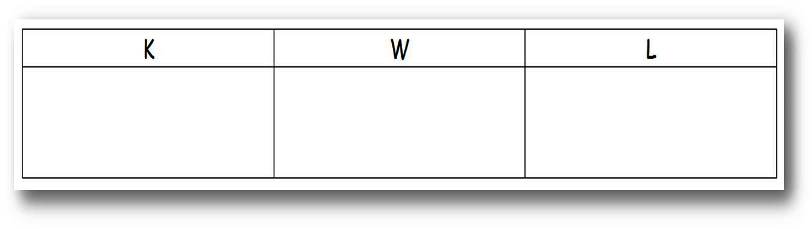
K stands for “know” or what the child already knows about a given topic. W stands for “want to know” or what new information the child would like to learn about a given topic. L stands for “learned” or what the child has learned after reading (or having been read to).Empty K-W-L chart

With younger children who cannot read yet, using the K-W-L strategy sets up a pattern which the children can use in the future. One reason some children struggle with reading comprehension is because they don’t think about a topic before they read about it. If children learn to consider what they already know, and link new information to that, they will usually understand the new information better and retain it.

Since writing down words doesn’t help a nonreader such as a preschooler or a new ESL student, drawing pictures can replace the words. Even for children who can read a bit, sometimes drawing the pictures adds fun to the learning experience.

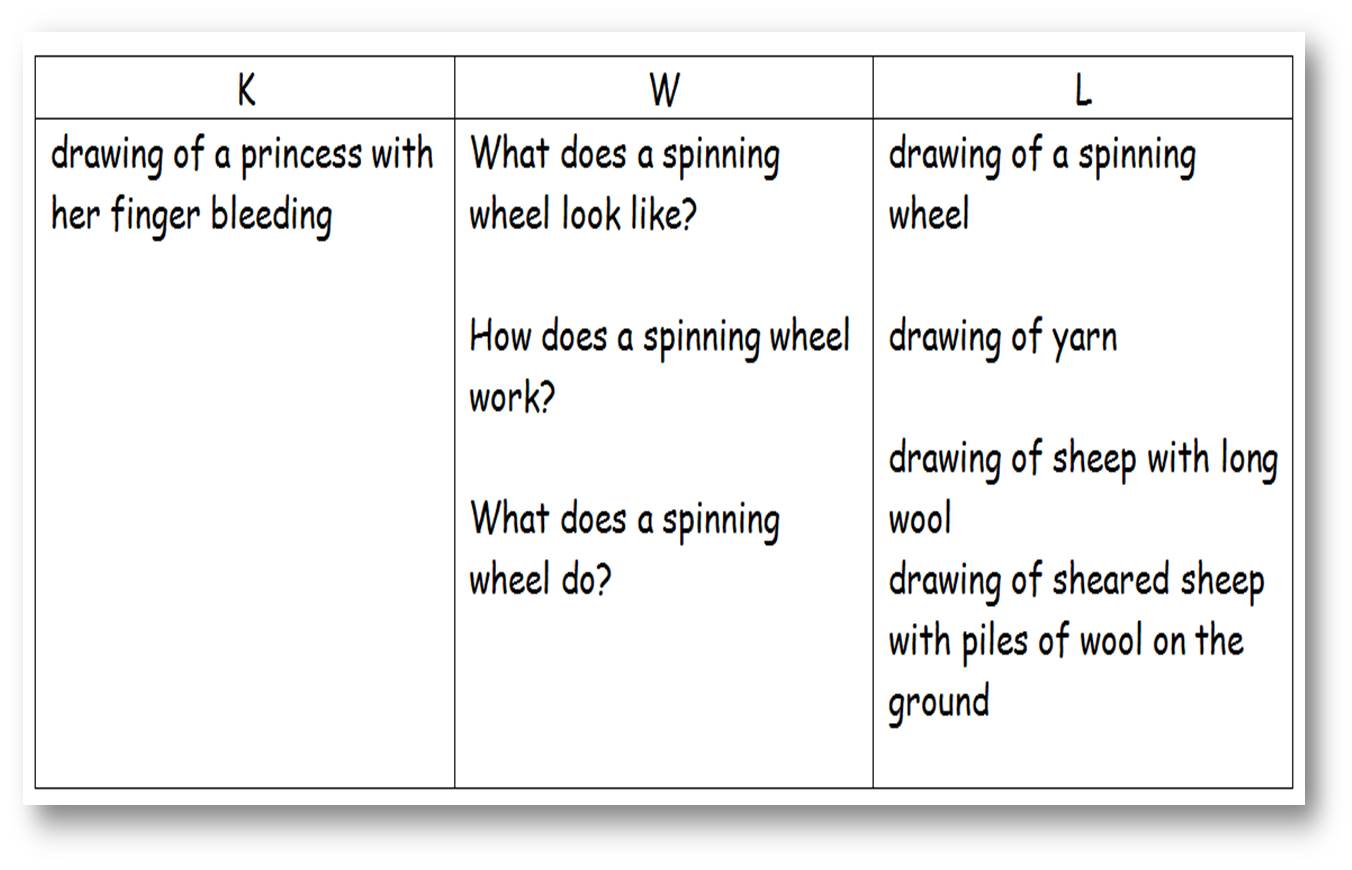
For example, suppose you read the story of Sleeping Beauty to your child, but she has no idea what a spinning wheel is. You find a book about how people used to make yarn by hand before machines did it. What kind of K-W-L chart might arise before you read the book about making yarn by hand?Example of filled-in K-W-L chart

If you, as the parent or teacher, want your child to learn a particular idea from a reading passage, you might steer the discussion to that idea as you and your child fill in the chart. But the chart works best if it reflects the child’s own understanding of a topic, and his own questions about that topic.

For example, if the topic is diamonds, the child might write:Example of a filled-in K-W-L chart

For the K-W-L strategy to help reluctant readers, the questions under “W” and the information under “L” should be linked back to what the child said she knows under “K.” So the teacher or parent might help the child create a chart like this:Example of a filled-in K-W-L chart

By connecting the “Want to Know” and “Learned” information to what the child already Knows, the child is extending the knowledge base she already has, rather than learning and soon forgetting isolated facts.

The K-W-L strategy and chart was first created by Donna Ogle. For more information, see Ogle, D.M. (1986). K-W-L: A teaching model that develops active reading of expository text. Reading Teacher, 39, 564-570.

How to help a child frontload information before he reads

Frontloading means preparing a child to read new material by loading his mind ahead of time with information which will help him understand the new material.

Good readers either consciously or subconsciously do this before they read something new, but many poor readers do not. For new readers and poor readers, parents and teachers need to model this activity until the child makes it his own.

But how should a parent or teacher model frontloading?

• For a work of fiction, many teachers discuss ahead of time the setting, characters, plot, and problem the students are about to read about. If any parts of it are familiar to the students, the teacher will point them out, connecting the new with what the student already knows.

Students shouting I Know to teacher

• Some teachers prepare a list of vocabulary words the child will encounter in the new reading. Often, the children write down definitions of the words and use those words in sentences so when they see them in the text, the words will be familiar.

• For stories in reading textbooks or for nonfiction information in textbooks, teachers sometimes discuss what the title could mean and what the subheadings could mean. If there are illustrations, the teacher asks the students to describe what is happening or what information is shown in the table, diagram, map or political cartoon.

According to Kylene Beers, a long-time reading teacher and author of When Kids Can’t Read; What Teachers Can Do, these prereading techniques often work with skilled readers but not with struggling or passive readers. She offers other prereading strategies to reach them.

• Because struggling readers often skip reading titles, captions, and subheadings, and rarely page through a reading assignment to see if there is any nontextual information, they need to be assigned to do what good readers do naturally, often with a teacher’s direct instruction.

• One kind of direct instruction in prereading is using an “Anticipation Guide.” Before a reading assignment is given to a student, the teacher—or parent of a young child—reads the selection and composes a short list of ideas from the reading for the child to respond to. For example, if the child is reading or being read Sylvester and the Magic Pebble, the list could include ideas like, If a child gets lost, does the mother and father stop thinking about that child? Or, Is there such a thing as a magic stone that can make people invisible? Together the adult and child can talk about these ideas which the child will encounter later in the book.

• Struggling readers often begin reading as if every reading—for school or for pleasure—is a cold read. While they are reading, they do almost no predicting what might happen next. Yet good readers do this all the time. One thing a parent can do is to pause as she is reading and to ask the child, “What do you think is going to happen next?” If the child shrugs, the parent might model some options—“Well, I think Sylvester will never come back to his family,” or “Well, maybe Sylvester will find a different magic pebble while he is invisible.” Gently encourage the child to respond, discussing the possible outcomes of those predictions.

For more ideas on prereading activities that can activate a child’s prior knowledge, see Beers, K., When Kids Can’t Read; What Teachers Can Do, Portsmouth, NH: Heinemann, 2003. This book, by the way, is one of the best I have read about how to teach reading—useful ideas that have been tested by teachers.

Use frontloading to prepare a student to read unfamiliar material

Good reading material for young children should include a wide variety of sources—nursery rhymes, the National Geographic Magazine and Laura Ingles Wilder’s stories of her childhood on the prairie, for example. But as unfamiliar subject matter is introduced—a good thing—children might have no previous knowledge with which to understand it—a bad thing.

The solution is for parents and teachers to prepare children for what they are about to read (or have read to them). Sometimes this prereading preparation is called “frontloading.”

The diagram below shows a child’s understanding of new knowledge without any frontloading. The first circle—prior knowledge—represents what the child already knows about a given subject. The second circle shows new knowledge—what the child is about to learn about the subject. If the two circles do not intersect, that means the child is making no connections between his knowledge and new information.  The child is likely to struggle to learn the new information, and without connections to what he already knows, the child is likely to forget the new information quickly.

without frontloading

With no overlap of information, the child has no way to “attach” new information to what he already knows. Little learning occurs.

Now compare the above diagram to the diagram below which shows a child’s understanding of new knowledge with frontloading. The intersection shows the overlap of what the child knows and the new knowledge. The larger this intersection is, the larger is the mental scaffold to which the child can attach the new information. The larger the intersection, the easier it is for the child to learn new information.

with frontloading

The green overlap shows frontloaded information–information which the child can use to remember new information.


Many poor readers don’t think about what they already know before they try to learn more. Sometimes they were never taught this skill in preschool or at home, and then later, teachers assume students know they should do this and the teachers don’t teach this skill. Yet rehearsing what one already knows about a topic it is an essential skill that good readers use all the time to prepare themselves for acquiring new information.

In our next blog, we’ll talk about how to help a child to frontload.