Category Archives: reading readiness.

What’s the right age to read Harry Potter?

Harry Potter turns 31 tomorrow, July 31, a good time to ask if there is a right age for children to read the Harry Potter books.


When the books were first published, Harry was 11, and The Sorcerer’s Stone was more fantasy and magic—owls who delivered mail, a sorting hat, photos who talked—than menacing evil.  No need for concern.  But later books focused on evil and Harry’s fight to conquer it.  Much tougher reading.

The first book came out in 1997; the second in 1998; the third in 1999; the fourth in 2000; the fifth in 2003; the sixth in 2005; and the seventh in 2007.  Kids who read the first book when they were eight couldn’t read the fifth book until they were 18 and, presumably, mature enough to handle its content.

But today, voracious eight year olds can devour the series in a month or two.  Should they?

Here are some suggestions to consider if you have a child coming of age to read Harry Potter.

Book one:  Harry Potter and the Sorcerer’s Stone  Lexile 880 (grades 5-6 reading level)

Harry turns 11.  Kids usually like to read about child characters who are slightly older than they are, so readers 8,  9, 10, and 11 years old (usually, third, fourth and fifth graders) might enjoy the first book.

However, a child’s reading level needs to be considered.  Some third graders are just starting chapter books while others have been reading chapter books since kindergarten.  Lagging readers might miss out on much of the meaning in Harry Potter books because of a lack of vocabulary or difficulty with inferences.  For them it might be better to wait.

Precocious readers, on the other hand, might be able to handle the first Harry Potter book with ease.  Two scary parts (a troll fight and a final fight between Harry and Voldemort) are a little scary, but not scarier than what children have been exposed to in the evening news or in video games.  They will miss some of the cultural differences between British writing and American writing (such as a cupboard in London being a closet in the US) but they will still understand what is important.

A child’s emotional resilience needs to be evaluated too.  If children suffer nightmares from TV shows or scary picture books, Harry Potter novels might not be a good choice until the children are older.  Or you could tell them when they start the first book that by the end of the last book Voldemort is dead and Harry is alive.  But that takes some of the suspense from the reading.

Book two:  Harry Potter and the Chamber of Secrets  Lexile 940 (grades 5-6 reading level)

If a child can read book one, that child is ready for book two.  It has another fight scene at the end, but in other ways The Chamber of Secrets is a fanciful children’s story like book one.

Book three:   Harry Potter and the Prisoner of Azkaban  Lexile 880 (grades 5-6 reading level)

Ditto for books one and two except that the concept of a serial killer is introduced.  This concept foreshadows events in a later book.

Book four:  Harry Potter and the Goblet of Fire  Lexile 880 (grades 5-6 reading level)

Two minor characters die in this book right in front of the reader’s eyes.  Also, children learn that some people cannot be trusted when one such person tries to lure Harry away.  The tone of this book is darker than the previous three, and for that reason precocious first and second graders probably shouldn’t read it, and sensitive third and fourth graders might not be emotionally ready. As a parent, you should be prepared to discuss the themes of death and trustworthiness with your children before you let them read book four.  I recommend waiting until fifth grade or middle school for this book.

Book five:   Harry Potter and the Order of the Phoenix  Lexile 950 (grades 5-7 reading level)

Someone Harry loves dies in this book.  Its tone is about the same as book four, that is, darker than in the first three books.  Harry is 15, indicating that readers should probably be almost that age too.  Postpone this book until middle grades for most children.

Book six:   Harry Potter and the Half-Blood Prince Lexile 1030 (grades 6-8 reading level)

Book six is too tough for elementary school children and even for some middle grades children.  Harry, 16, must take on enormous responsibilities and he has no one to protect him.  No place is safe.  Another scary idea is that people exist who murder for the heck of it—not for a rational reason but just because. At the end of the book a pivotal character dies a terrible death at the hands of another pivotal character. Harry vows to avenge his friend’s death.

Book seven:   Harry Potter and the Deathly Hallows Part I, Harry Potter and the Deathly Hallows Part 2  Lexile 980 (grades 6-7 reading level)

More deaths occur, but none so chilling as at the end of book six.  A reader who can stomach book six can stomach book seven.  Read during late middle grades or high school.

Board books meet babies’ literacy needs

baby reading a bookBoard books, those small-sized, thick cardboard books with brightly colored pictures and rounded corners, are celebrating their 70th birthday (more or less).  They were born with the baby boom in the late 1940’s, came in various shapes and sometimes included tactile surfaces for babies to touch.

By the late 1970’s and early 1980’s, board books became a recognized “genre” of children’s literature.  Illustrator Helen Oxenbury was an early pioneer of these books meant for one- and two-year-old children.  Some of her books have become classics.

They have caught on for many reasons.  Board books are small in size, some just two inches square, perfect for tiny hands.  Their pictures are simple illustrations of babies and little children.  The illustrations use primary colors to attract toddler eyes.  The round edges of the books can be chewed by teething babies.  Board books can be flung, chewed and slapped without ripping.

Some board books have become classics, such as The Very Hungry Caterpillar by Eric Carle and Green Eggs and Ham by Dr. Seuss.  Others teach ABC’s and counting.  Many focus on babies—animal babies and human babies.  Some have words—just a few and often in rhyme—but many are wordless.

Babies can learn quite a bit about literacy from “reading” board books.  They learn that books start on the left-hand side and move to the right.  They learn that book pages flip right to left in English.  They learn that there is a right-side-up to books.  They learn that the pictures and words have meaning.  They learn that reading is a fun experience and often a special time with someone they cherish.

For most children today, board books are their introduction to reading.

How to find the main idea in nonfiction articles

Understanding the main idea of a piece of writing is probably the most important aspect of reading once children understand phonics.  Yet many children struggle to find the main idea.  How can we help them?

  • Ask the children to read the title and any subheadings. Ask the children what those words mean.  Ask the children to predict what the writing might be about.
  • Ask the children to look at any graphics such as photos, graphs, charts, maps, diagrams or other nontextual information. Ask the children what they have learned from those graphics.  Ask them to predict what the reading might be about.
  • In nonfiction, the main idea is often expressed at the end of the first paragraph. Ask the children if the last sentence of the first paragraph tells what the main idea is.
  • In nonfiction, many times the first paragraph or even two or three paragraphs are a hook. They might give hints about the topic of the writing, but they might not tell the main idea.  Ask the children if that is the case with what they are reading.
  • In nonfiction, topic sentences often start the body paragraphs of a reading. Ask the child to read the first sentences of the body paragraphs.  Are they topic sentences?  If so, what is the topic that they are giving details about?
  • In the last paragraph of nonfiction, the main idea is often repeated. Ask the children to read the last paragraph and to identify the main idea if it is there.
  • Reading the first important paragraph (not the hook) and the last paragraph, one right after another, can sometimes help children to discover the main idea. Do both paragraphs talk about the same thing?  If so, what is it?

Some children will understand immediately while others will need many, many lessons focused on the main idea.  If children need more examples, more tries at figuring it out, make sure they get those extra examples and time.  Figuring out the main idea will be on almost every reading test they ever take from first grade to the SATs.

But more importantly, it is a life skill which they will need.

Teach the vocabulary of school subjects

Sometimes we think vocabulary words are the kinds  found in good literature, words like “evade,” “grandeur” and “prescient.”

Math VocabularyBut many times the words children must learn are the basic words and phrases of the subjects they learn in school, words like “remainder,” “summarize” and “find the function of.”
When children are in pre-K they are taught words like “thicker than,” “thinner than,” “shorter than,” and “taller than.”  We parents and teachers take the time to instruct about these terms and then to quiz the children informally to be sure they understand.

But as children age, some terms fall through the cracks.  The third grade teacher assumes that the second grade teacher has taught words related to subtraction, such as “difference” and “minus.”  And the second grade teacher probably has.  But what if a child was sick that day, or was distracted, or was moving from one school to another?

I was reminded of this when the mother of a middle schooler told me her son was having trouble figuring out some math terms, including “at most,” “at least,” “no more than,” “no fewer than,” “maximum,” “minimum” and “below.”

Her remarks reminded me of my own trouble learning what “function” meant in my algebra class.  Whatever my teacher said didn’t help me, and for weeks I was confounded by that word.

How can we help our children learn the vocabulary basic to the subjects they are studying in school?

  • When a child starts a new learning skill, such a multiplication, or a new unit, such as erosion, teach the vocabulary the child will need to know. Page through the child’s text to see what words are used.  Then quiz the child on the vocabulary, both informally and formally.  Make definitions part of subject matter testing.  Be sure to use domain-specific words, such as “factor” and “water cycle” as well as informal words.
  • Regularly review  vocabulary in a field of study. You could offer a “spelling” bee reviewing definitions of volcanic terms, such as lava, molten, intrusive, extrusive, ring of fire and magma.  You could play a BINGO game based on figures of speech, such as simile, metaphor, hyperbole and personification.
  • Ask students to create dictionaries of terms they need to know in order to talk about a subject. Instruct students to read their dictionaries for two minutes before each day’s instruction on that topic.
  • Give pretests which include definitions.
  • Be aware of students who are absent when you teach vocabulary and give them private lessons or ask an advanced student to catch the laggard up.
  • In emails home to parents, name new words the child needs to know and ask parents to discuss these words to reinforce them.

One of the key skills in reading well is learning and remembering vocabulary.

Use mind webs to increase reading comprehension

Creating mind webs (also called spider webs and concept maps) is a great way to increase comprehension for child readers.  Mind webs should be created while the child is reading.  Details can be added after each paragraph if the paragraph is rich in detail.  Or they can be added after a page or a chapter.  The length of the reading can determine how often the student adds to the mind web.

How does this strategy work?

  • First, on a piece of notebook paper, the child writes the topic in the center and encircles it. For a child not used to this strategy, an adult might draw three or four “spokes” from the center, and at the end of each spoke, write an idea that the child should note while reading.  For example, if a child is reading a biography about George Washington, one spoke might be labeled “childhood” or “education.”  Another might be labeled “family.”  Another could be called “soldier” or “general.”  And the last might be called “President.”
  • After the ideas are determined, the child begins reading. As he reads about Washington’s family, the child might write down the names of important family members, what happened to them, or how they influenced him.  For example, Washington’s father died when he was a child.  His older brother cared for him, but then Washington had to care for his brother when he became sick.  Next to “President,” the child could write the year Washington became president, people who helped him, why he was an important president.
  • Sometimes details in one category connect to details in other categories. Students can show this by drawing lines to connect the details.  For example, when he was a soldier, Washington hired Alexander Hamilton to be his aide.  Later he picked Hamilton to be a helper when he was President.

For reluctant readers, a parent or teacher might need to work one-on-one, helping the child to create the mind web.  For a group, the teacher could model the concept by drawing a mind web on the board or on a computer whose image is projected, and by jotting down suggestions from students.

Sometimes children will write laundry lists of facts on a mind web.  A parent or teacher should probe about those facts and encourage the child to detail why each fact is important.  It is better to have fewer subdivisions but more details for each one than a long list without details.  Why was one of Washington’s helpers Hamilton?  Why was Washington’s work as a soldier when he was 21 important later on?

To reinforce the comprehension, the students could write one or more paragraphs, using the mind web for information.

Mind webs can aid reading comprehension in any subject.  They help children organize information and see connections.  Because they are informally drawn and can be added to at any time, they can enlarge as the child’s knowledge enlarges.

Is my child on schedule to read?

The US Department of Education has put together a list of accomplishments* relating to talking and reading for children from birth to six years old.  This list shows the growth of typical children developing normally, but variations exist.  By seven years old, most children are reading.

From birth to age 3, most babies and toddlers become able to

  • Make sounds that imitate the tones and rhythms that adults use when talking.
  • Respond to gestures and facial expressions.
  • Begin to associate words they hear frequently with what the words mean.
  • Make cooing, babbling sounds in the crib, which gives way to enjoying rhyming and nonsense word games with a parent or caregiver.
  • Play along in games such as “peek-a-boo” and “pat-a-cake.”
  • Handle objects such as board books and alphabet blocks in their play.
  • Recognize certain books by their covers.
  • Pretend to read books.
  • Understand how books should be handled.
  • Share books with an adult as a routine part of life.
  • Name some objects in a book.
  • Talk about characters in books.
  • Look at pictures in books and realize they are symbols of real things.
  • Listen to stories.
  • Ask or demand that adults read or write with them.
  • Begin to pay attention to specific print such as the first letters of their names.
  • Scribble with a purpose (trying to write or draw something).
  • Produce some letter-like forms and scribbles that resemble, in some way, writing.

From ages 3-4, most preschoolers become able to

  • Enjoy listening to and talking about storybooks.
  • Understand that print carries a message.
  • Make attempts to read and write.
  • Identify familiar signs and labels.
  • Participate in rhyming games.
  • Identify some letters and make some letter-sound matches.
  • Use known letters (or their best attempt to write the letters) to represent written language especially for meaningful words like their names or phrases such as “I love you.”

At age 5, most kindergartners become able to

mother works with child reading story book

  • Sound as if they are reading when they pretend to read.
  • Enjoy being read to.
  • Retell simple stories.
  • Use descriptive language to explain or to ask questions.
  • Recognize letters and letter-sound matches.
  • Show familiarity with rhyming and beginning sounds.
  • Understand that print is read left-to-right and top-to-bottom.
  • Begin to match spoken words with written ones.
  • Begin to write letters of the alphabet and some words they use and hear often.
  • Begin to write stories with some readable parts.

At age 6, most first-graders can

Young child writing C-A-T.

  • Read and retell familiar stories.
  • Use a variety of ways to help with reading a story such as rereading, predicting what will happen, asking questions, or using visual cues or pictures.
  • Decide on their own to use reading and writing for different purposes;
  • Read some things aloud with ease.
  • Identify new words by using letter-sound matches, parts of words and their understanding of the rest of a story or printed item.
  • Identify an increasing number of words by sight.
  • Sound out and represent major sounds in a word when trying to spell.
  • Write about topics that mean a lot to them.
  • Try to use some punctuation marks and capitalization.

*Based on information from Preventing Reading Difficulties in Young Children, a report of the National Research Council, by the Committee on the Prevention of Reading Difficulties in Young Children, 1998; and from the Joint Position Statement of the International Reading Association (IRA) and the National Association for the Education of Young Children (NAEYC), 1998.

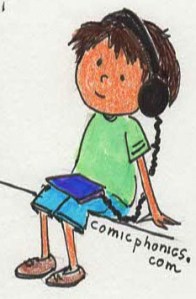
Are audio books right for your young child?

Audio books, also called books on tape, are a great way for busy adults to “read.”  Pop one in your car CD player for a long commute.  Listen while you make dinner or wait through a long soccer practice.

But are they good for your young children?  Yes and No.

  • Yes, if you speak English with an accent and want your child read to by native English speakers.
  • Yes, if you want to encourage reading but you are too busy making dinner or bathing the baby to read to your preschooler.
  • Yes, if you are looking for an educational alternative to video games, electronic games or TV.
  • Yes, if your child is a beginning reader or a poor reader who could benefit from hearing the same book read multiple times while reading along.
  • Yes, if you need a bedtime ritual for your child which doesn’t involve you or which takes the place of you when you work late or travel.

But sometimes video books are not a good choice.

  • No, if you think video books can take the place of your reading to your child on a regular basis.
  • No, if your child has questions, or wants to pause to look longer at the pictures.
  • No, if the pacing of the book is too fast for the child, or the language too advanced, or the themes too mature.
  • No, if you hope your struggling reader will read along rather than merely listen to the voice on the machine.
  • No, if the background music, sound effects or dramatic flair of the reader grate on your child’s nerves.

I have been in classrooms where some children listen intently to audio books while others tune out.  If your child is struggling to read or is generally restless, you might need to join him while he listens to audio books to keep him focused.

Audio books isolate a child.  Children learn better when they have a strong positive emotional connection to the learning process.  When a parent reads to a child, cuddling, answering her questions, pausing until she is ready to move on, explaining new words, roaring with wild thing noises or laughing at a cat in a hat, the child engages and learns to a greater degree than is possible with audio books.

Audio books can work well to supplement, but they cannot replace your reading to your child.

Spelling—What works? What doesn’t work?

Because no national student tests focus on spelling only, experts can’t say how widespread spelling problems are.  But ask any teacher, and she will tell you many, many children learn to spell with difficulty or depend on phonetic spellings.

EPSON MFP image

If you are the parent or teacher of such a child, what do you do?

Here’s what doesn’t work.

  • Teaching spelling rules rarely works. When students see a worksheet or test on one aspect of spelling, they can do okay.  That’s because they are focusing on one rule of spelling.  But if you test on several rules, or wait a week to retest on one rule, a poor speller makes numerous mistakes.  And if you ask the child to write a few sentences with words which use some of these spelling rules, spelling errors abound.  It’s as if you never taught the rules.
  • Having the child memorize often used words can work if the word is simple. But not always.  Many children spell “went” as “whent,” or confuse “then” and “than,” or use “b” for “d,” or spell “was” as “saw.”  These children might have great visual memories for colors and landmarks, but not for spelling.  Experts think this is because the brain’s “wiring” for spelling is part of the language processing part of the brain.  Poor spelling is one sign of underlying language processing problems.
  • Teaching word parts—prefixes, suffixes and roots—can help a child guess at the meaning of words, but it doesn’t help much with spelling. The child will say the word in her mind and spell it the way it sounds to her.  “Useful” might come out “youzful.”

Here’s what does work.

  • Accommodations, especially allowing the child to use electronic writing equipment, reduce some but not all spelling errors. Spellcheck alerts the child that a word has been misspelled.  She can click on the misspelled word and the correct spelling appears.  She clicks on the correct spelling and eliminates the problem.  You might think:  but then she will never learn correct spelling.    But how about you?  When you make a spelling error on your computer or phone, don’t you click and replace?  So why shouldn’t a student?  Because of ubiquitous technology, the same rules which applied to us when we were students shouldn’t necessarily apply to students today.  The SAT allows calculators.  It didn’t when I took the test.
  • Teachers who limit the number of points off for spelling errors would lessen the stress on poor spellers. What if teachers would limit the percentage of a writing grade devoted to spelling to 5%, no matter how many words are misspelled?  Spelling is a way of delivering a message, the same as sentence structure and vocabulary and type faces.  If teachers would focus more on the content of writing, on its organization and message, and focus less on spelling and handwriting, poor spelling would be less of an issue.
  • If a child focuses on learning the spelling of the 100 or 200 most commonly used words in English, and ignores the rest, her spelling would improve. If those “most used” words were posted in the classroom as a universal word bank available to any child any time, spelling would improve.  Or those words could be offered to each child in a little booklet which the child could keep in her desk and refer to at any time. Why not?  Do you remember every one of your relative’s phone numbers anymore?  Or do you let your smart phone remember for you?  Is it “cheating” for you to press a name rather than to key in a  ten-digit phone number?  Then why can’t a child look up a spelling word?

English is a tough language to spell–maybe the toughest.  So many rules, so many exemptions.  Let’s take away some of the energy that goes into spelling correctly and put it into more important skills, like writing well.

Facing dyslexia in a preschooler

So you suspect your preschooler has dyslexia.  What can you do?

  • Realize that the younger a child is when identified as dyslexic, the sooner help can begin. If possible, you want to identify the situation before the child becomes frustrated and discouraged, and before the child is labeled as “different.”child making letter T with his body
  • Ask your school district to test the child. Because of the child’s age, the district might balk, and say he will be tested when in kindergarten, or first grade, or later.  Sometimes the district will become involved if you have some “proof” that the child is dyslexic.  This might require private testing at your expense by some recognized expert.
  • From the school district, find out what services your child will receive and when.baby reading a book
  • If the school district “officially” won’t help, make an appointment with your elementary school’s reading specialist. She will probably have ideas you can start with, and she might be able to lend you materials or at least identify materials that will help.
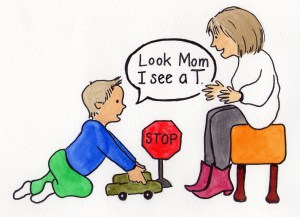
  • Consider hiring a reading tutor, one with experience teaching children with dyslexia. A good tutor will use many strategies, particularly game-like, hands-on approaches that will appeal to a preschooler.boy sees a T in STOP
  • If someone else in the immediate family has dyslexia, there’s a good chance your child has the same kind of reading problem and can be helped the same way. What worked for your other relative?
  • Check out ideas on the internet. Use keywords such as dyslexia, preschooler, reading and learning strategies.
  • Begin working with your child yourself. Focus on the sounds of the language first, and make sure your child can hear them and pronounce them properly.  Only then match sounds with letters.mother works with child reading story book
  • Is letter recognition difficult? Buy an ABC puzzle or letter tiles or a Scrabble game.  Use the letters to play games forcing the child to identify letters.  Unfortunately, most sources for letters use only capital letters, and it is generally lower case letters which cause problems.
  • Work on printing letters properly. If fine motor coordination is difficult, use a computer keyboard instead.  But again, most keyboards identify the keys with capital letters.Mother shows child spelling of her name Kelly
  • Use music. Teach your child the ABC song.  Sing songs together which rhyme or read nursery rhymes.
  • Teach directions. Up, down. Left, right.  Inside, outside.
  • You may find it takes longer for your dyslexic child to master certain skills when compared to a child without reading difficulties. Be patient.  If a younger sibling is catching on faster than the dyslexic child, work with each child independently and out of earshot from one another.  If at all possible, conceal from your child that he is having reading difficulties.  Find ways for him to succeed at learning.A teacher says the first part of a rhyme, and the child says the rest of it.

How about pulling your child out of preschool, or stopping all reading instruction for a year or until the child is seven or until the child reaches first grade?  These are not good solutions.  In pre-K students are expected to know their letter sounds and to match them with ABC’s.  In kindergarten children are expected to read CVC words, high frequency words, and some two-syllable words.  A child who can’t keep up with his classmates develops low self-esteem which can intensify reading problems.

Be proactive.  If you think your three or four-yer-old shows signs of reading difficulty, act as soon as possible for the best outcome.

How to test for kindergarten readiness

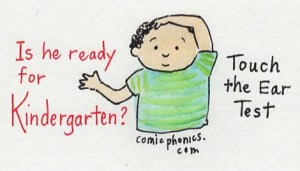
Checking that a child can touch his ear with the opposite hand is one test for kindergarten readiness.  But if you are looking for specific proof that your child is ready, here are some of the abilities which Kentucky looks for in each child:

young child attempting to touch his ear with opposite hand

  • Stating his or her name, age, birthday and phone number
  • Naming body parts as they are pointed to
  • Standing on one leg with eyes open and then closed
  • Identifying shapes such as triangles and squares
  • Printing his or her name
  • Saying (not singing) the ABC’s
  • Naming letters pointed to
  • Counting into the twenties
  • Sorting items by shape
  • Separating a certain number of blocks from a group of blocks
  • Identifying the front and back of a book
  • Identifying in what order words are read

The test used by Kentucky looks at five broad areas:  academic / cognitive; language development; physical development; self-help; and social-emotional.

Not all states test incoming kindergarteners, yet all are looking for  kindergarten-ready skills in children.  You can use this information to prepare your child for a great start to school.