Category Archives: reading readiness.

Are nursery rhymes still important?

Yes, they are, but sadly, more and more children come to school today with little knowledge of them.

boy pretending to be Humpty

There are many reasons—busy parents without time to read the rhymes, foreign-born parents unfamiliar with the rhymes, and competition from TV and electronics for children’s time.  Yet, for many reasons, nursery rhymes should be part of a child’s education, and the earlier the better.

  • Children—even one-year-old children—can appreciate nursery rhymes, often their first encounter with books, verses and rhythmical sentences.  If they are being read to, they learn what a book is, what side goes up, how to turn a page, what words look like in print and how to get meaning from pictures.  This experience is the beginning of getting meaning from printed words, a start to reading comprehension.
  • They learn that reading books can be fun, social occasions with Grandma cuddling as she sounds out the rhymes.
  • Children can learn what English sounds like.  They hear their mother’s voice rising and falling, speeding up and slowing down, getting softer and louder, and sounding scared or full of laughter.  This can be particularly important for ESL children who might hear these rhymes from preschool teachers.
  • They develop an ear for fluency, and when they are ready to repeat the rhymes themselves, they are likely to add the inflection of a good reader.
  • Kids naturally like rhythm which nursery rhymes offer in abundance.  If Dad claps out the rhythm to “Pat-a-cake, Pat-a-cake, Baker Man,” soon the child will mimic him, picking up the cadence of English.
  • Because nursery rhymes are so rhythmical, children become aware of units of sound (called phonemes) from which words are made.  They learn to progress through the sounds in a word in a particular order (called phonemic segmentation), a necessary prereading skill.
  • Children also love rhyme (one reason Dr. Seuss is so popular).  They begin to learn patterns, expecting a rhyme every so often in the rhythm, and are rewarded when that word comes.  They begin to share in the reading of nursery rhymes aloud.
  • Because nursery rhymes are short, children need only a short attention span for a single nursery rhyme.
  • Also because the rhymes are short, children can memorize them and recite them aloud.
  • Nursery rhymes contain words the child doesn’t hear every day or in a familiar context.  “Jack and Jill went up a hill to fetch,” “eating her curds and whey,” and “Jack, be nimble” are examples.
  • Many nursery rhymes tell simple stories with beginnings, middles and ends.  The children hear of problems they might encounter—falling down and getting lost—and hear how those problems are resolved, or in Humpty Dumpty’s case, not resolved.
  • Nursery rhymes are great for group chanting and singing, sometimes called choral reading.  Think of “Mary Had a Little Lamb,” “Twinkle, Twinkle, Little Star,” and “London Bridge is Falling Down.”  Can you think about “Mary Had a Little Lamb” without singing it in your head?  The tune makes the rhyme easier to remember and makes reading fun.
  • Reading nursery rhymes to children preserves an older American culture and a connection with past generations.  Many of today’s grandmothers, as children, were read the same rhymes by their grandmothers.
  • Later on in life, the child will encounter many allusions to nursery rhymes (and allusions to Greek mythology, Shakespeare and the Bible).  But the child will only make connections—and have a richer experience—if he is familiar with the original rhymes.  For example, Agatha Christie called one of her mysteries One, Two, Buckle My Shoe.  Why?
  • Reading nursery rhymes online is a way to connect a child’s use of a tablet, phone or computer with literature from an early age.

    Father reading to child and child asks, 'How old is Old McDonald?"

    To enlarge, click on the picture.

The history of nursery rhymes in English goes back hundreds of years to a time when most people could not read or write.  Part of an oral culture, they reported events of their time for adults and children alike.  For example,

  • “Ring around the Rosy” is believed to have originated in 1347 during the Black Death in Europe.  The ring referred to a round mark on the skin which was the first sign of the bubonic plague.  The last line, “And we all fall down,” was no laughing matter.
  • “Mary, Mary, Quite Contrary,” refers to Mary, Queen of Scots, who was beheaded for her religious beliefs.
  • “Little Miss Muffett” refers to the daughter of a bug expert in Shakespeare’s day.
  • “Thirty Days Hath September” is believed to come from the 13th century, based on a similar rhyme in French to help remember how many days are in a month.

So are nursery rhymes important?  What do you think?  Did someone read nursery rhymes to you?  Can you recite any from memory?  Have you enjoyed passing along this tradition to your children and grandchildren?  Let our readers know.

Thank you for visiting our blog!

Mrs. A and I want to thank you for increasing the success of our blog.  Thanks to you, this week we had more visitors than at any other time since we began blogging in December.  165 distinct visitors checked out our blog, and many of them returned to give us 355 views.

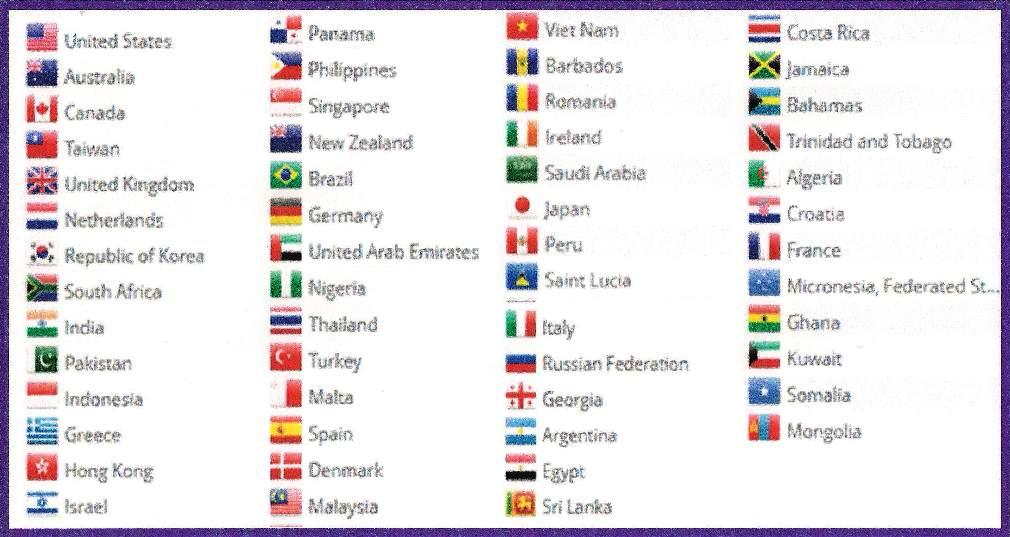
While most of you came from the U.S., we especially welcome our visitors who came from around the world.  Below is a chart showing the countries our visitors have come from in the past five months.

Chart of international  visitors to our comicphonics blog.

Click on the chart to enlarge it.

The month of May, our fifth month blogging, brought double the number of visitors compared to April, our second-best month.  We thank those of you who left comments and we hope more of you will do that.

Later this week, we hope to announce the publication of our second early reading picture book as an app.  But more about that another time.

Sincerely,  Mrs. K

Mrs. K and Mrs. A publish first phonics picture book

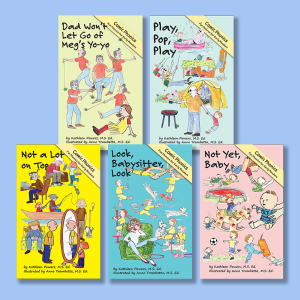
BREAKING NEWS—Mrs. K and Mrs. A published our first children’s book on May 23.  Called Not a Lot on Top, it concerns the attempts of a little girl to hide her father’s bald head.  The pictures are silly, the words easy and the cost low–$1.99 for the book and ten easy yet educational activity pages relating to the book.

bald dad with lampshade over head

See new app at http://goo.gl/ClVyM

Right now the book is available on all Apple products but we hope eventually it will be available on android products as well.  Go to http://goo.gl/ClVyM to read more information or to order.

More books are in the works.  We hope to publish two in June and one a month after that—all targeted for the beginning reader in English.

Mrs. K and Mrs. A would like to thank Patrick Powers who suggested publishing our books as apps, and who did the technical work to make it possible.  We would also like to thank Bill Powers who has done all the technical work which makes this blog possible.

In my library, I saw some wordless picture books. What are they for?

Wordless picture books (books with no words except for the titles) and almost-wordless books (books that repeat the same word, phrase or sentence over and over) are a category of picture books that began in the 1960’s but have grown increasingly popular.  There are several kinds:

  • Concept books.  These include ABC books, counting books and pictures for infants to identify.  They also provide pictures of everyday objects for ESL students to identify.
  • Books related by a theme or a sequence.  These books show illustrations that are related, but not by a story line.  Books showing different kinds of trucks, or pictures of how the seasons change, or pictures showing a bedtime routine are examples.
  • Books showing expository content.  These books might explain how a caterpillar becomes a butterfly or show all the protection a football player puts under his uniform.
  • Books showing visual games.  Interaction is required to find a hidden object or to find subtle differences in two nearly identical pictures.  The reader might need to point to the hidden item, or circle differences in pictures.
  • Story books.  These might show simple or complicated story lines.

I assume the books you are asking about are story books.  Why have stories without words?  Let’s start by talking about two-year-olds.

baby reading a book

Click on the picture to enlarge it.

Kids who have just turned two are probably not aware of “story” as we know it, even though they might have been read to a hundred times.  When they look at a picture book, they see individual pictures, not parts of a story.  They might be interested in the boy on page 3 because of his glittery sneakers, or they might notice the funny expression on a dog’s face.  When they look at page 4, two-year-olds probably are not aware that events on page 3 have caused events on page 4.  The picture book is not so much a story with a beginning, middle and end for such young children.  Rather it is a collection of fascinating pictures.

For such children, does it matter if there is text on page 3 or page 4?  Probably not.  They are getting their meaning from the pictures.

Does it matter if the adult reads the accompanying text aloud or not?  Probably not to the two-year-olds.  The words give just one meaning—that of the author.  But the children are more interested in gaining their own meanings.  They pick up on their own clues and focus on what is important to them.  You have probably had the situation where you are trying to finish reading a story but your child doesn’t care about the story ending.  He would rather talk about one of the pictures, or leaf back through the book to see a particular picture again.

young boy reading a book

Click on the picture to enlarge it.

Yet sometime between two and kindergarten, most children realize that story books are more than a collection of fun pictures:  the pictures tell a story with a beginning, middle and end.  Do children need text to learn this?  Probably not.  As they become more sophisticated at “reading” pictures, they notice more, they make more connections, and story emerges.  It is only when children begin to read words that they need words on the page.

So back to your question.  What are these wordless story books for?

  • With no right or wrong words to explain what is happening, these books allow for wider interpretations than a text might allow.  Children can bring their own meaning to the stories.
  • Research shows that parents who tell a story based on pictures only use a richer vocabulary and more complex sentence patterns than authors usually use in picture books.  Children pick up on the vocabulary and become attuned to longer sentences.
  • Bilingual parents can mix vocabulary from two languages to make the story meaningful for their children.  Parents who don’t speak English can “read” the story in their own languages.
  • Developmentally delayed children benefit from having the reader tailor the story to their level.  Or they get the chance to tell the story from their own point of view, with no right or wrong perspective.

As children grow, these books have other advantages:

  • Children can learn the elements of story from these books—characters, setting, beginning, middle, and end.
  • Children can think creatively, coming up with various possibilities to interpret a single picture book.
  • Children can learn how to tell stories orally before they have the skills to write stories down.
  • By using recording devices and cameras as children “read” these stories, children can record their favorite stories to share with Grandma in Taiwan or with Mom waiting at the gate for her flight.
  • Once children begin to read and write, they can write their own words for the wordless story books, and read them aloud.
  • Children can use the books as models, illustrate their own stories and then supply words, perhaps dictating to an adult.
  • Children can gain success in reading, like reading and feel confident reading all before they can “read” real words.

Like all books, the quality and sophistication of wordless picture books varies.  A children’s librarian can point out some good ones.  Or you can find lists on the web.  Some classic ones include:

  • A Boy, a Dog, and a Frog by Mercer Mayer
  • Pancakes for Breakfast by Tommie de Paola
  • Time Flies by Eric Rohmann
  • Picnic by Emily Arnold McCully
  • Up and Up by Shirley Hughes
  • Free Fall and Tuesdays by David Weisner
  • board picture books by Helen Oxenbury

How can I make reading to my four-year-old a more educational experience (not just fun)?

Children pick up many foundational skills when someone reads to them frequently.  In fact, reading to children is probably the single most important way to prepare them to read by themselves.  But you could monitor your child to be sure he is learning more subtle concepts about reading in English.  Most schools expect these skills to be mastered by the end of kindergarten:

  • Knowing that in English words are read from left to right.  (You could point to words with your finger as you read to reinforce this idea, especially if you come from another language in which words are read from right to left or top to bottom.  If you read to your child in both languages, remind the child that you are reading in English.)
  • Knowing that words are read from top to bottom.  (Occasionally, ask your child where you should begin reading on a page.  Or turn the book up-side-down to see if the child recognizes the mistake.)

    child telling grandpa he is holding the book upside down.

    Click on the picture to enlarge it.

  • Knowing that pages are turned from right to left.  (Ask your child to turn the pages for you.)
  • Knowing that words are shown in print by a grouping of letters with a space before and after.  The space before indicates a new word is to begin; the space after indicates that a word has ended.  (Point to tiny words like “a” or “I” and to big words like “dinosaur,” and comment on the size of the word.  Or ask the child to count how many words are on a particular line.)
  • Knowing that words are formed from specific sequences of letters.  (Write a “word” like xxxxxxx or abcdefg and ask your child if that is a word.  Even though a child cannot read, he begins to figure out that not every grouping of letters makes a word.)
  • Knowing that words are made from combinations of 26 letters, upper and lower case.  (Make sure your child can name the upper and lower case letters.)
  • Since understanding word families helps with reading (pig, wig, big), children need to identify words that rhyme.  (Play rhyming games with your child.  Recite nursery rhymes with your child.)
  • Since English words are made of syllables, understanding the number of syllables in a word is important.  (When you are reading, stop and say “ty-ran-a-saur-us” with a pause between each syllable.  Have your child clap the syllables and count the syllables with you.  Ask your child if you should pronounce the word “ty-ran-a-saur-us” with pauses between the parts, or “tyranasaurus.”  If your child is learning English as a second language, distinguishing syllables from words can be difficult, so for bilingual children you might want to slow down a bit until the child is more fluent in English.)
  • Knowing that rhyming words are the same at the end, but different at the beginning.  (Help a child to sound out the rhyming part and the sound beginnings for words such as bed, red and sled.)
  • Knowing that words are composed of sounds which correspond to letters.  (As you read, help the child to isolate the sounds in some three-letter words, such as sad, hop or fig.  The child doesn’t need to know the letter names that correspond to the sounds at this point, but she should gain experience reproducing the sounds.)
  • Knowing that changing a letter sound creates a new word.  (Say a word like “bag” and ask what would happen if you changed the first sound to the “r” sound or if you changed the last sound to a “t” sound.  Help the child to manipulate letter sounds to form new words.  Using letter tiles helps with this skill.)
  • Knowing that each letter usually corresponds to a sound.  (Help the child to learn the most common consonant letter sounds.)
  • Recognizing that there are long and short vowel sounds, and that adding certain letters, such as an e at the end of a three-letter word, changes the sound and the word.  (This is a more advanced skill, so if your child finds it hard, ignore it for a few months and then try again.)
  • Knowing sight words.  (Help the child to recognize more and more words by sight, and sometimes, let the child read those words when you come to them in a story.  Don’t do it every time or reading to your child won’t be fun.  But as a child gains sight word knowledge, point to the words as you read, so the child can recognize words he knows and can pick up new words.)
  • Knowing that many words are spelled almost the same, but slight differences do change the word.  (Point out “rat” and “rate” or “ball” and “bell” to show what a difference one letter can make.)

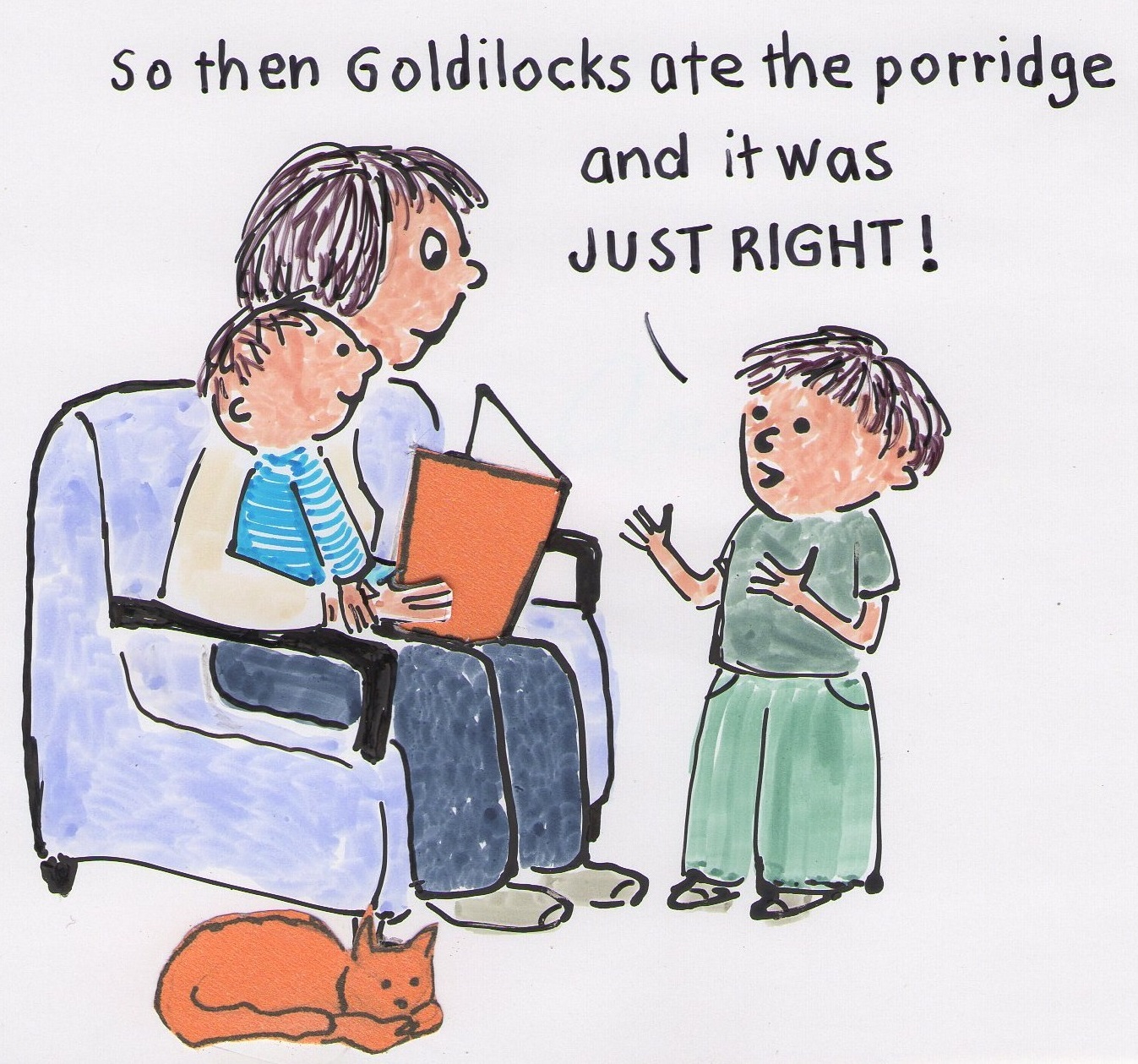
    child retelling story of Goldilocks

    Click on the picture to enlarge it.

  • Hearing sentences read fluently, with pauses at commas and periods.  Children should recognize a change in an emotional tone, or a change of voice when the big, bad wolf speaks compared to when Little Red Riding Hood speaks.  They should learn that there is meaning in stories and in nonfiction.  (Ask your child what is happening on a given page, or what the story is about.  Ask the child to predict what might happen next.  Ask the child what happened first, in the middle, and at the end.)

These ideas come from the Common Core State Standards Initiative (the suggestions in parentheses are from Mrs. K), and are intended as a standard for measuring the foundational reading skills of kindergarteners.  Most states are now using Common Core Standards.  For more information, go to http://www.corestandards.org/ELA-Literacy/RF/K.

Why is reading such a complex skill?

According to an April 2000 study (www.nationalreadingpanel.org) researched by the National Institute of Child Health and Human Development (a division of the National Institutes of Health) and the federal Department of Education, there are four main components to reading, each of which can be further divided.

Chart of 4 reading components

Click on the picture to enlarge it.

The first component is systematic phonics instruction.  The study defined phonics as how a letter corresponds to a sound in English, and defined systematic phonics as planned, sequential letter-sound instruction.  Some English letters have one corresponding sound (such as most consonants like b and d).  Some letters have two sounds (hard g and soft g, for example).  And some letters have many sounds (vowels and y).  Most systematic phonics instruction begins with teaching consistent consonant sounds and later moves on to vowels with multiple sounds, and then to consonants whose sounds change in combination with other letters (th and kn, for example).

Another component is phonemic awareness.  Phonemes are the smallest units of spoken English, 41 in all, represented by one or more of the 26 letters of the alphabet.  Some words have one phoneme (oh, for example, has the one phoneme o) while most words have two or more phonemes (go, for example, has two phonemes, g and o, while style has four phonemes, s, t, i and l.).  Putting together the phonemes to form words is an important component of reading.

Fluency is the third component.  The federal study defined fluency as reading aloud with speed, accuracy and proper expression.  When a child pauses at a comma or period and changes his pitch if he is reading a quote from a mean witch or a baby duck, that child is showing fluency.  Children who ignore punctuation or who read in a monotone or who plod along do not show fluency.

Reading comprehension, the fourth component, is perhaps the most complex.  It involves understanding vocabulary in the context of a text.  At the same time, reading comprehension means a student is actively engaging with a text so that the student can draw meaning.  If a child can read “trek” but does not know the word’s meaning, comprehension is limited by the lack of vocabulary but not by phonics or phenomes.  If a child can read a text but has little interest in the subject, and reads in a monotone, the child’s comprehension may be limited by fluency or passivity.

Adding to the complexity of reading is that all four of these skills work in unison as a child reads.  When a child is reading words accurately; when that child is grouping words in phrases and sentences with proper inflection; when that child is moving at a moderate rate; and when that child is laughing or questioning or pausing to consider what might happen next, that child is truly reading.

Do preschool-aged boys prefer different reading materials from girls?

Yes.  Even three- and four-year-olds show differences.  Here are some differences worth pointing out, although these vary from child to child.

  • Boys—even preschool boys—prefer different genres of reading from girls.  Boys like “how to” books read to them—how a car engine works or how a pitcher holds the ball for various throws, for example.  Boys often prefer books with humor or books that show a boy being mischievous.   Boys like science fiction and fantasy.  Boys as young as three might prefer different reading material from girls of the same age.

    Boy telling mother information from a book about turtles

    Click on image to enlarge it.

  • Girls like fairy tales more than boys.  Many fairy tales have girls as the main subjects—Cinderella, Goldilocks, Little Red Riding Hood, Sleeping Beauty, and Snow White.  Don’t be surprised if boys are bored by fairy tales.  Fairy tales originated in a time without bikes, jets, video games and Angry Birds.  Fairy tales can seem pretty dull to a three-year-old who regularly plays games on a smart phone or on wii.
  • Boys like visual aids to help understanding—a diagram of how an elevator works, photos of Hurricane Sandy, or cartoons, for example.  They may prefer to have nonfiction read to them more than girls do.  They like manuals and the diagram directions for Legos.
  • Boys like to see boy characters, or if not boys, then men they might want to become when they are big.  A boy who likes flying might enjoy a book about a sixteen-year-old boy learning to fly.  A four-year-old boy beginning baseball practice might like books about boys playing baseball or a biography of a slugger like Babe Ruth when he was a kid.  Boys want boy characters doing boy things, just as girls want girl characters doing all things.
  • Boys like fiction crammed with action.  They like books heavy on plot and low on emotion.  Girls like these books too, but they also like books about relationships more than boys do.
  • Boys like books with useful knowledge they can share with other boys, the kind of knowledge other boys will find appealing.  “Hey Grandpa!  Do you know the first team that ever won a Super Bowl?  I do.”

If you are reading this blog, you are probably a mother or female teacher of young children.  Your first choice of material to read to your child may not be the same as a little boy would choose.  If your child is interested in science, maybe reading an article in National Geographic or Popular Mechanics makes sense.  You don’t have to read books.  Magazines and newspapers are fine.  The daily Charlie Brown or Garfield comic might appeal more than a “Jack and the Beanstalk” story.

Boys love technology.  Figure out his passions and search for information on the internet.  Even if he can’t read yet, he will recognize that reading would be a useful skill to access information he loves.  Or help him write an email to someone and then help him to read the response.  Boys like useful reading.

Lastly, can you get Dad or Grandpa or another man to model reading?  If a boy sees the girls and women in his life reading, but not the teen boys or the men, he might think that reading is not a boy’s activity.  Try to get a man to read to your child regularly.

What is the right age for a child to learn to read?

The old rule of thumb was that when a child could put his hand over his head and touch the ear on the other side, the child was ready for school and reading—around six or seven.
Child Recognizes the Letter T.
However, with the drop in U.S. literacy and the push for preschool for four-year-olds, many parents and teachers begin teaching the ABC’s to four-year-olds, and in some cases, to three-year-olds.

Some signs that your child might be ready to read include:

  • Curiosity and questioning the world around her.
  • Recognizing letters.
  • Trying to write letters in her name and in important words.
  • Connecting sounds with letters.
  • Substituting words in nursery rhymes.
  • Interest in vocabulary or naming things properly.
  • Pronouncing words well.
  • Studying the pictures in picture books and drawing conclusions from them.

Research shows that acquiring language comes before reading.  Children acquire language from hearing their parents or caregivers talk to them.  When a parent responds to what a child says, even if it is babble, the child learns that sounds are important.  When a parent reads a book to a child and asks questions about the book or shows an emotional reaction to the story, children learn that reading is important.

Take your cue from your child.  But definitely by kindergarten the child should be acquiring prereading skills—recognizing letters in his name, learning the ABC’s, enjoying rhymes and beginning to connect letters with sounds.

How to prepare a two-year-old for reading

Suppose you have a two-year-old that you want to prepare for reading.  Do you

  • Enroll the child in an excellent tutoring center?
  • Use flash cards for sight words?
  • Play Simon Says?
  • Do nothing.  Two is too early for reading lessons?

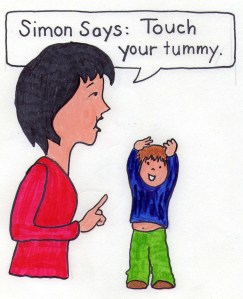
Simon Says touch your tummyResearch at Oregon State University shows that playing Simon Says, Red Light Green Light and other games that require a child to listen, focus, and act appropriately may be the best way to prepare a child for learning.

The idea is to take a simple game, add increasingly complicated directions, and the child will learn how to learn.  One example of an increasingly complicated direction is when the child has to do the opposite of the direction.  So if Simon Says “Rub your tummy,” the child would rub her lower back.

An increasing body of research shows that when a child masters focusing and self-control, the child will do better in learning reading, math and other cognitive skills.

Singing and clapping are additional “games” that improve learning skills.  Songs sung in rounds like “Row, Row, Row Your Boat” are difficult for a young child to master, but worth the effort.  Start by having the child sing along with you, learning the words and the tune.  Later clap to the beat.  Still later introduce the idea of rounds.

(For more information, see “Simon Says Don’t Use Flashcards” in the August 23, 2012, issue of The New York Times.)