Category Archives: reading readiness.

Give your child the gift of books. Give your child a library card.

I remember getting my first library card in kindergarten.
Child excited about her first library card.I needed to be able to write my own name with my mother promising to be responsible. As the librarian looked on, I carefully printed my name in block letters on a paper. Then the librarian put a blank library card into a typewriter, typed my name on it, and handed me the gift of books.

I felt so grown up, like when I earned my driver’s license years later. And did I ever use that card!

Luckily, my public library was three blocks away from my home, on a corner I passed to walk to kindergarten. Once a week my mother would meet me there after school and I would pick out two or three books. How I loved wandering through the tiny children’s section to pull my own selections. How I loved it when the librarian stamped my book!  My mother would take out books for my younger siblings using her card, but I took out my books on my own card.  And when I was in first grade, I could go all by myself, two or three times a week, and exchange books I’d read for new selections.

If your library allows young children to get their own library cards, this is a rite of passage worth celebrating. Keep the library card in your own wallet, if you think your child might lose it, or find a special place for it at home, but get your child a library card.  Take your child to the library, and let her relish the thrill of using a library card. Take her picture with her spanking new library card to show that you consider this an important milestone.

Just like enrolling your child in school, encouraging her to be a faithful library patron is one of the best investments in her education that you can make. And summertime is a great time to get a library card and to take part in the library’s summer reading program. –Mrs. K

Getting my own library card was a momentous occasion. Luckily, I had a short name so I could print it in the tiny space allotted. Back then, a library card was made from card stock. Each library book had a card and a pocket in the back for the book’s card. I never could quite figure out the system for keeping track of it all. But the stamp with the rolling date! I’m not even sure if those are sold anymore!

Living in a city, the library was available on a daily basis. Summer days it was a place to go! And it was free! Yes, the library was then and has always been a big part of my life. –Mrs. A

How many books are enough books for a preschooler?

Preschooler looking at a tall stack of books.1,000 books is a great goal, according to the 1,000 Books Foundation, a nonprofit organization which has enlisted the help of libraries across the US to promote reading. Their effort, “1,000 Books before Kindergarten,” has a simple goal: Children should be read 1,000 books before they start kindergarten.

1,000 books before kindergarten? Yes. They can be all different books or some of the same books read over and over to a child. The reading can begin in utero, or when the child is an infant or toddler, but the counting must stop by the day the child starts kindergarten. Parents are encouraged to write down the name of every book and the date it was read (Log sheets are available at 1000 books).  Writing down the names promotes accountability, and the growing list encourages persistence.

1,000 books might sound daunting, but if a parent reads one book a day for three years, that is more than 1,000 books. Many parents read more than one book a day, making the feat even easier. And if a parent reads a book to two or three children at a time, that counts as a book for each of them.

Some libraries provide their patrons with a journal in which they can list the titles. Some libraries offer stickers to children for meeting benchmark goals. Some local newspapers publish the picture of all children who reach 1,000 books.

Have you participated? Were you able to reach 1,000 books? Let our readers know. –Mrs. K

Of course there are some parents who may be turned off by the idea of listing the title of every book read every day. I know that would become tedious for me. It reminds me of diets where you list every food eaten every day. After a few weeks, most of us cannot maintain the daily log. But how about just a check mark or a number on the calendar…adding up the total at the end of the month and then adding on as the year continues. –Mrs. A

Ever hear of the “summer slide”?

For years, educators have known that students loose reading skills during the summer if they don’t continue reading.  They call this loss the “summer slide.”  It is most severe among low-income students who lose up to two months of reading skills, yet it is sometimes nonexistent among middle class students who make slight gains in reading during summer months.
 
Summer slide (decline) of reading scores.
 
Here’s what some studies show:

  • B. Heyns’ 1978 study of 3000 sixth and seventh graders in Atlanta Public School showed that students who read at least six books during the summer maintained or improved their reading skills.  But students who didn’t read lost up to a whole grade of reading skills.
  • K Alexander’s, D. Entwisle’s and L. Olson’s 2007 longitudinal study of Baltimore students over 15 years found that by the end of fifth grade, students who didn’t read during the summer measured two years behind their classmates who did.  They concluded that 2/3 of the reading difference in ninth graders can be attributed to reading or not during summer school breaks.
  • Dominican University’s study of students completing third grade who took part in their local libraries’ summer reading programs scored 52 Lexile points ahead of their classmates who did not.
  • The Campaign for Grade-Level Reading, funded by many foundations, concluded that children’s absence from reading during the summer is a major hurdle for achieving good reading skills by the end of third grade.
  • The summer slide is cumulative.  Some estimate that by the end of high school the summer slide can account for up to a four year lag in reading achievement, and it can have an effect on high school graduation rates.  According to the Annie E. Casey Foundation, “one in six children who are not reading proficiently in 3rd grade do not graduate from high school on time, a rate four times greater than that for proficient readers.”

So how can you combat the summer slide?

  • Sign your child up for your local library’s summer reading program, and make sure your child completes the reading.
  • Go to the library regularly and let your child select books she will enjoy.
  • Help your child to read a chapter book a week, or a picture book each night.
  • Encourage your child to read the newspaper, television guides, magazines and online articles.
  • Reward your child with a trip to the book store to select her very own book.
  • Read to your child every evening, and let him read to you.  Your reading will teach fluency and pronunciation, and establish the notion that reading for pleasure is fun.

How can I increase the impact of books when I read to my young son?

  • Have you considered pairing two books about the same subject, one facts, one fiction?
  • Or have you considered following a book with a related film?
  • Or have you considered reading a book about the making of a work of art (a cathedral, for example), and then visiting a cathedral with your child?
  • Have you considered reading about the creation of a piece of music and then listening to the actual piece with your child?

This slideshow requires JavaScript.


The example above pairs a picture book, sheet music (on page 78), a youtube piano tutorial, and a youtube video of an orchestra playing Gershwin’s Rhapsody in Blue. Click on these underlined links to see more details or to view the videos.

All too often, we read nursery rhymes, fairy tales and other fiction to our children without considering related nonfiction books, films, music, and paintings. Boys, in particular, might prefer additional factual information.

When my daughter was a third grader, she read Mr. Popper’s Penguins by Florence Atwater. I found some National Geographic Magazine articles on penguins, and together we read them, deepening her understanding of penguins. For a school assignment, she wrote her own penguin book, dedicating it to National Geographic. She could also have read Penguins and Antarctica by Mary Pope Osborne and Natalie Pope Boyce, a nonfiction companion book to Eve of the Emperor Penguin, part of the Magic Tree House fiction series by Mary Pope Osborne. A documentary film about penguins, March of the Penguins, would have told her about the brutal lives of penguins on Antarctica. The animated Happy Feet, though less factual, would have offered another perspective.

Is there a new baby coming into the family? Big Brother Dustin by Alden R. Carter follows a child with Down Syndrome as he anticipates becoming a big brother. A funny companion book might be Junie B. Jones and a Little Monkey Business by Barbara Park, a novel about a kindergartener’s belief that her newborn brother is really a monkey. Many child-oriented nonfiction books are available about pregnancy and birth.

When you read two different types of books on the same subject, often you investigate the subject from two different vantages. Little children need to learn that there are many ways of looking at the same information and that they all might be good, or that one might be real and the other entertaining.

Sometimes the child makes connections between the two books, but sometimes the adult needs to point out similarities and differences to obtain the most impact. For example, you could explain what the words “fiction” and “nonfiction” mean, and how Clifford is a pretend dog while a book about dog breeds shows pictures of real dogs. “Real” and “make believe” are concepts a child needs to learn.

Some children prefer fiction while others prefer nonfiction. By pairing them, the child is exposed to both genres. But of course the main reason for pairing is to deepen meaning for the child. Your child will gain the most impact if you discuss the books with him. –Mrs. K

When I was a child, my favorite book was Black Beauty.  Unfortunately, I never ventured to the nonfiction section of our library.  Was I unaware of it or just stubborn, refusing to step out of my comfort zone?  I certainly would have enjoyed learning more about horses.  My favorite TV horse was a dappled horse ridden by Little Joe on the TV show, Bonanza.  The nonfiction books would have given me opportunities to look at pictures or to read the captions, even if most of the content was too advanced for me. –Mrs. A

How about you? Have you found pairing books or books with other medium to be a good way for your child to learn more? Let us know.

Should I call vowels “long” and “short”? If I don’t, what do I call them?

When a vowel sounds like its name, we have traditionally called it a long vowel. When the vowel can be said with the mouth only partly opened, we have traditionally called it a short vowel.
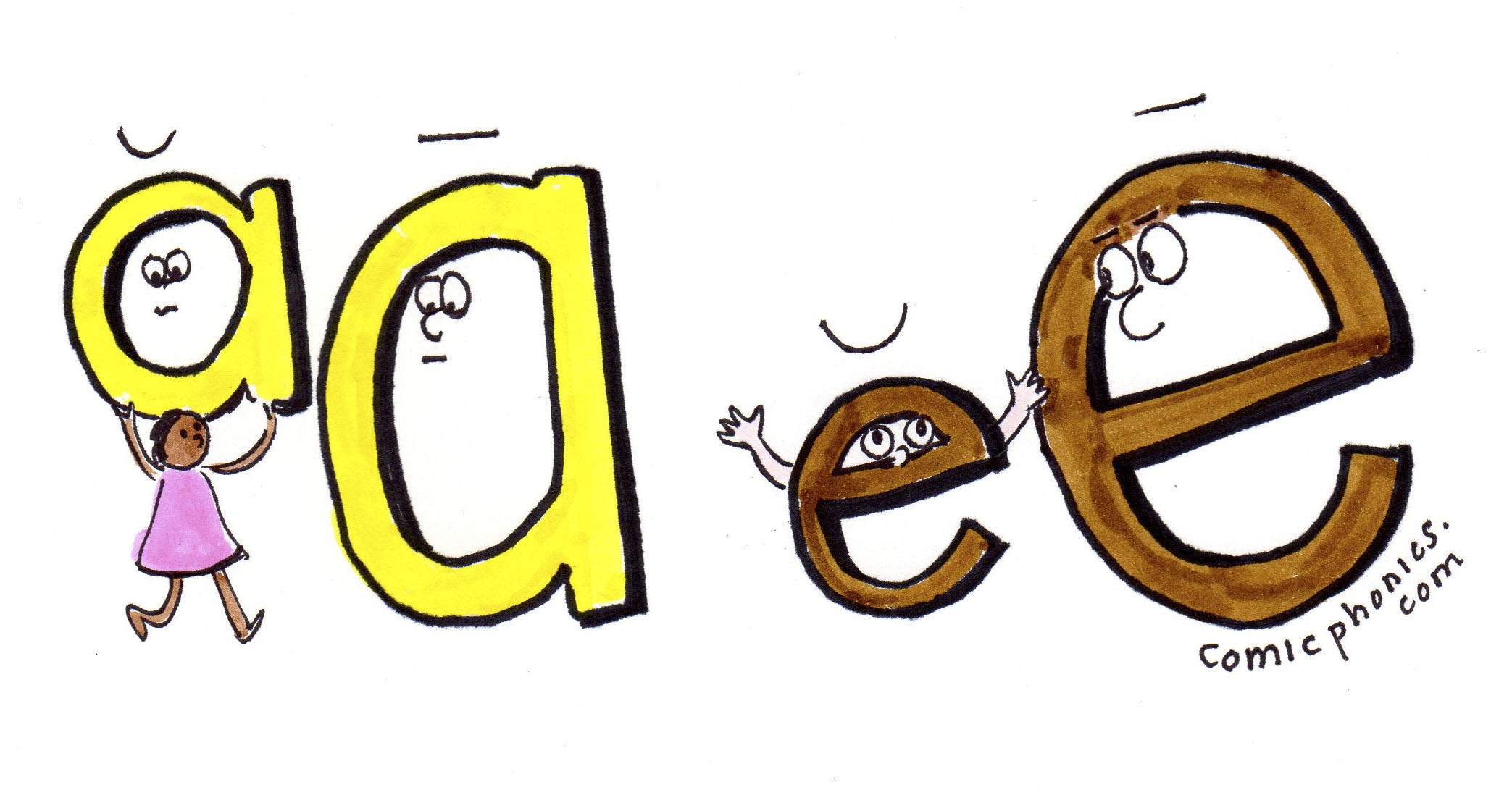
Long and short sounds of a and e
long, short i, o, u
Most Americans learned this way of naming vowel sounds, but today some experts recommend tossing out this old-fashioned naming system for several reasons.

    • First, calling a vowel sound either long or short does not accurately describe the vowel sound since both kinds of sounds take about the same amount of time to say.
    • Second, if the amount of time to pronounce these vowels is about the same, then what does long and short measure? Some experts say it is the length of the opening of the mouth. True, the mouth does open a bit more for long i’s and o’s, but not for the other long vowels.
    • Third, there is a whole other group of vowel sounds which is neither long nor short (ou and oi, for example). Reading specialists call these diphthongs, but that term is usually not used with little children. These vowel sounds are usually called by the sound they make.

You can teach vowel sounds without ever using the terms long and short vowels, but eventually in school, the teacher, or a workbook, or a test probably will use those terms. If your child has not heard the terms before, she might be confused.

I recommend focusing on the sounds until the child knows them. Associate the sounds with letters only after you are sure your child can hear and pronounce the sounds correctly. Mention long and short vowels in passing, but don’t dwell on those terms. After all, it’s not what you call a vowel sound that is important in learning to read; it is being able to pronounce the vowel sound correctly.

When your child notices that the ten common vowel sounds are represented by only five letters, explain that hundreds of years ago, when people were first writing down our language, they ran out of letters to use, so they doubled up on some letters, using them to represent two different sounds. But quickly add that there are clues in the words which tell you which way to pronounce the sounds, so it’s usually not a problem.

What is a Lexile score? My daughter’s Iowa test showed a Lexile score.

A Lexile score is a number used to measure a student’s reading achievement.  Several kinds of tests can be analyzed to determine this score.  The Iowa test is one of them.

Chart of typical grade level scoresA Lexile score is not the same as a grade level score in reading.  The lowest Lexile score—zero L—corresponds to the reading level of a beginning reader.  The highest scores—1600+L—correspond to advanced readers.

These scores can be used to choose appropriate reading materials for a student.  About a half a million books have been analyzed and given a Lexile score.  A student with a score of 800L, for example, would find appropriate reading material in books with a similar score.  At such a match, the student could be expected to comprehend 75% of the reading.  Below is a sampling of Lexile scored books.

List of Lexile scored books.

Find more book lists at: http://goo.gl/hA2X0P

A Lexile score is a scientific measurement of reading based on two factors:  how often words in the test or text are used in English and sentence length.  It is a 21st century readability formula developed by MetaMetrics (www.lexile.com), an organization which “develops scientific measures of student achievement,” according to its website.

Many state departments of education and school districts have licensed Lexile to analyze their tests and to link students with appropriate reading materials.  Several testing organizations such as the Gates-MacGinitie Reading Tests, the Iowa Test, the Sanford and Iowa achievement tests and the Total Reader, an online testing site, are “translating” their reading scores into Lexile scores.  Some online reading sites offer Lexile scores for their reading material.

One shortcoming of the Lexile readability measurement is that, like many readability formulas before it, Lexile measures just a few factors, leaving out many others.  Format and design factors (length of page, length of type line, length of paragraphs, type size and font, size of margins, white space between lines, use of graphics and use of color, for example) are not measured. Neither are the age-appropriateness of the material, the child’s interest in it, or the prior knowledge the child brings to reading.

Even so, Lexile is becoming a widely used method to measure a student’s reading ability and the readability of written materials.

Do you have a list of good books for my kindergartener to read? Or for me to read to her?

Yes!  The Common Core State Standards for English Language Arts and Literacy has published lists of recommended books by grade level.  These lists do not include all good books (far from it!).  Rather the lists suggest books of the right complexity and quality for children by grade level.  The lists also suggest the wide range of subjects that a student should encounter in reading.

The Common Core Standards developers would prefer that you use these lists as guides to find appropriate reading material for you child.  One of the criticisms of the Common Core Standards is that teachers will limit themselves to only the reading material listed.

For kindergarteners and first graders, the lists include stories, poetry, read-aloud stories, read-aloud poetry, informational texts and read-aloud informational texts.  Some of the stories are classics such as Are You My Mother by P. D. Eastman and Green Eggs and Ham by Dr. Seuss.  Others are newer stories.

When you read these or any books with your child, pause as you read and ask the child to tell you what is happening.  If there are pictures, ask him what he learns from them.  Ask him what he thinks will happen next.  When you complete the book, ask him what it was about.   Can he name the setting (time and place) and important characters?  Pick out two or three new words and see if he remembers what they mean.

To find complete lists of recommended books for all grade levels, review the contents listing at the front of the Common Core State Standards for English Language Arts & Literacy in History/Social Studies, Science, and Technical Subjects.

Below are the books recommended for kindergarten and first grade.

kindergarten to 1st grade stories.

To enlarge the graphic, click on it.

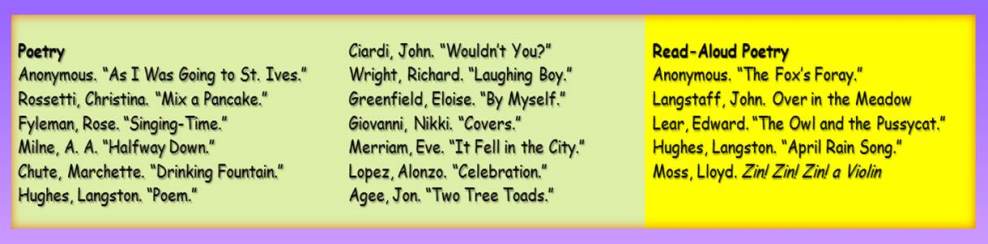
kindergarten to 1st grade poetry.

To enlarge the graphic. click on it.

kindergarten to 1st grade informational text

To enlarge the graphic, click on it.

My child can read basic words. What kind of literature skills should s/he have for kindergarten?

Most states have adopted a common core of standards now used to teach and to assess children’s learning at each grade level and in academic subjects.  Included in these standards are ones for kindergarten reading which include understanding literature, informational texts and reading skills.  Those standards are

kindergarden literature skill standards

Go to http://www.corestandards.org/ELA-Literacy/RL/K for more on the common core of standards.

Key Ideas and Details

  • With prompting and support, the child should be able to ask and answer questions about key details in a text.
  • With prompting and support, the child should be able to retell familiar stories, including key details.
  • With prompting and support, the child should be able to identify characters, settings, and major events in a story.

Craft and Structure

  • The child should be able to ask and answer questions about unknown words in a text
  • The child should be able to recognize common types of texts (e.g., storybooks, poems).
  • The child, with prompting and support, should be able to name the author and illustrator of a story and define the role of each in telling the story.

Integration of Knowledge and Ideas

  • With prompting and support, the child should be able to describe the relationship between illustrations and the story in which they appear (e.g., what moment in a story an illustration depicts).
  • With prompting and support, the child should be able to compare and contrast the adventures and experiences of characters in familiar stories.

Range of Reading and Level of Text Complexity

  • The child should actively engage in group reading activities with purpose and understanding.

For more information, go to www.corestandards.org/ELA-Literacy/RL/K

Is a child’s vocabulary destiny?

Consider this:

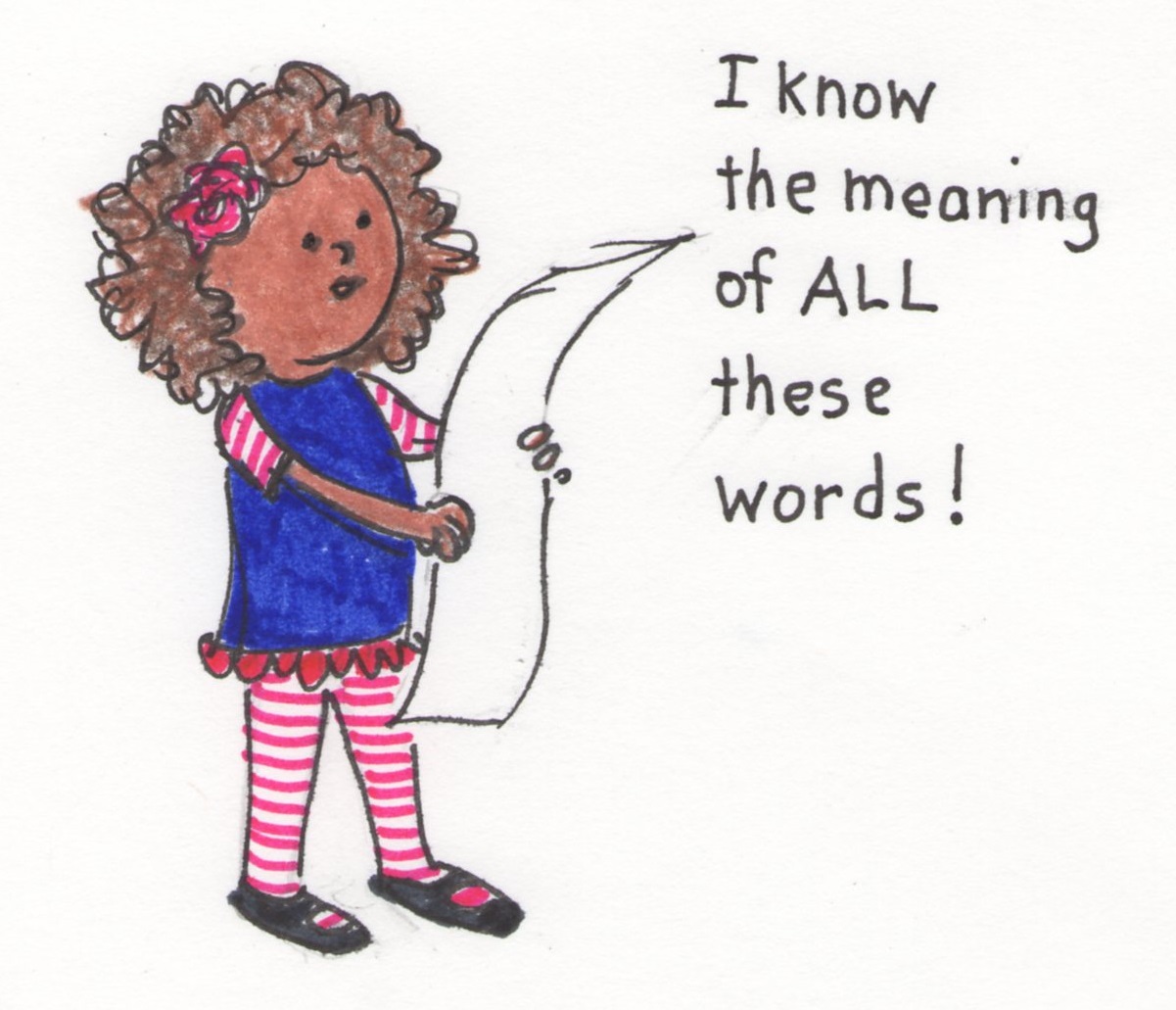
  • Three-year-old children from professional families already have bigger English vocabularies than parents in lowGirl is looking at a list of words she can read.-income families.
  • Children from professional families hear 300 more spoken English words in an hour than children of parents on welfare.
  • By the time children are four-years-old, children of professional parents will have heard 32 million more words than children from poor families.

What does this research by Betty Hart and Todd R. Risley (1980’s and 1990’s) mean?  Combined with more recent research that shows that vocabulary acquisition is the single greatest predictor of reading success, it means that children of professional parents are far ahead of children from low income families as they start preschool.  Other studies show that as a child moves through school, this vocabulary gap increases, directly correlating to a child’s achievement in reading comprehension.

So what can you do with your preschooler, primary grade child, or ESL learnerto increase his vocabulary?  Quite a bit.

A young girl uses the word odiferous to describe a stinky diaper.

  • Use “big” words when you talk to your child.  Provide a rich vocabulary for your child to hear.  “Baby” words are no easier to learn than adult words, so use adult vocabulary with your child.  For example, when I was a child, my father used to come home from work and ask us children, “Is everything copacetic?”  Of course, we didn’t know what he meant, but he explained, and within a short time we were asking one another the same thing.
  • Define new words when you know your child doesn’t understand.  Give an example you can refer to again and again.  Try to give an image to keep in mind if you can.  “Shutters are those door-like things on the sides of house windows, remember?”
  • Choose new words that sound somewhat similar to words the child already knows.  For example, a child knows what a computer is, but “compute” would probably be a new word.  Make the connection to how the computer can add up numbers quickly to help the child remember what compute means.
  • Encourage your child to ask you what a word means.  Don’t laugh at him because he doesn’t know.  We all learn by asking questions, so questioning is a great skill to help your child to develop.
  • Repeat new words often until the child understands.  One or two times is not usually enough.  Try six or ten uses of the word in a few days to cement the word into the child’s memory.
  • Read, read, read to children to expose them to new words.  Nursery rhymes contain old-fashioned words the child might not know.  Emails from Grandma might too.  Read from a variety of genres, but pick topics of interest to the child, so she will pay attention.  Choose books that stretch the child’s vocabulary with new words in context, but not too many.
  • When you are reading to your child, and you come to a new word, read it in context, and then ask the child what she thinks it means.  Try to find something right in her answer, even if it’s, “Well, that was a thoughtful explanation.  Well done.  Now let me explain what the word really means.”
  • Read the same book to a child several times, helping the child to conquer the words in context.  If there are many new words, don’t discuss each one.  Pick a few so the child focuses on enjoying the book.
  • Set yourself a goal of a word a day for a preschooler.  Keep a list on the refrigerator to remind you to use past words again to help with retention.  Let the child see the list growing.  As we measure the height of our children, they feel pride.  As we measure their learning, they will bask in that success, too.

How about you?  Have you come up with any ideas to help improve your child’s vocabulary?  Share your ideas by commenting on this blog.

How can I teach my child vowel sounds?

I have followed a low tech system somewhat similar to teaching consonant sounds, but a system that is a little different too.  This phonetic approach works well with ESL students, young native English speakers getting ready to read and even adults because it makes learning fun.

Looking "over the shoulder" of a young girl sorting pictures of things that have a short A sound when spoken.

To enlarge, click on the picture.

  • I make a set of a dozen or more picture cards for ă:  apple, astronaut, alligator and ax (which begin with ă sound), and other CVC words using ă such as hat, man, dad and bag.
  • I also make one card with ă written on it.
  • At the same time, I make picture (flash) cards with pictures for the other short vowels, and I take some of those cards and temporarily add them to the ă deck.
  • Knowing that discerning vowel sounds is hard, I put the apple card next to the ă card and say the word apple many times, focusing on the vowel sound.  Slowly I help the child say the words in the deck of cards and place the cards near the ă card or in a discard area.
  • When the ă sound is learned (usually this takes several sessions), I take ĕ, ĭ, ŏ and ŭ words, and one short vowel at a time, go through the process with each sound.  Because ĕ and ĭ are hard to distinguish, I do them after ă, ŏ and ŭ, and spend more time on them.
  • Then I start mixing up two of the sounds, such as ă and ŏ.  I put both the ă and ŏ cards on the table, and take the picture cards for only those two sounds, shuffle them, and go through them with the child.  Once the child can distinguish those sounds, I gradually add ŭ to the mix and have the child sort ă, ŏ and ŭ.
  • I leave ĕ and ĭ to last and do those two letters together before I include them with the other short vowel sounds.  It takes many weeks of practice to distinguish ĕ and ĭ sounds.  When the child has mastered them, I add the other three vowels to the deck and the child sorts all five short vowel sounds.
  • When the child has mastered all five short vowel sounds, I go through the same process with ā, ē, ī, ō and ū.  The process for the long vowels goes quicker than for the short vowels.
  • As I move on teaching the child other sounds, I review the vowel sounds if I notice the child is forgetting some of the sounds or mixing up any of them.  This happens with every child I have taught.

Preschoolers and primary school children like this method of learning because they are learning through a game.  They like the control they have—holding the cards and placing them.  They like working one on one with an adult tutor who is paying special attention to them.  Sometimes I do one card and the child does one card to emphasize the fun of learning.  No worksheets, no writing—just fun.  Yet children learn their letter sounds.