Category Archives: reading readiness.

How to know ahead of time if a child will do well in reading, part 2

In our past blog, we discussed one of the two best predictors of later reading achievement, an awareness of letter sounds, based on the research of Dr. Maryanne Wolf of Tufts University.

Today we will look at the second predictor, an ability to rapidly name objects.

Do you remember the story of Helen Keller, the blind and deaf child, who with the help of a gifted teacher, Annie Sullivan, learned to read and speak? Her progress began when one day she recognized that water has a name. From that “Eureka!” moment, Helen realized that everything has a name.

A toddler goes through the same process of learning that everything has a name. This happens at about 18 months when various parts of the child’s brain work in sync to integrate concepts. First, the child names concrete things (what we call nouns), such as Mom, Dad, cat, and dog. Every day the child adds new words, many of which come from the books read to him.

A little later, a child begins to name letters. This activity is sophisticated. The child realizes that those abstract shapes we call letters mean something. One time my friend offered a two-year-old a small stuffed animal which she had received at a fast food restaurant. The toddler looked at the tag on the toy and said, “Chick-fil-A.” Of course he couldn’t read, but he recognized the familiar shape of the letters on the red background.

Learning to recognize letters and numbers and to give them names is the beginning of reading. Here is how you can help a child learn to name things.

  • Play “Simon Says” so that the child learns her body parts.

Simon says Put your left arm up

  • Play “I see something. . .blue” so that the child needs to name objects in the room, in the car or in the grocery store.
  • Teach your child the ABC song, making sure she eventually learns that “elemeno” is actually four separate letters.
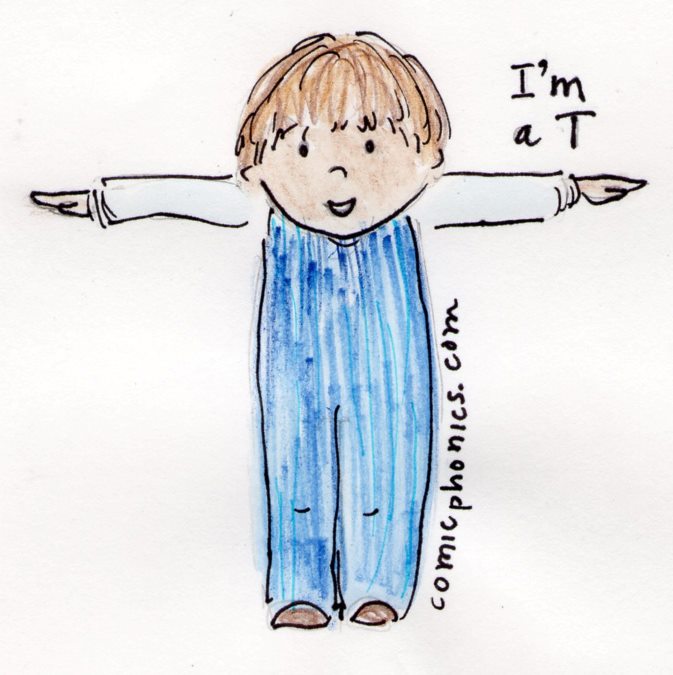
    child making the letter T
  • Point to familiar letters in unfamiliar places, such as the first letter of the child’s name in a sign or on a cereal box.
  • Read to your child. For the youngest children, let them absorb the pictures and name objects in the pictures. For three-year-olds and up, read the words, using your finger to point to the words as you read.

For a well-prepared child, reading doesn’t begin in school. It begins years before.

Is there any way to know ahead of time if my child will do well in reading?

Yes. According to Prof. Maryanne Wolf, director of the Center for Reading and Language Research at Tufts University, the two best predictors of later reading achievement are

  • an awareness of separate sounds (42 in English) and
  • the ability to rapidly name objects.

Today we’ll discuss sound awareness.

When I was a high school student studying French, I used to lie in bed listening to a Montreal radio station. I would try to figure out where one word ended and the next word began.  This same skill is what babies do when they listen to adults talk to them although they don’t realize it. Luckily for most babies, their mothers or caretakers speak slowly and distinctly and repeat words over and over.

With time toddlers begin to hear parts of words and realize that some words have one part (for example, Mom) while other words have more than one part (for example, Grandma).

Still later, usually around age four, children learn their ABC’s, not understanding what they are all about. But with instruction, they learn that each sound in English corresponds to a letter or a pair of letters in the ABC’s.

How can you enhance your child’s success in reading?

Make your child aware of words, syllables and individual sounds.

  • Encourage prereaders to write using invented spelling, advises Dr. Wolf. When the child writes, he sounds out a word and uses the letter symbols which seem appropriate. The “words” might not conform to proper spelling, but that is not the point. The child is working to figure out sounds, a skill he will need in order to read.Girl reading "inventive" writing of younger sister.
  • Encourage the child to listen to someone reading nursery rhymes. Then encourage the child to say the rhymes herself, advises Dr. Wolf.  Take “The Itsy Bitsy Spider,” for example.

The itsy bitsy spider
Climbed up the waterspout.

Down came the rain
And washed the spider out.

Out came the sun
And dried up all the rain.

So the itsy-bitsy spider
Climbed up the spout again!

  • Notice how “itsy bitsy,” “waterspout” and “out,” and “rain” and “again” rhyme. Notice the repetition of the word “rain” and the emphasis on the words “down” and “out.” Other nursery rhymes show alliteration (repetition of consonant sounds) and assonance (repetition of vowel sounds). When children listen to these sounds they learn to discriminate among similar sounds, figuring out what sounds the same and what sounds different.
  • Research shows that exposure to rhymes and alliteration helps children to figure out sounds and later, to read.

In our next blog we will discuss the other predictor of reading achievement, the ability to name.

Physical details can affect readability

Just like we don’t think about the plumbing, water pressure or electricity in our homes (unless there is a problem), we don’t think about little details that have an effect on readability. But these little details can make a big difference to new or struggling readers.

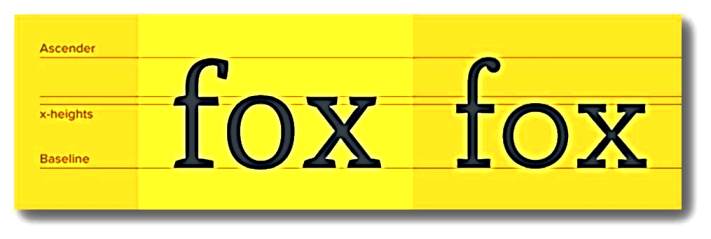
For example, the x-height factor alters readability. X-height refers to the measurement of the lower case x in a font. The bigger the x measures in relation to the type face, the easier that type face is to read. Notice that in the example below, the first x is slightly larger than the second x. Actually the first x is almost two-thirds the size of the f. So is the o.

The X factor in type facesAnother factor affecting readability is the length of the line of type.

Some short
lines of type
make the eye
shift back
and forth
uncomfortably.
They interrupt
eye movement,
making reading
hard.

Do you ever get emails which go from the left of your screen all the way over to the right margin? Are they harder to read than, say, an email that is half as wide? Yes. That’s because, for efficient reading, there is an optimal line length—about 55 to 66 characters, including the spaces between words—and a maximum line length—about 70 characters. Many books meant for children take line length into account, but not all do.


How do I read to my two-year-old? Is he even ready?

Some one-year-olds are ready to be read to, and some two-year-olds are not yet ready. But most are. Reading to a two-year-old can be fun and educational for the child, and subconsciously, prepare the child for more sophisticated reading.

Two-year-olds are all about physical motion, so reading to them should include movement. You could start with board books, and ask the child to tell you what he sees. He might say, “Baby.” Probe a bit. “What is the baby doing? Show me.” Even if he can’t put into words the baby’s actions, he might be able to act them out.  Helen Oxenbury’s books are great for children who cannot speak yet.

baby reading a bookHis physical needs might include holding the book and turning the pages. He will learn to turn pages correctly if you help him. But he will want to go back and forth. He might see a dog on page eight and remember seeing the dog on an earlier page, and he might flip the pages to find the dog. Don’t expect formal sequencing of pages with a two-year-old.

Some books for young children have textured parts for the child to touch. Others have flaps that open and close, or they offer pop-up parts that unfold. Little children love these books, but roddlers tend to rip the pages. Beware. They love to move things in a trial-or-error way to see what happens. Yet their touch is usually not delicate.

You might start reading a picture book and the child might interrupt, pointing to a picture and talking about it. He might not care for the story yet, but he might be fascinated by the pictures. Don’t think that just because there are words you must read them. Let the child guide you.  If he doesn’t want you to read, look for some wordless books or just discuss the pictures.  Most wordless books are intended for toddlers.  They are also great for older ESL students new to English.

Two-year-olds are acquiring language rapidly. If you point to a picture and say “bug” or “triangle,” the child might remember the new word. Two-year-olds are also picking up grammar, so be sure you use grammar correctly, even if the child doesn’t. You don’t need to correct him most of the time.  By hearing you say grammar correctly, he will eventually say sentences correctly.

I remember my preschoolers choosing the same books over and over. I was bored reading them repeatedly, but they weren’t. Children find it comforting to hear, day after day, how the little bird found its mother or how Sylvester returned to his family.

father reading Old McDonald to childNursery rhymes are great for the littlest readers.  Some, like “The Itsy, Bitsy Spider” and “This Little Piggy,” encourage finger or toe play. You can tell the child enjoys nursery rhymes when he starts doing the finger play himself.  Plus, children love rhymes, anticipate them, and race to complete the rhyme.  Rhymes teach children about word families (spout, out; rain, again), too.

You might use reading to a toddler to establish routines, such as what you and your child do before or after a nap.

If there are older children, you might want to read to them at a different time, since a two-year-old’s abilities are quite different from a four- or five-year-old’s.  On the other hand, a patient toddler might pick up reading skills and vocabulary by listening to his older sibling read with you.

So should you read to a two-year-old? Definitely, but keep in mind the abilities of a child that age.


Online site offers current events reading for young readers

If you have a young reader who is reading at a third grade level, a new online site offering nonfiction news articles might attract him.

Child Browsing the WebAt www.newsela.com news stories at five different reading levels are offered. The lowest reading level is targeted for an average third grader, and the highest (the original news story) is written at a college level.  In between are three rewrites at intermediate reading levels.  Two news articles are posted daily, along with a quiz for each article.  Both the news stories and the quizzes are aligned with the Common Core standards for nonfiction literacy.

The news stories are divided into seven topics:  war and peace, science, kids, money, law, health and arts.  Articles from Feb. 6 and 7 include “CVS to stop selling cigarettes,” “Marine biologists baffled by beached whales in Florida,” and “Fourth-graders have become better readers.”

Articles are geared to younger readers by the subject matter, choice of vocabulary and the average sentence length.  I calculated the CVS article written for third graders to have about 8 words per sentence.  Paragraphs in that article ranged from one sentence to five sentences.

To the right of each article, which comes with a colored photo or graphic, are five tabs to allow the reader to choose his own reading level.  If a child finds one level too hard or too easy, he can choose another.

Jennifer Coogan, chief content officer for the website, selects the stories to feature from the AP News Service and the McClatchy-Tribune News Service.  Stories might be international, such as a story about Parliament telling Buckingham Palace to cut back on expenses and to repair its palaces.   Or they might have regional interest, such as the effects of an inch or two of snow on Atlanta.

The people who rewrite the original stories use guidelines for readability, including sentence structure, context clues, and time shifting in narratives.  Because younger readers don’t have “reading stamina,” said Coogan, the articles’ word counts are aligned to state-wide assessments.

The quizzes use multiple choice questions, but they also might ask a student to tell in which paragraph an idea is found.  In the works are questions that require short answers from student readers.  Also coming is a Spanish version of this service.

Although the primary target audience of the website is teachers, parents can sign up for their children.  The annual cost is $18 per student for an individual student; $2,000 per grade in a single school; and $6,000 for a whole school.  So far 90,000 teachers and a half million students are using the site.

In an earlier blog, I wrote how boys often prefer nonfiction reading.  Websites like this one might be a good alternative for them.  The timeliness of the articles, the daily introduction of new articles, the subjects themselves—plus reading and answering questions online—might attract boys who are not keen on reading fiction.  –Mrs. K

Fractured fairy tales

Being able to discuss characteristics of fiction—character, setting, motivation, and point of view, for example—is an advanced skill, something beginning readers and certainly nonreaders can’t do.  Right?

Wrong!

By using two versions of the same fairy tale, children are able to contrast the stories, telling what is the same and what is different, who is telling the story, how characters change, and where and when the story takes place.  Even writing styles of authors can be contrasted.

Another advantage of using two versions of the same fairy tale is to deepen the meaning of the original.  Just like reading one book of fiction and one book of nonfiction on the same topic deepens meaning, so does reading two differing fictional accounts of the same story.

Read about these examples and see what I mean (clicking on the cover graphic will enlarge it).

    • Mike Artwell’s Three Little Cajun Pigs Mike Artwell’s Three Little Cajun Pigs sets the porcine trio deep in Louisiana where Trosclair, Thibodeaux and Ulysse need to build homes in swampland.  Old Claude, an alligator, would like to lick his chops on couchon de lait—that’s Cajun for roast pig.  The basic elements of The Three Little Pigs are included in the story, but with changes children can easily notice, including telling the story in couplets.


    • Lisa Campbell Ernst’s Little Red Riding Hood; A New Fangled Prairie Tale Lisa Campbell Ernst’s Little Red Riding Hood; A New Fangled Prairie Tale finds Little Red Riding Hood in a red hoodie riding a bike through rows and rows of sunflowers on her way to Grandma’s.  Meanwhile, a vegetarian wolf wants to learn Grandma’s secret muffin recipe.  However, Grandma is meaner than the wolf.  Lots of details are the same, but enough differ to make finding them a treasure hunt.


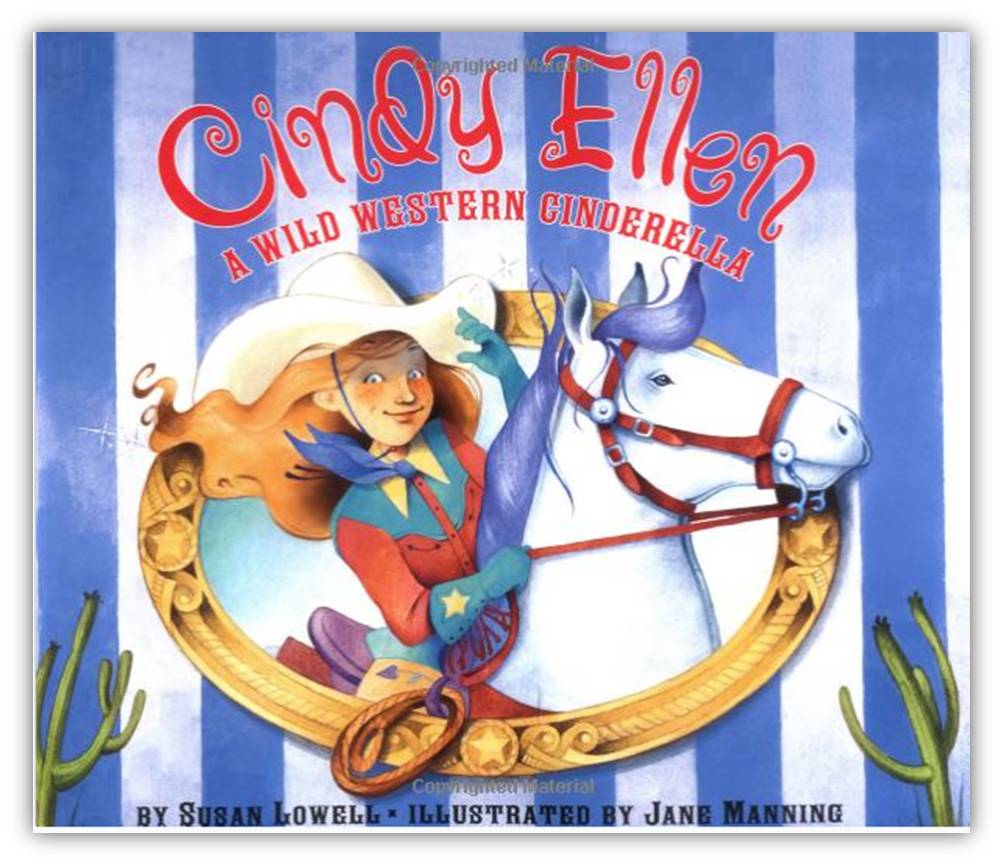
    • Susan Lowell’s Cindy Ellen:  A Wild Western Cinderella Susan Lowell’s Cindy Ellen:  A Wild Western Cinderella offers a sweet cowgirl whose father has married the “orneriest woman west of the Mississippi.”  Cindy Ellen mends fences, milks cows and shovels a corral, attracting Joe Prince, the son of a cattle king.  Lots of changes make this tale a delight, but younger kids might need help recognizing the original Cinderella in this fractured version.


    • Laura Murray’s The Gingerbread Man Loose in the School  Laura Murray’s The Gingerbread Man Loose in the School lets the sweet cookie monster loose in a school, looking for the students who baked him while they are outside at recess.  The silly story is illustrated through comic book panels, unlike a traditional fairy tale.


    •  Leah Wilcox’s Waking BeautyLeah Wilcox’s Waking Beauty focuses on a prince who will do almost anything not to kiss the snoring Beauty—hollering, jumping on her bed, throwing water at her, even shooting her from a canon.  Not your Grandma’s fairy tale.


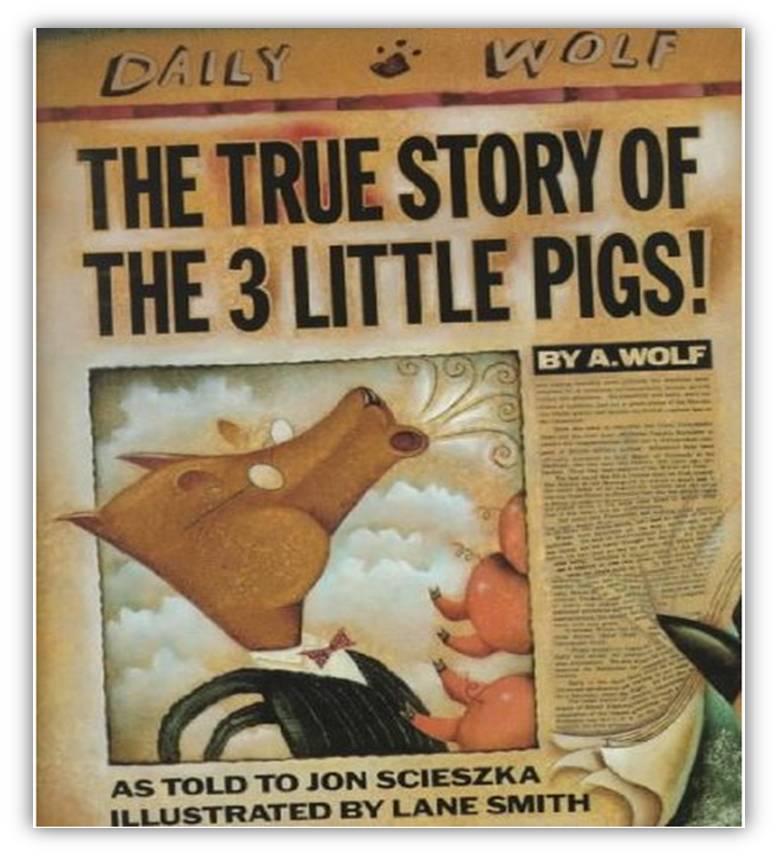
  • Jon Scieszka’s The True Story of the 3 Little PigsAnd of course Jon Scieszka’s The True Story of the 3 Little Pigs, one of the first of this type fairy tale and one of the best, tells the familiar story from Alexander T. Wolf’s point of view.

As starting points for discussion of literature with young children, these stories are great.

“Bring a Book” shower creates baby’s home library

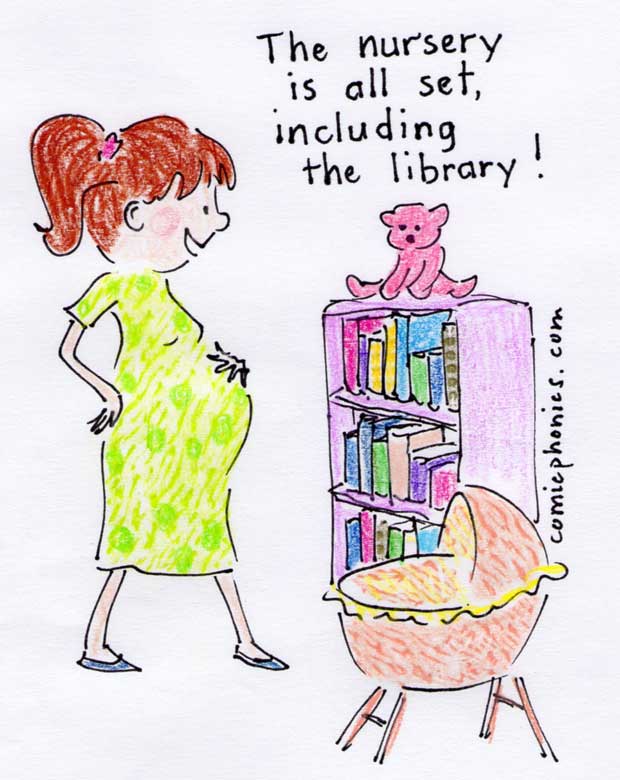
Recently I received an invitation to attend a baby shower with a separate small note attached suggesting that guests bring a children’s book instead of a card.  The idea was well received, with guests of all ages bringing picture books.  “Now all the baby needs is a bookcase,” remarked one of the guests, admiring the stack of books the unborn baby had received.

Home library of children's illustrated books  being admired by soon-to-be mom.Many guests brought a copy of their children’s favorite book.  Many wrote personal messages to the new baby inside the books’ covers, as did I.

What a great new concept, I thought.  But from friends, I hear that this idea has been around for at least a half dozen years.

My niece, whose first child was born six years ago, said guests at her baby shower brought picture books for her expected son.  In her case, bringing a book as a gift was not suggested in the invitation,.  But in the past three years, the practice has become more formalized either as part of the invitation, or as a little note added to the invitation.  My niece’s choices for the recent shower:  Skippy Jon Jones (“The best imagination and rhyming book ever!” she says) and Boynton board books (“Great for smaller people”).

One of the shower guests was a young librarian who brought not one book but a half dozen, including The Other Dog because the mother-to-be has a beloved dog.  She said since a card can cost $4 or $5 these days, buying a book was a much better value.

A male cousin of the mother-to-be picked out I Will Love You Forever because he remembers his mother reading it to him as a child.  His wife thinks the book gift idea is a charming one because each guest brought a book with sentimental value.–Mrs. K


My favorite books to “read” to my kids were the Richard Scarry books.  I say “read” because most of the time we looked at the books and talked about the pictures.  I would point to an object and my son would name it, or vice versa.  The drawings are fantastic and each page is loaded with visual information.

Scarry has a few books about trains, planes, and cars that my boys liked.   He also has books on manners which I loved!  One of them is called Huckle’s Good Manners.  In this book he would show both good manners and BAD manners!  It was so much fun to read about a character behaving badly…lots of laughs.

My kids loved the Where’s Waldo books too!   Even though I have moved a few times, I have held onto the Where’s Waldo books.  Now that I think about it there are no words, just incredibly detailed pictures filled with hundreds of characters.  I remember one year my son had to dress up as a book character for a school event.  He was Waldo.  His nana knitted him the hat.  When my grown up kids come to visit, they still look at the Waldo books.  –Mrs. A

Is recognizing patterns important for little kids?

I was working with a rising first grader over the weekend, using a hands-on parts-of-speech activity to help kids learn nouns, verbs, article adjectives, etc. The student’s job was to manipulate the parts of speech words over the appropriate words in printed sentences. For example, in the sentence, “The stinky dog farts,” the student put the word “article adjective” over the word “the,” “adjective” over “stinky,” “noun” over “dog,” and “verb” over “farts.”

Young boy sorting buttons.

Click graphic to enlarge it.

In a few minutes, however, my student did what all my students seem to do: she organized piles of the word “noun,” piles of the word “verb” and piles of other parts of speech. “That’s not important right now,” I told her, but she persisted as if the organizing of like words became as important to her as identifying parts of speech.

So what?

Recognizing patterns is a skill all human beings do. When doctors listen to the complaints of patients, they hope to find patterns to identify ailments. Quilters repeat sizes, shapes and colors to create pleasing arrangements. Mozart repeated patterns in his music for harmony and to tie elements together. When I was a three-year-old, I would sort my grandmother’s box of buttons by color, or by size, or by the number of holes in each button. There is something about being human being that seeks out patterns.

Finding patterns in groups of words helps children to read. I was working with a four-year-old this weekend, using letter tiles to construct letter sounds which when moved close together, created words. I said the sounds for “c,” “a,” and “t,” slowly moving the letters representing those sounds closer and closer until the child could say “cat.” When I took away the “c” and put a “b,” the child quickly said “bat.” For other words—“hat,” “rat,” and “sat,” she was even quicker. She had recognized a pattern in those words and realized she didn’t need to figure out the middle or ending sounds because they stayed the same.

Later a child will learn how patterns are important in alphabetic order; or how words with the same roots show a pattern in meaning; or how most words which end with –ly are adverbs. He will learn that stories show a familiar pattern—beginning, middle, and end, or that in fairy tales with princesses, “they all lived happily ever after.” He will learn that pronunciation of words follows patterns as do spelling rules most of the time.

If you are looking for fun pattern-building activities to do with your child, I recommend you check out the Reading Rockets website which suggests four easy activities to do with your preschooler to develop pattern thinking. This site also lists and describes five picture books which focus on pattern thinking. While you’re there, look at some of the other great information Reading Rockets provides for parents and teachers of young children learning to read.

Will watching TV help my child learn vocabulary or do better at reading?

Most studies of the effects of television viewing by young children show negative effects, but it is hard to single out effects on only vocabulary or reading readiness.

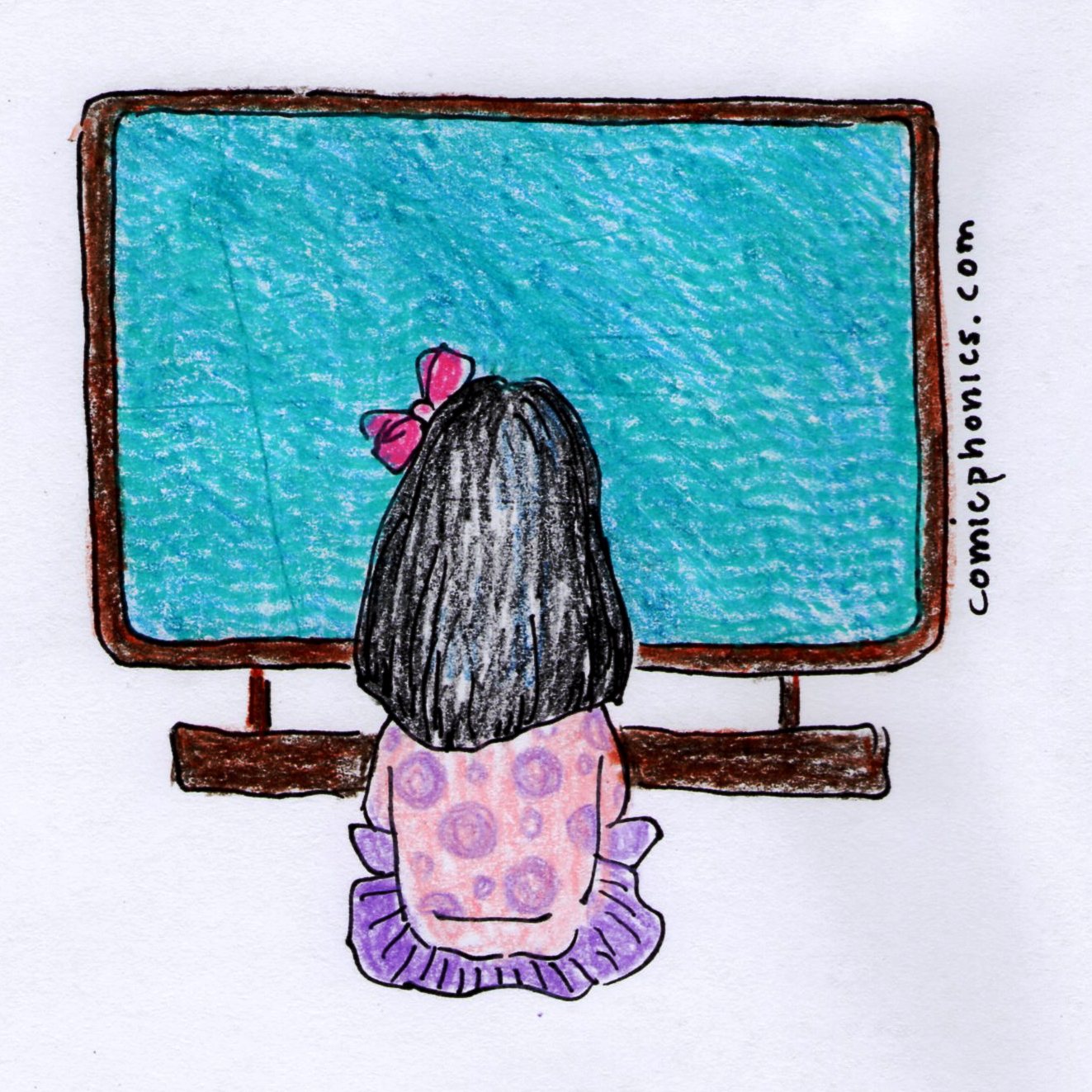
Child sitting in front of a large screen tv.

  • Kids two to five years old spend 32 hours a week—almost five hours a day—watching TV, DVD’s, DVR’s, videos, game consoles, tablets, and smart phones. Most of that time is spent watching live TV programs.
  • Toddlers 29 months old who spend two hours daily watching TV risk lower vocabulary and math skills, and by the time they go to kindergarten, have lower attention spans and are physically weaker.
  • Many homes (as many as 51%) report a TV on in the background most of the time. In such situations, children watch more TV and read less often than other kids. They are less likely to be able to read. One, two, and three-year-olds have shorter attention spans. Parents and children interact less frequently than in homes without constant TV. (the University of Michigan)
  • When the TV is on, adults speak 75 fewer words per hour compared to when the TV is off. Children speak 25 to 50% less when the TV is on. (the Seattle Children’s Hospital Research Institute)

What can you take away from this research?

  • The more time children watch TV, the less time they devote to reading, academic work, physical play and social interaction—all important for a healthy, well-rounded childhood.
  • The more time the TV is on, the less time adults talk to children, and the less time the children talk—all detrimental to healthy, developing children and especially to vocabulary building which is so important for learning to read.

When is the best time to prepare babies for reading?

Click on the graphic below to enlarge it.Questions

Anwsers:  Question 1, Question 2, Question 3, Question 4, Question 5  (each answer will open a browser tab)

Pregnant mom talking to baby in womb.What has this to do with reading?  Babies who have been spoken to often pick up the sounds of their native language.  They learn the patterns of sound that make words and sentences.  They learn that when there is a pause in the sounds, that is a good time for them to respond (with babbling at first).  They learn vocabulary.  When the time comes for them to connect sounds, intonations, pauses and vocabulary with written letters, they are way ahead of children who have limited exposure to oral language.

It’s fair to say that the groundwork for teaching a child to read begins in the womb.  –Mrs. K