Category Archives: reading comprehension

What does sentence difficulty mean? I’ve read that Lexile scores predict the difficulty of a reading passage based on two things: word difficulty and sentence difficulty.

The number of words per sentence can be a measure of sentence difficulty. Sentences written for beginning readers usually contain a handful of words while sentences written for more proficient readers contain one, two or even three dozen words.
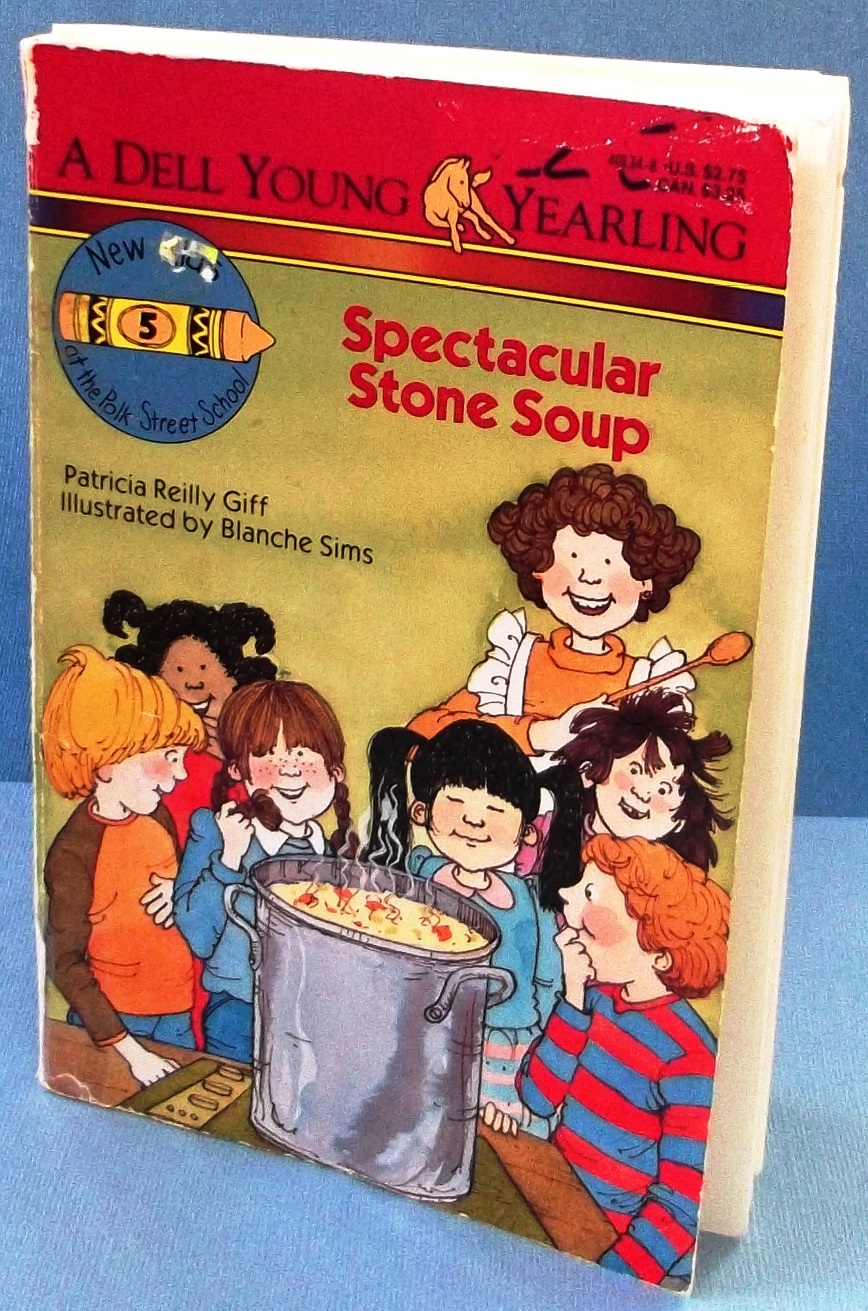
Stone Soup book cover• For example, take the first page of Spectacular Stone Soup, a novel often read in first grade. Here are the first page’s sentences and the number of words in each sentence:

Stacy Arrow hung her jacket on a hook. (8 words) Next to her Jiwon took off her coat. (8 words) Stacy pointed to a sweater on the floor. (8 words) “Whose is that?” (3 words) “No one’s.” (2 words) Jiwon shook her head. (4 words) “It’s been here all year.” (5 words)

• Now compare that novel for beginning readers to a novel for more advanced readers, Harry Potter and the Deathly Hallows.  Here are its first paragraph of two sentences:

Harry Potter book coverThe two men appeared out of nowhere, a few yards apart in the narrow, moonlit lane. (16 words) For a second they stood quite still, wands directed at each other’s chests; then, recognizing each other, they stowed their wands beneath their cloaks and started walking briskly in the same direction. (32 words)

The type of sentence (simple, compound or complex) can be another measure of reading difficulty.

• In the Spectacular Stone Soup selection, each sentence is a simple sentence with one subject and one verb. Some of the sentences have a prepositional phrase; some have adjectives; some have pronouns, but because of the short length of the sentences and the way each sentence limits itself to one idea, comprehension is easy.

• In the Harry Potter selection, the first sentence is a simple sentence but there are two prepositional phrases and an adverb phrase. The second sentence is a complicated compound sentence. Its first clause begins with a prepositional phrase followed by a subject, verb and two adverbs, followed by a noun phrase and a prepositional phrase. Its second clause (after the semicolon) begins with a participle phrase and a subject, but then begins one predicate with a verb, direct object and prepositional phrase and then begins another predicate with a verb, gerund, adverb and prepositional phrase.  Each sentence contains more than one idea.

Word order can be a measure of difficulty.

• In Spectacular Stone Soup, all but one sentence begin with a subject followed by a verb, the usual word order in English. The exception is a sentence which begins with an easy prepositional phrase.

• In the Harry Potter selection, the first sentence begins with a subject and a verb. The second sentence begins with a prepositional phrase, but the second clause in that sentence begins with a participle phrase.

Pronoun antecedents can be a measure of difficulty.

• The Spectacular Stone Soup selection uses the word “it” to refer back to the sweater used two sentences earlier.  It also uses the word “her” to refer back to each girl, but that pronoun is stated in the same sentence as its noun antecedent.

• The Harry Potter selection in the second sentence uses several pronouns (they, their, other’s) to refer back to the noun (men) used at the beginning of the first sentence.  The pronouns are father apart from their noun antecedent.

Parts of speech used can be a measure of difficulty.

• In Spectacular Stone Soup, the words are nouns, verbs, articles, adjectives, adverbs, pronouns and prepositions. Most are one syllable words but a few are two syllables.

• The Harry Potter selection includes the same types of words, but additionally uses a participle used as an adjective and as a gerund. The passage contains a three- and a four-syllable word.

Coupled with word difficulty, sentence difficulty can make reading passages easy or hard to understand. Authors consider their audiences and their reading abilities carefully before deciding how long to make sentences, whether to make sentences quite simple or complicated, whether to use pronouns or to repeat nouns and whether to write sentences in typical subject-verb word order.

As we mature we want more complicated vocabulary and sentence structure to entertain us. In fiction the story comes first, but how much we enjoy the story depends on the crafting of the sentences by the author. In nonfiction, the facts come first, but again, how willing we are to read those facts depends on the skill of the author in using the components of language, including sentence structure.

When my first grader reads aloud he plows right through periods as if they don’t exist. When I ask him about what he just read, he has only a vague idea. How do I help him?

It sounds like your son might be having a fluency problem. Fluency is one of the four components of reading and involves three skills:

  • Accuracy—decoding the words to pronounce each one correctly.
  • Speed—reading at a pace which is fast enough to connect words into ideas.
  • Prosody—reading with expression so that the words and sentences sound meaningful.

Assuring he can pronounce most written words properly is the first step. Since you don’t mention pronunciation problems, I assume he can decode just fine.

dhild running with book in handsSpeed is the next consideration. Is he reading at a normal reading pace—not too slowly because he is stumbling over pronunciation, and not too fast because he is racing? From your question, I assume he might be racing and jumbling too many words together to understand them. Insist that he stop at a comma and a period, and if he forgets, stop him and ask him to reread the sentence. Then ask him what it means.

Lastly, listen for the way he reads. Does he raise his voice at the end of a question? Does he change the tone of his voice when the big bad wolf is talking? Does he say some words louder and some words softer to show he understands the meaning behind the words? If he is not doing this, he will have a more difficult time figuring out the meaning because he is leaving out emotion.

One key for you to know that your child is comprehending what he is reading is his use of inflection, that is, altering his voice in tone or pitch. Children who plow through sentences don’t inflect. They are reading too fast to decode and to inflect at the same time.

When a child first learns to read, accuracy is most important. But it sounds like your child is beyond this stage of decoding, at least with the kind of books he is reading.

How can you help him?

  • Make sure your child is reading books just slightly beyond his level of reading, not books too advanced for him.  Does he understand the vocabulary he is reading?  Does he understand the topics?  If not, comprehension will go down.
  • Consider reading aloud to him more, modeling inflection. Just because he can read alone is no reason why you should stop reading aloud to him. He still has so much more to learn about reading—vocabulary, for example, and making conversation sound real.
  • Is he allowed to stop reading when he has finished a certain number of pages? If so, he might be racing in order to end his reading session early. Change your strategy.  Ask him to read a certain amount of time no matter how many pages he reads.
  • Let him know he is going to need to explain what he has read when he is done, and if he can’t explain it, he is going to need to reread it with you. Needing to explain or redo will force him to slow down.

Another possibility is that your child is a high functioning autistic person.  People with autism can have high intelligence, but emotions baffle them.  Because they cannot “decode” emotions in their everyday lives, they cannot “decode” emotions in books, so stopping for punctuation might add no meaning to what they read.  If your child is autistic, early intervention can help.  Contact your school counselor or your pediatrician for an evaluation.

But from what you have said, I suspect your son is in a hurry and needs to learn that speed reading without understanding is a waste of his time.

My child is almost four. She wants to learn to read. Where do I begin? Or does it matter?

It matters, according to research. You should start with teaching her “the code,” that is, the connection between the sounds of the English language and the letter symbols we use to mean those sounds. Here’s how. (Look for more information on all these ideas in previously published blogs at comicphonics.com.)

  • children moving letter tilesFirst, make sure she can pronounce all 42 sounds of English. Listen to how she pronounces everyday words and make sure she is saying the sounds correctly. Help her with pronunciation.
  • Then connect sounds with letter symbols, a few at a time. Start with the beginning sounds of a few key words such as the child’s name, m for mom, d for dad, b for baby. Help her to hear those sounds in the beginnings of other words. For example, if you are pouring her milk, ask her what sound milk begins with. Then show her an “m” and explain that is how we show that sound.
  • Beginning sounds are always the easiest to hear, so focus on them.
  • Help her to write the initial of her name and a few other meaningful letters.
  • child on floor reading picture bookSince each vowel has many sounds, teach her to associate each vowel with a word and an image that begins with a “short” vowel sound such as apple, egg, igloo, octopus and umbrella. Later, she can compare the vowel sounds in new words to those vowel sounds.
  • In speaking, start putting letter sounds together to form one-syllable short-vowel (CVC) words she knows, like “cat” and “dog.” When she can hear how words are formed (phonics) by combining sounds, use letter tiles to show her what the combining of sounds in words looks like using letter symbols.
  • When you are reading stories to her, point out words she might be able to decipher, and help her to sound them out.
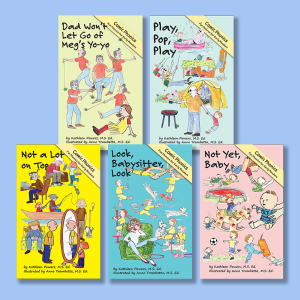
  • When she knows most of her sound – letter matches, she is ready to start reading books which use one-syllable, short-vowel words. Unfortunately, few good ones exist. We at comicphonics.com have written five humorous books for new readers. (See the links to the right of this blog.) Your librarian can point out where other books are shelved, but many labeled “first” readers contain difficult words. Margaret Hillert has written some good beginning books, and so has Dr. Seuss. Good illustrations can help the child figure out the meanings of difficult words, but she will probably need your help as she begins.

Figuring out the code of written English is how a child begins to learn to read. There are lots of commercial methods to do this, but the best I have found is the Explode the Code series. Children find its combination of goofy pictures and sequenced phonics instruction fun.

Later you can focus on other aspects of reading including fluency and comprehension. But the place to begin is demystifying the code by connecting the sounds of our speech to individual letters and pairs of letters, and then combining them to form words.

My kindergartener wants to read chapter books. What features should I be looking for so she doesn’t get discouraged?

Congratulations! Some early readers are ready for chapter books, but that doesn’t mean all chapter books are right for them. Here’s what you should be looking for.

  • Characters whom the child relates to and cares about are really important. That means child characters, ones the same age or just a bit older than the reader, or characters who behave in child-like ways, such as Toad in the Frog and Toad series. The characters in books for young readers must be encountering situations that the reader can relate to—like Junie B. Jones fearing to take the school bus, or of Nate the Great visiting his friends’ houses in search of a lost cat.
  • girl reading Junie B. JonesCharacters should be different from one another—their names, gender, and personalities. Junie B.’s friend, Lucille, is prissy and wears pretty dresses while her classmate, May, is a tattletale. Frog’s friend, Toad is a short, brown scared follower while Frog is a taller, green, organized leader.
  • If the chapter book is part of a series, familiar characters or activities should appear. Children delight in recognizing these patterns. They know that when reading Nate the Great stories, for example, Nate always takes a break to eat pancakes. His friend, Rosamond, always appears with her four black cats. Nate’s dog, Sludge, helps him solve crimes, while another dog, Fang, always makes an appearance.
  • Asian girl reading book Plots should be straightforward with no flashbacks or complicated subplots. If the story concerns finding one of Rosamond’s cats, then that becomes the whole focus of the story. Good books remind children what they have learned. A character like Nate might think about the clues he’s uncovered, and a list of them might appear as an illustration. The plots are shallow and move quickly through a series of events.
  • Good chapter books for young readers should contain illustrations. A page of text will appear harder to read than a page with a line drawing on it. The drawings should provide additional information that the text might not dwell on. For example, drawings of Junie B. show her with fly-away hair and one sock up, one sock down, telling us in pictures about her personality. Illustrations don’t need to appear on every page, but more illustrations make the book appear easier to read.  Also, illustrations lengthen the number of pages, so the child thinks she is reading more than she actually is.
  • girl looking at book displayPicture books are printed with large type, but chapter books have reduced size type. To offset this change, good chapter books for young readers will increase the space between the lines of type and increase white space by making margins larger. This makes the text easier to read and the page “friendlier.” Good children’s books use dialog too. Dialog is usually short, so more white space surrounds it. Hyphenations will not be used at the ends of lines to split words, and sentences will end on the bottom of a page rather than being carried forward to the next page.
  • Discouraged child thinks there are too many words in a book she is readingThe vocabulary of chapter books for young readers should be easy enough to read so that the child can read for enjoyment, without help. New words can be introduced, but in context, and should be repeated during the story so the child can master them.
  • Sentence structure should be normal, that is, subjects followed by predicates. When complex sentences are used, the dependent clause should come second. That is the way children speak and write, so that pattern will be easy to understand. Sentences should be shorter than adults would expect. Not all sentences need to be short, but longer sentences should make sense on the first read through.

Right now I am working with a second grader who is reading his first chapter book, Charlotte’s Web. It was assigned by his teacher. Some of the characters’ names are similar (Avery, and Mr. Arable, for example). The vocabulary is advanced. The pig is called “radiant”; he is put into a “crate”; he is watched by “goslings.” For a suburban child, these words are mysterious. The sentence structure is too sophisticated. Even though Charlotte’s Web is an excellent novel, it is not an appropriate first chapter book for my student. He is not ready to read it without help.

In my public library, chapter books for elementary school aged students are grouped together. Within those books, some are labeled on the spine, “First chap.” Those books are perfect for children reading their first chapter books. Or if you are lucky enough to have a children’s librarian, ask her what books she would suggest. Or phone or visit your school librarian and ask her for help.

Hundreds of wonderful books are appropriate for your kindergartener. Good luck!

Is the Common Core’s emphasis on nonfiction reading justified?

Perhaps the biggest change the Common Core is bringing to public school reading in the US is its emphasis on reading more nonfiction and less fiction. The reasoning behind this change is to prepare students better for the reading they need to do in their math, science and social studies classes and in their future careers, especially in STEM fields (science, technology, engineering and math).

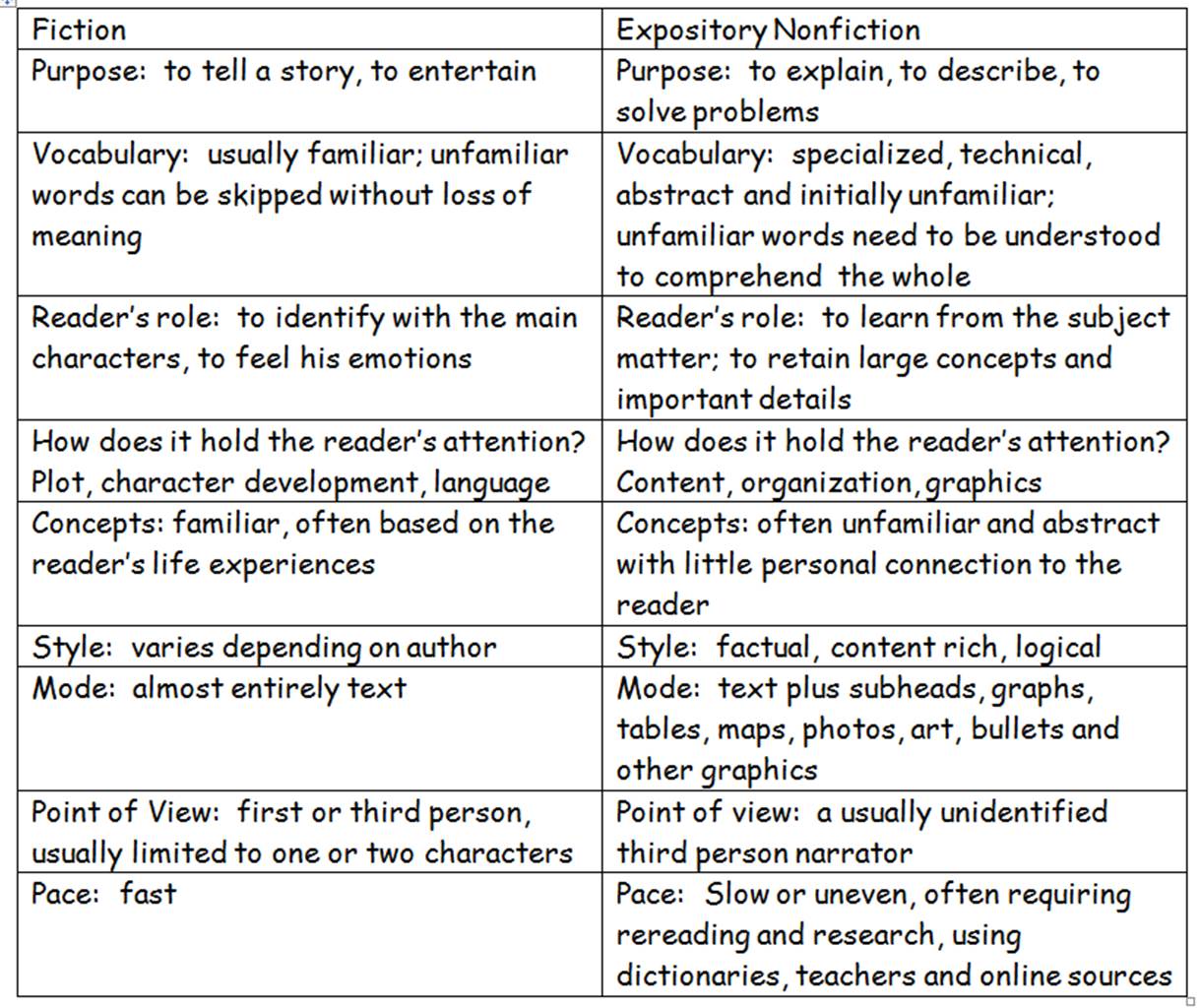
Is the change really necessary? Let’s compare fiction reading and nonfiction reading for students who are beyond the picture book stage.

chart comparing fiction reading skills with nonfiction reading skills

(Adapted from State of Wisconsin, Wisconsin Governor’s Literacy Education and Reading Network Source)

As you can see, reading nonfiction is harder than reading fiction. It often requires more parent or teacher involvement prior to the reading to make connections to what the student already knows; during the reading to explain vocabulary and concepts; and after the reading to restate the main ideas and important details or to explain complicated concepts.

Fiction, too, can be better understood with teacher involvement, but usually fiction can be appreciated (if to a lesser degree) by the student reading alone so long as the student’s reading level matches the reading selection.

If you hope your child will have a great career someday as a doctor or environmentalist or physics teacher, you can appreciate why an increased emphasis on nonfiction reading is important even in first grade. You may question the Common Core, but its emphasis on more nonfiction reading can only help our kids.

Is gesturing by a child learning to read important?

When my son was almost two, and not talking much, I often read to him a picture book by Helen Oxenbury which showed a toddler doing everyday things: pulling on his socks and pants, for example. I would ask my son, “What is the baby doing?” My son would show me by gesturing—pretending to put on his socks, or pretending to pull up his pants. Once he learned to say words, I stopped this practice.

child making letter T with his body

It turns out that I should have continued with the gesturing. Research shows there is a positive relationship between gesturing and learning in children. By noticing your child’s gestures, you might be able to tell when he understands a concept or when he is trying to figure it out.

According to research,If a child understands a concept, the child’s words and gestures are in sync.

  • For example, if you ask the shape of a triangle, and the child says “three sides” and then draws a triangle with his index finger, the gestures and words are in sync, and you can presume the child understands.
  • If a child is still learning a concept, the child’s words and gestures might be out of sync, and there might be an abundance of gestures or a shrug.
  • For example, if you ask a child to tell you what an orbit means, and the child says “space” and draws a rounded triangle,” the child’s words and gestures are not in sync. The child is still learning.
  • Out-of-sync responses offer parents and teachers an opportunity to help the child learn while his understanding is fluid and open to instruction and before he learns something wrong.

Is gesturing necessary for learning? Probably not, yet research shows that children who gesture while they are learning are more likely to learn. This is especially true if the child is asked to explain a general concept.

For more scholarly details on this subject, check out the work Susan Goldin-Meadow of the University of Chicago, an expert in this field.

If my child reads slowly, he can pronounce almost all the words correctly, but he understands almost nothing. If he reads faster, he mispronounces many words but he seems to understand a bit. Which do I go for—accuracy or comprehension?

Accuracy. But let’s backtrack a little.

At what stage of reading is your son? Is he reading passages matched to his reading level? If a child is plodding laboriously through text, the text is too difficult for his reading level. He is not achieving fluency. I suggest you go back to easy readers which he can read accurately and with understanding in order to give him confidence.boy reading book

If he is in third grade, for example, you might find some first grade reading for him. Ask your librarian for help. If he can read sight words and CVC words at a good pace, with word accuracy and with overall comprehension, you know he is reading at least at an early first grade level. Gradually increase the reading difficulty. You want to maintain the child’s confidence, so increasing the difficulty level should not happen in a matter of days but rather over weeks or months.

Some problems to listen for:

  • If a child is stumbling, word to word, he is not phrasing within sentences.  For example, all the words in a prepositional phrase go together and should be said as a unit; the subject and it’s modifiers should be said as a unit.  Practice reading aloud with you modeling how to say a given sentence, and ask your son to phrase words so that they make sense.
  • If a child is reading in a flat monotone, his reading lacks inflection.  Some languages lack inflection (Korean, for example), and children from that background might feel foolish saying some words louder and some words softer, or saying part of a word louder than the rest of a word.  If you can read with inflection, let the child listen to you and then ask him to repeat the words the same way.  If you cannot read with inflection, a child can listen and read along to books on tape.
  • If a child is bulldozing longer words rather than sounding them out, he could have problems with phonics, or be dyslexic,  or  be an impatient personality.  Cover suffixes and prefixes, discuss the root word’s meaning and the meaning of the suffixes and prefixes, and then reassemble the word.  Reread the sentence and ask the student what the word means in the context of that sentence.

Some manufacturers have a reading level on the back cover of children’s books. “RL 2.2” for example means reading level second grade, second month. Other books are color coded by the library, and still others show reading level with a lexile score. In my public library, one long wall of books contains easy readers for children learning to read. You might find an author whom your child likes. Ask your librarian for help so that your child is reading at the correct reading level and gaining confidence.

As your child progresses to higher reading levels, he will probably read with less accuracy and at a slower speed unless you actively intervene. Ask him to read aloud. When he pauses or stumbles, let him try to figure out the difficulty himself, but if he can’t, stop him and help him. Perhaps you will notice he doesn’t understand a concept in phonics; or that prefixes or suffixes confuse him; or that he doesn’t know where to make the break in multi-syllable words so he pronounces words wrong; or that a secondary meaning of a common word baffles him. Teach him how to solve his problem. Then let him continue reading that sentence or that paragraph. Now ask him to reread it. If he continues to stumble at the same spot, you know that he needs stronger intervention on a particular skill.

At the end of paragraphs or chapters, it’s important to ask your child what happened (in fiction) or what is the main idea (in nonfiction). If he talks around the idea but cannot nail it, he was focusing on individual words and missing the meaning of sentences or paragraphs. The reading was too hard. If he can retell the story or explain the main idea, he is comfortable at that reading level, and should try a slightly higher reading level.

What I see with many of my students is that they begin to have difficulty with reading once they have mastered the basic rules of phonics. It’s not a decoding problem; it’s a vocabulary problem.  As the reading level increases, so do the number of words they don’t understand. It’s not a matter of pronunciation usually; it’s a matter of having no idea what a given word or an idiom means. This is particularly true for ESL students.

That is why I say accuracy is important. If a child cannot read a given word accurately and know what it means, then understanding a sentence or a paragraph—with lots of unknown words—becomes impossible.

My daughter reads fast, but when I ask her to summarize, she can’t explain well. What do I do?

Occasionally a read-a-holic student will have lower than expected reading grades. The parent is baffled because the child always has a book in her hands and goes through novels voraciously. When I ask such a student to read aloud for me, she shows many of these behaviors:

dhild running with book in hands


  • She doesn’t slow down for commas or stop for periods.
  • Her sentences merge and keep going for as long as she can read without taking a breath, and when she pauses to breathe, it might be in the middle of a sentence.
  • She may skip a line of reading when moving from the end of one line to the beginning of the next.
  • When she comes to an unfamiliar vocabulary word, she bulldozes it, pronouncing it any which-way, and continues reading.
  • Her inflection is flat, like that of an auctioneer.
  • She does not self-monitor; she doesn’t pause to consider that she didn’t understand what she just read.
  • When she answers questions about the reading selection, she does not remember important details and she doesn’t take the time to search for them in the selection.
  • She misses inferences and more subtle figurative language like metaphors.When asked to restate the main idea in a sentence or two, she talks around the subject but doesn’t nail the point the author is making.

What’s going on?

For such a student, speed is the important value. Finish quickly. Move on. (Notice if she is slap-dash about her piano practicing, dressing or cleaning her room. This is a personality trait, not just a reading trait.) In reading, this behavior might develop as she reads novels of her choice. She doesn’t care if she understands every nuance; she would rather understand enough to enjoy the story without slowing down for details.

This kind of reading might work for leisure-time reading, but it doesn’t work for most school reading, especially the kind of reading being tested under the new Common Core Standards. Common Core is trying to break such bad habits by forcing a reader to name the paragraph in which the answer is found, to define a word, to distinguish between fact and opinion, to restate an idea, to infer and to summarize.

What to do to improve fluency and reading comprehension?

  • Ask your student to read aloud. She will fume because it takes longer to read aloud. But make her do it. Silently read along with her and note the kinds of errors  which she is making.
  • If she is ignoring punctuation, stop her and ask her to reread and pause appropriately. She will hate this, but making this one change is half the battle.
  • Ask her to use inflection now that she can hear the sentences correctly. Model it if necessary.
  • If she slides over longer words she doesn’t know, stop her immediately and ask her to sound out the word. If she can’t do it on her own, cover a prefix and a suffix; ask her what the root means, or if she knows another word with that root. Then reassemble the word and pronounce it.
  • Sometimes it is not the long words which stump students; it is the idioms or the secondary meanings of short, familiar words. Stop your student when she encounters such words to be sure she understands them.
  • If she skips lines of reading, have her use her finger to keep track, or an opaque book mark.
  • At the end of a paragraph or a few paragraphs, ask her to explain what she just read. If she has missed something significant, go back and show it to her and together figure out why she missed it.
  • Many times, ask what the main idea is. If she can’t nail it, have her reread while you point out clues to the overall meaning.
  • Model self-monitoring by stopping her now and then to take stock of what was read and what to expect next.  Let your student hear you talking to yourself about what you just read.
  • Lastly, let her read her leisure-time reading undisturbed, bad habits and all. You can only fight so many battles; let her win that one small skirmish.

Teach art literacy when sharing picture books

When children start to “read” picture books, generally they are reading the pictures; that is, they are trying to get meaning from the pictures since they can’t read the words yet.

They might study the appearance of a character, noting if it is a boy or girl from the clothes. Or they might look at the dark swirling clouds or the beaming sun to discover the atmosphere of the story. They might look at the colors the illustrator uses. Bright colors and pastels might indicate a happy or peaceful theme; dark colors or colors tinged with greys and blacks might indicate danger. Horizontal lines or smooth lines might indicate calm while jagged or diagonal lines might indicate action.

children looking at picture of Lincoln and Mrs. Lincoln

Some children perceive these clues without explicit instruction, but many children need someone to point out how colors, lines, and facial expressions tell the story too.

According to research by Kathleen Ellen O’Neil, illustrations can interact with the text in four different ways.

  • The art can reinforce the text, “showing” the text. For example, in “The Mitten,” adapted and illustrated by Jan Brett, a boy loses a mitten which his grandmother has just knit. One by one, we see animals from a tiny mole to an adult bear squeezing in to the mitten. The illustrations show the hedgehog’s quills and the badger’s nose poking through the wool.
  • The art can supplement the text, providing description which the text either skimps on or doesn’t describe at all. For example, also in “The Mitten,” we see the boy dressed in a Ukranian tunic, leather pants and boots with folk art borders. The book doesn’t mention where the setting is, but the art shows.
  • The art can provide far greater detail than the text, offering new insights which a literally-minded child might miss. It can illustrate nuances, inferences, humor and irony, adding depth to the text. In “The Mitten,” for example, the boy finds his mitten after the animals have left it behind, and he brings it home. The last page of the story shows the grandmother holding both mittens and noticing how much bigger one is than the other. No words are used, but we can hear her wondering, “How in the world?”
  • The art can convey a parallel story which either expands the text or contradicts it. Still in “The Mitten,” to the left side of almost every page we see the boy playing in the snow—hopping on a log where the rabbit lives, poking with a stick above the hedgehog’s burrow, looking in a tree’s knothole where the owl lives and climbing atop a woodpile where the fox lives. To the right side of those pages we see an animal leaving its disturbed home, and on the next page that animal squeezes into the mitten. Nothing in the text says that the boy disturbed the animals, forcing them to seek shelter elsewhere. A discerning youngster might notice it, but many children will need this part of the story explained.

For more information and other examples of books which clearly show the four different kinds of art interaction with text, go to the November 2011 issue of “The Reading Teacher,” page 214, for the article by Ms. O’Neil.

Use the K-W-L approach before reading to activate prior knowledge

K-W-L charts have been used by reading teachers for almost 30 years, but they can be just as useful to parents of young children to help them with reading comprehension.

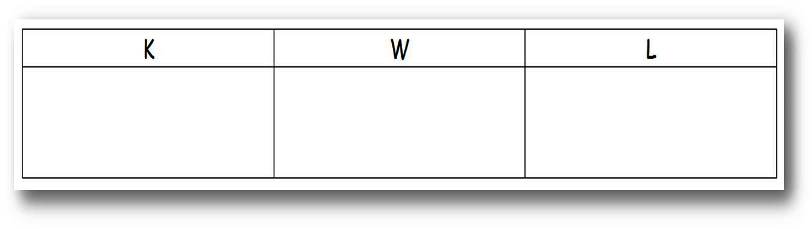
K stands for “know” or what the child already knows about a given topic. W stands for “want to know” or what new information the child would like to learn about a given topic. L stands for “learned” or what the child has learned after reading (or having been read to).Empty K-W-L chart

With younger children who cannot read yet, using the K-W-L strategy sets up a pattern which the children can use in the future. One reason some children struggle with reading comprehension is because they don’t think about a topic before they read about it. If children learn to consider what they already know, and link new information to that, they will usually understand the new information better and retain it.

Since writing down words doesn’t help a nonreader such as a preschooler or a new ESL student, drawing pictures can replace the words. Even for children who can read a bit, sometimes drawing the pictures adds fun to the learning experience.

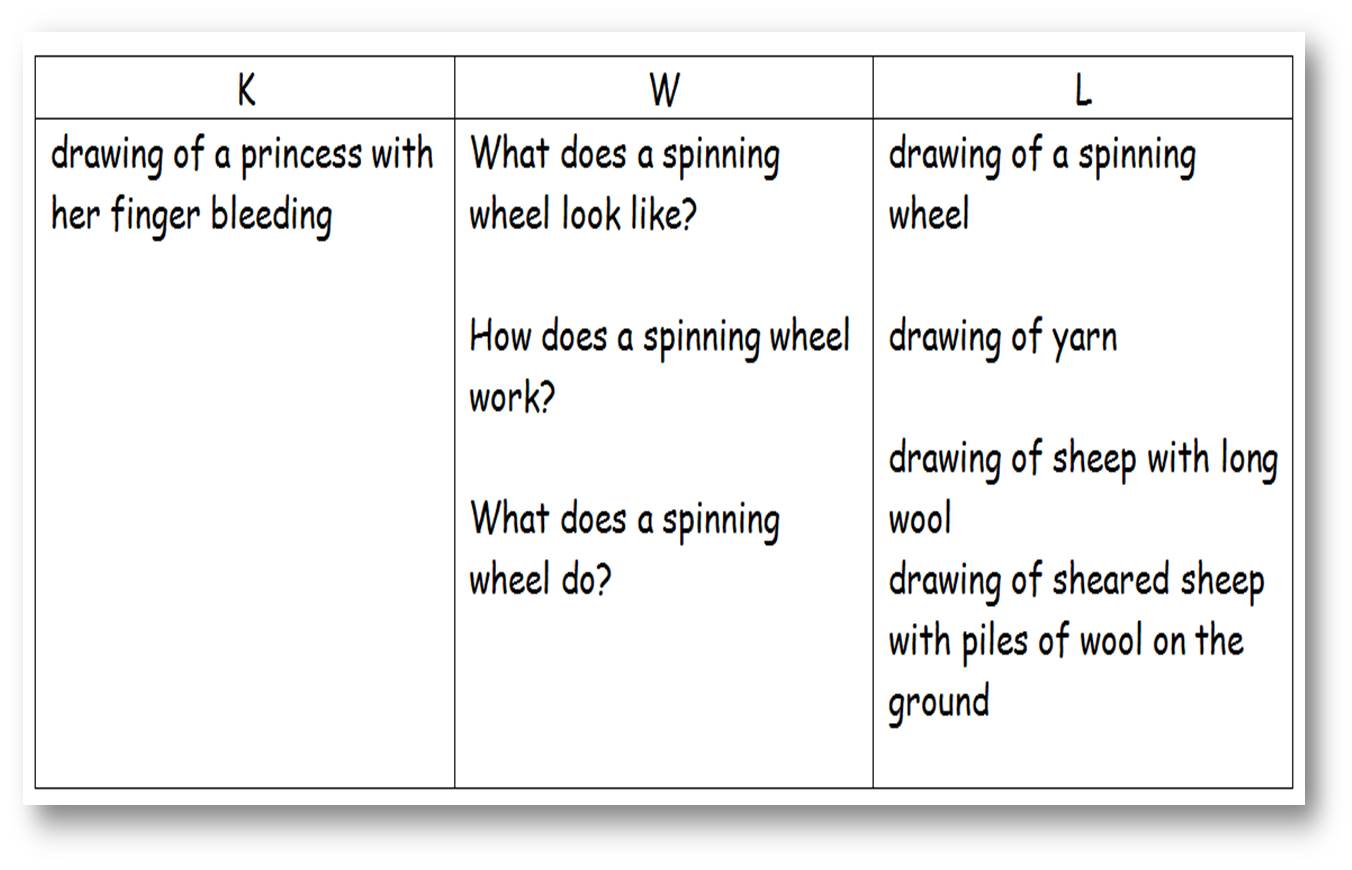
For example, suppose you read the story of Sleeping Beauty to your child, but she has no idea what a spinning wheel is. You find a book about how people used to make yarn by hand before machines did it. What kind of K-W-L chart might arise before you read the book about making yarn by hand?Example of filled-in K-W-L chart

If you, as the parent or teacher, want your child to learn a particular idea from a reading passage, you might steer the discussion to that idea as you and your child fill in the chart. But the chart works best if it reflects the child’s own understanding of a topic, and his own questions about that topic.

For example, if the topic is diamonds, the child might write:Example of a filled-in K-W-L chart

For the K-W-L strategy to help reluctant readers, the questions under “W” and the information under “L” should be linked back to what the child said she knows under “K.” So the teacher or parent might help the child create a chart like this:Example of a filled-in K-W-L chart

By connecting the “Want to Know” and “Learned” information to what the child already Knows, the child is extending the knowledge base she already has, rather than learning and soon forgetting isolated facts.

The K-W-L strategy and chart was first created by Donna Ogle. For more information, see Ogle, D.M. (1986). K-W-L: A teaching model that develops active reading of expository text. Reading Teacher, 39, 564-570.