Category Archives: reading comprehension

How to answer test questions for reading passages

Beginning in third grade, students need to learn strategies for answering multiple choice and fill-in-the-blank questions.  Here is a five-part strategy which works.
Student holding paper and reading it as he is writing

First, read the questions, not the selection.  That way, as you read the selection, you already know what the questions are and you might find answers.

Second, as you read the questions, circle key words.  Now find those same key words in the selection and circle them there.  Read the sentence or two before the circled words and the sentence or two after to be sure you have the right answer.

Third, underline the correct answer.  Next to the underline write the number of the question in case you need to go back later to check.

Fourth, in multiple choice questions, cross out any wrong answers. Don’t let them distract you. Usually one or two are obviously wrong, and the two left are pretty close to the right answer.  But one of those is usually better.

EPSON MFP image

Fifth, figure out the main idea.  Almost always one question asks for the main idea.  The question might ask, “What was this reading passage about?”  Or it might ask, “What could be another name for this story?”  To find out, reread the title or headline.  Reread the first paragraph, and especially if you are reading nonfiction, reread the last sentence of the first paragraph.  Or sometimes the main idea can be found in the last paragraph where the passage might be summarized.  Still don’t know?  Look for key words throughout the passage, words that are repeated.

Should my kindergarten son read aloud to me? How about my third grade daughter?

Reading aloud to a parent or teacher has two purposes:  to show that the child can decode words properly and to show that the child can read with fluency.  If the child is learning English as a second language, showing proper pronunciation is also a purpose.

child with adult helping to read

First decoding.  Probably your kindergarten son is at the decoding stage, that is, learning how to link language sounds with letters to form words.  If he is at this stage, then yes, he should read aloud.  That way you can tell what he knows, what he needs more practice on, and what he needs instruction on.

If you know from previous reading aloud that your third grader has mastered decoding, then your daughter needn’t read aloud for that purpose.  You might sit next to her as she reads.  If she has questions about pronouncing an unfamiliar word or if she asks about the meaning of a new word, you can help.  Occasionally you might ask her to tell you what she has read to be sure she has understood.

If your older child comes to English from a second language, she might be able to pronounce words perfectly yet have no idea what they mean.  If so, ask her to underline words she doesn’t know so you can talk about them.  If there are context clues, you might help her identify them.  With such a child, you should work on vocabulary development.

As for fluency (reading at a normal speed with voice inflection, pauses for punctuation and emotion in the voice) the kindergartener and ESL child should read aloud.  Some readers who are at the decoding stage spend so much energy on decoding that they miss the meaning.  By listening to how you say a line and then mimicking the way you say it, the child can pull together decoding and fluency.

Your third grader should be able to read fluently within her head.  However, if you notice that your child has trouble with comprehension even though she can decode well, then her reading aloud could help you to figure out why.  Is she ignoring punctuation and lumping parts of one sentence with another?  Is she sliding over longer words without decoding them because she is lazy or in a hurry?  Does she have short term memory problems, allowing her to forget the beginning of a sentence or paragraph before she gets to the end?  Is her emotional voice flat?  Is she missing inferences?  Some of this you can tell by listening to her read aloud, and some by asking her about what she has read.

In general, newer readers should read aloud with instruction and monitoring while experienced readers should read silently.

One way to increase vocabulary: learn Latin roots

Does your child show a logical way of thinking?  Does your son delight in finding patterns?  Does your daughter love puzzles?

If so, your child might like to learn English vocabulary by studying Latin and Greek roots.

uni- as root word

More than 60 percent of English words can be traced back to Latin or Greek words, sometimes with a bypass through France.  Most of those Latin or Greek roots developed into not one or two English words, but eight or ten or more.

If a child can memorize a Latin root, he can find that root pattern in many related English words.  Thinking logically, he can assume that those other words are related in meaning to the original Latin root.

The child’s vocabulary can grow exponentially.  A student who studies vocabulary the traditional way, learning ten new unrelated words a week, can possibly learn 380 new words in a school year.  But a child who studies one Latin root a week might learn thousands of new words in a school year.

The Common Core State Standards recommend that children be introduced to Latin prefixes, suffixes and roots in third grade. But even kindergarteners can learn a Latin root a week and can infer the meaning of words made from that root.

For example, suppose a little kid learns that “mater” is the Latin word for mother.  A teacher or parent could introduce the words maternity, maternal, matriarch, matrimony, matron, and alma mater.  Even if the child can’t read, she can hear “mater” in those words and can assume they have something to do with a mother.

One easy way is to begin with the Latin and Greek roots for numbers.  Or try a word which is part of children’s lives, such bicycle.  Cycle, circle, circular, cyclical, encircle—it’s not hard to remember that they all have something to do with a circle.   Encourage children to propose their own words.  How about circus, a child might ask.  Yes, circus comes from circle.  Can you guess why?  Maybe because of the rings?  Maybe.

Having a large vocabulary is associated with strong reading comprehension.  Using Latin roots is one way to gain a large vocabulary.

How lack of vocabulary stymies reading comprehension

Three superior ways of acquiring new vocabulary were found by the National Reading Technical Assistance in 2010.  They are

  • Higher frequency of exposure to targeted vocabulary words
  • Explicit instruction of words and their meanings
  • Questioning and language engagement

child with adult helping to read

Working with children daily, I see firsthand how a lack of vocabulary stymies their efforts to comprehend what they read.  For example, in the past week, a fourth grader reading aloud to me

  • pronounced “archaeological” as “architectural” and didn’t realizing his mistake.
  • did not know the meaning of the word “bid” as it was used in the passage. When I questioned him further, he admitted not knowing any meanings of that word.
  • did not know the meaning of “ancestral.” Questioning him showed me he did know what “ancestor” means.  When I pointed out that the roots of “ancestral” and “ancestor” are the same, he was able to figure out “ancestral.”
  • did not know the meaning of “interwoven.” Questioning showed me he did not know what “weave” means.  When I explained “weave” and “interwoven,” he still had no idea what “interwoven” meant in the passage because it was being used as a metaphor.
  • could not pronounce or understand “initial” used as an adjective. When I pronounced it, he still had no idea.  When I reminded him about the initials of his name, he recognized the word, but had no idea what it meant in context.  I explained that initials are the first letters in his name, and that “initial” in context meant “beginning” or “first.”  Then he understood.
  • could not pronounce or understand “notoriously.” He knew “famous,” so I said “notorious” means famous for doing something bad.  Still he was confused.  “Like Hitler.”  “What’s Hitler?”

Even though this boy was reading near his Lexile number, he either missed or misinterpreted chunks of the reading passage because of lack of vocabulary.

I will recommend to his mother that he works on vocabulary each lesson, using one of the many good vocabulary-building series available.  He also needs to read more and widely.

But doing one lesson in a vocabulary book, and then moving on to the next, is not enough.  He needs to hear the new vocabulary words often, review them, be questioned about their meanings, and be able to use them correctly in sentences.

If you are a parent, I recommend you either begin using a vocabulary-building series of workbooks, or if your child uses them at school, review past “learned” words with him or her.  My experience working with children, especially ESL children, shows me they need to engage with the words often in order for the words to become part of their vocabulary.

Writing more leads to better reading comprehension

Yes, writing more does lead to better reading comprehension. Research proves it. But why?

Student holding paper and reading it as he is writing

The authors of The Reading – Writing Connection (2010) suggest many reasons:

  • Both reading and writing are forms of communication. When writers create a text, little light bulbs go off as they think about their audience and what that audience needs in order to understand and want to continue reading their texts.  Students write, but at the same time they act as readers, their own first audience.
  • Writers think about composing skills when they read the texts of other writers. Why does the author use that vocabulary word? Why does the author have a first person narrator? How does the author identify characters through their dialog?  Does an autobiography have to start with a birth?  Does a story need to go in chronological order.? If not, how can  ideas be arranged?  How do other authors do this?  They read to find out.
  • How do other writers connect sentence ideas or paragraphs? How do they explain things—with figures of speech or with examples? How do other authors make a difficult idea clear? Do they depend on charts, graphs or maps?

When writers read, they are not merely enjoying or gaining information. They are also aware that what they are reading was written by someone who had to make writing decisions, the same kind of writing decisions they have to make. By thinking about those decisions, student writers understand better what they are reading.

How can writing improve reading?

When educators combed research on the writing / reading connection in 2010, they found three writing activities which improve reading comprehension.

EPSON MFP image

  • Having students write about the stories and texts they read by writing personal responses, analyses, or interpretations; by writing summaries; by writing notes; and by answering or asking questions in writing about what they have read.
  • Having students learn about the process of writing; about how texts are structured; about how paragraphs and sentences are put together; and about how to spell.
  • Having students write  frequently.

All of these writing activities improve students’ reading. In future blogs, we will look at why these activities improve reading, and how these activities can be incorporated into a student’s schoolwork or work at home. We’ll start in the next blog with the last idea, that students should write more to improve their reading.

Meanwhile, for more information, see Writing to Read.  At this site you can read the full report, Writing to Read; evidence for how writing can improve reading by Steve Graham and Michael Hebert for the Carnegie Corp. of NY, 2010.

You might also enjoy reading Shanahan on Literacy, a blog about reading by an expert in the field. In his current blog, Dr. Shanahan comments on ideas in this report.

How should children increase their vocabularies?

Research shows that a rich vocabulary is essential to reading comprehension. But are any methods of learning vocabulary better than others?

Yes.  A 2010 survey of research about vocabulary acquisition by the National Reading Technical Assistance showed three  ways are superior:

  • “Higher frequency of exposure to targeted vocabulary words will increase the likelihood that young children will understand and remember the meanings of new words and use them more frequently.” This means rereading The Three Little Pigs or a social studies chapter to a child three, four and five times has value in helping a child learn new vocabulary.

mother works with child reading story book

  • “Explicit instruction of words and their meanings increases the likelihood that young children will understand and remember the meanings of new words.” Your stopping to explain the meaning of a word helps a child to remember it. Learning words in the context of a story book or a science lesson helps students retain the meaning better than singling out a list of words, not in any context, for learning. Using multimedia, in addition to books, greatly helps ESL students to learn vocabulary and pronunciation.
  • “Questioning and language engagement enhance students’ word knowledge.” When a teacher or parent asks questions or comments on a new word, a child remembers that word better. Starting with easy questions and then building to more difficult questions helps too. While learning, the child should not be a passive listener; he needs to interact to retain vocabulary better.


How to overcome inference problems

If you know a child has trouble with inference (reading between the lines to come up with an idea which has not been stated but which the reader should know is true), here are some ideas to help.

child questions Rapunzel's actions

  • Go online and search for reading selections with inference questions. Make sure they are the right grade level or age for your child. Ask the child to read the selections aloud and then answer the inference questions provided. Help the child to make connections.
  • Expose your child to various times, places and cultures. Fill in the gaps in his knowledge. Together  read books or watch a TV show or go to a baseball game. Ask your child what seemed strange or unusual, and what reminded him of his own life.  ESL students need to know more about American culture to understand inferences and English language idioms.
  • Model inference-making as you read aloud to your child. “You know what I think will happen next? I think blah, blah, blah. What do you think?” Or, “Cinderella’s stepsisters are so mean. I bet something bad happens to them because they are so mean. What do you think?”
  • Expand your child’s vocabulary. If you encounter a new word or two while reading, explain the word. Use it later that day and the next day. Offer the child a reward—a high five—if he can use the word properly. Don’t baby his vocabulary. Use real words and real grammar. Let your child overhear you using an adult vocabulary, and explain a word if he looks perplexed.  Don’t wait for him to ask.
  • While reading, stop and ask about pronouns. “Who is the ‘he’ in this sentence? What does ‘it’ mean in this sentence? Problems with pronoun antecedents are common, so common that the SAT offers questions to see if high school students can figure them out.
  • Before your child starts to read a story, offer background information. Recently I was working with a sixth grader who was reading a Sherlock Holmes story. I asked who was telling the story. My student had not stopped to consider this, and when he did consider it, he didn’t know. I asked when the story took place? Again, he was clueless. Don’t assume. Provide helpful information to make a story or book clear.
  • When a student makes an inference connection, ask her how she knows. She might be guessing. Let her prove she has picked up the right clues.

Not understanding inference leads to reading comprehension problems

Inference, or reading between the lines, is the ability to use two or more ideas to arrive at another idea which hasn’t been stated.  For example, you see someone come into your home wearing a wet rain coat and carrying a wet umbrella. You can infer that it is raining out even though no one has said so.

A student with poor inference skills has reading comprehension problems.

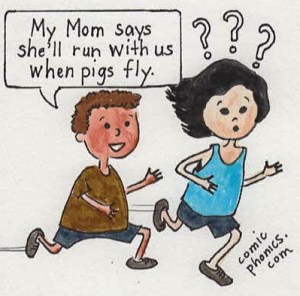
one child says "when pigs fly" but the other child doesn't understand

But there are many kinds of inferences which children must learn:

  • Pronoun antecedents:  In the sentence, “Mary gave her dog a hug,” the child needs to infer that “her” means Mary.  Figuring out pronoun references is a kind of inference.
  • Physical or emotional responses:  In the sentences, “Alan read the math problem. He frowned,” the inference is that Alan read something puzzling.
  • Cause and effect:  In the sentences, “Mom put the baby on the floor. Mom left him alone for a moment,” the inference could be the effect of a cause. What will the baby do? Will the baby do something dangerous?
  • Cumulative ideas:  When Junie B. Jones hides in a classroom cupboard, plays with clay she isn’t supposed to play with, and sticks dozens of bandages from the nurses’ office on herself, the reader can infer that Junie is a mischievous, fun-loving kid who doesn’t follow the rules.

What leads children to have problems understanding inference?

  • Vocabulary:  If a child does not understand the meaning of a word, and the inference depends on that meaning, making an inference is difficult. ESL children have this problem. I have worked with children who mix up he and she, him and her, or who use those words interchangeably. But native English speakers with limited vocabularies also miss inferences.
  •  Idioms:  ESL children are confounded by idioms and cannot make an inference from words which they interpret literally.
  • Working memory: If a child with a poor working memory must hold a certain idea in his mind over several sentences, making an  inference can be hard.
  • Predicting: Some children do not make predictions while they read. Perhaps they are focusing intently on decoding words or on pronunciation, and they have no mental energy left to make sense of what they read. Or perhaps they have never been taught to ask “why?” while they read. I work with a middle schooler whom I stop while we read together. I ask, “What do you think will happen next.” He always says the same thing. “I don’t know.”
  • Background knowledge:  Children who have encountered a situation, or who have heard their parents talk about a situation, or who have seen a situation on TV will have an easier job of making connections to what they read. Sheltered children without much life experience will have a harder time making inferences.
  • Cultural differences:  A child from one cultural background—say, Chinese—might not understand subtleties of a story about an Italian immigrant child from 100 years ago. Or an only child might miss inferences clear to a child from a large family.

In our next blog, we’ll talk about how you can help your child overcome inference problems.

Ways to strengthen children’s working memory

How can you help a child with a poor working memory to increase reading comprehension?

child playing card memory game

  • Play memory games.  Lay face down a deck of cards and find pairs.  Or play “In my suitcase.” The first person says, “I packed my suitcase, and in it I put a ____.” The next person repeats what the first person said, and adds a second item to the suitcase. Now the first person repeats what the second person said and adds a third item. The internet offers plenty of other kinds of online games.
  • Give directions  one step at a time. You might say, “Put your pencil down,” and wait until the child does that. Then say, “Put the book inside your desk.” Again wait for compliance before giving the next direction.
  • Use simple sentences when giving directions. Also, use transition words like “first,” “next,” and “finally.”
  • Choose children’s books written mostly in simple sentences or compound sentences. If there are complex sentences, make sure they are limited to one subordinate clause and are clear.
  • Ask the child to explain a complex sentence.  Ask him to describe the relationship between the two parts of the sentence–cause and effect, for example, or time order.
  • Eliminate distractions. At home, have the child do her homework in a quiet place with plainly painted walls and draperies. Settle the dogs down. Turn off all electronics. Even a ticking clock can interfere with a child’s concentration.
  • Don’t rush a child. That stress might distract her, her working memory.
  • Remind the child that she needs to remember what she reads.  Later, ask her questions about what she read so she gets in the habit of remembering.
  • Question a child about what she has just read.   After each paragraph, or after a short conversation, ask what those sentences mean. If the child has trouble remembering the beginning part, question the child after she has read less information.