Category Archives: phonics

My child is almost four. She wants to learn to read. Where do I begin? Or does it matter?

It matters, according to research. You should start with teaching her “the code,” that is, the connection between the sounds of the English language and the letter symbols we use to mean those sounds. Here’s how. (Look for more information on all these ideas in previously published blogs at comicphonics.com.)

  • children moving letter tilesFirst, make sure she can pronounce all 42 sounds of English. Listen to how she pronounces everyday words and make sure she is saying the sounds correctly. Help her with pronunciation.
  • Then connect sounds with letter symbols, a few at a time. Start with the beginning sounds of a few key words such as the child’s name, m for mom, d for dad, b for baby. Help her to hear those sounds in the beginnings of other words. For example, if you are pouring her milk, ask her what sound milk begins with. Then show her an “m” and explain that is how we show that sound.
  • Beginning sounds are always the easiest to hear, so focus on them.
  • Help her to write the initial of her name and a few other meaningful letters.
  • child on floor reading picture bookSince each vowel has many sounds, teach her to associate each vowel with a word and an image that begins with a “short” vowel sound such as apple, egg, igloo, octopus and umbrella. Later, she can compare the vowel sounds in new words to those vowel sounds.
  • In speaking, start putting letter sounds together to form one-syllable short-vowel (CVC) words she knows, like “cat” and “dog.” When she can hear how words are formed (phonics) by combining sounds, use letter tiles to show her what the combining of sounds in words looks like using letter symbols.
  • When you are reading stories to her, point out words she might be able to decipher, and help her to sound them out.
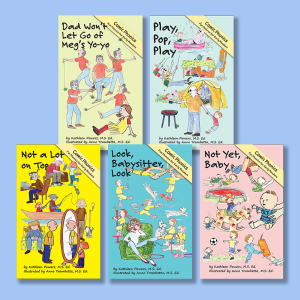
  • When she knows most of her sound – letter matches, she is ready to start reading books which use one-syllable, short-vowel words. Unfortunately, few good ones exist. We at comicphonics.com have written five humorous books for new readers. (See the links to the right of this blog.) Your librarian can point out where other books are shelved, but many labeled “first” readers contain difficult words. Margaret Hillert has written some good beginning books, and so has Dr. Seuss. Good illustrations can help the child figure out the meanings of difficult words, but she will probably need your help as she begins.

Figuring out the code of written English is how a child begins to learn to read. There are lots of commercial methods to do this, but the best I have found is the Explode the Code series. Children find its combination of goofy pictures and sequenced phonics instruction fun.

Later you can focus on other aspects of reading including fluency and comprehension. But the place to begin is demystifying the code by connecting the sounds of our speech to individual letters and pairs of letters, and then combining them to form words.

Teach children to predict, an important reading skill

Predicting means anticipating ahead of time what might happen in a story. As adults, we do it all the time. We read a murder mystery and we predict “who done it.” We read a romance and predict how the couple will get together. We read a thriller and predict if the characters will escape.

Predicting is more than making a guess. It is using what we already know and applying it to a new situation. When children predict, they make a connection between what they know and what they don’t know yet. They increase the likelihood that they will comprehend what they read. Wild guesses are not predictions.

Predicting from what we know to what we don't know graphic

Predicting focuses little children on what they are about to read. By looking at pictures, titles, subtitles, charts, photos, cartoons and other graphics, they grasp an idea about a story. Predicting attracts the child to a story. She wants to know if her prediction is correct. Predicting forces children to use visual or word clues to create meaning.

The Common Core State Standards include predicting in the reading standards.

However, predicting does not come naturally to all children. Children with dyslexia might be able to predict in a real life situation when there is no reading involved, but because they struggle deciphering the phonics code, they lose track of the meaning. Some children with dyslexia also have trouble sequencing. If so, predicting what will happen next is difficult.

Autistic children may also have trouble predicting since they have trouble interpreting social clues. The text might say that a character froze and was unable to talk, but the child might not know that the character is scared. How then can he predict what will happen next?

Here is a method of predicting that can be used with children of all ages. It combines vocabulary with predicting.

  • Go through a picture book or reading selection before the student reads it. Write down a dozen or more vocabulary words important to understanding the meaning of the text. Choose words which the child is likely to already know plus one or two new words.
  •  Write or type the words clearly on a paper, and then cut apart the words. Have one set of words for each pair of children if children are working in pairs. Put the words in plastic sandwich bags.
  • Explain to the child that he will be predicting what a story is about. He will be acting like a detective by using word clues.
  • Let the child pull out one word from the bag, read it aloud it and tell you what it means. If the child can’t read yet, tell him what the word says. If he doesn’t know the meaning, explain it to him. Lay the word on the desk or table in front of the child.
  •  Ask him what he thinks the story will be about based on that one word. Accept his answer.
  • Let the child pull a second word, repeating the previous two steps. Continue until all the words are read aloud. Encourage the child to change his mind about the prediction, or to become more convinced with each word.
  • Now ask the child to sort the words into categories or groups. (This step might be too advanced for some preschoolers.) Again, ask what he thinks the text might be about. Accept all answers, but gently steer the child into a prediction related to the text.
  • Now read the text. As you or the child read, note words the child pulled from the bag. Ask if the child still thinks his prediction is correct, or if he has changed his mind.
  • When the reading selection is complete, remind the child of his prediction and ask if he was correct.  Look at the words again.  Talk about what words helped and what words didn’t.  Ask what other words might have made the prediction closer to the truth.

Case study: Julie, a seven-year-old, high-achieving reader

Julie had just turned four when I began to tutor her in reading. Her mother, a native of China, had been taking Julie to a tutoring agency since she was barely three. The mother worked with her daughter daily on the reading lessons which Julie brought home.

Child looking at flash cards of two and three letter words.

.

When I met Julie, she could read many one-syllable words and some two syllable words. However, I noticed that when confronted with a new word, she could not figure it out. She had memorized the look of the words she knew but she had not learned phonics skills to sound out new words.

We began by reviewing ABC names and consonant sounds, almost all of which Julie knew. Then we spent many lessons on vowel sounds, focusing on short vowels first, and later mixing both short and long vowel sounds. We did this using pictures (pig, hat, run) which Julie would match with cards labeled ā ē ī ō ū and ă ĕ ĭ ŏ ŭ. We would spend about ten minutes of a lesson on this kind of work. Julie’s attention span was about ten to twelve minutes, so this was one of several activities in a single, hour-long lesson.

Tutor teaching a child.

When she mastered the vowel sounds using pictures, we worked on forming three-letter words using short vowels. At first I moved letter tiles around to form words, and with time, Julie made her own combinations and tested me to see if I knew what words she had formed.

Next, I added blends to short vowel words, first at the beginnings of words, and later at the ends of words. She found the beginning blends easier than the ending blends, as most children do. I made index cards with blend words on them, and when Julie would read a word on a card correctly, she would use a date stamp to mark the card—a way to make the learning fun. After a few weeks she mastered the blend words.

Late in our first year together, Julie began work on long vowel words ending with a silent “e.” She knew many of them by sight but not by sounding a word out. As our first year ended, we were working on long vowel single syllable words with double vowels such as “beat,” “fuel” and “rain.”

We were also building words using roots, prefixes and suffixes whose parts were written on little cards which Julie would push together to form words such as re-mix-ing and un-read-able. In the months which followed, when she encountered a long, unfamiliar word, she sometimes covered the prefix or suffix to figure out the middle part, and then constructed the word bit by bit as I had demonstrated.

Young girl reading a book

Julie could read many picture books. She enjoyed short paragraphs with colorful pictures on each page, but she would not try a chapter book. “Too many words,” she would say. She continued to go to the tutoring agency and do the reading homework with her mother, and to work with me once a week. When Julie was five, we began adding spelling and sentence writing to her lessons.

Julie is 7 now and has finished first grade. She is in the gifted program at her school. She reads voraciously, everything from Ranger Rick magazines to hundred-page chapter books. She has exhausted the phonics-like reading materials I have. She can read fourth or fifth grade materials as fluently as I can. She is working on expanding her vocabulary and on using more details in writing.

Julie is an example of the progress a child can make with a tutor or tutoring center augmenting school instruction. She is also an example of what studying during school breaks can do. She goes to school year round—nine months in her public school, and 12 months with tutors and her mother. Julie has a mother committed to Julie’s education, a mother who scours the library for appropriate books for Julie, subscribes to Ranger Rick, and oversees Julie’s homework and her piano practicing. She also teaches Julie how to write using Chinese pictographs.

For Julie, education is a way of life.

Julie—mischievous, hardworking and accomplished—could be your child’s classmate.

If my child reads slowly, he can pronounce almost all the words correctly, but he understands almost nothing. If he reads faster, he mispronounces many words but he seems to understand a bit. Which do I go for—accuracy or comprehension?

Accuracy. But let’s backtrack a little.

At what stage of reading is your son? Is he reading passages matched to his reading level? If a child is plodding laboriously through text, the text is too difficult for his reading level. He is not achieving fluency. I suggest you go back to easy readers which he can read accurately and with understanding in order to give him confidence.boy reading book

If he is in third grade, for example, you might find some first grade reading for him. Ask your librarian for help. If he can read sight words and CVC words at a good pace, with word accuracy and with overall comprehension, you know he is reading at least at an early first grade level. Gradually increase the reading difficulty. You want to maintain the child’s confidence, so increasing the difficulty level should not happen in a matter of days but rather over weeks or months.

Some problems to listen for:

  • If a child is stumbling, word to word, he is not phrasing within sentences.  For example, all the words in a prepositional phrase go together and should be said as a unit; the subject and it’s modifiers should be said as a unit.  Practice reading aloud with you modeling how to say a given sentence, and ask your son to phrase words so that they make sense.
  • If a child is reading in a flat monotone, his reading lacks inflection.  Some languages lack inflection (Korean, for example), and children from that background might feel foolish saying some words louder and some words softer, or saying part of a word louder than the rest of a word.  If you can read with inflection, let the child listen to you and then ask him to repeat the words the same way.  If you cannot read with inflection, a child can listen and read along to books on tape.
  • If a child is bulldozing longer words rather than sounding them out, he could have problems with phonics, or be dyslexic,  or  be an impatient personality.  Cover suffixes and prefixes, discuss the root word’s meaning and the meaning of the suffixes and prefixes, and then reassemble the word.  Reread the sentence and ask the student what the word means in the context of that sentence.

Some manufacturers have a reading level on the back cover of children’s books. “RL 2.2” for example means reading level second grade, second month. Other books are color coded by the library, and still others show reading level with a lexile score. In my public library, one long wall of books contains easy readers for children learning to read. You might find an author whom your child likes. Ask your librarian for help so that your child is reading at the correct reading level and gaining confidence.

As your child progresses to higher reading levels, he will probably read with less accuracy and at a slower speed unless you actively intervene. Ask him to read aloud. When he pauses or stumbles, let him try to figure out the difficulty himself, but if he can’t, stop him and help him. Perhaps you will notice he doesn’t understand a concept in phonics; or that prefixes or suffixes confuse him; or that he doesn’t know where to make the break in multi-syllable words so he pronounces words wrong; or that a secondary meaning of a common word baffles him. Teach him how to solve his problem. Then let him continue reading that sentence or that paragraph. Now ask him to reread it. If he continues to stumble at the same spot, you know that he needs stronger intervention on a particular skill.

At the end of paragraphs or chapters, it’s important to ask your child what happened (in fiction) or what is the main idea (in nonfiction). If he talks around the idea but cannot nail it, he was focusing on individual words and missing the meaning of sentences or paragraphs. The reading was too hard. If he can retell the story or explain the main idea, he is comfortable at that reading level, and should try a slightly higher reading level.

What I see with many of my students is that they begin to have difficulty with reading once they have mastered the basic rules of phonics. It’s not a decoding problem; it’s a vocabulary problem.  As the reading level increases, so do the number of words they don’t understand. It’s not a matter of pronunciation usually; it’s a matter of having no idea what a given word or an idiom means. This is particularly true for ESL students.

That is why I say accuracy is important. If a child cannot read a given word accurately and know what it means, then understanding a sentence or a paragraph—with lots of unknown words—becomes impossible.

My first grader seems clueless when it comes to rhymes. Are rhymes important?

Yes and no. Being able to hear rhymes (sometimes called word families) helps a child to recognize that many of the last sounds in words are similar and are often spelled the same. Hat, cat, fat and sat all have similar rhymes and are spelled with the same ending letters. When a new reader figures out that many words have ending patterns and don’t need to be learned from scratch, these patterns might seem like helpful short-cuts.

A teacher says the first part of a rhyme, and the child says the rest of it.In a one-syllable word, a rhyme is considered everything but the initial sound (called by reading experts the  onset sound). So eight, bait and Kate all rhyme even though they are spelled differently.

However, reading research shows that being able to recognize rhymes is not the most important skill for a beginning reader. Other skills such as matching a sound to a letter or pair of letters, or being able to break apart a word into its phonemes (separate sounds), or blending separate sounds into words are more important skills than rhyming and predict better whether a child will learn to read.

Recent research shows that learning how to read sometimes increases a child’s ability to recognize rhymes, rather than the other way around (McNorgan, Awati, Desroches, & Booth, 2014).

Recognizing rhymes can be fun though. You might try reading nursery rhymes to your child, emphasizing the rhyming words. Or you might try singing childish songs  such as “The Itsy Bitsy Spider” or “Three Blind Mice” with your child. Sometimes replacing the second rhyming word with a nonsensical rhyming word can jolt the child into supplying the correct rhyming word. This can lead to a comment by you about finding the correct rhyming word.

Don’t fret about your child not recognizing rhymes, especially if your child is ESL. With time we all figure it out. Focus on the more important phonics skills.

Kids learn sounds from big to small

Little children who are learning about the sounds in words move from larger units of sound—phrases and words—to smaller units of sound—sounds within syllables.

Take the word “elephant,” for example.

Word: elephant
Syllables: el-e-phant
Onsets/rhymes e-l e f-int
Phonemes e l e f i n t

children pronouncing elephant

First, children learn that sentences are composed of words. (I can remember being in first grade and learning that “of the” is two words, a revelation at the time).

Next, children learn the sound of the whole word. They might mispronounce “elephant,” saying it as a two-syllable word (el-phint) as they grow accustomed to it. Eventually they say it right.

Children then learn to break the word into parts (syllables), pronouncing each syllable distinctly.

With a teacher’s or parent’s help, they learn to identify sounds within the word.

Later, they learn to match those sounds to letters.

This sequence—from a phrase to whole words to syllables to the smallest distinct sounds—provides a useful guide for adults teaching reading to preschoolers. We should make sure a child can hear the sounds of a word and can reproduce them properly before we begin to break a word into parts and associate letters with those parts.

What are some activities that help a child to master the phonological awareness sequence?

• Say a two or three-syllable word, leaving pauses of a second or two between syllables. Ask the child to combine the syllable sounds into a word.

• Ask the child to break a two or three-syllable word into its parts. This is a harder skill than combining.

• Ask the child to say (not spell) the sound before the vowel sound in a word (the onset sound). For example, in the word “dog,” the onset sound is the sound a “d” makes.

• Say tongue-twisters and ask the child to identify the alliterated sound. For example, in “Peter Piper picked a peck of pickled peppers,” the onset sound is the sound a letter “p” makes.

• Sing songs with rhymes. Ask the child to identify the rhyming sounds.

• Ask the child to say the rhyme part of a word or syllable. The rhyme part is all the sounds beginning with the vowel. So in “dog,” the rhyme is “og.”

• The hardest activity is for the child to break down a syllable into every sound (phoneme). American English has 42 phonemes, or sometimes more depending on regional pronunciations. (Sounds made by “th,” “sh” and other digraphs are considered distinct sounds, which is why English has more phonemes than alphabet letters.)

While learning the ABC’s is a skill most preschools stress, the other skills explained need to be learned first. Some kids are ready to break a syllable into phenomes at four years old, but many more are not ready until part way through first grade. Don’t rush them. Instead, spend time on all the preliminary steps.

For more details on this sequencing of learning sounds, go to http://www.naeyc.org/files/yc/file/200901/BTJPhonologicalAwareness.pdf. While you are there, check out the list of read-aloud books that emphasize sounds, and the additional activities you can do with a child who is learning sounds.

Phonemes, phonics, phonemic awareness—what’s the difference?

A phoneme is the smallest sound in a spoken language. There are 42 in American English, according to some experts, but more if regional pronunciations are considered. Many are represented by a single letter—b and h, for example. But others are represented by a pair of letters—sh and th, for example. A phoneme is not a letter; it is a sound to which we have associated a letter in order to read the sound. By itself, a phoneme has no meaning.

listof phonemes

Phonemic awareness is the ability to hear words at the phoneme level, to hear that the word “cat” contains three separate sounds. Phonemic awareness does not mean letter awareness. A child can have phonemic awareness without knowing the ABC’s. It means the ability to pull apart words and to say the separate sounds in words. It means a child can recognize that all the sounds we make can be put together various ways to create words.

Phonics is the code, the assigning of sounds to symbols (letters) so that the sounds can be pronounced correctly by looking at visual letters. With more than 250 letter patterns to represent all the sounds in American English, reading instruction focuses mostly on phonics.

Children with excellent hearing and from a language-rich environment pick up phonemic awareness early in life because they hear all the sounds of American English. Before they start school they may be able to pronounce all the phonemes correctly, echoing an adult. But most children cannot figure out phonics on their own. They need instruction matching a sound to a letter or letter pair.

Is Why Johnny Can’t Read still used to teach reading?

Why Johnny Can’t Read is a book by Rudolph Flesch, Ph. D., a readability expert in the US from the 1950s until his death in the 1980’s. This book advocated a phonics-based approach to learning to read when most American children were learning the “look-see” approach of memorizing the look of a word. Today Flesch’s approach is out of favor if used alone, but if it is used in combination with some other approaches, it can be part of a good approach to teaching reading.

However, kids hate it.

CVC words that end in _ch and _ook.

To enlarge, click on the picture.

Flesch’s approach is to break down phonics into sounds which correspond with letters, and to teach lists of the same sound. One of the beginning lessons is a list of several columns of short a CVC words; it is followed by a page each of the other short vowel sounds. Then the short vowels are mixed together, two vowel sounds at a time. Gradually all the sounds of English are introduced through lists of words which use those sounds.

The problem is that reading lists is boring for children. They find it hard to stay focused for more than a few minutes on such a task, so if that is the only strategy, kids resist these lessons.

Other reading programs have taken Flesch’s idea and have presented the lists a different way. One of the most successful is Explode the Code. For a lesson on bl, cl, fl and gl bends, for example, there are nine pages of activities. On one page the word to be learned is to the left, and to the right are three pictures, one of which illustrates the word. The child needs to circle the correct picture. On the next page the student sees a word on the left and needs to circle the same word (one of three) on the right. On another page the student fills in the blank with a word which is illustrated to the left. On another page the student answers a question using one of the blend words. Students prefer the variety that this approach takes.

When I teach reading to beginners, I use a combination of Flesch’s ideas and others. I don’t use his long list of words, but sometimes I give my students one column of his lists. For variety, I put words on index cards which the child can hold and shuffle, so the child has more control. Again, I limit the number.

I taught my three children how to read using the lists at the back of Why Johnny Can’t Read, so I will always be grateful to Flesch, his research, and his simple, straight-forward approach to teaching phonics. As a writer, I am grateful for his guides on how to write plain English.

How to use spelling tests to reinforce CVC words

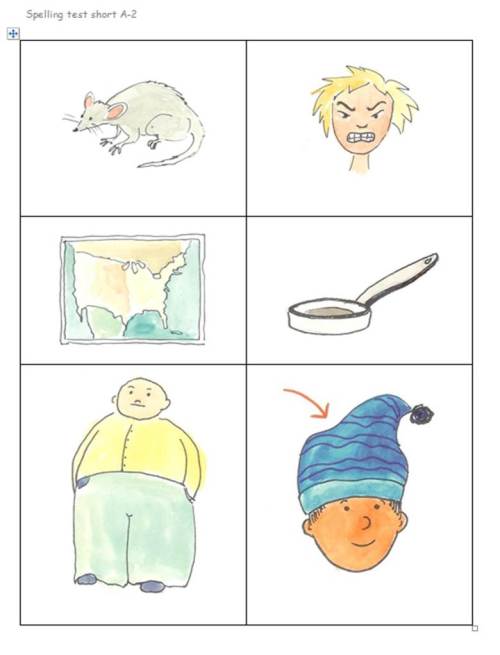
Years ago, I would cut  pictures of CVC words from various sources, paste them on index cards, sort them by vowel sound.  Then I would use them as spelling tests for beginning readers. (Now Mrs. A draws the pictures, including those below.)  This low-tech approach still works great with beginning readers and spellers.

Six drawings of short A CVC words

These drawings are samples of a packet of 12 pages of CVC drawings that can be downloaded for a small fee.  Click on the pictures for more information.  

Why use pictures for the spelling test instead of just dictating the words?

  • When the child is in charge of the pile of pictures, she can spell at her own pace, jotting down words she knows quickly and slowing down for words she is unsure of or for words she writes incorrectly and needs to repair.
  • Young children are people in motion, so the more parts of their bodies they can use to learn, the better. Taking off the rubber band, shuffling the cards, flipping them into a second pile as they are used and rubber-banding them again are fun.  Making learning fun is so important for children of any age, but especially for preschoolers.
  • Some children delight in erasing and will write a word incorrectly just so they can erase it. Spelling is a new experience for them, but it can take time, time when a tutor or mother might grow impatient. But since the child is working independently, the process can take as long as the child wants.
  • While the child is working independently, I can observe where she might need more help or prepare the next lesson, a better use of my time than dictating.
  • ESL students who might be shy about moving at a slow pace gain privacy by controlling the time it takes to complete the test.

One time I gave a preK student a short A test which he finished with pride—his first spelling test! When he found out I had more cards—more tests—he begged me to let him take the cards home and use them for the next week.  His mother later told me that  he took the spelling tests every day. What an eager learner!

Teaching CVC words ending in double consonants

When a child is learning to read, the child is learning to spell as well. Since most one-syllable, short vowel words (CVC) have three letters, all of which are pronounced, these words are usually easy for the child to spell. If you use letter tiles or cards with individual letters written on them, reinforce spelling as you and the child move the tiles around to form new words. At this stage, merging reading and spelling is easy.CVCC twin consonants

Another set of words are almost as easy to learn to spell. These are words which end with the double consonants of l, s, and f and z. If you take the time to point out to the child the double final consonants in these words, the child will learn to spell them easily. Be sure to tell the child that these double consonants are pronounced as a single sound. What are some common CVC word families with double ending consonants?

  • –ell: bell, dell, fell, hell, sell, smell, spell, tell, well, yell
  • –ill: bill, dill, fill, hill, kill, mill, pill, sill, still, till, will
  • –oll: doll
  • –ull: dull, gull, hull, mull, skull
  • –ass: ass, bass, class, glass, grass, pass
  • –ess: bless, dress, less, mess
  • –iss: bliss, criss, hiss, kiss, miss
  • –oss: boss, cross, floss, loss, moss, toss
  • –uss: fuss, muss
  • –aff: staff
  • –eff: Jeff
  • –iff: cliff, miff, sniff, stiff, tiff,
  • –off: off, scoff
  • –uff: bluff, buff, cuff, fluff, gruff, huff, muff, puff, scruff, scuff, snuff, stuff
  • –azz: jazz, razz
  • –iz: fizz, frizz
  • –uz: buzz, fuzz

It is important to point out to the child that even though most of the time l, s, f and z are doubled at the end of short words, sometimes these letters are not doubled. So as not to confuse the child, list just a few exceptions to this doubling rule (pal, gas, bus, yes, us, and plus), using words that the child is likely to encounter.

Also point out that a few common words that don’t end in l, s, f and z double the final consonant even though most other words do not. Add, odd, egg, inn, and mitt are some examples that the child might read and use. When the child understands the concept of syllables, you can explain that this rule of doubling the l, s, f and z usually applies to one syllable words only. Many times children try to write “until” as “untill” (proving they have internalized the rule), so it is worth pointing out the correct spelling when the child is ready to learn two-syllable, short vowel words. –Mrs. K