Category Archives: phonics

4 ways to improve reading comprehension

For years I have focused on the importance of a phonics-based reading curriculum for beginning readers.  Research shows that young students exposed to sequential phonics instruction have better reading outcomes than students who learn primarily through other approaches.

But once students have learned the basic rules of phonics, and they are reading to learn new information, research shows other activities can help students comprehend better.  Here are some.

Photos, drawings, sounds, videos and picture books can help students understand new-to-them concepts before they read about them.  Providing students with rich background information can make acquiring new information easier.  Students can fit new ideas into old ideas, or show how the new idea is the same or different from the old idea.

Venn diagrams are another way to do this.  For example, to learn the relationship of math operations, students could see a Venn diagram like this:


The idea is to connect new information to information students already know.  Stick figures showing two families’ with arrows from one person to another could show what nieces and nephews are.

Tables connecting what students know to what they don’t know can help.  Here is how.  Create a row of three sections.  On the left, write a vocabulary word or concept students know.  Leave the middle blank.  On the right, write the new concept to be learned.  Help students fill in the center by connecting the idea on the left to the new word on the right.

my birthday important day in my life, hard to forget day, day I think about milestone
What I’m doing at different times all day long 8  Pledge of Allegiance

8:15 reading class

9:15 snack

9:30 math class

schedule

We adults connect new concepts to what we know all the time.  And, like students, if what we know is scant, we have a hard time learning the new concept.  For example, I was reading a novel about a World War I soldier who was demobbed.  What in the world is demobbed? I wondered. Attacked by a mob?  Thrown out from a mob?  I looked the word up, and found that demobbed means discharged from military service.

Okay, so how do I remember it?  I know what a mob is, but in this case mob is short for mobilized, so that doesn’t help.  I know what a mobile phone is though, so I pictured a soldier texting someone on his mobile phone to tell that he is discharged.  Maybe he is throwing his hat in the air too.  So connecting pictures to words and events is another method of comprehending.

Learning to read doesn’t stop with applying the rules of phonics.  That is a vital start.  Another vital aspect of reading is comprehension, a lifelong process.


The idea is to connect new information to information students already know.  Stick figures showing two familie with arrows from one person to another could show what nieces and nephews are.

Tables connecting what students know to what they don’t know can help.  Create a row of three sections.  On the left, write a vocabulary word or concept students know.  Leave the middle blank.  On the right, write the new concept to be learned.  Help students fill in the center by connecting the idea on the left to the new word on the right.

my birthday important day in my life, hard to forget day, day I think about milestone
What I’m doing at different times all day long 8  Pledge of Allegiance

8:15 reading class

9:15 snack

9:30 math class

schedule


We adults connect new concepts to what we know all the time.  And if what we know is scant, we have a hard time learning the new concept.  For example, I was reading a novel about a World War I soldier who was demobbed.  What in the world is demobbed? I wondered. Attacked by a mob?  Thrown out from a mob?  I looked the word up, and demobbed means discharged from military service.  Okay, so how do I remember it?  I know what a mob is, but in this case mob is short for mobilized, so that doesn’t help.  I know what a mobile phone is though, so I pictured a soldier texting on his mobile phone that he is discharged.  Maybe he is throwing his hat in the air too.

Learning to read doesn’t stop with applying the rules of phonics.  That is a vital start.  Another vital aspect of reading is comprehension, a lifelong process.
New York students must learn phonics in 2025

Phonics must be taught to students in grades pre-K through third grade in all New York State (NYS) schools beginning in the fall of 2025.

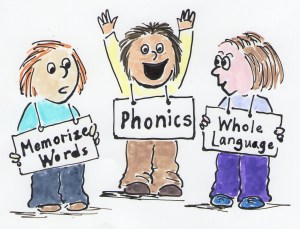
Three children with signs around their necks that read: Meniruze words, Phonics, Whole Language

This emergency directive by the NYS Board of Regents requires all public school districts to review how reading is taught in their districts.  It requires NYS districts to make necessary changes so that phonics is taught to pre-primary and primary grade students next September.

In particular, districts must teach six concepts associated with reading:

  • phonemic awareness (the ability to hear individual sounds in a word such as the sounds K A T in the word “cat”),
  • phonics (the ability to put together individual sounds to form words),
  • fluency (the ability to read words accurately, at a reasonable pace and with expression),
  • comprehension (the ability to understand what is read)
  • vocabulary (the ability to understand the meaning of words and to integrate new words into reading), and
  • oral language (the ability to listen and to speak).
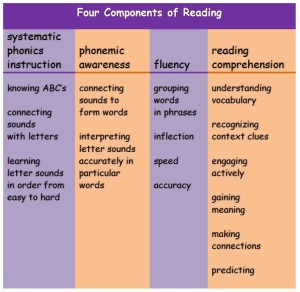
Chart of 4 reading components

Click on the picture to enlarge it.

This emergency action by the NYS Regents comes because almost a third of students cannot figure out new words by fourth grade.  They have been taught to memorize sight words and high frequency words.  But they have not been taught how to sound out new words.  As a result, about a third of students can’t read fourth grade texts.

The NYS Regents is authorized by law to oversee all educational activities in NYS.

Nearly 25 years ago a federal study of research on reading showed that knowing phonemes and phonics is fundamental to learning to read.  Yet many teacher training programs and district curricula do not focus on teaching phonemes and phonics.  Last year the Regents encouraged school districts to teach phonics but resistance was strong.  Now the Regents has mandated it.

New kindergarteners, new readers

It’s September, which means a new school year, which means a new set of kindergarteners learning to read.

Where to start?  I have hundreds of blogs on this website showing how to teach reading.  But in general,

Start with prereading skills.  These include knowing how to hold a book, which cover is the front, reading from left to right and from up to down, and knowing that text means words.

Teach that letters are symbols of sounds, with each letter representing a different sound. Of course, some letters represent more than one sound, and some letter pairs represent a single sound, but that news can wait.

Help the child memorize several consonant/sound pairings and one vowel/sound pairing (usually the letter A). The child does not need to know every letter sound to start reading.  Learn a few, and while you make words, learn a few more.  And knowing ABC order is not important at all at this point.

Make sure the child realizes that joining letters together forms words.  Create two- and three-letter words with the letters the child knows.  I recommend using letter tiles, saying aloud the letter sounds and moving them closer together until they create words.

Help the child learn one-syllable, short-vowel words which follow the rules.  “Golf,” yes.  “Half,” no.

Help the child learn often used “sight” words necessary to form sentences.  Lists are online.

Cover adding S for the plural; double F, L, S, and Z to make a single sound at the end of some words; CK to make the sound K; blends at the beginning of words; and blends at the ends of words.  By now it’s winter break or maybe spring break depending on how often your child works on reading and how ready your child is.

Supplement what your child is learning with small early-reading booklets. You will find many publishers.

Review what the child has learned at each lesson. One way is to buy reading workbooks.  The quality varies greatly.  I recommend Explode the Code because it follows the pattern I have outlined above and because children like the silly drawings.  (I have no connection to the publisher of that series.)

Keep reading to your child to instill a strong interest in reading.

Teach long-vowel, single-syllable words containing silent E and double vowels.  Expect backsliding here from many children.

By now your child is more than ready for first grade.  Check with your state education department’s standards for kindergarten to be sure you have covered everything.  If you haven’t, or even if you have, keep at it over school breaks, including summer break.

And check back issues of my blog.  If I haven’t covered a topic you are looking for, let me know and I will.

Transitioning from short vowels to long vowels

Today I worked with a kindergartener who has mastered CVC words with blends at the beginnings and ends of words (for example, “slept” and “brand”).  It was time to move on to long vowels.

I started with two-letter words ending in “e” (be, he, me, and we).  I explained for small words ending in “e,” the “e” is pronounced differently.  Even so, the child wanted to say the words as if they ended in a short e.

In one way this was satisfying to me, her teacher.  She had learned the rules about pronouncing short vowels.

But in another way it was frustrating.  Her brain was saying she didn’t accept the logic of one letter representing two sounds.  Until now every letter of every word we have read together has had one sound only.  But now I am changing the rules.  It’s like I am telling the child that until now your little brother has had one name, but from now on he is going to have two names, and you have to remember when to call him John and when to call him Fred.  Huh?

Some students learn sight words in school at the same time they are learning phonics.  For them, words like “me” and “go” are memorized rather than sounded out.  But my student has not learned sight words, so I needed to switch gears.

I stopped focusing on two-letter words.  Instead, I focused on words ending in “ee.”  It was easier for my student to accept that “ee” represents a different sound from “e.”  So, we worked on reading words like “bee,” “fee,” “lee,” “see,” and “tee.”  I added nonsense words like “dee,” “pee,” “vee,” and “zee” as well to extend the practice.

At our next class I plan to continue delaying two-letter words like “he” and “me.”  Instead I will continue with “ee” words, adding ending letters and blends.  “Bleed,” “creek,” “heel,” “seem,” “green,” “sleep,” and “feet” are some examples.

Until now, my student has moved quickly in acquiring reading skills.  But I may need to slow down now and make sure she can go back and forth from short-vowel words to long-vowel words and vice-versa.  For some students this is easy.  For others, it takes months.  We will see.

Don’t stint on advanced reading skills

One of my students is a high schooler still learning English as her second language.  She has learned so much in the few years she has lived in the US, but she struggles with reading.

She has pretty much mastered how to read one-syllable and two-syllable words which follow the rules.  But three-syllable words confound her.  Instead of stopping to figure out big words, she slurs over them and keeps reading almost as if they aren’t there.

That works when the reading level is at the second or third grade level because not many three- or four-syllable words are in books meant for that reading level.  But my student is in high school.  She is confronted with long words in almost every sentence she reads in text books.  Like many older students I have taught, she thinks she can get by skipping over words.  Now that she is preparing for the SAT, she realizes she can’t.

In late elementary grades students learn about root words, prefixes and suffixes.  Knowing words can be dissected leads good readers to break apart words rather than skipping over them.  My student thinks this is too time-consuming, so she is reluctant to do this on her own.

She is a wiz with computers and can look up the meaning of a word faster than I can.  But sometimes the synonyms are long words too.  Or sometimes one synonym works in one context, but not in another context.  Or sometimes, most times, she doesn’t bother.

What’s my point?  Reading instruction can’t stop after a student learns basic phonics rules.  This is especially true for impatient students who would rather finish quickly than finish well.  The tedious work of learning how to break words into syllables can’t be skipped.  Nor can understanding the meanings of prefixes, suffixes and roots.

Reading is probably the most important skill we learn in school.  Don’t stint on it.

Learning to read is not a race

This fall I am teaching two kindergarteners to read via Zoom.  I am making progress with both students, but it is an uneven progress typical of young children.

One student—I will call her Jane—is lighthearted and imaginative.  For Halloween, she came to class wearing a wolf’s face.  Jane is social, engaging me in conversation as easily as she talks to her sibling.  She can identify almost all letters and letter sounds.  When I show her an alphabet letter, she will say, “Maybe B, for banana and ball.”

Jane is working on reading two-letter “A” words like “at” and “ax.”  Three-letter words are a bit advanced except for a few she has memorized.  Her mother tells me that outside class she loves to mix up letters and to make silly sounds.

John is serious and reserved with me.  He does not engage in chit-chat during our lesson.  Two months ago, he could identify fewer letters and their sounds than Jane could, but now he has mastered them all.  He pronounced two-letter “A” words with such consistency that we have moved on to three-letter “A” words.  At our lesson this week John read several phrases and a few sentences containing short “A” words (A fat cat sat.  A man ran in a can.).  I was thrilled.  He smiled and said nothing.  At our next lesson we will begin to work on short “O” words.

Mrs. K is a writing, reading and grammar tutor.

Both Jane and John are normal kindergarteners, displaying behaviors typical of children learning to read.  One is not better.  One is not worse.  They are each moving along at their own pace.

Learning to read is not like learning algebra.  With algebra, every student starts at the same place on page one of the text and is expected to keep up with the pace the teacher sets for covering the curriculum within a school year.

With reading, students start at different places depending on personality, preschool or parental exposure to letters and sounds, hearing and vision acuity, being read to, and speaking English as a native language or as a second language.  Age of the student is another factor.

By the end of kindergarten, both John and Jane should have a solid foundation in phonics.  They will continue instruction in how to read in first and second grades.  At that point their reading skills will probably not be any more identical than they are now. But they will read sufficiently well to use their reading skills to learn more.  That’s why we learn to read, after all—so we can keep learning.


The four, no five, no eight pillars of reading

Focusing on four skills leads to good reading achievement in children, we used to think.  Then came a comprehensive US government report in 2000 saying five skills are necessary.  In the ensuing 23 years, researchers tell us three more skills are necessary.   Let’s look at those skills, starting with a chart showing four skills, followed by information on five skills, and ending with the latest three skills.

Chart of 4 reading components

Previously, vocabulary was considered part of the fourth component of reading. Now it is considered a separate component, as are three previously unrecognized skills: oral language, writing, and background knowledge.

  • Phonemic awareness, the ability to hear and identify individual sounds in words—such as the sound of “b” in “bat”—and to move sounds around to hear them in various parts of words. This skill is taught in pre-K and kindergarten to most American school children.


  • Phonics, the ability to match the sounds of English to letters or to letter pairs in order to form words. This skill is usually taught in kindergarten and first grade.


  • Vocabulary, the ability to recognize and understand three kinds of words: everyday spoken words, more complex words (SAT-like words), and domain specific words (words used in specific contexts, such as the baseball-related words of pitcher, shortstop, foul ball and bunt).


  • Fluency, the ability to read text accurately at conversational speed, using expression.


  • Comprehension, the ability to understand what is read.

The three other skills that have been identified as crucial to learning to read are

  • Oral language, the ability to understand spoken language and to speak it. Proficiency in oral language precedes proficiency in reading.


  • Writing, the ability to use written symbols to represent words and to transmit meaning


  • Background knowledge, the ability to store and retrieve information and apply it to new knowledge gained from reading.


No wonder reading is such a complex skill for children to master.

You can teach your child to read. Start with a phonics assessment.

Are you are planning to teach your child how to read this summer, either starting at the beginning or filling in the gaps?  If so, where do you start? I suggest you give your child a pretest to see what reading skills your child has learned well, and what ones he has not yet grasped. The words on this pretest are more or less divided into four kinds of words in this order: 1. Short (closed) vowel, one-syllable words. These include one- and two-letter words, words beginning or ending with blends and digraphs (black, church) words which end in twin consonants (fell, jazz), words which end in “ck,” and words to which an “s” can be added to make plural words or certain verbs (maps, runs). 2. Long (open) vowel, one-syllable words.  These include words ending with silent “e,” words with double vowels which have only one vowel pronounced (goes, pear), and certain letter combinations (ild, old).  They also include words with “oi,” “oy,” “ow” and “ou” letters. 3. Two– and three-syllable words which follow the above rules (catnip, deplete) and two- and three-syllable words which don’t follow the above rules but which follow a pattern (light, yield). These words include words with certain suffixes (le, ies) and words with a single consonant between two vowels (robin, motel). 4. Exceptions.  These include words with silent letters (gnaw, lamb), words from other languages (debris, cello), and words which fit no pattern (business). Ask your child to read the words in the pretest below.  Each row across tests a particular phonics skill.  If you child hesitates at all, that is the place to begin teaching him or her phonics.  I will talk more about how to teach these four groups of phonics skills in my next blog. Phonics assessment bad, hem, fit, don, pug, am, if, lass, jazz lock, Mick, bills, cliffs, mitts, catnip, Batman grand, stent, frisk, stomp, stuck chuck, shun, them, branch, brush, tenth star, fern, birds, fork, purr, actor, doctor, victor muffin, kitten, collect, pepper, gallon complex, helmet, falcon, napkin, after tantrum, muskrat, constant, fulcrum, ostrich skate, bike, Jude, mole, dare, shore, tire, pure need, cheer, aim, hair, bay, pie, boat, oar, Joe, low, soul fruit, few, child, blind, fold, colt, roll, light, high earn, worm, rook, pool fault, claw, all, chalk, Walt boil, so, pound, down comet, dragon, liver, salad, denim total, ever, student, basic, demon, vital apron, elude, Ethan, Owen, ideal, usurp inside, nearly, absent, unicorn, degrade, tripod advance, offense, fence gripped, planned, melted, batted, handed sweeping, boiling, thinning, flopping, biking, dating rapper, saddest, finer, bluest, funnier, silliest easily, busily, massive, active, arrive, wives keys, monkeys, armies, carried action, section, musician, racial, crucial, nuptials brittle, pickle, carbon, dormer parcel, decent, gem, urge, badge lose, sugar, nature, sure graph, Phil, then, moth bomb, thumb, gnat, gnome, high, sign whip, whirl, echo, ghoul, knee, knob could, calf, folk, hustle, listen, wrist alone, bread, bear, chief, young, squaw, swan, waltz, word decision, exposure, gigantic, polarize, occupant, quarantine If you want to help your child learn to read, one of the best things you can do is not to let him guess.  Most words can be deciphered if the student has a phonics background. Also, don’t let your child depend on pictures for meaning once the child starts to read.  Most adult reading material is not accompanied by graphics.  Students must learn to gain meaning from the text alone. If you have decided to help your child read this summer, good for you.  You don’t need to be a rocket scientist to help your child read better.  Years of research show that the best way to teach reading is to start with letter sounds (phonemes) and then to combine those letter sounds into words (phonics).  If you do this in a systematic way, such as following the four-part sequence I describe above, your child will learn to read.    
Largest US school system to change how reading is taught

With half its students unable to pass reading tests, the City of New York has decided to change the way it teaches reading.

CVCC twin consonants

Starting this fall in some schools and in the fall of 2024 in others, “the science of reading” will ground all reading instruction.  This means that students will focus on learning sounds associated with letters (phonemes) and on joining those letter sounds (phonics) to form words.

Chancellor David C. Banks will announce the change today (May 9, 2023).  He hopes the new approach will change the current outcome in reading instruction in which half the city’s third through eighth graders are not proficient in reading.

The city’s schools are divided into 32 local districts.  Each district can choose one of three acceptable reading programs, all of which focus–to varying degrees–on phonics.  Research has shown that a phonics-based approach to learning to read produces the best results for primary grade students.

The city’s principals’ union is opposed to a one-size fits all approach in the city’s 700 elementary schools.  Teachers say they need training.

Local school districts within the city will have some choice in how to proceed.  They must choose one of three reading programs: Into Reading, Expeditionary Learning, and Wit & Wisdom.  They can and in some cases must supplement these programs with more systematic phonics instruction.

One advantage of the unified approach is to provide students who transfer from one New York school to another a single reading curriculum.  Another is to follow the mandate of New York’s Mayor Eric Adams, who has dyslexia, to teach reading using a phonics-based approach.  Still another is to provide teachers with materials that have been shown to work, so each teacher doesn’t need to seek materials independently.

The change will start this fall in city school districts showing the least proficiency in reading.

New York is the latest and biggest school district to show dissatisfaction with the way reading has been taught and to turn to a research-supported approach.  Poor student performance on reading tests, parents’ demanding change after Covid 19 educational losses, and a growing cohort of students who cannot read are propelling changes in reading instruction throughout the US.

Reading instruction is finally catching up to research

Increasing numbers of state legislatures are mandating that a phonics-based approach be used to teach young children how to read.  Not all states are on board yet, despite a massive study more than 20 years ago that culled research and concluded that teaching children phonemes (the sounds associated with letters) and phonics (assembling letters into words) is the most successful way to teach reading.

Three children with signs around their necks that read: Meniruze words, Phonics, Whole Language

Beginning in 2014 in Mississippi, states have forced teacher training programs, school districts and public school teachers to switch to a phonics-based approach to teaching reading.  Here are states* which have passed legislation mandating a phonics-based approach or strengthening laws already mandating such an approach.

  • 2013: Mississippi
  • 2014: South Carolina
  • 2015: Nevada
  • 2016: Michigan, Mississippi
  • 2017: Arkansas
  • 2018: Montana, Nebraska
  • 2019: Alabama, Colorado, New Mexico, Nevada, Oklahoma, Rhode Island, West Virginia
  • 2020: DC
  • 2021: Arkansas, California, Connecticut, Delaware, Florida, Louisiana, Minnesota, North Carolina, North Dakota, Oklahoma, Pennsylvania, Tennessee, Texas
  • 2022: Arkansas, Arizona, Kentucky, Utah, Virginia

As you can see, the number of states passing laws to require phonics-based reading instruction has steadily increased with the greatest increase in 2021.  Educators surmise that because students were home for months in 2020 because of the Covid 19 virus, parents became more aware of how their children were being taught to read.  As a result, they demanded change.

While not all states have updated their education laws concerning the teaching of reading, the trajectory is in that direction.  Expect improved reading scores on national tests as students being taught using this approach infiltrate into higher grades.  Mississippi has already noted this positive change.

*according to Education Week