Category Archives: methods of teaching reading

How lack of vocabulary stymies reading comprehension

Three superior ways of acquiring new vocabulary were found by the National Reading Technical Assistance in 2010.  They are

  • Higher frequency of exposure to targeted vocabulary words
  • Explicit instruction of words and their meanings
  • Questioning and language engagement

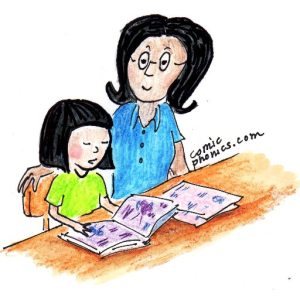
child with adult helping to read

Working with children daily, I see firsthand how a lack of vocabulary stymies their efforts to comprehend what they read.  For example, in the past week, a fourth grader reading aloud to me

  • pronounced “archaeological” as “architectural” and didn’t realizing his mistake.
  • did not know the meaning of the word “bid” as it was used in the passage. When I questioned him further, he admitted not knowing any meanings of that word.
  • did not know the meaning of “ancestral.” Questioning him showed me he did know what “ancestor” means.  When I pointed out that the roots of “ancestral” and “ancestor” are the same, he was able to figure out “ancestral.”
  • did not know the meaning of “interwoven.” Questioning showed me he did not know what “weave” means.  When I explained “weave” and “interwoven,” he still had no idea what “interwoven” meant in the passage because it was being used as a metaphor.
  • could not pronounce or understand “initial” used as an adjective. When I pronounced it, he still had no idea.  When I reminded him about the initials of his name, he recognized the word, but had no idea what it meant in context.  I explained that initials are the first letters in his name, and that “initial” in context meant “beginning” or “first.”  Then he understood.
  • could not pronounce or understand “notoriously.” He knew “famous,” so I said “notorious” means famous for doing something bad.  Still he was confused.  “Like Hitler.”  “What’s Hitler?”

Even though this boy was reading near his Lexile number, he either missed or misinterpreted chunks of the reading passage because of lack of vocabulary.

I will recommend to his mother that he works on vocabulary each lesson, using one of the many good vocabulary-building series available.  He also needs to read more and widely.

But doing one lesson in a vocabulary book, and then moving on to the next, is not enough.  He needs to hear the new vocabulary words often, review them, be questioned about their meanings, and be able to use them correctly in sentences.

If you are a parent, I recommend you either begin using a vocabulary-building series of workbooks, or if your child uses them at school, review past “learned” words with him or her.  My experience working with children, especially ESL children, shows me they need to engage with the words often in order for the words to become part of their vocabulary.
What kind of books do you read to your kids?

When my kids were little, I selected their reading materials from the picture book section of my library and book store.  In retrospect, I was limiting my children’s literature to fairy tales, Dr. Seuss and fiction of all kinds.

Yet children need exposure to nonfiction as well:  how to books, how things work books, information about animals and the natural world we live in, biographies, history, books with maps and tables, books about dinosaurs, even current events news.

Take a quick survey of the books you have read to your preschooler in the past week.  Were any of them nonfiction?

Expand your child’s horizons starting today.  Find the nonfiction section of the children’s section of your library and see what’s there that might interest your child.

  • Does he like dinosaurs? Lots of books explore the lives of these amazing creatures.  Or does he have a pet?  Books on dogs, cats, birds and almost every other animal abound.
  • Is your daughter into fashion? Find books about how clothes have changed over the centuries.  Find a biography of Coco Channel.  Look for a magazine with Downton Abbey or Academy Award dresses.
  • Is your child into building? You can find books and magazines on how to build a soap box, a tree house or a house of cards.  Or you can learn how a spider builds a web, how a bird builds a nest or how a beaver dams a stream to build a house with an underwater doorway.
  • Do you travel with your child? Magazines highlight fascinating places around the world.  Even if your child can’t read, together you can compare your home with the ones pictured.  Or together you can wonder what it would be like to take a gondola ride or to walk on the Great Wall of China.  Maybe you could plan a vacation.
  • Did Grandpa serve in the Army? Let Grandpa read to your child about the locations where he served or about the military uniforms he wore.  Did Grandpa fly a jet?  Find books about military aircraft.
  • Cooking books are great how-to books. With your child, find a picture of something you would like to eat and cook it together.
  • How about the handbook for your car? Or you phone?  Your child and you can look over the pictures and identify parts and what they do, picking up vocabulary.
  • Look for books with maps, charts, tables, pictographs, photos and other non-textual ways of presenting information.  Help your child to understand what those graphics mean.

Reading nonfiction is harder than reading fiction, yet students must be adept at both kinds of literature under the Common Core State Standards.  Start now preparing your child for his future by exploring nonfiction together.

Writing more leads to better reading comprehension

Yes, writing more does lead to better reading comprehension. Research proves it. But why?

Student holding paper and reading it as he is writing

The authors of The Reading – Writing Connection (2010) suggest many reasons:

  • Both reading and writing are forms of communication. When writers create a text, little light bulbs go off as they think about their audience and what that audience needs in order to understand and want to continue reading their texts.  Students write, but at the same time they act as readers, their own first audience.
  • Writers think about composing skills when they read the texts of other writers. Why does the author use that vocabulary word? Why does the author have a first person narrator? How does the author identify characters through their dialog?  Does an autobiography have to start with a birth?  Does a story need to go in chronological order.? If not, how can  ideas be arranged?  How do other authors do this?  They read to find out.
  • How do other writers connect sentence ideas or paragraphs? How do they explain things—with figures of speech or with examples? How do other authors make a difficult idea clear? Do they depend on charts, graphs or maps?

When writers read, they are not merely enjoying or gaining information. They are also aware that what they are reading was written by someone who had to make writing decisions, the same kind of writing decisions they have to make. By thinking about those decisions, student writers understand better what they are reading.

How can writing improve reading?

When educators combed research on the writing / reading connection in 2010, they found three writing activities which improve reading comprehension.

EPSON MFP image

  • Having students write about the stories and texts they read by writing personal responses, analyses, or interpretations; by writing summaries; by writing notes; and by answering or asking questions in writing about what they have read.
  • Having students learn about the process of writing; about how texts are structured; about how paragraphs and sentences are put together; and about how to spell.
  • Having students write  frequently.

All of these writing activities improve students’ reading. In future blogs, we will look at why these activities improve reading, and how these activities can be incorporated into a student’s schoolwork or work at home. We’ll start in the next blog with the last idea, that students should write more to improve their reading.

Meanwhile, for more information, see Writing to Read.  At this site you can read the full report, Writing to Read; evidence for how writing can improve reading by Steve Graham and Michael Hebert for the Carnegie Corp. of NY, 2010.

You might also enjoy reading Shanahan on Literacy, a blog about reading by an expert in the field. In his current blog, Dr. Shanahan comments on ideas in this report.

How should children increase their vocabularies?

Research shows that a rich vocabulary is essential to reading comprehension. But are any methods of learning vocabulary better than others?

Yes.  A 2010 survey of research about vocabulary acquisition by the National Reading Technical Assistance showed three  ways are superior:

  • “Higher frequency of exposure to targeted vocabulary words will increase the likelihood that young children will understand and remember the meanings of new words and use them more frequently.” This means rereading The Three Little Pigs or a social studies chapter to a child three, four and five times has value in helping a child learn new vocabulary.

mother works with child reading story book

  • “Explicit instruction of words and their meanings increases the likelihood that young children will understand and remember the meanings of new words.” Your stopping to explain the meaning of a word helps a child to remember it. Learning words in the context of a story book or a science lesson helps students retain the meaning better than singling out a list of words, not in any context, for learning. Using multimedia, in addition to books, greatly helps ESL students to learn vocabulary and pronunciation.
  • “Questioning and language engagement enhance students’ word knowledge.” When a teacher or parent asks questions or comments on a new word, a child remembers that word better. Starting with easy questions and then building to more difficult questions helps too. While learning, the child should not be a passive listener; he needs to interact to retain vocabulary better.


How to overcome inference problems

If you know a child has trouble with inference (reading between the lines to come up with an idea which has not been stated but which the reader should know is true), here are some ideas to help.

child questions Rapunzel's actions

  • Go online and search for reading selections with inference questions. Make sure they are the right grade level or age for your child. Ask the child to read the selections aloud and then answer the inference questions provided. Help the child to make connections.
  • Expose your child to various times, places and cultures. Fill in the gaps in his knowledge. Together  read books or watch a TV show or go to a baseball game. Ask your child what seemed strange or unusual, and what reminded him of his own life.  ESL students need to know more about American culture to understand inferences and English language idioms.
  • Model inference-making as you read aloud to your child. “You know what I think will happen next? I think blah, blah, blah. What do you think?” Or, “Cinderella’s stepsisters are so mean. I bet something bad happens to them because they are so mean. What do you think?”
  • Expand your child’s vocabulary. If you encounter a new word or two while reading, explain the word. Use it later that day and the next day. Offer the child a reward—a high five—if he can use the word properly. Don’t baby his vocabulary. Use real words and real grammar. Let your child overhear you using an adult vocabulary, and explain a word if he looks perplexed.  Don’t wait for him to ask.
  • While reading, stop and ask about pronouns. “Who is the ‘he’ in this sentence? What does ‘it’ mean in this sentence? Problems with pronoun antecedents are common, so common that the SAT offers questions to see if high school students can figure them out.
  • Before your child starts to read a story, offer background information. Recently I was working with a sixth grader who was reading a Sherlock Holmes story. I asked who was telling the story. My student had not stopped to consider this, and when he did consider it, he didn’t know. I asked when the story took place? Again, he was clueless. Don’t assume. Provide helpful information to make a story or book clear.
  • When a student makes an inference connection, ask her how she knows. She might be guessing. Let her prove she has picked up the right clues.

Ways to strengthen children’s working memory

How can you help a child with a poor working memory to increase reading comprehension?

child playing card memory game

  • Play memory games.  Lay face down a deck of cards and find pairs.  Or play “In my suitcase.” The first person says, “I packed my suitcase, and in it I put a ____.” The next person repeats what the first person said, and adds a second item to the suitcase. Now the first person repeats what the second person said and adds a third item. The internet offers plenty of other kinds of online games.
  • Give directions  one step at a time. You might say, “Put your pencil down,” and wait until the child does that. Then say, “Put the book inside your desk.” Again wait for compliance before giving the next direction.
  • Use simple sentences when giving directions. Also, use transition words like “first,” “next,” and “finally.”
  • Choose children’s books written mostly in simple sentences or compound sentences. If there are complex sentences, make sure they are limited to one subordinate clause and are clear.
  • Ask the child to explain a complex sentence.  Ask him to describe the relationship between the two parts of the sentence–cause and effect, for example, or time order.
  • Eliminate distractions. At home, have the child do her homework in a quiet place with plainly painted walls and draperies. Settle the dogs down. Turn off all electronics. Even a ticking clock can interfere with a child’s concentration.
  • Don’t rush a child. That stress might distract her, her working memory.
  • Remind the child that she needs to remember what she reads.  Later, ask her questions about what she read so she gets in the habit of remembering.
  • Question a child about what she has just read.   After each paragraph, or after a short conversation, ask what those sentences mean. If the child has trouble remembering the beginning part, question the child after she has read less information.

When a word has a single consonant between two vowels, which syllable does the consonant go with?

When a two-syllable word has a single consonant in the middle of two vowels, which syllable does the consonant go with?

Usually the consonant goes with the second syllable.  This forms a first syllable with a long vowel and a second syllable that is either CVC or CVCe. The first syllable which ends with a long vowel is called an open syllable. Some examples include:red headed girl in easy chair reading, legs up

  • minus
  • tulip
  • pupil
  • motel
  • basic
  • humid
  • rotate
  • unite

Sometimes these words  have a one-syllable, stand-alone word as the first syllable.  Or they have a prefix as the first syllable. Helping students to recognize this tiny word or prefix can help them to pronounce the word correctly. Some words like this include:

  • beside
  • rerun
  • protest
  • defend
  • trisect
  • bypass
  • nomad
  • hotel

Some students get mixed up if the first syllable is a single vowel. They want to put the middle consonant with the first syllable instead of with the second.  If this happens, ask the child to pronounce the word both ways. Usually one way will make sense and one won’t unless the child is not familiar with the word. Some words like this include:

  • omit
  • item
  • unit
  • ozone
  • even
  • evil
  • amen

I recommend teaching children words with a single consonant between syllables after they have learned words with two middle consonants.  The latter are easier to learn because children more easily spot the CVC + CVC pattern.

One warning:  Many words beginning with the letter “a” follow the letter pattern just mentioned, but the “a” is not pronounced as a long vowel.  “Alive,” “along,” “awake,” “atone” and “apart” and dozens of other “a” words pronounce the “a” as “uh.”  Save them for a separate lesson.

How to divide words into syllables—start with words having double consonants between two short vowels

Figuring out how to pronounce words with two or more separated vowels can be a problem. However, there are guidelines which often help.

boy reading book If a word has two consonants of the same letter in the middle of the word, the split into syllables happens between the two consonants. These words are easy to segment and to pronounce. Words like this include

  • happen
  • little
  • mitten
  • ribbon
  • puddle
  • peddler
  • attic
  • minnow
  • biggest

girl on floor readginIf a word has two different middle consonants preceded by and followed by short vowels, the split into syllables usually happens between the two consonants. Usually the vowel sound to the left of the double consonants is short because the first syllable creates a CVC “word,” and the syllable after the split is short for the same reason. Words like this include

  • Hagrid
  • often
  • piston
  • Wilson
  • walnut
  • mascot
  • dentist
  • impish
  • whiplash

Seated young boy is playing a portable video game..Sometimes in the middle of a two-syllable word are three consonants composed of a consonant and a blend or a blend and a consonant.  The three consonants are preceded and followed by a single vowel. The split into syllables happens before or after the blend, in such a way as to keep the blend together. Usually these words contain short vowels before and after the split. Words like this include

  • chinchilla
  • tundra
  • umbrella
  • ashes
  • pumpkin
  • sandbox
  • liftoff
  • pigskin
  • distress

All of these two-syllable words have certain features in common which make pronunciation easy:

  • they have either two consonants or one consonant and a blend in the middle of the word,
  • and they have a single vowel preceding and following the middle consonants.
  • The first vowel is a short vowel, and usually the second vowel is short also if it is followed by a single consonant or a blend.

But what if there is only one consonant between two vowels? Does the consonant go with the first vowel or the second? It depends.  We’ll talk about that soon.

Skipping long words can be a sign of a struggling reader. How can you help a child decode such words?

One way to help children decode big words is by familiarizing children with prefixes and suffixes. English is a language which creates new words from already existing words by adding a word part—usually a single syllable—before or after the original word. If the word part is added at the beginning of a word, the word part is called a prefix. If it is added after the word part, it is called a suffix.boy choosing right root for a prefix

Prefixes usually change the meaning of a word. Un + happy creates “unhappy,” whose meaning is the opposite of “happy.” Re + view creates “review” which means to view again. Suffixes usually change the part of speech of a word, the verb tense of a word or the number of a word. Music +al changes “music,” a noun, to “musical,” an adjective. Jump + ed changes the present tense verb, “jump” to the past tense verb, “jumped.” Girl + s changes the singular, “girl,” to the plural, “girls.”

If children can recognize that a long word has a prefix or a suffix or both, they can segment that word both for pronunciation and for meaning. “Unwinding” can become un + wind + ing. “Un” means not, “wind” means coil and “ing” makes the word an action.

Children should be taught prefixes and suffixes as a separate part of reading instruction. I would start with prefixes only. One way to do this is to make a game of combining prefixes with words, sometimes called roots. (I like to use materials the child can touch, but of course, this work can be done on computer using sites such as ixl.com.) Here’s how:

  • Find a list of commonly used prefixes. Many web sites list about one hundred such prefixes, but I would start with a shorter list of ten or twelve of the most commonly used ones, such as bi (two), dis (the opposite), il (not), im (not) in (not), mis (badly), non (not), pre (before), re (again), sub (under) and un (not).
  • Teach the child what each prefix means, giving her a word to help her remember each one, such as bicycle, disagree, illogical, improper, indirect, mispronounce, nonfat, prepay, resend, submarine, and unhappy.
  • When she knows the meaning of the prefixes, write each prefix on an index card. Write two or three familiar words which could be paired with each prefix. Shuffle both sets of cards separately. Match each prefix with a word which makes sense, and ask the child to read the word and tell what it means.
  • Or, you could choose two root words, one of which can be paired with a given prefix, and help the child determine which root works and why.
  • Later, you could create a list of the words she has created. See if she can segment the words and tell what they mean. If she can’t do some of them, repeat the activity until she can. Gradually remove the words and prefixes she knows and add new prefixes and words until she knows several dozen prefixes.

In a future blog we’ll talk about how to figure out suffixes.  Suffixes are trickier because they sometimes involve changes in spelling the original word.