Category Archives: methods of teaching reading

How to make reading nonfiction easier

Here is a pattern I have taught second graders, but  children of all ages can benefit.  It works especially well for reading nonfiction which is usually harder than reading fiction.

boy reading on the floor

First, before reading the text,

  • Read the title and think about what it means. Then look at all the photos, drawings, charts, cartoons, maps and tables.  Try to figure out what they mean.  From all them, try to figure out what you will be reading about.
  • If there are subheadings, read them. Go through the whole article and read them.  If you are reading a book, read chapter headings.  Ask yourself, what is this about?  Try to predict what you’ll be reading about.
  • If there are vocabulary words in the margins or highlighted in the text, read them and their definitions. Say them out loud, and if you can’t, ask an adult how to pronounce them.

Now you are ready to read the text.

  • The most important thing to figure out is the main idea. Often in nonfiction, the main idea is stated at the end of the first paragraph.  But sometimes the first paragraph is a hook, so the main idea comes later.  Reread the title and find words in one of the first paragraphs which say the same thing.  If you own the book, underline or highlight the main idea and in the margin write “main idea.”  If the book cannot be written in, start a mindweb on a separate paper with the main idea in the center.  Or write “main idea” on a sticky note and paste it over the main idea in the text.
  • The next most important thing to figure out is shich details are important. Underline them or add those ideas to your mind web.  It’s easier to study a mindweb than it is to study a whole lot of paragraphs.
  • Highlight or write down the words you don’t understand. Then write down their meanings.  Sometimes there are clues in the nearby words, or the book contains a glossary.  Or you can ask someone.  Or you can use a dictionary.
  • If some idea is difficult to understand, ask someone to explain it.  If you can find a young child’s version of the information, that is a good place to start.  Online sources might say what you need to know in an easier way.

When I work with my son on reading, should he read silently or should I interrupt and ask questions?

If you are working with your son, you should be involved.  What does an involved reading teacher do?

  • Before he reads a selection, you could read it, understand it, and preview it with your son. That does not mean giving away the ending if it is a story.  But it might mean explaining the setting or motivation of the main character.  In nonfiction, it might mean showing him a map or other graphic to make the reading easier to comprehend.

Tutor teaching a child.

  • Before reading, you and your son together could look at any graphics accompanying the article. You could ask him to interpret the graphics to be sure he understands the data.  You could ask him to read headlines and subheadings, and then ask him to predict what he is about to read.
  • If he has trouble pronouncing words or if he slurs big words, ask him to read a short section at a time aloud. Go back to the words he missed and discuss them, asking him to pronounce them, writing the words in syllables on notebook paper so he can see the structure of the word, explaining prefixes, suffixes or word roots.  If there are vocabulary words you suspect he might not know, ask him the meanings, and if he can’t explain them correctly, discuss their meanings.  Then ask him to read that part of the selection again.
  • Now ask him what it means. Don’t accept, “It’s about a farm,” but ask for more specific meaning.  “It’s about a small baby pig that a farmer is going to kill.”  Ask him if his prediction was right or should he change it.
  • Fluency can only be judged by a teacher if the child reads aloud.  Listen for pacing, inflection, changing of voice tone, loudness or softness.  If you know your child is a fluent reader, you needn’t have him read aloud often for fluency.  But if he is not a fluent reader, you might want to read a sentence at a time using fluency and have your child mimic you.
  • If you read along silently, and your child finishes a selection long before you do, probably he is racing. Ask him about the meaning.  If his answer is vague, ask him to read again but slower.
  • If your child is a competent reader, your job might consist of asking for feedback—orally or written. If your child is reading fiction, you might ask about setting, characters, theme, ups and downs in the story and the climax.  If he is reading nonfiction, ask for the thesis and organization of the article.  Ask a question which the article answers and let the student find and read the part which answers your question.
  • If you can’t be engaged with your child during the reading, you could leave questions to answer so you know the child has paid attention.

Good teachers interrupt when they hear mistakes or hesitancy.  They ask questions if they suspect the student is not understanding.

But if your son is reading strictly for his own pleasure, back off.  Maybe when the day’s reading is done, ask him what his reading selection was about or what he liked, but don’t pressure him.  If he is asking you questions like, “Hey, Mom, what does contentious mean?” or “Why do hunters want elephant tusks anyway?” he is doing what you want—consulting an expert when he doesn’t understand.

How to answer test questions for reading passages

Beginning in third grade, students need to learn strategies for answering multiple choice and fill-in-the-blank questions.  Here is a five-part strategy which works.

Student holding paper and reading it as he is writing

First, read the questions, not the selection.  That way, as you read the selection, you already know what the questions are and you might find answers.

Second, as you read the questions, circle key words.  Now find those same key words in the selection and circle them there.  Read the sentence or two before the circled words and the sentence or two after to be sure you have the right answer.

Third, underline the correct answer.  Next to the underline write the number of the question in case you need to go back later to check.

Fourth, in multiple choice questions, cross out any wrong answers. Don’t let them distract you. Usually one or two are obviously wrong, and the two left are pretty close to the right answer.  But one of those is usually better.

EPSON MFP image

Fifth, figure out the main idea.  Almost always one question asks for the main idea.  The question might ask, “What was this reading passage about?”  Or it might ask, “What could be another name for this story?”  To find out, reread the title or headline.  Reread the first paragraph, and especially if you are reading nonfiction, reread the last sentence of the first paragraph.  Or sometimes the main idea can be found in the last paragraph where the passage might be summarized.  Still don’t know?  Look for key words throughout the passage, words that are repeated.

Helping a child with sensory integration issues

Sometimes what we think is a reading problem is really a sensory integration problem.

child tired, cold, hungry with mother

Sensory integration means sorting through all the input from our senses—what we see, hear, smell, taste or feel—into a meaningful message in our brains. Sometimes too much sensory data clogs our brains, causing problems. On an airplane, for example, some of us can easily tune out the baby crying and the plane bumping through clouds.  But others are ready to scream.

A child might show sensory integration issues if the cat is purring is too loudly.  Or the new shoes are too tight.  The bath towel is too scratchy.  The banana texture is too squishy.  Bathtub bubbles hurt .  The label inside the T-shirt tickles.

If you child has sensory integration issues here’s how you can help her focus when reading:

  • Motion: Make sure she is sitting in a still, comfortable place where she is less likely to fidget.  No gliders or swings.  Not in the back seat of a moving car.  Make sure her feet are supported.
  • Sound: Eliminate noise distractions.  Turn off the TV and radio.  Put the dog in his cage.  Stop the washing machine.  Seclude your child to the quietest part of the house.  If there is still noise, turn on your hair dryer or your vacuum cleaner to provide constant, steady “white” noise which obscures background sounds.  One of those recordings of waves or a mother’s heartbeat meant for new babies might also help.
  • Sight: Face a plain painted wall if possible.  No wallpaper with designs.  Draw the blinds.  Surround the child with calm, soothing colors like pastels, whites or tans.  No oranges, reds or bright pinks.  Choose picture books with plainer backgrounds so the child’s eyes know what to focus on.
  • Touch: Dress the child in soft, comfortable, nonbinding clothes.  Remove shoes and socks.  Have her sit on a smooth or pillowy surface—nothing scratchy.  If you are with her, cuddle if she likes but keep some distance if she prefers not to be touched.
  • A trick an occupational therapist taught me: To settle the child, scratch her back for a few minutes.  Begin at the neck and scratch straight down the backbone—not sideways and not from the bottom up, but from the top of the spine to just below the waist.  Scratch with your nails hard enough for the child not to feel tickled but not roughly enough to hurt.  (This is a great technique to help a baby relax to fall asleep, too.)

In the next blog we’ll talk about some modifications a teacher can make to a classroom to help children with sensory integration issues to prevail in school.


Facing dyslexia in a preschooler

So you suspect your preschooler has dyslexia.  What can you do?

  • Realize that the younger a child is when identified as dyslexic, the sooner help can begin. If possible, you want to identify the situation before the child becomes frustrated and discouraged, and before the child is labeled as “different.”child making letter T with his body
  • Ask your school district to test the child. Because of the child’s age, the district might balk, and say he will be tested when in kindergarten, or first grade, or later.  Sometimes the district will become involved if you have some “proof” that the child is dyslexic.  This might require private testing at your expense by some recognized expert.
  • From the school district, find out what services your child will receive and when.baby reading a book
  • If the school district “officially” won’t help, make an appointment with your elementary school’s reading specialist. She will probably have ideas you can start with, and she might be able to lend you materials or at least identify materials that will help.
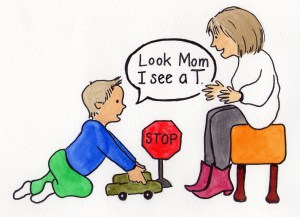
  • Consider hiring a reading tutor, one with experience teaching children with dyslexia. A good tutor will use many strategies, particularly game-like, hands-on approaches that will appeal to a preschooler.boy sees a T in STOP
  • If someone else in the immediate family has dyslexia, there’s a good chance your child has the same kind of reading problem and can be helped the same way. What worked for your other relative?
  • Check out ideas on the internet. Use keywords such as dyslexia, preschooler, reading and learning strategies.
  • Begin working with your child yourself. Focus on the sounds of the language first, and make sure your child can hear them and pronounce them properly.  Only then match sounds with letters.mother works with child reading story book
  • Is letter recognition difficult? Buy an ABC puzzle or letter tiles or a Scrabble game.  Use the letters to play games forcing the child to identify letters.  Unfortunately, most sources for letters use only capital letters, and it is generally lower case letters which cause problems.
  • Work on printing letters properly. If fine motor coordination is difficult, use a computer keyboard instead.  But again, most keyboards identify the keys with capital letters.Mother shows child spelling of her name Kelly
  • Use music. Teach your child the ABC song.  Sing songs together which rhyme or read nursery rhymes.
  • Teach directions. Up, down. Left, right.  Inside, outside.
  • You may find it takes longer for your dyslexic child to master certain skills when compared to a child without reading difficulties. Be patient.  If a younger sibling is catching on faster than the dyslexic child, work with each child independently and out of earshot from one another.  If at all possible, conceal from your child that he is having reading difficulties.  Find ways for him to succeed at learning.A teacher says the first part of a rhyme, and the child says the rest of it.

How about pulling your child out of preschool, or stopping all reading instruction for a year or until the child is seven or until the child reaches first grade?  These are not good solutions.  In pre-K students are expected to know their letter sounds and to match them with ABC’s.  In kindergarten children are expected to read CVC words, high frequency words, and some two-syllable words.  A child who can’t keep up with his classmates develops low self-esteem which can intensify reading problems.

Be proactive.  If you think your three or four-yer-old shows signs of reading difficulty, act as soon as possible for the best outcome.

How to teach sight words

You can teach your child sight words through many methods.  Buying or making cards with pictures on them can help make the words stick better in the child’s mind.  You can have your child learn a word a day by pointing to the word and having the child say it aloud.  Repeating helps the words stick.  Many kindergarten classrooms have word walls where the sight words are posted so children can use them when writing.

EPSON MFP image

You can find such words with magnetic backings (or you can make them).  Put them on your refrigerator, or in a large metallic baking pan or cookie sheet.  Then help your child move the words around to make phrases or sentences.

Games are another good way to teach sight words.

  • Make a BINGO sheet with sight words for your child to find and cover.
  • Play Concentration. Make a set of cards with two of each sight word.  Start with just a few pairs, mix them up and turn them over on a table, and then turn them, two at a time, to see who can find the most matching pairs.
  • Play Go Fish with the same set of matching cards.

Some word pairs can easily be confused, so spend extra time on them:  of and off; for and from; was and saw; on and no; their and there; them and then; and when, where, what and with.

One caution:  Children who learn sight words before they learn phonics may try to memorize all words rather than sounding them out.  They may balk at learning phonics.  They need to know it is important to be able to sound out words using certain rules so when they encounter new words they can figure them out.

How to retain new vocabulary

Review, review and more review is the way to help children retain new vocabulary.

"I know that word, Mom," says the child lookin

Too often the push by teachers is to teach more words rather than to solidify the words students already “learned.”  The result is that the words practiced weeks ago don’t stick in students’ minds.

What can you do to make words stick?

Suppose one week you teach ten or twelve new words to a student.  That week you review the words daily—perhaps asking the student to draw each word’s meaning one day, or to have a spelling bee kind of review another day, or to write the words in sentences another day.

The next week you teach ten or twelve new words.  You use the same kind of daily review, but you include a few words from the previous week’s list which have caused the most problems.

For the third week of vocabulary instruction, instead of introducing new words, intensively review the combined words of the previous two weeks.  Perhaps you could offer fill-in-the-blank worksheets with a bank of vocabulary words at the top of the sheet.  Or during a writing lesson, suggest composing a paragraph using ten of the words from both lists.  Offer a prize (a bell rung in a student’s honor or a sticker) if the student can find one of the new vocabulary words in the ordinary course of the day’s work.

During the fourth week, introduce another set of new words, using various strategies.  Repeat some of the words from the previous weeks during the daily review.

During the fifth week, do not introduce new words; instead focus on words from the first three weeks which are difficult to remember and which are likely to be used or encountered by the student.  Focus on useful words.

Learn new, review.  Learn new, sweeping review.  Continue this pattern, spending as much time on learning new words as reviewing old ones, and your student will remember vocabulary words.

Should my kindergarten son read aloud to me? How about my third grade daughter?

Reading aloud to a parent or teacher has two purposes:  to show that the child can decode words properly and to show that the child can read with fluency.  If the child is learning English as a second language, showing proper pronunciation is also a purpose.

child with adult helping to read

First decoding.  Probably your kindergarten son is at the decoding stage, that is, learning how to link language sounds with letters to form words.  If he is at this stage, then yes, he should read aloud.  That way you can tell what he knows, what he needs more practice on, and what he needs instruction on.

If you know from previous reading aloud that your third grader has mastered decoding, then your daughter needn’t read aloud for that purpose.  You might sit next to her as she reads.  If she has questions about pronouncing an unfamiliar word or if she asks about the meaning of a new word, you can help.  Occasionally you might ask her to tell you what she has read to be sure she has understood.

If your older child comes to English from a second language, she might be able to pronounce words perfectly yet have no idea what they mean.  If so, ask her to underline words she doesn’t know so you can talk about them.  If there are context clues, you might help her identify them.  With such a child, you should work on vocabulary development.

As for fluency (reading at a normal speed with voice inflection, pauses for punctuation and emotion in the voice) the kindergartener and ESL child should read aloud.  Some readers who are at the decoding stage spend so much energy on decoding that they miss the meaning.  By listening to how you say a line and then mimicking the way you say it, the child can pull together decoding and fluency.

Your third grader should be able to read fluently within her head.  However, if you notice that your child has trouble with comprehension even though she can decode well, then her reading aloud could help you to figure out why.  Is she ignoring punctuation and lumping parts of one sentence with another?  Is she sliding over longer words without decoding them because she is lazy or in a hurry?  Does she have short term memory problems, allowing her to forget the beginning of a sentence or paragraph before she gets to the end?  Is her emotional voice flat?  Is she missing inferences?  Some of this you can tell by listening to her read aloud, and some by asking her about what she has read.

In general, newer readers should read aloud with instruction and monitoring while experienced readers should read silently.

One way to increase vocabulary: learn Latin roots

Does your child show a logical way of thinking?  Does your son delight in finding patterns?  Does your daughter love puzzles?

If so, your child might like to learn English vocabulary by studying Latin and Greek roots.

uni- as root word

More than 60 percent of English words can be traced back to Latin or Greek words, sometimes with a bypass through France.  Most of those Latin or Greek roots developed into not one or two English words, but eight or ten or more.

If a child can memorize a Latin root, he can find that root pattern in many related English words.  Thinking logically, he can assume that those other words are related in meaning to the original Latin root.

The child’s vocabulary can grow exponentially.  A student who studies vocabulary the traditional way, learning ten new unrelated words a week, can possibly learn 380 new words in a school year.  But a child who studies one Latin root a week might learn thousands of new words in a school year.

The Common Core State Standards recommend that children be introduced to Latin prefixes, suffixes and roots in third grade. But even kindergarteners can learn a Latin root a week and can infer the meaning of words made from that root.

For example, suppose a little kid learns that “mater” is the Latin word for mother.  A teacher or parent could introduce the words maternity, maternal, matriarch, matrimony, matron, and alma mater.  Even if the child can’t read, she can hear “mater” in those words and can assume they have something to do with a mother.

One easy way is to begin with the Latin and Greek roots for numbers.  Or try a word which is part of children’s lives, such bicycle.  Cycle, circle, circular, cyclical, encircle—it’s not hard to remember that they all have something to do with a circle.   Encourage children to propose their own words.  How about circus, a child might ask.  Yes, circus comes from circle.  Can you guess why?  Maybe because of the rings?  Maybe.

Having a large vocabulary is associated with strong reading comprehension.  Using Latin roots is one way to gain a large vocabulary.

Piquant ways to learn new vocabulary words

Looking up words in a dictionary is one way to learn new vocabulary words, but children, parents and teachers have so many other options.

girl with ipad in bed

  • Do a google image search. Type in Google.com/search and when the website comes up, click on Google images.  Then type in the word you want to see illustrated.
  • Create visual flashcards. Copy and paste the image from your google search, print it, and tape it to one side of an index card.  Or draw an image yourself.  Write the word on that side and on the reverse.  Study the image side; test yourself using the side with just the word.
  • Use those flashcards while walking or exercising. While fresh oxygen is pumping into your brains, you are better able to learn.
  • Replace words in a song with words you want to learn. “Oh, say, can you discern, by the dawn’s early glimmer. . .”
  • Replace words in a famous quote with words you want to learn. “Clamor not for what your country can attain for you. . .”
  • Create word graphics such as mind webs. Children could start with a word they know and find synonyms, shades of meaning or antonyms.  Or they could start with the word they are trying to learn.
  • Still using mind webs, write a root word in the center, and then develop family lines using that root.
  • Use color-coded flashcards from your paint store. Find several shades of blue, for example, each one more intense than the previous one.  Write on each card a word which becomes more intense in meaning compared to the previous one.  For example, you could learn “disdainful,” “contemptuous,” and “insolent” this way.
  • Create BINGO cards with words you want to know. They could be three-by-three or five-by-five cards.  Write one word in each box.  Then draw an emoji next to each word to help remember it.  Write a list of definitions for the words words on the card (minus the word), read the definitions, and find the word.
  • Read the front page of The New York Times, Washington Post or Wall Street Journal every day. Or read an article from the National Geographic or Sports Illustrated daily.  Those newspapers and magazines use a wide variety of vocabulary words.  Reading is one of the best ways to acquire vocabulary.
  • Sign up for a vocabulary learning blog, such as vocabulary.com to learn a word a day. “Search vocabulary learning blogs” to find several such blogs.
  • Sign up for a dictionary’s website. For example, Merriam Webster (merriamwebster.com) has a word of the day and a list of words which are timely based on the news of the day.

By the way, “piquant” means charming, interesting or attractive.