
When my older son neared the end of first grade, his teachers told me he would need to repeat because he could not read. What! I couldn’t believe it. I phoned my brother, a special ed teacher, and he said, “Relax. You can bring him up to grade level if you work with him all summer.” He recommended I buy Why Johnny Can’t Read by Rudolph Flesch, a then out-of-favor approach to teaching reading using phonics. My brother said to turn to the word list at the back of the book and start there. I trusted my brother, bought the book, and worked with my son every day. He hated the lessons—lists of progressively more difficult words—but in September he started second grade reading on grade level.

Thus began my interest in how to teach reading. Time and research have proven Flesch and my brother right. A systematic—not random—phonics-based approach yields the best results in teaching children to read. Even so, today many teachers do not teach reading using phonics. And as a result, many children fail to learn to read.
If your child has been left behind, or if you want to be sure that never happens, this blog is for you. In coming weeks I will advise parents and teachers of beginning readers
1) how to teach reading skills by sounding out letter patterns, and
2) in what order to teach those letter patterns.
If your child already knows how to read some words, you can assess his or her skills by using the word lists below to know where to begin.
These lessons start with one sound represented by one letter, a simple yet reliable decoding system. While these lessons introduce the most common letter patterns of English, they do not introduce them all. That is not necessary. As children read widely, they encounter new letter patterns which they figure out from context clues, by asking questions, or by using a dictionary.
If you choose to supplement the ideas in coming lessons with lessons from reading sources like Why Johnny Can’t Read or Explode the Code (both good), their lessons might not sequence letter sounds or letter patterns in the same order as I do. That is because reading experts do not agree upon a single sequence for teaching reading. The sequence I will use here extends the one-sound, one-letter pattern as long as possible, reinforcing what seems logical to little children.
IMPORTANT: Beware of any reading advice which encourages your child to guess at words, a strategy that can lead to lifelong reading problems. Instead, ask your child to sound out words based on the rules of phonics. That leads to reading independence.

Phonics assessment
The following words are listed in the same order as the lessons I will share in coming weeks. If your child can read some words, and you wonder where to begin teaching her phonics, ask her to read these words in order. When she starts making mistakes, stop her and turn to my corresponding lesson. Proceed from there.
bad, hem, fit, don, pug, am, if, lass, jazz
lock, Mick, bills, cliffs, mitts, catnip, Batman
grand, stent, frisk, stomp, stuck
chuck, shun, them, branch, brush, tenth
star, fern, birds, fork, purr, actor, doctor, victor
muffin, kitten, collect, pepper, gallon
complex, helmet, falcon, napkin, after
tantrum, muskrat, constant, fulcrum, ostrich
skate, bike, Jude, mole, dare, shore, tire, pure
need, cheer, aim, hair, bay, pie, boat, oar, Joe, low, soul
fruit, few, child, blind, fold, colt, roll, light, high
earn, worm, rook, pool
fault, claw, all, chalk, Walt
boil, so, pound, down
comet, dragon, liver, salad, denim
total, ever, student, basic, demon, vital
apron, elude, Ethan, Owen, ideal, usurp
inside, nearly, absent, unicorn, degrade, tripod
advance, offence, fence
gripped, planned, melted, batted, handed
sweeping, boiling, thinning, flopping, biking, dating
rapper, saddest, finer, bluest, funnier, silliest
easily, busily, massive, active, arrive, wives
keys, monkeys, armies, carried
action, section, musician, racial, crucial, nuptials
brittle, pickle, carbon, dormer
parcel, decent, gem, urge, badge
lose, sugar, nature, sure
graph, Phil, then, moth
bomb, thumb, gnat, gnome, high, sign
whip, whirl, echo, ghoul, knee, knob
could, calf, folk, hustle, listen, wrist
alone, bread, bear, chief, young, squaw, swan, waltz, word
decision, exposure, gigantic, polarize, occupant, quarantine



 First, buy two copies of “Why Johnny Can’t Read” by Rudolph Flesch. Send one to your grandson and you keep one. Go to the back where there are lists of words. Start on page one, asking the boy to pronounce the sound of each letter shown. When he can do that, move on to the page of short a words. Have the boy read the short a words, or a portion of them.
 Second, buy two copies of “Explode the Code” workbooks 1, 1 ½, 2 and 2 ½. (Eventually, buy the next sets in this series, but for starts, these workbooks are enough.) This series teaches reading using a phonics-based approach. Kids like it because of the silly illustrations. Have the child start reading while you follow along on your copy, noting and correcting mistakes. Eventually, the child might do some of the pages for homework or with his parents.
 Third, buy a set of letter tiles. You can use the tiles from a Scrabble game or from Bananagrams. Or use a keyboard. What you want to do is to introduce, teach and review new concepts. using tiles or computer words. If you are teaching short a, for example, manipulate the tiles so the child can see them to form “cat” and then “hat” and then “fat,” etc. Changing the first letter while keeping the ending vowel and consonant is easier for beginning readers to decode. Using tiles or computer-generated words enables you to go quickly. Later, you can move from “mat” to “mate” or from “mick” to “mike” and back and forth quickly to show differences in spellings and sounds.
 Fourth, recommend to the child’s parents that the child watch the Netflix series “Alphablocks,” an animated series using silly letter characters to teach phonics. This British series offers tiny segments of three or four minutes to teach particular phonics skills. Even three-year-olds will learn to recognize letters from watching this series. Older children will be able to read words as they pop up on the screen.
 Looking for a fun way to teach or review basic phonics with your beginning reader? Try the game “Blah Blah Blah” Level 1000.
 But strategy counts too. Some cards allow players to force the next player to draw two or four more cards. Other cards force the next player to lose a turn.
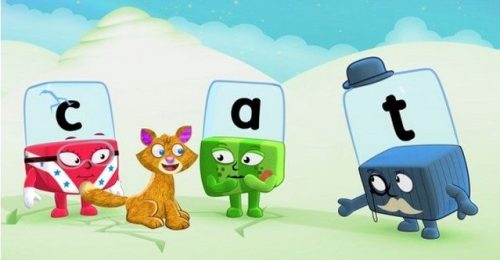

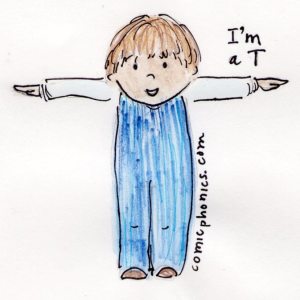 The word “it,” for example, has two sounds, each of which is associated with a letter. The word “shop” has three sounds with “sh” corresponding to a single sound.
 What two printed letters are the hardest for children to distinguish?
 In order to learn to read, do children need to recite and/or recognize the ABC’s in alphabetical order?
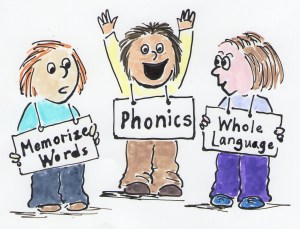 Primarily using phonics is the best method for learning to read. The US government did a comprehensive study of hundreds of research studies on how children learn to read and discovered that using a phonics-based approach produces the best results.
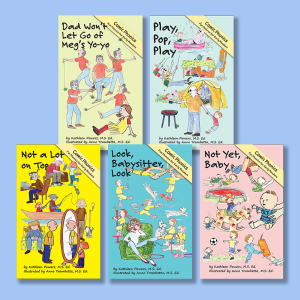


 comicphonics for early readers