Category Archives: methods of teaching reading

Use frontloading to prepare a student to read unfamiliar material

Good reading material for young children should include a wide variety of sources—nursery rhymes, the National Geographic Magazine and Laura Ingles Wilder’s stories of her childhood on the prairie, for example. But as unfamiliar subject matter is introduced—a good thing—children might have no previous knowledge with which to understand it—a bad thing.

The solution is for parents and teachers to prepare children for what they are about to read (or have read to them). Sometimes this prereading preparation is called “frontloading.”

The diagram below shows a child’s understanding of new knowledge without any frontloading. The first circle—prior knowledge—represents what the child already knows about a given subject. The second circle shows new knowledge—what the child is about to learn about the subject. If the two circles do not intersect, that means the child is making no connections between his knowledge and new information.  The child is likely to struggle to learn the new information, and without connections to what he already knows, the child is likely to forget the new information quickly.

without frontloading

With no overlap of information, the child has no way to “attach” new information to what he already knows. Little learning occurs.

Now compare the above diagram to the diagram below which shows a child’s understanding of new knowledge with frontloading. The intersection shows the overlap of what the child knows and the new knowledge. The larger this intersection is, the larger is the mental scaffold to which the child can attach the new information. The larger the intersection, the easier it is for the child to learn new information.

with frontloading

The green overlap shows frontloaded information–information which the child can use to remember new information.


Many poor readers don’t think about what they already know before they try to learn more. Sometimes they were never taught this skill in preschool or at home, and then later, teachers assume students know they should do this and the teachers don’t teach this skill. Yet rehearsing what one already knows about a topic it is an essential skill that good readers use all the time to prepare themselves for acquiring new information.

In our next blog, we’ll talk about how to help a child to frontload.

Is there any way to know ahead of time if my child will do well in reading?

Yes. According to Prof. Maryanne Wolf, director of the Center for Reading and Language Research at Tufts University, the two best predictors of later reading achievement are

  • an awareness of separate sounds (42 in English) and
  • the ability to rapidly name objects.

Today we’ll discuss sound awareness.

When I was a high school student studying French, I used to lie in bed listening to a Montreal radio station. I would try to figure out where one word ended and the next word began.  This same skill is what babies do when they listen to adults talk to them although they don’t realize it. Luckily for most babies, their mothers or caretakers speak slowly and distinctly and repeat words over and over.

With time toddlers begin to hear parts of words and realize that some words have one part (for example, Mom) while other words have more than one part (for example, Grandma).

Still later, usually around age four, children learn their ABC’s, not understanding what they are all about. But with instruction, they learn that each sound in English corresponds to a letter or a pair of letters in the ABC’s.

How can you enhance your child’s success in reading?

Make your child aware of words, syllables and individual sounds.

  • Encourage prereaders to write using invented spelling, advises Dr. Wolf. When the child writes, he sounds out a word and uses the letter symbols which seem appropriate. The “words” might not conform to proper spelling, but that is not the point. The child is working to figure out sounds, a skill he will need in order to read.Girl reading "inventive" writing of younger sister.
  • Encourage the child to listen to someone reading nursery rhymes. Then encourage the child to say the rhymes herself, advises Dr. Wolf.  Take “The Itsy Bitsy Spider,” for example.

The itsy bitsy spider
Climbed up the waterspout.

Down came the rain
And washed the spider out.

Out came the sun
And dried up all the rain.

So the itsy-bitsy spider
Climbed up the spout again!

  • Notice how “itsy bitsy,” “waterspout” and “out,” and “rain” and “again” rhyme. Notice the repetition of the word “rain” and the emphasis on the words “down” and “out.” Other nursery rhymes show alliteration (repetition of consonant sounds) and assonance (repetition of vowel sounds). When children listen to these sounds they learn to discriminate among similar sounds, figuring out what sounds the same and what sounds different.
  • Research shows that exposure to rhymes and alliteration helps children to figure out sounds and later, to read.

In our next blog we will discuss the other predictor of reading achievement, the ability to name.

How to use spelling tests to reinforce CVC words

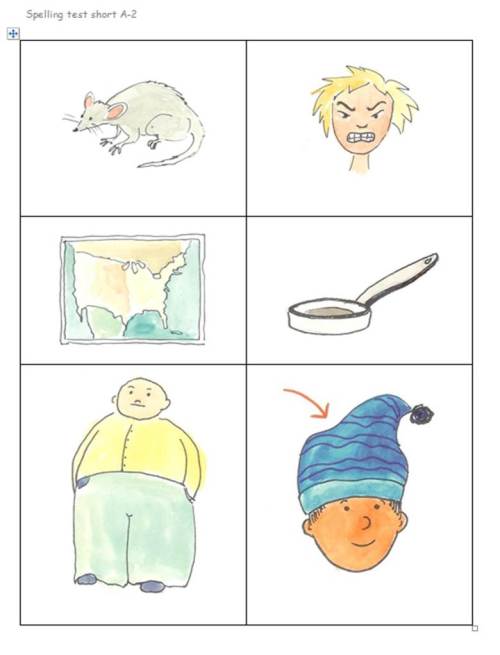
Years ago, I would cut  pictures of CVC words from various sources, paste them on index cards, sort them by vowel sound.  Then I would use them as spelling tests for beginning readers. (Now Mrs. A draws the pictures, including those below.)  This low-tech approach still works great with beginning readers and spellers.

Six drawings of short A CVC words

These drawings are samples of a packet of 12 pages of CVC drawings that can be downloaded for a small fee.  Click on the pictures for more information.  

Why use pictures for the spelling test instead of just dictating the words?

  • When the child is in charge of the pile of pictures, she can spell at her own pace, jotting down words she knows quickly and slowing down for words she is unsure of or for words she writes incorrectly and needs to repair.
  • Young children are people in motion, so the more parts of their bodies they can use to learn, the better. Taking off the rubber band, shuffling the cards, flipping them into a second pile as they are used and rubber-banding them again are fun.  Making learning fun is so important for children of any age, but especially for preschoolers.
  • Some children delight in erasing and will write a word incorrectly just so they can erase it. Spelling is a new experience for them, but it can take time, time when a tutor or mother might grow impatient. But since the child is working independently, the process can take as long as the child wants.
  • While the child is working independently, I can observe where she might need more help or prepare the next lesson, a better use of my time than dictating.
  • ESL students who might be shy about moving at a slow pace gain privacy by controlling the time it takes to complete the test.

One time I gave a preK student a short A test which he finished with pride—his first spelling test! When he found out I had more cards—more tests—he begged me to let him take the cards home and use them for the next week.  His mother later told me that  he took the spelling tests every day. What an eager learner!

Do after-school tutoring centers really improve a child’s reading?

Yes, after-school tutoring centers can improve the reading abilities of many children.

According to 2009 research by the University of Illinois, tutoring centers which do the following have the best chances of helping a student to improve reading skills:

• The center uses trained tutors (experienced teachers but also tutors whom the center trains).

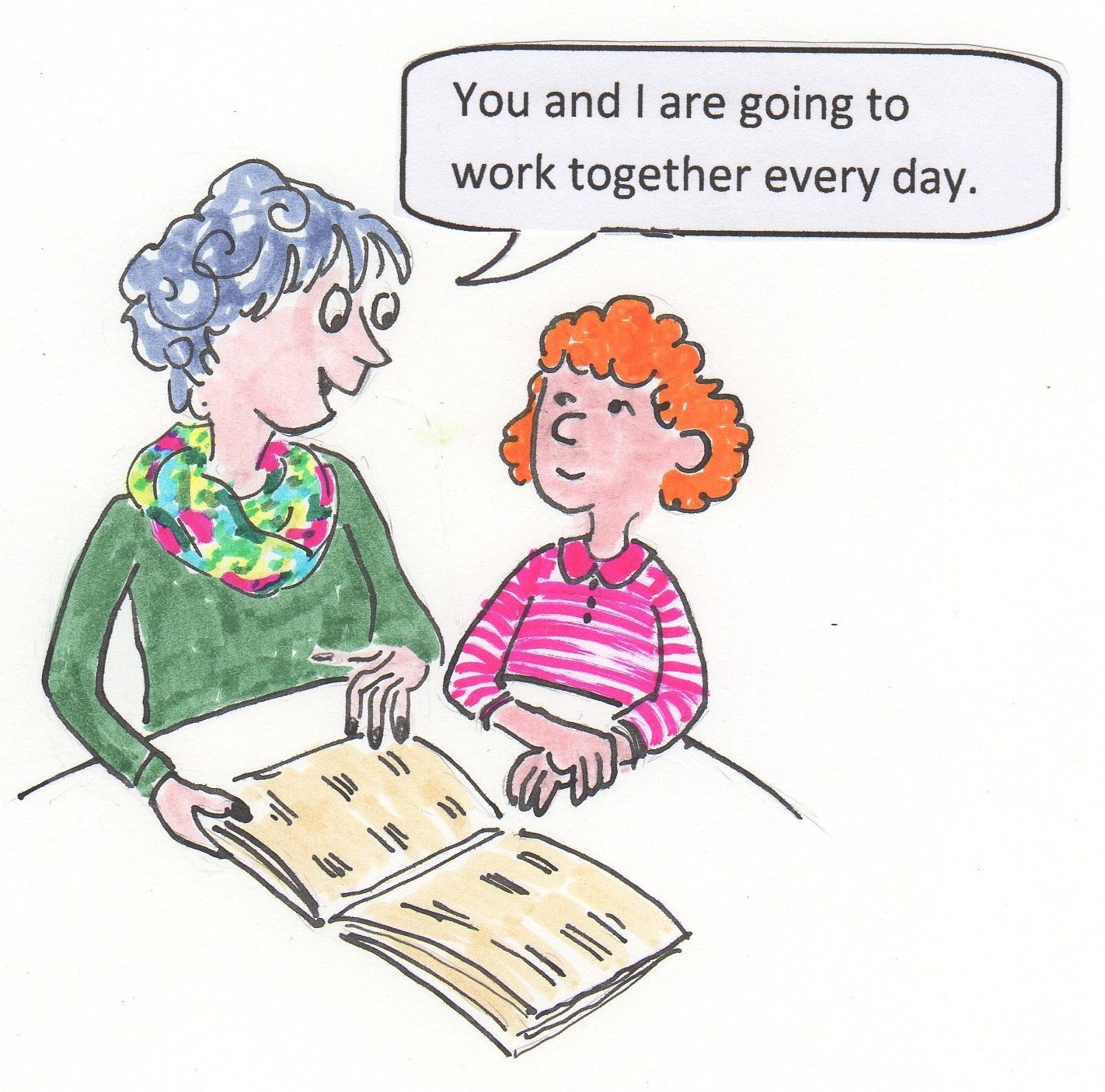
Adult holding a book open for the child next to her and saying, "You and I are going to work together every day."

• The center tests the student to identify his reading strengths and weaknesses and then prepares a plan to address the weaknesses.

• The center continues to assess the student from time to time—with formal tests and with informal tutor appraisals—to show progress or a need for more work on certain concepts.

• The center’s tutors are in touch with the students’ classroom teachers so that they can work together to help students.

• The center’s reading program follows a sequenced strategy.

A 2001 US Department of Education report on tutoring centers agrees on these good practices suggested by the University of Illinois, but adds these others:

• The center offers intensive, on-going training for teachers.

• The center works with the child regularly (daily or at a minimum of once a week for up to an hour of instruction).

• The center offers individual strategies to meet the needs of the 17 to 20% of students not helped by the center’s usual approach to teaching reading.

Whether a tutoring center can improve the reading skills of a particular child depends on the needs of that child. If a child is doing average-to-well in school or is a good ESL student, the after-school program probably can strengthen his skills. If the child has serious reading problems, such as dyslexia, the tutoring center might be willing to develop an individualized instruction plan. But not all centers are able to do this.

My advice is to identify your child’s needs with the help of his classroom teacher and then interview various tutoring centers to find one which will meet his needs or, if none seem right, look for a private tutor who specializes in teaching reading.

For more information on these research reports, go to
http://www.cprd.illinois.edu/files/ResearchBrief_Tutoring_2009.pdf and http://www.cns.gov/areads/about/evtutoringworks.pdf.

How do I read to my two-year-old? Is he even ready?

Some one-year-olds are ready to be read to, and some two-year-olds are not yet ready. But most are. Reading to a two-year-old can be fun and educational for the child, and subconsciously, prepare the child for more sophisticated reading.

Two-year-olds are all about physical motion, so reading to them should include movement. You could start with board books, and ask the child to tell you what he sees. He might say, “Baby.” Probe a bit. “What is the baby doing? Show me.” Even if he can’t put into words the baby’s actions, he might be able to act them out.  Helen Oxenbury’s books are great for children who cannot speak yet.

baby reading a bookHis physical needs might include holding the book and turning the pages. He will learn to turn pages correctly if you help him. But he will want to go back and forth. He might see a dog on page eight and remember seeing the dog on an earlier page, and he might flip the pages to find the dog. Don’t expect formal sequencing of pages with a two-year-old.

Some books for young children have textured parts for the child to touch. Others have flaps that open and close, or they offer pop-up parts that unfold. Little children love these books, but roddlers tend to rip the pages. Beware. They love to move things in a trial-or-error way to see what happens. Yet their touch is usually not delicate.

You might start reading a picture book and the child might interrupt, pointing to a picture and talking about it. He might not care for the story yet, but he might be fascinated by the pictures. Don’t think that just because there are words you must read them. Let the child guide you.  If he doesn’t want you to read, look for some wordless books or just discuss the pictures.  Most wordless books are intended for toddlers.  They are also great for older ESL students new to English.

Two-year-olds are acquiring language rapidly. If you point to a picture and say “bug” or “triangle,” the child might remember the new word. Two-year-olds are also picking up grammar, so be sure you use grammar correctly, even if the child doesn’t. You don’t need to correct him most of the time.  By hearing you say grammar correctly, he will eventually say sentences correctly.

I remember my preschoolers choosing the same books over and over. I was bored reading them repeatedly, but they weren’t. Children find it comforting to hear, day after day, how the little bird found its mother or how Sylvester returned to his family.

father reading Old McDonald to childNursery rhymes are great for the littlest readers.  Some, like “The Itsy, Bitsy Spider” and “This Little Piggy,” encourage finger or toe play. You can tell the child enjoys nursery rhymes when he starts doing the finger play himself.  Plus, children love rhymes, anticipate them, and race to complete the rhyme.  Rhymes teach children about word families (spout, out; rain, again), too.

You might use reading to a toddler to establish routines, such as what you and your child do before or after a nap.

If there are older children, you might want to read to them at a different time, since a two-year-old’s abilities are quite different from a four- or five-year-old’s.  On the other hand, a patient toddler might pick up reading skills and vocabulary by listening to his older sibling read with you.

So should you read to a two-year-old? Definitely, but keep in mind the abilities of a child that age.


What is choral reading?

Choral reading is group reading aloud in which a fluent reader serves as a model for students learning to read. It is a reading method frequently used in pre-K to second grade classrooms and in ESL classrooms, but it can also be a good method to teach reading at home.

Here’s how it works:

  • A fluent reader, usually a teacher, parent or recorded voice, reads a story aloud. The students gather around the teacher who uses a large-sized book whose text is also large. As she reads, she points to each word. Or, if children have their own copies of the text, they point to the words she says with their fingers.choral reading
  • The teacher reads the selection once while the children follow along silently with their eyes on the text.
  •  The teacher reads the selection several more times, each time with students joining in for the words they can say. Usually, with repeated readings, students can read more of the words.
  • Often the selection is reread the next day or soon after to reinforce the students’ ability to read the selection.

Why do choral reading?

  • It’s fun. Children love to read aloud when they are one of many voices. Many times the selections have repeated phrases like “I’ll huff and I’ll puff and I’ll blow your house down,” or rhymes, which increase the fun.
  • More skilled readers serve as models for the less skilled students sitting by their sides. The less skilled readers listen not only to their teacher, but to their peers, and they learn from each other.
  • Less skilled students, who might be embarrassed to read aloud by themselves, feel comfortable as part of the group. Their mistakes either can’t be heard or are ignored. They feel more confident about reading aloud. They also realize that with repeated readings, they can read more words.
  • ESL students learn proper pronunciation, phrasing and intonation from listening and mimicking the fluent reader.
  • Dyslexic readers, who often memorize words rather than sound them out, remember better because they are enjoying the reading experience. Their lack of reading ability is less noticeable when they are part of a group.


What research tells us about reading

What can we learn about reading from all the research that has been done over the years? Carol Gordon from Rutgers University offers many ideas.

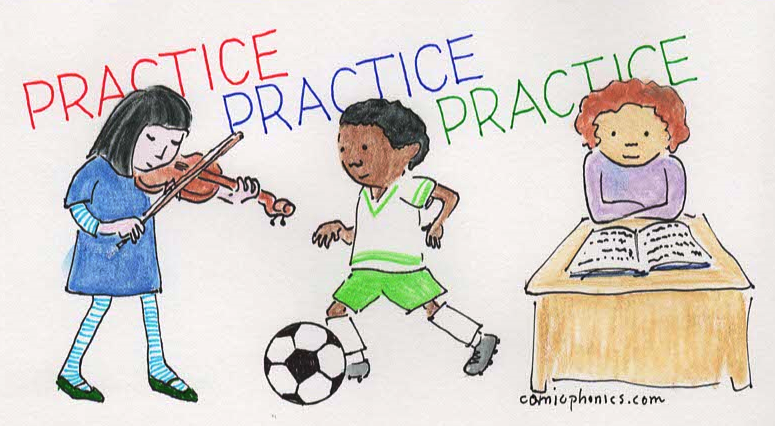
Three students practicing different activities--reading being one.
 

  • Students become better readers by reading (just like swimmers become better swimmers by swimming or pianists become better piano players by practicing). The more they read, the better they read.
  • Choice among genres and media encourages reading. Restricting reading to books only is too restricting when comic books, graphic novels, magazines, web sites, blogs, emails, chat rooms, text messaging and apps tempt students. Students will read more when they are free to choose what they want to read.
  • Teaching students how to read (once they know the basics) is often no more helpful than letting students read and read and read. If they are motivated to read, they will figure out how to do it better.
  • Students read when reading materials are easily accessible. No books in the bedroom? Is it any wonder the student doesn’t read? Piles of library books next to the bed? Of course, the student will read.
  • Summer reading programs maintain or increase reading skills. Research shows that poor children lose two months or more of reading skills if they don’t read during the summer. Better off families, meanwhile, enroll their kids in library programs or hire a summer tutor, so their children’s reading scores improve during the summer.
  • Blogs, apps, reading groups, reading buddies, student reviews and other means of making reading a social experience encourage reading.
  • The best motivator is the enjoyment or satisfaction that a student gets from reading. If a student needs an outside motivator, connect that motivator to reading—rewarding with a new comic book, for example.

For more information, go to School Library Journal, November 2010.

Online site offers current events reading for young readers

If you have a young reader who is reading at a third grade level, a new online site offering nonfiction news articles might attract him.

Child Browsing the WebAt www.newsela.com news stories at five different reading levels are offered. The lowest reading level is targeted for an average third grader, and the highest (the original news story) is written at a college level.  In between are three rewrites at intermediate reading levels.  Two news articles are posted daily, along with a quiz for each article.  Both the news stories and the quizzes are aligned with the Common Core standards for nonfiction literacy.

The news stories are divided into seven topics:  war and peace, science, kids, money, law, health and arts.  Articles from Feb. 6 and 7 include “CVS to stop selling cigarettes,” “Marine biologists baffled by beached whales in Florida,” and “Fourth-graders have become better readers.”

Articles are geared to younger readers by the subject matter, choice of vocabulary and the average sentence length.  I calculated the CVS article written for third graders to have about 8 words per sentence.  Paragraphs in that article ranged from one sentence to five sentences.

To the right of each article, which comes with a colored photo or graphic, are five tabs to allow the reader to choose his own reading level.  If a child finds one level too hard or too easy, he can choose another.

Jennifer Coogan, chief content officer for the website, selects the stories to feature from the AP News Service and the McClatchy-Tribune News Service.  Stories might be international, such as a story about Parliament telling Buckingham Palace to cut back on expenses and to repair its palaces.   Or they might have regional interest, such as the effects of an inch or two of snow on Atlanta.

The people who rewrite the original stories use guidelines for readability, including sentence structure, context clues, and time shifting in narratives.  Because younger readers don’t have “reading stamina,” said Coogan, the articles’ word counts are aligned to state-wide assessments.

The quizzes use multiple choice questions, but they also might ask a student to tell in which paragraph an idea is found.  In the works are questions that require short answers from student readers.  Also coming is a Spanish version of this service.

Although the primary target audience of the website is teachers, parents can sign up for their children.  The annual cost is $18 per student for an individual student; $2,000 per grade in a single school; and $6,000 for a whole school.  So far 90,000 teachers and a half million students are using the site.

In an earlier blog, I wrote how boys often prefer nonfiction reading.  Websites like this one might be a good alternative for them.  The timeliness of the articles, the daily introduction of new articles, the subjects themselves—plus reading and answering questions online—might attract boys who are not keen on reading fiction.  –Mrs. K

How much do you know about reading and vocabulary?

1. How many word families (go, going, goes, went, and gone, for example, are one word family) does an incoming ninth grader need to know?  a. about 1000  b. about 10,000  c. about 100,000  d. about 1 million

2. If a student reads widely 60 minutes a day, five days a week, how many words will he read in a year?  a. about 30,000  b. about 100,000  c. about 1 million  d. about 2.5 million

3. If a student reads widely for 60 minutes a day, five days a week, about how many new vocabulary words will he learn in a year?  a. 1000  b. 2000  c. 3000  d. 4000

4. If a teacher assigns a student to look up vocabulary words, and to write their definitions, and to write sentences using the words properly, is this an effective way to learn new vocabulary words?  a. yes  b. no

5. If a student reads all assigned school reading, but does not read widely outside of assigned reading, can a student learn as much vocabulary as he needs to know?  a. yes  b. no

Click here for  ANSWERS

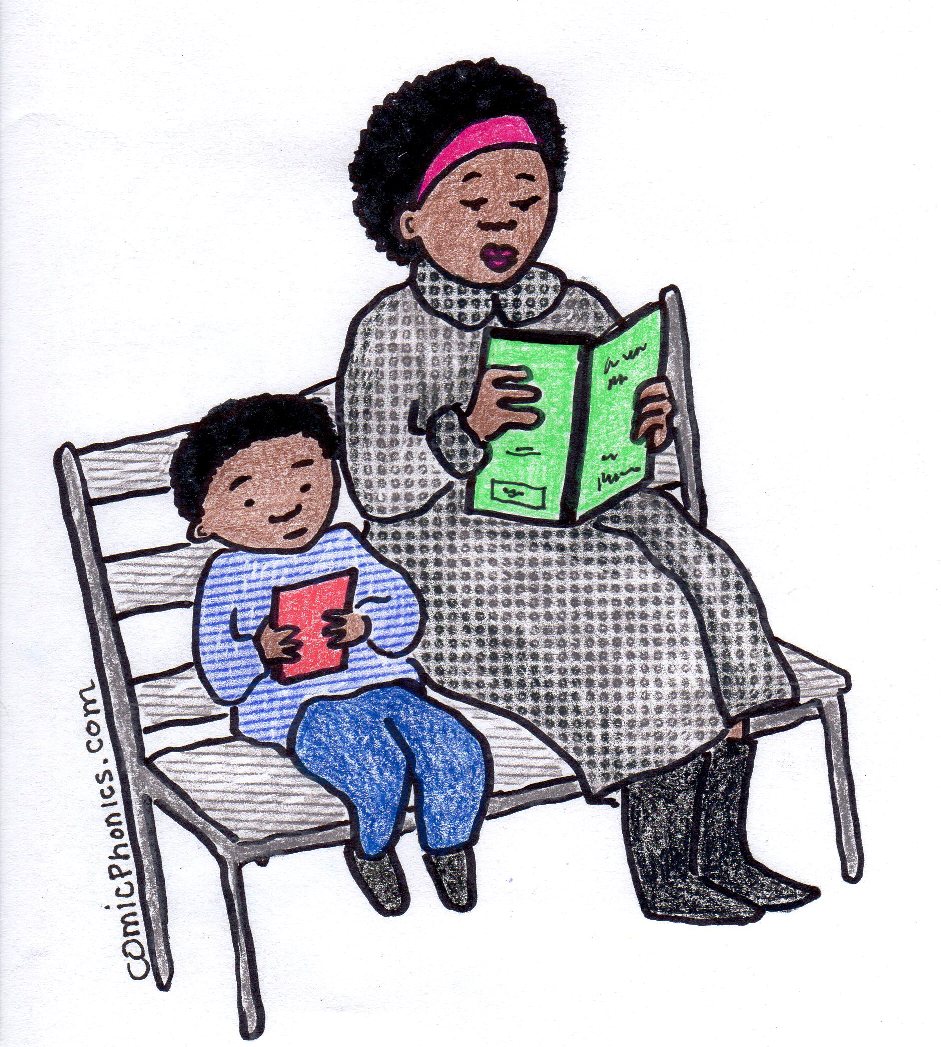
Son and mother reading on a park bench.So what can parents do to make sure their children—even beginning readers—learn the vocabulary they will need to succeed in school?

  • Read often and widely to your children. Choose fairy tales, how-to books, biographies and any subject of interest to your child.
  • Once your child can read independently, make sure she does. You read one page while she reads the next; or you read your book while she sits next to you reading hers.  If you model the behavior you expect, you are more likely to get it than if you watch TV while you ask your child to read.
  • When your child asks you what a word means, tell her, and sometimes explain how you know or how your remember that word. If you don’t know a meaning, look it up.  Make your child familiar with dictionaries, thesauruses and online search engines.
  • Make sure your child knows the vocabulary of the subjects she is studying in school. If she is learning her shapes, she needs to know circle, square, rectangle, oval, rectangular prism and trapezoid.  If she is studying grammar, she needs to know her parts of speech.
  • Some words have one meaning in one context (to set the book on the table) and have another meaning in another context (the set of odd numbers). Make sure your child knows multiple meanings of everyday words.
  • Let your child see you figuring out the meanings of words through context clues, through breaking a word into prefixes, roots and suffixes, and through the use of dictionaries, thesauruses and online search engines. Help her to do this over and over, so she has strategies to use to figure out new words.
  • Engage in conversations with your child using new-to-her vocabulary words. These could be discussions about something you are reading together or about what she studied in preschool today.  If your child uses words like “thing,” “something,” or “stuff,” ask her to use a more specific word.

To learn, we need to know the vocabulary of what we are learning.  To comprehend reading, we need to know thousands of words.  It begins at the beginning, reading aloud to your child.

How to teach short e and short i

Short e and short i are difficult sounds to distinguish for most beginning readers.  When I teach these sounds, I rely on two game-like activities that little children seem to like.

For one of the activities, I have gathered small pictures of words which either start with short e or short i or which use them in the CVC pattern.  Such pictures might include an igloo, bed, fish, elephant, mitt, pen, pin and bell.  I cut several index cards in half and paste one picture on each card.  Also on one card I write an e and on another card an i.

During the lesson, I put the e and i cards in front of the child and we practice saying those letter sounds.  Then the child sorts the deck of cards I have created, putting cards under one of the two letter sounds.  We say the word aloud to reinforce the letter sound.

For another activity, I have created BINGO-like cards of short e and short i words.  Since most children learning these sounds with me are four years old, I limit each BINGO card to nine words.  I say one of the words and the child must find and cover it, using a letter tile or a plastic marker.

Included here are several BINGO cards which you can download or use on your tablet or iPad.

This slideshow requires JavaScript.