Category Archives: methods of teaching reading

I haven’t read to my child at bedtime. How do I start?

Dad reading to children in bedIf you haven’t been reading to your child at bedtime, but you want to establish that tradition in your family, here are some ways to begin.

You might gain your child’s approval by saying she is going to be allowed to stay up 15 minutes later every night while you read together.

You might let her choose the reading material. You needn’t read a book together. If she is into fashion, read a fashion magazine or newspaper. If he is into making things with his hands, read Popular Mechanics. The idea is to make the reading experience pleasurable for your child.

Help your child to vary the reading material. Go to the library together and poke into the nonfiction section about animals, stars, and history. Show her the biography section and read some names of famous people she might know a bit about. Let her choose so she has have a stake in the reading.

If electronic equipment will entice your child, use it. If comic books will entice your child, use them. If graphic novels will entice your child, use them.

Many children are ignorant of world news, but an evening read of a news story can make children aware of the wider world. With you there to interpret, the child can become more sophisticated.

If your child is reading too, and he is a reluctant reader, suggest that he read one page and you read another, or he read one paragraph and you read another. But at first you might want to do the reading yourself, to attract your child to the idea of bedtime reading. If he thinks he has to work, he will balk.

If you read a book for which there is a film, suggest that you watch it together after you finish the book. Heidi, Treasure Island, Tom Sawyer and so many more children’s books have been turned into films. You can discuss how the book and movie differ, and which she likes better.

If there is a special TV show one night or you are on vacation, you might suggest skipping the evening read for that special event. You might be surprised to see disappointment on your child’s face. If so, suggest that you could read, but just a bit later or during the baby’s nap. For the chance to cuddle up with Mom or Dad, most children will want to read.

Keep this time stress free. If your child is relaxed, she might raise questions about matters she is tossing around in her mind. Let that be her choice though.

Stick to the time you set—15 minutes, 20 minutes or whatever you decide on. If necessary, set a timer. The child must learn that this is a limited happy experience that she can look forward to again tomorrow evening.

Good luck!

Do you read stories to your children at bedtime?

Dad reading to children in bedIf you do, you are one of a small group of parents. An online survey of more than 1000 US parents shows that one-third of parents read to their young children every night. Half the parents said that their children prefer watching video games or watching TV to reading.

Another survey of 2000 mothers in Britain showed that about 2/3 of mothers read to their children, but only 13% read to their children every night. Parents say stress at the end of the day and lack of time are reasons that they don’t read to their kids. But TV, video games and other distractions also are factors.

Yet reading to children at bedtime can offer so many advantages.

  • Establishing a bedtime ritual—a bath, brushing teeth, kissing family members good-night, a prayer, and a snuggle with Mom or Dad while they read—is a time-honored way to settle children down and prepare them for sleep.
  • Children learn fluency by hearing an adult read. They learn to slow down for commas and periods. They learn to change their tone for direct quotes. They learn that certain parts should be read faster or slower, louder or softer, or in a high squeaky voice or a low threatening voice.
  • In the privacy of the bedroom, parents might feel more inclined to “act” out the words of the book—to be silly or gruff, whiny or sugary. Children sometimes see a different side of their parents during bedtime reading. This can be a great ice breaker between a child and a usually distant parent.
  • Children learn vocabulary. They can ask, “What does that mean?” and get an immediate answer.
  • Children learn about setting, plot, character, tension and happy endings. They learn about culture. Especially as children get older, parents can read books to a child which the child isn’t ready to read yet but which the child is quite able to understand.
  • Children often reveal what they are thinking and feeling during a nighttime read. Snuggled safely with Mom or Dad’s arm around her, a child might open up about her hopes and fears. This is a time for the child to feel protected.

In our next blog we’ll talk about how you can establish bedtime reading if you don’t already do it, or how to improve the experience for you and your child.

The American study was conducted by Macy’s and Reading Is Fundamental in 2013. The British study was conducted by Littlewoods, also in 2013

Teach art literacy when sharing picture books

When children start to “read” picture books, generally they are reading the pictures; that is, they are trying to get meaning from the pictures since they can’t read the words yet.

They might study the appearance of a character, noting if it is a boy or girl from the clothes. Or they might look at the dark swirling clouds or the beaming sun to discover the atmosphere of the story. They might look at the colors the illustrator uses. Bright colors and pastels might indicate a happy or peaceful theme; dark colors or colors tinged with greys and blacks might indicate danger. Horizontal lines or smooth lines might indicate calm while jagged or diagonal lines might indicate action.

children looking at picture of Lincoln and Mrs. Lincoln

Some children perceive these clues without explicit instruction, but many children need someone to point out how colors, lines, and facial expressions tell the story too.

According to research by Kathleen Ellen O’Neil, illustrations can interact with the text in four different ways.

  • The art can reinforce the text, “showing” the text. For example, in “The Mitten,” adapted and illustrated by Jan Brett, a boy loses a mitten which his grandmother has just knit. One by one, we see animals from a tiny mole to an adult bear squeezing in to the mitten. The illustrations show the hedgehog’s quills and the badger’s nose poking through the wool.
  • The art can supplement the text, providing description which the text either skimps on or doesn’t describe at all. For example, also in “The Mitten,” we see the boy dressed in a Ukranian tunic, leather pants and boots with folk art borders. The book doesn’t mention where the setting is, but the art shows.
  • The art can provide far greater detail than the text, offering new insights which a literally-minded child might miss. It can illustrate nuances, inferences, humor and irony, adding depth to the text. In “The Mitten,” for example, the boy finds his mitten after the animals have left it behind, and he brings it home. The last page of the story shows the grandmother holding both mittens and noticing how much bigger one is than the other. No words are used, but we can hear her wondering, “How in the world?”
  • The art can convey a parallel story which either expands the text or contradicts it. Still in “The Mitten,” to the left side of almost every page we see the boy playing in the snow—hopping on a log where the rabbit lives, poking with a stick above the hedgehog’s burrow, looking in a tree’s knothole where the owl lives and climbing atop a woodpile where the fox lives. To the right side of those pages we see an animal leaving its disturbed home, and on the next page that animal squeezes into the mitten. Nothing in the text says that the boy disturbed the animals, forcing them to seek shelter elsewhere. A discerning youngster might notice it, but many children will need this part of the story explained.

For more information and other examples of books which clearly show the four different kinds of art interaction with text, go to the November 2011 issue of “The Reading Teacher,” page 214, for the article by Ms. O’Neil.

Is Why Johnny Can’t Read still used to teach reading?

Why Johnny Can’t Read is a book by Rudolph Flesch, Ph. D., a readability expert in the US from the 1950s until his death in the 1980’s. This book advocated a phonics-based approach to learning to read when most American children were learning the “look-see” approach of memorizing the look of a word. Today Flesch’s approach is out of favor if used alone, but if it is used in combination with some other approaches, it can be part of a good approach to teaching reading.

However, kids hate it.

CVC words that end in _ch and _ook.

To enlarge, click on the picture.

Flesch’s approach is to break down phonics into sounds which correspond with letters, and to teach lists of the same sound. One of the beginning lessons is a list of several columns of short a CVC words; it is followed by a page each of the other short vowel sounds. Then the short vowels are mixed together, two vowel sounds at a time. Gradually all the sounds of English are introduced through lists of words which use those sounds.

The problem is that reading lists is boring for children. They find it hard to stay focused for more than a few minutes on such a task, so if that is the only strategy, kids resist these lessons.

Other reading programs have taken Flesch’s idea and have presented the lists a different way. One of the most successful is Explode the Code. For a lesson on bl, cl, fl and gl bends, for example, there are nine pages of activities. On one page the word to be learned is to the left, and to the right are three pictures, one of which illustrates the word. The child needs to circle the correct picture. On the next page the student sees a word on the left and needs to circle the same word (one of three) on the right. On another page the student fills in the blank with a word which is illustrated to the left. On another page the student answers a question using one of the blend words. Students prefer the variety that this approach takes.

When I teach reading to beginners, I use a combination of Flesch’s ideas and others. I don’t use his long list of words, but sometimes I give my students one column of his lists. For variety, I put words on index cards which the child can hold and shuffle, so the child has more control. Again, I limit the number.

I taught my three children how to read using the lists at the back of Why Johnny Can’t Read, so I will always be grateful to Flesch, his research, and his simple, straight-forward approach to teaching phonics. As a writer, I am grateful for his guides on how to write plain English.

My child knows how to read pretty well for a first grader. Should I still read aloud to her?

Yes! Here’s why:

  • A child’s reading level doesn’t catch up with a child’s listening level until eighth grade, according to Jim Trelease, author of The Read-Aloud Handbook. A younger child can appreciate a book she cannot read yet—the plot, the descriptions, the characters and the vocabulary—if an adult reads it aloud to her.

    Father reading to child and child asks, 'How old is Old McDonald?"

    To enlarge, click on the picture.

  • Reading aloud to a child attracts him to reading by himself. He takes pleasure from being read to, and will want more of that pleasure even if an adult is not available to read to him. He will delight in life-long reading.
  • Books contain rich vocabulary, words more numerous than what we parents say on an everyday basis to our children. Children learn the vocabulary from the books we read aloud because we pronounce the words properly and because we explain them to our children. With such a rich vocabulary they are better prepared to understand their teachers and the reading they do on their own.
  • In books read aloud, children hear more sophisticated grammar than they read in grade-level books. Subconsciously they learn good grammar.
  • Good books contain the kind of values we want to pass on to our children. Reading these books aloud offers opportunities to discuss these values with our children.
  • Reading to fidgety children increases their attention span. It gives them practice sitting and listening which they need to do in school to succeed since so much school instruction is verbal.
  • Read-aloud time is bonding time. Do you remember in To Kill a Mockingbird how first grader, Scout, would sit on her father’s lap while he read legal papers aloud? She didn’t care what he read. It was their special time together.

Common Core requires increasingly complex texts

One of the goals of the Common Core Standards that is receiving flak across the country is the push for students to understand increasingly complex texts.

Discouraged child thinks there are too many words in a book she is readingYou might assume that a second grader would read more difficult books than a first grader, but according to the people who wrote the standards, there is not proof that this is happening in US schools. Their “research shows that while the complexity of reading demands for college, career, and citizenship have held steady or risen over the past half century, the complexity of texts students are exposed to has steadily decreased in that same interval.”

They believe that the texts used in middle schools and in high schools have been “dumbed down” over recent decades. To counteract the “dumbing down” of texts, the Common Core Standards want to increase the difficulty of the texts students read so that US students are well prepared for college and for work.

The Standards state that the reading complexity levels for all grades need to be made more difficult, and that what a student studies in May should be more complex than what he studied in the previous September.

How will this be measured? Three ways:

  • Qualitatively: An attentive teacher will note whether a student recognizes various levels of meaning in a work of literature, or if he recognizes that language is used in new or archaic ways, of if the reading requires background specific knowledge that the student might not have.
  • Quantitatively: Readability measures will be used to determine the difficulty level of the materials students read, and the students will be tested to see how much of the material they understand.
  • Reader-task considerations: A teacher with knowledge of her student will rate the student’s motivation, knowledge base, and experience as well as the purpose of the assigned reading, and the difficulty of the task which the teacher assigns (for example, responding to open-ended questions is more difficult than responding to multiple choice questions).
Common Core Georgia Standards

Click on picture for the entire document.

The Georgia Department of Education has created a rubric for teachers (and parents) to use to determine the text complexity of a given reading selection. When the points are totaled, texts with scores of between 80 to 100 are considered of appropriate complexity.

For more information, go to: https://www.learninga-z.com/commoncore/text-complexity.html and https://www.georgiastandards.org/Common-Core/Pages/ELA.aspx

Is it necessary to teach “r” words like “car” and “or” separately or should I include them with short vowel, CVC words?

Although children will pick up r-controlled words as they learn to read, it is a good idea to have a separate lesson on them since they are neither short nor long vowel words, and since “ir,” “er” and “ur” sound the same.

Just like it helps to have a reference word for short vowel words, it is a good idea to teach reference words for r-controlled words. I suggest you use nouns whose image is obvious to a child, such as

ar car, jar or star
or fork, stork or sword
er Bert (from Sesame Street) or fern
ir bird or skirt
ur church or turtle

pictures of R-controlled words to use for memory

When you begin to teach r-controlled words, choose words whose spelling follows the rules, such as

far bar fir her
purr slur stir for
nor sir sort start

Don’t choose “store,” “floor” or “boar,” or other words whose spelling varies. Start with one syllable words, and then move on to two syllable CVC-CVR words with twin consonants such as

better bitter butter differ
hammer dinner ladder matter
offer pepper rubber zipper

Continue with two syllable CVC-CVR words whose middle consonants are not identical such as

timber under lantern fender
lobster master silver winter
lumber member butler monster

Then put the r-controlled syllable at the beginning of the word, using words such as

carpet organ carbon hermit
perfect serpent verdict perhaps
perfume person Vermont artist

At this point the student should be able to add consonants after the r-controlled syllable to create flirt, squirted and discard.

If your child has already learned CVC-CVC words, adding r-controlled words should be easy for the child. Even so, take small steps, and when he is ready, move on. As for “store,” “floor” and “boar,” you can tell your child that there are some variations in the spelling of r-controlled words. Rather than confuse the child at this point, when you are reading together, point out alternate spellings as you come upon them. –Mrs. K

Use the K-W-L approach before reading to activate prior knowledge

K-W-L charts have been used by reading teachers for almost 30 years, but they can be just as useful to parents of young children to help them with reading comprehension.

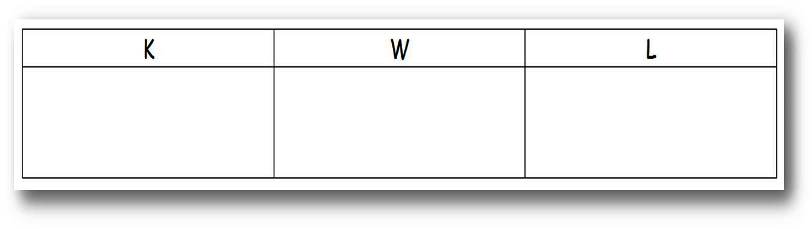
K stands for “know” or what the child already knows about a given topic. W stands for “want to know” or what new information the child would like to learn about a given topic. L stands for “learned” or what the child has learned after reading (or having been read to).Empty K-W-L chart

With younger children who cannot read yet, using the K-W-L strategy sets up a pattern which the children can use in the future. One reason some children struggle with reading comprehension is because they don’t think about a topic before they read about it. If children learn to consider what they already know, and link new information to that, they will usually understand the new information better and retain it.

Since writing down words doesn’t help a nonreader such as a preschooler or a new ESL student, drawing pictures can replace the words. Even for children who can read a bit, sometimes drawing the pictures adds fun to the learning experience.

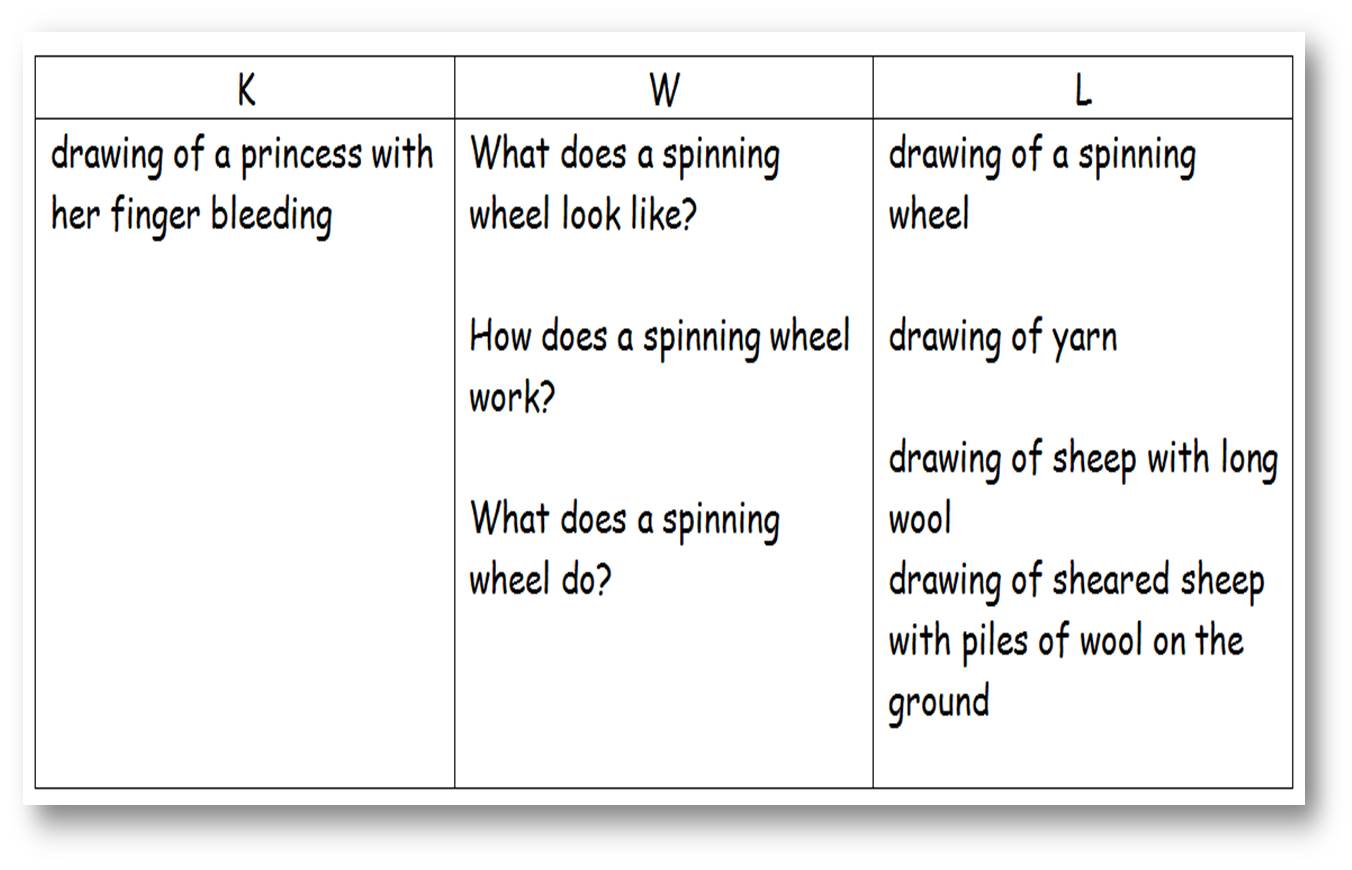
For example, suppose you read the story of Sleeping Beauty to your child, but she has no idea what a spinning wheel is. You find a book about how people used to make yarn by hand before machines did it. What kind of K-W-L chart might arise before you read the book about making yarn by hand?Example of filled-in K-W-L chart

If you, as the parent or teacher, want your child to learn a particular idea from a reading passage, you might steer the discussion to that idea as you and your child fill in the chart. But the chart works best if it reflects the child’s own understanding of a topic, and his own questions about that topic.

For example, if the topic is diamonds, the child might write:Example of a filled-in K-W-L chart

For the K-W-L strategy to help reluctant readers, the questions under “W” and the information under “L” should be linked back to what the child said she knows under “K.” So the teacher or parent might help the child create a chart like this:Example of a filled-in K-W-L chart

By connecting the “Want to Know” and “Learned” information to what the child already Knows, the child is extending the knowledge base she already has, rather than learning and soon forgetting isolated facts.

The K-W-L strategy and chart was first created by Donna Ogle. For more information, see Ogle, D.M. (1986). K-W-L: A teaching model that develops active reading of expository text. Reading Teacher, 39, 564-570.

How can I jump start my child’s reading comprehension

Reading comprehension—taking meaning from printed words—is the goal of all reading. Before reaching this goal, independent readers need to advance through three other stages: recognizing that the 42 sounds in English are represented by 26 letters and combinations of letters; recognizing that arranging those letters or letter pairs with other letters creates words; and being able to say the words aloud (or in the mind) in such a way that the sounds represent the way people speak English. If children can do this, then children are in a position to comprehend what they read.

Chart of 4 reading components

Click on the picture to enlarge it.

But even with all this good foundation, some children flounder when it comes to understanding what they read. There are many reasons. One of the most important, especially for ESL students and for culturally deprived children, is not understanding the vocabulary.

What can a parent or teacher do to jump start reading comprehension?

Ask the right kind of questions, according to reading expert Timothy Shanahan, a reading researcher whose views are highlighted in the February issue of Reading Rockets, an online source for excellent information about reading.  (For a link, see the end of the blog.)

According to Dr. Shanahan, three kinds of questions should be asked to guide students into understanding a text:

  • First, what are the important issues and important details raised by the reading selection? When Junie B. Jones misses the school bus, for example, the young reader should be questioned about why Junie B. didn’t want to take the school bus, not where she sat on the bus or who annoyed her. At the end of the story, why did Junie B. finally run outside to talk to the janitor? “Close reading”—the kind of reading demanded by the Common Core Standards—is not the same as trivial reading, according to Dr. Shanahan.

questions to ask when reading closely

  • Second, how has the author crafted the reading selection? These kinds of questions should be “text dependent.” That is, the child should be able to answer these questions only if the child has read the text. In Alexander and the Terrible, Horrible, No Good, Very Bad Day, for example, what kind of mood is Alexander in when he wakes up? Why is that kind of mood important for the start of the story? Is Alexander the oldest child, the middle child or the youngest child? What difference does this make in the story?
  • Since a part of crafting a reading selection is choosing the vocabulary to use, children should be asked about important vocabulary words. What is Australia? Where is Australia? What is a janitor? Why is he at school when the children have gone home?
  • Third, what are the conclusions a reader can take from the story? What are the big ideas?  What has Junie B. learned?  Why are Junie B’s mother and teacher happy and not mad at the end of the story? Will Junie B. take the school bus in the future?  Why does Alexander’s mother say again and again that some days are like that, even in Australia? Why does she say Australia and not a nearby city? Why does Alexander say that too, at the very end of the book?  The purpose of these questions, according to Dr. Shanahan, is to interpret the text.

Dr. Shanahan recommends asking questions in the same order as the information is presented in the reading selection. He says it is not important to ask a particular number of questions, or that the number of questions from each of the three categories be equal. Always there should be some questions from each category asked, but sometimes one kind of question needs to be more thoroughly investigated than the other two. In particular, understanding how a writer crafted a reading selection will demand closer reading and might require more questions from a parent or teacher.

To read the posting on Reading Rockets, go to http://www.readingrockets.org/blog/examples-close-reading-questions. While you are there, sign up for the free monthly newsletter full of good ideas about teaching reading.

How to help a child frontload information before he reads

Frontloading means preparing a child to read new material by loading his mind ahead of time with information which will help him understand the new material.

Good readers either consciously or subconsciously do this before they read something new, but many poor readers do not. For new readers and poor readers, parents and teachers need to model this activity until the child makes it his own.

But how should a parent or teacher model frontloading?

• For a work of fiction, many teachers discuss ahead of time the setting, characters, plot, and problem the students are about to read about. If any parts of it are familiar to the students, the teacher will point them out, connecting the new with what the student already knows.

Students shouting I Know to teacher

• Some teachers prepare a list of vocabulary words the child will encounter in the new reading. Often, the children write down definitions of the words and use those words in sentences so when they see them in the text, the words will be familiar.

• For stories in reading textbooks or for nonfiction information in textbooks, teachers sometimes discuss what the title could mean and what the subheadings could mean. If there are illustrations, the teacher asks the students to describe what is happening or what information is shown in the table, diagram, map or political cartoon.

According to Kylene Beers, a long-time reading teacher and author of When Kids Can’t Read; What Teachers Can Do, these prereading techniques often work with skilled readers but not with struggling or passive readers. She offers other prereading strategies to reach them.

• Because struggling readers often skip reading titles, captions, and subheadings, and rarely page through a reading assignment to see if there is any nontextual information, they need to be assigned to do what good readers do naturally, often with a teacher’s direct instruction.

• One kind of direct instruction in prereading is using an “Anticipation Guide.” Before a reading assignment is given to a student, the teacher—or parent of a young child—reads the selection and composes a short list of ideas from the reading for the child to respond to. For example, if the child is reading or being read Sylvester and the Magic Pebble, the list could include ideas like, If a child gets lost, does the mother and father stop thinking about that child? Or, Is there such a thing as a magic stone that can make people invisible? Together the adult and child can talk about these ideas which the child will encounter later in the book.

• Struggling readers often begin reading as if every reading—for school or for pleasure—is a cold read. While they are reading, they do almost no predicting what might happen next. Yet good readers do this all the time. One thing a parent can do is to pause as she is reading and to ask the child, “What do you think is going to happen next?” If the child shrugs, the parent might model some options—“Well, I think Sylvester will never come back to his family,” or “Well, maybe Sylvester will find a different magic pebble while he is invisible.” Gently encourage the child to respond, discussing the possible outcomes of those predictions.

For more ideas on prereading activities that can activate a child’s prior knowledge, see Beers, K., When Kids Can’t Read; What Teachers Can Do, Portsmouth, NH: Heinemann, 2003. This book, by the way, is one of the best I have read about how to teach reading—useful ideas that have been tested by teachers.