Category Archives: letter sounds

Teach 16 consonant sound-letter associations first, not vowels

If you are teaching your child to read, and you wonder what letters to begin with, choose the 16 consonants that almost always make the same sound at the beginning of English words.  Those letters are b, d, f, h, j, k, l, m, n, p, qu, r, t, v, x, and z.

Why these 16?  These sound-letter pairings follow one-to-one logic.  A d always sounds like a d when it begins a word.  An r always sounds like an r when it begins a wordLater your child will learn that certain letters can represent more than one sound (all the vowels, for example) and that certain sounds can be represented by more than one letter (the z sound can be represented by z and s, for example).  That can be confusing.

But for now, as your child learns to read, sticking to one-to-one relationships gives your child confidence.  An m always sounds like an m.  A k always sounds like a k.

Start with sounds that have meaning to children.  If your child’s name is Marco, start by teaching the letter sound m, and tape Marco’s photo on an Mm card to hang on the refrigerator.  If your dog’s name is Bandit, tape Bandit’s picture to a Bb card.  However, don’t use pictures of words beginning with blended sounds (br as in Brian) or digraphs (sh as in Shelly).

Children learn sounds from big to small

children pronouncing elephantLittle children who are learning about sounds in words move from larger units of sound—phrases and words—to smaller units of sound—sounds within words and syllables.  Adults hear “On your mark, get set, go,” but a two-year-old hears “Onyourmark, getset, go.”  Children need to hear distinct sounds within words and to reproduce those sounds properly before they start pairing sounds with letters.

For this reason, most two-year-olds are too young to learn to read.  Even some five-year-olds might not be able to distinguish sounds within words.  In some countries, children don’t learn to read until they are seven. 

A good example of this is when children learn the ABC song.  Most three-year-olds can start the song with A-B-C-D. . .E-F-G-. . .H-I-J-K .  But when they get to L-M-N-O-P they sing L-um-men-oh-P or M-uh-let-O-P.  They don’t hear L-M-N-O as distinct sounds.

I still remember the day when I was in first grade when  my teacher taught my class the words of and the.  I thought, wow, those are two different words.  I didn’t know that.  I thought ofthe was a single sound.

Most two-year-olds are too young to learn to read.  Even some five-year-olds might not be able to distinguish sounds within words.  For this reason, in some countries, children don’t learn to read until they are seven. 

What can you do to help your child hear sounds more clearly?  Speak distinctly.  Slow down.  Face your child and let her watch your mouth when you talk.  When you hear her slurring sounds together which should be pronounced separately, don’t correct her but instead repeat the sounds properly.

While we’re on the subject of hearing words correctly, children will subconsciously learn the rules of grammar without instruction.  A four-year-old might say, “Mommy goed to the store,” properly making the verb past tense by adding the d sound to the end of the word without realizing go does not follow the rules.  Or he might say, “I amn’t done yet.”  He is learning contractions, not realizing that am can’t be contracted in the negative form.  Or a child might say, “Her said so.”  Objective pronouns are learned before subject pronouns.

To correct these mistakes, repeat what the child says correctly without comment on the error.  When the child hears words said properly enough times, he or she will say words that way too.


How to teach a child to read

When my older son neared the end of first grade, his teachers told me he would need to repeat because he could not read.  What!  I couldn’t believe it. I phoned my brother, a special ed teacher, and he said, “Relax. You can bring him up to grade level if you work with him all summer.”  He recommended I buy Why Johnny Can’t Read by Rudolph Flesch, a then out-of-favor approach to teaching reading using phonics. My brother said to turn to the word list at the back of the book and start there.  I trusted my brother, bought the book, and worked with my son every day.  He hated the lessons—lists of progressively more difficult words—but in September he started second grade reading on grade level.

Thus began my interest in how to teach reading.  Time and research have proven Flesch and my brother right.  A systematic—not random—phonics-based approach yields the best results in teaching children to read.  Even so, today many teachers do not teach reading using phonics.  And as a result, many children fail to learn to read.

If your child has been left behind, or if you want to be sure that never happens, this blog is for you.  In coming weeks I will advise parents and teachers of beginning readers

1) how to teach reading skills by sounding out letter patterns, and

2) in what order to teach those letter patterns. 

If your child already knows how to read some words, you can assess his or her skills by using the word lists below to know where to begin.

These lessons start with one sound represented by one letter, a simple yet reliable decoding system.  While these lessons introduce the most common letter patterns of English, they do not introduce them all.  That is not necessary.  As children read widely, they encounter new letter patterns which they figure out from context clues, by asking questions, or by using a dictionary.

If you choose to supplement the ideas in coming lessons with lessons from reading sources like Why Johnny Can’t Read or Explode the Code (both good), their lessons might not sequence letter sounds or letter patterns in the same order as I do.  That is because reading experts do not agree upon a single sequence for teaching reading.  The sequence I will use here extends the one-sound, one-letter pattern as long as possible, reinforcing what seems logical to little children.

IMPORTANT: Beware of any reading advice which encourages your child to guess at words, a strategy that can lead to lifelong reading problems.  Instead, ask your child to sound out words based on the rules of phonics.  That leads to reading independence.

Phonics assessment

The following words are listed in the same order as the lessons I will share in coming weeks.  If your child can read some words, and you wonder where to begin teaching her phonics, ask her to read these words in order.  When she starts making mistakes, stop her and turn to my corresponding lesson.  Proceed from there.

bad, hem, fit, don, pug, am, if, lass, jazz

lock, Mick, bills, cliffs, mitts, catnip, Batman

grand, stent, frisk, stomp, stuck

chuck, shun, them, branch, brush, tenth

star, fern, birds, fork, purr, actor, doctor, victor

muffin, kitten, collect, pepper, gallon

complex, helmet, falcon, napkin, after

tantrum, muskrat, constant, fulcrum, ostrich

skate, bike, Jude, mole, dare, shore, tire, pure

need, cheer, aim, hair, bay, pie, boat, oar, Joe, low, soul

fruit, few, child, blind, fold, colt, roll, light, high

earn, worm, rook, pool

fault, claw, all, chalk, Walt

boil, so, pound, down

comet, dragon, liver, salad, denim

total, ever, student, basic, demon, vital

apron, elude, Ethan, Owen, ideal, usurp

inside, nearly, absent, unicorn, degrade, tripod

advance, offence, fence

gripped, planned, melted, batted, handed

sweeping, boiling, thinning, flopping, biking, dating

rapper, saddest, finer, bluest, funnier, silliest

easily, busily, massive, active, arrive, wives

keys, monkeys, armies, carried

action, section, musician, racial, crucial, nuptials

brittle, pickle, carbon, dormer

parcel, decent, gem, urge, badge

lose, sugar, nature, sure

graph, Phil, then, moth

bomb, thumb, gnat, gnome, high, sign

whip, whirl, echo, ghoul, knee, knob

could, calf, folk, hustle, listen, wrist

alone, bread, bear, chief, young, squaw, swan, waltz, word

decision, exposure, gigantic, polarize, occupant, quarantine

Four stages in learning to read

The saying goes, in kindergarten through third grade, a child learns to read (think phonics); in third and later grades, a child reads to learn (think comprehension).*

But practically, what does this mean?

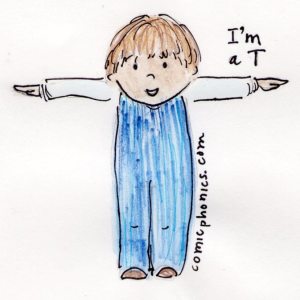
Child with arms stretched out at his sides, forming the letter T.

By the end of kindergarten:

  • Students can recognize almost all letters, upper and lower case.
  • Some students can state the sound represented by an individual consonant letter, and they can recognize closed (short) vowel sounds.
  • Some students can read consonant-vowel-consonant (CVC) words.
  • Most students cannot yet read open (long) vowel patterns such as oa and ight.
  • Many students rely on first and last letters in words to sound words out.
  • Students rely on pictures to help figure out words.

By the end of first grade:CVCC twin consonants

  • Students can decode one-syllable CVC words, including those with blends.
  • Students can decode one-syllable words ending in a silent e.
  • Students can read one-syllable open (long) vowel words like he and my.
  • Students can read one-syllable r-controlled words like star and dirt.
  • Students can read some one-syllable words with two-vowels like bee and boot.
  • Many students need to sound out common one-syllable words rather than recognizing them as sight words.
  • Students depend less on pictures and context clues to decipher words.

By the end of second grade:children looking at picture of Lincoln and Mrs. Lincoln

  • Increasingly, students are able to decode two- and three-syllable words if those words follow rules of phonics.
  • Students can decode words by separating familiar suffixes and prefixes to find root words and then reassembling the parts.
  • Students recognize common letter patterns.

By the end of third grade:girl reading Junie B. Jones

  • Students have mastered decoding of words using phonics, including many multi-syllabic words.
  • Students recognize most common words by sight.
  • Students recognize word families and can use that knowledge to decipher new words.

This breakdown covers word recognition.  But there is another part of learning to read, namely, language comprehension.  We will discuss that in the next blog.

*Researcher Jeanne Chall (1983) first coined this idea.

See researchers Linnea Ehri (1991, 2005) and Spear-Swerling (2015) for more indepth discussion of reading stages.

Ah ha!

My first grade grandson had an “Ah ha!” moment while reading to me this week.

He was reading a short chapter book especially meant for beginning readers.  Almost all the words were short-vowel, one-syllable words.  Many of them were repeated for reinforcement.  Most pages contained only four or five short sentences.  Every page had line drawings to give extra meaning.

Usually when he reads, he sounds out every word and then says the complete word.  But this time—except for unfamiliar words—he said aloud just the word, not the phonics within the word.

“Gramma,” he said, his eyes bright.  “I read fast!  I didn’t have to say all the letter sounds.  Did you hear?”

“You read great!” I said, and we high-fived.

My grandson didn’t know it, but he made a transition that all good readers eventually make.  Instead of reading individual letters, he read individual words and in a couple of cases, individual phrases.

When children are learning to read, we tell children to sound out words, not to memorize the look of words.  But in fact, when we encounter a word often enough, we no longer need to sound it out.  We recognize it from its appearance.

Elite athletes go through a similar phase.  A great diver doesn’t need to think about which way his palms are facing or which leg to lead his spring with or how to tuck his body or whether his feet are pointed at the same angle.  He has done the individual parts of the dive hundreds—thousands—of times and he has developed muscle memory.

As adults, that’s what you and I do whenever we read.  Unless we encounter an unfamiliar word, we recognize words and phrases and no longer need to read individual letters or even individual words.  We read chunks.

Test this idea on yourself.  As you are reading these words, are you pausing over each word?  Or are you reading chunks of words?  For example, in the second sentence, didn’t you read, “As you are reading—these words—are you pausing—over each word?”

I am so proud of my grandson’s progress in reading.  From the day kindergarten ended abruptly in March, he has continued to learn to read using a phonics approach.  How wonderful for him to recognize his own progress.  And how lucky for me to be sitting by his side when he did.

“How do I teach my grandson to read remotely?”

How do I teach my grandson to read remotely?” asked a grandmother. She plans to use Zoom, Facetime, and ready-to-go reading materials for an hour daily.  After testing the boy informally, she believes she needs to start from scratch to fill in any gaps in basic phonics.

Here is what I advised her:

First, buy two copies of “Why Johnny Can’t Read” by Rudolph Flesch.  Send one to your grandson and you keep one.  Go to the back where there are lists of words.  Start on page one, asking the boy to pronounce the sound of each letter shown.  When he can do that, move on to the page of short a words.  Have the boy read the short a words, or a portion of them.
Reading lists of words is tiring, so do maybe ten minutes of such work and ask the boy’s parents to do another ten minutes at night.  Or read from the list at the beginning of the lesson, then do something else, and then come back to the list.  Move through the lists at whatever pace indicates that the boy is mastering the words.

Why use “Why Johnny Can’t Read” a 65-year-old resource?  The simple answer is because I know it works.  I have used this phonics-based resource for almost 35 years with native born children and with immigrant children.  All of them hated it, true, but all of them learned to read quickly.  There are other reading primers, but for me this is a tried and true resource.  It’s available in bookstores and online.

Second, buy two copies of “Explode the Code” workbooks 1, 1 ½, 2 and 2 ½.  (Eventually, buy the next sets in this series, but for starts, these workbooks are enough.)  This series teaches reading using a phonics-based approach.  Kids like it because of the silly illustrations.  Have the child start reading while you follow along on your copy, noting and correcting mistakes.  Eventually, the child might do some of the pages for homework or with his parents.

“Explode the Code” reinforces the harder work of reading lists of words.  It does not follow the exact sequencing of skills in “Why Johnny Can’t Read,” but you can adapt one to the other easily.

Why “Explode the Code”?  I have used this series with dozens of children, and all have liked the silliness of the drawings.  For children whose vocabulary is limited, the drawings and distractor words offer opportunities to develop new vocabulary.  There are other workbook series, but because of the humor and sequence of phonics development in “Explode the Code,” I like it.

Seated young boy is playing a portable video game..Third, buy a set of letter tiles.  You can use the tiles from a Scrabble game or from Bananagrams.  Or  use a keyboard.  What you want to do is to introduce, teach and review new concepts. using tiles or computer words.  If you are teaching short a, for example, manipulate the tiles so the child can see them to form “cat” and then “hat” and then “fat,” etc.  Changing the first letter while keeping the ending vowel and consonant is easier for beginning readers to decode.  Using tiles or computer-generated words enables you to go quickly.  Later, you can move from “mat” to “mate” or from “mick” to “mike” and back and forth quickly to show differences in spellings and sounds.

Fourth, recommend to the child’s parents that the child watch the Netflix series “Alphablocks,” an animated series using silly letter characters to teach phonics.  This British series offers tiny segments of  three or four minutes to teach particular phonics skills.  Even three-year-olds will learn to recognize letters from watching this series.  Older children will be able to read words as they pop up on the screen.

All of these materials are readily available, allowing you to start teaching immediately.  Young children need variety, so move from one resource to another every 10 or 15 minutes.  The younger or more distractible the child, the more necessary it is to have a variety of approaches—as well as learning materials the child can manipulate, like the tiles.

Reading lists and reading tile-made words or computer-screen words does not require the fine motor coordination some beginning readers lack.  When I use “Explode the Code,” for some children I allow drawing lines from words to drawings rather than writing words.  Keep in mind you are teaching reading, and even though it would be nice for the child to print the letters, or to spell correctly, that is not necessary to read.  For particularly uncoordinated children, I will write or draw or encircle providing they do the reading.  Anything to keep them reading!

Start each lesson with a quick—two or three minute—review of past work, slowing down if the concepts haven’t been learned.  Then introduce new work or repeat old work if that is needed.  At the end of the lesson, review the new work of the lesson.  Review, teach new, review again.

Finally, FYI, I am not being paid to suggest these particular products.  I am suggesting them because I know they work, they are available and they are affordable.

Please share your experiences teaching reading online.  That is the kind of information we are all wanting right now.

Learning through phonics is the best way to learn to read

If a child is having trouble reading, what is the most likely cause?

  • Reliance on pictures for meaning?
  • Guessing?
  • Weak word recognition skills?
  • Reliance on context word clues?

Child sitting with legs outstretched, forming the letter LWeak word recognition skills is the mostly likely cause, and because of that, students guess at words or search for clues from pictures and other words.

Weak word recognition skills means an inability to sound out the letters which form words.  If a child comes upon a new word—for example, “trek”—and the child cannot sound out the individual letters, the child cannot read the word.

Since 2000 we have known that the most effective way to teach reading is through a system of associating sounds with letters and combining those letters to form words—in other words, a phonics-based approach.  A National Reading Panel authorized and funded by Congress assessed scientific research on reading.  The Panel’s goal was to determine the most efficient way children learn to read.  The Panel concluded in 2000 that to read well, children should associate sounds of English (phonemes) with letters or letter pairs and to combine the letter-sounds into words.

Child with arms stretched out at his sides, forming the letter T.The word “it,” for example, has two sounds, each of which is associated with a letter.  The word “shop” has three sounds with “sh” corresponding to a single sound.

By deconstructing words into their basic sounds, children learn to sound out words.  Without guessing, without context clues, without pictures, children can figure out how to read words.  Even though there are some words which defy this sounding-out system (words like “one” and “two”), the vast majority of words in English can be sounded out.

The problem is, even though we know what works best, teachers are still asking children to guess at words, to look at pictures to figure out what words mean, to read other words nearby and use those context clues to figure out words, and to memorize the look of a word.  In other words, some teachers are not teaching phonics as the primary way to learn to read.  They are relying on methods which research shows do not work as well as phonics.

When I went to first grade, I was taught to read using a memorization approach.  The first page of my first reader had the word ”look” under a picture.  The next page had the words “Oh, look” with a different picture.  The next page had “See, see, see” with another picture.  It wasn’t until fourth grade that my teacher, Sister James Bernard, CSJ, offered lesson after lesson on phonics.  What a revelation!

If your child hasn’t learned phonics, teach him or her.  If your child is guessing at words, make him sound out each letter or each syllable.  No guessing allowed!  This is the surest way to create a strong reader.

5 ways to keep beginning readers engaged

The younger the reading student, the more activities a teacher needs to keep the student engaged during a lesson.  For four- and five-year-olds, I come prepared with a bagful of reading activities such as

  • A stack of pictures showing CVC words (flag, map, dog, cat, and pen) which the student sorts into two piles: those that have the desired vowel or consonant sound, and those that don’t.
  • Letter tiles which I use to form words, phrases and sentences for the student to read. Sentences using the student’s own name attract the youngest readers.  Letting the student create some of the words. also keeps the student engaged.
  • Stories written with the simplest CVC vocabulary which the student and I read together, and then which she reads independently.
  • Twelve pictures of rhyming words on index cards .

Another kind of reading assignment that my youngest reading students like is reading and answering silly questions like the following:

  1. Can an ant wink to a cat? Yes   No
  2. Can a bug land on a lip? Yes   No
  3. Will a duck swim in a mug? Yes   No
  4. Can a big cat fit in a bag? Yes   No
  5. Will a dog dig with a pen? Yes   No

The questions consist of whatever examples of the reading concept we are studying at the time such as CVC words, blends, or two-syllable short-vowel words.  Almost all the questions are ridiculous and the more ridiculous the better.  Having colored pencils or markers to use intensifies the fun.

I find that the more hands-on the activity, the better.  Early readers sometimes cannot print letters, but they can make ovals around words or draw matching lines.  They can hold a small stack of pictures and sort them into piles.  They can move around letter tiles.

The more busy their bodies are, the more likely they are to stay engaged.

Six questions to test your beginning reader knowledge

What is the best method for learning to read, based on research?

  • primarily using phonics
  • figuring out words from their context or from pictures
  • memorizing words (sight words, whole language)

Two fists with thumbs up and knuckles touching make letter "b" and "d" with a BeD visualized between the two thumbs.What two printed letters are the hardest for children to distinguish?
  • p and q
  • q and g
  • b and d
  • m and n

Which two short vowel sounds are hardest for children to distinguish?

  • a and e
  • e and i
  • o and u
  • a and o

In order to learn to read, do children need to recite and/or recognize the ABC’s in alphabetical order?

  • yes
  • no

Which comes first?

  • recognizing a letter
  • recognizing a sound?

How many letter sounds does a child need to hear and speak in order to speak standard American English?

  • 26
  • 23
  • 42

Answers

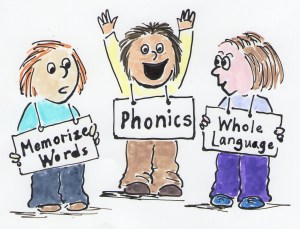
Three children with signs around their necks that read: Meniruze words, Phonics, Whole LanguagePrimarily using phonics is the best method for learning to read. The US government did a comprehensive study of hundreds of research studies on how children learn to read and discovered that using a phonics-based approach produces the best results.

Lower case “b” and “d” are the hardest letter shapes for children to distinguish. Most children are confused at first.  Sometimes this confusion lasts into third grade, but with time, all children figure it out.

Short “e” and “i” are the hardest letter sounds to distinguish. Most reading series start by teaching short “a” followed by short “o” because these two sounds are the easiest to distinguish.  Expect lots of errors when “e” and “i” words are learned, and expect learning them will take more time.  Short “u” is harder than “a” and “o,” but since there are far fewer such words, learning “u” is not so hard as learning “e” and “i.

Beginning readers do not need to know their ABC’s in order. Alphabetic order is a second or third grade skill, so it doesn’t need to be learned immediately.

Recognizing a sound is more important than recognizing a letter at first. Beginning readers need to be able to hear sounds and to pronounce them aloud.  They do not need an alphabet in front of them to do that.  Toddlers can learn to recognize sounds long before they are ready to read letters.

Child looking at flash cards of two and three letter words.

.

American standard English has 42 sounds. Some of the 26 letters duplicate sounds such as “c” and “k,” “c” and “s,” “s” and “z,” and “qu” and “kw.”  Many vowel sounds can be written multiple ways (ugly, Hannah, other).  Some sounds take two letters to make (th, ch, sh).  Regional dialects can add or subtract a sound or two, but in general there are 42 separate sounds in American English.

Worth reading: The Settled Science of Teaching Reading*

I thought the time for discussion was over, that the correct way to teach reading had been established by research almost twenty years ago.

Apparently not.  On social media the discussion continues.  Is it better to focus on teaching phonics and how letter sounds form words or to focus on whole language (memorizing words and discovering meaning).

After a study of hundreds of research reports of how children learn to read, the US government reported in 2000 that the best way to teach English reading is to focus on phonemes and phonics first.  Children need instruction on how sounds correspond to letters, and how combining those letters forms words. New readers also need to memorize high frequency words that don’t necessarily follow the rules of phonics (words like “was, ” “do,” and “the”).

According to the 2000 National Reading Panel, students need to learn five concepts relating to reading:

  • Phonics (combining letters to form words)
  • Phonological awareness (how sounds correspond to letters)
  • Fluency (reading in phrases with appropriate stops and starts and with voice inflection)
  • Vocabulary
  • Comprehension (understanding what is read)

Decoding the language comes from studying phonics, phonological awareness and fluency.  Combine that with vocabulary and you achieve the desired result of reading comprehension.

Yet research also shows that even today not all reading teachers know, or even if they know, apply the correct approaches to teaching reading.

If your kindergarten child comes home with lists of words to memorize, beware.  If those words are sight words, okay.  But the main focus of his or her learning should be how sounds correspond to letters, and how combining those letters forms words, and how combining those words forms sentences with meaning.

*https://www.collaborativeclassroom.org/blog/the-settled-science-of-teaching-reading-part-1/?_hsmi=76082821