Category Archives: how to make learning fun

One example of how to teach a four-year-old to read

For several weeks I have been tutoring a four-year-old, teaching her to read.

  • I started with letter tiles, placing one before her at a time and asking her what sound each letter represented. She knew many of them, but not all of them.  As I expected, she couldn’t sound out “e” and “i” and was vague on “u” too.  The consonants “d,” “j,” “q,” “x,” “y” and “z” also were mysteries.
  • On a paper I had written all the sounds associated with individual letters, and as she said them properly, I crossed them out, to know which letters we needed to focus on.
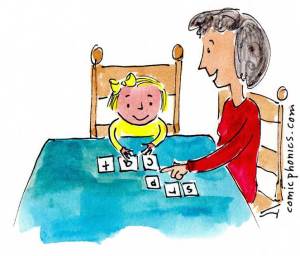
  • Reading tutor with 4-year-oldSince she was confident about “o” and “a,” I used those letters to form CVC words, real and imaginary, spelling them phonetically. With the letter “a” I sandwiched two consonants, one on either side, separating the tiles and then moving them closer and closer until they looked like a word.  All the time I was pronouncing the sounds, such as “c” “a” and “t.”
  • Since the hardest letter sounds for beginning readers to hear are the middle sounds in CVC words, I kept using the same vowel sound, the letter “a,” for one half-hour lesson. I put a “t” after the “a” and kept it there for several minutes, exchanging one beginning consonant for another as she read the words.
  • My little student caught on quickly that the sound in the middle and at the end of the word didn’t change, so all she had to focus on was the beginning sound. When we encountered one of her difficult letter sounds, I would say it and then she would.
  • At our next lesson, I repeated much of the first lesson, asking her to pronounce the sound for each letter tile. This time she sounded the “q” consistently correct, so I crossed out that letter sound on my list.
  • I made CVC words using the letter “o.” Some words were real; some were nonsense words or real words spelled phonetically.  What she showed me was that she knows the sounds of various letters.
  • The next week I used both “a” and “o” words. This was more difficult because my student needed to keep track of two sounds in CVC words.
  • This past week I used “u” as the vowel. At first, my student would forget the sound “u” represents, but by the end of the lesson, she was remembering it.

Because the lesson lasts just 30 minutes, this student hangs in there, but by the end of a half hour she is losing interest.  I compliment her work often, telling her, “You didn’t know that letter last week, and now you do!” or “You figured out that word all by yourself.”  Sometimes she acts out a word or tells me what it means, and I compliment her on that too.

These early lessons focus on letter sounds and how combining sounds gives us words.  It might seem boring to an adult, but brain research shows that there are no built-in pathways in our brains for reading, the way there are for movement and speech.  A novice reader, like my student, must activate much more of her brain to read “cat” than an experienced reader like me.  Over years of reading, my brain has built shortcuts to figuring out words that this child’s brain hasn’t done yet.

At our next lesson, we will do more CVC words using “u” as the vowel, and then exchange the “u” for “a” and “o.”  We will focus on letter sounds my student is still learning.  Her progress may seem slow, but it is steady.

Help your child make bookmarks to encourage reading

Are you looking for an activity to do with your child that will promote reading?  How about making bookmarks together?

Bookmark cut from a gift card.Bookmarks are usually long rectangles, about two inches by eight inches.  Traditionally they are made from card stock, available at your office supply store.  But you can also cut up file folders or those plastic covers of three-ring binders.  Notebook or computer paper works well too if you later reinforce it with clear tape or laminating.

What kinds of bookmarks can you make?  How about these?

  • A small picture of your child with her name and the date in her own handwriting. With a hole punch, put a hole at the top or bottom and attach a ribbon.
  • A drawing your child has made. He could do a large drawing and then cut it apart and paste parts to form a bookmark.
  • Tiny flowers from the garden taped to the bookmark. If they are laminated, they will last for years.
  • A list of words your child can read, or a list of books your child has read. Include the date so the child can appreciate her progress.
  • A drawing of her favorite book character downloaded from the internet.
  • A timeline of the child’s life.
  • The ABC’s in the child’s handwriting with the date, of course.
  • The child’s name in her own handwriting.

The child will be thrilled to use her hand-crafted bookmarks when reading her own books, whether she needs the bookmarks or not.  Or she can give them as gifts to Mom and Dad, grandparents, teachers and friends.  Inside a gift book, a bookmark makes a fine birthday present for another child.  Bookmarks can be saved for the future too, when they will become treasured artifacts from the child’s past.

Fractured fairy tales

Being able to discuss characteristics of fiction—character, setting, motivation, and point of view, for example—is an advanced skill, something beginning readers and certainly nonreaders can’t do.  Right?

Wrong!

By using two versions of the same fairy tale, children are able to contrast the stories, telling what is the same and what is different, who is telling the story, how characters change, and where and when the story takes place.  Even writing styles of authors can be contrasted.

Another advantage of using two versions of the same fairy tale is to deepen the meaning of the original.  Just like reading one book of fiction and one book of nonfiction on the same topic deepens meaning, so does reading two differing fictional accounts of the same story.

Read about these examples and see what I mean (clicking on the cover graphic will enlarge it).

    • Mike Artwell’s Three Little Cajun Pigs Mike Artwell’s Three Little Cajun Pigs sets the porcine trio deep in Louisiana where Trosclair, Thibodeaux and Ulysse need to build homes in swampland.  Old Claude, an alligator, would like to lick his chops on couchon de lait—that’s Cajun for roast pig.  The basic elements of The Three Little Pigs are included in the story, but with changes children can easily notice, including telling the story in couplets.


    • Lisa Campbell Ernst’s Little Red Riding Hood; A New Fangled Prairie Tale Lisa Campbell Ernst’s Little Red Riding Hood; A New Fangled Prairie Tale finds Little Red Riding Hood in a red hoodie riding a bike through rows and rows of sunflowers on her way to Grandma’s.  Meanwhile, a vegetarian wolf wants to learn Grandma’s secret muffin recipe.  However, Grandma is meaner than the wolf.  Lots of details are the same, but enough differ to make finding them a treasure hunt.


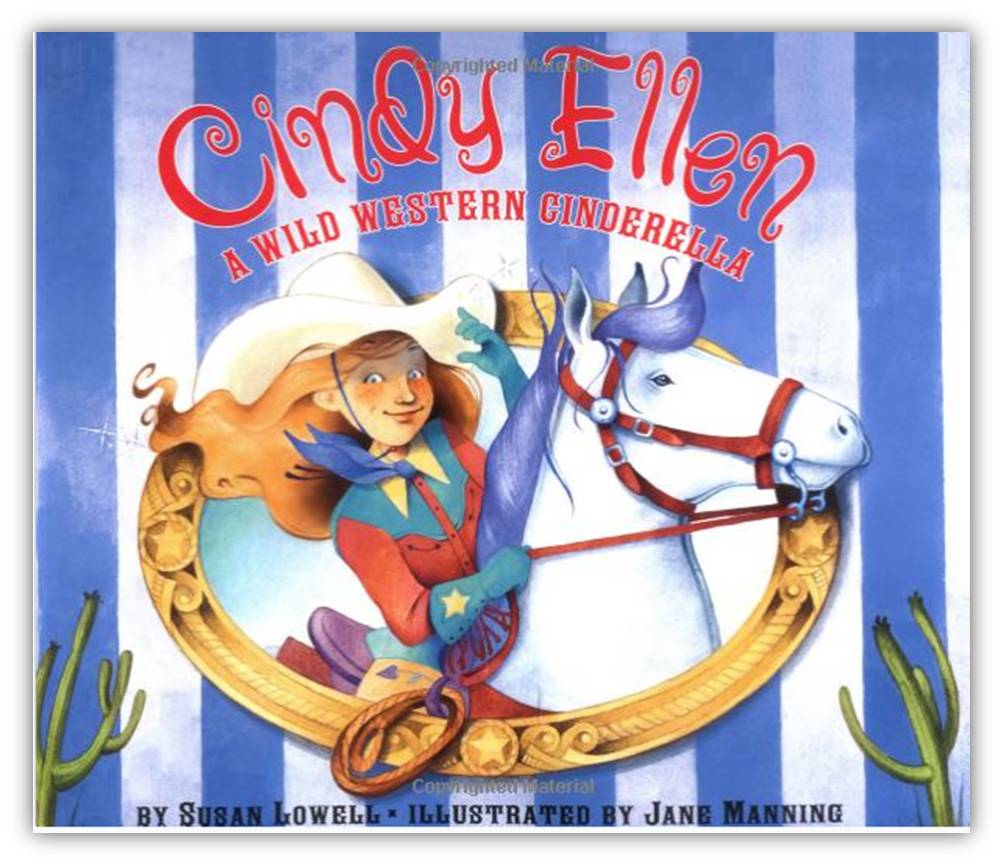
    • Susan Lowell’s Cindy Ellen:  A Wild Western Cinderella Susan Lowell’s Cindy Ellen:  A Wild Western Cinderella offers a sweet cowgirl whose father has married the “orneriest woman west of the Mississippi.”  Cindy Ellen mends fences, milks cows and shovels a corral, attracting Joe Prince, the son of a cattle king.  Lots of changes make this tale a delight, but younger kids might need help recognizing the original Cinderella in this fractured version.


    • Laura Murray’s The Gingerbread Man Loose in the School  Laura Murray’s The Gingerbread Man Loose in the School lets the sweet cookie monster loose in a school, looking for the students who baked him while they are outside at recess.  The silly story is illustrated through comic book panels, unlike a traditional fairy tale.


    •  Leah Wilcox’s Waking BeautyLeah Wilcox’s Waking Beauty focuses on a prince who will do almost anything not to kiss the snoring Beauty—hollering, jumping on her bed, throwing water at her, even shooting her from a canon.  Not your Grandma’s fairy tale.


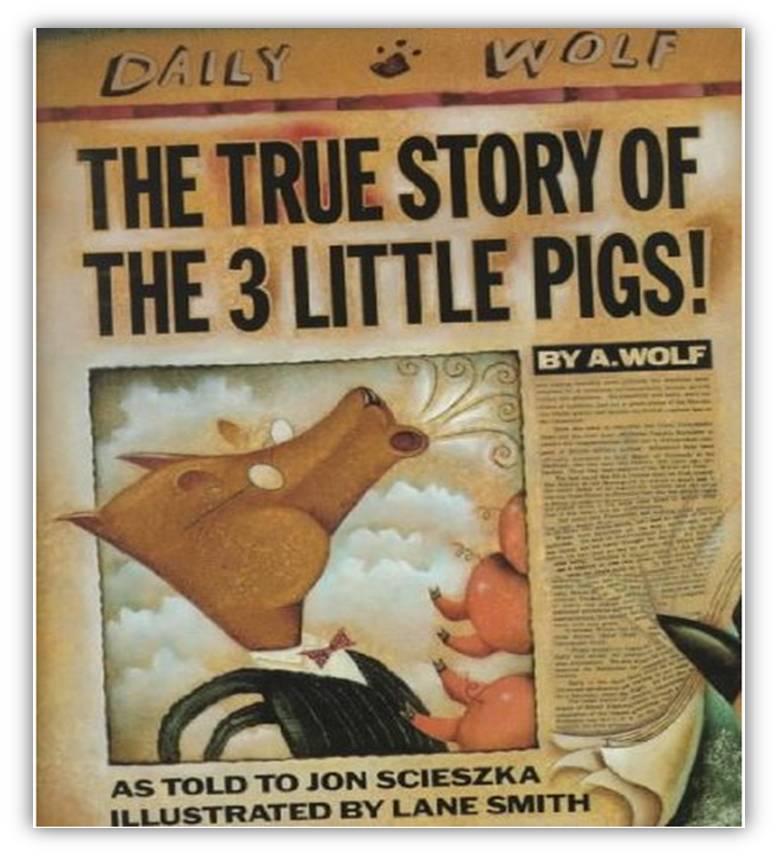
  • Jon Scieszka’s The True Story of the 3 Little PigsAnd of course Jon Scieszka’s The True Story of the 3 Little Pigs, one of the first of this type fairy tale and one of the best, tells the familiar story from Alexander T. Wolf’s point of view.

As starting points for discussion of literature with young children, these stories are great.

What’s a graphic novel?

One of the biggest trends in children’s literature in the past ten years is the rise of graphic novels.  Not sure what I mean?  Think Captain Underpants and The Wimpy Kid.  Graphic novels are

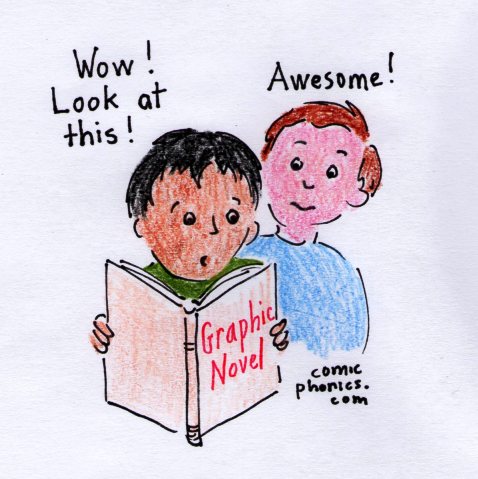
  • Two boys reading a book entitled "Graphic Novel."comic-strip-like stories with a beginning, middle and end (not a continuing saga).
  • fiction and nonfiction stories told as much in colorful drawings as in words.
  • a hybrid form of action literature that appeals to 12 to 18-year-olds but now is working its way to much younger readers.
  • a newly recognized form of literature by the Young Adult Library Services Association, part of the American Library Association, which has been selecting the best graphic novels for teens since 2007.
  • a form of children’s literature reviewed in respected journals such as School Library Journal.

Graphic novels, like all novels, cover many themes such as romance, sci-fi, fantasy, super heroes, and modern warfare.  Not all graphic novels are novels.  Recent nonfiction titles include Pride and Prejudice, a biography of Thomas Jefferson, Poseidon, landing on the moon and the great apes of Africa.

When graphic novels started appearing, said Mary Tyner, a media specialist from Peachtree Elementary School in Peachtree Corners, Georgia, they were inferior literature and she did not buy them for her school library.  But as they improved and as they were reviewed by respected journals, she began buying, and now she can’t keep the 153 titles on her library’s shelves.

“They are an extremely motivating literature that encourages children to read,” Tyner said.  Over time, she has seen the reading level of graphic novels press downward, but there are few for beginning readers, perhaps because it is hard to have a meaningful story line in beginning reading books, said Tyner.

Another advantage of graphic novels is that they teach synthesizing skills, said Deb Schiano, media specialist at Loundsberry Hollow Middle School in Vernon, New Jersey.  “In our society children must be aware how to read images,” said Schiano, and how to combine the images with words to form meaning.  She compares graphic novels to storyboards from which the student can pick up story arcs by reading the drawings.  Combining the pictures with the words creates more complex meaning.

Graphic novels also attract disabled students, said Schiano.  “For the dyslexic student who can’t decipher words, graphic novels are another way to learn.” In her school last year one teacher used them consistently with learning disabled students.

Both media specialists said graphic novels also encourage children to write and illustrate their own stories, sometimes using online sites.

What has all this to do with beginning readers?

  • Young children will see their older siblings reading graphic novels, and will enjoy paging through them to study the drawings.  The joy that that the older child shows might encourage the younger child to want to read.
  • With time, graphic novels will probably reach down into first grade reading levels and attract younger and younger readers.
  • As a child’s reading ability improves, he might want to buy these books or to borrow them from the library.  Parents unfamiliar with this genre might scorn graphic novels as inferior, but it is worth remembering they have advantages over text-only books.  For reluctant readers, or disabled readers, or boys, they can be a way to motivate the child to read.
  • Graphic novels can also be found on iPhones and Android phones.  Expect your young children to be intrigued when they find them online, and eventually, to want to buy them this way.

How can I increase the impact of books when I read to my young son?

  • Have you considered pairing two books about the same subject, one facts, one fiction?
  • Or have you considered following a book with a related film?
  • Or have you considered reading a book about the making of a work of art (a cathedral, for example), and then visiting a cathedral with your child?
  • Have you considered reading about the creation of a piece of music and then listening to the actual piece with your child?

This slideshow requires JavaScript.


The example above pairs a picture book, sheet music (on page 78), a youtube piano tutorial, and a youtube video of an orchestra playing Gershwin’s Rhapsody in Blue. Click on these underlined links to see more details or to view the videos.

All too often, we read nursery rhymes, fairy tales and other fiction to our children without considering related nonfiction books, films, music, and paintings. Boys, in particular, might prefer additional factual information.

When my daughter was a third grader, she read Mr. Popper’s Penguins by Florence Atwater. I found some National Geographic Magazine articles on penguins, and together we read them, deepening her understanding of penguins. For a school assignment, she wrote her own penguin book, dedicating it to National Geographic. She could also have read Penguins and Antarctica by Mary Pope Osborne and Natalie Pope Boyce, a nonfiction companion book to Eve of the Emperor Penguin, part of the Magic Tree House fiction series by Mary Pope Osborne. A documentary film about penguins, March of the Penguins, would have told her about the brutal lives of penguins on Antarctica. The animated Happy Feet, though less factual, would have offered another perspective.

Is there a new baby coming into the family? Big Brother Dustin by Alden R. Carter follows a child with Down Syndrome as he anticipates becoming a big brother. A funny companion book might be Junie B. Jones and a Little Monkey Business by Barbara Park, a novel about a kindergartener’s belief that her newborn brother is really a monkey. Many child-oriented nonfiction books are available about pregnancy and birth.

When you read two different types of books on the same subject, often you investigate the subject from two different vantages. Little children need to learn that there are many ways of looking at the same information and that they all might be good, or that one might be real and the other entertaining.

Sometimes the child makes connections between the two books, but sometimes the adult needs to point out similarities and differences to obtain the most impact. For example, you could explain what the words “fiction” and “nonfiction” mean, and how Clifford is a pretend dog while a book about dog breeds shows pictures of real dogs. “Real” and “make believe” are concepts a child needs to learn.

Some children prefer fiction while others prefer nonfiction. By pairing them, the child is exposed to both genres. But of course the main reason for pairing is to deepen meaning for the child. Your child will gain the most impact if you discuss the books with him. –Mrs. K

When I was a child, my favorite book was Black Beauty.  Unfortunately, I never ventured to the nonfiction section of our library.  Was I unaware of it or just stubborn, refusing to step out of my comfort zone?  I certainly would have enjoyed learning more about horses.  My favorite TV horse was a dappled horse ridden by Little Joe on the TV show, Bonanza.  The nonfiction books would have given me opportunities to look at pictures or to read the captions, even if most of the content was too advanced for me. –Mrs. A

How about you? Have you found pairing books or books with other medium to be a good way for your child to learn more? Let us know.

My child keeps mixing up left and right. She’s only six, but still. What can I do to help her?

"Left? Right?" says boy, flailing arms, "I'm so confused!"For a child so young, make learning a game so she will want to continue.

  • Have her hold up her hands, fingers touching and thumbs sticking out, with palms facing away from her body. Ask which side makes a proper “L.” That is the left side. (My son used this method throughout elementary school.)Girl looking at how the thumb and forefinger of the left hand make an L shape.
  • Play Simon Says using left and right directions. “Simon says touch your right ear.”
  • Play a guessing game. “I see something on the left side of the room that is red.”
  • Create a wristband for the dominant or nondominant hand and mark it L or R.
  • Write L on left palm and R on right palm.
  • Have the child trace her hands (or if she can’t, you do it) and label one hand L and the other R. Cut out pictures for a simple wordless story, and have the child sequence them properly, left to right.
  • Let the child sit on your lap and type on your computer. Point out the way the letters always go, from left to right.
  • Your child might already play some electronic games on your phone or tablet. Show her how the Angry Bird’s shot arches from left to right.
  • Create a book mark with an L on one side and a R on the other side.
  • Create a series of dots and have the child connect them, left to right.
  • Using a doll or teddy bear, ask which is the doll’s left leg, or right arm, or left eye.
  • Play hopscotch, asking her to name the leg she is stepping on.
  • Give her a bracelet or watch to wear on special occasions on one of her wrists. Remind her which wrist she is putting it on.

Don’t get annoyed if this skill takes time. Gently offer her the correct choice and move on. Eventually we all figure it out. –Mrs. K

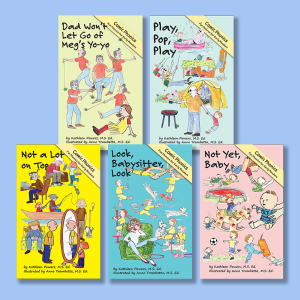
Mrs. K and Mrs. A publish fifth book, “Not Yet, Baby”

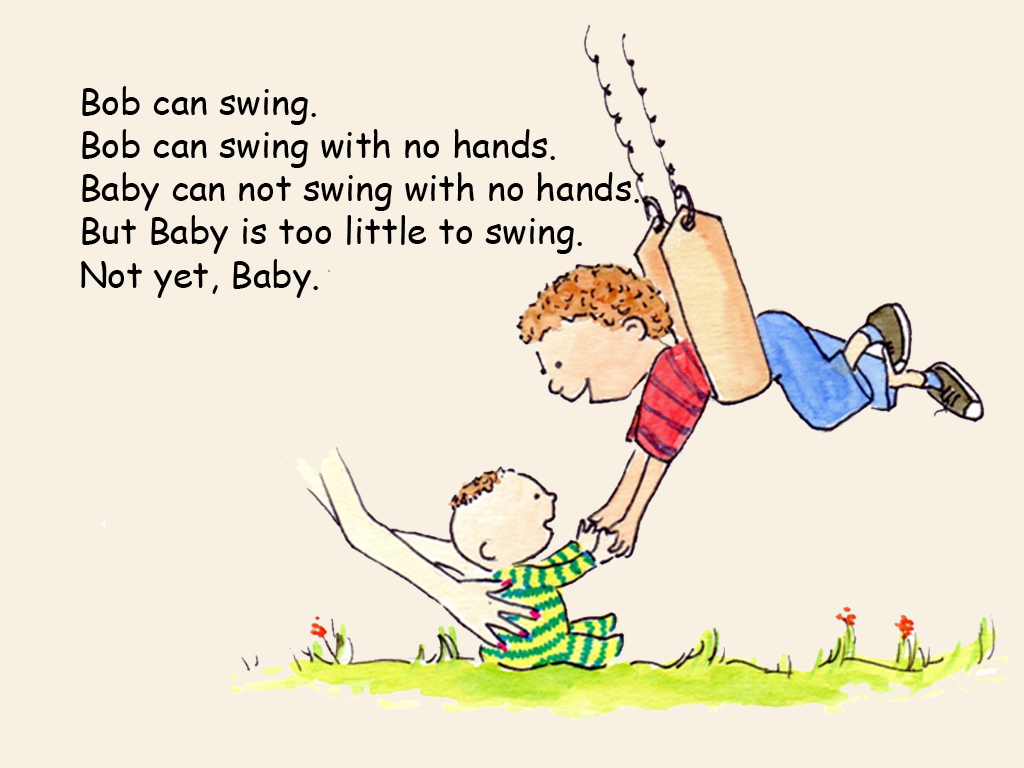
Our fifth book for children learning to read was published this past week as an app on Apple products.  Not Yet, Baby is the story of a big brother and the family baby.  The little one wants to do whatever the big brother does.

This slideshow requires JavaScript.

If big brother swims, baby wants to swim.  If big brother eats a hot dog, baby wants to eat a hot dog.  If big brother kick-boxes, baby wants to kick box.  Often in danger, the baby is dragged away just in time by two arms.

Like our other books, Not Yet, Baby illustrates typical yet humorous situations that a four, five, or six-year old would understand.  The book uses mostly one syllable, short vowel words appropriate for beginning readers.  Interactive activity pages follow—word searches, matching rhyming words, filling in the correct vowel and answering yes and no questions.

This slideshow requires JavaScript.

The idea came to me as I was traveling through national parks in Utah and Arizona last summer.  Occasionally I would get a text or a picture from my son, Tom, the dad of two little boys.  The younger one was walking and following his three-year-old brother everywhere.  Whatever the older boy had, the baby wanted.  Whatever the older boy was doing, the baby was underfoot.

I reminded Tom that he too, had been a younger brother and had been a pain in the neck to his big brother, Lou.  Lou would build elaborate corrals with wooden blocks, enclosing a dinosaur in "Not Yet, Baby" sketch bookeach compartment.  Tom would totter across the rug, destroying the entire habitat.  On the tour bus in the Rockies, as I remembered spending hours restraining the rambunctious Tom, the ideas flowed, and within a few days I had a book full of sketches!

As you read Not Yet, Baby, you may remember being the older child trying to understand the limitations of a younger one.

Page 13 of "Not Yet, Baby"

Here’s page 13 of “Not Yet, Baby” from the sketch book idea.

Or maybe you can relate to a baby trying to keep up, or the adult who works tirelessly to keep one child safe and another one happy.  Maybe the story will lead to talks with your child about your childhood or his.  There’s so much to talk about in Not Yet, Baby.  You can find the “Not Yet, Baby” iTunes app at http://goo.gl/CVTFZx.

Mrs. A

What is Accelerated Reader? Is it appropriate for my kindergartener?

Accelerated Reader (called A.R. by most students) is a computer software program that can be purchased by school districts.  It is designed to encourage reading by children.  A child selects a book from more than 25,000 titles (fiction and nonfiction), reads it, and then takes a quiz on the contents.  The books in the database are classified according to their reading level.  When a child masters a certain number of books at one level, she is encouraged to choose books at the next level.

Because each child is reading at his or her own level, children are competing with themselves, trying to better their previous reading levels.  One student might be reading Junie B. Jones books while another student in the same grade might be reading Harry Potter books.  Teachers usually set individual goals for students based on the number of books read, their quality and their difficulty level.  Often school time is used for quiet reading of A.R. books and students are assigned A.R. reading for homework.Two students taking reading tests on portable NEO computers.

When a student begins an A.R. program, he is assessed to find his reading level.  He is offered hundreds of books to read in this range.  When he finishes reading a book, he takes a multiple choice test (usually ten questions) on that book online using a classroom computer, a media center computer, a NEO 2, a tablet, Apple apps, or other electronic equipment.  Immediately the student receives his score which is converted into points using this formula:  (10 + reading level) x (words in book ÷ 100,000).

How do students know the reading level of a book?  Some libraries have three-ring binders listing A.R. books and their reading levels.  In my neighborhood school, books have colored dots attached to their spines, and nearby, a prominent chart lists the colors and reading level they signify.  Students look for books with their color on the spine.  But other media centers have other ways of differentiating reading levels.

In my neighborhood school, students accumulate points to “buy” a cap and later buttons to attach to the cap.  The more buttons, the more reading the child is doing and the more success the child is having.  Hats are usually not allowed in the school, but students who earn A.R. hats can wear those hats and do so proudly.  Other schools reward students in other ways.

Teachers receive feedback from the program, allowing them to intervene in a child’s learning if he is not making progress.

Students in my neighborhood school each have a Neo 2 assigned to them.  This is a portable electronic device that they can keep in their desks and use to take A.R. tests.  Additionally, they can use the device for other software programs, such as computing math facts.  The Neos allow a student to take an A.R. test at almost any time of the day without forming a queue at the classroom computer.  Students who finish assignments early are often allowed to work on their Neos.

Is the A.R. program appropriate for a kindergartener?  The child must be able to read a bit in order to take the quizzes.  And if she does poorly on a quiz and wants to take it again, she can’t.  She must move on to another book.  But if your child can read, it’s a way to encourage more reading and to prove to you and her that she is understanding what she reads.

–Mrs. K

Accelerated Reader was a popular program in the school where I taught.  There were competitions each month and each quarter to see who had earned the most points.  A school winner was announced at the Honors Assembly.  High scores were posted, and occasional ice cream parties recognized achievement.

Many teachers and parents liked the program because it got children reading.  A child who detested “reading for fun” would read an A.R. book.  The competitive nature of the program encouraged some kids to read more and more.  Teachers required a certain number of A.R. points to be earned as homework.  Because the A.R. books were good, teachers and students assumed the child was reading quality books.  I noticed kids talking about books and recommending books to each other.  They remembered the name of the author and then read his entire collection.

One criticism of the program is that the test questions are based on the ability to remember trite facts, not to comprehend the information.  For example a typical question might be “What was the name of Tom’s cat?”  A student who did not have the skill to remember details would do poorly, even though he may have truly understood the symbolism and irony of the story.  Another criticism is that a student could choose easy books, not challenging books.  Fifth graders were reading “picture books” to earn 2 points, rather than chapter books worth 12 points.

Even so, I think A.R. is a good program.  My children did not read for pleasure.  I forced them to read 30 minutes a day.  Had there been an Accelerated Reader program in their school, I know they would have been motivated to earn points.  Reading a picture book is better than reading no book.  Reading twenty picture books and earning perfect scores on the tests might encourage students to try reading something a bit more challenging.

Accelerated Reader is not a free program.  Each test must be purchased by the school district.  It requires a lot of work to set up, but once it is implemented, it is great.  More books/tests can be added every year.

If your child does not have A.R. in his school, talk to the media specialist or the principal.

–Mrs. A

Barbara Park, “mother” of Junie B. Jones, leaves behind millions of happy child readers

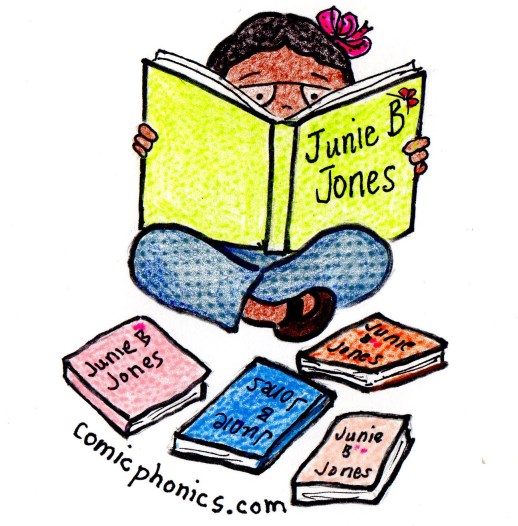
If there is one favorite book of little girls learning to read in English, it is every book starring Junie B. Jones, the rambunctious kindergartener and then first grader, who so often gets in trouble for being herself. With more than 55 million copies of “Junie B. Jones” books in circulation, author Barbara Park has reached millions of children with the antics of her sassy child character, Junie B., and her friends Lucille, that Grace, William, and Meanie Jim.Girl reading Junie B. Jones.

Sadly, there will be no more “Junie B. Jones” books. Author Barbara Park died on Friday, November 15.

I first used Junie B. books to teach children how to read with a Korean-born girl who didn’t know what to make of the cheeky kindergartener, laughing out loud at the silly ways Junie B. used to avoid taking the school bus home. At first we read together, but eventually my student couldn’t wait for a whole week to pass before starting another Junie B. book. She took them out of the library four or five at a time. When book number 26, “Aloah-ha-ha,” was about to be published, she was tingling with excitement and rushed to the book store the day it came out. She lent me that book after she read it, but told me I needed to return it so her brother could read it when he was old enough.

Another little girl whom I introduced to Junie B. stayed up late into the night reading with a flashlight.

If you are not familiar with Park’s series, the books are appropriate for students who have mastered basic phonics skills—short and long-vowel words, and some multi-syllabic words. For students who are not there yet, reading with an adult or older child is a way to enjoy Junie B.’s antics, with the adult reading the parts the child cannot.

Start your child with the first book, “Junie B. Jones and the Stupid, Smelly Bus.” You will be hooked by the ebullient Junie B. who hides atop a pile of construction paper in a kindergarten cupboard while her teacher walks the students to the buses. Later, when the school is empty, Junie B. uses her teacher’s new modeling clay, and sneaks into the nurse’s office and tries on bandages and crutches, all blithely unaware that her frantic teacher, mother and the police are searching for her.

The stories are so humorous that children find them page-turners. Clever line drawings throughout the books add to their appeal. In one book, Junie B. thinks her mother has given birth to a monkey. In another, she receives a Valentine from a secret admirer. Junie B. practices to be a beautician by cutting her own hair. She dresses up for career day by copying the school janitor, whose large ring of keys she admires so much.

Sometimes Junie B. says things the wrong way which children find funny. But she makes the same kinds of mistakes that all children do when they learn English. In some of the books, Junie B. keeps a journal in which she crosses out mistakes and fixes them.

But it is her wacky world view that lures children to read book after book. Like J. K. Rowling with her “Harry Potter” series, Barbara Park has created an unforgettable child character set in the familiar world of kindergarten and first grade. When my granddaughter was learning to read in kindergarten, I gave her a set of Junie B. kindergarten books. When my granddaughter started first grade, I gave her a set of Junie B. first grade books. When she lost a tooth, we read “Junie B., First Grader Toothless Wonder.”

Luckily for us, Barbara Park’s work lives on, and Junie B. Jones will be engaging young readers for generations to come.

Reading Rainbow app attracts young readers

Do you remember watching Reading Rainbow as a child?  It’s the American PBS television series encouraging young children to read.  It was broadcast for 23 years, from 1983 to 2006, winning 26 Emmy Awards for “Outstanding Children’s Series.”  Today it is still watched on video in schools around the country and is available for sale.

Well, times change.  A year ago the Reading Rainbow app was released with new books reviewed, new toddler reading iPad miniadventures for host LeVar Burton and updated music.  Within 36 hours of its release, it became the number one educational app.  The Reading Rainbow app has been viewed 2.5 million times since then, with 50,000 digital books a week going into homes of subscribers.

Burton, who owns the rights to Reading Rainbow and has developed the app, says he has proven that kids will read on electronic devices.  The app contains a combination of animated characters, video field trips, music and of course, books—hundreds and hundreds of books.

The cost to subscribe is about $10 monthly.  The app is available on Apple operating systems of 5.0 or later.  Like the TV series, the app targets elementary school-aged children.

How about you?  Has your child tried this app?  Do you recommend it?  Or do you recommend another app to encourage reading for young children?  Please take a minute to let our blog readers know.