Category Archives: how to make learning fun

What’s choral reading?

Choral reading is reading aloud as a group, much like a choir reads the words and sings them together aloud. It is commonly done in lower grades and in ESL classes for several reasons:group of students reading together from a single book

  • Children who are less skilled readers can listen to the more skilled readers beside them, and can model their reading after their classmates’ reading. In particular, less skilled readers can hear fluency (emphasis of certain words or syllables, pauses for punctuation, speeding up and slowing down) which less skilled readers might read too slowly to use correctly.
  • Children who stumble over sight words can hear them pronounced and can say them aloud without drawing attention to themselves. ESL students can hear correct inflections and can practice copying them.
  • Less skilled readers can practice aloud with anonymity, their mistakes or hesitancies masked by the reading of the larger group.
  • Children who are poky readers, who stumble while trying to decode words, will gain comprehension which they sometimes miss.
  • Choral reading is fun for children.

Certain kinds of books or readings work well for choral reading.

  • If a book has a rhyme pattern, or a predictable rhythm, it can be a good choice. A poem or nursery rhyme makes a good choral reading selection.
  • If the book is short, so that it can be repeated several times in a few minutes, it can be a good choice.
  • If the book is at the reading level of the less skilled students, it can be a good choice.
  • If less skilled readers are familiar with the rhyme or story, it can be a good choice.

Working one-on-one with a student, the parent and student can read aloud together from the same page. If the choral reading happens in a classroom, each student should have a copy of the text or be able to see a Big Book which everyone can use. Usually the adult reads first while the students follow along, pointing their fingers at the spoken words. Then the student joins in. The student might feel more comfortable if the adult reads with gusto, drowning out the mistakes of the beginning reader. As the selection is reread, the adult can read less loudly, allowing the child’s voice to be heard. Rereading the selection several times over several days is a good way to help the less skilled reader to remember the words or to figure them out quickly.

Case study: Julie, a seven-year-old, high-achieving reader

Julie had just turned four when I began to tutor her in reading. Her mother, a native of China, had been taking Julie to a tutoring agency since she was barely three. The mother worked with her daughter daily on the reading lessons which Julie brought home.

Child looking at flash cards of two and three letter words.

.

When I met Julie, she could read many one-syllable words and some two syllable words. However, I noticed that when confronted with a new word, she could not figure it out. She had memorized the look of the words she knew but she had not learned phonics skills to sound out new words.

We began by reviewing ABC names and consonant sounds, almost all of which Julie knew. Then we spent many lessons on vowel sounds, focusing on short vowels first, and later mixing both short and long vowel sounds. We did this using pictures (pig, hat, run) which Julie would match with cards labeled ā ē ī ō ū and ă ĕ ĭ ŏ ŭ. We would spend about ten minutes of a lesson on this kind of work. Julie’s attention span was about ten to twelve minutes, so this was one of several activities in a single, hour-long lesson.

Tutor teaching a child.

When she mastered the vowel sounds using pictures, we worked on forming three-letter words using short vowels. At first I moved letter tiles around to form words, and with time, Julie made her own combinations and tested me to see if I knew what words she had formed.

Next, I added blends to short vowel words, first at the beginnings of words, and later at the ends of words. She found the beginning blends easier than the ending blends, as most children do. I made index cards with blend words on them, and when Julie would read a word on a card correctly, she would use a date stamp to mark the card—a way to make the learning fun. After a few weeks she mastered the blend words.

Late in our first year together, Julie began work on long vowel words ending with a silent “e.” She knew many of them by sight but not by sounding a word out. As our first year ended, we were working on long vowel single syllable words with double vowels such as “beat,” “fuel” and “rain.”

We were also building words using roots, prefixes and suffixes whose parts were written on little cards which Julie would push together to form words such as re-mix-ing and un-read-able. In the months which followed, when she encountered a long, unfamiliar word, she sometimes covered the prefix or suffix to figure out the middle part, and then constructed the word bit by bit as I had demonstrated.

Young girl reading a book

Julie could read many picture books. She enjoyed short paragraphs with colorful pictures on each page, but she would not try a chapter book. “Too many words,” she would say. She continued to go to the tutoring agency and do the reading homework with her mother, and to work with me once a week. When Julie was five, we began adding spelling and sentence writing to her lessons.

Julie is 7 now and has finished first grade. She is in the gifted program at her school. She reads voraciously, everything from Ranger Rick magazines to hundred-page chapter books. She has exhausted the phonics-like reading materials I have. She can read fourth or fifth grade materials as fluently as I can. She is working on expanding her vocabulary and on using more details in writing.

Julie is an example of the progress a child can make with a tutor or tutoring center augmenting school instruction. She is also an example of what studying during school breaks can do. She goes to school year round—nine months in her public school, and 12 months with tutors and her mother. Julie has a mother committed to Julie’s education, a mother who scours the library for appropriate books for Julie, subscribes to Ranger Rick, and oversees Julie’s homework and her piano practicing. She also teaches Julie how to write using Chinese pictographs.

For Julie, education is a way of life.

Julie—mischievous, hardworking and accomplished—could be your child’s classmate.

I haven’t read to my child at bedtime. How do I start?

Dad reading to children in bedIf you haven’t been reading to your child at bedtime, but you want to establish that tradition in your family, here are some ways to begin.

You might gain your child’s approval by saying she is going to be allowed to stay up 15 minutes later every night while you read together.

You might let her choose the reading material. You needn’t read a book together. If she is into fashion, read a fashion magazine or newspaper. If he is into making things with his hands, read Popular Mechanics. The idea is to make the reading experience pleasurable for your child.

Help your child to vary the reading material. Go to the library together and poke into the nonfiction section about animals, stars, and history. Show her the biography section and read some names of famous people she might know a bit about. Let her choose so she has have a stake in the reading.

If electronic equipment will entice your child, use it. If comic books will entice your child, use them. If graphic novels will entice your child, use them.

Many children are ignorant of world news, but an evening read of a news story can make children aware of the wider world. With you there to interpret, the child can become more sophisticated.

If your child is reading too, and he is a reluctant reader, suggest that he read one page and you read another, or he read one paragraph and you read another. But at first you might want to do the reading yourself, to attract your child to the idea of bedtime reading. If he thinks he has to work, he will balk.

If you read a book for which there is a film, suggest that you watch it together after you finish the book. Heidi, Treasure Island, Tom Sawyer and so many more children’s books have been turned into films. You can discuss how the book and movie differ, and which she likes better.

If there is a special TV show one night or you are on vacation, you might suggest skipping the evening read for that special event. You might be surprised to see disappointment on your child’s face. If so, suggest that you could read, but just a bit later or during the baby’s nap. For the chance to cuddle up with Mom or Dad, most children will want to read.

Keep this time stress free. If your child is relaxed, she might raise questions about matters she is tossing around in her mind. Let that be her choice though.

Stick to the time you set—15 minutes, 20 minutes or whatever you decide on. If necessary, set a timer. The child must learn that this is a limited happy experience that she can look forward to again tomorrow evening.

Good luck!

Do you read stories to your children at bedtime?

Dad reading to children in bedIf you do, you are one of a small group of parents. An online survey of more than 1000 US parents shows that one-third of parents read to their young children every night. Half the parents said that their children prefer watching video games or watching TV to reading.

Another survey of 2000 mothers in Britain showed that about 2/3 of mothers read to their children, but only 13% read to their children every night. Parents say stress at the end of the day and lack of time are reasons that they don’t read to their kids. But TV, video games and other distractions also are factors.

Yet reading to children at bedtime can offer so many advantages.

  • Establishing a bedtime ritual—a bath, brushing teeth, kissing family members good-night, a prayer, and a snuggle with Mom or Dad while they read—is a time-honored way to settle children down and prepare them for sleep.
  • Children learn fluency by hearing an adult read. They learn to slow down for commas and periods. They learn to change their tone for direct quotes. They learn that certain parts should be read faster or slower, louder or softer, or in a high squeaky voice or a low threatening voice.
  • In the privacy of the bedroom, parents might feel more inclined to “act” out the words of the book—to be silly or gruff, whiny or sugary. Children sometimes see a different side of their parents during bedtime reading. This can be a great ice breaker between a child and a usually distant parent.
  • Children learn vocabulary. They can ask, “What does that mean?” and get an immediate answer.
  • Children learn about setting, plot, character, tension and happy endings. They learn about culture. Especially as children get older, parents can read books to a child which the child isn’t ready to read yet but which the child is quite able to understand.
  • Children often reveal what they are thinking and feeling during a nighttime read. Snuggled safely with Mom or Dad’s arm around her, a child might open up about her hopes and fears. This is a time for the child to feel protected.

In our next blog we’ll talk about how you can establish bedtime reading if you don’t already do it, or how to improve the experience for you and your child.

The American study was conducted by Macy’s and Reading Is Fundamental in 2013. The British study was conducted by Littlewoods, also in 2013

Is Why Johnny Can’t Read still used to teach reading?

Why Johnny Can’t Read is a book by Rudolph Flesch, Ph. D., a readability expert in the US from the 1950s until his death in the 1980’s. This book advocated a phonics-based approach to learning to read when most American children were learning the “look-see” approach of memorizing the look of a word. Today Flesch’s approach is out of favor if used alone, but if it is used in combination with some other approaches, it can be part of a good approach to teaching reading.

However, kids hate it.

CVC words that end in _ch and _ook.

To enlarge, click on the picture.

Flesch’s approach is to break down phonics into sounds which correspond with letters, and to teach lists of the same sound. One of the beginning lessons is a list of several columns of short a CVC words; it is followed by a page each of the other short vowel sounds. Then the short vowels are mixed together, two vowel sounds at a time. Gradually all the sounds of English are introduced through lists of words which use those sounds.

The problem is that reading lists is boring for children. They find it hard to stay focused for more than a few minutes on such a task, so if that is the only strategy, kids resist these lessons.

Other reading programs have taken Flesch’s idea and have presented the lists a different way. One of the most successful is Explode the Code. For a lesson on bl, cl, fl and gl bends, for example, there are nine pages of activities. On one page the word to be learned is to the left, and to the right are three pictures, one of which illustrates the word. The child needs to circle the correct picture. On the next page the student sees a word on the left and needs to circle the same word (one of three) on the right. On another page the student fills in the blank with a word which is illustrated to the left. On another page the student answers a question using one of the blend words. Students prefer the variety that this approach takes.

When I teach reading to beginners, I use a combination of Flesch’s ideas and others. I don’t use his long list of words, but sometimes I give my students one column of his lists. For variety, I put words on index cards which the child can hold and shuffle, so the child has more control. Again, I limit the number.

I taught my three children how to read using the lists at the back of Why Johnny Can’t Read, so I will always be grateful to Flesch, his research, and his simple, straight-forward approach to teaching phonics. As a writer, I am grateful for his guides on how to write plain English.

My child knows how to read pretty well for a first grader. Should I still read aloud to her?

Yes! Here’s why:

  • A child’s reading level doesn’t catch up with a child’s listening level until eighth grade, according to Jim Trelease, author of The Read-Aloud Handbook. A younger child can appreciate a book she cannot read yet—the plot, the descriptions, the characters and the vocabulary—if an adult reads it aloud to her.

    Father reading to child and child asks, 'How old is Old McDonald?"

    To enlarge, click on the picture.

  • Reading aloud to a child attracts him to reading by himself. He takes pleasure from being read to, and will want more of that pleasure even if an adult is not available to read to him. He will delight in life-long reading.
  • Books contain rich vocabulary, words more numerous than what we parents say on an everyday basis to our children. Children learn the vocabulary from the books we read aloud because we pronounce the words properly and because we explain them to our children. With such a rich vocabulary they are better prepared to understand their teachers and the reading they do on their own.
  • In books read aloud, children hear more sophisticated grammar than they read in grade-level books. Subconsciously they learn good grammar.
  • Good books contain the kind of values we want to pass on to our children. Reading these books aloud offers opportunities to discuss these values with our children.
  • Reading to fidgety children increases their attention span. It gives them practice sitting and listening which they need to do in school to succeed since so much school instruction is verbal.
  • Read-aloud time is bonding time. Do you remember in To Kill a Mockingbird how first grader, Scout, would sit on her father’s lap while he read legal papers aloud? She didn’t care what he read. It was their special time together.

How to know ahead of time if a child will do well in reading, part 2

In our past blog, we discussed one of the two best predictors of later reading achievement, an awareness of letter sounds, based on the research of Dr. Maryanne Wolf of Tufts University.

Today we will look at the second predictor, an ability to rapidly name objects.

Do you remember the story of Helen Keller, the blind and deaf child, who with the help of a gifted teacher, Annie Sullivan, learned to read and speak? Her progress began when one day she recognized that water has a name. From that “Eureka!” moment, Helen realized that everything has a name.

A toddler goes through the same process of learning that everything has a name. This happens at about 18 months when various parts of the child’s brain work in sync to integrate concepts. First, the child names concrete things (what we call nouns), such as Mom, Dad, cat, and dog. Every day the child adds new words, many of which come from the books read to him.

A little later, a child begins to name letters. This activity is sophisticated. The child realizes that those abstract shapes we call letters mean something. One time my friend offered a two-year-old a small stuffed animal which she had received at a fast food restaurant. The toddler looked at the tag on the toy and said, “Chick-fil-A.” Of course he couldn’t read, but he recognized the familiar shape of the letters on the red background.

Learning to recognize letters and numbers and to give them names is the beginning of reading. Here is how you can help a child learn to name things.

  • Play “Simon Says” so that the child learns her body parts.

Simon says Put your left arm up

  • Play “I see something. . .blue” so that the child needs to name objects in the room, in the car or in the grocery store.
  • Teach your child the ABC song, making sure she eventually learns that “elemeno” is actually four separate letters.
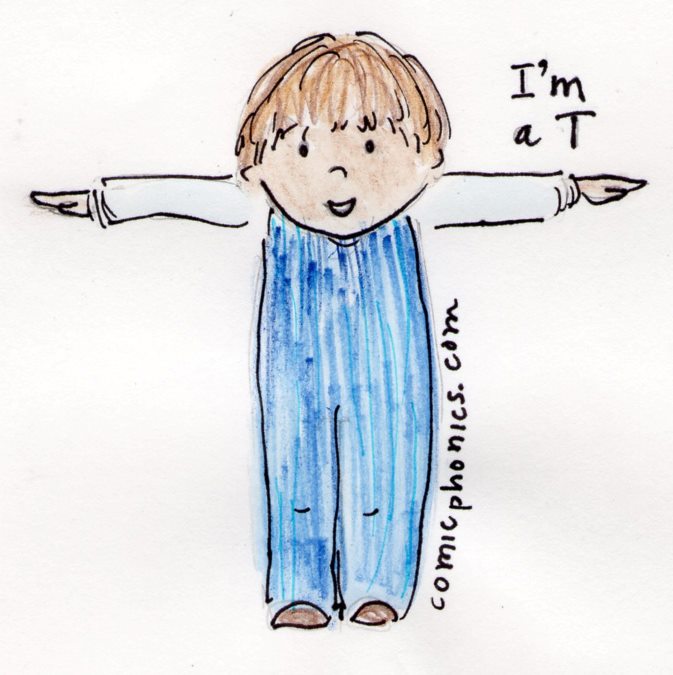
    child making the letter T
  • Point to familiar letters in unfamiliar places, such as the first letter of the child’s name in a sign or on a cereal box.
  • Read to your child. For the youngest children, let them absorb the pictures and name objects in the pictures. For three-year-olds and up, read the words, using your finger to point to the words as you read.

For a well-prepared child, reading doesn’t begin in school. It begins years before.

Is there any way to know ahead of time if my child will do well in reading?

Yes. According to Prof. Maryanne Wolf, director of the Center for Reading and Language Research at Tufts University, the two best predictors of later reading achievement are

  • an awareness of separate sounds (42 in English) and
  • the ability to rapidly name objects.

Today we’ll discuss sound awareness.

When I was a high school student studying French, I used to lie in bed listening to a Montreal radio station. I would try to figure out where one word ended and the next word began.  This same skill is what babies do when they listen to adults talk to them although they don’t realize it. Luckily for most babies, their mothers or caretakers speak slowly and distinctly and repeat words over and over.

With time toddlers begin to hear parts of words and realize that some words have one part (for example, Mom) while other words have more than one part (for example, Grandma).

Still later, usually around age four, children learn their ABC’s, not understanding what they are all about. But with instruction, they learn that each sound in English corresponds to a letter or a pair of letters in the ABC’s.

How can you enhance your child’s success in reading?

Make your child aware of words, syllables and individual sounds.

  • Encourage prereaders to write using invented spelling, advises Dr. Wolf. When the child writes, he sounds out a word and uses the letter symbols which seem appropriate. The “words” might not conform to proper spelling, but that is not the point. The child is working to figure out sounds, a skill he will need in order to read.Girl reading "inventive" writing of younger sister.
  • Encourage the child to listen to someone reading nursery rhymes. Then encourage the child to say the rhymes herself, advises Dr. Wolf.  Take “The Itsy Bitsy Spider,” for example.

The itsy bitsy spider
Climbed up the waterspout.

Down came the rain
And washed the spider out.

Out came the sun
And dried up all the rain.

So the itsy-bitsy spider
Climbed up the spout again!

  • Notice how “itsy bitsy,” “waterspout” and “out,” and “rain” and “again” rhyme. Notice the repetition of the word “rain” and the emphasis on the words “down” and “out.” Other nursery rhymes show alliteration (repetition of consonant sounds) and assonance (repetition of vowel sounds). When children listen to these sounds they learn to discriminate among similar sounds, figuring out what sounds the same and what sounds different.
  • Research shows that exposure to rhymes and alliteration helps children to figure out sounds and later, to read.

In our next blog we will discuss the other predictor of reading achievement, the ability to name.

How to use spelling tests to reinforce CVC words

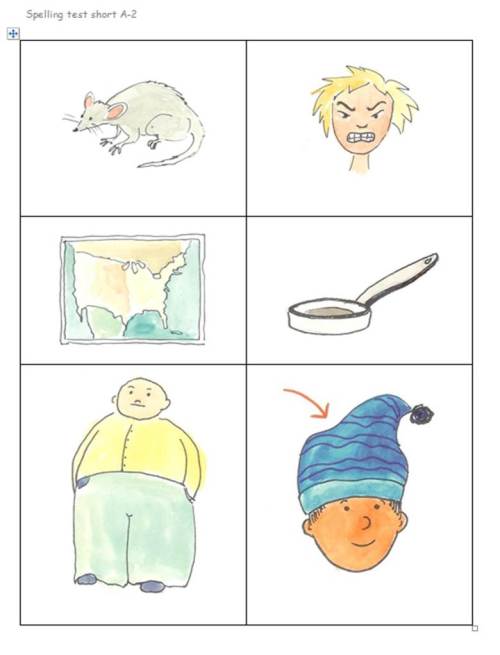
Years ago, I would cut  pictures of CVC words from various sources, paste them on index cards, sort them by vowel sound.  Then I would use them as spelling tests for beginning readers. (Now Mrs. A draws the pictures, including those below.)  This low-tech approach still works great with beginning readers and spellers.

Six drawings of short A CVC words

These drawings are samples of a packet of 12 pages of CVC drawings that can be downloaded for a small fee.  Click on the pictures for more information.  

Why use pictures for the spelling test instead of just dictating the words?

  • When the child is in charge of the pile of pictures, she can spell at her own pace, jotting down words she knows quickly and slowing down for words she is unsure of or for words she writes incorrectly and needs to repair.
  • Young children are people in motion, so the more parts of their bodies they can use to learn, the better. Taking off the rubber band, shuffling the cards, flipping them into a second pile as they are used and rubber-banding them again are fun.  Making learning fun is so important for children of any age, but especially for preschoolers.
  • Some children delight in erasing and will write a word incorrectly just so they can erase it. Spelling is a new experience for them, but it can take time, time when a tutor or mother might grow impatient. But since the child is working independently, the process can take as long as the child wants.
  • While the child is working independently, I can observe where she might need more help or prepare the next lesson, a better use of my time than dictating.
  • ESL students who might be shy about moving at a slow pace gain privacy by controlling the time it takes to complete the test.

One time I gave a preK student a short A test which he finished with pride—his first spelling test! When he found out I had more cards—more tests—he begged me to let him take the cards home and use them for the next week.  His mother later told me that  he took the spelling tests every day. What an eager learner!

What is choral reading?

Choral reading is group reading aloud in which a fluent reader serves as a model for students learning to read. It is a reading method frequently used in pre-K to second grade classrooms and in ESL classrooms, but it can also be a good method to teach reading at home.

Here’s how it works:

  • A fluent reader, usually a teacher, parent or recorded voice, reads a story aloud. The students gather around the teacher who uses a large-sized book whose text is also large. As she reads, she points to each word. Or, if children have their own copies of the text, they point to the words she says with their fingers.choral reading
  • The teacher reads the selection once while the children follow along silently with their eyes on the text.
  •  The teacher reads the selection several more times, each time with students joining in for the words they can say. Usually, with repeated readings, students can read more of the words.
  • Often the selection is reread the next day or soon after to reinforce the students’ ability to read the selection.

Why do choral reading?

  • It’s fun. Children love to read aloud when they are one of many voices. Many times the selections have repeated phrases like “I’ll huff and I’ll puff and I’ll blow your house down,” or rhymes, which increase the fun.
  • More skilled readers serve as models for the less skilled students sitting by their sides. The less skilled readers listen not only to their teacher, but to their peers, and they learn from each other.
  • Less skilled students, who might be embarrassed to read aloud by themselves, feel comfortable as part of the group. Their mistakes either can’t be heard or are ignored. They feel more confident about reading aloud. They also realize that with repeated readings, they can read more words.
  • ESL students learn proper pronunciation, phrasing and intonation from listening and mimicking the fluent reader.
  • Dyslexic readers, who often memorize words rather than sound them out, remember better because they are enjoying the reading experience. Their lack of reading ability is less noticeable when they are part of a group.