Category Archives: English as a second language (ESL)

What is choral reading?

Choral reading is group reading aloud in which a fluent reader serves as a model for students learning to read. It is a reading method frequently used in pre-K to second grade classrooms and in ESL classrooms, but it can also be a good method to teach reading at home.

Here’s how it works:

  • A fluent reader, usually a teacher, parent or recorded voice, reads a story aloud. The students gather around the teacher who uses a large-sized book whose text is also large. As she reads, she points to each word. Or, if children have their own copies of the text, they point to the words she says with their fingers.choral reading
  • The teacher reads the selection once while the children follow along silently with their eyes on the text.
  •  The teacher reads the selection several more times, each time with students joining in for the words they can say. Usually, with repeated readings, students can read more of the words.
  • Often the selection is reread the next day or soon after to reinforce the students’ ability to read the selection.

Why do choral reading?

  • It’s fun. Children love to read aloud when they are one of many voices. Many times the selections have repeated phrases like “I’ll huff and I’ll puff and I’ll blow your house down,” or rhymes, which increase the fun.
  • More skilled readers serve as models for the less skilled students sitting by their sides. The less skilled readers listen not only to their teacher, but to their peers, and they learn from each other.
  • Less skilled students, who might be embarrassed to read aloud by themselves, feel comfortable as part of the group. Their mistakes either can’t be heard or are ignored. They feel more confident about reading aloud. They also realize that with repeated readings, they can read more words.
  • ESL students learn proper pronunciation, phrasing and intonation from listening and mimicking the fluent reader.
  • Dyslexic readers, who often memorize words rather than sound them out, remember better because they are enjoying the reading experience. Their lack of reading ability is less noticeable when they are part of a group.

 

One example of how to teach a four-year-old to read

For several weeks I have been tutoring a four-year-old, teaching her to read.

  • I started with letter tiles, placing one before her at a time and asking her what sound each letter represented. She knew many of them, but not all of them.  As I expected, she couldn’t sound out “e” and “i” and was vague on “u” too.  The consonants “d,” “j,” “q,” “x,” “y” and “z” also were mysteries.
  • On a paper I had written all the sounds associated with individual letters, and as she said them properly, I crossed them out, to know which letters we needed to focus on.
  • Reading tutor with 4-year-oldSince she was confident about “o” and “a,” I used those letters to form CVC words, real and imaginary, spelling them phonetically. With the letter “a” I sandwiched two consonants, one on either side, separating the tiles and then moving them closer and closer until they looked like a word.  All the time I was pronouncing the sounds, such as “c” “a” and “t.”
  • Since the hardest letter sounds for beginning readers to hear are the middle sounds in CVC words, I kept using the same vowel sound, the letter “a,” for one half-hour lesson. I put a “t” after the “a” and kept it there for several minutes, exchanging one beginning consonant for another as she read the words.
  • My little student caught on quickly that the sound in the middle and at the end of the word didn’t change, so all she had to focus on was the beginning sound. When we encountered one of her difficult letter sounds, I would say it and then she would.
  • At our next lesson, I repeated much of the first lesson, asking her to pronounce the sound for each letter tile. This time she sounded the “q” consistently correct, so I crossed out that letter sound on my list.
  • I made CVC words using the letter “o.” Some words were real; some were nonsense words or real words spelled phonetically.  What she showed me was that she knows the sounds of various letters.
  • The next week I used both “a” and “o” words. This was more difficult because my student needed to keep track of two sounds in CVC words.
  • This past week I used “u” as the vowel. At first, my student would forget the sound “u” represents, but by the end of the lesson, she was remembering it.

Because the lesson lasts just 30 minutes, this student hangs in there, but by the end of a half hour she is losing interest.  I compliment her work often, telling her, “You didn’t know that letter last week, and now you do!” or “You figured out that word all by yourself.”  Sometimes she acts out a word or tells me what it means, and I compliment her on that too.

These early lessons focus on letter sounds and how combining sounds gives us words.  It might seem boring to an adult, but brain research shows that there are no built-in pathways in our brains for reading, the way there are for movement and speech.  A novice reader, like my student, must activate much more of her brain to read “cat” than an experienced reader like me.  Over years of reading, my brain has built shortcuts to figuring out words that this child’s brain hasn’t done yet.

At our next lesson, we will do more CVC words using “u” as the vowel, and then exchange the “u” for “a” and “o.”  We will focus on letter sounds my student is still learning.  Her progress may seem slow, but it is steady.

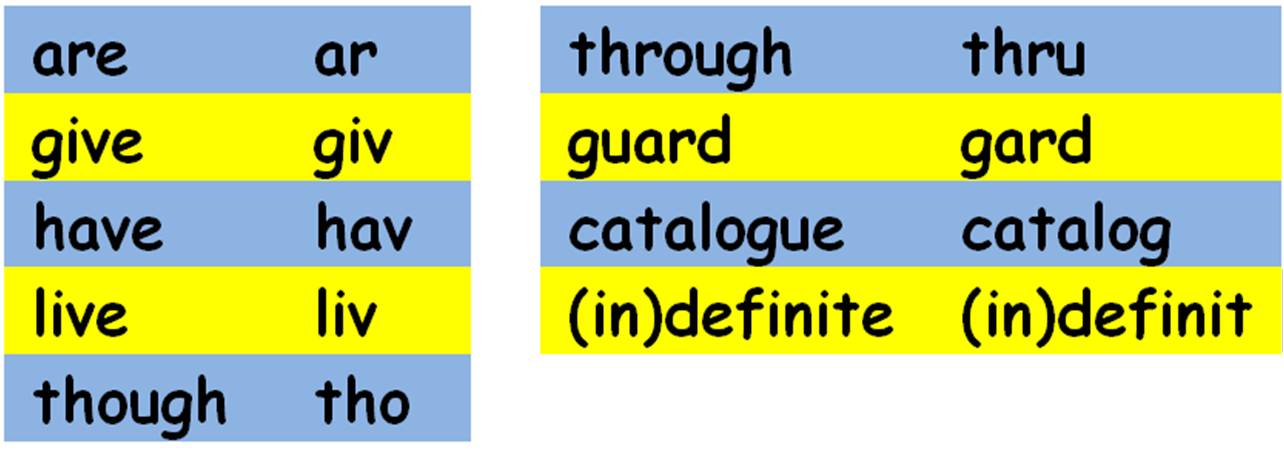
Can English spelling b impruvd?

The English language’s antiquated spelling patterns make English difficult to learn.  Way and weigh, threw and through, Phil and fill—English is replete with spelling patterns that inhibit reading and spelling for young children and ESL students.

Can anything be done about it?

Daniel Webster was the last to have had a small success.  He studied the first English dictionary, written by Samuel Johnson in 1755 in Britain.  Webster found much to dislike.  In particular, he thought a dictionary should reflect the words and usage of the public, not of another country’s aristocracy.  His American dictionary of 1825 simplified some British spellings—eliminating the “u” in “colour” and “honour”; he changed some French spellings to better match their English pronunciations, such as “centre” to “center” and “theatre” to “theater.”

In 1837, Isaac Pitman, and in 1848, Alexander John Ellis proposed a phonetic alphabet.  Their efforts garnered interest but little support.

In 1876, the American Philological Society reformed eleven spellings which the Chicago Tribune started to use.  However, the changes didn’t take with the public.  They are

NewSpellings

In 1883, the American Philological Association made 24 spelling reform rules, but to no effect.

In 1898, the National Education Association created a list of twelve spelling changes which were to be used in all its writings.  They were

Suggested spelling changes of 1898

(Spellcheck on my computer accepts all the old-fashioned spellings but two, and rejects all the recommended changes but three, showing how few of these changes have been implemented in the past 110 years.)

In 1906 the Simplified Spelling Board published a list of 300 spelling changes.  President Theodore Roosevelt ordered the Government Printing Office to make the changes, but Congress stopped it with a resolution to keep the old spellings.

And so it goes through the 20th century and into the 21st.  Some small changes have crept into the language—cigaret for cigarette, dialog for dialogue.  But substantial improvement hasn’t come.

However, there is hope from an unexpected source:  technology.  Texting is doing what hundreds of years of reformers have not:  making phonetic spelling commonplace and acceptable among large numbers of readers and writers.  And because Americans text so often in a phonetic language, they are bringing their easier, more logical spellings into everyday English.  Not into standard English—that hasn’t come yet.  But into everyday English, yes.

Texters use the word “tonite” rather than “tonight” because it is shorter, and takes fewer keys to press for a quick message.  “Because” is also changing to “becuz.”  I suspect that this bottoms-up approach—changes introduced by young Americans—will bring more change to spelling than the top-down efforts of the past two centuries.  And about time!

What do you think?  Is texting making inroads into standard English?  Or is it just a fad?  –Mrs. K

What’s a graphic novel?

One of the biggest trends in children’s literature in the past ten years is the rise of graphic novels.  Not sure what I mean?  Think Captain Underpants and The Wimpy Kid.  Graphic novels are

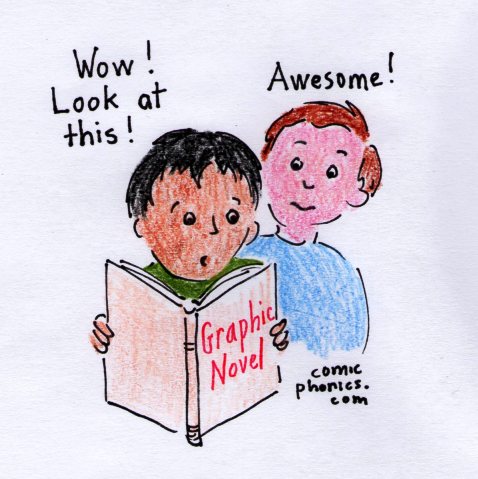
  • Two boys reading a book entitled "Graphic Novel."comic-strip-like stories with a beginning, middle and end (not a continuing saga).
  • fiction and nonfiction stories told as much in colorful drawings as in words.
  • a hybrid form of action literature that appeals to 12 to 18-year-olds but now is working its way to much younger readers.
  • a newly recognized form of literature by the Young Adult Library Services Association, part of the American Library Association, which has been selecting the best graphic novels for teens since 2007.
  • a form of children’s literature reviewed in respected journals such as School Library Journal.

Graphic novels, like all novels, cover many themes such as romance, sci-fi, fantasy, super heroes, and modern warfare.  Not all graphic novels are novels.  Recent nonfiction titles include Pride and Prejudice, a biography of Thomas Jefferson, Poseidon, landing on the moon and the great apes of Africa.

When graphic novels started appearing, said Mary Tyner, a media specialist from Peachtree Elementary School in Peachtree Corners, Georgia, they were inferior literature and she did not buy them for her school library.  But as they improved and as they were reviewed by respected journals, she began buying, and now she can’t keep the 153 titles on her library’s shelves.

“They are an extremely motivating literature that encourages children to read,” Tyner said.  Over time, she has seen the reading level of graphic novels press downward, but there are few for beginning readers, perhaps because it is hard to have a meaningful story line in beginning reading books, said Tyner.

Another advantage of graphic novels is that they teach synthesizing skills, said Deb Schiano, media specialist at Loundsberry Hollow Middle School in Vernon, New Jersey.  “In our society children must be aware how to read images,” said Schiano, and how to combine the images with words to form meaning.  She compares graphic novels to storyboards from which the student can pick up story arcs by reading the drawings.  Combining the pictures with the words creates more complex meaning.

Graphic novels also attract disabled students, said Schiano.  “For the dyslexic student who can’t decipher words, graphic novels are another way to learn.” In her school last year one teacher used them consistently with learning disabled students.

Both media specialists said graphic novels also encourage children to write and illustrate their own stories, sometimes using online sites.

What has all this to do with beginning readers?

  • Young children will see their older siblings reading graphic novels, and will enjoy paging through them to study the drawings.  The joy that that the older child shows might encourage the younger child to want to read.
  • With time, graphic novels will probably reach down into first grade reading levels and attract younger and younger readers.
  • As a child’s reading ability improves, he might want to buy these books or to borrow them from the library.  Parents unfamiliar with this genre might scorn graphic novels as inferior, but it is worth remembering they have advantages over text-only books.  For reluctant readers, or disabled readers, or boys, they can be a way to motivate the child to read.
  • Graphic novels can also be found on iPhones and Android phones.  Expect your young children to be intrigued when they find them online, and eventually, to want to buy them this way.

Do I say “red new book” or do I say “new red book”? Is there some rule to teach my daughter?

Royal Order of Adjectives SignYou say “new red book,” and yes, there is a rule. It’s called the Royal Order of Adjectives—an imperious name for an ordering system. The list below begins with adjectives placed farthest away from the noun (Determiners) to those placed nearest to the noun (Specifiers).

Determiners: Which one (the, a, an, my, her, this, that, these, those). Most singular nouns in English are preceded by either an article, a possessive noun or adjective, or a demonstrative adjective. Plural nouns do not use “a” and “an” but may use the other determiners.

Subjective description: (slow, ugly, easy, delicious) These adjectives can be considered opinions of the speaker or writer.

Size: (large, small, three-inch-long, two-liter) The hyphens are used to create words that don’t exist in English. Notice that every adjective is singular (three-inch, not three-inches) even if the word it describes is plural.

Shape: (round, misshapen, skinny, elongated)

Age: (new, antique, fifty-year-old) Notice that the adjective “fifty-year-old” does not put an “s” on year because all adjectives are singular. “My fifty-year-old brother” but “My brother is fifty years old.”

Color: (red, striped, mottled)

Nationality: (American, Asian, Indian)

Material: (cardboard, polyester, paper, metal)

Specifier: (rocking [chair], player [piano], Apple [iPhone])

Related to this idea of ordering adjectives is the question of which ones need commas to separate them. The rule is that if the adjectives fall into the same category (both colors, for example), then use a comma. If the adjectives come from different categories, no comma is necessary.

 Correct: My successful tall, willowy Korean sister travels often.

Most Americans cannot explain the rule of ordering adjectives. If they have heard the adjectives ordered correctly as children, they use that same order. They go by what sounds right, but they cannot explain it. ESL students who have not heard adjectives ordered a particular way may not know there is an order, and may order the adjectives arbitrarily. It is important for teachers and parents to point out to ESL students that there is a correct order.

Even preschoolers can be told to say “a new red bike, with the color red right next to the bike” so that they become aware that there is a right way to order words. Little children often use size and color to describe an item, so it is important to point out that size comes first, then color.

Some Americans put commas between all adjectives preceding a noun, and others don’t use any commas. More and more the practice in the U.S. is not to use commas unless leaving them out leads to confusion.

Try this quiz to see if you understand the Royal Order of Adjectives:

Adjective test

–Mrs. K

What are high/low books?

High interest / low reading level books are books that appeal to children who are older than the reading level of the book.

High/low books in a way are a mismatch: the reading level is lower than the age of the child to whom the book appeals. A good example is the Fudge series by Judy Blume. The early books are written at a second grade level but appeal to third or fourth grade children because the narrator begins as a fourth grader and grows older in the series.

Too many words on a page make reading hard.These books appeal to children who are struggling to read. The stories are about kids their age doing activities they do. These books are also good for ESL students whose age might not align with their reading level in English, and for disabled children, including those with dyslexia, who are behind their peers in their reading level.

What makes these books different? They share many of these qualities:

  • Shorter, everyday vocabulary words with concrete meanings
  • Short sentences
  • Short paragraphs
  • Large margins
  • Unjustified right margins (margins that look ragged)
  • Larger type size (minimum 11 point) in clear fonts
  • Realistic characters who are the same age as the reader
  • Easily differentiated characters
  • A fast moving plot which is low on description
  • Compelling stories
  • Chronological order (no flashbacks)
  • One point of view, not two
  • Illustrations, photos, graphs and maps
  • Tight, concrete writing

Many lists of these books can be found online.

A long list can be found at http://www.schoolonwheels.org/pdfs/3328/Hi-Lo-Book-List.pdf. This list gives the reading level (RL) and the interest level (IL) plus a one sentence description of the book. All the books on this list are fiction.

Some small house book publishers are known for publishing books for reluctant readers who often happen to be high/low readers. At http://www.nbss.ie/sites/default/files/publications/READ_-_hilow_books.pdf you can find the books of several publishers which are geared to students older than their reading level suggests. These books are mostly appropriate for high schoolers.

At http://www.booktrust.org.uk/books/children/bookmark/booklists/141/ there is a list of 14 books for various age levels written below age level.

http://specialeducation.answers.com/english-and-math/10-high-interest-low-reading-level-books-for-teens-with-reading-difficulties gives information about ten books, some nonfiction, which are written at low reading levels but which would still appeal to kids in their teens.

The largest teachers’ union in Britain has a listing of book publishers and book series appropriate for high/low readers. Go to http://www.teachers.org.uk/node/12418 .

Seven publishers of high/low books are listed at http://www.writing-world.com/children/foster03.shtml. Included are hyperlinks to those publishers. –Mrs. K


Assessing reading comprehension by using multiplication

Are you looking for a simple way to assess your child’s reading comprehension skills?  Take a look at the “Simple View of Reading.”

Although a “Simple View of Reading” (SVR) was proposed in 1986, its simplicity and success make it a useful tool to assess reading comprehension today.  Almost thirty years ago, two researchers, P. Gough and W. Tunmer, suggested that reading includes two primary steps, decoding words (using phonics skills to figure out words) and language comprehension (knowing the meaning of words especially when words are strung together to form sentences).

They represented their Simple View of Reading with a math equation:

Decoding x Language Comprehension = Reading Comprehension

(This formula uses scores from tests in decoding and language comprehension.  For this formula to work, all scores for decoding and language comprehension must be between 0% and 100%.)

What does this simple formula mean?

  • Reading comprehension requires the child to master two areas, decoding words and language comprehension.
  • If a child can do one but not the other, or can do one better than the other, his reading comprehension score will be only as high as the lower of the two other scores.

How can you use this Simple View of Reading to identify your child’s reading comprehension skills or lack of them?

  • First, ask yourself:  Is my child’s reading problem decoding?  Is his problem language comprehension?  Is he having problems in both areas?
  • If you are not sure, test the child in both areas.
  • You can test decoding by having a child read lists of real and nonsense words.  Lists are available online.  Having the child read nonsense words (e.g., zups, thab, slig) is important because some children memorize the look of a word without being able to sound it out.  Also, to assess decoding, don’t use words from a reading passage because the child might figure out a word from the context.  To test decoding, you must remove context.
  • You can also test decoding by reading an unfamiliar passage aloud and asking the child questions about facts, main ideas, sequencing and paraphrasing .  If he can respond accurately when he is the listener, yet he cannot do that when he is the reader, his problem could be decoding.
  • You can test both decoding and language comprehension by having the child read aloud to you.  (If he can pronounce words correctly, or in a few cases, use phonetic pronunciation for unfamiliar words, decoding is not his issue.)  Stop and ask the child what various words mean.  Ask the child to paraphrase a difficult sentence.  Ask the child to paraphrase the passage.  Ask the child to predict what might happen next.  If the child can decode, yet he cannot explain what he has read, his problem is likely language comprehension.  Teachers often see this situation in ESL students who learn the rules of phonics well but whose vocabulary in English is not extensive.
  • To make the evaluation easy, use a scoring method of high, medium, and low based on your own mental tally from working with the child.  If the child scores high in both decoding and language comprehension, he probably does not have a reading comprehension problem.  But if he scores medium or low in decoding or language comprehension, he has a reading comprehension problem.
  • A medium or low score in decoding means he needs more work in phonics.
  • A medium or low score in language comprehension means he needs vocabulary building, work on pronunciation, time listening to a native speaker read a text aloud, and strategies to gain meaning from sentences and passages.

My neighbor, who was born in Korea, sends her children to English tutors year-round. Should I do the same? Her children get straight A’s and are in gifted classes.

Tutoring is a way of life in some cultures, including South Korea.  There children go to school for six to eight hours during the day, 220 days a year, and then they go to a tutor for another four to six hours in the evening.  Estimates are that Korean children spend up to 13 hours a day being educated, almost half of that time in the largest private tutoring system in the world. Tutor teaching a child.

The cost is high.  Some Korean parents spend up to half their income on their children’s education, leaving them little money for other expenses.  It also has increased the debt of private citizens.

So why do parents in South Korea use private tutoring?

  • Dissatisfaction with the fairly uniform curriculum available to Korean students;
  • A desire for their children to be accepted at top universities;
  • The option for students to study subjects they cannot get in school;
  • The opportunity for students to receive excellent educations, leading to excellent jobs.

In the U.S., Korean parents continue using tutoring services.  They rarely cancel a tutoring lesson, and when they do, they make it up.  Often, they help their children with math and science homework, but use private tutors for English and social studies.

But in the U.S., many non-Asian parents balk at using tutors. Why?  They might think that

  • tutoring is elitist;
  • tutoring stresses children;
  • tutoring leads a child to believe he is deficient and cannot learn on his own;
  • tutoring usurps the time when children should be playing;
  • tutoring interferes with organized sports programs;
  • tutoring interrupts the time when parents might want to chill out after work.

Yet when you look at the valedictorians and salutatorians of our high schools, or at a breakdown of student backgrounds at excellent universities, you find many privately tutored students of Asian background.

One way of looking at extracurricular learning is that it can add months of learning to each year of a child’s education.  I have personally seen four-year-olds, who don’t know their ABC’s, start working with a private tutor and by the end of kindergarten—after working one hour a week, year-round—able to read at third or fourth grade levels and easily qualify for gifted programs in their public schools.

Should you hire a tutor for your child?  I cannot answer that, but I know that your child will be competing for scholarships, a place in college, and good jobs with children like your neighbors who are being tutored.  –Mrs. K

Many parents have their child participate in after-school sports for hours a day. They will drive many miles to have the child on the elite team or with the best coach.  They will send their child to sports camps and even hire a personal trainer. They’ll fly across the country for gymnastics meets or baseball world series.  They do not consider the athletic endeavors to be stressful, yet those same parents may never consider hiring an academic tutor.  In our typical American culture, too much time spent on academics is considered stressful.  Yet, a child who does better in school may be less stressed at school.  It is a complicated issue.  –Mrs. A

My neighbor hires a tutor to work with her preschool child on reading for an hour a week. Is that really necessary?

Tutoring is a multi-billion dollar industry in the U.S., so your neighbor joins plenty of other parents in using tutoring services. I work as a private tutor, and I have tutored four-year-olds in how to read. Good idea? Bad idea? It depends.

Parents hire reading tutors for many reasons:

  • Many foreign-born parents speak English as a second language. They want their children to learn reading, vocabulary and pronunciation from a native English speaker.
  • Other parents want their children to be the best in the class and can afford to pay for that excellence.
  • Some children are poorly organized and benefit from systematic instruction.
  • Some children have no one at home to help them. The tutor takes on that role.
  • Some parents hire a tutor as a babysitter—someone to develop a relationship with the child and keep the child occupied in useful tasks while the parent is working.
  • Some students have genuine learning problems—dyslexia, for example. The sooner the problem is identified and the sooner the child works with an expert, the more likely the child will keep up with classmates and learn ways to overcome her disabilities

In many Asian countries, using tutors is customary. When parents move to the U.S., they bring that custom with them. In some immigrant communities, almost all the children are tutored, so the children assume that tutoring is normal. Their parents are often engineers or doctors, and expect the same careers for their children. What gave the parents an edge in Korea, Taiwan, India or Shanghai is what they want for their children in the U.S.

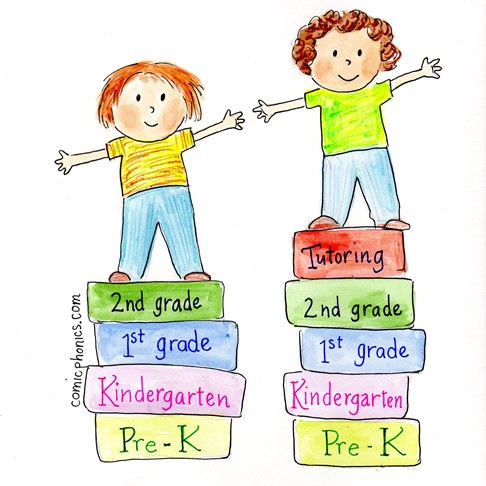
2 kids showing tutoring's advantageOne of the most compelling reasons for tutoring is the amount of extra education it gives a child. A four-year-old who is tutored only during the weeks when school is not in session gains 16 weeks a year of ongoing education. Multiply those 16 weeks by kindergarten, first grade and second grade, and that child will have studied a year more than her classmates when she starts third grade. A year more of education at a time in life when learning is so essential!

One grandmother I know said when her son was young, he struggled learning how to read. By first grade he was already behind and feeling overwhelmed. This grandmother helped her son with his homework, but it was always a struggle. If she had it to do over, she says, she certainly would get him a tutor, and enroll him in a structured summer program. Now it is 25 years later and she sees the same learning style in her grandson. She has recommended that her son hire a tutor for the boy, and he agrees.

Should your child be tutored? If it is just to keep up with the neighbor, maybe not. Talk to his preschool teacher. Read with him yourself. Not every child needs to be tutored, especially those who have an involved parent. I never had an outside tutor, but I had a wonderful mother who read to me every day and helped me with my homework. Don’t underestimate your capabilities or your influence. After all, most of the learning your child has done until now has been with you as his teacher.

Is a child’s vocabulary destiny?

Consider this:

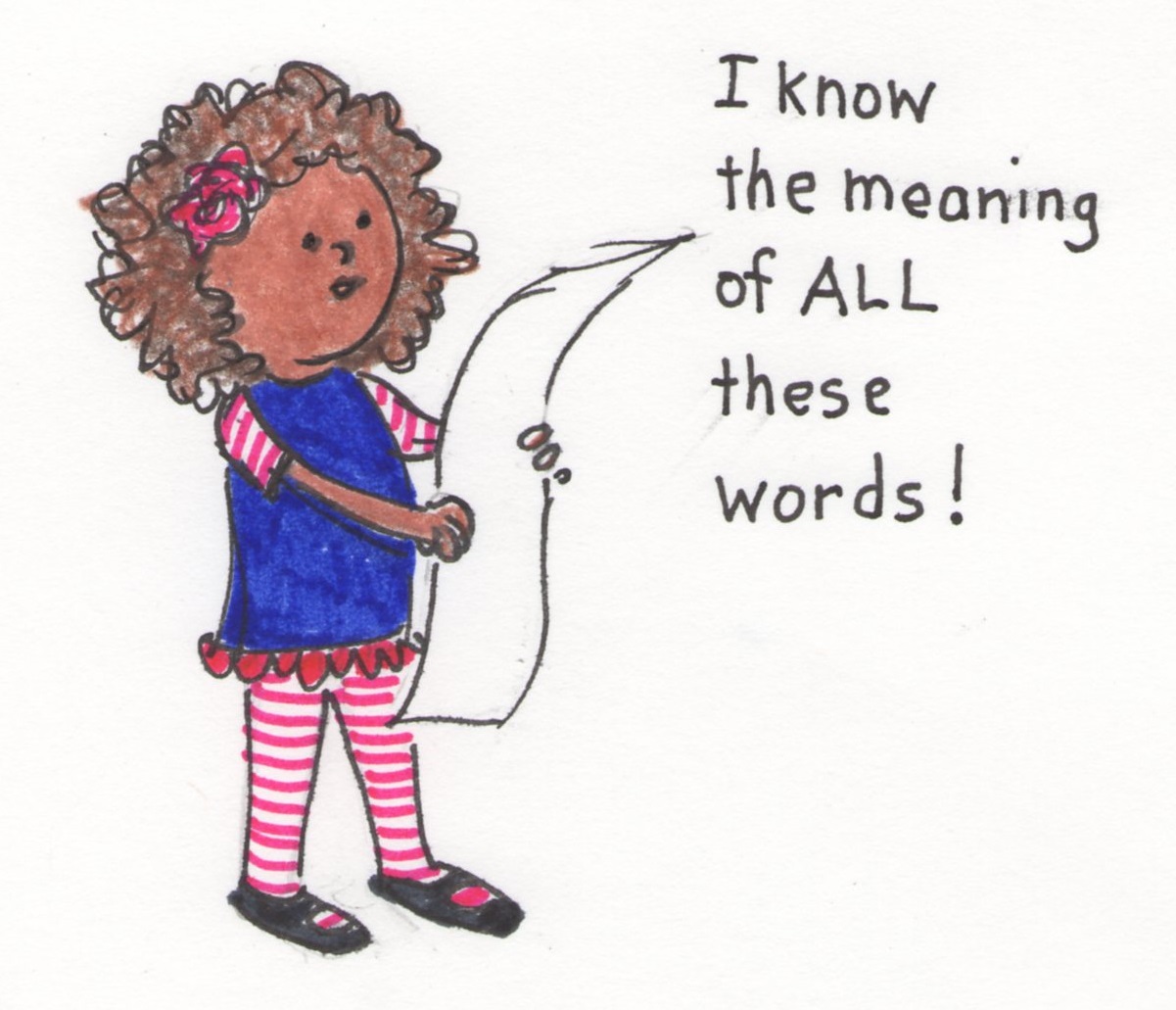
  • Three-year-old children from professional families already have bigger English vocabularies than parents in lowGirl is looking at a list of words she can read.-income families.
  • Children from professional families hear 300 more spoken English words in an hour than children of parents on welfare.
  • By the time children are four-years-old, children of professional parents will have heard 32 million more words than children from poor families.

What does this research by Betty Hart and Todd R. Risley (1980’s and 1990’s) mean?  Combined with more recent research that shows that vocabulary acquisition is the single greatest predictor of reading success, it means that children of professional parents are far ahead of children from low income families as they start preschool.  Other studies show that as a child moves through school, this vocabulary gap increases, directly correlating to a child’s achievement in reading comprehension.

So what can you do with your preschooler, primary grade child, or ESL learnerto increase his vocabulary?  Quite a bit.

A young girl uses the word odiferous to describe a stinky diaper.

  • Use “big” words when you talk to your child.  Provide a rich vocabulary for your child to hear.  “Baby” words are no easier to learn than adult words, so use adult vocabulary with your child.  For example, when I was a child, my father used to come home from work and ask us children, “Is everything copacetic?”  Of course, we didn’t know what he meant, but he explained, and within a short time we were asking one another the same thing.
  • Define new words when you know your child doesn’t understand.  Give an example you can refer to again and again.  Try to give an image to keep in mind if you can.  “Shutters are those door-like things on the sides of house windows, remember?”
  • Choose new words that sound somewhat similar to words the child already knows.  For example, a child knows what a computer is, but “compute” would probably be a new word.  Make the connection to how the computer can add up numbers quickly to help the child remember what compute means.
  • Encourage your child to ask you what a word means.  Don’t laugh at him because he doesn’t know.  We all learn by asking questions, so questioning is a great skill to help your child to develop.
  • Repeat new words often until the child understands.  One or two times is not usually enough.  Try six or ten uses of the word in a few days to cement the word into the child’s memory.
  • Read, read, read to children to expose them to new words.  Nursery rhymes contain old-fashioned words the child might not know.  Emails from Grandma might too.  Read from a variety of genres, but pick topics of interest to the child, so she will pay attention.  Choose books that stretch the child’s vocabulary with new words in context, but not too many.
  • When you are reading to your child, and you come to a new word, read it in context, and then ask the child what she thinks it means.  Try to find something right in her answer, even if it’s, “Well, that was a thoughtful explanation.  Well done.  Now let me explain what the word really means.”
  • Read the same book to a child several times, helping the child to conquer the words in context.  If there are many new words, don’t discuss each one.  Pick a few so the child focuses on enjoying the book.
  • Set yourself a goal of a word a day for a preschooler.  Keep a list on the refrigerator to remind you to use past words again to help with retention.  Let the child see the list growing.  As we measure the height of our children, they feel pride.  As we measure their learning, they will bask in that success, too.

How about you?  Have you come up with any ideas to help improve your child’s vocabulary?  Share your ideas by commenting on this blog.