Category Archives: English as a second language (ESL)

Not understanding inference leads to reading comprehension problems

Inference, or reading between the lines, is the ability to use two or more ideas to arrive at another idea which hasn’t been stated.  For example, you see someone come into your home wearing a wet rain coat and carrying a wet umbrella. You can infer that it is raining out even though no one has said so.

A student with poor inference skills has reading comprehension problems.
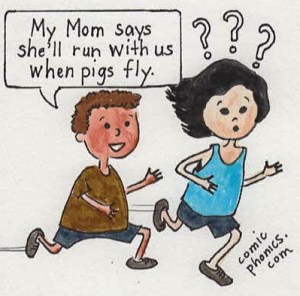
one child says "when pigs fly" but the other child doesn't understand

But there are many kinds of inferences which children must learn:

  • Pronoun antecedents:  In the sentence, “Mary gave her dog a hug,” the child needs to infer that “her” means Mary.  Figuring out pronoun references is a kind of inference.
  • Physical or emotional responses:  In the sentences, “Alan read the math problem. He frowned,” the inference is that Alan read something puzzling.
  • Cause and effect:  In the sentences, “Mom put the baby on the floor. Mom left him alone for a moment,” the inference could be the effect of a cause. What will the baby do? Will the baby do something dangerous?
  • Cumulative ideas:  When Junie B. Jones hides in a classroom cupboard, plays with clay she isn’t supposed to play with, and sticks dozens of bandages from the nurses’ office on herself, the reader can infer that Junie is a mischievous, fun-loving kid who doesn’t follow the rules.

What leads children to have problems understanding inference?

  • Vocabulary:  If a child does not understand the meaning of a word, and the inference depends on that meaning, making an inference is difficult. ESL children have this problem. I have worked with children who mix up he and she, him and her, or who use those words interchangeably. But native English speakers with limited vocabularies also miss inferences.
  •  Idioms:  ESL children are confounded by idioms and cannot make an inference from words which they interpret literally.
  • Working memory: If a child with a poor working memory must hold a certain idea in his mind over several sentences, making an  inference can be hard.
  • Predicting: Some children do not make predictions while they read. Perhaps they are focusing intently on decoding words or on pronunciation, and they have no mental energy left to make sense of what they read. Or perhaps they have never been taught to ask “why?” while they read. I work with a middle schooler whom I stop while we read together. I ask, “What do you think will happen next.” He always says the same thing. “I don’t know.”
  • Background knowledge:  Children who have encountered a situation, or who have heard their parents talk about a situation, or who have seen a situation on TV will have an easier job of making connections to what they read. Sheltered children without much life experience will have a harder time making inferences.
  • Cultural differences:  A child from one cultural background—say, Chinese—might not understand subtleties of a story about an Italian immigrant child from 100 years ago. Or an only child might miss inferences clear to a child from a large family.

In our next blog, we’ll talk about how you can help your child overcome inference problems.
My third grader skips over long words when she reads aloud. When I ask her to pronounce them, sometimes she can if she segments them, but many times she can’t. How can I help her?

Lots of children do this, thinking they can gain enough meaning from the rest of the words. And sometimes they can. But usually this is a sign of a struggling reader.

Your daughter needs to learn strategies to figure out new words.

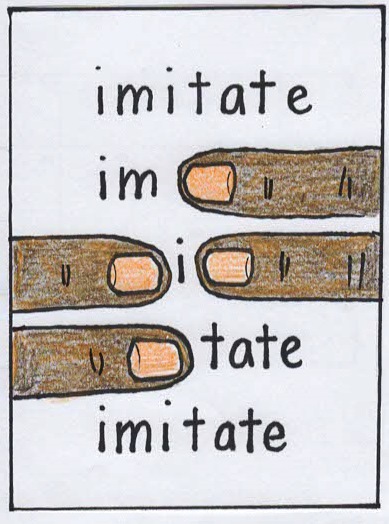
fingers covering parts of word, then revealing themWhen she reads aloud to you and encounters a word she skips, stop her and cover parts of the word to help her figure it out in small chunks. For example, in a word like “imitate,” cover over all but the “im” part. Ask her to pronounce “im.” Then ask her what a short i sounds like. Show her the “i” in the middle of the word and ask her to put those sounds together. Then show her the “tate” which should be easy to pronounce. Now reveal the word bit by bit as the child says it. You say it too to be sure she hears it pronounced correctly.

But she still might not know what the word means. Help her to understand it. Use it in a couple of sentences. My experience working with children is that many times they can remember the meaning of words, but they cannot use them properly in sentences. Ask her to create her own sentence using the word.

I would make a list of words she has learned this way, and later in the day or the next day, go back to them. Ask her to read the words and tell you what they mean. Return to these words from time to time to reinforce them.

I would also try to find ways to use the words in your everyday conversations with your daughter.

Perhaps your daughter needs more phonics education. You could quickly go over CVC rules of adding suffixes. You could instruct her about prefixes and what they mean and rules for adding them to root words.

Letting your child slide over long, unfamiliar words sets up a bad habit. Eventually, when she gets into middle school classes, she’ll encounter such words routinely and will need strategies to figure them out. Talk to her teacher about the situation. Perhaps there is a reading specialist in your school who could come to her classroom from time to time and help the students decode longer words.

And I will provide more information about how to decode longer words in upcoming blogs. Keep tuned.

One way to learn English vocabulary: Study Latin and Greek roots

When I was in high school, studying Latin, I experienced one of those “light bulb” moments when I discovered that many of the words I used every day in English came from Latin. And I realized that if I could learn Latin words, I could increase my English vocabulary exponentially!

child looking at a unicycle, bicycle and tricycle

Even young children can increase their vocabularies if they learn Latin and Greek roots. For example, suppose a child plays the game “Uno.” The child learns quickly that “uno” means one. But so do many words that begin with uni. Uniform means one kind of clothes worn every day. Unite means everybody becomes one big group. Universe means one huge collection of stars and planets. Unicycle means a bicycle with one wheel.

Teaching children new vocabulary words using Latin roots has many advantages.

  • Many ESL children who come from Latino backgrounds already are familiar with many Latin roots and the meanings of the roots because the roots and meanings are the same or similar in Spanish, Portuguese and Italian. Connections to new English words are already a part of their vocabularies.
  • Instead of children learning isolated words which bear no relationship to one another, children can learn word families which are connected by a single idea. For example, “ped” in Latin means foot. Pedal, pedestrian, and pedicure all have meanings related to feet.
  • Children can combine two roots to understand some English words which don’t need to be studied separately. For example, bicycle comes from “bi” which means two and “cyclus” which means circle.
  • Certain areas of study, such as biology and mathematics, use Latin or Greek roots for basic vocabulary. Children who are fascinated by dinosaurs can look at pictures of many different kinds and notice that many names contain the root “–saurus” which means “terrible lizard.” Others have names with the root “pod” which means foot or feet.

One way to begin learning vocabulary from Latin and Greek roots is to have children study the words for numbers, from which there are so many derivations.  Duo, meaning two, has led to duet, duel, and duplicate.  Tres, meaning three, has led to triple, tricycle and triangle.  Quator, meaning four, has led to quarter, quart, and quatrain.

Online you can find many Latin and Greek root vocabulary-building websites as well as workbooks devoted to teaching vocabulary through roots. I am mystified why this way of approaching vocabulary is not used more often. I considered it a short cut way to study for the SAT!

What’s choral reading?

Choral reading is reading aloud as a group, much like a choir reads the words and sings them together aloud. It is commonly done in lower grades and in ESL classes for several reasons:group of students reading together from a single book

  • Children who are less skilled readers can listen to the more skilled readers beside them, and can model their reading after their classmates’ reading. In particular, less skilled readers can hear fluency (emphasis of certain words or syllables, pauses for punctuation, speeding up and slowing down) which less skilled readers might read too slowly to use correctly.
  • Children who stumble over sight words can hear them pronounced and can say them aloud without drawing attention to themselves. ESL students can hear correct inflections and can practice copying them.
  • Less skilled readers can practice aloud with anonymity, their mistakes or hesitancies masked by the reading of the larger group.
  • Children who are poky readers, who stumble while trying to decode words, will gain comprehension which they sometimes miss.
  • Choral reading is fun for children.

Certain kinds of books or readings work well for choral reading.

  • If a book has a rhyme pattern, or a predictable rhythm, it can be a good choice. A poem or nursery rhyme makes a good choral reading selection.
  • If the book is short, so that it can be repeated several times in a few minutes, it can be a good choice.
  • If the book is at the reading level of the less skilled students, it can be a good choice.
  • If less skilled readers are familiar with the rhyme or story, it can be a good choice.

Working one-on-one with a student, the parent and student can read aloud together from the same page. If the choral reading happens in a classroom, each student should have a copy of the text or be able to see a Big Book which everyone can use. Usually the adult reads first while the students follow along, pointing their fingers at the spoken words. Then the student joins in. The student might feel more comfortable if the adult reads with gusto, drowning out the mistakes of the beginning reader. As the selection is reread, the adult can read less loudly, allowing the child’s voice to be heard. Rereading the selection several times over several days is a good way to help the less skilled reader to remember the words or to figure them out quickly.

Case study: Julie, a seven-year-old, high-achieving reader

Julie had just turned four when I began to tutor her in reading. Her mother, a native of China, had been taking Julie to a tutoring agency since she was barely three. The mother worked with her daughter daily on the reading lessons which Julie brought home.

Child looking at flash cards of two and three letter words.

.

When I met Julie, she could read many one-syllable words and some two syllable words. However, I noticed that when confronted with a new word, she could not figure it out. She had memorized the look of the words she knew but she had not learned phonics skills to sound out new words.

We began by reviewing ABC names and consonant sounds, almost all of which Julie knew. Then we spent many lessons on vowel sounds, focusing on short vowels first, and later mixing both short and long vowel sounds. We did this using pictures (pig, hat, run) which Julie would match with cards labeled ā ē ī ō ū and ă ĕ ĭ ŏ ŭ. We would spend about ten minutes of a lesson on this kind of work. Julie’s attention span was about ten to twelve minutes, so this was one of several activities in a single, hour-long lesson.

Tutor teaching a child.

When she mastered the vowel sounds using pictures, we worked on forming three-letter words using short vowels. At first I moved letter tiles around to form words, and with time, Julie made her own combinations and tested me to see if I knew what words she had formed.

Next, I added blends to short vowel words, first at the beginnings of words, and later at the ends of words. She found the beginning blends easier than the ending blends, as most children do. I made index cards with blend words on them, and when Julie would read a word on a card correctly, she would use a date stamp to mark the card—a way to make the learning fun. After a few weeks she mastered the blend words.

Late in our first year together, Julie began work on long vowel words ending with a silent “e.” She knew many of them by sight but not by sounding a word out. As our first year ended, we were working on long vowel single syllable words with double vowels such as “beat,” “fuel” and “rain.”

We were also building words using roots, prefixes and suffixes whose parts were written on little cards which Julie would push together to form words such as re-mix-ing and un-read-able. In the months which followed, when she encountered a long, unfamiliar word, she sometimes covered the prefix or suffix to figure out the middle part, and then constructed the word bit by bit as I had demonstrated.

Young girl reading a book

Julie could read many picture books. She enjoyed short paragraphs with colorful pictures on each page, but she would not try a chapter book. “Too many words,” she would say. She continued to go to the tutoring agency and do the reading homework with her mother, and to work with me once a week. When Julie was five, we began adding spelling and sentence writing to her lessons.

Julie is 7 now and has finished first grade. She is in the gifted program at her school. She reads voraciously, everything from Ranger Rick magazines to hundred-page chapter books. She has exhausted the phonics-like reading materials I have. She can read fourth or fifth grade materials as fluently as I can. She is working on expanding her vocabulary and on using more details in writing.

Julie is an example of the progress a child can make with a tutor or tutoring center augmenting school instruction. She is also an example of what studying during school breaks can do. She goes to school year round—nine months in her public school, and 12 months with tutors and her mother. Julie has a mother committed to Julie’s education, a mother who scours the library for appropriate books for Julie, subscribes to Ranger Rick, and oversees Julie’s homework and her piano practicing. She also teaches Julie how to write using Chinese pictographs.

For Julie, education is a way of life.

Julie—mischievous, hardworking and accomplished—could be your child’s classmate.

If my child reads slowly, he can pronounce almost all the words correctly, but he understands almost nothing. If he reads faster, he mispronounces many words but he seems to understand a bit. Which do I go for—accuracy or comprehension?

Accuracy. But let’s backtrack a little.

At what stage of reading is your son? Is he reading passages matched to his reading level? If a child is plodding laboriously through text, the text is too difficult for his reading level. He is not achieving fluency. I suggest you go back to easy readers which he can read accurately and with understanding in order to give him confidence.boy reading book

If he is in third grade, for example, you might find some first grade reading for him. Ask your librarian for help. If he can read sight words and CVC words at a good pace, with word accuracy and with overall comprehension, you know he is reading at least at an early first grade level. Gradually increase the reading difficulty. You want to maintain the child’s confidence, so increasing the difficulty level should not happen in a matter of days but rather over weeks or months.

Some problems to listen for:

  • If a child is stumbling, word to word, he is not phrasing within sentences.  For example, all the words in a prepositional phrase go together and should be said as a unit; the subject and it’s modifiers should be said as a unit.  Practice reading aloud with you modeling how to say a given sentence, and ask your son to phrase words so that they make sense.
  • If a child is reading in a flat monotone, his reading lacks inflection.  Some languages lack inflection (Korean, for example), and children from that background might feel foolish saying some words louder and some words softer, or saying part of a word louder than the rest of a word.  If you can read with inflection, let the child listen to you and then ask him to repeat the words the same way.  If you cannot read with inflection, a child can listen and read along to books on tape.
  • If a child is bulldozing longer words rather than sounding them out, he could have problems with phonics, or be dyslexic,  or  be an impatient personality.  Cover suffixes and prefixes, discuss the root word’s meaning and the meaning of the suffixes and prefixes, and then reassemble the word.  Reread the sentence and ask the student what the word means in the context of that sentence.

Some manufacturers have a reading level on the back cover of children’s books. “RL 2.2” for example means reading level second grade, second month. Other books are color coded by the library, and still others show reading level with a lexile score. In my public library, one long wall of books contains easy readers for children learning to read. You might find an author whom your child likes. Ask your librarian for help so that your child is reading at the correct reading level and gaining confidence.

As your child progresses to higher reading levels, he will probably read with less accuracy and at a slower speed unless you actively intervene. Ask him to read aloud. When he pauses or stumbles, let him try to figure out the difficulty himself, but if he can’t, stop him and help him. Perhaps you will notice he doesn’t understand a concept in phonics; or that prefixes or suffixes confuse him; or that he doesn’t know where to make the break in multi-syllable words so he pronounces words wrong; or that a secondary meaning of a common word baffles him. Teach him how to solve his problem. Then let him continue reading that sentence or that paragraph. Now ask him to reread it. If he continues to stumble at the same spot, you know that he needs stronger intervention on a particular skill.

At the end of paragraphs or chapters, it’s important to ask your child what happened (in fiction) or what is the main idea (in nonfiction). If he talks around the idea but cannot nail it, he was focusing on individual words and missing the meaning of sentences or paragraphs. The reading was too hard. If he can retell the story or explain the main idea, he is comfortable at that reading level, and should try a slightly higher reading level.

What I see with many of my students is that they begin to have difficulty with reading once they have mastered the basic rules of phonics. It’s not a decoding problem; it’s a vocabulary problem.  As the reading level increases, so do the number of words they don’t understand. It’s not a matter of pronunciation usually; it’s a matter of having no idea what a given word or an idiom means. This is particularly true for ESL students.

That is why I say accuracy is important. If a child cannot read a given word accurately and know what it means, then understanding a sentence or a paragraph—with lots of unknown words—becomes impossible.

How can I jump start my child’s reading comprehension

Reading comprehension—taking meaning from printed words—is the goal of all reading. Before reaching this goal, independent readers need to advance through three other stages: recognizing that the 42 sounds in English are represented by 26 letters and combinations of letters; recognizing that arranging those letters or letter pairs with other letters creates words; and being able to say the words aloud (or in the mind) in such a way that the sounds represent the way people speak English. If children can do this, then children are in a position to comprehend what they read.

Chart of 4 reading components

Click on the picture to enlarge it.

But even with all this good foundation, some children flounder when it comes to understanding what they read. There are many reasons. One of the most important, especially for ESL students and for culturally deprived children, is not understanding the vocabulary.

What can a parent or teacher do to jump start reading comprehension?

Ask the right kind of questions, according to reading expert Timothy Shanahan, a reading researcher whose views are highlighted in the February issue of Reading Rockets, an online source for excellent information about reading.  (For a link, see the end of the blog.)

According to Dr. Shanahan, three kinds of questions should be asked to guide students into understanding a text:

  • First, what are the important issues and important details raised by the reading selection? When Junie B. Jones misses the school bus, for example, the young reader should be questioned about why Junie B. didn’t want to take the school bus, not where she sat on the bus or who annoyed her. At the end of the story, why did Junie B. finally run outside to talk to the janitor? “Close reading”—the kind of reading demanded by the Common Core Standards—is not the same as trivial reading, according to Dr. Shanahan.

questions to ask when reading closely

  • Second, how has the author crafted the reading selection? These kinds of questions should be “text dependent.” That is, the child should be able to answer these questions only if the child has read the text. In Alexander and the Terrible, Horrible, No Good, Very Bad Day, for example, what kind of mood is Alexander in when he wakes up? Why is that kind of mood important for the start of the story? Is Alexander the oldest child, the middle child or the youngest child? What difference does this make in the story?
  • Since a part of crafting a reading selection is choosing the vocabulary to use, children should be asked about important vocabulary words. What is Australia? Where is Australia? What is a janitor? Why is he at school when the children have gone home?
  • Third, what are the conclusions a reader can take from the story? What are the big ideas?  What has Junie B. learned?  Why are Junie B’s mother and teacher happy and not mad at the end of the story? Will Junie B. take the school bus in the future?  Why does Alexander’s mother say again and again that some days are like that, even in Australia? Why does she say Australia and not a nearby city? Why does Alexander say that too, at the very end of the book?  The purpose of these questions, according to Dr. Shanahan, is to interpret the text.

Dr. Shanahan recommends asking questions in the same order as the information is presented in the reading selection. He says it is not important to ask a particular number of questions, or that the number of questions from each of the three categories be equal. Always there should be some questions from each category asked, but sometimes one kind of question needs to be more thoroughly investigated than the other two. In particular, understanding how a writer crafted a reading selection will demand closer reading and might require more questions from a parent or teacher.

To read the posting on Reading Rockets, go to http://www.readingrockets.org/blog/examples-close-reading-questions. While you are there, sign up for the free monthly newsletter full of good ideas about teaching reading.

How to use spelling tests to reinforce CVC words

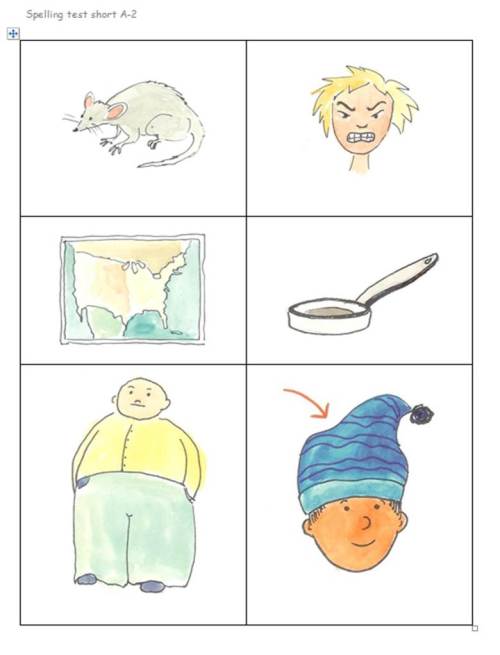
Years ago, I would cut  pictures of CVC words from various sources, paste them on index cards, sort them by vowel sound.  Then I would use them as spelling tests for beginning readers. (Now Mrs. A draws the pictures, including those below.)  This low-tech approach still works great with beginning readers and spellers.

Six drawings of short A CVC words

These drawings are samples of a packet of 12 pages of CVC drawings that can be downloaded for a small fee.  Click on the pictures for more information.  

Why use pictures for the spelling test instead of just dictating the words?

  • When the child is in charge of the pile of pictures, she can spell at her own pace, jotting down words she knows quickly and slowing down for words she is unsure of or for words she writes incorrectly and needs to repair.
  • Young children are people in motion, so the more parts of their bodies they can use to learn, the better. Taking off the rubber band, shuffling the cards, flipping them into a second pile as they are used and rubber-banding them again are fun.  Making learning fun is so important for children of any age, but especially for preschoolers.
  • Some children delight in erasing and will write a word incorrectly just so they can erase it. Spelling is a new experience for them, but it can take time, time when a tutor or mother might grow impatient. But since the child is working independently, the process can take as long as the child wants.
  • While the child is working independently, I can observe where she might need more help or prepare the next lesson, a better use of my time than dictating.
  • ESL students who might be shy about moving at a slow pace gain privacy by controlling the time it takes to complete the test.

One time I gave a preK student a short A test which he finished with pride—his first spelling test! When he found out I had more cards—more tests—he begged me to let him take the cards home and use them for the next week.  His mother later told me that  he took the spelling tests every day. What an eager learner!

Do after-school tutoring centers really improve a child’s reading?

Yes, after-school tutoring centers can improve the reading abilities of many children.

According to 2009 research by the University of Illinois, tutoring centers which do the following have the best chances of helping a student to improve reading skills:

• The center uses trained tutors (experienced teachers but also tutors whom the center trains).

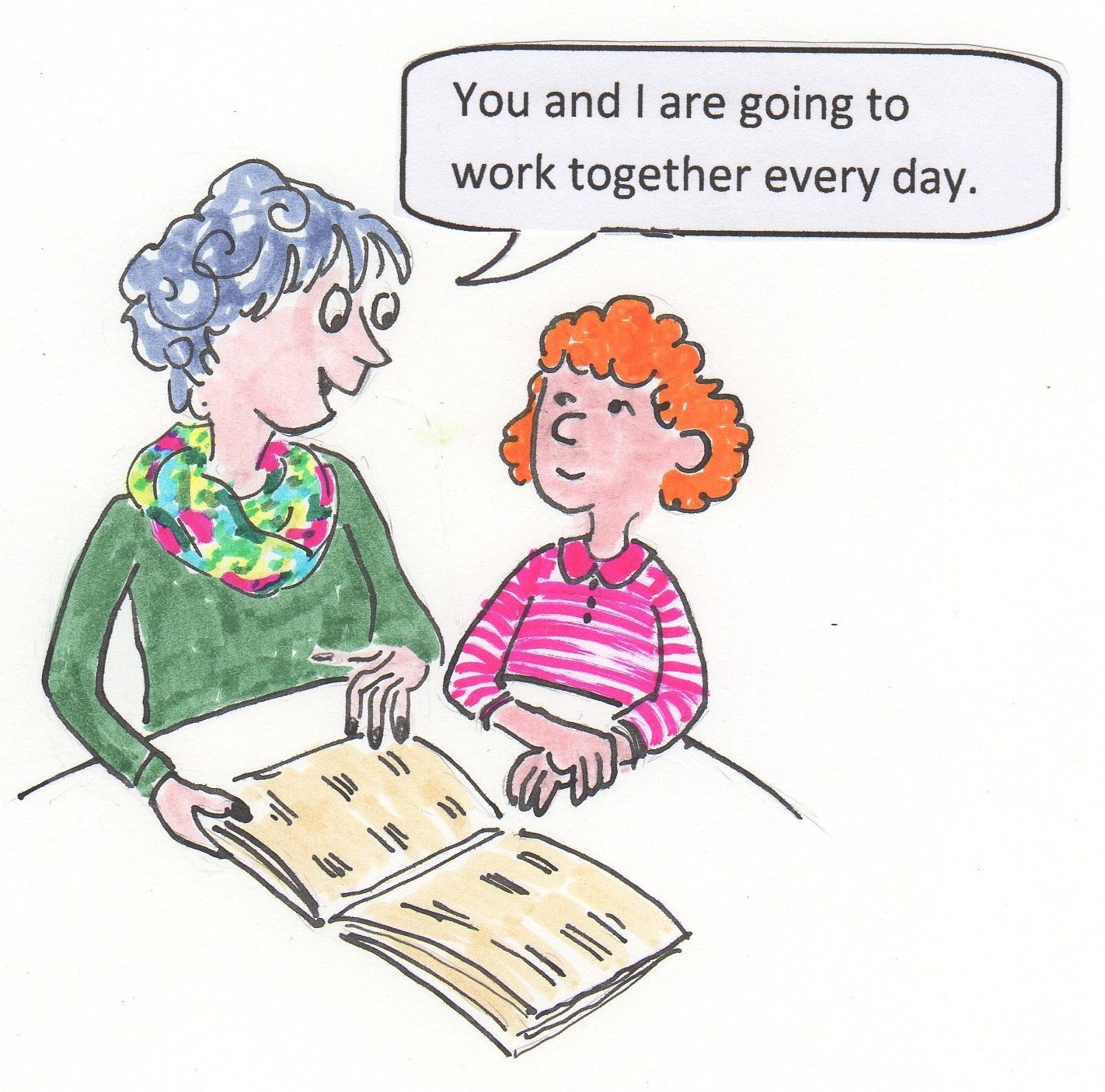
Adult holding a book open for the child next to her and saying, "You and I are going to work together every day."

• The center tests the student to identify his reading strengths and weaknesses and then prepares a plan to address the weaknesses.

• The center continues to assess the student from time to time—with formal tests and with informal tutor appraisals—to show progress or a need for more work on certain concepts.

• The center’s tutors are in touch with the students’ classroom teachers so that they can work together to help students.

• The center’s reading program follows a sequenced strategy.

A 2001 US Department of Education report on tutoring centers agrees on these good practices suggested by the University of Illinois, but adds these others:

• The center offers intensive, on-going training for teachers.

• The center works with the child regularly (daily or at a minimum of once a week for up to an hour of instruction).

• The center offers individual strategies to meet the needs of the 17 to 20% of students not helped by the center’s usual approach to teaching reading.

Whether a tutoring center can improve the reading skills of a particular child depends on the needs of that child. If a child is doing average-to-well in school or is a good ESL student, the after-school program probably can strengthen his skills. If the child has serious reading problems, such as dyslexia, the tutoring center might be willing to develop an individualized instruction plan. But not all centers are able to do this.

My advice is to identify your child’s needs with the help of his classroom teacher and then interview various tutoring centers to find one which will meet his needs or, if none seem right, look for a private tutor who specializes in teaching reading.

For more information on these research reports, go to
http://www.cprd.illinois.edu/files/ResearchBrief_Tutoring_2009.pdf and http://www.cns.gov/areads/about/evtutoringworks.pdf.

How do I read to my two-year-old? Is he even ready?

Some one-year-olds are ready to be read to, and some two-year-olds are not yet ready. But most are. Reading to a two-year-old can be fun and educational for the child, and subconsciously, prepare the child for more sophisticated reading.

Two-year-olds are all about physical motion, so reading to them should include movement. You could start with board books, and ask the child to tell you what he sees. He might say, “Baby.” Probe a bit. “What is the baby doing? Show me.” Even if he can’t put into words the baby’s actions, he might be able to act them out.  Helen Oxenbury’s books are great for children who cannot speak yet.

baby reading a bookHis physical needs might include holding the book and turning the pages. He will learn to turn pages correctly if you help him. But he will want to go back and forth. He might see a dog on page eight and remember seeing the dog on an earlier page, and he might flip the pages to find the dog. Don’t expect formal sequencing of pages with a two-year-old.

Some books for young children have textured parts for the child to touch. Others have flaps that open and close, or they offer pop-up parts that unfold. Little children love these books, but roddlers tend to rip the pages. Beware. They love to move things in a trial-or-error way to see what happens. Yet their touch is usually not delicate.

You might start reading a picture book and the child might interrupt, pointing to a picture and talking about it. He might not care for the story yet, but he might be fascinated by the pictures. Don’t think that just because there are words you must read them. Let the child guide you.  If he doesn’t want you to read, look for some wordless books or just discuss the pictures.  Most wordless books are intended for toddlers.  They are also great for older ESL students new to English.

Two-year-olds are acquiring language rapidly. If you point to a picture and say “bug” or “triangle,” the child might remember the new word. Two-year-olds are also picking up grammar, so be sure you use grammar correctly, even if the child doesn’t. You don’t need to correct him most of the time.  By hearing you say grammar correctly, he will eventually say sentences correctly.

I remember my preschoolers choosing the same books over and over. I was bored reading them repeatedly, but they weren’t. Children find it comforting to hear, day after day, how the little bird found its mother or how Sylvester returned to his family.

father reading Old McDonald to childNursery rhymes are great for the littlest readers.  Some, like “The Itsy, Bitsy Spider” and “This Little Piggy,” encourage finger or toe play. You can tell the child enjoys nursery rhymes when he starts doing the finger play himself.  Plus, children love rhymes, anticipate them, and race to complete the rhyme.  Rhymes teach children about word families (spout, out; rain, again), too.

You might use reading to a toddler to establish routines, such as what you and your child do before or after a nap.

If there are older children, you might want to read to them at a different time, since a two-year-old’s abilities are quite different from a four- or five-year-old’s.  On the other hand, a patient toddler might pick up reading skills and vocabulary by listening to his older sibling read with you.

So should you read to a two-year-old? Definitely, but keep in mind the abilities of a child that age.