Category Archives: early childhood education

Should my kindergarten son read aloud to me? How about my third grade daughter?

Reading aloud to a parent or teacher has two purposes:  to show that the child can decode words properly and to show that the child can read with fluency.  If the child is learning English as a second language, showing proper pronunciation is also a purpose.
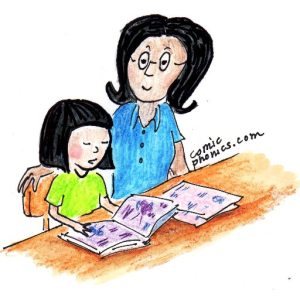
child with adult helping to read

First decoding.  Probably your kindergarten son is at the decoding stage, that is, learning how to link language sounds with letters to form words.  If he is at this stage, then yes, he should read aloud.  That way you can tell what he knows, what he needs more practice on, and what he needs instruction on.

If you know from previous reading aloud that your third grader has mastered decoding, then your daughter needn’t read aloud for that purpose.  You might sit next to her as she reads.  If she has questions about pronouncing an unfamiliar word or if she asks about the meaning of a new word, you can help.  Occasionally you might ask her to tell you what she has read to be sure she has understood.

If your older child comes to English from a second language, she might be able to pronounce words perfectly yet have no idea what they mean.  If so, ask her to underline words she doesn’t know so you can talk about them.  If there are context clues, you might help her identify them.  With such a child, you should work on vocabulary development.

As for fluency (reading at a normal speed with voice inflection, pauses for punctuation and emotion in the voice) the kindergartener and ESL child should read aloud.  Some readers who are at the decoding stage spend so much energy on decoding that they miss the meaning.  By listening to how you say a line and then mimicking the way you say it, the child can pull together decoding and fluency.

Your third grader should be able to read fluently within her head.  However, if you notice that your child has trouble with comprehension even though she can decode well, then her reading aloud could help you to figure out why.  Is she ignoring punctuation and lumping parts of one sentence with another?  Is she sliding over longer words without decoding them because she is lazy or in a hurry?  Does she have short term memory problems, allowing her to forget the beginning of a sentence or paragraph before she gets to the end?  Is her emotional voice flat?  Is she missing inferences?  Some of this you can tell by listening to her read aloud, and some by asking her about what she has read.

In general, newer readers should read aloud with instruction and monitoring while experienced readers should read silently.
What kind of books do you read to your kids?

When my kids were little, I selected their reading materials from the picture book section of my library and book store.  In retrospect, I was limiting my children’s literature to fairy tales, Dr. Seuss and fiction of all kinds.

Yet children need exposure to nonfiction as well:  how to books, how things work books, information about animals and the natural world we live in, biographies, history, books with maps and tables, books about dinosaurs, even current events news.

Take a quick survey of the books you have read to your preschooler in the past week.  Were any of them nonfiction?

Expand your child’s horizons starting today.  Find the nonfiction section of the children’s section of your library and see what’s there that might interest your child.

  • Does he like dinosaurs? Lots of books explore the lives of these amazing creatures.  Or does he have a pet?  Books on dogs, cats, birds and almost every other animal abound.
  • Is your daughter into fashion? Find books about how clothes have changed over the centuries.  Find a biography of Coco Channel.  Look for a magazine with Downton Abbey or Academy Award dresses.
  • Is your child into building? You can find books and magazines on how to build a soap box, a tree house or a house of cards.  Or you can learn how a spider builds a web, how a bird builds a nest or how a beaver dams a stream to build a house with an underwater doorway.
  • Do you travel with your child? Magazines highlight fascinating places around the world.  Even if your child can’t read, together you can compare your home with the ones pictured.  Or together you can wonder what it would be like to take a gondola ride or to walk on the Great Wall of China.  Maybe you could plan a vacation.
  • Did Grandpa serve in the Army? Let Grandpa read to your child about the locations where he served or about the military uniforms he wore.  Did Grandpa fly a jet?  Find books about military aircraft.
  • Cooking books are great how-to books. With your child, find a picture of something you would like to eat and cook it together.
  • How about the handbook for your car? Or you phone?  Your child and you can look over the pictures and identify parts and what they do, picking up vocabulary.
  • Look for books with maps, charts, tables, pictographs, photos and other non-textual ways of presenting information.  Help your child to understand what those graphics mean.

Reading nonfiction is harder than reading fiction, yet students must be adept at both kinds of literature under the Common Core State Standards.  Start now preparing your child for his future by exploring nonfiction together.

Numbers, numbers

2-3      Between 2 and 3 years old, toddlers learn a new word every day.

3rd      Third grade is long past the time to intervene for a struggling reader.

3-4      3 to 4 letters/spaces to the left and 14-15 letters/spaces to the right of where we fix our eyes is where we pick up meaning from what we read .

4          There are 4 ways to pronounce the letter A using standard American English.

4-5      Children should be speaking in complete sentences by 4 or 5 years old.

6-12    Between 6 and 12 months old, infants should start babbling.

10-15   A typical student needs to interact with a word 10 to 15 times in order to learn it.

12-18   Children usually say their first words between 12 to 18 months, but not always.

18-24   Children usually say their first tiny sentences between 18 and 24 months.

20        If a child can count to 20, that is a sign he might be ready for kindergarten.

20-30 Kindergarten children should read or be read to 20 to 30 minutes daily.

24th    US students scored 24th out of 65 countries taking the latest Program for International Assessment tests.

30       First graders should read or be read to 30 minutes daily.

42-44 The number of letter sounds in standard American English is 42 to 44, depending where you live.

220     There are 220 Dolch words, better known as sight words.

300    Children from professional families hear 300 more spoken English words in an hour than children of parents on welfare.

1,000 Parents should read to their children 1,000 books before kindergarten, according to the 1,000 Books Foundation.

2,000 A student learns about 2,000 new words a year.

88,500 An incoming high school freshman should know 88,500 word families.

2,250,000 A student reading an hour a day will read 2.25 million words in a year.

32,000,000 Children from professional families hear about 32 million more words—including repeated words—than children from poorly educated families.

Should kids leave kindergarten knowing how to read?

Yes, kids should finish kindergarten knowing how to read, according to a survey of kindergarten teachers. Eighty percent of teachers said yes in 2012, up from 31 percent in 1998.

boy reading

This change in thinking about kindergarteners’ reading achievement was discovered through research by the University of Virginia. The researchers looked at surveys of 2500 kindergarten teachers in 1998 and compared them with surveys of 2700 kindergarten teachers taken about five years ago.

Expectations of kindergarteners today are more like expectations of first graders in the recent past. According to the teachers, students should enter kindergarten knowing the alphabet and they should leave kindergarten knowing how to read.

Why the change? Credit (or blame) the 2001 No Child Left Behind law which required third graders to be tested in English language skills.  To raise third graders’ achievement levels, teachers needed to find more time to teach the basics.  That time was found in kindergarten.

This pressure to learn academic skills at younger and younger ages has come at a price, according to the researchers. The amount of time kindergarteners spend in art, music, play and child-selected activities has decreased.

Is this change good or bad for children? We will need to wait for future research to answer that question.

For a struggling reader, intervene as early as possible, says new research

child with adult helping to readIf you notice a child is having trouble reading, intervene as soon as possible, even in preschool.

So conclude researchers who looked at the reading achievement of students for twelve years.  The researchers concluded that struggling readers should receive help as early as possible.

Their research shows that struggling readers are obvious to teachers in first grade (the earliest grade included in the research).  Without help, these kids will not improve over time.

In short, there is no advantage in waiting to intervene.  Start now.

Many children do not receive help until third grade–too late, according to the researchers.  This might be because many states have passed laws saying that all children should be reading by third grade.

Participants in the study were 414 people in the Connecticut Longitudinal Study who were assessed annually every year in elementary, middle and high school.

For more information, read “Achievement Gap in Reading Is Present as Early as First Grade and Persists through Adolescence” in the November 2015 issue of The Journal of Pediatrics.

My child is almost four. She wants to learn to read. Where do I begin? Or does it matter?

It matters, according to research. You should start with teaching her “the code,” that is, the connection between the sounds of the English language and the letter symbols we use to mean those sounds. Here’s how. (Look for more information on all these ideas in previously published blogs at comicphonics.com.)

  • children moving letter tilesFirst, make sure she can pronounce all 42 sounds of English. Listen to how she pronounces everyday words and make sure she is saying the sounds correctly. Help her with pronunciation.
  • Then connect sounds with letter symbols, a few at a time. Start with the beginning sounds of a few key words such as the child’s name, m for mom, d for dad, b for baby. Help her to hear those sounds in the beginnings of other words. For example, if you are pouring her milk, ask her what sound milk begins with. Then show her an “m” and explain that is how we show that sound.
  • Beginning sounds are always the easiest to hear, so focus on them.
  • Help her to write the initial of her name and a few other meaningful letters.
  • child on floor reading picture bookSince each vowel has many sounds, teach her to associate each vowel with a word and an image that begins with a “short” vowel sound such as apple, egg, igloo, octopus and umbrella. Later, she can compare the vowel sounds in new words to those vowel sounds.
  • In speaking, start putting letter sounds together to form one-syllable short-vowel (CVC) words she knows, like “cat” and “dog.” When she can hear how words are formed (phonics) by combining sounds, use letter tiles to show her what the combining of sounds in words looks like using letter symbols.
  • When you are reading stories to her, point out words she might be able to decipher, and help her to sound them out.
  • When she knows most of her sound – letter matches, she is ready to start reading books which use one-syllable, short-vowel words. Unfortunately, few good ones exist. We at comicphonics.com have written five humorous books for new readers. (See the links to the right of this blog.) Your librarian can point out where other books are shelved, but many labeled “first” readers contain difficult words. Margaret Hillert has written some good beginning books, and so has Dr. Seuss. Good illustrations can help the child figure out the meanings of difficult words, but she will probably need your help as she begins.

Figuring out the code of written English is how a child begins to learn to read. There are lots of commercial methods to do this, but the best I have found is the Explode the Code series. Children find its combination of goofy pictures and sequenced phonics instruction fun.

Later you can focus on other aspects of reading including fluency and comprehension. But the place to begin is demystifying the code by connecting the sounds of our speech to individual letters and pairs of letters, and then combining them to form words.

My kindergartener wants to read chapter books. What features should I be looking for so she doesn’t get discouraged?

Congratulations! Some early readers are ready for chapter books, but that doesn’t mean all chapter books are right for them. Here’s what you should be looking for.

  • Characters whom the child relates to and cares about are really important. That means child characters, ones the same age or just a bit older than the reader, or characters who behave in child-like ways, such as Toad in the Frog and Toad series. The characters in books for young readers must be encountering situations that the reader can relate to—like Junie B. Jones fearing to take the school bus, or of Nate the Great visiting his friends’ houses in search of a lost cat.
  • girl reading Junie B. JonesCharacters should be different from one another—their names, gender, and personalities. Junie B.’s friend, Lucille, is prissy and wears pretty dresses while her classmate, May, is a tattletale. Frog’s friend, Toad is a short, brown scared follower while Frog is a taller, green, organized leader.
  • If the chapter book is part of a series, familiar characters or activities should appear. Children delight in recognizing these patterns. They know that when reading Nate the Great stories, for example, Nate always takes a break to eat pancakes. His friend, Rosamond, always appears with her four black cats. Nate’s dog, Sludge, helps him solve crimes, while another dog, Fang, always makes an appearance.
  • Asian girl reading book Plots should be straightforward with no flashbacks or complicated subplots. If the story concerns finding one of Rosamond’s cats, then that becomes the whole focus of the story. Good books remind children what they have learned. A character like Nate might think about the clues he’s uncovered, and a list of them might appear as an illustration. The plots are shallow and move quickly through a series of events.
  • Good chapter books for young readers should contain illustrations. A page of text will appear harder to read than a page with a line drawing on it. The drawings should provide additional information that the text might not dwell on. For example, drawings of Junie B. show her with fly-away hair and one sock up, one sock down, telling us in pictures about her personality. Illustrations don’t need to appear on every page, but more illustrations make the book appear easier to read.  Also, illustrations lengthen the number of pages, so the child thinks she is reading more than she actually is.
  • girl looking at book displayPicture books are printed with large type, but chapter books have reduced size type. To offset this change, good chapter books for young readers will increase the space between the lines of type and increase white space by making margins larger. This makes the text easier to read and the page “friendlier.” Good children’s books use dialog too. Dialog is usually short, so more white space surrounds it. Hyphenations will not be used at the ends of lines to split words, and sentences will end on the bottom of a page rather than being carried forward to the next page.
  • Discouraged child thinks there are too many words in a book she is readingThe vocabulary of chapter books for young readers should be easy enough to read so that the child can read for enjoyment, without help. New words can be introduced, but in context, and should be repeated during the story so the child can master them.
  • Sentence structure should be normal, that is, subjects followed by predicates. When complex sentences are used, the dependent clause should come second. That is the way children speak and write, so that pattern will be easy to understand. Sentences should be shorter than adults would expect. Not all sentences need to be short, but longer sentences should make sense on the first read through.

Right now I am working with a second grader who is reading his first chapter book, Charlotte’s Web. It was assigned by his teacher. Some of the characters’ names are similar (Avery, and Mr. Arable, for example). The vocabulary is advanced. The pig is called “radiant”; he is put into a “crate”; he is watched by “goslings.” For a suburban child, these words are mysterious. The sentence structure is too sophisticated. Even though Charlotte’s Web is an excellent novel, it is not an appropriate first chapter book for my student. He is not ready to read it without help.

In my public library, chapter books for elementary school aged students are grouped together. Within those books, some are labeled on the spine, “First chap.” Those books are perfect for children reading their first chapter books. Or if you are lucky enough to have a children’s librarian, ask her what books she would suggest. Or phone or visit your school librarian and ask her for help.

Hundreds of wonderful books are appropriate for your kindergartener. Good luck!

Case study: Julie, a seven-year-old, high-achieving reader

Julie had just turned four when I began to tutor her in reading. Her mother, a native of China, had been taking Julie to a tutoring agency since she was barely three. The mother worked with her daughter daily on the reading lessons which Julie brought home.

Child looking at flash cards of two and three letter words.

.

When I met Julie, she could read many one-syllable words and some two syllable words. However, I noticed that when confronted with a new word, she could not figure it out. She had memorized the look of the words she knew but she had not learned phonics skills to sound out new words.

We began by reviewing ABC names and consonant sounds, almost all of which Julie knew. Then we spent many lessons on vowel sounds, focusing on short vowels first, and later mixing both short and long vowel sounds. We did this using pictures (pig, hat, run) which Julie would match with cards labeled ā ē ī ō ū and ă ĕ ĭ ŏ ŭ. We would spend about ten minutes of a lesson on this kind of work. Julie’s attention span was about ten to twelve minutes, so this was one of several activities in a single, hour-long lesson.

Tutor teaching a child.

When she mastered the vowel sounds using pictures, we worked on forming three-letter words using short vowels. At first I moved letter tiles around to form words, and with time, Julie made her own combinations and tested me to see if I knew what words she had formed.

Next, I added blends to short vowel words, first at the beginnings of words, and later at the ends of words. She found the beginning blends easier than the ending blends, as most children do. I made index cards with blend words on them, and when Julie would read a word on a card correctly, she would use a date stamp to mark the card—a way to make the learning fun. After a few weeks she mastered the blend words.

Late in our first year together, Julie began work on long vowel words ending with a silent “e.” She knew many of them by sight but not by sounding a word out. As our first year ended, we were working on long vowel single syllable words with double vowels such as “beat,” “fuel” and “rain.”

We were also building words using roots, prefixes and suffixes whose parts were written on little cards which Julie would push together to form words such as re-mix-ing and un-read-able. In the months which followed, when she encountered a long, unfamiliar word, she sometimes covered the prefix or suffix to figure out the middle part, and then constructed the word bit by bit as I had demonstrated.

Young girl reading a book

Julie could read many picture books. She enjoyed short paragraphs with colorful pictures on each page, but she would not try a chapter book. “Too many words,” she would say. She continued to go to the tutoring agency and do the reading homework with her mother, and to work with me once a week. When Julie was five, we began adding spelling and sentence writing to her lessons.

Julie is 7 now and has finished first grade. She is in the gifted program at her school. She reads voraciously, everything from Ranger Rick magazines to hundred-page chapter books. She has exhausted the phonics-like reading materials I have. She can read fourth or fifth grade materials as fluently as I can. She is working on expanding her vocabulary and on using more details in writing.

Julie is an example of the progress a child can make with a tutor or tutoring center augmenting school instruction. She is also an example of what studying during school breaks can do. She goes to school year round—nine months in her public school, and 12 months with tutors and her mother. Julie has a mother committed to Julie’s education, a mother who scours the library for appropriate books for Julie, subscribes to Ranger Rick, and oversees Julie’s homework and her piano practicing. She also teaches Julie how to write using Chinese pictographs.

For Julie, education is a way of life.

Julie—mischievous, hardworking and accomplished—could be your child’s classmate.

My grandson is scheduled to start kindergarten this fall, but I think he might not be ready. Is there any way to know for sure?

The old rule of thumb is that if a child can put his hand across the top of his head and touch his opposite ear, he is the right age to start school. If he can’t reach his ear yet, he is too young.

young child attempting to touch his ear with opposite hand

But such a test doesn’t begin to take into account all the criteria which could be used to judge the readiness of a child for school.

If your child has been to preschool, his pre-K teacher should be consulted. She has a good idea which students are ready to move on. And if you do send your child to kindergarten, and the kindergarten teacher contacts you in the early weeks of the school year saying your child is not ready, believe her. Not every child who is the right age is ready for kindergarten.

What criteria should you use to assess your child? According to the U.S. Department of Education’s National Center for Education Statistics, these criteria should be assessed:

  • Can your child communicate his wants and needs? Can he say, for example, that he needs to urinate or that another student is bothering him?
  • Can your child get along with peers by sharing and taking turns?
  •  Can your child count to 20?
  • Does your child recognize letters and numbers? Kindergartener are not expected to know how to read—although many can. But your child should recognize many letters and numbers and have an inkling of what they are used for.
  • Can your child follow directions? Sit or stand, line up, voices off, criss cross apple sauce—these are common directions that your child will be expected to follow.
  • Can your child sit still for ten, fifteen or twenty minutes, and pay attention to a teacher during that time? Kindergarteners have short attention spans, but they should be able to sit still long enough to listen to a teacher read a story or to watch a film about a baby whale. Not every five-year-old can do that.
  • Is your child able to hold a pencil or paint brush? Is he able to cut with a scissors? Most kindergarteners need more work on these skills as well as on gross motor skills, but they should show rudimentary skill.
child cutting with a scissors

EPSON MFP image

Kindergarten teachers who responded to the Fast Response Survey System (FRSS) Kindergarten Teacher Survey on Student Readiness said being able to communicate needs and wants and being curious and enthusiastic about trying new activities are the two most important skills kindergarteners need to start school with.

Some other things to look for include:

  • Can your child handle emotions? It’s normal for a five year old to break down in tears when she’s upset. But, it’s important that she has coping strategies.
  • Can your child use the toilet unassisted? And can he or she be trusted to behave in a restroom without adult supervision?
  • Is your child obviously meek and likely to be picked on? If so, he might need some coping skills to keep bullies at bay.

Although the first two or three years might be hard for young kindergarteners, research shows that they show no academic difference from their classmates by third grade.

If your child is in sports, another consideration is the cut-off birthday. Baseball in my state has a cut-off date of July 31, meaning any child born on August 1 or later cannot participate on the same teams as children born in July. For August-born children sent to kindergarten on schedule, this means they will play on teams with kids a year behind them in school. Their teammates might be strangers rather than classmates.

Still another consideration is driving. If a student is one of the youngest children in his class, his classmates will get their driving permits up to a year before he does. Your child might feel left out, or he might pressure you to let him drive as a passenger with his older friends. Will you be comfortable with that?

And will you be comfortable with your 17-year-old heading off for college with classmates who are already 18 and 19?

Good luck on your decision. There’s so much to consider.

How to use spelling tests to reinforce CVC words

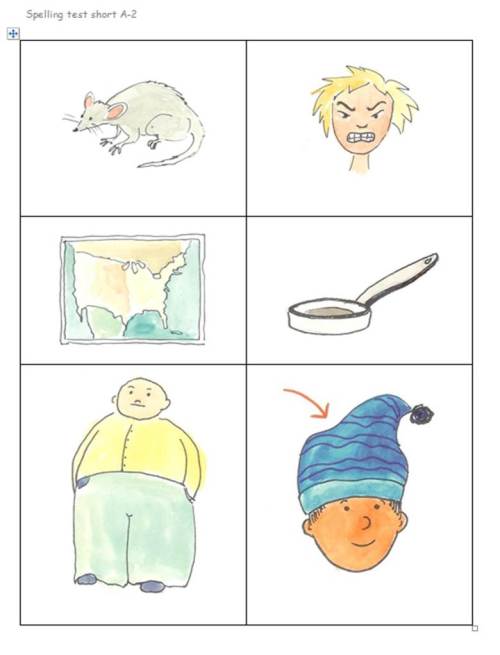
Years ago, I would cut  pictures of CVC words from various sources, paste them on index cards, sort them by vowel sound.  Then I would use them as spelling tests for beginning readers. (Now Mrs. A draws the pictures, including those below.)  This low-tech approach still works great with beginning readers and spellers.

Six drawings of short A CVC words

These drawings are samples of a packet of 12 pages of CVC drawings that can be downloaded for a small fee.  Click on the pictures for more information.  

Why use pictures for the spelling test instead of just dictating the words?

  • When the child is in charge of the pile of pictures, she can spell at her own pace, jotting down words she knows quickly and slowing down for words she is unsure of or for words she writes incorrectly and needs to repair.
  • Young children are people in motion, so the more parts of their bodies they can use to learn, the better. Taking off the rubber band, shuffling the cards, flipping them into a second pile as they are used and rubber-banding them again are fun.  Making learning fun is so important for children of any age, but especially for preschoolers.
  • Some children delight in erasing and will write a word incorrectly just so they can erase it. Spelling is a new experience for them, but it can take time, time when a tutor or mother might grow impatient. But since the child is working independently, the process can take as long as the child wants.
  • While the child is working independently, I can observe where she might need more help or prepare the next lesson, a better use of my time than dictating.
  • ESL students who might be shy about moving at a slow pace gain privacy by controlling the time it takes to complete the test.

One time I gave a preK student a short A test which he finished with pride—his first spelling test! When he found out I had more cards—more tests—he begged me to let him take the cards home and use them for the next week.  His mother later told me that  he took the spelling tests every day. What an eager learner!