
I write quizzes about books to help my students understand books better. Coming up with thought-provoking questions is a struggle. Too often I want to ask for a single fact, such as “Who is Peter’s little brother.” To help me devise more meaningful questions, I keep a list of question types. Here are questions you might use with your students.

What is the best summary of the book/chapter? I provide four options, keeping in mind that some students have trouble distinguishing between main ideas and details.
What is the best paraphrasing of a sentence or paragraph? I provide options which range from mostly restating information to truly putting the information into other words.
Why does the author ____? Repeat a word? Describe the weather so much? Not talk about negative feelings? Use a simile? These kinds of questions ask the student to consider the author’s style and the choices the author makes in writing a particular way.

How is this book/chapter structured? In chronological order? From most important to least important information? Stating a cause and its effects? Stating effects leading to a cause? From scary to scarier to scariest? Stating a conversation that becomes funnier and funnier? Many students read without realizing someone wrote what they read, and that someone made choices.
Does the writer like or approve of ____? We know right from the beginning that J.K. Rowling does not approve of Malfoy in the Harry Potter series. But how do we know that? What words tell us that? What actions? What facial expressions?
In what order do actions occur? List two or three actions, and ask what the next action is. Sequencing questions might force students to reread sections or to read more carefully the first time.
What is the tone of a chapter or conversation? What is the mood? I usually define tone and mood in the question to help the student.
What might a certain action foreshadow? A child falls while jumping rope. What might that fall foreshadow? Probably another, more serious fall.
What is an important fact in a chapter? Many children cannot distinguish between trivial facts and important facts. All facts seem important. Questions like this force students to rank facts.
What can you infer from the frown on a character’s face? Or from a character’s silence? Or from a character’s cowering?
From the picture book stage to the chapter book stage, these questions can be used to help a student grasp a deeper understanding of a book and the choices its author made to create it.


 Parents and teachers can help poor readers develop the skills of good readers by asking questions about the reading passage before students begin to read.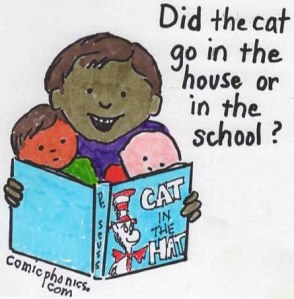

 of little children. Children do not need to be taught these words; they learn them from interacting with their caretakers and other children. In kindergarten, some of these words are called sight words. Usually these words do not have multiple meanings. Such words include “no,” “dad” and “dog.”
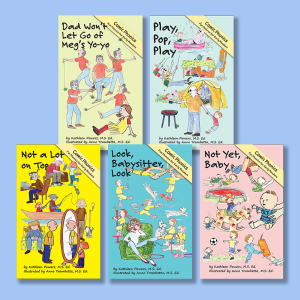


 comicphonics for early readers