Tag Archives: how to encourage more reading

What’s a graphic novel?

One of the biggest trends in children’s literature in the past ten years is the rise of graphic novels.  Not sure what I mean?  Think Captain Underpants and The Wimpy Kid.  Graphic novels are
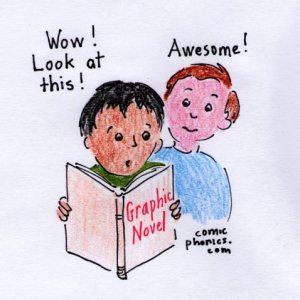
  • Two boys reading a book entitled "Graphic Novel."comic-strip-like stories with a beginning, middle and end (not a continuing saga).
  • fiction and nonfiction stories told as much in colorful drawings as in words.
  • a hybrid form of action literature that appeals to 12 to 18-year-olds but now is working its way to much younger readers.
  • a newly recognized form of literature by the Young Adult Library Services Association, part of the American Library Association, which has been selecting the best graphic novels for teens since 2007.
  • a form of children’s literature reviewed in respected journals such as School Library Journal.
Graphic novels, like all novels, cover many themes such as romance, sci-fi, fantasy, super heroes, and modern warfare.  Not all graphic novels are novels.  Recent nonfiction titles include Pride and Prejudice, a biography of Thomas Jefferson, Poseidon, landing on the moon and the great apes of Africa.

When graphic novels started appearing, said Mary Tyner, a media specialist from Peachtree Elementary School in Peachtree Corners, Georgia, they were inferior literature and she did not buy them for her school library.  But as they improved and as they were reviewed by respected journals, she began buying, and now she can’t keep the 153 titles on her library’s shelves.

“They are an extremely motivating literature that encourages children to read,” Tyner said.  Over time, she has seen the reading level of graphic novels press downward, but there are few for beginning readers, perhaps because it is hard to have a meaningful story line in beginning reading books, said Tyner.

Another advantage of graphic novels is that they teach synthesizing skills, said Deb Schiano, media specialist at Loundsberry Hollow Middle School in Vernon, New Jersey.  “In our society children must be aware how to read images,” said Schiano, and how to combine the images with words to form meaning.  She compares graphic novels to storyboards from which the student can pick up story arcs by reading the drawings.  Combining the pictures with the words creates more complex meaning.

Graphic novels also attract disabled students, said Schiano.  “For the dyslexic student who can’t decipher words, graphic novels are another way to learn.” In her school last year one teacher used them consistently with learning disabled students.

Both media specialists said graphic novels also encourage children to write and illustrate their own stories, sometimes using online sites.

What has all this to do with beginning readers?

  • Young children will see their older siblings reading graphic novels, and will enjoy paging through them to study the drawings.  The joy that that the older child shows might encourage the younger child to want to read.
  • With time, graphic novels will probably reach down into first grade reading levels and attract younger and younger readers.
  • As a child’s reading ability improves, he might want to buy these books or to borrow them from the library.  Parents unfamiliar with this genre might scorn graphic novels as inferior, but it is worth remembering they have advantages over text-only books.  For reluctant readers, or disabled readers, or boys, they can be a way to motivate the child to read.
  • Graphic novels can also be found on iPhones and Android phones.  Expect your young children to be intrigued when they find them online, and eventually, to want to buy them this way.

How many books are enough books for a preschooler?

Preschooler looking at a tall stack of books.1,000 books is a great goal, according to the 1,000 Books Foundation, a nonprofit organization which has enlisted the help of libraries across the US to promote reading. Their effort, “1,000 Books before Kindergarten,” has a simple goal: Children should be read 1,000 books before they start kindergarten.

1,000 books before kindergarten? Yes. They can be all different books or some of the same books read over and over to a child. The reading can begin in utero, or when the child is an infant or toddler, but the counting must stop by the day the child starts kindergarten. Parents are encouraged to write down the name of every book and the date it was read (Log sheets are available at 1000 books).  Writing down the names promotes accountability, and the growing list encourages persistence.

1,000 books might sound daunting, but if a parent reads one book a day for three years, that is more than 1,000 books. Many parents read more than one book a day, making the feat even easier. And if a parent reads a book to two or three children at a time, that counts as a book for each of them.

Some libraries provide their patrons with a journal in which they can list the titles. Some libraries offer stickers to children for meeting benchmark goals. Some local newspapers publish the picture of all children who reach 1,000 books.

Have you participated? Were you able to reach 1,000 books? Let our readers know. –Mrs. K

Of course there are some parents who may be turned off by the idea of listing the title of every book read every day. I know that would become tedious for me. It reminds me of diets where you list every food eaten every day. After a few weeks, most of us cannot maintain the daily log. But how about just a check mark or a number on the calendar…adding up the total at the end of the month and then adding on as the year continues. –Mrs. A

My child is a reluctant reader. How can I encourage him?

First, commit to working with your child every day for many months or even years.  He will not become an eager reader without your help, or the help of a dedicated tutor who works with him several times a week.

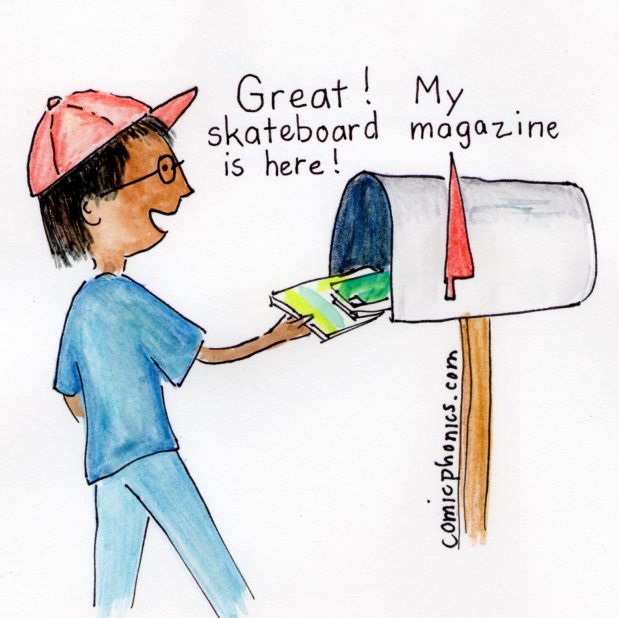
Boy at mailbox discovering skateboard magazineNext, find reading material that your child enjoys.  Boys—and most reluctant readers are boys—prefer nonfiction—how an engine works, for example, or how to build a bird house, or sports stories.  Nonfiction offers certain pluses:  illustrations (photos, charts, and diagrams), subheadings, a separate introduction, and maybe a summary.  Tempt your child with a skateboard magazine or a comic book or graphic novels.  Find online sites too.  Then:

  • Build on past success.  Ask your child to reread material he has mastered, but which he couldn’t read a short time ago.  Remind him of his gains.
  • Introduce new reading material which you suspect your child can read with 90% success.  Increase the difficulty level in tiny, tiny increments so the child has a growing feeling of success, not failure.
  • If a child stumbles through a sentence, focusing on individual words and not on the sentence, repeat the sentence for him with fluency, so he knows what the sentence means.
  • Stop the child after a passage and ask what it means.  Don’t let him move on until he knows the meaning of what he has already read.
  • Take turns reading.  You read one page; he reads one page.  Or for older students, you read one paragraph; he reads one paragraph.
  • Let him read to you without distractions.  No TV calling from another room.  No cell phone in your hand, or tablet in your lap.  No brother on a video game in another room.  Give him your undivided attention.
  • Read to your child—maybe at bedtime?—without any expectation that he will join in.  Let him enjoy reading as pure entertainment.
  • If he has only one reading strategy—such as guessing at a word—model other strategies.
  • Cover part of the word to show a part he can read.  Reveal more of the word.
  • Point out prefixes and suffixes, and cover them so the child can see the basic word unit.
  • Ask him to read a sentence leaving out a difficult word.  Together discuss what that word might mean.
  • Ask him if a word looks like any other word he knows.  Talk about word families or rhyming words which often sound the same.
  • If the child’s attention span is short, have more reading sessions but limit their time, and use a timer so the child can monitor how long the reading session will go on.
  • Praise his efforts.  Point out successes like
    • Knowing a word he missed in the past.
    • Sounding out a word.
    • Pronouncing a word using correct syllable breaks.
    • Putting inflection into his reading.
  • Talk to your child’s teacher.  She might know appropriate reading materials to recommend.  She can keep you abreast of reading skills the class is working on so you can work on them at home.  She will carefully watch your child for reading problems or successes if she knows you are working with him too.

My son was a reluctant reader, way behind at the end of first grade.  I consulted an expert and followed his advice.  I worked with my son for at least a half hour every day over summer vacation, asking him to read lists of words (for phonics) and easy reading books (for comprehension).  He hated it.  Every session was a struggle.  Yet he started second grade reading on grade level and was an eager reader after that.  By sixth grade he was devouring a chapter book a week, anticipating the publication dates of books in series he enjoyed.

The sooner you can intervene with a reluctant reader, the more likely you are of success.  Analyze your kindergartener’s or first grader’s reading habits.  If he is a reluctant reader, commit yourself to working with him now, before he becomes discouraged or evasive.  –Mrs. K

What is a Lexile score? My daughter’s Iowa test showed a Lexile score.

A Lexile score is a number used to measure a student’s reading achievement.  Several kinds of tests can be analyzed to determine this score.  The Iowa test is one of them.

Chart of typical grade level scoresA Lexile score is not the same as a grade level score in reading.  The lowest Lexile score—zero L—corresponds to the reading level of a beginning reader.  The highest scores—1600+L—correspond to advanced readers.

These scores can be used to choose appropriate reading materials for a student.  About a half a million books have been analyzed and given a Lexile score.  A student with a score of 800L, for example, would find appropriate reading material in books with a similar score.  At such a match, the student could be expected to comprehend 75% of the reading.  Below is a sampling of Lexile scored books.

List of Lexile scored books.

Find more book lists at: http://goo.gl/hA2X0P

A Lexile score is a scientific measurement of reading based on two factors:  how often words in the test or text are used in English and sentence length.  It is a 21st century readability formula developed by MetaMetrics (www.lexile.com), an organization which “develops scientific measures of student achievement,” according to its website.

Many state departments of education and school districts have licensed Lexile to analyze their tests and to link students with appropriate reading materials.  Several testing organizations such as the Gates-MacGinitie Reading Tests, the Iowa Test, the Sanford and Iowa achievement tests and the Total Reader, an online testing site, are “translating” their reading scores into Lexile scores.  Some online reading sites offer Lexile scores for their reading material.

One shortcoming of the Lexile readability measurement is that, like many readability formulas before it, Lexile measures just a few factors, leaving out many others.  Format and design factors (length of page, length of type line, length of paragraphs, type size and font, size of margins, white space between lines, use of graphics and use of color, for example) are not measured. Neither are the age-appropriateness of the material, the child’s interest in it, or the prior knowledge the child brings to reading.

Even so, Lexile is becoming a widely used method to measure a student’s reading ability and the readability of written materials.

What are high/low books?

High interest / low reading level books are books that appeal to children who are older than the reading level of the book.

High/low books in a way are a mismatch: the reading level is lower than the age of the child to whom the book appeals. A good example is the Fudge series by Judy Blume. The early books are written at a second grade level but appeal to third or fourth grade children because the narrator begins as a fourth grader and grows older in the series.

Too many words on a page make reading hard.These books appeal to children who are struggling to read. The stories are about kids their age doing activities they do. These books are also good for ESL students whose age might not align with their reading level in English, and for disabled children, including those with dyslexia, who are behind their peers in their reading level.

What makes these books different? They share many of these qualities:

  • Shorter, everyday vocabulary words with concrete meanings
  • Short sentences
  • Short paragraphs
  • Large margins
  • Unjustified right margins (margins that look ragged)
  • Larger type size (minimum 11 point) in clear fonts
  • Realistic characters who are the same age as the reader
  • Easily differentiated characters
  • A fast moving plot which is low on description
  • Compelling stories
  • Chronological order (no flashbacks)
  • One point of view, not two
  • Illustrations, photos, graphs and maps
  • Tight, concrete writing

Many lists of these books can be found online.

A long list can be found at http://www.schoolonwheels.org/pdfs/3328/Hi-Lo-Book-List.pdf. This list gives the reading level (RL) and the interest level (IL) plus a one sentence description of the book. All the books on this list are fiction.

Some small house book publishers are known for publishing books for reluctant readers who often happen to be high/low readers. At http://www.nbss.ie/sites/default/files/publications/READ_-_hilow_books.pdf you can find the books of several publishers which are geared to students older than their reading level suggests. These books are mostly appropriate for high schoolers.

At http://www.booktrust.org.uk/books/children/bookmark/booklists/141/ there is a list of 14 books for various age levels written below age level.

http://specialeducation.answers.com/english-and-math/10-high-interest-low-reading-level-books-for-teens-with-reading-difficulties gives information about ten books, some nonfiction, which are written at low reading levels but which would still appeal to kids in their teens.

The largest teachers’ union in Britain has a listing of book publishers and book series appropriate for high/low readers. Go to http://www.teachers.org.uk/node/12418 .

Seven publishers of high/low books are listed at http://www.writing-world.com/children/foster03.shtml. Included are hyperlinks to those publishers. –Mrs. K


Can writing make my child a better reader?

Yes.  The skills are entwined and reinforce one another if taught together.

  • Brain research shows that the more modes of learning which we use, the more apt we are to remember.  Children who are learning how to recognize a letter shape, or to distinguish between two similar letter shapes, will reinforce reading these shapes if they write the letters as well.
  • Children with poor reading skills often have poor handwriting skills. Yet practice at handwriting (drawing letters with their fingers, forming the shape of letters with their bodies, tracing letter strokes and patterns,  or giving directions to another person on how to write a letter) can improve not only writing skills but reading skills.
  • If a young child likes a certain genre, say fairy tales, and attempts to write one (even just a few sentences), she may encounter problems—how to begin, sequencing, spelling, or how to describe the frog’s voice.  The next time she reads a fairy tale, or has one read to her, she will be more aware of the way another author handled the same problems.  Her reading comprehension will develop in more sophisticated ways than if she had not written her own fairy tale.
  • Sounding out letters and then assembling groups of letters into words is one of the first steps of reading.  Many methods from flash cards to letter tiles help children grasp the connection between letters and sounds, but one of the best methods is writing.  The child wonders about the spelling of a word and sounds it out before writing it down, sometimes erasing, until he is satisfied.
  • Kindergarteners might not be ableGirl reading "inventive" writing of younger sister. to read many words, but if they know their letter sounds, they can write any word they can think of using phonetic spelling.  Then they can read their passage back.  With adult help, they can understand that stories, emails and even books are within their grasp both as writers and as readers.
  • The phrase “reading and writing” puts the reading first, but research in the past thirty years has shown that writing comes first for most children.  The old philosophic idea of a child being an empty vessel who needs to be filled up with knowledge (often from reading) has been shown not to be true.  Children are vessels bursting with ideas, longing for an audience to share them with, sometimes through writing.  –Mrs. K

When my son was in kindergarten, phonetic spelling was called inventive writing.  I loved it since I could read his thoughts even in kindergarten.  But many parents didn’t like it.  They claimed that their children would never learn to spell words correctly.  That has been an ongoing criticism which young adults now blame for their not being able to spell well.  However, with spell-check, this is becoming a moot point.  –Mrs. A

Do you know how many pages a day your child reads?

Research shows that the more pages a student reads each day, the more likely it is that the student will do well on reading tests at school.  Some students will breeze through pages while others will snail-read.  What is important is that they keep reading.  Eventually, the slow reader will read faster if the reading level is appropriate and the genre alluring.

Girl looking at a chart of the number of pages she's read in the week.If you are not sure how much reading your child is doing daily, you might start a chart on which the child logs in the number of pages read after every reading session.  Over several weeks a pattern will emerge, so that you can assess how many pages your child is reading daily.  This can be helpful to get an accurate understanding of your child’s reading.  Sometimes the numbers tell a different story from what we assume.

How many pages are enough?  How many are too little?

Since books vary in the number of words per page, these are questions without solid answers.  But there is a way to find out if your child’s reading is improving.

  • Look up the Accelerated Reader level of the books your child is bringing home from the school media center.  Often books from school libraries have the reading level coded onto the spine or onto a front or back cover.  Your child should be reading books at the reading level appropriate for his skills.  If he is consistently reading books at the same reading level, or moving from one level to a higher level, and the number of pages he reads is increasing, that is a positive clue.
  • If he is reading for about the same amount of time each day (20 to 30 minutes for a kindergartener, 30 minutes for a first grader), and the number of page read is increasing, that is another positive clue.

On the chart you want to see an increase in the number of pages read if the child reads at the same level and for the same amount of time.  Then you can suspect that your child is improving.  But to be sure, ask the child about the story or nonfiction topic.  Ask what the book is about (main ideas).  Ask the child to put the ideas of the story in order (sequencing).  If the child can do that, the child is probably grasping the story line and is improving in his reading skills.

To encourage the child, display the chart prominently, and point out the improvement.  If a child needs external motivation, offer a reward when she reads a certain number of pages a day for a week.  But for many children, just seeing the number go up and the pleasure this brings to you will be enough reward.

Is your home print-rich?

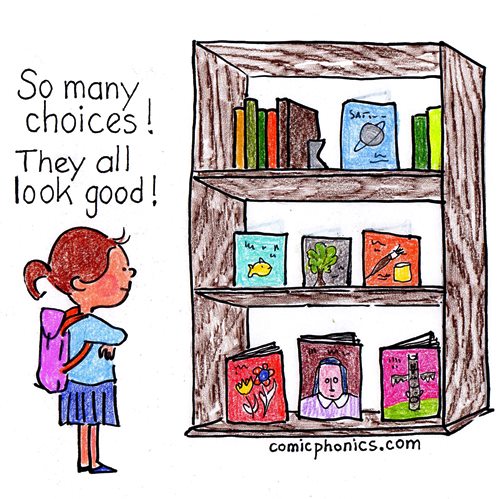
Are children’s books plentiful in your home?girl looking at book display  Are magazines your child might enjoy—even for the pictures—obvious?  Do you display books on coffee tables?  Does your child have a bookcase—or a shelf—to call his own?  Do you stand up books in their attractive jackets so that your child will be lured to read them?

Research shows that the more contact children have with reading materials—books, magazines, comic books, emails, book apps—the better readers children become.

The first step to getting your child to read more is to provide more reading materials.  Take her to the library and bring home not one or two but ten books.  Then display the books where the child is likely to see them and read them.red headed girl in easy chair reading If the child has a designated reading spot—a certain chair in a window, the end of a couch near a lamp, her bed—prop up the books there to entice her.  Set aside some time every day and read with her, or let her read to you.

Is a bookstore one of your weekly stops?  Or the book section of a department store?  Even if you just prowl through the children’s section with your child, he will find books he might like to read.  If you can afford them, great, but if not, write down titles and go to your public library to request them.  Make your child aware of your determination to find the books he wants.

Studies show that having a variety of books at hand motivates kids to read.  Combine that with more time to read, and kids become better readers.  One study shows that the best predictor of reading achievement (high test scores, for example), is the amount of time kids read on their own, without pressure to read.

What have you done to make your home a place where your child wants to read?  Please share your ideas by responding to this blog.  Your email won’t be shown, nor your name.  But your ideas might spur another parent or teacher to increase the reading of her children and students.