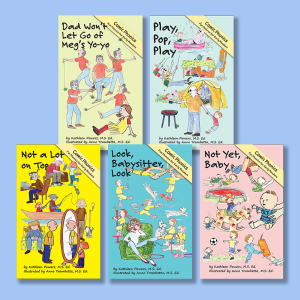
How many letter sounds are there in English?

That depends.

The International Phonetic Association (IPA) which devised a method to categorize spoken sounds, says American English has 44 sounds—20 vowel sounds and 24 consonant (and digraph) sounds.  The IPA has devised symbols for each of these sounds—most of them letters of the Latin alphabet with some Greek letters and other symbols thrown in.  Speech pathologists use these symbols to write down the exact sounds a student speaks when they are identifying speech problems.

The International Phonetic Association (IPA) says American spoken English has 44 sounds—20 vowel sounds and 24 consonant sounds.

Click on the chart for an enlarged version.

In general, American English has fewer sounds than British English.  Standard English (usually considered the way English is spoken by someone from the Midwest) has 16 vowel sounds, at least four fewer vowel sounds than standard British English.  Since accents vary from region to region, some parts of the US might have more or fewer vowel sounds.

When a child is learning to read in English, making a sound is not the problem; it is the many ways a single sound can be shown in letters.

Some teachers have tried to help students, especially ESL students, to master the sounds by adding symbols to letters with multiple sounds:  a curve over a short vowel, a horizontal line over a long vowel, and printing two letters that have a single sound as one letter without a space between them.  This does make it easier for the student to associate sounds with symbols, but teachers have found the students grow dependent on the symbols and cannot shift to reading letters without those symbols.

Because students have so much trouble matching a sound to a letter, many reading methods have developed.  However, a study by the U.S. government a few years ago found that a systematic phonetic approach works best with young children learning to read.

Are there any tricks to help my child with reading comprehension?

One proven tactic to learn almost anything factual is music.  According to Annie Murphy Paul, author of the blog, The Brilliant Report, and an expert on human intelligence, music has been used for thousands of years to help us remember facts.  You used this technique when you were a child.  How did you learn your ABC’s?  By singing them, of course.

Ways to improve the likelihood of facts being remembered through song are to write lyrics that use concrete actions and powerful visual images.  Literary devices such as alliteration (words beginning with the same letter), assonance (words with the same vowel sounds), repetition and especially rhyme make a song more memorable, according to Paul.

Young girl reading a bookResearch shows that there are certain steps to increase reading comprehension as well.  Those steps are to read the title and try to understand what it means; then to read subtitles and boldfaced words and to ask yourself what they mean; then to interpret the drawings, photos, graphs, tables, political cartoons and charts to see what information you can glean from them; and last, to read the text.  If you follow the first three steps before you read the text, you should have a good idea what the text will be about.  You will have created a context into which the text makes sense.

This is true for picture books and early reading books as well as a high school chemistry text.  First the title, then the subtitles, then the illustrations and last the words themselves.

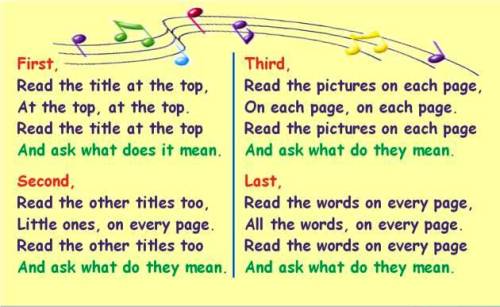
I have “translated” this information into a song about reading comprehension that you and your preschooler can remember.  Sing the following verses to the melody of “London Bridges Falling Down.”

Reading Skills Rhyme

To enlarge or print an 11″ x 8.5″ version, click on the picture.

Using this pattern when reading books with your child should improve her reading comprehension.  And after your child memorizes the song, she should have a sequence of strategies to use even when you are not there.

Let me know if this song helps by responding to our blog.  And if you are interested in practical research on how the brain works, go to www.anniemurphypaul.com and subscribe to her weekly newsletter as I do.

My child is struggling to learn short vowel sounds. What can I do?

As a temporary help, you could create word lists or flash cards using color-coded letters for the vowels.

Colors for vowel soundsIn Tutoring is Caring, Montessori teacher Aline D. Wolf suggests printing the letter representing the vowel sound in a particular color to help the child remember the sound.  She suggests using colors whose name has the letter sound that the child is trying to say.  So for example, short e words would be written with red e’s.  Since vowels are the most difficult sounds for the child to master, the color would alert the child that the colored letter is a vowel, and the color would also give the child a clue as to the letter’s pronunciation.

The colors Wolf suggests are

  • Red for the short e sound since red’s vowel sound is short e.
  • Rust for the short u sound since rust’s vowel sound is short u.
  • Silver for the short i sound since silver’s vowel sound is short i.
  • Tan for the short a sound since tan’s vowel sound is short a.
  • Olive for the short o sound since olive’s vowel sound is short o.
  • Black for all consonants.

Wolf says it is important that the child recognize the colors using their specific names.  If a child sees olive and says green, then the clue that the sound of “ol” gives would be lost.  She recommends beginning with “e” and then “u” because they are easier.

Wolf wrote her suggestions in 1981, before personal computers, so today we have other options.  Using a computer, it is easy to duplicate these colored letters in words, just as using crayons or colored pencils makes it easy by hand.

Another suggestion she makes is to use broken lines for silent letters, a signal to the student that the letter is necessary but it is not pronounced.  This is easy to do if you are handwriting the letters, but I could not find a broken letter type face on my computer.  However, the computer offers other options such as outlined letters or highlighted letters, either of which could indicate silent letters.

With her lists of color-coded words, Wolf puts a drawing of a word that begins with that letter at the top of the list as an extra reminder of the letter sound.  So for short e, there is a drawing of an elephant; for u, an umbrella; for i, an igloo; for a, an alligator; and for o, an olive.

Cautioning that color-coding is a crutch, Wolf says it should be used as long as necessary, but that gradually the child should be weaned from the colors.  For children who don’t need the extra boost that colored letters give, they should not be used at all.

How to wean a child?  Wolf suggests that the child could match color coded words with the same words printed in black.  Or the child could match words printed in black with objects around the house or at school such as milk, pan and egg.  The child could also match words with pictures.

How many minutes a day does your preschooler spend “untethered”?

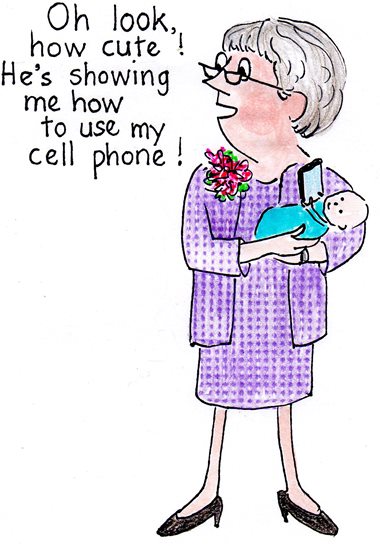
New baby showing grandma how to use a cell phone.Let me review, for a minute, the e-history of many American children today while you think about your own child.  Is your child’s history similar?  Should it be?

Before children are one-year-old, they are playing in front of a TV and turning their heads occasionally when the music or bright colors attract them.  In their cribs they are listening to music meant to increase their intelligence.  When moms give them milk, they are aware their mothers are not looking at them but rather at a phone or tablet or television.

By two, children have developed favorite television programs, often cartoons.  Their daily schedules might be based on a TV schedule—up at a certain time to watch a certain TV show.  Or Mom might be using the TV as a babysitter while she gets ready for work or fixes dinner.  baby looking at an iPadWhen traveling, children might watch videos in the car on a portable DVD or tablet.  They might see Mom and Dad wearing ear plugs and demand the same.  They might cuddle with Mom and Dad in bed watching a movie.

By three, children are learning how to use some electronic devices.  They know how to turn on the TV and how to operate the remote.  They know how to turn on smart phones and tablets, tapping on their favorite icons to play games.  They can not only play games, but they can excel at them from practice.  They might own some electronic devices meant for preschoolers, and own a dozen or more game cartridges.  Their thumbs might have mastered the directional controller on the keypad.  One-third of three-year-olds have a TV in their bedrooms and watch it two hours a day.

child taking iPad out of toy chestBy four, children might own DVDs and video games designated for little kids.  They might have games for X-box and Wii, or use apps their parents have ordered for their children’s entertainment.  They probably know how to take pictures using a mobile phone and have Skyped Grandma in another city.  With quick dial features on some phones, they might initiate phone calls.

By five, children might have “saved” TV shows to watch at another time.  They might be mastering video games or visiting virtual worlds to play dress-up.  With an adult’s help, they might be learning to read, add, and subtract at online sites.  They might receive birthday cards online.

All this and they haven’t started kindergarten yet.

According to Dr. Catherine Steiner-Adair, author of the just published The Big Disconnect, all this electronic activity comes at a price, including

  • A growing number of children with less imaginative and less creative play.
  • Children preferring passive play such as watching TV or using electronic devices where there is a single goal set by the game’s designer.
  • Children with shorter attention spans.
  • Children with less patience learning new skills and with an inability to handle the discomfort of learning.
  • More impulsive children.
  • Children with more difficulty transitioning from one activity to another.
  • Fewer children making eye contact.
  • A growing number of children unable to “read” their own emotions or the emotions of others.
  • Children with less empathy.
  • Children showing signs of addiction.  Dopamine, a neurotransmitter which brings pleasure to the brain, is released when children use tech devices.

And what about reading?  According to The Big Disconnect,

  • Children are born without reading pathways in the brain.  From years of repeated practice, those pathways develop and deepen.  If technology is used instead of an adult and child reading aloud a book together, those circuits in the brain may not develop properly, and the child may not be able to reflect deeply on what is read.  The same thing happens when audio books read aloud to children.
  • High tech use by preschoolers is leading to lower reading comprehension.

Although most of The Big Disconnect does not focus on children’s ability to learn to read, the research presented, as well as the anecdotes from the author’s psychological practice, present a cogent argument that technology is rewiring the human brain, and in particular, children’s brains.

Technology is not only inevitable, but it is useful, says Stein-Adair, author ofThe Big Disconnect.  Yet she admonishes parents to use technology willfully, not absent-mindedly, with young children.  Nothing replaces cuddling with a child, listening to a child, and playing with a child.  Unplug your child to give her a better chance at becoming a well-rounded human being, urges Steiner-Adair.

How about you?  How have you handled technology with your children?  Have you noticed the effects mentioned above?  Are you a teacher of young children who has seen a change in children in the past ten years due to technology?  Let us know what you think.

Mrs. A describes how she illustated Dad Won’t Let Go of Meg’s Yo-Yo

Illustration used in the book app

Illustration used in the book app

Like the characters in Play, Pop, Play, the characters in our new ebook app, Dad Won’t Let Go of Meg’s Yo-Yo, are based on real people.  As an artist, I find it helps to imagine someone I know when I am drawing.  My brother-in-law, John, is one of the funniest people I have ever met, both in his words, and in his over-the-top gestures!  He is the role model for the father in our story.  His daughter, Meaghan, (Meg) is a sweet, forgiving girl like the birthday girl in our story. Meaghan’s older sister, Rachel, unfortunately for our purposes, has a name that can’t be easily decoded by beginning readers, so we changed Rachel to Jen.  Rachel looks out for her little sister, and sometimes reminds her Dad to settle down if he is getting too enthused. 

An early version of an illustration for Dad Won't Let Go of Meg's Yo-Yo, not used in the book

An early version of an illustration for Dad Won’t Let Go of Meg’s Yo-Yo, not used in the book

My early sketches (I am attaching one here) look so simple compared to the final drawings that comprise the book.  I try to put many details into each page of art, so that a child reading the book has lots to notice and discuss.  Somehow a mischievous cat sneaked into this story too! 

Although there are many yo-yo tricks (around the world, side winder, boomerang, and sleeper), none of these are C-V-C (one-syllable, short-vowel) words. The challenge for us in composing Dad Won’t Let Go of Meg’s Yo-Yo was to find a way to show the tricks yet use simple words.  Instead of around the world, our book says, “spin the yo-yo.”  Instead of side winder, we say “jump the yo-yo.”

Most of us can do the simple up and down motion of a yo-yo unless the string is too long.  And THAT is the premise of our book: Dad delays cutting the string so little Meg can’t play with her yo-yo. Maybe I should call this book a memoir.  It reminds me of being a little girl, and of having a bigger, taller and smarter brother (or so I thought at the time), who was also a master of the yo-yo.  Like the Dad in Dad Won’t Let Go of Meg’s Yo-Yo, my brother would sometimes torment me, showing off his yo-yo prowess, until—SPOILER!  I almost away gave the ending.  You’ll have to read our latest book to find out what happens!

Also, to see some mighty nice yo-yos, go www.yo-yo.com and www.yo-yoplay.com

Check out our newest beginning reader book app, “Dad Won’t Let Go of Meg’s Yo-Yo.”

Like our previous app books, Dad Won’t Let Go of Meg’s Yo-Yo is written in easy, one-syllable, mostly short-vowel words that beginning readers can sound out.  The story is silly—a father gives his little girl a yo-yo for her birthday, and becomes so engrossed in showing her how to do tricks that little Meg can’t play with her yo-yo.  Eventually the father realizes his mistake, apologizes, and cuts the string to fit Meg.

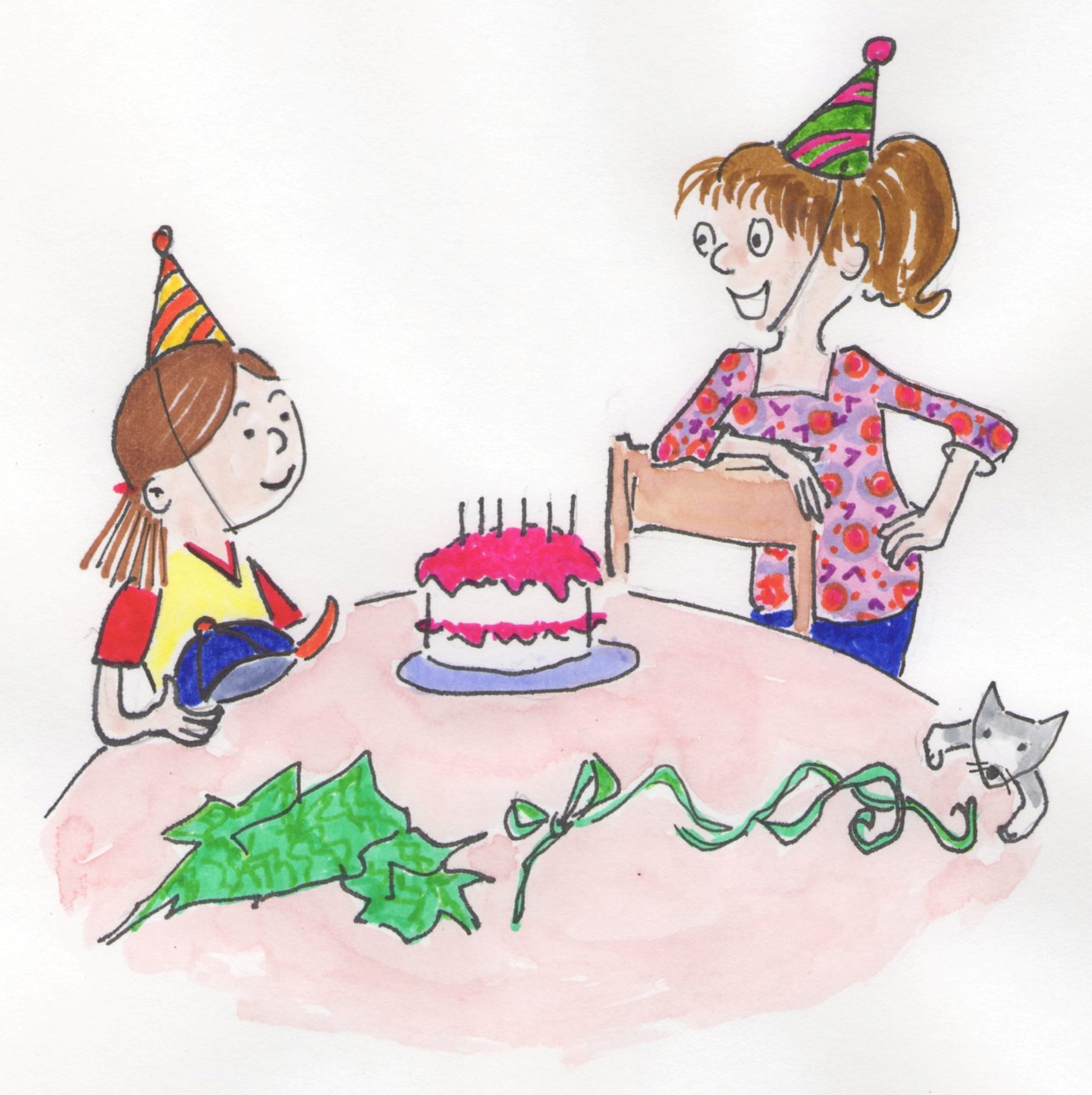
Dad won't let go of Meg's yo-yo.

Our fourth book app for early readers is at http://goo.gl/XDZoy1

Our app books are genuine literature, that is, real stories with a beginning, middle and end.  Yet very early readers—those who know consonant and short vowel sounds—can read the books and appreciate the story.  The art is humorous, meant to appeal to the child’s funny bone, yet the message at the end—an apology—teaches the child an important value.

In addition, because Dad Won’t Let Go of Meg’s Yo-Yo and other books are apps, they are interactive.  At the end of each book are ten pages of activities which take advantage of technology.  Students can draw lines with electronic crayons; they can swipe words with a highlighter; they can draw letters or circle yes or no.  When they are done, they can erase and start over, or save, or email to Grandma.

Dad won't let go of Meg's yo-yo vocabulary exercise.If you are a teacher with a white board, and you have an iPad or iPhone and a computer compatible with Apple products, you can show the book on your white board and let the whole class participate.  Right now you need to be able to download our app on an Apple device, but eventually we will have our books available for Android products.

To preview Dad Won’t Let Go of Meg’s Yo-Yo, go to http://goo.gl/XDZoy1.   To preview our other books go to http://goo.gl/JMrT3, http://goo.gl/ClVyM, and http://goo.glK1HcU.

My child can read basic words. What kind of literature skills should s/he have for kindergarten?

Most states have adopted a common core of standards now used to teach and to assess children’s learning at each grade level and in academic subjects.  Included in these standards are ones for kindergarten reading which include understanding literature, informational texts and reading skills.  Those standards are

kindergarden literature skill standards

Go to http://www.corestandards.org/ELA-Literacy/RL/K for more on the common core of standards.

Key Ideas and Details

  • With prompting and support, the child should be able to ask and answer questions about key details in a text.
  • With prompting and support, the child should be able to retell familiar stories, including key details.
  • With prompting and support, the child should be able to identify characters, settings, and major events in a story.

Craft and Structure

  • The child should be able to ask and answer questions about unknown words in a text
  • The child should be able to recognize common types of texts (e.g., storybooks, poems).
  • The child, with prompting and support, should be able to name the author and illustrator of a story and define the role of each in telling the story.

Integration of Knowledge and Ideas

  • With prompting and support, the child should be able to describe the relationship between illustrations and the story in which they appear (e.g., what moment in a story an illustration depicts).
  • With prompting and support, the child should be able to compare and contrast the adventures and experiences of characters in familiar stories.

Range of Reading and Level of Text Complexity

  • The child should actively engage in group reading activities with purpose and understanding.

For more information, go to www.corestandards.org/ELA-Literacy/RL/K

How can I test my child’s basic reading skills so I know what skills he has mastered and what ones he needs to learn?

If your child knows a little bit about how to read, but you are not sure how much or where to begin, I came across a series of tests that might help you.
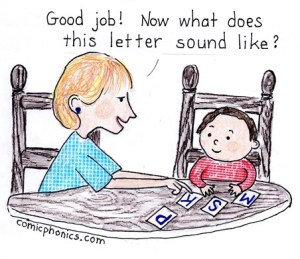
Mother sointing to Letters on flash card and asking, "What does the letter sound like/"The tests are from a 1981 book by a Montessori educator, Aline D. Wolf.  She wrote Tutoring is Caring for tutors of students who are experiencing difficulty in learning how to read.  Here is what she suggests, updated by Mrs. K to suggest online resources not available 32 years ago:

First test—recognizing sounds.  With a deck of ABC’s (available where school supplies are sold) or letter tiles (Scrabble pieces or letter tiles sold as parts of games) or an online site of moveable ABC’s, ask the student to say aloud the sound each letter makes.  The order of the ABC’s is irrelevent.

You might think, “Johnny can already read some words.  I can skip this step.”  Don’t.  Your child might have memorized the look of certain words the way a two-year-old can recognize “McDonalds” without being able to read.  Or he might have had a certain book read to him so many times that he can say the words from memory.  Test the letter sound of every letter.

A word of caution:  Test the letter sound, not the letter name.  This is not a test of ABC’s.  It is a test of the sound that the ABC’s make.  For vowels, listen for the short vowel sounds.

Another word of caution: Certain letters—a, g and q—can be written different ways in different type faces.  The child needs to recognize the common ways these letters are written as well as recognizing capital and lower case forms of every letter.  If you are writing the letters yourself, show all the common ways these letters are represented, but in general, use the letter form children use when they print.

If the child knows none or few of the letter sounds, begin by teaching some consonants that are generally pronounced the same all the time.  You don’t need to teach them all before you begin the vowels.  Teach ones that look different (not both “b” and “d,” or “m” and “n” or “p” and “q”).  You might start with “b,” “g,” “n,” “s,” and “t,” for example, and then add a short vowel sound (not i or e for starts since they sound so much alike).  From these few letters you can form words and show the child how words are formed.  He should be able to maneuver the cards or tiles or online letters to form words and to pronounce them.

Second test—combining the sounds.  Once the child knows the alphabet sounds, ask her to construct words by moving the cards or tiles around.  Have the child use all the letters.  If this is difficult, brush up on the sounds she finds troubling and try again.

Third test—reading simple words with short vowel sounds.  Create a list of CVC words and ask the child to read them.  You can find lists of such words online, or you can create your own list.  Try to use all the letter sounds.  If the child can’t read these words with ease, Wolf suggests preparing color-coded word lists (which our blog will explain soon).  If the child can read these words, move on to the fourth test.

Fourth test—reading words with blends.  Create a list of about 25 short-vowel words with blends at the beginning, at the end, or both.  If the child cannot read these words, go to the color-coded word lists.  If the child can read these words, move on to the fifth test.

A word of caution:  Blends are two or three consonants which together sound exactly like they sound when used separately.  The “s” and “t” in “stop” sound like they should in “sit” and “Tom.”  Don’t introduce digraphs at this point, that is, two or three consonants which, when used together, create a completely new sound.  The “t” and “h” in “the” do not sound like a “t” and “h” in Tom and hen.

Fifth test—reading short vowel words with two syllables.  You can find word lists online, or in some workbooks, or you can create them yourself.  Make sure each syllable uses a short-vowel.  Blends are okay.  If the child can’t do this, Wolf suggests a method to teach two-syllable words which our blog will talk about soon.  If the child can read these words, move on to the sixth test.

Sixth test—reading words with digraphs or unusual consonant sounds.  Now introduce a word list of about 25 words that uses sh, ch, th, wh, qu, ck, tch, ce, ci, ge, gi, gy, and other unexpected consonant pairings.  If the child can’t read these words fluently, a future blog will explain what to do.  If he can read the list, move on to the seventh test.

Seventh test—reading words with long vowel sounds.  This list should consist of about 25 one-syllable words with various patterns of long vowels—a silent “e” at the end; twin vowels side-by-side; two different vowels side-by-side, including “y”; “-ight,”  “-ild” and “—ow.”  If the child has trouble, then begin teaching long-vowels; if not, proceed to the final test.

Final test—reading words that cannot be pronounced using rules of phonics.  These words are exceptions to every rule—“should,” “was,” “mother” and “do,” for example.  They are sight words whose sound must be memorized.

If the child can score well on all these tests, and the child is still having difficulty reading, Wolf suggests that the problem is not decoding.  It might be fluency, phrasing, or comprehension.

Guest blogger: Mrs. A on the development of “Play, Pop, Play”

Several people have asked Mrs. K and me questions regarding our most recent book, Play Pop Play.  As the illustrator at Comicphonics.com, and the person who developed the idea for the book, let me tell you how it came about.

Where did the idea come from?

"Play, Pop, Play" book app cover

Our third most recent book app, “Play, Pop, Play” is at http://goo.gl/JMrT3 .

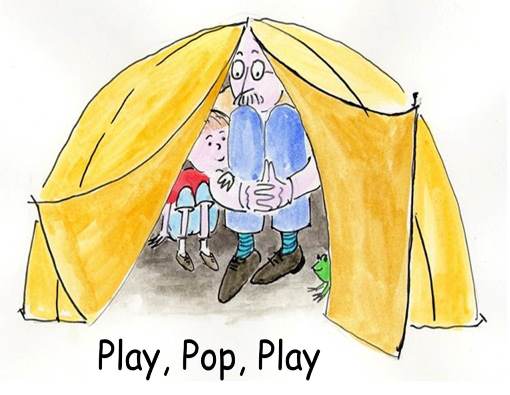
My husband, Paul, and I have three grandsons.  Our oldest just turned three.  Whenever we get together, the first thing he does is take Papa by the hand, dragging him from place to place.  “C’mon Papa.  Let’s play tent.”  “Let’s play cars.”  “Let’s look at bugs!”  Last Christmas, he and his Papa sat together in a tiny little tent, in the corner of the dining room and hid from the rest of us. As I watched a six foot two grandpa and a two-year-old squeezed into a tiny tent, the story line began to form.

Do the characters in the story look like real people?

"Pop" Paul and grandsonYes.  If you know my husband, Paul, you will certainly recognize him in the book. He is tall, follicly challenged, and has a mustache and glasses.  Tom, the little boy in the story, is just like our little grandson—blond, impulsive and go, go, go!

You are the artist?

Yes. I do the illustrations, and my sister, Mrs. K, does the text.  We live in different states and communicate via computer.  I scan the sketches into the computer, email them to Mrs. K and we begin a dialogue.  Eventually the drawings get more developed and detailed, and we decide on a beginning, middle and ending.  Then the art and the words come together, and with the help of Mrs. K’s husband who finagles art and words onto a single page, and our App-man, Mrs. K’s son, the app appears on line.

How much time does it take from start to finish?

I like to have a lot of ideas simmering at the same time.  I keep a separate sketch book for each book idea and add to the books as the ideas surface.  I guess it is sort of like reading several books at the same time.  It’s nice to go back and forth. At any time, I might have three or four projects going at once.  For this particular book, the idea was conceived in December.  On a long car ride from NY to NC, I made lots of rough sketches and listed ideas.  (No, I was not driving.)  I then let it go for a while, conferred with Mrs. K, and after a period of time, looked at my sketches again with a fresh perspective.  I scanned more detailed sketches to Mrs. K, and she began work on the words.  More time elapsed before I began the final artwork.  By then it was May.  The app appeared in the Apple store in June.  But meanwhile, three more books are in various stages of readiness!

Are you satisfied with your work?

Never!  But I am thrilled to be doing what I am doing.  I’m always trying to improve my work and it is great being part of comicphonics.com!

What should a typical reading lesson be like for a beginning reader?

First, review work from the previous lesson that the child can do.  If he can’t be successful yet with the past lesson’s work, review work from an earlier lesson that allows the child to be successful.  This gives the child confidence and eases the child into a learning situation which he may not like.

Reviewing past lessons before adding a new lesson.

Adding a new letter combination to an already learned long A sound list.

An education teacher of mine once drew two sets of circles on the board.  The first two circles were side by side, but they did not overlap.  The second set overlapped.  The teacher said the first two circles represented learning new material with no connection to what we already know.  If we read and speak English (the first circle), and we are trying to learn Spanish (the second circle) with no common words or culture, the learning is extremely hard.

But if the English circle and the Spanish circle overlap, with words in common, learning Spanish is easier.  And the more information in the intersecting part of the circles, the easier it is to learn new material.

Reviewing what is in the first circle is a good way to begin lessons.  Help the student recall what she already knows and the progress she has made so far before introducing new work.

 “Emily, you’ve learned so many letter patterns for the sound of ‘a.’  Good for you.  Now let’s learn another one.”

Next, introduce new work.  Use several approaches, if possible, and encourage plenty of hand manipulation so the new ideas stick.

The younger the child, the shyer the child, and the less confident the child, the more important it is to have multiple ways to learn and to demonstrate learning.  In school, a teacher often asks a child to read aloud to assess reading skills, but many children are not comfortable reading aloud.  Provide other ways to show mastery—matching pictures with letters or words; acting out words in mime; drawing letters with a finger in the air; moving letter tiles around; writing; or telling a story in pictures.

Third, end the lesson with a game.  If the child knows there will be a game at the end, he will endure the difficult learning for the pleasure of the game.  Plus, he will feel good about coming back for another lesson knowing he will be rewarded with another game.

You might think you are wasting time with a game, but my experience says you’re not.  I’ve played word BINGO, Scrabble, who can write the most words from the letters in a phrase the fastest, pantomimes, and games the child makes up herself.  If you can, relate the game to the topic you’ve been teaching.  Or relate the game to a favorite interest of the child—dinosaurs, for example.  Or read to the child.

In the last minute of the lesson, review one more time the new information. Research shows this is a good teaching practice that leads to retention.

Do you have a successful lesson procedure?  We’d love to hear about it.